


 |
市场调查报告书
商品编码
1906275
工业机械:市场占有率分析、产业趋势与统计、成长预测(2026-2031)Industrial Machinery - Market Share Analysis, Industry Trends & Statistics, Growth Forecasts (2026 - 2031) |
||||||

※ 本网页内容可能与最新版本有所差异。详细情况请与我们联繫。
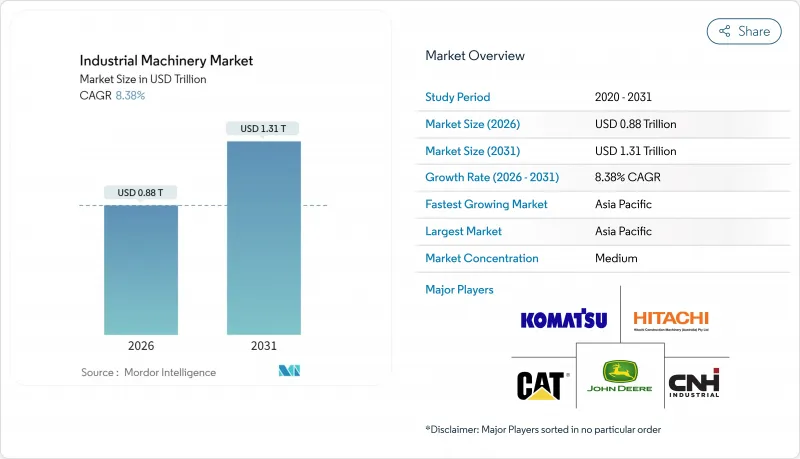
预计工业机械市场将从 2025 年的 8,100 亿美元成长到 2026 年的 8,800 亿美元,到 2031 年将达到 1.31 兆美元,2026 年至 2031 年的复合年增长率为 8.38%。
这一成长反映了持续的基础设施投资、工厂自动化进程的加速以及零排放设备的日益普及。终端用户增加了对基于人工智慧的预测性维护平台的投入,以减少计划外停机时间,而製造商则致力于采用模组化机器设计以加快交付速度。亚太地区在2024年继续保持其主导地位,这主要得益于中国和印度产能的快速扩张。北美和欧洲的买家则专注于便于回流生产的多进程机器,这些机器能够在产品线之间快速切换,以增强其国内供应链的韧性。数控工具机和机器人领域的熟练劳动力短缺使得自动化需求居高不下,并推动了设备即服务(EaaS)模式的普及,这种模式可以降低初始资本投入。
全球工业机械市场趋势与洞察
采用工业4.0和智慧製造
全球製造商纷纷采用感测器、云端分析和数数位双胞胎来减少停机时间并提高生产效率。西门子的Senseye平台每分钟可处理超过一百万个机器资料点,将预测准确率提高85%,并将维护成本降低高达40%。设备製造商已整合边缘分析模组,以开拓新的订阅收入来源并实现设备即服务(EaaS)合约。数位双胞胎使操作人员能够在不停止生产的情况下测试週期时间的变化,从而有助于证明资本投资的合理性。这些功能可加快投资报酬率,并促进自动化技术的采用,即使是预算紧张的中型工厂也不例外。为了应对日益增强的网路安全意识,供应商正在透过设备端加密和网路分段来增强设备控制器的功能。
来自建筑和基础设施计划的需求不断增长
亚太和中东地区多年公共工程预算持续推动土木机械、起重机和混凝土设备的订单。为满足不断变化的低排放气体和低噪音法规,电池驱动的紧凑型装载机在都市区越来越受欢迎。凯斯工程机械的12EV电动紧凑型轮式装载机配备23kWh电池,载重能力达1.15吨,且实现零排放。承包商也开始为大型挖土机采用混合动力系统,以降低怠速时的油耗。来自原厂配套租赁公司的弹性融资方案和残值担保帮助承包商抵消了高昂的前期成本,进一步提振了市场需求。
高昂的资本投资和维修成本
高精度铣床和自动化焊接单元的初始购置成本对许多小规模加工厂来说都是一道障碍。卡特彼勒公司报告称,2025年第一季销售额为142亿美元,年减10%,原因是经济情势的不确定性导致一些客户推迟了设备升级。计划外停机时间仍平均占生产成本的24%,凸显了老旧资产带来的财务风险。原始设备製造商(OEM)推出了按机器工时运作模式,将维护、软体和耗材捆绑在一起。 SKF的「一切皆服务」(Everything-as-a-Service)方案使加工厂能够按轴承性能付费,而不是按所有权付费,从而减轻了其资产负债表的负担。
细分市场分析
2025年,受全球公路、住宅和能源计划发展的推动,土木工程和施工机械占工业机械市场份额的30.85%。高功率推土机和挖土机是进行大规模土方作业的必备设备,但随着成熟市场车队更新换代完成,需求趋于平稳。工业机器人和自动化单元是成长最快的产品类别,到2031年复合年增长率将达到12.57%。随着製造商采用协作机器人与工人安全协作,其装置量达到165亿美元。机器人即服务(RoA)合约的广泛应用降低了前期成本,并使视觉引导机械手臂即使在小规模车间也能进行取放操作。压缩机和泵浦受益于变速驱动装置的升级,降低了能源成本,从而促进了销售成长。
设备製造商将人工智慧整合到动作控制器中,以缩短循环时间并提高拣选精度。受特斯拉超级工厂自动化模式的启发,汽车製造商将固定式和自主式移动机器人结合,按需运输零件并减少在製品库存。物流中心的物料输送设备需求持续成长,满足了电履约中心对高吞吐量输送机和分类机的需求。随着精准喷洒系统和自动拖拉机的普及,农业机械也随之发展,以缓解农村地区的劳动力短缺问题。产品多样化持续推进,推出了诸如用于室内物流的电动加长型堆高机和用于城市高层建筑的混合动力履带起重机等专用机械。
预计到2025年,建筑业仍将占据工业机械市场29.12%的最大份额,这反映了交通网络的持续更新和公共产业的扩张。建筑商在城市计划中优先考虑低噪音、零排放的机械设备,这催生了超越简单马力的新规格标准。农业应用成长最快,复合年增长率达10.71%。自动驾驶拖拉机、无人机引导喷药机和智慧收割机在提高产量的同时,减少了化学投入。迪尔公司计画投资200亿美元用于美国工厂,部署自动化技术以缓解农业劳动力短缺问题。食品加工厂实现了托盘装载和品质检测的自动化,人工智慧视觉技术则减少了废弃物。
汽车製造商扩大了电动车产能,并为电池机壳采用了高精度雷射切割系统。化学和製药厂采用了具有远端监控功能的原位就地清洗(CIP) 撬装包装,以满足更严格的安全和可追溯性法规。纺织製造商部署了小型机器人来实现缝纫线的自动化,并扭转了境外外包趋势。发电工程,特别是风力发电机安装和电网级电池组装,需要客製化设计的物料输送钻机。印刷公司实施了支援工业 4.0 的工作流程软体,以优化印刷机的运转率并扩大模组化后加工设备的市场。每项应用都需要专门的自动化,从而促进了各种设备的销售。
区域分析
预计到2025年,亚太地区将维持42.35%的市场份额,复合年增长率达8.42%,进一步巩固其在工业机械市场的主导地位。中国自动化设备供应商推出了具有竞争力的伺服驱动器和PLC产品,并以本地化的价格与进口品牌竞争。印度的生产关联激励政策支持了机械进口,并促进了本土製造合资企业的建立。日本和韩国专注于超精密机器人和半导体设备,维持了较高的单价。台湾电子代工製造商需要持续投资表面黏着技术装机和检测设备,从而支撑了对专用送料器和相机的需求。
在北美,联邦基础设施建设资金和私营部门回流倡议起到了推动作用。製造商们实施了模组化加工单元,透过加快零件更换速度来支援准时生产,并扩大了现有工厂。加拿大矿场引进自动驾驶运输卡车,显示该地区对高科技重型机械的需求旺盛。货币稳定和低成本能源的供应吸引了更多投资进入石化和电池生产线,从而带动了压缩机、泵浦和捲材处理系统的订单成长。教育合作推动了机器人技术员培训计画的发展,以解决技术纯熟劳工短缺的问题。
欧洲市场需求稳定,企业持续投资多功能机械设备以因应不断上涨的能源成本,保持竞争力。德国製造商向东欧的汽车和家电工厂供应高精度成型压力机。斯堪地那维亚的木材加工厂安装了智慧锯切生产线,以优化每根原木的出材率。英国启动了津贴零排放施工机械补贴计划,旨在促进小型电动挖土机在城市改造中的广泛应用。由于预测分析的需求不断增长,以延长机械设备的使用寿命,欧洲的维修、保养和大修产业也随之发展壮大。
南美洲、中东和非洲成为新的成长区域。巴西的基础设施建设需要大规模土木机械和混凝土泵,但外汇波动限制了进口。日立建机和丸红在巴西成立了一家矿业设备服务合资企业,以实现在地化支援并减少停机时间。波湾合作理事会(GCC)成员国投资海水淡化和可再生能源计划,需要耐腐蚀泵浦和大容量起重机。非洲各国政府优先发展农业机械化,透过补贴拖拉机购买和支持销售低马力设备来实现这一目标。
其他福利:
- Excel格式的市场预测(ME)表
- 3个月的分析师支持
目录
第一章 引言
- 研究假设和市场定义
- 调查范围
第二章调查方法
第三章执行摘要
第四章 市场情势
- 市场概览
- 市场驱动因素
- 采用工业4.0和智慧製造
- 建筑和基础设施计划需求增加
- 新兴经济体的快速工业化
- 对小型零排放机械的需求(都市区维修)
- 预测性维护订阅模式推动了更换需求。
- 生产回流推动了对弹性多工序机械的需求
- 市场限制
- 高昂的资本投资和维护成本
- 原物料价格波动
- 先进数控和机器人技术领域技术纯熟劳工短缺
- 连网装置的网路安全风险
- 价值链分析
- 监管环境
- 技术展望
- 波特五力分析
- 新进入者的威胁
- 买方的议价能力
- 供应商的议价能力
- 替代品的威胁
- 竞争对手之间的竞争
- 宏观经济因素的影响
第五章 市场规模与成长预测
- 依产品类型
- 土木工程施工机械
- 物料输送设备
- 农业机械
- 工业机器人和自动化单元
- 其他(压缩机、泵浦等)
- 按应用产业
- 印刷
- 食物
- 纤维
- 建造
- 製药
- 化学
- 车
- 农业
- 发电
- 按最终使用者所有权
- OEM
- 契约製造
- 租赁公司
- 政府和地方政府
- 按自动化级别
- 传统手动操作型
- 半自动/CNC
- 全自动/无人值守单元
- 按地区
- 北美洲
- 美国
- 加拿大
- 墨西哥
- 欧洲
- 德国
- 法国
- 英国
- 北欧国家
- 其他欧洲地区
- 亚太地区
- 中国
- 台湾
- 韩国
- 日本
- 印度
- 亚太其他地区
- 南美洲
- 巴西
- 墨西哥
- 阿根廷
- 其他南美洲
- 中东和非洲
- 中东
- 沙乌地阿拉伯
- 阿拉伯聯合大公国
- 土耳其
- 其他中东地区
- 非洲
- 南非
- 其他非洲地区
- 中东
- 北美洲
第六章 竞争情势
- 市场集中度
- 策略趋势
- 市占率分析
- 公司简介
- Caterpillar Inc.
- Komatsu Ltd.
- Deere & Company
- Hitachi Construction Machinery Co., Ltd.
- CNH Industrial NV
- Sandvik AB
- Doosan Infracore Co., Ltd.
- Volvo Construction Equipment AB
- Liebherr-International AG
- JC Bamford Excavators Ltd.(JCB)
- Terex Corporation
- Manitowoc Company, Inc.
- Astec Industries, Inc.
- Illinois Tool Works Inc.
- Lincoln Electric Holdings, Inc.
- AGCO Corporation
- Alamo Group Inc.
- Wacker Neuson SE
- SANY Heavy Industry Co., Ltd.
- XCMG Construction Machinery Co., Ltd.
- Zoomlion Heavy Industry Science & Technology Co., Ltd.
- Kubota Corporation
- Yanmar Holdings Co., Ltd.
- Atlas Copco AB
- ABB Ltd.
第七章 市场机会与未来展望
The industrial machinery market is expected to grow from USD 0.81 trillion in 2025 to USD 0.88 trillion in 2026 and is forecast to reach USD 1.31 trillion by 2031 at 8.38% CAGR over 2026-2031.
Expansion reflected sustained infrastructure investment, accelerated factory automation, and the growing availability of zero-emission equipment. End-users increased spending on artificial-intelligence-enabled predictive maintenance platforms to curb unplanned downtime, while manufacturers pursued modular machine designs to shorten delivery cycles. Asia-Pacific held a commanding lead in 2024, helped by rapid capacity additions in China and India. North American and European buyers focused on reshoring-ready, multi-process machines that can switch quickly between product lines, supporting domestic supply-chain resilience. Tight skilled-labor pools for CNC and robotics roles kept automation demand elevated and encouraged Equipment-as-a-Service models that lower initial capital needs.
Global Industrial Machinery Market Trends and Insights
Adoption of Industry 4.0 & Smart Manufacturing
Manufacturers worldwide adopted sensors, cloud analytics, and digital twins to curb downtime and enhance throughput. Siemens' Senseye platform processed more than 1 million machine data points per minute and lifted forecast accuracy by 85%, cutting maintenance costs by as much as 40%. Equipment builders embedded edge analytics modules that unlock new subscription revenue and enable Equipment-as-a-Service contracts. Digital twins let operators test cycle-time changes without stopping production, helping to justify capital upgrades. These capabilities drove faster paybacks and encouraged mid-sized plants to adopt automation despite tight budgets. Rising cybersecurity awareness prompted vendors to harden machine controllers with on-device encryption and network segmentation.
Growing Demand from Construction & Infrastructure Projects
Multi-year public-works budgets in Asia-Pacific and the Middle East continued to boost orders for earth-moving machines, cranes, and concrete equipment. Battery-powered compact loaders gained traction on urban job sites because they meet evolving low-emission and noise regulations. CASE Construction Equipment's 12EV electric compact wheel loader delivered a 1.15-ton payload using a 23 kWh battery while eliminating exhaust emissions . Contractors also adopted hybrid drivetrains in large excavators to cut fuel consumption during idling. Flexible finance packages and residual-value guarantees from OEM-linked leasing units helped contractors offset high upfront prices, further strengthening demand.
High Capex and Maintenance Costs
Initial purchase prices for high-precision multitasking lathes and automated welding cells deterred many small plants. Caterpillar recorded a 10% year-over-year sales decline to USD 14.2 billion in Q1 2025 as some customers delayed fleet renewals amid economic uncertainty. Unplanned downtime still averaged 24% of production costs, underscoring the financial risk of older assets. OEMs introduced subscription models where buyers pay per machine-hour, bundling maintenance, software, and consumables. SKF's Everything-as-a-Service offering let factories pay for bearing performance instead of ownership, easing balance-sheet pressure.
Other drivers and restraints analyzed in the detailed report include:
- Rapid Industrialisation in Emerging Economies
- Demand for Compact Zero-Emission Machinery (Urban Retrofit)
- Raw-Material Price Volatility
For complete list of drivers and restraints, kindly check the Table Of Contents.
Segment Analysis
Earth-moving equipment captured 30.85% of industrial machinery market share in 2025 as global highway, housing, and energy projects progressed. High-horsepower dozers and excavators remained essential for bulk earthworks, but demand plateaued in mature markets where fleets had been refreshed. Industrial robots and automation cells were the fastest-growing product, advancing at a 12.57% CAGR toward 2031. The installed base reached USD 16.5 billion as manufacturers adopted collaborative robots that work safely next to operators. Wider use of Robot-as-a-Service contracts reduced upfront costs, permitting small job-shops to deploy vision-guided arms for pick-and-place tasks. Compressors and pumps benefited from upgrades to variable-speed drives that lower energy bills, supporting incremental sales.
Equipment builders integrated artificial intelligence into motion controllers to cut cycle times and improve pick accuracy. Tesla's gigafactory automation model inspired automakers to blend fixed robots with autonomous mobile robots that deliver parts on demand, trimming work-in-progress inventory. Material-handling equipment held steady demand from e-commerce fulfillment centers that required high-throughput conveyors and sorters. Agricultural machinery also advanced, helped by precision spraying systems and autonomous tractors that address rural labor shortages. The products segment continued to diversify as vendors introduced specialty machines, including electric-drive telehandlers for indoor logistics and hybrid-powered crawler cranes for urban high-rise construction.
Construction retained the largest application share at 29.12% of the industrial machinery market size in 2025, reflecting ongoing transport-network upgrades and utility expansions. Contractors prioritized low-noise, zero-emission machines for city projects, creating new specification points beyond raw horsepower. Agricultural applications recorded the fastest growth at a 10.71% CAGR. Autosteering tractors, drone-guided sprayers, and smart harvesters supported yield gains while reducing chemical inputs. Deere and Company earmarked USD 20 billion for United States factory investments that will roll out autonomous technologies to mitigate farm labor gaps. Food-processing facilities automated palletizing and quality inspection, leveraging artificial-vision to cut waste.
Automotive manufacturers expanded electric-vehicle capacity and installed high-tolerance laser-cutting systems for battery enclosures. Chemical and pharmaceutical plants adopted clean-in-place skid packages with remote monitoring, meeting stricter safety and traceability rules. Textile producers deployed compact robots to automate sewing lines, reversing offshoring trends. Power-generation projects, especially wind-turbine installation and grid-scale battery assembly, required purpose-built material-handling rigs. Printing firms embraced Industry 4.0 workflow software to optimize press utilization, extending the market for modular finishing machines. Each application segment demanded tailored automation, underpinning broad-based equipment sales.
The Global Industrial Machinery Market Report is Segmented by Product Type (Earth-Moving Equipment, Material-Handling and More), Application Industry (Printing, Food, Textile, Construction, and More), End-User Ownership (OEMs, Contract Manufacturers, and More), Automation Level (Conventional Manually Operated, Semi-Automated/CNC, and More) and Geography. The Market Forecasts are Provided in Terms of Value (USD).
Geography Analysis
Asia-Pacific maintained a 42.35% revenue share in 2025 and recorded an 8.42% CAGR, strengthening its dominance in the industrial machinery market. Chinese automation suppliers introduced competitive servo drives and PLCs, enabling localized price points that challenged imported brands. India's Production-Linked Incentive schemes supported machinery imports and encouraged joint ventures for domestic manufacture. Japan and South Korea focused on ultraprecise robotics and semiconductor equipment, sustaining high unit values. Taiwan's contract electronics manufacturing required continuous investment in surface-mount and inspection machines, preserving demand for specialty feeders and cameras.
North America benefited from federal infrastructure funding and private-sector reshoring initiatives. Manufacturers expanded brownfield sites with modular machining cells that switch quickly between parts, supporting just-in-time delivery. Autonomous haul trucks deployed in Canadian mining underscored the region's appetite for high-technology heavy equipment. Currency stability and access to low-cost energy attracted further investment in petrochemical and battery production lines, bolstering orders for compressors, pumps, and web-handling systems. Education partnerships addressed skilled-labor shortages by promoting robotics technician programs.
Europe saw steady demand as firms invested in multi-process machinery to defend competitiveness against rising energy costs. German builders supplied high-tolerance forming presses to Eastern European automotive and appliance plants. Scandinavian wood-processing mills installed intelligent saw lines that optimise yield from every log. The United Kingdom launched grants for zero-emission construction machinery, promoting adoption of compact electric excavators in urban redevelopment. The European repair-maintenance-overhaul sector grew as operators extended machine lifespans with predictive analytics.
South America and the Middle East and Africa represented emerging growth pockets. Brazilian infrastructure upgrades needed large earth-moving fleets and concrete pumps, but exchange-rate volatility constrained imports. Hitachi Construction Machinery and Marubeni set up a mining-equipment service venture in Brazil to localise support and shorten downtime. Gulf Cooperation Council nations invested in desalination and renewable-energy projects, requiring corrosion-resistant pumps and high-capacity cranes. African governments prioritised agricultural mechanisation by subsidising tractor purchases, aiding sales of low-horsepower machines.
- Caterpillar Inc.
- Komatsu Ltd.
- Deere & Company
- Hitachi Construction Machinery Co., Ltd.
- CNH Industrial N.V.
- Sandvik AB
- Doosan Infracore Co., Ltd.
- Volvo Construction Equipment AB
- Liebherr-International AG
- J.C. Bamford Excavators Ltd. (JCB)
- Terex Corporation
- Manitowoc Company, Inc.
- Astec Industries, Inc.
- Illinois Tool Works Inc.
- Lincoln Electric Holdings, Inc.
- AGCO Corporation
- Alamo Group Inc.
- Wacker Neuson SE
- SANY Heavy Industry Co., Ltd.
- XCMG Construction Machinery Co., Ltd.
- Zoomlion Heavy Industry Science & Technology Co., Ltd.
- Kubota Corporation
- Yanmar Holdings Co., Ltd.
- Atlas Copco AB
- ABB Ltd.
Additional Benefits:
- The market estimate (ME) sheet in Excel format
- 3 months of analyst support
TABLE OF CONTENTS
1 INTRODUCTION
- 1.1 Study Assumptions and Market Definition
- 1.2 Scope of the Study
2 RESEARCH METHODOLOGY
3 EXECUTIVE SUMMARY
4 MARKET LANDSCAPE
- 4.1 Market Overview
- 4.2 Market Drivers
- 4.2.1 Adoption of Industry 4.0 and Smart Manufacturing
- 4.2.2 Growing Demand from Construction and Infrastructure Projects
- 4.2.3 Rapid Industrialisation in Emerging Economies
- 4.2.4 Demand for Compact Zero-Emission Machinery (Urban Retrofit)
- 4.2.5 Predictive-Maintenance Subscription Models Spur Replacements
- 4.2.6 Reshoring Fuels Flexible Multi-Process Machinery Demand
- 4.3 Market Restraints
- 4.3.1 High Capex and Maintenance Costs
- 4.3.2 Raw-Material Price Volatility
- 4.3.3 Skilled-Labour Shortage for Advanced CNC and Robotics
- 4.3.4 Cyber-Security Risks in Connected Equipment
- 4.4 Value Chain Analysis
- 4.5 Regulatory Landscape
- 4.6 Technological Outlook
- 4.7 Porters Five Forces Analysis
- 4.7.1 Threat of New Entrants
- 4.7.2 Bargaining Power of Buyers
- 4.7.3 Bargaining Power of Suppliers
- 4.7.4 Threat of Substitutes
- 4.7.5 Intensity of Competitive Rivalry
- 4.8 Impact of Macroeconomic Factors
5 MARKET SIZE AND GROWTH FORECASTS (VALUE)
- 5.1 By Product Type
- 5.1.1 Earth-Moving Equipment
- 5.1.2 Material-Handling Equipment
- 5.1.3 Agricultural Machinery
- 5.1.4 Industrial Robots and Automation Cells
- 5.1.5 Others (Compressors, Pumps, etc.)
- 5.2 By Application Industry
- 5.2.1 Printing
- 5.2.2 Food
- 5.2.3 Textile
- 5.2.4 Construction
- 5.2.5 Pharmaceuticals
- 5.2.6 Chemical
- 5.2.7 Automotive
- 5.2.8 Agriculture
- 5.2.9 Power Generation
- 5.3 By End-User Ownership
- 5.3.1 OEMs
- 5.3.2 Contract Manufacturers
- 5.3.3 Rental / Leasing Companies
- 5.3.4 Government and Municipalities
- 5.4 By Automation Level
- 5.4.1 Conventional Manually-Operated
- 5.4.2 Semi-Automated / CNC
- 5.4.3 Fully-Automated / Lights-Out Cells
- 5.5 By Geography
- 5.5.1 North America
- 5.5.1.1 United States
- 5.5.1.2 Canada
- 5.5.1.3 Mexico
- 5.5.2 Europe
- 5.5.2.1 Germany
- 5.5.2.2 France
- 5.5.2.3 United Kingdom
- 5.5.2.4 Nordics
- 5.5.2.5 Rest of Europe
- 5.5.3 Asia-Pacific
- 5.5.3.1 China
- 5.5.3.2 Taiwan
- 5.5.3.3 South Korea
- 5.5.3.4 Japan
- 5.5.3.5 India
- 5.5.3.6 Rest of Asia-Pacific
- 5.5.4 South America
- 5.5.4.1 Brazil
- 5.5.4.2 Mexico
- 5.5.4.3 Argentina
- 5.5.4.4 Rest of South America
- 5.5.5 Middle East and Africa
- 5.5.5.1 Middle East
- 5.5.5.1.1 Saudi Arabia
- 5.5.5.1.2 United Arab Emirates
- 5.5.5.1.3 Turkey
- 5.5.5.1.4 Rest of Middle East
- 5.5.5.2 Africa
- 5.5.5.2.1 South Africa
- 5.5.5.2.2 Rest of Africa
- 5.5.5.1 Middle East
- 5.5.1 North America
6 COMPETITIVE LANDSCAPE
- 6.1 Market Concentration
- 6.2 Strategic Moves
- 6.3 Market Share Analysis
- 6.4 Company Profiles (includes Global level Overview, Market level overview, Core Segments, Financials as available, Strategic Information, Market Rank/Share for key companies, Products and Services, and Recent Developments)
- 6.4.1 Caterpillar Inc.
- 6.4.2 Komatsu Ltd.
- 6.4.3 Deere & Company
- 6.4.4 Hitachi Construction Machinery Co., Ltd.
- 6.4.5 CNH Industrial N.V.
- 6.4.6 Sandvik AB
- 6.4.7 Doosan Infracore Co., Ltd.
- 6.4.8 Volvo Construction Equipment AB
- 6.4.9 Liebherr-International AG
- 6.4.10 J.C. Bamford Excavators Ltd. (JCB)
- 6.4.11 Terex Corporation
- 6.4.12 Manitowoc Company, Inc.
- 6.4.13 Astec Industries, Inc.
- 6.4.14 Illinois Tool Works Inc.
- 6.4.15 Lincoln Electric Holdings, Inc.
- 6.4.16 AGCO Corporation
- 6.4.17 Alamo Group Inc.
- 6.4.18 Wacker Neuson SE
- 6.4.19 SANY Heavy Industry Co., Ltd.
- 6.4.20 XCMG Construction Machinery Co., Ltd.
- 6.4.21 Zoomlion Heavy Industry Science & Technology Co., Ltd.
- 6.4.22 Kubota Corporation
- 6.4.23 Yanmar Holdings Co., Ltd.
- 6.4.24 Atlas Copco AB
- 6.4.25 ABB Ltd.
7 MARKET OPPORTUNITIES AND FUTURE OUTLOOK
- 7.1 White-Space and Unmet-Need Assessment

 工业机械市场:2026-2032年全球市场预测(依产品类型、操作方式、动力来源、控制架构、应用与销售管道)
 2026年全球人工智慧(AI)预测性维护市场报告2026年工业机械人工智慧(AI)全球市场报告2026年全球商业和服务业机械市场报告2026年全球工业机械市场报告全球客製化加工服务市场(按製程类型、材料类型、生产规模和最终用途产业划分)预测(2026-2032年)客製化铸铁加工服务市场(按最终用户、製程类型、产品类型、材料等级和服务模式划分),全球预测(2026-2032年)铸铁机械加工服务市场(按加工服务类型、最终用途行业、工具机类型和材料等级划分),全球预测,2026-2032年
 GMIPulse - 工业机械市场情报订阅
 筛分机:全球市场份额和排名、总收入和需求预测(2025-2031年)