


 |
市场调查报告书
商品编码
1906858
石英:市场占有率分析、产业趋势与统计、成长预测(2026-2031)Quartz - Market Share Analysis, Industry Trends & Statistics, Growth Forecasts (2026 - 2031) |
||||||

※ 本网页内容可能与最新版本有所差异。详细情况请与我们联繫。
预计到 2026 年,石英市场规模将达到 380 万吨,高于 2025 年的 359 万吨。
预计到 2031 年将达到 505 万吨,2026 年至 2031 年的复合年增长率为 5.86%。
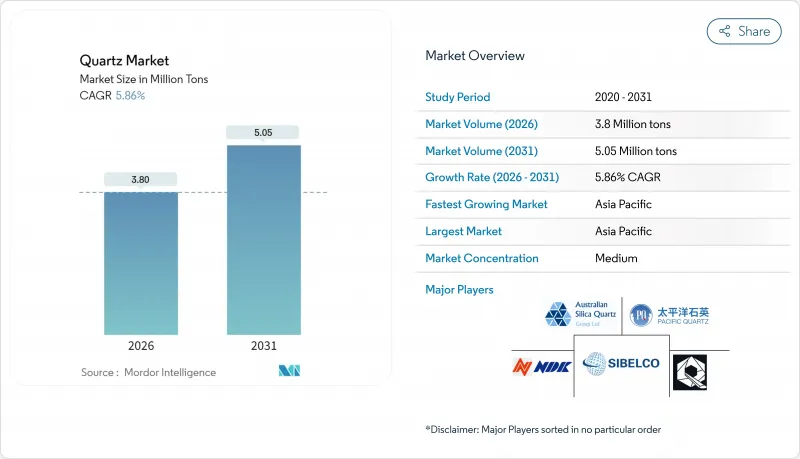
这种稳定成长反映了石英在半导体光刻、太阳能晶锭生长、光纤和工程表面处理等领域中不可替代的作用。随着製程节点缩小到7奈米以下,晶片製造厂正在将杂质容差提高到十亿分之一的水平,迫使供应商投资先进的精炼设备。同时,太阳能晶锭製造设备正在扩大坩埚直径以适应更大的晶圆,使石英的基准用量翻了一番。气候相关的供应衝击——最近的例子是飓风海伦导致斯普鲁斯派恩工厂停产——正在推动石英生产多元化,转向挪威、巴西和非洲,同时维持超高纯度石英的溢价。最后,一系列产业整合和产能扩张表明,人们相信石英市场将在本世纪末继续保持其在高科技製造生态系统中的基础地位。
全球石英市场趋势及展望
太阳能发电能力快速成长
全球太阳能发电装置容量的扩张需要超高纯度石英坩埚,以承受采用柴可拉斯基法法生长硅锭时高达 1723°C 的高温。 M12 等更大尺寸的晶圆推动了单线产量的提升,迫使坩埚製造商提高坩埚直径和壁厚均匀性。拥有纯度达 99.999% 或更高 SiO2 的供应商正与寻求降低材料供应风险的大型晶圆製造商签订长期承购协议。亚太地区的需求是主导,但欧洲和美国的能源转型奖励也创造了额外的需求,并促进了加工基地的地域多角化。因此,即使在电子市场週期性波动的情况下,太阳能应用预计仍将是石英市场的稳定支柱。
半导体小型化推动了对超高纯度半导体的需求
7奈米及以下製程的尖端逻辑和记忆体晶圆厂对杂质含量要求极高,达到十亿分之一级别,这提高了熔融石英和石英产品供应商的技术门槛。独家流程,包括合成、熔融石英和多级酸浸,可实现铝含量低于9ppm、铁含量低于0.2ppm。相关的资本密集度和认证週期有效地阻止了新进入者,使得现有企业能够协商与纯度而非吨位挂钩的多年定价结构。随着晶片製造商向3奈米製程过渡并推进2奈米试生产,预计到2030年,对超高纯度石英的需求成长速度将超过整个石英市场的成长速度。
石英开采对生态环境的影响
栖息地破坏、地下水位变化和颗粒排放正促使北卡罗来纳州、魁北克省和斯堪的纳维亚半岛部分地区实施更严格的许可製度。修復矿藏、生物多样性基准评估和社区咨询等环节,使得前置作业时间延长了长达24个月。缺乏可靠ESG(环境、社会和治理)蓝图的生产商将面临更高的资本支出,而利用回收商和尾矿的措施也正获得监管机构的认可。这种环境审查对石英市场施加了可衡量的限制,同时也推动了更环保的采购模式的创新。
细分市场分析
到2025年,硅金属将占据石英市场96.55%的份额,继续保持其在产量上的主导地位,巩固其与铝合金、硅酮和多晶硅并驾齐驱的关键地位。受轻量化交通工具发展趋势以及美国两国太阳能电池用多晶硅产能扩张的推动,硅金属加工所得石英的市场规模预计将稳定成长。 Ferroglobe、Elkem和Hosin等公司凭藉其大型埋弧炉和自有石英矿,保持着成本优势,但电力供应的稳定性仍然是新参与企业面临的关键挑战。
儘管高纯度石英的产量微乎其微,但其价值却不成比例地高,平均售价超过每吨7000美元。预计到2031年,其年复合成长率(CAGR)将达到7.18%,反映了微缩技术进步和太阳能电池晶圆尺寸增大带来的长期利多因素。进入门槛,例如ISO 9001:2000认证和需要12至18个月的客户审核,确保了合约一旦签订就能长期有效。受飓风海伦对云杉木材运输的影响,半导体製造商开始从挪威和亚洲双重采购,凸显了经过认证的高纯度石英(HPQ)供应商的战略优势。这一趋势使高纯度石英成为石英市场中成长最快的细分市场,即使硅金属仍保持其销售主导。
本石英市场报告按产品类型(高纯度石英、石英晶体、金属硅)、终端用户产业(电子及半导体、太阳能、建筑、光纤及通讯、汽车、其他终端用户产业)及地区(亚太、北美、欧洲、南美、中东和非洲)进行细分。市场预测以吨为单位。
区域分析
到2025年,亚太地区将占据全球石英市场55.01%的份额,这主要得益于中国垂直整合的丛集,这些集群能够在数百公里范围内将石英矿石加工成电子元件、太阳能电池板和工程表面材料。区域监管机构持续优化从矿场到製造工厂的物流,进一步缩短了营运资金週转週期。在优惠的电价和鼓励半导体后端加工在地化的政策支持下,印度和越南正在崛起为二次加工中心。到2031年,该地区的复合年增长率将达到6.27%,这主要受东南亚国协智慧型手机普及率的持续增长、屋顶太阳能政策的推动以及中产阶级住宅维修需求的增长。
北美具有重要的战略地位,其核心在于丰富的超高纯度云杉松矿藏。在2024年飓风灾害发生之前,该地区供应了全球80%至90%的高硅原料。 Sibelco计划投资7亿美元进行扩建,Quartz在挪威新建工厂,体现了双管齐下的风险缓解策略,该策略结合了地质优势和地理冗余。美国亚利桑那州、德克萨斯州和纽约州的晶圆厂运作正在推动下游需求,但不断上涨的能源成本和严格的环境许可限制了商品级石英晶体生产的扩张。加拿大和墨西哥正利用其地理优势为区域建筑市场提供石英晶体,同时也试图透过可再生能源走廊吸引利基高纯度石英晶体(HPQ)投资。
欧洲正利用严格的ESG(环境、社会和治理)标准,在加值石英加工领域开拓高端市场。伊梅里斯公司在瑞典和法国经营矿床,并将低碳水力发电与邻近的石英熔融厂结合。德国提供用于无浆切割和热区组装的精密机械,儘管矿石蕴藏量有限,但仍保持技术领先地位。南美洲和中东/非洲地区也在为石英生产做出贡献,特别是巴西米纳斯吉拉斯矿带的供应量不断增加,但基础设施不足和水资源短缺限制了近期的成长。这些地区严重依赖进口,亚太和北美地区的供应商对全球石英市场的影响力日益增强。
其他福利:
- Excel格式的市场预测(ME)表
- 3个月的分析师支持
目录
第一章 引言
- 研究假设和市场定义
- 调查范围
第二章调查方法
第三章执行摘要
第四章 市场情势
- 市场概览
- 市场驱动因素
- 太阳能发电能力快速成长
- 半导体节点小型化推动了对超高纯度材料的需求。
- 人造石英内表面的需求激增
- 5G/FTTx中的光纤部署
- 尾矿衍生的高纯度石英(HPQ)降低了成本曲线
- 市场限制
- 石英开采对生态环境的影响
- 高耗能的精炼过程
- 气候变迁导致采矿作业中断
- 价值链分析
- 波特五力模型
- 供应商的议价能力
- 买方的议价能力
- 新进入者的威胁
- 替代品的威胁
- 竞争对手之间的竞争
第五章 市场规模与成长预测
- 依产品类型
- 高纯度石英
- 石英石檯面和瓷砖
- 熔融石英坩埚
- 石英玻璃
- 水晶
- 硅金属
- 高纯度石英
- 按最终用户行业划分
- 电子和半导体
- 太阳能发电
- 建筑/施工
- 光纤和电讯
- 车
- 其他终端用户产业
- 按地区
- 亚太地区
- 中国
- 印度
- 日本
- 韩国
- 马来西亚
- 泰国
- 印尼
- 越南
- 亚太其他地区
- 北美洲
- 美国
- 加拿大
- 墨西哥
- 欧洲
- 德国
- 英国
- 法国
- 义大利
- 西班牙
- 北欧国家
- 土耳其
- 俄罗斯
- 其他欧洲地区
- 南美洲
- 巴西
- 阿根廷
- 哥伦比亚
- 南美洲其他地区
- 中东和非洲
- 沙乌地阿拉伯
- 卡达
- 阿拉伯聯合大公国
- 奈及利亚
- 埃及
- 南非
- 其他中东和非洲地区
- 亚太地区
第六章 竞争情势
- 市场集中度
- 策略趋势
- 市占率(%)/排名分析
- 公司简介
- AGC Inc.
- Australian Silica Quartz Group Ltd
- Dow
- East Hope Group
- Elkem ASA
- Ferroglobe
- Hoshine Silicon Industry Co., Ltd.
- Imerys
- India Quartz
- Jiangsu Pacific Quartz Co., Ltd
- MACTUS
- NIHON DEMPA KOGYO CO., LTD.
- Nordic Mining ASA
- Saint-Gobain
- Sibelco
- SIMCOA
- The Quartz Corp
- WACKER CHEMIE AG
第七章 市场机会与未来展望
Quartz Market size in 2026 is estimated at 3.8 million tons, growing from 2025 value of 3.59 million tons with 2031 projections showing 5.05 million tons, growing at 5.86% CAGR over 2026-2031.
This steady expansion reflects the mineral's irreplaceable role in semiconductor lithography, photovoltaic ingot growth, optical fibers, and engineered surfaces. As node geometries shrink below 7 nm, chip fabs elevate impurity thresholds to parts-per-billion, forcing suppliers to invest in advanced purification assets. Solar ingot pullers are simultaneously scaling crucible diameters for larger wafers, multiplying baseline quartz volumes. Climate-related supply shocks-most recently Hurricane Helene's disruption of Spruce Pine-have propelled diversification efforts into Norway, Brazil, and Africa while sustaining premium pricing for ultra-high-purity grades. Finally, a wave of consolidation and capacity additions signals confidence that the quartz market will remain a cornerstone of high-tech manufacturing ecosystems through the end of the decade.
Global Quartz Market Trends and Insights
Growing Solar-PV Capacity Surge
Global photovoltaic build-outs require ultra-pure quartz crucibles capable of withstanding 1,723 °C during Czochralski silicon ingot growth. Larger wafer formats, such as M12, amplify volume per line, forcing crucible producers to scale both diameter and wall uniformity. Suppliers with track records in more than 99.999% SiO2 grades secure long-term offtake agreements from wafer majors eager to derisk material availability. Asia-Pacific dominates demand, yet European and U.S. energy-transition incentives are creating incremental pull that helps regionalize processing footprints. As a result, solar applications are forecast to be a stabilizing pillar for the quartz market amid cyclical swings in electronics.
Semiconductor Node-Shrink Drives Ultra-High-Purity Demand
Leading-edge logic and memory fabs operating below 7 nm mandate impurity ceilings in the parts-per-billion range, raising the technical bar for fused silica and quartz ware suppliers. Proprietary processes. including synthetic route, fused silica, and multi-stage acid leaching, enable aluminum contents below 9 ppm and iron below 0.2 ppm. The capital intensity and qualification cycles involved effectively deter new entrants, allowing incumbents to negotiate multi-year pricing formulas tracking purity rather than tonnage. As chipmakers move toward 3 nm production and pilot 2 nm, demand for ultra-high-purity quartz is set to outpace broader quartz market growth through 2030.
Ecological Impact of Quartz Mining
Habitat disruption, water-table alteration, and particulate emissions are prompting stricter permitting regimes across North Carolina, Quebec, and parts of Scandinavia. Restoration bonding, baseline biodiversity assessments, and community consultations now extend lead times by up to 24 months. Producers lacking credible ESG roadmaps face escalating capex, while recyclers and tailings-based initiatives gain regulatory goodwill. This environmental scrutiny places a measurable drag on the quartz market, although it simultaneously accelerates innovation in lower-impact sourcing models.
Other drivers and restraints analyzed in the detailed report include:
- Boom in Engineered-Quartz Interior Surfaces
- Tailings-Derived HPQ Lowers Cost Curve
- Energy-Intensive Purification Process
For complete list of drivers and restraints, kindly check the Table Of Contents.
Segment Analysis
Silicon metal dominated tonnage with a 96.55% quartz market share in 2025, underscoring its indispensable role in aluminum alloys, silicones, and polysilicon. The quartz market size attributed to silicon metal processing is projected to expand steadily in line with light-weighting in transportation, and solar-grade polysilicon capacity adds in China and the U.S. Ferroglobe, Elkem, and Hoshine capitalize on large submerged-arc furnaces and captive quartzite mines to defend cost positions, while electricity availability remains a swing factor for new entrants.
High-purity quartz, though tiny in volume, captures a disproportionate value pool thanks to average selling prices exceeding USD 7,000 per ton. Its forecast 7.18% CAGR through 2031 reflects secular tailwinds from node migration and larger solar wafer formats. Qualification barriers such as ISO 9001:2000 and customer audits spanning 12-18 months cement long-term contracts once secured. Hurricane Helene's interference with Spruce Pine shipments prompted chipmakers to dual-source from Norway and Asia, spotlighting the strategic leverage of certified HPQ suppliers. This dynamic positions HPQ as the fastest-rising slice of the quartz market, even as silicon metal maintains volume leadership.
The Quartz Report is Segmented by Product Type (High-Purity Quartz, Quartz Crystal, and Silicon Metal), End-User Industry (Electronics and Semiconductor, Solar, Building and Construction, Optical Fiber and Telecommunication, Automotive, and Other End-User Industries), and Geography (Asia-Pacific, North America, Europe, South America, and Middle-East and Africa). The Market Forecasts are Provided in Terms of Volume (Tons).
Geography Analysis
Asia-Pacific accounted for 55.01% of the quartz market share in 2025, driven by China's vertically integrated clusters that convert quartz ore into electronics, solar panels, and engineered surfaces within a few hundred kilometers. Regional regulators continue to streamline mine-to-fab logistics, further compressing working capital cycles. India and Vietnam are emerging as supplementary processing hubs, buoyed by favorable power tariffs and incentives to localize semiconductor back-end. The 6.27% regional CAGR through 2031 is underpinned by relentless smartphone adoption, rooftop solar policies, and middle-class home upgrades across ASEAN economies.
North America remains strategically vital owing to Spruce Pine's ultra-pure vein-the bedrock for 80-90% of global HPQ feedstock before the 2024 hurricane event. Sibelco's USD 700 million expansion and The Quartz Corp's Norway commissioning reflect a dual-axis mitigation strategy that pairs geological excellence with geographic redundancy. U.S. fab build-outs in Arizona, Texas, and New York offer a downstream pull, yet higher energy costs and stringent environmental permitting temper capacity growth in commodity grades. Canada and Mexico serve regional construction markets with proximity advantages, while aiming to attract niche HPQ investments through renewable power corridors.
Europe leverages stringent ESG standards to carve out a premium niche in value-added quartz processing. Imerys operates deposits in Sweden and France, integrating them with fused silica plants adjacent to low-carbon hydro power. Germany supplies precision machinery for slurry-less sawing and hot-zone assembly, ensuring technological leadership despite modest ore endowment. South America, the Middle East, and Africa contribute incremental tonnage, particularly from Brazil's Minas Gerais belt, yet infrastructure deficits and water scarcity cap near-term growth. These regions rely heavily on imports, reinforcing Asia-Pacific and North American suppliers' influence over the global quartz market.
- AGC Inc.
- Australian Silica Quartz Group Ltd
- Dow
- East Hope Group
- Elkem ASA
- Ferroglobe
- Hoshine Silicon Industry Co., Ltd.
- Imerys
- India Quartz
- Jiangsu Pacific Quartz Co., Ltd
- MACTUS
- NIHON DEMPA KOGYO CO., LTD.
- Nordic Mining ASA
- Saint-Gobain
- Sibelco
- SIMCOA
- The Quartz Corp
- WACKER CHEMIE AG
Additional Benefits:
- The market estimate (ME) sheet in Excel format
- 3 months of analyst support
TABLE OF CONTENTS
1 Introduction
- 1.1 Study Assumptions and Market Definition
- 1.2 Scope of the Study
2 Research Methodology
3 Executive Summary
4 Market Landscape
- 4.1 Market Overview
- 4.2 Market Drivers
- 4.2.1 Growing solar-PV capacity surge
- 4.2.2 Semiconductor node-shrink drives ultra-high-purity demand
- 4.2.3 Boom in engineered-quartz interior surfaces
- 4.2.4 Fibre-optic rollout in 5G/FTTx
- 4.2.5 Tailings-derived HPQ lowers cost curve
- 4.3 Market Restraints
- 4.3.1 Ecological impact of quartz mining
- 4.3.2 Energy-intensive purification process
- 4.3.3 Climate-driven mine disruptions
- 4.4 Value Chain Analysis
- 4.5 Porter's Five Forces
- 4.5.1 Bargaining Power of Suppliers
- 4.5.2 Bargaining Power of Buyers
- 4.5.3 Threat of New Entrants
- 4.5.4 Threat of Substitutes
- 4.5.5 Competitive Rivalry
5 Market Size and Growth Forecasts (Volume)
- 5.1 By Product Type
- 5.1.1 High-purity Quartz
- 5.1.1.1 Quartz Surface and Tile
- 5.1.1.2 Fused Quartz Crucible
- 5.1.1.3 Quartz Glass
- 5.1.2 Quartz Crystal
- 5.1.3 Silicon Metal
- 5.1.1 High-purity Quartz
- 5.2 By End-user Industry
- 5.2.1 Electronics and Semiconductor
- 5.2.2 Solar
- 5.2.3 Building and Construction
- 5.2.4 Optical Fiber and Telecommunication
- 5.2.5 Automotive
- 5.2.6 Other End-user Industries
- 5.3 By Geography
- 5.3.1 Asia-Pacific
- 5.3.1.1 China
- 5.3.1.2 India
- 5.3.1.3 Japan
- 5.3.1.4 South Korea
- 5.3.1.5 Malaysia
- 5.3.1.6 Thailand
- 5.3.1.7 Indonesia
- 5.3.1.8 Vietnam
- 5.3.1.9 Rest of Asia-Pacific
- 5.3.2 North America
- 5.3.2.1 United States
- 5.3.2.2 Canada
- 5.3.2.3 Mexico
- 5.3.3 Europe
- 5.3.3.1 Germany
- 5.3.3.2 United Kingdom
- 5.3.3.3 France
- 5.3.3.4 Italy
- 5.3.3.5 Spain
- 5.3.3.6 NORDIC Countries
- 5.3.3.7 Turkey
- 5.3.3.8 Russia
- 5.3.3.9 Rest of Europe
- 5.3.4 South America
- 5.3.4.1 Brazil
- 5.3.4.2 Argentina
- 5.3.4.3 Colombia
- 5.3.4.4 Rest of South America
- 5.3.5 Middle-East and Africa
- 5.3.5.1 Saudi Arabia
- 5.3.5.2 Qatar
- 5.3.5.3 United Arab Emirates
- 5.3.5.4 Nigeria
- 5.3.5.5 Egypt
- 5.3.5.6 South Africa
- 5.3.5.7 Rest of Middle-East and Africa
- 5.3.1 Asia-Pacific
6 Competitive Landscape
- 6.1 Market Concentration
- 6.2 Strategic Moves
- 6.3 Market Share (%)/Ranking Analysis
- 6.4 Company Profiles (includes Global level Overview, Market level overview, Core Segments, Financials as available, Strategic Information, Market Rank/Share for key companies, Products and Services, and Recent Developments)
- 6.4.1 AGC Inc.
- 6.4.2 Australian Silica Quartz Group Ltd
- 6.4.3 Dow
- 6.4.4 East Hope Group
- 6.4.5 Elkem ASA
- 6.4.6 Ferroglobe
- 6.4.7 Hoshine Silicon Industry Co., Ltd.
- 6.4.8 Imerys
- 6.4.9 India Quartz
- 6.4.10 Jiangsu Pacific Quartz Co., Ltd
- 6.4.11 MACTUS
- 6.4.12 NIHON DEMPA KOGYO CO., LTD.
- 6.4.13 Nordic Mining ASA
- 6.4.14 Saint-Gobain
- 6.4.15 Sibelco
- 6.4.16 SIMCOA
- 6.4.17 The Quartz Corp
- 6.4.18 WACKER CHEMIE AG
7 Market Opportunities and Future Outlook
- 7.1 White-space and Unmet-need Assessment

 全球石英市场规模、份额、趋势和成长分析报告(2026-2034年)
 石英市场规模、份额、趋势及预测(按产品、最终用户及地区划分),2026-2034年
 2026年全球石英市场报告
 住宅人造石英石市场(按产品类型、表面处理、厚度、应用和分销管道划分)预测(2026-2032年)电子级石英砂市场按产品类型、粒径、纯度等级、最终用途产业和分销管道划分-全球预测(2026-2032 年)石英管市场依直径、形状、壁厚、应用通路-2026-2032年全球预测石英粉市场按产品类型、纯度、粒径、技术、应用和通路划分-2026-2032年全球预测
 人造石英石表面市场规模、份额和成长分析(按类型、应用、表面处理、图案、技术和地区划分)—产业预测(2026-2033 年)
 石英市场规模、份额及成长分析(按产品、应用及地区划分)-2026年至2033年产业预测
 石英市场规模、份额和趋势分析报告:按等级、应用、地区和细分市场预测(2025-2033 年)