


 |
市场调查报告书
商品编码
1906935
卵磷脂:市场占有率分析、产业趋势与统计、成长预测(2026-2031)Lecithin - Market Share Analysis, Industry Trends & Statistics, Growth Forecasts (2026 - 2031) |
||||||

※ 本网页内容可能与最新版本有所差异。详细情况请与我们联繫。
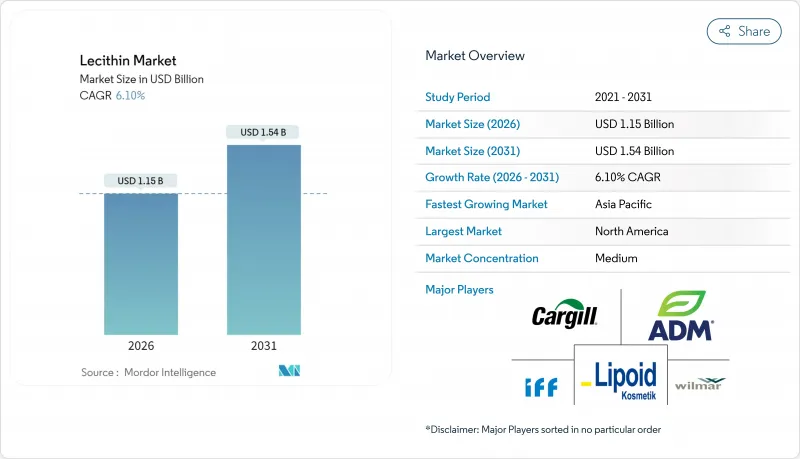
预计卵磷脂市场将从 2025 年的 10.8 亿美元成长到 2026 年的 11.5 亿美元,到 2031 年将达到 15.4 亿美元,2026 年至 2031 年的复合年增长率为 6.1%。
加工食品中天然乳化剂的日益普及、严格的洁净标示法规以及药用级磷脂渗透率的不断提高,共同推动了卵磷脂需求的强劲增长。同时,製药公司在药物递送技术和认知健康产品中对卵磷脂的广泛应用,也推高了高纯度卵磷脂的平均售价。由于向日葵卵磷脂具有非基因改造(Non-GMO)和无致敏性等特点,因此在洁净标示配方中表现出显着的增长势头。鑑于人们对基因改造成分的日益关注,北美和欧洲的食品饮料生产商正从大豆卵磷脂转向向日葵卵磷脂。向日葵卵磷脂风味中性且磷脂含量高,使其适用于植物性乳製品、烘焙食品和糖果甜点产品。製药业也越来越多地将向日葵卵磷脂应用于脂质体药物递送系统,而对高纯度和可追溯性的需求正在推动高纯度卵磷脂市场的成长。
全球卵磷脂市场趋势与洞察
加工食品中对乳化剂和稳定剂的需求不断增长
加工食品产业正向天然乳化剂转型,卵磷脂成为维持产品稳定性并满足洁净标示要求的关键成分。消费者对便利、保质期长、即食食品的偏好日益增长,推动了对能够维持产品一致性、改善质地并延长保质期的乳化剂和稳定剂的需求。卵磷脂源自大豆、葵花籽和鸡蛋等天然成分,具有乳化剂、分散剂和保湿剂等多种功能,为生产商提供了多样化的选择和成本效益。洁净标示运动正在推动市场需求,鼓励食品生产商选择卵磷脂等天然添加剂而非合成替代品。消费者在加工包装食品上的支出依然强劲,美国劳工统计局的预测显示,2023年美国家庭在烘焙产品上的平均支出将达574美元。
在饲料应用的广泛应用
动物营养是卵磷脂需求成长的关键领域,这得益于监管部门的核准以及卵磷脂在提高畜牧生产力方面已被证实的有效性。美国食品药物管理局(FDA) 的 21 CFR 第 573 部分法规确认了卵磷脂作为动物饲料的安全性,为饲料生产商提供了清晰的法规结构,并确保了整个行业的统一实施。卵磷脂中的磷脂质能够促进单胃动物的脂肪消化,进而提高畜牧业的生长速度和饲料转换率。水产养殖业是卵磷脂等功能性饲料成分需求的主要驱动力。根据联合国粮食及农业组织 (FAO) 的数据,预计 2022/23 年度全球水产养殖产量将达到 1.309 亿吨,比 2020 年增长 4%,而 2020 年全球水产养殖总产量为 2.232 亿吨。这种成长给饲料和动物饲料产业带来了越来越大的压力,促使其采用永续的植物来源替代品来取代传统的饲料成分。
原物料价格波动
由于大豆、葵花籽和鸡蛋等原料价格波动,卵磷脂市场面临巨大的限制。这些主要原料来源易受多种因素影响,包括天气状况、地缘政治议题、贸易政策和供应链中断。例如,美国、巴西和乌克兰等主要产区的极端天气和干旱会降低作物产量,并影响卵磷脂生产所需原料的供应和成本。由于卵磷脂来自油籽加工,食用油市场的整体波动也会影响卵磷脂的价格。消费模式的变化和生质燃料法规导致大豆油和葵花籽油需求的波动,进而影响卵磷脂的供应和定价。这种波动为生产者维持稳定的成本结构和利润率带来了挑战。不断上涨的生产成本也会影响卵磷脂相对于合成乳化剂的竞争力,尤其是在价格敏感市场。
细分市场分析
预计到2025年,大豆卵磷脂将占64.78%的市场份额,这主要得益于其成熟的供应链和全球大豆加工基础设施带来的成本优势。葵花籽卵磷脂预计将成为成长最快的原料类别,2026年至2031年的复合年增长率将达到7.65%,因为其非基因改造(非GMO)和不含致敏成分的特性符合注重健康的消费者的需求以及不断增长的市场需求。蛋黄卵磷脂在高附加价值领域表现稳定,在需要卓越功能性的特殊应用领域,尤其是在医药和高端食品领域,维持其市场地位。
在供应链中断影响传统原料来源的情况下,菜籽卵磷脂已成为一种可行的替代原料,为製造商提供了更大的采购柔软性。包括菜籽卵磷脂在内的替代原料,正透过监管部门的核准扩大市场份额,例如嘉吉公司获得美国食品药物管理局(FDA) 的「公认安全 (GRAS)」认定,使其能够广泛应用于有机和非基因改造产品中。
到2025年,食品级卵磷脂将占据56.62%的市场份额,主要服务于加工食品业,在烘焙、糖果和乳製品领域用作乳化剂。这种成分在食品製作流程中用途广泛。预计2026年至2031年,医药级卵磷脂的复合年增长率将达到9.02%,主要成长动力来自其在药物递送系统和营养保健品配方中日益广泛的应用。医药领域的成长得益于卵磷脂已获证实的安全性以及美国食品药物管理局(FDA)核准的多种用途。监管部门的核准进一步增强了医药製剂市场的成长潜力。
随着製造商将卵磷脂引入非传统应用领域,其他等级的卵磷脂,包括化妆品和工业应用领域,也迎来了成长机会。美国卵磷脂公司等企业正透过开发特种衍生物,例如源自大豆卵磷脂和向日葵卵磷脂的丝胺酸,推动医药级卵磷脂市场的发展。这些配方符合严格的药品品质标准和规范。高价值衍生物使供应商能够在医药应用领域获得溢价和更高的利润率。
区域分析
北美将继续保持卵磷脂市场的主导地位,预计到2025年将占35.21%的市场份额。这主要得益于美国食品药物管理局(FDA)的严格监管,该监管鼓励使用天然乳化剂。北美地区正透过对大豆和芥花籽油压榨设施的大量投资以及植物性食品不断涌入市场,来平衡其产能。消费者在膳食补充剂上的高支出推动了脑健康产品中对高品质磷脂质的需求。亚太地区预计在2026年至2031年间达到最高的复合年增长率(CAGR),达到8.38%。中国膳食补充剂产业的扩张以及印度烘焙连锁店的扩张,正在推动对标准和高端卵磷脂产品的需求。
亚太地区预计将成为成长最快的地区,2026年至2031年间的复合年增长率将达到8.38%,这主要得益于膳食补充剂市场的扩张以及消费者可支配收入增加带来的对高端成分的需求增长。中国膳食补充剂市场,尤其是卵磷脂在认知健康和心血管健康产品的应用,是推动该地区需求成长的主要因素。该地区庞大的加工食品製造业对高性价比的乳化解决方案有着显着的需求,而消费者对卵磷脂健康益处的日益关注也推动了其在各种应用领域的广泛使用。
欧洲在销售和价值方面均保持平衡。由于欧洲食品安全局 (EFSA) 的监管以及对基因改造生物 (GMO) 的担忧,对葵花籽和油菜籽卵磷脂的需求正在增长。东欧的生产商在等待地缘政治问题解决的同时,正利用其靠近葵花籽产区的优势。南美洲是主要的供应基地,这主要得益于巴西的大豆生产。中东和非洲地区由于食品加工业的扩张以及消费者对功能性成分日益增长的认知,展现出巨大的成长潜力。然而,与更成熟的市场相比,基础设施的限制和法规结构的不完善仍然限制该地区的市场成长。
其他福利:
- Excel格式的市场预测(ME)表
- 3个月的分析师支持
目录
第一章 引言
- 研究假设和市场定义
- 调查范围
第二章调查方法
第三章执行摘要
第四章 市场情势
- 市场概览
- 市场驱动因素
- 加工食品中对乳化剂和稳定剂的需求不断增长
- 在饲料应用的广泛应用
- 在製药和营养保健品产业中不断拓展的应用
- 来自植物来源和纯素食品产业的需求不断增长
- 消费者对洁净标示天然食品原料的需求不断增长
- 天然化妆品配方中应用日益广泛
- 市场限制
- 原物料价格波动
- 消费者对基因改造成分的负面看法
- 与替代乳化剂和界面活性剂的竞争
- 液态卵磷脂产品的保存期限有限
- 供应链分析
- 监管环境
- 技术展望
- 波特五力模型
- 新进入者的威胁
- 买方的议价能力
- 供应商的议价能力
- 替代品的威胁
- 竞争对手之间的竞争
第五章 市场规模与成长预测
- 按来源
- 大豆
- 向日葵
- 蛋
- 油菜籽
- 其他资讯来源
- 按年级
- 食品级
- 医药级
- 其他的
- 按形式
- 液体
- 粉末
- 其他的
- 自然
- 有机的
- 传统的
- 透过使用
- 食品/饮料
- 麵包糖果甜点
- 乳製品
- 饮料
- 其他食品和饮料
- 动物饲料
- 营养补充品
- 製药
- 化妆品和个人护理
- 其他应用
- 食品/饮料
- 按地区
- 北美洲
- 美国
- 加拿大
- 墨西哥
- 北美其他地区
- 欧洲
- 德国
- 法国
- 英国
- 西班牙
- 荷兰
- 义大利
- 瑞典
- 波兰
- 比利时
- 其他欧洲地区
- 亚太地区
- 中国
- 印度
- 日本
- 澳洲
- 韩国
- 印尼
- 泰国
- 新加坡
- 亚太其他地区
- 南美洲
- 巴西
- 阿根廷
- 智利
- 哥伦比亚
- 秘鲁
- 其他南美洲
- 中东和非洲
- 阿拉伯聯合大公国
- 南非
- 奈及利亚
- 沙乌地阿拉伯
- 埃及
- 摩洛哥
- 土耳其
- 其他中东和非洲地区
- 北美洲
第六章 竞争情势
- 市场集中度
- 策略趋势
- 市场排名分析
- 公司简介
- Archer Daniels Midland Company
- Cargill Inc.
- Bunge Limited
- International Flavors & Fragrances, Inc.
- Wilmar International
- Lipoid GmbH
- Sternchemie GmbH and Co KG
- VAV Life Sciences Pvt Ltd
- American Lecithin Company
- The Scoular Company
- Ciranda Inc.
- Sonic Biochem
- Lecico GmbH
- Clarkson Specialty Lecithins
- Fishmer Lecithin
- AAK
- GIIAVA Industrial Biotech
- SternWywiol Gruppe
- Emerson Resources
- Austrade Ingredients
第七章 市场机会与未来展望
The lecithin market is expected to grow from USD 1.08 billion in 2025 to USD 1.15 billion in 2026 and is forecast to reach USD 1.54 billion by 2031 at 6.1% CAGR over 2026-2031.
Rising uptake of natural emulsifiers in processed foods, stringent clean-label regulations, and deepening penetration of pharmaceutical-grade phospholipids keep demand on a solid upward path. In parallel, pharmaceutical companies extend lecithin's reach into drug-delivery and cognitive-health products, lifting average selling prices in the high-purity segment. Sunflower lecithin is experiencing significant growth due to its non-GMO status and allergen-free properties in clean-label formulations. Food and beverage manufacturers in North America and Europe are transitioning from soy-based to sunflower-derived lecithin as consumers become more concerned about genetically modified ingredients. The neutral flavor profile and high phospholipid content of sunflower lecithin make it suitable for plant-based dairy, bakery, and confectionery products. The pharmaceutical industry is also increasing its use of sunflower lecithin in liposomal drug delivery systems, where high purity and traceability requirements drive growth in the high-purity lecithin segment.
Global Lecithin Market Trends and Insights
Rising Need for Emulsifiers and Stabilizers in Processed Foods
The processed food industry is shifting toward natural emulsifiers, making lecithin an essential ingredient for maintaining product stability while meeting clean-label requirements. The increasing consumer preference for convenient, shelf-stable, and ready-to-eat food products has created a higher demand for emulsifying and stabilizing agents that maintain consistency, improve texture, and extend shelf life. Lecithin, extracted from natural sources such as soybeans, sunflower seeds, and eggs, serves multiple functions as an emulsifier, dispersing agent, and wetting agent, providing manufacturers with versatility and cost efficiency. The clean-label movement has encouraged food producers to choose natural additives like lecithin over synthetic alternatives, increasing its market demand. Consumer spending on processed and packaged foods remains strong, as evidenced by U.S. households spending an average of USD 574 on bakery products in 2023, according to the Bureau of Labor Statistics .
Increased Adoption in Animal Feed Applications
Animal nutrition applications represent a significant growth area for lecithin demand, supported by regulatory approvals and demonstrated benefits in livestock productivity. The Food and Drug Administration (FDA)'s 21 CFR Part 573 regulations confirm lecithin's safety for animal feed applications, providing a clear regulatory framework for feed manufacturers and ensuring consistent implementation across the industry . The phospholipid content in lecithin improves fat digestion in monogastric animals, resulting in better growth rates and feed efficiency in livestock operations. The aquaculture industry has become a major driver of demand for functional feed ingredients like lecithin. The Food and Agriculture Organization of the United Nations (FAO) reports that global aquaculture production reached 130.9 million tons in 2022/23, contributing to a total fisheries and aquaculture output of 223.2 million tons, representing a 4% increase from 2020 . This growth has increased pressure on aquafeed and animal feed industries to incorporate sustainable, plant-based alternatives to conventional feed ingredients.
Fluctuating Raw Material Prices
The lecithin market faces significant constraints due to fluctuating raw material prices, particularly soybeans, sunflower seeds, and eggs. These primary sources are vulnerable to various factors, including weather conditions, geopolitical issues, trade policies, and supply chain disruptions. For instance, extreme weather events or droughts in major producing regions such as the United States, Brazil, or Ukraine can reduce crop yields, affecting the availability and cost of lecithin production materials. The volatility in the broader edible oil market also influences lecithin prices, as lecithin is derived from oilseed processing. Changes in soybean or sunflower oil demand, whether from shifting consumption patterns or biofuel regulations, affect lecithin supply and pricing. This instability creates challenges for manufacturers in maintaining stable cost structures and profit margins. The increased production costs also affect lecithin's competitiveness against synthetic emulsifiers, particularly in price-sensitive markets.
Other drivers and restraints analyzed in the detailed report include:
- Expanding Applications in Pharmaceutical and Nutraceutical Industries
- Growing Demand from Plant-Based and Vegan Food Sectors
- Negative Consumer Perception of GMO Ingredients
For complete list of drivers and restraints, kindly check the Table Of Contents.
Segment Analysis
Soy lecithin holds a dominant 64.78% market share in 2025, supported by established supply chains and cost benefits from the global soybean processing infrastructure. Sunflower lecithin represents the fastest-growing source segment with a projected 7.65% CAGR during 2026-2031, driven by its non-GMO status and allergen-free characteristics that align with consumer health preferences and increasing market demands. Egg lecithin maintains its position in specialized applications requiring superior functionality, particularly in pharmaceutical and premium food products, while demonstrating consistent performance in high-value segments.
Rapeseed lecithin has emerged as a viable alternative during supply chain disruptions affecting conventional sources, offering manufacturers additional sourcing flexibility. Alternative sources, including canola lecithin, have expanded their market presence through regulatory approvals, such as Cargill's Food and Drug Administration (FDA) Generally Recognised as Safe (GRAS) determination, enabling broader use in organic and non-GMO formulations.
Food grade lecithin holds 56.62% market share in 2025, primarily serving the processed food industry with emulsification solutions across bakery, confectionery, and dairy applications. The ingredient demonstrates significant versatility in food processing operations. Pharmaceutical grade lecithin projects a 9.02% CAGR during 2026-2031, driven by its increasing use in drug delivery systems and nutraceutical formulations. The pharmaceutical segment expands through lecithin's proven safety profile and Food and Drug Administration (FDA) approval for various applications. The regulatory acceptance strengthens market growth potential across pharmaceutical formulations.
Additional grades, including cosmetic and industrial applications, present growth opportunities as manufacturers implement lecithin in non-traditional uses. Companies such as American Lecithin Company advance the pharmaceutical-grade segment by developing specialized derivatives, including phosphatidylserine from soy and sunflower lecithins. These formulations comply with stringent pharmaceutical quality standards and specifications. The high-value derivatives enable suppliers to benefit from premium pricing and enhanced profit margins in pharmaceutical applications.
The Lecithin Market is Segmented by Source (Soy, Sunflower, and More), by Grade (Food Grade, Pharmaceutical Grade, and Others), by Form (Liquid, Powder, and Others), by Nature (Organic, and Conventional), by Application (Food and Beverage, Animal Feed, and More), and Geography (North America, Europe, and More). The Market Forecasts are Provided in Terms of Value (USD).
Geography Analysis
North America holds a dominant 35.21% share of the lecithin market in 2025, supported by strict Food and Drug Administration (FDA) regulations favoring natural emulsifiers. The region maintains balanced capacity through significant investments in soybean and canola crushing facilities and increased plant-based food product launches. High consumer spending on supplements drives the adoption of premium phospholipids in brain-health products. Asia-Pacific demonstrates the highest growth rate with an 8.38% CAGR during 2026-2031. The expansion of China's supplement industry and India's bakery chains drives demand for both standard and premium lecithin products.
Asia-Pacific emerges as the fastest-growing region with a CAGR of 8.38% during 2026-2031, driven by expanding nutraceutical markets and rising disposable incomes that enable premium ingredient adoption. China's dietary supplement market, particularly for lecithin applications in cognitive health and cardiovascular wellness products, contributes significantly to regional demand expansion. The region's processed food manufacturing base generates substantial demand for cost-effective emulsification solutions, while increasing consumer awareness of health benefits supports premium lecithin usage in various applications.
Europe maintains a balanced approach between volume and value segments. European Food Safety Authority (EFSA) regulations and GMO concerns drive demand toward sunflower and rapeseed lecithin. Eastern European producers benefit from proximity to sunflower production regions, pending resolution of geopolitical issues. South America serves as a key supply center, leveraging Brazil's substantial soybean production. The Middle East and Africa present growth potential due to the expansion of food processing industries and rising consumer awareness of functional ingredients. However, infrastructure constraints and underdeveloped regulatory frameworks continue to limit market growth compared to mature markets.
- Archer Daniels Midland Company
- Cargill Inc.
- Bunge Limited
- International Flavors & Fragrances, Inc.
- Wilmar International
- Lipoid GmbH
- Sternchemie GmbH and Co KG
- VAV Life Sciences Pvt Ltd
- American Lecithin Company
- The Scoular Company
- Ciranda Inc.
- Sonic Biochem
- Lecico GmbH
- Clarkson Specialty Lecithins
- Fishmer Lecithin
- AAK
- GIIAVA Industrial Biotech
- SternWywiol Gruppe
- Emerson Resources
- Austrade Ingredients
Additional Benefits:
- The market estimate (ME) sheet in Excel format
- 3 months of analyst support
TABLE OF CONTENTS
1 INTRODUCTION
- 1.1 Study Assumptions and Market Definition
- 1.2 Scope of the Study
2 RESEARCH METHODOLOGY
3 EXECUTIVE SUMMARY
4 MARKET LANDSCAPE
- 4.1 Market Overview
- 4.2 Market Drivers
- 4.2.1 Rising need for emulsifiers and stabilizers in processed foods
- 4.2.2 Increased adoption in animal feed applications
- 4.2.3 Expanding applications in pharmaceutical and nutraceutical industries
- 4.2.4 Growing demand from plant-based and vegan food sectors
- 4.2.5 Consumer demand for clean-label and natural food ingredients
- 4.2.6 Increased adoption in natural cosmetics formulations
- 4.3 Market Restraints
- 4.3.1 Fluctuating Raw Material Prices
- 4.3.2 Negative consumer perception of GMO ingredients
- 4.3.3 Competition from alternative emulsifiers and surfactants
- 4.3.4 Limited shelf life of liquid lecithin products
- 4.4 Supply Chain Analysis
- 4.5 Regulatory Landscape
- 4.6 Technological Outlook
- 4.7 Porter's Five Forces
- 4.7.1 Threat of New Entrants
- 4.7.2 Bargaining Power of Buyers
- 4.7.3 Bargaining Power of Suppliers
- 4.7.4 Threat of Substitutes
- 4.7.5 Competitive Rivalry
5 MARKET SIZE AND GROWTH FORECASTS (VALUE)
- 5.1 By Source
- 5.1.1 Soy
- 5.1.2 Sunflower
- 5.1.3 Egg
- 5.1.4 Rapeseed
- 5.1.5 Other Sources
- 5.2 By Grade
- 5.2.1 Food Grade
- 5.2.2 Pharmaceutical Grade
- 5.2.3 Others
- 5.3 By Form
- 5.3.1 Liquid
- 5.3.2 Powder
- 5.3.3 Others
- 5.4 By Nature
- 5.4.1 Organic
- 5.4.2 Conventional
- 5.5 By Application
- 5.5.1 Food and Beverage
- 5.5.1.1 Bakery and Confectionery
- 5.5.1.2 Dairy Products
- 5.5.1.3 Beverages
- 5.5.1.4 Other Food and Beverages
- 5.5.2 Animal Feed
- 5.5.3 Dietary Supplements
- 5.5.4 Pharmaceuticals
- 5.5.5 Cosmetics and Personal Care
- 5.5.6 Other Application
- 5.5.1 Food and Beverage
- 5.6 By Geography
- 5.6.1 North America
- 5.6.1.1 United States
- 5.6.1.2 Canada
- 5.6.1.3 Mexico
- 5.6.1.4 Rest of North America
- 5.6.2 Europe
- 5.6.2.1 Germany
- 5.6.2.2 France
- 5.6.2.3 United Kingdom
- 5.6.2.4 Spain
- 5.6.2.5 Netherlands
- 5.6.2.6 Italy
- 5.6.2.7 Sweden
- 5.6.2.8 Poland
- 5.6.2.9 Belgium
- 5.6.2.10 Rest of Europe
- 5.6.3 Asia-Pacific
- 5.6.3.1 China
- 5.6.3.2 India
- 5.6.3.3 Japan
- 5.6.3.4 Australia
- 5.6.3.5 South Korea
- 5.6.3.6 Indonesia
- 5.6.3.7 Thailand
- 5.6.3.8 Singapore
- 5.6.3.9 Rest of Asia-Pacific
- 5.6.4 South America
- 5.6.4.1 Brazil
- 5.6.4.2 Argentina
- 5.6.4.3 Chile
- 5.6.4.4 Colombia
- 5.6.4.5 Peru
- 5.6.4.6 Rest of South America
- 5.6.5 Middle East and Africa
- 5.6.5.1 United Arab Emirates
- 5.6.5.2 South Africa
- 5.6.5.3 Nigeria
- 5.6.5.4 Saudi Arabia
- 5.6.5.5 Egypt
- 5.6.5.6 Morocco
- 5.6.5.7 Turkey
- 5.6.5.8 Rest of Middle East and Africa
- 5.6.1 North America
6 COMPETITIVE LANDSCAPE
- 6.1 Market Concentration
- 6.2 Strategic Moves
- 6.3 Market Ranking Analysis
- 6.4 Company Profiles (includes Global level Overview, Market level overview, Core Segments, Financials as available, Strategic Information, Market Rank/Share, Products and Services, Recent Developments)
- 6.4.1 Archer Daniels Midland Company
- 6.4.2 Cargill Inc.
- 6.4.3 Bunge Limited
- 6.4.4 International Flavors & Fragrances, Inc.
- 6.4.5 Wilmar International
- 6.4.6 Lipoid GmbH
- 6.4.7 Sternchemie GmbH and Co KG
- 6.4.8 VAV Life Sciences Pvt Ltd
- 6.4.9 American Lecithin Company
- 6.4.10 The Scoular Company
- 6.4.11 Ciranda Inc.
- 6.4.12 Sonic Biochem
- 6.4.13 Lecico GmbH
- 6.4.14 Clarkson Specialty Lecithins
- 6.4.15 Fishmer Lecithin
- 6.4.16 AAK
- 6.4.17 GIIAVA Industrial Biotech
- 6.4.18 SternWywiol Gruppe
- 6.4.19 Emerson Resources
- 6.4.20 Austrade Ingredients
7 MARKET OPPORTUNITIES AND FUTURE OUTLOOK

 2026年全球卵磷脂补充剂市场报告
 甜味蛋黄市场分析及预测(至2035年):依类型、产品、应用、最终用户、形态、製程、技术、成分及材料类型全球卵磷脂市场报告(2026 年)
 卵磷脂市场机会、成长要素、产业趋势分析及预测(2026年至2035年)
 卵磷脂市场规模、份额和成长分析(按来源、形态、应用和地区划分)-2026-2033年产业预测
 全蛋和蛋黄粉:全球市场份额和排名、总收入和需求预测(2025-2031年)
 卵磷脂市场(按来源、类型、应用和形式)—2025-2032 年全球预测
 卵磷脂市场-全球产业规模、份额、趋势、机会和预测,按来源、最终用途、形式、地区和竞争细分,2020-2030 年
 蛋黄卵磷脂市场报告:2030 年趋势、预测与竞争分析
 卵磷脂市场规模、份额、趋势分析报告:按原料、按最终用途、按形式、按地区、细分市场预测,2025-2030