


 |
市场调查报告书
商品编码
1906983
玻璃纤维增强聚合物:市场份额分析、产业趋势与统计、成长预测(2026-2031)Glass Fiber Reinforced Polymer - Market Share Analysis, Industry Trends & Statistics, Growth Forecasts (2026 - 2031) |
||||||

※ 本网页内容可能与最新版本有所差异。详细情况请与我们联繫。
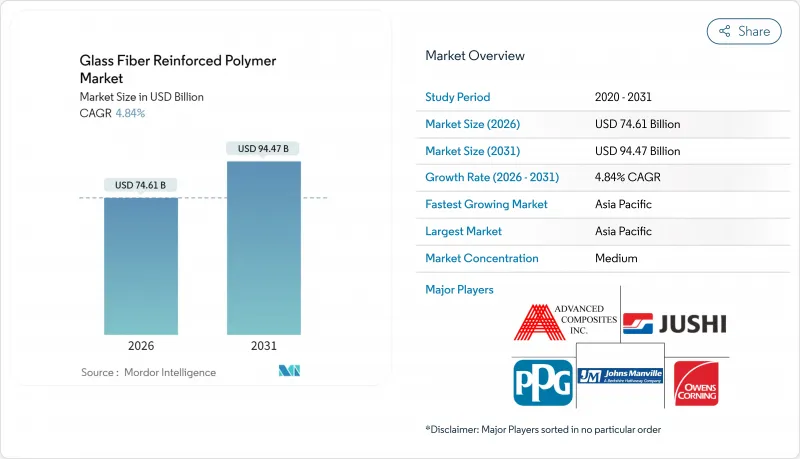
预计玻璃纤维增强聚合物市场将从 2025 年的 711.7 亿美元成长到 2026 年的 746.1 亿美元,到 2031 年将达到 944.7 亿美元,2026 年至 2031 年的复合年增长率为 4.84%。
需求成长主要由交通运输、可再生能源、航太和建筑业的原始设备製造商 (OEM) 推动,他们采用无腐蚀复合材料取代现有材料,以减轻重量、提高耐久性并满足更严格的永续性目标。快速的都市化,尤其是在亚太地区,正在推动基础设施投资,这些投资指定使用玻璃纤维增强聚合物解决方案来製造钢筋、桥面和管道内衬。材料创新正在拓展性能范围。生物基环氧树脂正进入大规模生产阶段,四缝加固和碳-玻璃纤维复合材料复合材料正在催生新的结构应用。竞争异常激烈,但多元化程度正在提高。跨国公司正在精简低利润产品线并与回收商合作,而区域製造商则在更靠近客户的地方扩大产能,以避免物流和汇率风险。儘管报废处理仍面临挑战,热解和碳化硅增值回收的技术创新正在推动循环经济计划,并缓解欧洲和北美的监管压力。
全球玻璃纤维增强聚合物市场趋势及洞察
汽车产业需求不断成长
电动车专案正在加速复合材料的应用,因为每减轻一公斤重量,就能增加续航里程并缩小电池尺寸。玻璃纤维增强热塑性塑胶正在取代电池机壳中的冲压钢,在提高耐火性和绝缘性的同时,也能减轻40%的重量。汽车製造商正在采用碳-玻璃混合变速箱壳体,这种壳体在保持刚性以实现精确齿轮定位的同时,还能减轻30%的重量。玻璃纤维增强聚合物市场的参与企业正在利用降低的模具成本,在本地生产诸如张紧钢板弹簧之类的专用零件,这些零件可以为商用车减轻高达50公斤的重量,从而提高有效负载容量。
扩大玻璃纤维增强聚合物在风力发电机中的应用
风电产业是成长最快的终端用户,因为高耸的塔架和长长的叶片需要轻质而坚固的材料。涡轮机原始设备製造商 (OEM) 正在整合碳-玻璃复合材料混合翼樑和根部嵌件,以实现可接受的叶尖挠度,从而打造 15 兆瓦级平台。立陶宛研究人员展示了热解工艺,与掩埋处理相比,可将废弃物处理的影响减少高达 51%。诸如此类的进展有助于改善生命週期认证,而这在国内竞标中正变得越来越重要。
高昂的製造成本
特殊的纤维上浆製程、严格的製程控制以及高能耗的熔炼过程,使得它们比普通金属价格更高。 2024年的价格下跌挤压了利润空间,导致欧文斯科宁复合材料部门2024年第一季的销售额下降11%至5.23亿美元,并促使该公司对其玻璃纤维增强材料部门进行战略评估。资本密集的熔炼炉以及新兴地区有限的规模经济效益,使得单位成本居高不下,减缓了成本敏感型细分市场对玻璃纤维增强材料的采用。
细分市场分析
聚酯树脂价格低廉,且与压缩成型和喷涂成型製程相容性强,预计到2025年将占据玻璃纤维增强聚合物市场61.47%的份额。环氧树脂虽然市占率较小,但凭藉其优异的黏合性、抗疲劳性和低空隙率的加工性能,预计到2031年将以4.99%的复合年增长率高速成长,满足航太、风能和汽车业的严格规范要求。乙烯基酯树脂的耐化学性优于聚酯树脂,成本低于环氧树脂,因此在对性能要求中等的细分市场(如船舶和化学品储存计划)中需求旺盛。一种新开发的生物基环氧树脂含有23%的可再生乙二醇,在不影响机械强度的前提下,可减少21%的生产排放,有助于满足ESG评分卡和采购指南的要求。奈米填料改质环氧树脂也可用作固体聚合物电解质,在结构电池和超级电容具有开创性的应用前景。在玻璃纤维增强聚合物市场,随着下游客户寻求低碳替代品,传统聚酯树脂的成本压力预计将持续存在。
为了适应高速树脂传输线,乙烯基酯树脂生产商正在提高固化速度。同时,聚氨酯树脂越来越多地应用于衝击吸收板,在这些应用中,韧性比刚性更为重要。诸如PEEK之类的特殊热塑性树脂仍然是油气井下工具的关键材料,这些工具需要耐高温达240°C。由于中国的大型聚酯工厂拥有独立的炉窑网络,能够根据需求波动快速调整产量,因此供应过剩的担忧有限。环氧树脂供应商透过双酚A和环氧氯丙烷的远期合约来对冲原材料价格波动风险,从而稳定航太主要製造商的价格。连续加工技术的创新,例如60秒脱模的快速固化环氧树脂,正在缩短生产週期,并支持玻璃纤维增强聚合物市场大规模生产的扩张。
由于其在中等批量生产中具有高重复性和经济性,压缩成型(包括片状成型塑料和玻璃纤维毡热塑性塑料)预计在2025年将占总收入的30.56%。射出成型预计到2031年将维持4.89%的复合年增长率,这主要得益于高流动性、长纤维热塑性塑胶的出现,这些塑胶无需二次加工即可生产薄壁复杂零件。真空辅助树脂传递模塑技术正在不断发展,该技术利用固化过程中的压力,将纤维含量提高到62%,拉伸强度提高到760兆帕,同时将厚度减少4%。对于建筑板材和游艇船体而言,手工铺层仍然是主流工艺,因为在这些领域,设计自由度远大于生产週期。
连续拉挤成型生产线整合了在线连续抛光和底漆工艺,降低了窗框和电网横担等下游产品的人事费用。可在热固性和热塑性基体之间切换的混合生产单元提高了资产利用率,并实现了玻璃纤维增强聚合物市场的复合材料模组化。机器人操作减少了废弃物,闭合迴路数位双胞胎技术能够即时侦测树脂过载区域,防止分层热点出现。对于大批量生产的汽车门槛梁,低于 55 秒的生产週期在成本上可与铝挤型相媲美,这也是主要一级供应商设定的 2027 年目标。在新兴经济体,支援技术转移的优惠融资计画正使本地生产的压缩机能够满足当地需求。
区域分析
预计到2025年,亚太地区将占全球销售额的48.35%,并在2031年之前以4.93%的复合年增长率成长。中国正加速产能扩张,例如BASF投资108亿美元的湛江综合体项目,运作再生能源,并为汽车和电子应用领域提供复合材料。印度的铁路和公路现代化计画正在刺激国内需求,BASF宣布增加聚酰胺和PBT的产量,以满足下游加工商的需求。东南亚国协的供应链多元化正在推动近岸外包,玻璃纤维增强聚合物市场的参与企业选择更靠近终端用户的位置进行生产。
在北美,美国在涡轮叶片、航太和基础设施的需求成长方面处于主导。巨石集团正在美国完成一座新熔炉的建设,这将确保区域供应安全并避免进口关税。联邦政府的「购买美国货」条款越来越倾向国内采购,这既有利于现有生产商,也有利于新参与企业。加拿大正专注于轻型公车和电池机壳,以满足零排放车辆法规的要求。在欧洲,循环经济立法正在推动对再生树脂和叶片间玻璃纤维回收技术的投资。 Carbon Rivers公司的多级热解技术可回收用于隔热材料和片状成型塑料的纤维,并因此获得了津贴和品牌所有者的合作。德国正在支持需要耐腐蚀衬里的氢气管道维修,而北海离岸风力发电的扩张也持续推动高模量粗纱的需求。虽然南美洲和中东及非洲仍然是小众市场,但随着巴西对其港口进行现代化改造,沙乌地阿拉伯向交通运输和可再生能源领域的重大计划投入资金,这些市场正在获得发展动力,为玻璃纤维增强聚合物市场开闢了新的竞争领域。
其他福利:
- Excel格式的市场预测(ME)表
- 分析师支持(3个月)
目录
第一章 引言
- 研究假设和市场定义
- 调查范围
第二章调查方法
第三章执行摘要
第四章 市场情势
- 市场概览
- 市场驱动因素
- 汽车产业需求不断成长
- 风力发电机中玻璃纤维增强聚合物的使用日益增多
- 航太工业中玻璃纤维增强聚合物的应用日益增多
- 建筑和基础设施行业的扩张
- 建设产业越来越重视能源效率和轻量材料
- 市场限制
- 高昂的製造成本
- 回收能力有限
- 替代材料的可用性
- 价值链分析
- 波特五力模型
- 新进入者的威胁
- 买方的议价能力
- 供应商的议价能力
- 替代品的威胁
- 竞争程度
第五章 市场规模与成长预测
- 依树脂类型
- 聚酯纤维
- 乙烯基酯树脂
- 环氧树脂
- 聚氨酯
- 其他树脂类型(PEEK树脂、酚醛树脂等)
- 透过流程
- 人工流程
- 压缩成型
- 片状成型塑胶(SMC)工艺
- 玻璃纤维毡热塑性树脂工艺
- 连续製程
- 射出成型
- 依纤维类型
- 粗纱
- 切割纤维垫
- 连续纤维丝毡
- 粗纱/织物
- 按最终用户行业划分
- 活力
- 车
- 船
- 建筑和基础设施
- 电气和电子设备
- 航太/国防
- 其他终端使用者产业(医疗保健、消费品)
- 按地区
- 亚太地区
- 中国
- 印度
- 日本
- 韩国
- 亚太其他地区
- 北美洲
- 美国
- 加拿大
- 墨西哥
- 欧洲
- 德国
- 英国
- 法国
- 义大利
- 其他欧洲地区
- 南美洲
- 巴西
- 阿根廷
- 其他南美洲
- 中东和非洲
- 沙乌地阿拉伯
- 南非
- 其他中东和非洲地区
- 亚太地区
第六章 竞争情势
- 市场集中度
- 策略趋势
- 市占率(%)/排名分析
- 公司简介
- Advanced Composites Inc.
- BASF SE
- BGF Industries
- Binani Industries Ltd.
- Celanese Corporation
- China Beihai Fiberglass Co. Ltd
- China Jushi Co. Ltd
- Chongqing Polycomp International Corp.(CPIC)
- Gurit Services AG, Zurich
- Jiuding New Material Co., Ltd
- Johns Manville
- Nippon Electric Glass Co.,Ltd.
- Owens Corning
- PPG Industries Inc.
- Reliance Industries Limited
- SAERTEX GmbH & Co. KG
- Scott Bader Company Ltd.
- The Composite Group
第七章 市场机会与未来展望
The Glass Fiber Reinforced Polymer market is expected to grow from USD 71.17 billion in 2025 to USD 74.61 billion in 2026 and is forecast to reach USD 94.47 billion by 2031 at 4.84% CAGR over 2026-2031.
Demand is rising as OEMs in transportation, renewable energy, aerospace, and construction replace heavier metals with corrosion-free composites to lower weight, boost durability, and meet stricter sustainability targets. Rapid urbanization, especially in Asia-Pacific, is stimulating infrastructure investments that specify glass fiber reinforced polymer solutions for rebar, bridge decks, and pipeline liners. Material innovation is widening the performance envelope: bio-based epoxy chemistries are entering series production, while quadaxial stitched reinforcements and hybrid carbon-glass fabrics are enabling new structural applications. Competition is intense but fragmented; multinationals are pruning low-margin lines and partnering with recyclers, whereas regional producers expand capacity close to customers to hedge logistics risk and currency volatility. End-of-life hurdles remain; nevertheless, breakthroughs in pyrolysis and silicon-carbide up-cycling are improving the circularity narrative and easing regulatory pressure in Europe and North America.
Global Glass Fiber Reinforced Polymer Market Trends and Insights
Growing Demand from the Automotive Sector
Electric-mobility programs are accelerating composite uptake because every kilogram saved extends driving range and shrinks battery size. Glass fiber reinforced thermoplastics now replace stamped steel in battery enclosures, trimming mass by 40% while improving fire resistance and thermal insulation. OEMs deploy hybrid carbon-glass transmission housings that cut 30% weight yet keep stiffness for precise gear alignment. Glass fiber reinforced polymer market participants also exploit lower tooling costs to localize niche parts such as tension leaf springs that remove up to 50 kg from commercial vehicles, thereby permitting higher payloads.
Increasing Usage of Glass Fiber Reinforced Polymers in Wind Turbines
The wind sector is the fastest-growing end-user because taller towers and longer blades mandate lighter yet stronger materials. Turbine OEMs integrate carbon-glass hybrid spars and root inserts to keep tip deflection within limits, thereby enabling 15-MW platforms. Lithuanian researchers have validated pyrolysis routes that reclaim fibers and toxic styrene from end-of-life blades, reducing disposal impacts by up to 51% versus landfill. These advances improve the life-cycle credentials that national tenders increasingly require.
High Manufacturing Cost
Specialized fiber sizing, tight process controls, and energy-intensive melting raise costs versus commodity metals. Price declines during 2024 squeezed margins; Owens Corning's Composites sales fell 11% to USD 523 million in Q1 2024, prompting a strategic review of its glass reinforcements unit. Capital-intensive furnaces and limited economies of scale in emerging regions keep unit costs elevated, delaying adoption in cost-driven segments.
Other drivers and restraints analyzed in the detailed report include:
- Increasing Adoption of Glass Fiber Reinforced Polymers in the Aerospace Industry
- Expansion of Construction and Infrastructure Sector
- Limited Recycling Capabilities
For complete list of drivers and restraints, kindly check the Table Of Contents.
Segment Analysis
Polyester resins dominated 2025 demand with a 61.47% share of the glass fiber reinforced polymer market size, thanks to low price and broad compatibility with compression and spray-up processes. Epoxy, though smaller, will register the highest 4.99% CAGR to 2031 because its superior adhesion, fatigue resistance, and low-void processing meet stringent aerospace, wind, and automotive specifications. Vinyl ester fills the mid-performance niche, combining better chemical resistance than polyester with lower cost than epoxy, and thus appeals to marine and chemical containment projects. Recent bio-based epoxies containing 23% renewable glycol cut manufacturing emissions by 21% without sacrificing mechanical strength, supporting ESG scorecards and procurement guidelines. Nanofiller-modified epoxies that double as solid polymer electrolytes open structural battery and supercapacitor use cases. The glass fiber reinforced polymer market expects continued cost pressure on conventional polyester as downstream customers seek lower embedded carbon alternatives.
Vinyl ester producers are enhancing cure kinetics to suit high-speed resin transfer lines, while polyurethane chemistries gain adoption in impact-absorption panels where toughness outweighs stiffness. Niche thermoplastics such as PEEK remain essential in oil-and-gas downhole tools requiring 240 °C service temperatures. Oversupply concerns are limited because large polyester plants in China run captive furnace networks, allowing quick output throttling during demand swings. Epoxy suppliers hedge raw-material volatility through forward contracts on bisphenol-A and epichlorohydrin, stabilizing pricing to aerospace primes. Innovations in continuous processing, such as snap-cure epoxies that reach demold in 60 seconds, will compress cycle time and support volume ramp-ups in the glass fiber reinforced polymer market.
Compression molding, including Sheet Molding Compound and Glass Mat Thermoplastic, accounted for 30.56% of 2025 revenue due to high repeatability and favorable economics at medium volumes. Injection molding will post a 4.89% CAGR through 2031 as high-flow, long-fiber thermoplastic compounds allow thin-wall complex parts without secondary finishing. Vacuum-assisted resin transfer molding has evolved; adding pressure during cure boosts fiber volume to 62% and lifts tensile strength to 760 MPa while trimming thickness by 4%. Manual lay-up persists for architectural panels and yacht hulls where design freedom overrules takt time.
Continuous pultrusion lines now integrate inline sanding and priming, reducing downstream labor for window frames and power-grid crossarms. Hybrid production cells that switch between thermoset and thermoplastic matrices extend asset utilization and enable multimaterial modules in the glass fiber reinforced polymer market. Robotic handling lowers scrap, and closed-loop digital twins detect resin-rich zones in real time, preventing delamination hot spots. Cost parity with aluminum extrusion is within reach for high-volume automotive sill beams once cycle times fall below 55 seconds, a benchmark that major Tier-1 suppliers target by 2027. In emerging economies, localized compression presses fill regional demand, aided by concessional financing that supports technology transfer.
The Glass Fiber Reinforced Polymer Market Report Segments the Industry by Resin Type (Polyester, Vinyl Ester, Epoxy, and More), Process (Manual Process, Compression Molding, and More), Fiber Form (Rovings, Chopped Strands Mats, and More), End-User Industry (Energy, Automotive, and More), and Geography (Asia-Pacific, North America, Europe, South America, and Middle East and Africa).
Geography Analysis
Asia-Pacific dominated with 48.35% revenue in 2025 and is projected to grow at a 4.93% CAGR through 2031. China accelerates capacity with mega-plants such as BASF's USD 10.8 billion Zhanjiang Verbund, which will operate on 100% renewable electricity and supply automotive and electronics composites. India's rail and road modernization campaigns stimulate local demand; BASF has announced additional polyamide and PBT expansions to serve downstream converters. ASEAN countries leverage near-shoring as supply-chain diversification pushes glass fiber reinforced polymer market participants to locate closer to end users.
In North America, the United States leads turbine blade, aerospace, and infrastructure uptake. Jushi Group is finalizing a greenfield furnace in the country, promising regional supply security and import duty avoidance. Federal Buy-America clauses increasingly favor domestic sourcing, benefitting incumbent producers and new entrants. Canada focuses on lightweight buses and battery enclosures to meet zero-emission vehicle mandates. Europe enforces circular-economy legislation that spurs investment in recyclable resins and blade-to-blade glass reclamation. Carbon Rivers' multi-stage pyrolysis recovers fiber for reuse in insulation and sheet molding compounds, attracting grants and brand-owner partnerships. Germany supports hydrogen pipeline retrofits that require corrosion-resistant liners, while offshore wind build-out in the North Sea sustains high-modulus roving demand. South America and Middle East & Africa remain niche but are gaining momentum as Brazil upgrades ports and Saudi Arabia funds mega-projects in transport and renewable energy, opening new arenas for the glass fiber reinforced polymer market.
- Advanced Composites Inc.
- BASF SE
- BGF Industries
- Binani Industries Ltd.
- Celanese Corporation
- China Beihai Fiberglass Co. Ltd
- China Jushi Co. Ltd
- Chongqing Polycomp International Corp. (CPIC)
- Gurit Services AG, Zurich
- Jiuding New Material Co., Ltd
- Johns Manville
- Nippon Electric Glass Co.,Ltd.
- Owens Corning
- PPG Industries Inc.
- Reliance Industries Limited
- SAERTEX GmbH & Co. KG
- Scott Bader Company Ltd.
- The Composite Group
Additional Benefits:
- The market estimate (ME) sheet in Excel format
- 3 months of analyst support
TABLE OF CONTENTS
1 Introduction
- 1.1 Study Assumptions and Market Definition
- 1.2 Scope of the Study
2 Research Methodology
3 Executive Summary
4 Market Landscape
- 4.1 Market Overview
- 4.2 Market Drivers
- 4.2.1 Growing Demand from the Automotive Sector
- 4.2.2 Increasing Usage of Glass Fiber Reinforced Polymers in Wind Turbines
- 4.2.3 Increasing Adoption of Glass Fiber Reinforced Polymers in the Aerospace Industry
- 4.2.4 Expandion of Construction and Infrastructure Sector
- 4.2.5 Growing Emphasis on Energy Efficent and Low-Weight Materials in Construction Industry
- 4.3 Market Restraints
- 4.3.1 High Manufacturing Cost
- 4.3.2 Limited Recycling Capabilities
- 4.3.3 Availability of Alternative Materials
- 4.4 Value Chain Analysis
- 4.5 Porter's Five Forces
- 4.5.1 Threat of New Entrants
- 4.5.2 Bargaining Power of Buyers
- 4.5.3 Bargaining Power of Suppliers
- 4.5.4 Threat of Substitute Products
- 4.5.5 Degree of Competition
5 Market Size and Growth Forecasts (Value)
- 5.1 By Resin Type
- 5.1.1 Polyester
- 5.1.2 Vinyl Ester
- 5.1.3 Epoxy
- 5.1.4 Polyurethane
- 5.1.5 Other Resin Types (PEEK Resin, Phenolic Resin, etc.)
- 5.2 By Process
- 5.2.1 Manual Process
- 5.2.2 Compression Molding
- 5.2.2.1 Sheet Molding Compound Process
- 5.2.2.2 Glass Mat Thermoplastic Process
- 5.2.3 Continuous Process
- 5.2.4 Injection Molding
- 5.3 By Fiber Form
- 5.3.1 Rovings
- 5.3.2 Chopped Strands Mats
- 5.3.3 Continuous Filament Mats
- 5.3.4 Woven Rovings/Fabrics
- 5.4 By End User Industry
- 5.4.1 Energy
- 5.4.2 Automotive
- 5.4.3 Marine
- 5.4.4 Construction and Infrastructure
- 5.4.5 Electrical and Electronics
- 5.4.6 Aerospace and Defence
- 5.4.7 Other End User Industries (Healthcare, Consumer Goods)
- 5.5 By Geography
- 5.5.1 Asia-Pacific
- 5.5.1.1 China
- 5.5.1.2 India
- 5.5.1.3 Japan
- 5.5.1.4 South Korea
- 5.5.1.5 Rest of Asia-Pacific
- 5.5.2 North America
- 5.5.2.1 United States
- 5.5.2.2 Canada
- 5.5.2.3 Mexico
- 5.5.3 Europe
- 5.5.3.1 Germany
- 5.5.3.2 United Kingdom
- 5.5.3.3 France
- 5.5.3.4 Italy
- 5.5.3.5 Rest of Europe
- 5.5.4 South America
- 5.5.4.1 Brazil
- 5.5.4.2 Argentina
- 5.5.4.3 Rest of South America
- 5.5.5 Middle East and Africa
- 5.5.5.1 Saudi Arabia
- 5.5.5.2 South Africa
- 5.5.5.3 Rest of Middle-East and Africa
- 5.5.1 Asia-Pacific
6 Competitive Landscape
- 6.1 Market Concentration
- 6.2 Strategic Moves
- 6.3 Market Share(%)/Ranking Analysis
- 6.4 Company Profiles (includes Global-level Overview, Market-level Overview, Core Segments, Financials as available, Strategic Information, Market Rank/Share, Products and Services, Recent Developments)
- 6.4.1 Advanced Composites Inc.
- 6.4.2 BASF SE
- 6.4.3 BGF Industries
- 6.4.4 Binani Industries Ltd.
- 6.4.5 Celanese Corporation
- 6.4.6 China Beihai Fiberglass Co. Ltd
- 6.4.7 China Jushi Co. Ltd
- 6.4.8 Chongqing Polycomp International Corp. (CPIC)
- 6.4.9 Gurit Services AG, Zurich
- 6.4.10 Jiuding New Material Co., Ltd
- 6.4.11 Johns Manville
- 6.4.12 Nippon Electric Glass Co.,Ltd.
- 6.4.13 Owens Corning
- 6.4.14 PPG Industries Inc.
- 6.4.15 Reliance Industries Limited
- 6.4.16 SAERTEX GmbH & Co. KG
- 6.4.17 Scott Bader Company Ltd.
- 6.4.18 The Composite Group
7 Market Opportunities and Future Outlook
- 7.1 White-space and Unmet-Need Assessment
- 7.2 Increasing Applications in Marine Industry

 2026年全球钢筋连接系统市场报告2026年全球玻璃纤维增强聚合物市场报告
 纤维增强聚合物市场:依产品材料、应用、国家及地区划分-全球产业分析、市场规模、市场占有率及2026年至2033年预测
 纤维增强聚合物(FRP)市场:按产品、应用和地区划分
 复合太阳能板框架市场(按材料类型、安装类型、框架设计、最终用户、应用和分销管道划分),全球预测(2026-2032年)玻璃纤维增强液晶聚合物市场:按纤维含量、聚合物类型、等级、应用和最终用途行业分類的全球预测(2026-2032年)
 纤维增强聚合物(FRP)复合材料市场-2025年至2030年预测
 2032年全球纤维增强聚合物复合材料市场预测:依纤维类型、树脂类型、增强形式、製造流程、应用和地区分析
 钢筋连接器市场-全球产业规模、份额、趋势、机会与预测(细分、按产品、按应用、按地区、按竞争,2020-2030 年)
 纤维增强聚合物 (FRP) 复合材料:市场占有率分析、行业趋势和统计、成长预测(2025-2030 年)