


 |
市场调查报告书
商品编码
1906991
电动车充电站:市场占有率分析、产业趋势与统计、成长预测(2026-2031)Electric Vehicle Charging Station - Market Share Analysis, Industry Trends & Statistics, Growth Forecasts (2026 - 2031) |
||||||

※ 本网页内容可能与最新版本有所差异。详细情况请与我们联繫。
预计到 2026 年,电动车充电站市场规模将达到 557.8 亿美元,高于 2025 年的 461.3 亿美元。
预计到 2031 年将达到 1,437.6 亿美元,2026 年至 2031 年的复合年增长率为 20.85%。
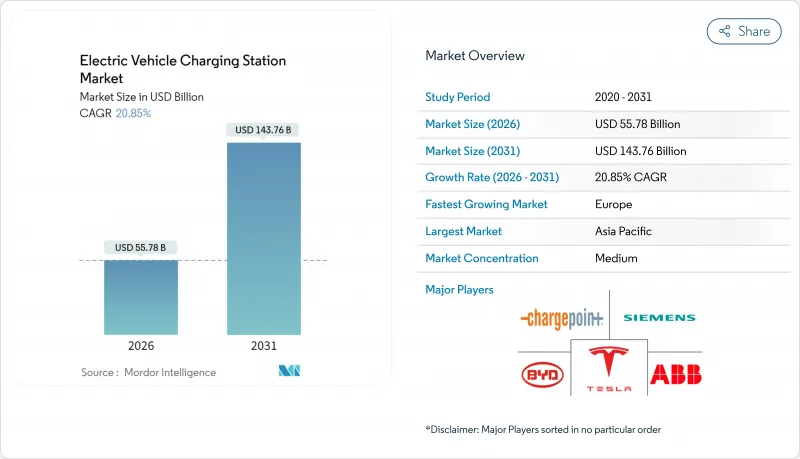
持续的政策压力促使内燃机汽车逐步淘汰,电池成本的快速下降加速了车辆总拥有成本的盈亏平衡,以及高速公路快速充电走廊的建设旨在缓解里程焦虑,这些都是推动需求激增的关键因素。大型车队营运商正致力于制定多年电气化目标,确保充电桩的高运转率,而车网互动(V2G)经营模式则创造了额外的收入来源,并提高了计划的盈利。儘管亚太地区仍是装置容量最大的地区,但欧洲目前正经历最快的成长速度,这主要得益于跨国网路整合。在北美,NEVI Formula计画以及特斯拉向其他品牌开放其超级充电系统,正在加速充电桩的部署,并提升人们对该技术平台的期望。同时,壳牌等能源巨头正在关闭加油站,并将资金重新分配到高功率充电桩,这标誌着一种策略转变,将加剧市场竞争。
全球电动车充电站市场趋势与洞察
政府主导的零排放强制令及内燃机车辆禁令计划
随着各国政府实施具有约束力的零排放车辆强制规定并设定具体的充电容量要求,监管力度正在加速充电基础设施的部署。欧盟的《替代燃料基础设施法规》要求成员国根据註册电动车的数量按比例增加充电容量。同时,加州的《先进清洁车队法规》要求公共和私营车队营运商在行业规定的期限内过渡到零排放车辆。 2024年,中国国家发展与改革委员会扩大了高速公路休息区的充电基础设施,新增了3,000个充电站和5,000个停车位,以支持中国新能源汽车40.9%的市场渗透率。新兴市场也面临监管压力,沙乌地阿拉伯承诺在2025年安装5万个充电站,阿联酋则设定了2050年实现50%的电动或混合动力汽车保有量的目标。这些强制性规定创造了可预测的需求讯号,并为私人资本投资充电基础设施提供了合理性。这降低了投资风险,并加速了市场扩张。
透过降低电池单价来平衡总拥有成本 (TCO)。
随着电动车的整体拥有成本 (TCO) 逐渐与内燃机汽车持平,电池成本的下降正在推动对充电基础设施的需求。大型采购合约正将锂离子电池组的价格降至 100 美元/千瓦时以下,这有助于电动车在用电量高的细分市场中与汽油动力汽车展开成本竞争。诸如碳化硅逆变器等组件创新提高了充电效率并减少了能量损耗,使营运商能够以每千瓦的装置容量为更多车辆充电。价格合理的电池也使得换电站模式成为可能,该模式可以将资本支出分摊到整个车队,从而促进电动车充电站产业的服务多元化。电池成本下降和充电效率提高的结合产生了协同效应,透过缩短充电时间和减少基础设施需求,加速了电动车的普及。商业车队营运商尤其受益于此趋势,因为更低的电池成本可以实现更小、更频繁的充电,从而优化营运柔软性。
150kW以上充电桩需要较高的初始资本投入
高功率充电基础设施所需的资本支出是其普及推广的一大障碍,尤其对于独立营运商和新兴市场而言更是如此。 P3集团对欧洲电动卡车充电基础设施的分析预测,到2030年,欧洲将需要4.5万个公共充电桩和23.5万个集中式充电桩。分析指出,高昂的初始资本支出和漫长的电网扩建核准流程是关键挑战。加州能源委员会的一项研究发现,直流快速充电站面临巨大的资金筹措挑战,需要每年透过降低需求获利能力节省4300美元,并透过太阳能併网节省4780至6000美元才能实现盈利。部署能够为重型车辆提供高达3.75兆瓦充电功率的兆瓦级充电系统,需要对电力基础设施进行大规模升级,每个安装项目的成本超过100万美元。高昂的资本支出尤其限制了农村和欠发达地区的普及,因为这些地区的利用率可能不足以抵消投资成本,造成充电基础设施可用性的地理差异。
细分市场分析
预计到2025年,乘用车将占据电动车充电站市场88.45%的份额,而商用车市场将以52.20%的复合年增长率(CAGR)实现最快增长,直至2031年,这反映了车队电气化强制要求带来的基础设施需求。公车是重要的商用车细分市场,随着都市区空气品质法规和可预测的线路模式的实施,其电气化进程正在加速,从而有利于充电基础设施的最佳化布局。两轮车在新兴市场,尤其是在印度,越来越受欢迎,因为换电模式已被证明具有经济可行性。卡车由于重量限制和营运需求,需要最先进的充电基础设施,这推动了高功率充电系统和基于站点的充电解决方案的创新。
商用车的电气化创造了巨大的基础需求,从而为充电基础设施投资提供了充分的理由。这是因为车队营运商的用车模式可预测,且其用电量高于乘用车。 CharIN 在奥斯陆举行的 EVS35 大会上正式发布了其兆瓦级充电系统,该系统树立了高达 3.75 兆瓦的充电容量标桿,使商用车的运营性能能够与柴油车相媲美。商用车的引进也惠及乘用车基础设施,因为共用充电走廊降低了单位基础设施成本,并提高了不同类型车辆的网路利用率。
2025年,直流充电站将占据电动车充电站市场77.95%的份额,预测期内复合年增长率将达到53.10%。这主要得益于营运商旨在缩短充电时间和提高充电效率的策略。橡树岭国家实验室在无线充电技术领域取得了突破性进展,成功实现了透过5英寸(约12.7厘米)的空气间隙向乘用车传输100千瓦的功率,效率高达96%,这有望颠覆传统的基于连接器的充电方式。 22千瓦以下的交流充电主要用于住宅和职场场所,在这些场所,较长的停车时间允许进行慢速充电,同时在低使用率的安装环境中保持成本优势。兆瓦级商用车充电系统的出现,开创了一个独特的超高功率类别,需要专用的电力基础设施和冷却系统。
SAE International 发布了小型电动车无线充电的新标准,其中包括差分感应定位系统 (DIPOS)。该系统可实现不同供应商硬体之间的互通性,充电效率高达 93%。无线充电技术解决了用户对便利性的担忧,并透过消除易磨损和人为破坏的实体连接器,降低了基础设施维护需求。向高功率充电系统的转变反映了营运商的经济效益:更快的充电速度可提高充电站利用率和投资回报率,尤其是在交通繁忙、土地成本高昂的地区,更快的充电速度更值得投入。
区域分析
亚太地区将在2025年占据全球电动车充电站市场60.10%的份额,这主要得益于中国1282万个公共充电桩的规模以及25%的年增长率。目前,中国已在6,000个高速公路服务区部署了国家级充电设施,其覆盖范围之广反映了中国新能源汽车销售占全球40.9%的构成比。日本在重型卡车充电系统方面领先,兆瓦级系统特别引人注目;印度的摩托车换电站则展现了提高充电桩密度以满足低成本出行需求的巨大潜力。在贸易摩擦的背景下,韩国正努力将自身定位为替代电池材料供应商;而澳洲则在偏远地区建造充电站,以连接遥远的城市。
欧洲是该地区成长最快的国家,预计到2031年复合年增长率将达到40.50%。 Spark联盟已在25个国家整合了11,000个高功率连接器,提供透明的价格和100%再生能源。德国计划在2030年安装超过100万个新的充电桩,符合欧盟将基础设施分配与註册电动车数量挂钩的规定。挪威维持着全球人均充电桩数量最高的国家,法国则透过低利率贷款鼓励私人安装。英国已从2035年起禁止销售新的汽油动力汽车,并强制要求公共充电桩实现支付卡互通性,进一步增强了消费者的信任。
在北美,NEVI计画将加速推进,投资50亿美元兴建20.4万个公共充电桩。 IONNA计画涵盖七家汽车製造商,将新增3万个高功率充电接口,并对特斯拉超级充电桩维修,使其能够兼容其他品牌,预计到2030年将创造60亿至120亿美元的额外收入。跨产业合作将进一步连接充电和零售设施,效仿欧洲的服务站模式。
其他福利:
- Excel格式的市场预测(ME)表
- 3个月的分析师支持
目录
第一章 引言
- 研究假设和市场定义
- 调查范围
第二章调查方法
第三章执行摘要
第四章 市场情势
- 市场概览
- 市场驱动因素
- 政府主导的零排放强制令及内燃机车辆禁令计划
- 透过降低电池单价(美元/度)来平衡总拥有成本(TCO)
- 全球高速公路快速充电走廊的建设
- 大型物流公司引进电动车的计画迅速增加
- 网格业务收益(V2G/V2X)经营模式
- 透过人工智慧优化改进充电桩安装,有助于提高充电运转率。
- 市场限制
- 150kW以上充电桩的初始资本投资成本较高
- 许可证发放及公用设施接取时间表不统一
- SiC MOSFET原料供不应求
- 连网充电器中的网路安全漏洞
- 监管环境
- 波特五力模型
- 新进入者的威胁
- 买方的议价能力
- 供应商的议价能力
- 替代品的威胁
- 竞争对手之间的竞争
第五章 市场规模及成长预测(金额)
- 按车辆类型
- 搭乘用车
- 商用车辆
- 公车和长途客车
- 按充电器类型
- 交流充电站
- 直流充电站
- 所有权
- 一般的
- 私人住宅
- 私人 - 车队/职场
- 按安装位置
- 家
- 目的地/零售
- 高速公路/公共运输
- 舰队仓库
- 依连接器标准
- CCS
- CHAdeMO
- GB/T
- Tesla NACS
- 无线的
- 按地区
- 北美洲
- 美国
- 加拿大
- 北美其他地区
- 南美洲
- 巴西
- 智利
- 南美洲其他地区
- 欧洲
- 德国
- 英国
- 法国
- 挪威
- 义大利
- 西班牙
- 荷兰
- 波兰
- 奥地利
- 俄罗斯
- 其他欧洲地区
- 亚太地区
- 中国
- 日本
- 印度
- 韩国
- 印尼
- 越南
- 菲律宾
- 澳洲
- 纽西兰
- 亚太其他地区
- 中东和非洲
- 沙乌地阿拉伯
- 阿拉伯聯合大公国
- 埃及
- 土耳其
- 南非
- 其他中东和非洲地区
- 北美洲
第六章 竞争情势
- 市场集中度
- 策略趋势
- 市占率分析
- 公司简介
- ABB Ltd.
- ChargePoint Inc.
- Tesla Inc.
- Siemens AG
- Schneider Electric Corporation
- Shell Plc.
- ENGIE SA(EVBox)
- BYD Motors Inc.
- Tritium Charging Inc.
- Blink Charging o.
- Delta Electronics Inc.
- Kempower Oyj
- Electrify America, LLC
- IONITY GmbH
- Leviton Manufacturing Co. Inc.
第七章 市场机会与未来展望
Electric vehicle charging station market size in 2026 is estimated at USD 55.78 billion, growing from 2025 value of USD 46.13 billion with 2031 projections showing USD 143.76 billion, growing at 20.85% CAGR over 2026-2031.
Continuous policy pressure to phase out internal-combustion engines, steep battery cost declines that bring total ownership parity forward, and the roll-out of highway fast-charging corridors that neutralize range anxiety are the core forces keeping demand on a steep climb. Large fleet operators are locking in multi-year electrification targets, guaranteeing high charger utilization, while vehicle-to-grid business models create additional revenue layers that lift project returns. Asia-Pacific still accounts for most installations, but Europe now supplies the fastest incremental growth on the back of cross-border network alliances. In North America, the NEVI Formula Program and the opening of Tesla's Supercharger system to other brands accelerate deployment while raising baseline technology expectations. Meanwhile, energy majors like Shell are closing petroleum stations and reallocating capital toward high-power chargers, signaling a strategic shift that tightens competitive intensity.
Global Electric Vehicle Charging Station Market Trends and Insights
Government-backed Zero-emission Mandates and ICE-ban Timelines
Regulatory momentum accelerates charging infrastructure deployment as governments implement binding zero-emission vehicle mandates with specific charging capacity requirements. The EU's Alternative Fuels Infrastructure Regulation mandates that member states increase charging capacity proportionally to EV registrations. At the same time, California's Advanced Clean Fleets Rule requires public and private fleet operators to transition to zero-emission vehicles by sector-specific deadlines. China's National Development and Reform Commission expanded highway service area charging infrastructure by adding 3,000 charging piles and 5,000 parking spaces in 2024, supporting the country's 40.9% new energy vehicle market penetration. Saudi Arabia's commitment to 50,000 charging stations by 2025 and the UAE's target of 50% electric or hybrid vehicles by 2050 extend regulatory pressure to emerging markets. These mandates create predictable demand signals that justify private capital deployment in charging infrastructure, reducing investment risk and accelerating market expansion.
Falling Battery $/kWh Driving TCO Parity
Battery cost reductions approach the critical threshold where electric vehicles achieve total cost of ownership parity with internal combustion engines, catalyzing charging infrastructure demand. Lithium-ion pack prices now edge below USD 100/kWh in leading procurement contracts, helping electric cars reach cost parity with petrol equivalents in usage-heavy segments. Component innovations such as silicon-carbide inverters raise charging efficiency and lower energy losses, allowing operators to serve more vehicles per installed kilowatt. Cheaper batteries also enable swap-station models that spread capex across fleets, broadening service formats within the electric vehicle charging station industry. The convergence of falling battery costs and improved charging efficiency creates a compounding effect where reduced charging times and lower infrastructure utilization requirements accelerate deployment economics. Commercial fleet operators particularly benefit from this dynamic, as reduced battery costs enable smaller, more frequent charging sessions that optimize operational flexibility.
High Upfront CAPEX for More Than 150 kW Chargers
Capital expenditure requirements for high-power charging infrastructure create deployment barriers, particularly for independent operators and emerging markets. The P3 Group analysis of European eTruck charging infrastructure forecasts 45,000 public and 235,000 depot charging points needed by 2030, with high initial capital expenditures and lengthy approval processes for grid expansions identified as primary challenges. The California Energy Commission research demonstrated that DC fast charging stations face significant financing challenges, with potential annual savings of USD 4,300 from demand charge mitigation and USD 4,780 to USD 6,000 from solar integration required to improve viability. The deployment of megawatt charging systems, capable of delivering up to 3.75 MW for heavy-duty vehicles, requires substantial electrical infrastructure upgrades exceeding USD 1 million per installation site. High CAPEX requirements particularly constrain deployment in rural and underserved areas where utilization rates may not justify investment, creating geographic disparities in charging infrastructure availability.
Other drivers and restraints analyzed in the detailed report include:
- Global Build-out of Highway Fast-charging Corridors
- Surging Fleet-Electrification Commitments from Logistics Giants
- Uneven Permitting and Utility Interconnection Timelines
For complete list of drivers and restraints, kindly check the Table Of Contents.
Segment Analysis
Passenger cars commanded 88.45% of the electric vehicle charging station market share in 2025, yet commercial vehicles exhibit the fastest growth at 52.20% CAGR through 2031, reflecting the infrastructure requirements for fleet electrification mandates. Buses represent a critical commercial segment where electrification accelerates due to urban air quality mandates and predictable route patterns that enable optimized charging infrastructure deployment. Two-wheelers gain traction in emerging markets where battery swapping models prove economically viable, particularly in India. Trucks require the most sophisticated charging infrastructure due to weight constraints and operational demands, driving innovation in high-power charging systems and depot-based solutions.
Commercial vehicle electrification creates anchor demand that justifies charging infrastructure investment, as fleet operators provide predictable utilization patterns and higher power requirements than passenger vehicles. CharIN officially launched the Megawatt Charging System at EVS35 in Oslo, establishing standards for charging capacities up to 3.75 MW that enable commercial vehicles to achieve operational parity with diesel counterparts. Passenger car infrastructure benefits from commercial vehicle deployment as shared charging corridors reduce per-unit infrastructure costs and improve network utilization rates across vehicle categories.
DC charging station maintained 77.95% of the electric vehicle charging station market share in 2025, while it accelerated at 53.10% CAGR during the forecast period, driven by operator strategies to reduce charging session duration and increase throughput. Oak Ridge National Laboratory achieved a breakthrough in wireless charging technology, demonstrating 100-kW power transfer to passenger vehicles with 96% efficiency across a five-inch air gap, potentially disrupting traditional connector-based charging. AC charging below 22 kW serves primarily residential and workplace applications where longer dwell times accommodate slower charging speeds, while maintaining cost advantages for installations with lower utilization requirements. The emergence of megawatt charging systems for commercial vehicles creates a distinct ultra-high-power category that requires specialized electrical infrastructure and cooling systems.
SAE International published new standards for wireless light-duty EV charging, including the Differential Inductive Positioning System that enables cross-compatibility among different suppliers' hardware with up to 93% efficiency. Wireless charging technology addresses user convenience concerns and reduces infrastructure maintenance requirements by eliminating physical connectors that experience wear and vandalism. The transition toward higher-power charging systems reflects operator economics. Reduced charging times enable higher station utilization and improved return on investment, particularly in high-traffic locations where land costs justify premium charging speeds.
The Electric Vehicle Charging Station Market Report is Segmented by Vehicle Type (Passenger Cars, Commercial Vehicles, and More), Charger Type (AC Charging Station, and DC Charging Station), Ownership Model (Public, and More), Installation Site (Home, and More), Connector Standard (CCS, and More), and Geography. The Market Forecasts are Provided in Terms of Value (USD).
Geography Analysis
Asia-Pacific leads the electric vehicle charging station market with a 60.10% share in 2025, supported by China's 12.82 million public connectors and a 25% annual installation increase. National programs now equip 6,000 highway service areas, ensuring long-distance coverage mirrors the country's 40.9% new-energy vehicle sales mix. Japan pioneers megawatt systems for heavy trucks, while India's two-wheeler battery-swapping hubs show how low-cost mobility needs can accelerate charger density. South Korea is positioning itself as an alternative battery-material supplier amid trade tensions, and Australia funds remote-area corridor sites to bridge its vast intercity distances.
Europe shows the fastest regional growth at 40.50% CAGR to 2031. The Spark Alliance integrates 11,000 high-power connectors across 25 countries, offering transparent pricing and 100% renewable electricity. Germany's plan for more than 1 million new charging points by 2030 aligns with EU regulations that tie infrastructure quotas to EV registrations. Norway retains the world's highest per-capita charger count, while France uses low-interest loans to spur private deployments. UK policy bans sales of most new petrol cars from 2035 and now mandates payment-card interoperability at public chargers, further strengthening consumer confidence.
North America accelerates through the NEVI Formula's USD 5 billion funding, enabling 204,000 public ports. The seven-automaker IONNA venture will add 30,000 high-power connectors, and the retrofitting of Tesla Superchargers for multi-brand use could generate USD 6-12 billion in additional revenue by 2030. Cross-industry alliances link charging to retail amenities, mirroring European service-station strategies.
- ABB Ltd.
- ChargePoint Inc.
- Tesla Inc.
- Siemens AG
- Schneider Electric Corporation
- Shell Plc.
- ENGIE SA (EVBox)
- BYD Motors Inc.
- Tritium Charging Inc.
- Blink Charging o.
- Delta Electronics Inc.
- Kempower Oyj
- Electrify America, LLC
- IONITY GmbH
- Leviton Manufacturing Co. Inc.
Additional Benefits:
- The market estimate (ME) sheet in Excel format
- 3 months of analyst support
TABLE OF CONTENTS
1 Introduction
- 1.1 Study Assumptions and Market Definition
- 1.2 Scope of the Study
2 Research Methodology
3 Executive Summary
4 Market Landscape
- 4.1 Market Overview
- 4.2 Market Drivers
- 4.2.1 Government-backed zero-emission mandates and ICE-ban timelines
- 4.2.2 Falling battery $/kWh driving TCO parity
- 4.2.3 Global build-out of highway fast-charging corridors
- 4.2.4 Surging fleet-electrification commitments from logistics giants
- 4.2.5 Grid-services monetisation (V2G/V2X) business models
- 4.2.6 AI-optimised charger siting improving utilisation rates
- 4.3 Market Restraints
- 4.3.1 High upfront CAPEX for More Than 150 kW chargers
- 4.3.2 Uneven permitting and utility interconnection timelines
- 4.3.3 Raw-material bottlenecks for SiC MOSFETs
- 4.3.4 Cyber-security vulnerabilities in networked chargers
- 4.4 Regulatory Landscape
- 4.5 Porter's Five Forces
- 4.5.1 Threat of New Entrants
- 4.5.2 Bargaining Power of Buyers
- 4.5.3 Bargaining Power of Suppliers
- 4.5.4 Threat of Substitutes
- 4.5.5 Competitive Rivalry
5 Market Size and Growth Forecasts (Value (USD))
- 5.1 By Vehicle Type
- 5.1.1 Passenger Cars
- 5.1.2 Commercial Vehicles
- 5.1.3 Buses and Coaches
- 5.2 By Charger Type
- 5.2.1 AC Charging Station
- 5.2.2 DC Charging Station
- 5.3 By Ownership Model
- 5.3.1 Public
- 5.3.2 Private - Residential
- 5.3.3 Private - Fleet/Workplace
- 5.4 By Installation Site
- 5.4.1 Home
- 5.4.2 Destination/Retail
- 5.4.3 Highway/Transit
- 5.4.4 Fleet Depot
- 5.5 By Connector Standard
- 5.5.1 CCS
- 5.5.2 CHAdeMO
- 5.5.3 GB/T
- 5.5.4 Tesla NACS
- 5.5.5 Wireless
- 5.6 By Geography
- 5.6.1 North America
- 5.6.1.1 United States
- 5.6.1.2 Canada
- 5.6.1.3 Rest of North America
- 5.6.2 South America
- 5.6.2.1 Brazil
- 5.6.2.2 Chile
- 5.6.2.3 Rest of South America
- 5.6.3 Europe
- 5.6.3.1 Germany
- 5.6.3.2 United Kingdom
- 5.6.3.3 France
- 5.6.3.4 Norway
- 5.6.3.5 Italy
- 5.6.3.6 Spain
- 5.6.3.7 Netherlands
- 5.6.3.8 Poland
- 5.6.3.9 Austria
- 5.6.3.10 Russia
- 5.6.3.11 Rest of Europe
- 5.6.4 Asia-Pacific
- 5.6.4.1 China
- 5.6.4.2 Japan
- 5.6.4.3 India
- 5.6.4.4 South Korea
- 5.6.4.5 Indonesia
- 5.6.4.6 Vietnam
- 5.6.4.7 Philippines
- 5.6.4.8 Australia
- 5.6.4.9 New Zealand
- 5.6.4.10 Rest of Asia-Pacific
- 5.6.5 Middle East and Africa
- 5.6.5.1 Saudi Arabia
- 5.6.5.2 United Arab Emirates
- 5.6.5.3 Egypt
- 5.6.5.4 Turkey
- 5.6.5.5 South Africa
- 5.6.5.7 Rest of Middle East and Africa
- 5.6.1 North America
6 Competitive Landscape
- 6.1 Market Concentration
- 6.2 Strategic Moves
- 6.3 Market Share Analysis
- 6.4 Company Profiles (includes Global level Overview, Market level overview, Core Segments, Financials as available, Strategic Information, Market Rank/Share, Products and Services, and Recent Developments)
- 6.4.1 ABB Ltd.
- 6.4.2 ChargePoint Inc.
- 6.4.3 Tesla Inc.
- 6.4.4 Siemens AG
- 6.4.5 Schneider Electric Corporation
- 6.4.6 Shell Plc.
- 6.4.7 ENGIE SA (EVBox)
- 6.4.8 BYD Motors Inc.
- 6.4.9 Tritium Charging Inc.
- 6.4.10 Blink Charging o.
- 6.4.11 Delta Electronics Inc.
- 6.4.12 Kempower Oyj
- 6.4.13 Electrify America, LLC
- 6.4.14 IONITY GmbH
- 6.4.15 Leviton Manufacturing Co. Inc.
7 Market Opportunities and Future Outlook
- 7.1 White-space and Unmet-Need Assessment

 2026年全球电动车充电站市场报告
 电动车充电站市场规模、份额、成长率及全球产业分析:按类型、应用和地区划分,预测2026-2034年全球电动车充电站市场规模、份额、趋势和成长分析报告(2026-2034年)
 全球太阳能电动车充电站市场:按充电方式、组件、安装方式、应用、车辆类型、国家及地区划分-产业分析、市场规模、份额及2025年至2032年未来预测全球电动车充电站市场:按充电器类型、充电等级、连接器类型、部署方式、应用、最终用户、国家和地区划分-产业分析、市场规模、份额和预测(2025-2032)2026年全球电动车充电站设备市场报告
 按功率等级、连接器类型、应用和最终用户分類的高功率液冷充电桩市场-全球预测,2026-2032年电动车充电站保险丝市场:按保险丝类型、额定电流、分销管道、额定电压、材料、技术、应用和最终用户划分-全球预测,2026-2032年电动车充电站继电器市场:按继电器类型、额定电流、线圈电压、配置和最终用户划分-全球预测,2026-2032年语音晶片解决方案市场按技术类型、应用、部署类型和最终用户划分 - 全球预测 2026-2032