


 |
市场调查报告书
商品编码
1907210
耐火材料:市场占有率分析、产业趋势与统计、成长预测(2026-2031)Refractories - Market Share Analysis, Industry Trends & Statistics, Growth Forecasts (2026 - 2031) |
||||||

※ 本网页内容可能与最新版本有所差异。详细情况请与我们联繫。
预计耐火材料市场将从 2025 年的 5,736 万吨增长到 2026 年的 5,961 万吨,到 2031 年将达到 7,231 万吨,2026 年至 2031 年的复合年增长率为 3.93%。
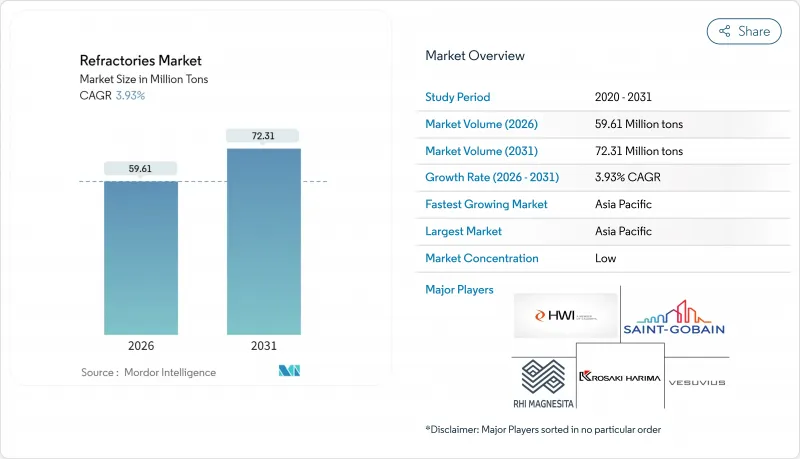
这一成长趋势反映了耐火材料市场适应不断变化的炼钢技术、不断扩张的能源密集型产业以及日益严格的监管要求的能力。亚洲钢铁厂产能扩张、向氢基直接还原铁(DRI)炉的转型以及新一代电池、水泥和废弃物发电设施的规模建设,都在推动近期需求成长。同时,日益严格的二氧化硅粉尘排放法规和碳边境调节税的引入,正在加速材料创新,并促进主要供应商之间的策略整合。例如,RHI Magnesita公司预测,儘管销量下滑,但其2023年调整后息税前利润(EBITA)仍将达到4.09亿欧元,较上年增长7%,这表明严格的定价策略和有针对性的收购可以缓解週期性波动。
全球耐火材料市场趋势与洞察
亚洲钢铁厂产能快速扩张
亚洲钢铁产能的扩张正推动耐火材料需求空前高涨。 2024年上半年,中国投产12座新高炉,总产能达1,897万吨。虽然用更有效率的炉子取代老旧设备有望延长运作运作,但不断增加的热负荷也使得耐火材料市场迫切需要开发高等级的氧化镁碳产品和整体式解决方案。印度的快速成长同样意义重大。 RHI Magnesita India Ltd.累计2023-2024财年营收将达到378.1亿印度卢比(约4.53亿美元),该公司在九个地点为700多家客户提供服务,凸显了印度国内市场的强劲需求。区域集中化有利于本地生产商缩短前置作业时间,而西方供应商则面临维持市场份额的挑战。同时,韩国2024年的耐火材料产量预计将下降5.7%,凸显了耐火材料市场成长的不平衡。
向氢基直接还原铁(DRI)炉过渡
氢基直接还原铁(DRI)製程改变了温度分布和气氛,因此需要具有优异抗热衝击性和抗氢脆性的耐火材料。根据《镁业》杂誌的一项研究显示,用于「绿色钢」的电熔炉需要能够耐受富氢气体的新型耐火材料。虽然该製程可将炼钢二氧化碳排放降低至每吨钢0.1吨,但资本投资和能源价格仍是限制因素。安赛乐米塔尔公司于2025年退出德国的一个计划并偿还13亿欧元的补贴,凸显了经济的不确定性。然而,能源经济研究所预测,到2050年,DRI用铁矿石的需求将成长十倍,这显示特种DRI耐火材料具有长期的发展机会。
镁碳砖的碳排放罚款
欧盟的碳边境调节税和北美的脱碳政策正在抑制对传统镁碳砖的需求。生命週期评估表明,无碳镁替代品可以降低环境影响,但仍需在工业层面进行广泛的示范应用。美国对来自中国和墨西哥的镁碳砖征收反倾销税(部分生产商的税率高达236%),这加剧了成本压力,并推动耐火材料市场向低碳解决方案转型。 RHI Magnesita公司的高回收率镁碳系列产品提供了一种过渡方案,但无碳粘合剂和陶瓷基质复合材料才是更长远的发展方向。
细分市场分析
在研究期间,非黏土耐火材料的复合年增长率将达到 4.57%,并持续成长至 2031 年,超过黏土基耐火材料。其在氢基炼钢、先进电池和废弃物领域优异的耐腐蚀性和抗热震性是推动成长的基础。氧化镁砖因其对炉渣化学成分的耐受性,在基础炼钢领域占据主导地位;氧化锆砖则在严苛的循环环境和极端温度下表现出色。硅酸盐砖是焦炉格栅墙的必需材料,但其使用受到结晶质二氧化硅暴露法规(粉尘浓度限值为 50 μg/m³)的限制。铬酸盐砖因其优异的抗金属渗透性,在非铁金属冶炼领域保持重要地位。儘管黏土耐火材料在出货量方面仍占据主导地位,但这些非黏土耐火材料类别支撑了价值成长。
到2025年,包括高铝耐火材料在内的黏土耐火材料将占据耐火材料市场54.88%的份额,这充分证明了其在各种炉衬应用中的成本效益。耐火粘土砖用于中温钢包和锅炉,而隔热耐火材料则有助于各行业的节能。研究人员在飞灰无机聚合物砖中,于1100°C下烧製后,实现了84 MPa的抗压强度,这为粘土耐火材料的循环经济开闢了道路。圣戈班的超高温陶瓷,特别是碳化硅(SiC)和氧化锆,将性能极限推至1400°C以上,展现了混合配方如何模糊了传统黏土/非黏土的界限。
耐火材料市场报告按产品类型(非粘土耐火材料和粘土耐火材料)、终端用户行业(钢铁、水泥、能源化工、非铁金属、玻璃、陶瓷及其他终端用户行业)和地区(亚太地区、北美、欧洲、南美以及中东和非洲)进行细分。市场预测以吨为单位。
区域分析
预计到2025年,亚太地区将占全球耐火材料市场的73.20%,并在2031年之前以4.12%的复合年增长率成长。中国高炉现代化改造和老旧设施的关闭,推动了对高等级耐火砖和浇注料的持续需求。印度的成长速度明显高于其他国家,RHI Magnesita执行长预测,该国耐火材料市场年增率将达到6%至13%,这反映了钢铁和水泥产业的大规模扩张。在日本,在JFE控股公司22.6亿美元投资的推动下,日本正转向电弧炉技术转型,炉衬规范也正向电弧炉优化型基础混合料转变。韩国2024年的产量下降了5.7%,但仍致力于生产需要高品质耐火材料的高价值钢铁产品。中国和整个东南亚锂离子电池超级工厂的加速建设,巩固了该地区作为耐火材料市场成长中心的地位。
儘管北美市场已趋于成熟,但其战略意义仍然重大。哈比森-沃克国际公司(Harbison-Walker International)在密苏里州富尔顿投资1,390万美元进行扩建,将使轻质整体式耐火材料的产量提高60%,体现了该公司致力于在该地区开发高价值应用产品的承诺。美国职业安全与健康管理局(OSHA)日益严格的二氧化硅粉尘法规正在推动对封闭式加工技术和低粉尘材料的投资,促使产品系列。美国正寻求在生铁出口领域占据主导,这可能会刺激对特种直接还原铁(DRI)耐火材料的需求。同时,美国反倾销税推高了镁碳砖的成本,从而限制了墨西哥的竞争力。
欧洲在环境政策方面处于领先地位。欧盟碳边境调节机制推高了高碳耐火材料的成本,促使人们采用无碳材料和回收解决方案。安赛乐米塔尔决定退还在德国氢能炼钢计划13亿欧元的补贴,凸显了绿色转型带来的经济负担。然而,研发投入依然强劲。圣戈班计划在纽约州惠特菲尔德投资4000万美元建设NorPro工厂,该工厂将位于美国,但将为欧洲供应催化剂,凸显了跨大西洋供应链的整合。中东和非洲地区展现出新的潜力,沙乌地阿拉伯的产业多元化和南非的采矿业都体现了这一点,但政治不确定性和基础设施不足阻碍了计划的进展。
其他福利:
- Excel格式的市场预测(ME)表
- 3个月的分析师支持
目录
第一章 引言
- 研究假设和市场定义
- 调查范围
第二章调查方法
第三章执行摘要
第四章 市场情势
- 市场概览
- 市场驱动因素
- 亚洲钢铁製造商产能迅速扩张
- 向氢基直接还原炉过渡
- 水泥窑转向替代燃料
- 利用高温陶瓷的大规模储能电池的发展
- 用于废弃物焚化发电厂的新型超低孔隙率砖
- 市场限制
- 镁碳砖的碳排放处罚
- 冶金级矾土和菱镁矿供应的波动性;
- 加强经合组织国家的职业性二氧化硅粉尘法规
- 价值链分析
- 波特五力模型
- 供应商的议价能力
- 买方的议价能力
- 新进入者的威胁
- 替代品的威胁
- 竞争程度
第五章 市场规模与成长预测
- 依产品类型
- 非黏土耐火材料
- 镁砖
- 氧化锆砖
- 硅砖
- 铬矿砖
- 其他(碳化物、硅酸盐)
- 黏土耐火材料
- 高铝
- 耐火粘土
- 绝缘
- 非黏土耐火材料
- 按最终用户行业划分
- 钢
- 水泥
- 能源与化工
- 非铁金属
- 玻璃
- 陶瓷製品
- 其他终端用户产业(纸浆和造纸、废弃物发电)
- 按地区
- 亚太地区
- 中国
- 印度
- 日本
- 韩国
- 亚太其他地区
- 北美洲
- 美国
- 加拿大
- 墨西哥
- 欧洲
- 德国
- 英国
- 法国
- 义大利
- 俄罗斯
- 其他欧洲地区
- 南美洲
- 巴西
- 阿根廷
- 南美洲其他地区
- 中东和非洲
- 沙乌地阿拉伯
- 南非
- 其他中东和非洲地区
- 亚太地区
第六章 竞争情势
- 市场集中度
- 策略趋势
- 市占率分析
- 公司简介
- Chosun Refractories
- Gouda Refractories Group
- HarbisonWalker International
- IFGL
- Imerys
- Krosaki Harima Corporation
- Liaoning Qinghua Refractory Material Co., Ltd.
- Monolithisch India Limited
- Morgan Advanced Materials
- Puyang Refractories Group Co.,Ltd.
- Rath-Group
- Refratechnik
- RHI Magnesita
- Saint-Gobain
- SHINAGAWA REFRACTORIES CO., LTD.
- Vesuvius
第七章 市场机会与未来展望
The Refractories Market is expected to grow from 57.36 Million tons in 2025 to 59.61 Million tons in 2026 and is forecast to reach 72.31 Million tons by 2031 at 3.93% CAGR over 2026-2031.
This forward momentum reflects the ability of the refractories market to adapt to shifting steelmaking technologies, expanding energy-intensive industries, and rising regulatory expectations. Capacity expansions across Asian steel plants, the pivot toward hydrogen-based direct-reduced-iron (DRI) furnaces, and the scale-up of next-generation battery, cement, and waste-to-energy facilities all reinforce near-term demand. At the same time, tighter silica-dust limits and carbon-border tariffs are accelerating materials innovation and spurring strategic consolidation among leading suppliers. RHI Magnesita, for example, delivered 7% growth in 2023 Adjusted EBITA to EUR 409 million despite softer volumes, underscoring how disciplined pricing and targeted acquisitions can buffer cyclical swings.
Global Refractories Market Trends and Insights
Rapid Capacity Expansions in Asian Iron and Steel Plants
Steel capacity additions across Asia are driving unprecedented refractory demand, with China commissioning 12 new blast furnaces totaling 18.97 million tons in H1 2024. Replacing aging units with high-efficiency furnaces lengthens campaign life expectations and raises thermal loads, prompting the refractories market to innovate higher-grade magnesia-carbon and monolithic solutions. India's surge is equally pivotal; RHI Magnesita India posted INR 3,781 crore (USD 453 million) FY 2023-24 revenue while serving more than 700 customers across nine sites, highlighting the depth of domestic pull. Regional concentration benefits local producers through shorter lead times yet challenges Western suppliers to sustain share. Meanwhile, Korean production fell 5.7% in 2024, underscoring uneven growth within the broader refractories market.
Shift Toward Hydrogen-Based Direct-Reduced-Iron Furnaces
Hydrogen-based DRI alters temperature profiles and atmospheres, demanding refractories with superior thermal-shock resistance and hydrogen embrittlement resilienceMagnesita research confirms that electric melting furnaces intended for "green steel" require novel refractory chemistries capable of withstanding hydrogen-rich gases. Although the process can slash steelmaking CO2 emissions to 0.1 tons per ton of steel, capex and energy-price hurdles persist; ArcelorMittal's 2025 withdrawal from a German project and return of EUR 1.3 billion in subsidies highlights the economic uncertainties. Nevertheless, the Institute for Energy Economics forecasts a ten-fold rise in DR-grade iron ore demand by 2050, signaling long-run opportunities for specialized DRI refractories,
Carbon-Emission Penalties on Mag-Carbon Bricks
EU carbon-border tariffs and North American decarbonization policies are curbing demand for traditional magnesia-carbon bricks. Life-cycle assessments show that carbonless magnesia alternatives deliver lower environmental impacts but still need broader industrial validation. US antidumping duties on certain Chinese and Mexican mag-carbon bricks-reaching 236% for some producers-add cost pressure and push the refractories market toward lower-carbon solutions. RHI Magnesita's high-recycling mag-carbon series offers an interim path, yet long-term trajectories favor carbon-free bonds and ceramic-matrix composites.
Other drivers and restraints analyzed in the detailed report include:
- Cement Kilns Switching to Alternative Fuels
- Growth of Large Utility-Scale Energy-Storage Batteries Using High-Temperature Ceramics
- Volatility in Metallurgical-Grade Bauxite and Magnesite Supply
For complete list of drivers and restraints, kindly check the Table Of Contents.
Segment Analysis
Non-clay refractories grew at a 4.57% CAGR during the review period and continue to outpace clay grades through 2031. They thrive on superior corrosion and thermal-shock resistance critical in hydrogen-based steelmaking, advanced batteries, and waste-to-energy incinerators. Magnesite bricks dominate basic steelmaking for their resistance to slag chemistry, while zirconia bricks excel in severe cycling and extremely high temperature zones. Silica bricks remain indispensable for coke-oven checker walls, yet usage is moderated by rising crystalline-silica exposure rules capping dust at 50 µg/m3. Chromite bricks maintain a foothold in non-ferrous smelting thanks to strong metal-penetration resistance. Together, these non-clay categories underpin value growth even as clay refractories retain volume leadership.
Clay refractories, topped by high-alumina variants, captured 54.88% of refractories market share in 2025, reflecting their cost-effectiveness across multiple furnace linings. Fireclay bricks serve moderate-temperature ladles and boilers, while insulating refractories unlock energy savings across industries. Researchers have achieved 84 MPa compressive strength in fly-ash geopolymer bricks after 1,100 °C exposure, hinting at circular-economy pathways for clay refractories. Saint-Gobain's ultra-high-temperature ceramics, particularly SiC and zirconia, stretch performance ceilings above 1,400 °C and illustrate how hybrid formulations blur the traditional clay/non-clay divide.
The Refractories Market Report is Segmented by Product Type (Non-Clay Refractories and Clay Refractories), End-User Industry (Iron and Steel, Cement, Energy and Chemicals, Non-Ferrous Metals, Glass, Ceramic, and Other End-User Industries), and Geography (Asia-Pacific, North America, Europe, South America, and Middle East and Africa). The Market Forecasts are Provided in Terms of Volume (Tons).
Geography Analysis
Asia-Pacific owned 73.20% of the refractories market in 2025 and is slated to grow at a 4.12% CAGR through 2031. China continues modernizing blast furnaces while shutting obsolete capacity, driving sustained uptake of higher-grade bricks and castables. India outpaces all peers; RHI Magnesita's CEO forecasts 6-13% annual domestic refractory growth, reflecting large-scale steel and cement expansions. Japan's shift toward EAF technology, supported by JFE Holdings' USD 2.26 billion investment, redirects lining specifications toward EAF-optimized basic mixes. South Korea encountered a 5.7% production dip in 2024 but aims to pivot toward higher-value steel products that still require premium refractories. Accelerating lithium-ion battery gigafactory construction across China and Southeast Asia cements the region's role as the growth nucleus of the refractories market.
North America remains a mature yet strategically vital arena. HarbisonWalker International's USD 13.9 million expansion in Fulton, Missouri, will lift lightweight monolithic output by 60% and embodies the region's commitment to high-value applications. Heightened OSHA silica-dust limits incentivize investment in sealed handling and low-dust materials, reshaping product portfolios. Canada eyes leadership in green-iron exports, which could stimulate specialized DRI refractory demand. Mexico's competitiveness, however, is tempered by US antidumping duties that inflate costs for mag-carbon bricks.
Europe sets the pace on environmental policy. The EU Carbon Border Adjustment Mechanism raises the cost of high-carbon refractories, propelling adoption of carbon-free bonds and recycling solutions. ArcelorMittal's decision to return EUR 1.3 billion in subsidies for a German hydrogen-steel project illustrates the economic strain in the green transition. Yet R&D pipelines stay robust; Saint-Gobain's planned USD 40 million NorPro plant in Wheatfield, New York, although US-based, will serve European catalysts and emphasizes trans-Atlantic supply-chain integration. The Middle East and Africa offer emergent promise through Saudi industrial diversification and South African mining ventures, although political certainty and infrastructure gaps influence project pacing.
- Chosun Refractories
- Gouda Refractories Group
- HarbisonWalker International
- IFGL
- Imerys
- Krosaki Harima Corporation
- Liaoning Qinghua Refractory Material Co., Ltd.
- Monolithisch India Limited
- Morgan Advanced Materials
- Puyang Refractories Group Co.,Ltd.
- Rath-Group
- Refratechnik
- RHI Magnesita
- Saint-Gobain
- SHINAGAWA REFRACTORIES CO., LTD.
- Vesuvius
Additional Benefits:
- The market estimate (ME) sheet in Excel format
- 3 months of analyst support
TABLE OF CONTENTS
1 Introduction
- 1.1 Study Assumptions and Market Definition
- 1.2 Scope of the Study
2 Research Methodology
3 Executive Summary
4 Market Landscape
- 4.1 Market Overview
- 4.2 Market Drivers
- 4.2.1 Rapid Capacity Expansions in Asian Iron and Steel Plants
- 4.2.2 Shift Toward Hydrogen-Based Direct-Reduced-Iron Furnaces
- 4.2.3 Cement Kilns Switching to Alternative Fuels
- 4.2.4 Growth of Large Utility-Scale Energy-Storage Batteries Using High-Temperature Ceramics
- 4.2.5 Novel Ultra-Low-Porosity Bricks for Waste-To-Energy Incinerators
- 4.3 Market Restraints
- 4.3.1 Carbon-Emission Penalties on Mag-Carbon Bricks
- 4.3.2 Volatility in Metallurgical-Grade Bauxite and Magnesite Supply
- 4.3.3 Occupational Silica-Dust Regulations Tightening in OECD Nations
- 4.4 Value Chain Analysis
- 4.5 Porter's Five Forces
- 4.5.1 Bargaining Power of Suppliers
- 4.5.2 Bargaining Power of Buyers
- 4.5.3 Threat of New Entrants
- 4.5.4 Threat of Substitutes
- 4.5.5 Degree of Competition
5 Market Size and Growth Forecasts (Volume)
- 5.1 By Product Type
- 5.1.1 Non-clay Refractories
- 5.1.1.1 Magnesite Brick
- 5.1.1.2 Zirconia Brick
- 5.1.1.3 Silica Brick
- 5.1.1.4 Chromite Brick
- 5.1.1.5 Other (Carbides, Silicates)
- 5.1.2 Clay Refractories
- 5.1.2.1 High-Alumina
- 5.1.2.2 Fireclay
- 5.1.2.3 Insulating
- 5.1.1 Non-clay Refractories
- 5.2 By End-User Industry
- 5.2.1 Iron and Steel
- 5.2.2 Cement
- 5.2.3 Energy and Chemicals
- 5.2.4 Non-Ferrous Metals
- 5.2.5 Glass
- 5.2.6 Ceramic
- 5.2.7 Other End-user Industries (Pulp and Paper, Waste-to-Energy)
- 5.3 By Geography
- 5.3.1 Asia-Pacific
- 5.3.1.1 China
- 5.3.1.2 India
- 5.3.1.3 Japan
- 5.3.1.4 South Korea
- 5.3.1.5 Rest of Asia-Pacific
- 5.3.2 North America
- 5.3.2.1 United States
- 5.3.2.2 Canada
- 5.3.2.3 Mexico
- 5.3.3 Europe
- 5.3.3.1 Germany
- 5.3.3.2 United Kingdom
- 5.3.3.3 France
- 5.3.3.4 Italy
- 5.3.3.5 Russia
- 5.3.3.6 Rest of Europe
- 5.3.4 South America
- 5.3.4.1 Brazil
- 5.3.4.2 Argentina
- 5.3.4.3 Rest of South America
- 5.3.5 Middle East and Africa
- 5.3.5.1 Saudi Arabia
- 5.3.5.2 South Africa
- 5.3.5.3 Rest of Middle East and Africa
- 5.3.1 Asia-Pacific
6 Competitive Landscape
- 6.1 Market Concentration
- 6.2 Strategic Moves
- 6.3 Market Share Analysis
- 6.4 Company Profiles (includes Global level Overview, Market level overview, Core Segments, Financials as available, Strategic Information, Market Rank/Share for key companies, Products and Services, and Recent Developments)
- 6.4.1 Chosun Refractories
- 6.4.2 Gouda Refractories Group
- 6.4.3 HarbisonWalker International
- 6.4.4 IFGL
- 6.4.5 Imerys
- 6.4.6 Krosaki Harima Corporation
- 6.4.7 Liaoning Qinghua Refractory Material Co., Ltd.
- 6.4.8 Monolithisch India Limited
- 6.4.9 Morgan Advanced Materials
- 6.4.10 Puyang Refractories Group Co.,Ltd.
- 6.4.11 Rath-Group
- 6.4.12 Refratechnik
- 6.4.13 RHI Magnesita
- 6.4.14 Saint-Gobain
- 6.4.15 SHINAGAWA REFRACTORIES CO., LTD.
- 6.4.16 Vesuvius
7 Market Opportunities and Future Outlook
- 7.1 White-space and Unmet-Need Assessment
- 7.2 Demand spike from EAF share rising in steel

 全球耐火材料市场规模、份额、趋势和成长分析报告(2026-2034年)
 耐火材料市场规模、份额、趋势及预测(按类型、碱度、製造製程、成分、耐火矿物、应用及地区划分),2026-2034年
 2026年全球耐火材料市场报告
 耐火材料市场-全球产业规模、份额、趋势、机会及预测(依化学成分、类型、应用、地区及竞争格局划分,2021-2031年)
 2026-2030年全球耐火材料市场
 低硅高钙焊接氧化镁市场:依产品类型、产品形态及最终用途产业划分,全球预测(2026-2032年)日本耐火材料市场:按类型、碱度、製造工艺、成分、耐火矿物、应用和地区划分,2026-2034年
 耐火材料市场预测至2032年:按类型、材料、形式、安装方法、最终用户和地区分類的全球分析
 耐火材料市场规模、份额和成长分析(按类型、产品、碱度、最终用途产业和地区划分)—产业预测(2026-2033 年)
 耐火砖市场规模、份额及成长分析(按来源、应用、形状、性能及地区划分)-2026-2033年产业预测