


 |
市场调查报告书
商品编码
1907240
分散式控制系统:市场占有率分析、产业趋势与统计、成长预测(2026-2031)Distributed Control Systems - Market Share Analysis, Industry Trends & Statistics, Growth Forecasts (2026 - 2031) |
||||||

※ 本网页内容可能与最新版本有所差异。详细情况请与我们联繫。
预计到 2025 年,分散式控制系统市场规模将达到 227.1 亿美元,从 2026 年的 238.9 亿美元成长到 2031 年的 307.8 亿美元,在预测期(2026-2031 年)内,复合年增长率将达到 5.20%。
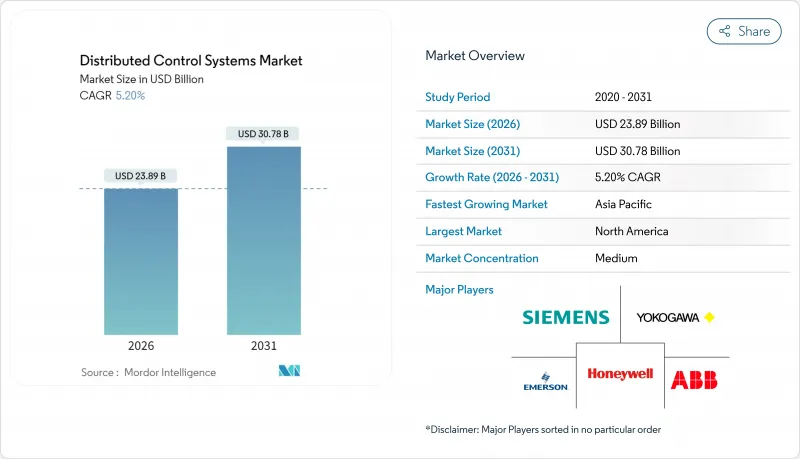
绿氢能的日益普及、碳捕获计划的推进、核能发电的增加以及製药业向连续生产模式的转变,共同推动了产业成长。供应商正积极拓展软体定义架构、数位双胞胎整合和边缘连接,以提升营运效益;同时,小规模的工厂则采用精简平台以降低准入门槛。日益增长的网路安全需求、认证工程师的短缺以及持续存在的半导体供应限制,虽然减缓了扩张速度,但并未抑製成长。竞争的焦点集中在预测性维护、模组化部署和订阅授权模式等方面,以分散资本支出。
全球分散式控制系统市场趋势与洞察
能源转型推动了绿色氢能和碳捕获、利用与封存(CCUS)设施对分散式控制系统(DCS)的需求。
预计到2024年,绿色氢气产能将达到1,640万吨,每座新建厂都将部署价值200万至1,000万美元的先进控制平台。分散式控制系统(DCS)架构必须足够柔软性,以应对间歇性可再生能源,确保氢气安全,并适应电解槽效率的快速提升-预计五年内将提升20%至30%。供应商正在打包模组化控制节点,这些节点可根据工厂发展阶段进行扩展,使营运商无需拆除更换即可进行升级。欧洲和中东地区在部署方面处于领先地位,但北美开发商也在迅速发布与《通货膨胀控制法案》(IRA)激励措施相关的询价单。长期投资前景已催生出一批稳定的分散式控制系统市场计划,其发展週期将远超过2030年。
核能和小型模组化反应器计划需要具备网路安全措施的安全级分散式控制系统 (DCS)
监管机构现在要求所有新核子反应炉都必须配备空气间隙、安全等级符合标准的分散式控制系统(DCS)以及经过认证的冗余系统。美国美国核能管理委员会(NRC)于2025年收紧了网路安全法规,这增加了合规成本,但也锁定了合规平台的溢价。小型模组化反应器(SMR)供应商正在缩短实体布线距离、加快建造进度,并指定数位安全通道以支援远距离诊断。欧洲和中国正在采用类似的框架进行标准化,而海湾国家则正在增加核子反应炉机组以实现海水淡化厂的脱碳。长达18个月或更久的认证週期阻碍了新进者,并巩固了现有供应商在分散式控制系统市场的地位。
与现代PLC/SCADA替代方案相比,初始资本支出较高
开放式流程自动化试点部署已证明,与传统分散式控制系统(DCS)相比,成本可节省 52%,这使其成为谨慎控制资本支出的中小型营运商的理想选择。供应商正透过订阅许可、灵活的 I/O 和预製库来减少硬体需求,以应对这项挑战。然而,高昂的价格引发的担忧导致东协、拉丁美洲和非洲部分地区的计划延期,使分散式控制系统市场成长率下降了 0.8 个百分点。
细分市场分析
2025年,硬体在分散式控制系统市场中仍占据54.35%的份额,这反映了终端用户对经过现场验证的控制器、通用I/O和冗余网路的偏好。受能源和化学产业更新换代週期的推动,硬体分散式控制系统市场规模达123.4亿美元。供应商现在提供的可配置I/O模组,可以在任何通道上接收类比、数位或HART讯号,从而减少高达30%的机柜数量。通用卡还支援后期设计变更,这对于面临工期紧张的EPC承包商来说极具吸引力。控制器平台能够加快绿色氢能工厂中密集PID迴路的循环速度,并在可再生能源供电波动期间保持精度。
软体收入虽然规模较小,但随着营运商采用分析、虚拟化和OT-IT融合技术,正以每年7.55%的速度成长。嵌入历史资料层的模型预测演算法能够微调设定点,进而降低2-5%的能耗。虚拟化伺服器在单一虚拟机器管理程式上託管多个控制域,以便于容错移转和修补程式管理。服务组合也在不断发展:艾默生的驻地工程师确保关键绩效指标(KPI)的达成,而ABB的生命週期软体计画则整合了网路安全加固和警报简化更新。这种转变正在重塑整个分散式控制系统市场的价值获取结构,将重点从资本财转向经常性服务收入。
混合架构将集中式监控节点与分散式边缘控制器结合,预计到2025年将占据分散式控制系统市场45.40%的份额。工厂正在采用这种拓扑结构,以逐步迁移传统的I/O,在保留现有布线的同时,无需拆除和更换现有基础设施即可添加新的分析功能。在典型的维修场景中,本地虚拟机器承载控制逻辑,而确定性乙太网路环连接现场模组,实现低于50微秒的低延迟。混合配置还简化了网路安全区域划分,隔离安全迴路,同时允许透过安全代理进行资料存取。
全冗余高可用性设计正以8.95%的复合年增长率快速增长,製药、液化天然气和核能等行业的终端用户都要求零计划外停机时间。冗余设计涵盖控制器、电源、开关,甚至包括GPS同步时间戳,以确保事件序列的准确性。西门子在奥迪生产线上展示了一种虚拟PLC,可在伺服器之间迁移工作负载,而不会中断运动控制。虽然集中式控制器仍然用于涡轮岛和间歇式消化器等优先考虑确定性循环而非柔软性的装置中,但随着模组化数位化工厂在新资本投资中占据主导地位,它们在分散式控制系统市场的份额正在下降。
分散式控制系统 (DCS) 市场报告从组件(硬体、软体、服务)、最终用户行业(发电、石油天然气及其他)、架构(集中式控制器系统及其他)、部署模式(本地部署等)、工厂规模(小规模(小于 5000 个 I/O)等)和地区(北美、欧洲等)等方面对产业进行了分析。市场预测以美元计价。
区域分析
截至2025年,亚太地区将占据分散式控制系统(DCS)市场37.60%的份额,这主要得益于中国强大的炼油和化工能力以及印度快速发展的基础设施。区域供应商Supcon已赢得城市供水事业和中型化工厂项目,但全球巨头仍主导着数十亿美元的液化天然气(LNG)和核能计划。北京的智慧製造计画正在资助将DCS数据与企业人工智慧(AI)连接起来的维修,从而推动了软体需求。印度的生产关联激励(PLI)计画正在帮助吸引製药和电池工厂,这些工厂从一开始就指定使用模组化、扩充性的DCS。东南亚国家在柔性包装生产线和生质柴油设施新增的推动下,维持着个位数的温和成长。
中东地区以6.95%的复合年增长率成为成长最快的地区,这主要得益于沙乌地阿拉伯的「2030愿景」。该愿景旨在实现沙乌地阿拉伯40%电网的自动化,并建立绿色氢能产业丛集。海湾合作委员会(GCC)成员国已承诺投入3.1兆美元用于资本计划,每个项目都从设计阶段就融入了营运技术(OT)与资讯科技(IT)的整合。本地计划正与跨国公司合作,以实现在在地采购生产,并拓展分散式控制系统市场的供应商生态系统。
北美正在对其老化的电力和化学基础设施进行现代化改造,网路安全措施现已被纳入能源部 (DOE) 和国防安全保障部 (DHS) 项目的资金筹措需求。 《通货膨胀控制法案》(IRA) 促进了二氧化碳捕集技术和无污染燃料激励措施的应用,并在重工业中广泛采用分散式控制系统 (DCS)。欧洲优先考虑永续性,加工厂部署了先进的分析技术以降低能耗并达到「Fit for 55」目标。南美洲正在投资铜和锂矿开采,并在偏远地区采用边缘连接控制系统,而非洲则在当地可再生能源併入海水淡化和电网升级的推动下,实现了两位数的需求成长。
其他福利:
- Excel格式的市场预测(ME)表
- 3个月的分析师支持
目录
第一章 引言
- 研究假设和市场定义
- 调查范围
第二章调查方法
第三章执行摘要
第四章 市场情势
- 市场概览
- 市场驱动因素
- 能源转型推动了绿色氢能和碳捕获、利用与封存(CCUS)设施对分散式控制系统(DCS)的需求。
- 核能和小型模组化反应器 (SMR)计划需要具备网路安全措施的安全级分散式控制系统 (DCS)。
- 海上浮式液化天然气(LNG)装置日益复杂,推动了高可靠性分散式控制系统(DCS)的应用。
- 製药业连续生产的兴起正在推动模组化批次分散式控制系统(DCS)的应用。
- 数位双胞胎整合DCS用于现有设施的预测性维护
- 采矿业远端营运中心的兴起推动了边缘连接的分散式控制系统的发展。
- 市场限制
- 初始投资额高 / 与现代PLC/SCADA替代技术相比
- DCS认证工程师和全生命週期服务人员短缺
- 高效能控制器硬体所需的半导体供不应求
- 网路安全认证和合规週期过长
- 价值/供应链分析
- 监管或技术环境
- 波特五力分析
- 新进入者的威胁
- 买方的议价能力
- 供应商的议价能力
- 替代品的威胁
- 竞争对手之间的竞争
- 产业产能和投资趋势
第五章 市场规模与成长预测
- 按组件
- 硬体
- 软体
- 服务
- 建筑设计
- 集中控制系统
- 混合/分散式混合系统
- 全冗余高可用性系统
- 按部署模式
- 本地部署
- 云端/边缘託管
- 按行业
- 发电
- 火力发电厂
- 可再生能源和电池储能电站
- 核能发电厂
- 石油和天然气
- 上游
- 中产阶级
- 下游和炼油厂
- 化学品和石油化工
- 采矿和金属
- 纸浆和造纸
- 製药和生命科学
- 食品/饮料
- 供水和污水处理
- 其他行业
- 发电
- 按工厂规模(控制器 I/O)
- 小规模(超过 5,000 个 I/O)
- 中等规模(5,000-15,000 I/O)
- 大型(I/O少于15,000)
- 按地区
- 北美洲
- 美国
- 加拿大
- 加勒比海
- 南美洲
- 巴西
- 阿根廷
- 其他南美洲
- 欧洲
- 德国
- 英国
- 法国
- 义大利
- 北欧国家
- 其他欧洲地区
- 中东
- 阿拉伯聯合大公国
- 沙乌地阿拉伯
- 卡达
- 其他中东地区
- 非洲
- 南非
- 奈及利亚
- 其他非洲地区
- 亚太地区
- 中国
- 日本
- 印度
- 韩国
- ASEAN
- 亚太其他地区
- 北美洲
第六章 竞争情势
- 市场集中度
- 策略趋势
- 市占率分析
- 公司简介
- ABB Ltd.
- Emerson Electric Co.
- Honeywell International Inc.
- Siemens AG
- Yokogawa Electric Corporation
- Schneider Electric SE
- Mitsubishi Electric Corporation
- Rockwell Automation, Inc.
- Valmet Oyj
- Azbil Corporation
- Omron Corporation
- Novatech LLC
- Toshiba Corporation
- Hitachi, Ltd.
- GE Digital(General Electric Co.)
- Fuji Electric Co., Ltd.
- Supcon Technology Co., Ltd.
- Hollysys Automation Technologies Ltd.
- Endress+Hauser Group Services AG
- BandR Industrial Automation GmbH
第七章 市场机会与未来展望
The distributed control systems market was valued at USD 22.71 billion in 2025 and estimated to grow from USD 23.89 billion in 2026 to reach USD 30.78 billion by 2031, at a CAGR of 5.20% during the forecast period (2026-2031).
The green-hydrogen build-out, carbon-capture projects, nuclear power additions, and the pharmaceutical shift to continuous production anchor growth. Vendors are expanding software-defined architectures, digital-twin integration, and edge connectivity to unlock operational gains, while small plants adopt scaled-down platforms that lower entry costs. Rising cybersecurity requirements, shortages of certified engineers, and residual semiconductor constraints temper the pace but do not derail the expansion. Competitive momentum centers on predictive maintenance, modular deployment, and subscription licensing that spread capital outlays.
Global Distributed Control Systems Market Trends and Insights
Energy Transition Drives DCS Demand in Green Hydrogen and CCUS Facilities
Green-hydrogen capacity announcements reached 16.4 million tons in 2024 and each new plant installs sophisticated control platforms valued at USD 2-10 million. DCS architectures must handle intermittent renewable power, ensure hydrogen safety, and flex for rapid electrolyzer efficiency gains forecast at 20-30% within five years. Vendors are packaging modular control nodes that scale with plant phases, letting operators upgrade without wholesale rip-and-replace. Europe and the Middle East lead early adoption, but North American developers are quickly issuing RFQs tied to Inflation Reduction Act incentives. The long investment horizon underpins a stable pipeline of distributed control systems market projects well beyond 2030.
Nuclear and SMR Projects Requiring Cyber-secure Safety-Classified DCS
Regulators now demand air-gapped, safety-class DCS with certified redundancy for every new reactor. The U.S. Nuclear Regulatory Commission tightened cyber rules in 2025, raising qualification costs but also locking in premium pricing for compliant platforms. SMR vendors specify digital safety channels that shorten physical wiring runs, cut construction schedules, and support remote diagnostics. Europe and China are standardizing on similar frameworks, while Gulf countries add nuclear units to decarbonize desalination. Certification cycles that run 18 months or more keep new entrants out and reinforce the position of incumbent suppliers in the distributed control systems market.
High Up-front CAPEX versus Modern PLC/SCADA Alternatives
Open process automation pilots show 52% cost savings over classic DCS builds, tempting small and mid-tier operators that weigh every capital dollar Vendors counter with subscription licenses, flexible I/O, and pre-engineered libraries that trim hardware counts. Yet sticker shock still postpones projects in ASEAN, Latin America, and parts of Africa, shaving 0.8 percentage points off distributed control systems market growth.
Other drivers and restraints analyzed in the detailed report include:
- Offshore Floating LNG Complexity Elevates High-Reliability DCS Adoption
- Pharma Continuous Manufacturing Spurs Modular Batch DCS Installations
- Scarcity of DCS-Certified Engineers and Lifecycle Service Staff
For complete list of drivers and restraints, kindly check the Table Of Contents.
Segment Analysis
Hardware retained a 54.35% distributed control systems market share in 2025, reflecting end-user preference for field-proven controllers, universal I/O, and redundant networks. The distributed control systems market size for hardware hit USD 12.34 billion, buoyed by replacement cycles in energy and chemicals. Vendors now ship configurable I/O slices that accept analog, digital, or HART signals on any channel, cutting cabinet counts by up to 30%. Universal cards also support late-stage design changes, a compelling feature for EPC contractors facing tight schedules. Controller platforms add fast cycle times for high-density PID loops in green hydrogen plants, safeguarding accuracy when power supply fluctuates with renewables.
Software revenue, though smaller, is rising 7.55% per year as operators embrace analytics, virtualization, and OT-IT convergence. Model-predictive algorithms embedded in historian layers fine-tune setpoints and shave energy consumption 2-5%. Virtualized servers host multiple control domains on a single hypervisor, easing failover and patch management. Service portfolios evolve as well: Emerson's factory resident engineers guarantee KPIs, while ABB's lifecycle software plans bundle cyber hardening and alarm-rationalization updates. This pivot reshapes value capture across the distributed control systems market, shifting focus from capital goods to recurring service streams.
Hybrid architectures blended centralized supervisory nodes with distributed edge controllers to secure 45.40% of the distributed control systems market size in 2025. Plants adopt this topology to migrate legacy I/O in phases, preserve wiring, and layer new analytics without wholesale rip-and-replace. In a typical retrofit, on-premise virtual machines host logic while deterministic Ethernet rings connect field modules, yielding latency under 50 microseconds. Hybrid layouts also simplify cybersecurity zoning, keeping safety loops isolated yet data-accessible via secure proxies.
Fully redundant high-availability designs grow fastest at 8.95% CAGR as pharma, LNG, and nuclear end-users mandate zero unplanned downtime. Redundancy spans controllers, power, switches, and even GPS-synchronized time stamps to maintain sequence-of-events accuracy. Siemens demonstrated a virtual PLC in a production Audi line that migrated workloads between servers without interrupting motion control. Centralized controllers still serve turbine islands and batch digesters where deterministic cycles trump flexibility, but their share of the distributed control systems market declines as modular digital plants dominate new capex.
Distributed Control System (DCS) Market Report Segments the Industry Into by Component (Hardware, Software, Services), by End-User Vertical (Power Generation, Oil & Gas, and More), Architecture (Centralized Controller Systems and More), Deployment Model(On-Premise and More), Plant Size(Small ( Less Than 5000 I/O) and More) and Geography (North America, Europe, and More). The Market Forecasts are Provided in Terms of Value (USD).
Geography Analysis
Asia-Pacific held 37.60% share of the distributed control systems market in 2025, anchored by China's refining and chemicals capacity and India's rapid infrastructure build-out. Regional suppliers like Supcon win municipal water and mid-tier chemical jobs, yet global majors still dominate multi-billion-dollar LNG and nuclear projects. Beijing's smart-manufacturing program funds retrofits that couple DCS data with enterprise AI, expanding software pull-through. India's PLI incentives spur pharmaceutical and battery plants that specify modular, scalable DCS from day one. Southeast Asian economies add flexible packaging lines and biodiesel units, sustaining mid-single-digit growth.
The Middle East posts the fastest 6.95% CAGR, powered by Saudi Arabia's Vision 2030, which automates 40% of the kingdom's grid and builds green-hydrogen clusters. GCC states commit to USD 3.1 trillion in capital projects, each embedding OT-IT convergence from design. Local integrators partner with multinationals to meet localization quotas, broadening the vendor ecosystem within the distributed control systems market.
North America modernizes aging power and chemicals infrastructure, embedding cybersecurity as a funding prerequisite under DOE and DHS programs. The Inflation Reduction Act funnels incentives to carbon capture and clean fuels, both heavy DCS users. Europe emphasizes sustainability; process plants deploy advanced analytics to trim energy and comply with Fit-for-55 targets. South America invests in copper and lithium mining that uses edge-connected control for remote sites, while Africa rolls out desalination and grid upgrades blending local renewables, creating pockets of double-digit demand.
- ABB Ltd.
- Emerson Electric Co.
- Honeywell International Inc.
- Siemens AG
- Yokogawa Electric Corporation
- Schneider Electric SE
- Mitsubishi Electric Corporation
- Rockwell Automation, Inc.
- Valmet Oyj
- Azbil Corporation
- Omron Corporation
- Novatech LLC
- Toshiba Corporation
- Hitachi, Ltd.
- GE Digital (General Electric Co.)
- Fuji Electric Co., Ltd.
- Supcon Technology Co., Ltd.
- Hollysys Automation Technologies Ltd.
- Endress+Hauser Group Services AG
- BandR Industrial Automation GmbH
Additional Benefits:
- The market estimate (ME) sheet in Excel format
- 3 months of analyst support
TABLE OF CONTENTS
1 INTRODUCTION
- 1.1 Study Assumptions and Market Definition
- 1.2 Scope of the Study
2 RESEARCH METHODOLOGY
3 EXECUTIVE SUMMARY
4 MARKET LANDSCAPE
- 4.1 Market Overview
- 4.2 Market Drivers
- 4.2.1 Energy Transition Drives DCS Demand in Green Hydrogen and CCUS Facilities
- 4.2.2 Nuclear and SMR Projects Requiring Cyber-secure Safety-Classified DCS
- 4.2.3 Offshore Floating LNG Complexity Elevates High-Reliability DCS Adoption
- 4.2.4 Pharma Continuous Manufacturing Spurs Modular Batch DCS Installations
- 4.2.5 Digital-Twin-Integrated DCS for Predictive Maintenance in Brownfields
- 4.2.6 Remote Operations Centres in Mining Accelerate Edge-Connected DCS
- 4.3 Market Restraints
- 4.3.1 High Up-front CAPEX versus Modern PLC/SCADA Alternatives
- 4.3.2 Scarcity of DCS-Certified Engineers and Lifecycle Service Staff
- 4.3.3 Semiconductor Supply Crunch for High-Performance Controller Hardware
- 4.3.4 Lengthy Cyber-security Certification and Compliance Cycles
- 4.4 Value / Supply-Chain Analysis
- 4.5 Regulatory or Technological Outlook
- 4.6 Porter's Five Forces Analysis
- 4.6.1 Threat of New Entrants
- 4.6.2 Bargaining Power of Buyers
- 4.6.3 Bargaining Power of Suppliers
- 4.6.4 Threat of Substitute Products
- 4.6.5 Intensity of Competitive Rivalry
- 4.7 Industry Capacity and Investment Trends
5 MARKET SIZE AND GROWTH FORECASTS (VALUE)
- 5.1 By Component
- 5.1.1 Hardware
- 5.1.2 Software
- 5.1.3 Services
- 5.2 By Architecture
- 5.2.1 Centralized Controller Systems
- 5.2.2 Hybrid / Distributed Hybrid Systems
- 5.2.3 Fully Redundant High-Availability Systems
- 5.3 By Deployment Model
- 5.3.1 On-Premise
- 5.3.2 Cloud / Edge-Hosted
- 5.4 By Industry Vertical
- 5.4.1 Power Generation
- 5.4.1.1 Thermal Power Plants
- 5.4.1.2 Renewable and Battery Storage Plants
- 5.4.1.3 Nuclear Power Plants
- 5.4.2 Oil and Gas
- 5.4.2.1 Upstream
- 5.4.2.2 Midstream
- 5.4.2.3 Downstream and Refineries
- 5.4.3 Chemicals and Petrochemicals
- 5.4.4 Mining and Metals
- 5.4.5 Pulp and Paper
- 5.4.6 Pharmaceuticals and Life Sciences
- 5.4.7 Food and Beverage
- 5.4.8 Water and Wastewater
- 5.4.9 Other Industries
- 5.4.1 Power Generation
- 5.5 By Plant Size (Controller I/O)
- 5.5.1 Small ( greater than 5 000 I/O)
- 5.5.2 Medium (5 000 - 15 000 I/O)
- 5.5.3 Large (less than 15 000 I/O)
- 5.6 By Geography
- 5.6.1 North America
- 5.6.1.1 United States
- 5.6.1.2 Canada
- 5.6.2 Caribbean
- 5.6.3 South America
- 5.6.3.1 Brazil
- 5.6.3.2 Argentina
- 5.6.3.3 Rest of South America
- 5.6.4 Europe
- 5.6.4.1 Germany
- 5.6.4.2 United Kingdom
- 5.6.4.3 France
- 5.6.4.4 Italy
- 5.6.4.5 Nordics
- 5.6.4.6 Rest of Europe
- 5.6.5 Middle East
- 5.6.5.1 UAE
- 5.6.5.2 Saudi Arabia
- 5.6.5.3 Qatar
- 5.6.5.4 Rest of Middle East
- 5.6.6 Africa
- 5.6.6.1 South Africa
- 5.6.6.2 Nigeria
- 5.6.6.3 Rest of Africa
- 5.6.7 Asia-Pacific
- 5.6.7.1 China
- 5.6.7.2 Japan
- 5.6.7.3 India
- 5.6.7.4 South Korea
- 5.6.7.5 ASEAN
- 5.6.7.6 Rest of Asia-Pacific
- 5.6.1 North America
6 COMPETITIVE LANDSCAPE
- 6.1 Market Concentration
- 6.2 Strategic Moves
- 6.3 Market Share Analysis
- 6.4 Company Profiles {(includes Global level Overview, Market level overview, Core Segments, Financials as available, Strategic Information, Market Rank/Share for key companies, Products and Services, and Recent Developments)}
- 6.4.1 ABB Ltd.
- 6.4.2 Emerson Electric Co.
- 6.4.3 Honeywell International Inc.
- 6.4.4 Siemens AG
- 6.4.5 Yokogawa Electric Corporation
- 6.4.6 Schneider Electric SE
- 6.4.7 Mitsubishi Electric Corporation
- 6.4.8 Rockwell Automation, Inc.
- 6.4.9 Valmet Oyj
- 6.4.10 Azbil Corporation
- 6.4.11 Omron Corporation
- 6.4.12 Novatech LLC
- 6.4.13 Toshiba Corporation
- 6.4.14 Hitachi, Ltd.
- 6.4.15 GE Digital (General Electric Co.)
- 6.4.16 Fuji Electric Co., Ltd.
- 6.4.17 Supcon Technology Co., Ltd.
- 6.4.18 Hollysys Automation Technologies Ltd.
- 6.4.19 Endress+Hauser Group Services AG
- 6.4.20 BandR Industrial Automation GmbH
7 MARKET OPPORTUNITIES AND FUTURE OUTLOOK
- 7.1 White-Space and Unmet-Need Assessment

 2026-2030年全球石油天然气产业分散式控制系统(DCS)市场
 2026年全球分散式控制系统市场报告
 分散式控制系统市场分析及预测(至2035年):按类型、产品类型、技术、组件、应用、流程、部署类型、最终用户、功能和安装类型划分
 分散式控制系统市场 - 全球产业规模、份额、趋势、机会及预测(按组件、应用、最终用户产业、地区和竞争格局划分),2021-2031年
 工业自动化硬体分散式控制系统市场,按组件、按应用、按最终用途、按国家和地区 - 2025 年至 2032 年全球行业分析、市场规模、市场份额和预测
 分散式控制系统市场(按组件、应用、最终用途行业和地区划分)- 预测至 2030 年
 2032 年分散式控制系统市场预测:按类型、组件、应用、最终用户和地区进行的全球分析
 分散式控制系统 (DCS) 市场机会、成长动力、产业趋势分析与 2025 - 2034 年预测
 2024 年至 2031 年分散式控制系统市场(按组件、垂直行业、应用、最终用户和地区划分)