


 |
市场调查报告书
商品编码
1907289
纸板包装:市场占有率分析、产业趋势与统计、成长预测(2026-2031)Paperboard Packaging - Market Share Analysis, Industry Trends & Statistics, Growth Forecasts (2026 - 2031) |
||||||

※ 本网页内容可能与最新版本有所差异。详细情况请与我们联繫。
预计纸板包装市场将从 2025 年的 2,856.3 亿美元成长到 2026 年的 2,975.4 亿美元,并预计在 2031 年达到 3,651.2 亿美元,2026 年至 2031 年的复合年增长率为 4.17%。
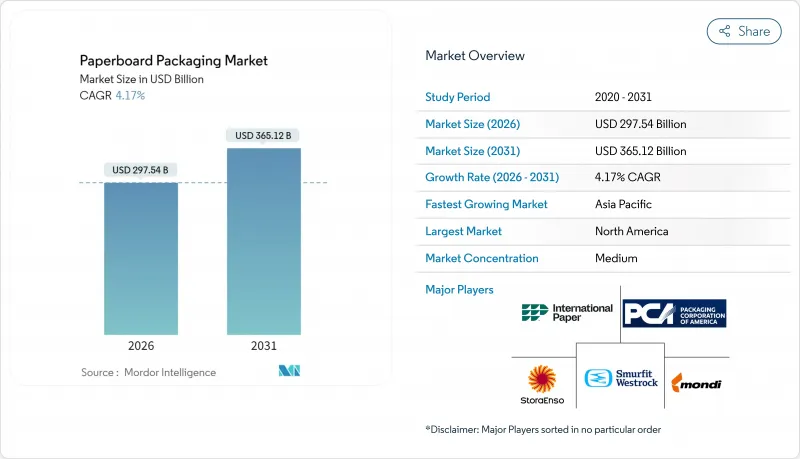
电子商务交易量的成长、监管政策对纤维而非塑胶的偏好,以及轻量化和数位加工技术的不断进步,都在推动市场扩张。再生纤维优异的成本绩效特性,与零售商建构循环供应链的努力相辅相成,即使在原料成本波动的情况下,也能维持市场需求。瓦楞纸包装仍然是物流网络的支柱,而高端消费品行业则越来越多地采用折迭纸盒。为了因应不断上涨的能源成本和再生纸价格的波动,市场参与企业正在低成本林业地区投资垂直整合和纸浆生产能力。
全球纸板包装市场趋势与洞察
电子商务的快速发展推动了对瓦楞纸箱运输的需求。
线上零售的兴起推动了对坚固耐用、尺寸优化且能承受多次搬运的运输包装箱的需求。纸箱製造商透过将高性能瓦楞型材与即时设计工具相结合,实现了订单的激增,这些工具能够根据 SKU 的形状客製化包装设计。美国包装公司 (PCA) 计划在 2025 年初将每吨价格上调 70 美元,这凸显了供需平衡的紧张。直接面向消费者的销售模式进一步强化了外包装品牌展示空间的需求,促使加工商整合高解析度数位印刷模组。智慧标籤技术(包括位置和衝击监测)正被整合到瓦楞纸衬纸中,创造的价值远不止于保护功能。
塑胶替代品法规促进纺织包装业发展
欧盟的《包装及包装废弃物法规》规定,到2030年,包装材料的可回收率必须达到90%,加速从多层塑胶到可回收纤维材料的过渡。北美各州已实施生产者延伸责任制,亚太地区的多个市场也正在製定类似的法规。生产商正积极回应,采用分散阻隔涂层和不含PFAS的耐油化学处理技术,将食品保护与再生纸浆生产相结合。品牌所有者正利用这些解决方案来实现其永续永续性目标,并避免即将征收的塑胶税。
加强对森林砍伐和纤维来源的审查
欧盟反毁林法规的实施要求造纸厂在2020年12月后追溯木材来源,直到获得无毁林认证为止。这增加了审核成本,并使不合规的供应链面临进口禁令。跨国公司正在全球推广类似的通讯协定,实际上实现了合规的全球化。规模较小的加工商面临不成比例的行政负担,因此转向认证池和与人工林主的垂直联盟。为认证原木支付的溢价推高了某些等级原木的损益平衡点,在监管链体系成熟之前,利润空间将被压缩。
细分市场分析
得益于完善的家庭垃圾收集网路和成熟的脱墨技术,预计到2025年,再生纤维将占据纸板包装市场72.10%的份额。受与循环经济目标相关的监管奖励的推动,该细分市场预计将比原生纸板实现6.65%的复合年增长率。随着品牌商强制要求高需求产品达到最低再生材料含量,再生纸板包装市场规模预计将进一步扩大。然而,在对视觉品质和湿强度要求极高的应用领域,例如化妆品礼盒和药品泡壳包装,原生纤维仍将保持其重要性。
对低成本人工林业的持续投资巩固了再生纸的优势。苏扎诺新建的巴西桉树综合设施每年将供应255万吨高白度纸浆,这些纸浆可与回收材料无缝混合,从而降低全球造纸厂的平均原料成本。 FSC和PEFC认证进一步提升了再生纸板的竞争力,使加工商能够添加碳中和声明,从而引起具有环保意识的消费者的共鸣。这种供应保障和品牌优势使再生纤维在纸板包装市场中占据了领先地位。
受全通路零售带来的出货频率激增的推动,到2025年,瓦楞纸箱将占42.10%的收入份额。内建的防潮层和抗压微瓦楞结构使这些纸箱能够以最小的损坏通过自动化分类系统,进一步凸显了其不可或缺性。折迭纸盒儘管产量较低,但由于其高解析度印刷能力与高端食品和个人保健产品的陈列方式相契合,预计将以5.55%的复合年增长率快速增长。此外,由于市场对「货架易取包装」(兼具鲜艳的印刷效果和更高的可回收性)的需求不断增长,折迭纸盒的纸质包装市场预计也将扩大。
在创新方面,Greif 的 EnviroRAP™ 提供了一种单材料包装方案,可取代贴合加工信封,同时保持家庭可回收性。同时,数位瓦楞纸板製造设备的进步使加工商能够以印刷速度列印可变数据,从而支持区域性节日主题和网红合作。这种柔软性使瓦楞纸板解决方案在纸板包装市场中脱颖而出,并保持其作为分销主力产品的领先地位。
区域分析
预计到2025年,北美将占据38.55%的收入份额,这主要得益于一体化的再生纤维网络以及各州层面的塑胶减量政策,这些政策促使加工商转向利用生活垃圾进行回收的解决方案。美国包装公司(Packaging Corporation of America)以18亿美元收购Containerboard,增强了区域产能,并标誌着产业整合的趋势,旨在利用规模经济。零售商的当日配送服务进一步刺激了对合适尺寸瓦楞纸箱的需求,帮助纸板包装市场在能源成本上涨的不利影响下保持了个位数的温和增长。
亚太地区是成长最快的市场,预计到2031年将以6.78%的复合年增长率成长,这主要得益于都市区家庭对包装日用品和快餐的需求增加。中国在出口订单中越来越多地指定使用纺织基运输包装,而越南国内包装产业预计到2026年将创造35亿美元的收入。区域各国政府正在将循环经济条款纳入新的废弃物指令,并为再生纸板进口商提供关税优惠。这些政策措施,加上低成本劳动力和不断扩张的线上零售,使亚太地区成为纸板包装市场的成长引擎。
在欧洲,诸如《包装废弃物指令》(PPWR) 和《欧洲废弃物指令》(EUDR) 等法规正推动材料持续创新,以提高可回收性和采购标准。 Sappi 公司斥资 5 亿欧元(约 5.8773 亿美元)升级设备,提升了其轻质涂布纸的产能;而 Mondi 公司的收购热潮则扩大了其在消费品丛集的折迭纸盒业务版图。高回收率和消费者对环保标籤的认可维持了稳固的基础,但疲软的宏观需求抑制了销售成长。儘管如此,严格的合规要求仍然构成了一定的障碍,有利于纸板包装市场的现有企业。
其他福利:
- Excel格式的市场预测(ME)表
- 分析师支持(3个月)
目录
第一章 引言
- 研究假设和市场定义
- 调查范围
第二章调查方法
第三章执行摘要
第四章 市场情势
- 市场概览
- 市场驱动因素
- 电子商务的快速成长带动了对瓦楞纸箱运输的需求。
- 塑胶替代品法规有利于纺织包装
- 透过轻量化技术降低物流成本
- 亚太地区包装食品和饮料产业快速成长
- 人工智慧驱动的按需客製化印刷
- 拉丁美洲桉树纸浆的繁荣降低了原生纤维的成本。
- 市场限制
- 加强对森林砍伐和纤维来源的审查
- 再生纸价格波动与能源成本
- 品牌所有者背弃永续性承诺
- 柔软性塑胶袋的剪切侵蚀。
- 产业价值链分析
- 波特五力分析
- 供应商的议价能力
- 买方的议价能力
- 新进入者的威胁
- 替代产品和服务的威胁
- 竞争对手之间的竞争
- 宏观经济因素如何影响市场
- 技术展望
- 监管环境
第五章 市场规模与成长预测
- 按原料
- 原生光纤
- 再生纤维
- 依产品类型
- 折迭纸箱
- 瓦楞纸箱
- 硬盒
- 其他产品类型
- 按包装类型
- 初级包装
- 二级包装
- 运输/电子商务配送
- 按最终用户行业划分
- 食物
- 饮料
- 卫生保健
- 个人护理和化妆品
- 家居用品
- 电气和电子设备
- 其他终端用户产业
- 按地区
- 北美洲
- 美国
- 加拿大
- 墨西哥
- 南美洲
- 巴西
- 阿根廷
- 智利
- 南美洲其他地区
- 欧洲
- 英国
- 德国
- 法国
- 西班牙
- 义大利
- 其他欧洲地区
- 亚太地区
- 中国
- 印度
- 日本
- 澳洲
- 韩国
- 越南
- 亚太其他地区
- 中东和非洲
- 中东
- 沙乌地阿拉伯
- 阿拉伯聯合大公国
- 土耳其
- 其他中东地区
- 非洲
- 南非
- 奈及利亚
- 埃及
- 其他非洲地区
- 中东
- 北美洲
第六章 竞争情势
- 市场集中度
- 策略趋势与发展
- 市占率分析
- 公司简介
- International Paper Company
- Smurfit WestRock
- Mondi plc
- Packaging Corporation of America
- Stora Enso Oyj
- Oji Holdings Corporation
- Nippon Paper Industries Co., Ltd.
- Rengo Co., Ltd.
- Metsa Board Oyj
- Graphic Packaging Holding Company
- Cascades Inc.
- Sonoco Products Company
- Nine Dragons Paper(Holdings)Ltd.
- Georgia-Pacific LLC
- Klabin SA
- Sappi Limited
- Mayr-Melnhof Karton AG
- Huhtamaki Oyj
- Visy Industries Holdings Pty Ltd.
- Seaboard Folding Box Company Inc.
- Clearwater Paper Corporation
- ITC Limited
第七章 市场机会与未来展望
The Paperboard Packaging market is expected to grow from USD 285.63 billion in 2025 to USD 297.54 billion in 2026 and is forecast to reach USD 365.12 billion by 2031 at 4.17% CAGR over 2026-2031.
Rising e-commerce volumes, regulatory momentum favoring fiber over plastic, and continuous improvements in lightweighting and digital converting technologies collectively propel expansion. Recycled fiber's strong cost-to-performance profile complements retailer commitments to circular supply chains, sustaining demand despite raw-material cost swings. Corrugated formats remain the backbone of fulfillment networks, while folding cartons gain ground in premium consumer categories. Market participants counter mounting energy and recovered-paper price volatility by investing in vertical integration and pulp capacity in low-cost forestry regions.
Global Paperboard Packaging Market Trends and Insights
E-commerce Surge Boosting Corrugated-Shipping Demand
Online retail penetration requires stronger, dimension-optimized shipping containers that withstand multiple touchpoints. Box producers captured surging orders by pairing high-performance flute profiles with real-time design tools that tailor packaging to SKU geometry. Packaging Corporation of America's USD 70-per-ton price increase in early 2025 illustrated a tight demand-supply balance. Direct-to-consumer models further reinforce the need for branding space on outer packs, incentivizing converters to integrate high-graphics digital print modules. Smart-label technologies supporting location and shock monitoring now ship on corrugated liners, creating value beyond protection.
Plastic-Substitution Regulations Favor Fiber Packaging
The European Union's Packaging and Packaging Waste Regulation mandates 90% recyclability by 2030, accelerating the shift from multilayer plastics toward recyclable fiber formats. North American states replicate extended-producer-responsibility frameworks, while several Asia-Pacific markets draft similar statutes. Producers respond with dispersion-based barrier coatings and PFAS-free grease-proof chemistries that safeguard food while maintaining repulpability. Brand owners leverage these solutions to meet public sustainability pledges and evade upcoming plastic taxes.
Deforestation and Fiber-Sourcing Scrutiny
Implementation of the European Union Deforestation Regulation compels mills to trace wood back to plots verified as deforestation-free after December 2020, adding auditing costs and exposing non-compliant supply chains to import bans. Multinationals extend the same protocols worldwide, effectively globalizing compliance. Smaller converters face disproportionate administrative burdens, nudging them toward certification pooling or vertical partnerships with plantation owners. Premiums paid for certified logs increase the break-even point for certain grades, compressing margins until chain-of-custody systems mature.
Other drivers and restraints analyzed in the detailed report include:
- Light-Weighting Innovations Lowering Logistics Cost
- Rapid Growth of Packaged F&B in Asia-Pacific
- Volatile Recovered-Paper and Energy Costs
For complete list of drivers and restraints, kindly check the Table Of Contents.
Segment Analysis
Recycled fiber secured a 72.10% share of the paperboard packaging market in 2025, underpinned by extensive curbside collection networks and maturing de-inking technologies. This segment is also projected to clock a 6.65% CAGR, outpacing virgin grades due to regulatory credits linked to circularity goals. The paperboard packaging market size for recycled grades is forecast to widen as brand owners mandate minimum post-consumer content for high-volume SKUs. Virgin fiber retains relevance where impeccable visual quality or high wet-strength is mandatory, such as cosmetics gift boxes and pharmaceutical blister cards.
Continuous investments in low-cost plantation forestry bolster recycled leadership. Suzano's new Brazilian eucalyptus complex provides 2.55 million t/year of high-brightness pulp that blends seamlessly with recovered streams, lowering average furnish costs for global mills. Certification through FSC and PEFC further differentiates recycled sheets, enabling converters to add carbon-neutral claims that resonate with eco-conscious consumers. Resulting supply security and branding leverage keep recycled fiber at the forefront of the paperboard packaging market.
Corrugated boxes captured 42.10% revenue share in 2025, propelled by shipment frequency spikes tied to omnichannel retail. Embedded moisture barriers and crush-resistant micro-flutes allow these boxes to traverse automated sortation systems with minimal damage, reinforcing their indispensability. Folding cartons, though smaller in tonnage, promise the fastest 5.55% CAGR, as high-graphics capabilities align with premium food and personal-care placement. The paperboard packaging market size for folding cartons is projected to expand alongside demand for shelf-ready packs that combine vivid print with easier recyclability.
On the innovation front, Greif's EnviroRAP(TM) showcases mono-material wrap formats that replace laminated mailers while retaining curbside recyclability. Parallel progress in digital corrugators lets converters print variable data at press speed, supporting localized holiday themes or influencer collaborations. Such flexibility differentiates corrugated solutions within the paperboard packaging market and sustains their lead as the workhorse of distribution.
The Paperboard Packaging Market Report is Segmented by Raw Material Source (Virgin Fibre, and Recycled Fibre), Product Type (Folding Cartons, Corrugated Boxes, and More), Packaging Format (Primary Packaging, Secondary Packaging, and More), End-User Industry (Food, Beverage, Healthcare, and More), and Geography (North America, South America, and More). The Market Forecasts are Provided in Terms of Value (USD).
Geography Analysis
North America commanded 38.55% revenue share in 2025, buoyed by integrated recovered-fiber networks and state-level plastic-reduction mandates that steer converters toward curbside-recyclable solutions. Packaging Corporation of America's USD 1.8 billion containerboard acquisition bolsters regional capacity, evidencing consolidation that harnesses scale efficiencies. Retailers' same-day delivery services further stimulate demand for right-sized corrugated shippers, helping the paperboard packaging market sustain mid-single-digit growth despite energy-cost headwinds.
Asia-Pacific represents the fastest-expanding arena, clocking a 6.78% CAGR through 2031 as urban households buy more packaged staples and quick-service meals. China's export orders increasingly specify fiber-based transit wraps, while Vietnam's local industry eyes USD 3.5 billion in packaging revenue by 2026. Regional governments embed circular-economy clauses in new waste directives, granting tariff concessions to importers of recycled sheets. These policy levers, coupled with low-cost labor and expanding online retail, turn Asia-Pacific into the growth engine of the paperboard packaging market.
Europe sustains material innovations underpinned by regulations such as the PPWR and the EUDR, which tighten recyclability and sourcing standards. Sappi's EUR 500 million(USD 587.73 million) machine upgrade enhances lightweight coated capacity, while Mondi's acquisition spree widens folding-carton footprints across consumer-goods clusters. High recovery rates and consumer receptiveness to eco-labels maintain a robust baseline, although sluggish macro demand tempers tonnage growth. Still, stringent compliance hurdles create a moat that favors established players inside the paperboard packaging market.
- International Paper Company
- Smurfit WestRock
- Mondi plc
- Packaging Corporation of America
- Stora Enso Oyj
- Oji Holdings Corporation
- Nippon Paper Industries Co., Ltd.
- Rengo Co., Ltd.
- Metsa Board Oyj
- Graphic Packaging Holding Company
- Cascades Inc.
- Sonoco Products Company
- Nine Dragons Paper (Holdings) Ltd.
- Georgia-Pacific LLC
- Klabin S.A.
- Sappi Limited
- Mayr-Melnhof Karton AG
- Huhtamaki Oyj
- Visy Industries Holdings Pty Ltd.
- Seaboard Folding Box Company Inc.
- Clearwater Paper Corporation
- ITC Limited
Additional Benefits:
- The market estimate (ME) sheet in Excel format
- 3 months of analyst support
TABLE OF CONTENTS
1 INTRODUCTION
- 1.1 Study Assumptions and Market Definition
- 1.2 Scope of the Study
2 RESEARCH METHODOLOGY
3 EXECUTIVE SUMMARY
4 MARKET LANDSCAPE
- 4.1 Market Overview
- 4.2 Market Drivers
- 4.2.1 E-commerce surge boosting corrugated-shipping demand
- 4.2.2 Plastic-substitution regulations favor fibre packaging
- 4.2.3 Light-weighting innovations lowering logistics cost
- 4.2.4 Rapid growth of packaged F&B in Asia-Pacific
- 4.2.5 AI-enabled on-demand custom printing
- 4.2.6 LatAm eucalyptus pulp boom lowering virgin-fibre cost
- 4.3 Market Restraints
- 4.3.1 Deforestation and fibre-sourcing scrutiny
- 4.3.2 Volatile recovered-paper and energy costs
- 4.3.3 Brand-owner pull-back on sustainability pledges
- 4.3.4 Flexible plastic pouches eroding share
- 4.4 Industry Value Chain Analysis
- 4.5 Porter's Five Forces Analysis
- 4.5.1 Bargaining Power of Suppliers
- 4.5.2 Bargaining Power of Buyers
- 4.5.3 Threat of New Entrants
- 4.5.4 Threat of Substitute Products and Services
- 4.5.5 Degree of Competitive Rivalry
- 4.6 The Impact of Macroeconomic Factors on the Market
- 4.7 Technological Outlook
- 4.8 Regulatory Landscape
5 MARKET SIZE AND GROWTH FORECASTS (VALUE)
- 5.1 By Raw Material Source
- 5.1.1 Virgin Fibre
- 5.1.2 Recycled Fibre
- 5.2 By Product Type
- 5.2.1 Folding Cartons
- 5.2.2 Corrugated Boxes
- 5.2.3 Rigid Boxes
- 5.2.4 Other Product types
- 5.3 By Packaging Format
- 5.3.1 Primary Packaging
- 5.3.2 Secondary Packaging
- 5.3.3 Transit / E-commerce Shipping
- 5.4 By End-user Industry
- 5.4.1 Food
- 5.4.2 Beverage
- 5.4.3 Healthcare
- 5.4.4 Personal Care and Cosmetics
- 5.4.5 Household Care
- 5.4.6 Electrical and Electronics
- 5.4.7 Other End-user Industries
- 5.5 By Geography
- 5.5.1 North America
- 5.5.1.1 United States
- 5.5.1.2 Canada
- 5.5.1.3 Mexico
- 5.5.2 South America
- 5.5.2.1 Brazil
- 5.5.2.2 Argentina
- 5.5.2.3 Chile
- 5.5.2.4 Rest of South America
- 5.5.3 Europe
- 5.5.3.1 United Kingdom
- 5.5.3.2 Germany
- 5.5.3.3 France
- 5.5.3.4 Spain
- 5.5.3.5 Italy
- 5.5.3.6 Rest of Europe
- 5.5.4 Asia-Pacific
- 5.5.4.1 China
- 5.5.4.2 India
- 5.5.4.3 Japan
- 5.5.4.4 Australia
- 5.5.4.5 South Korea
- 5.5.4.6 Vietnam
- 5.5.4.7 Rest of Asia-Pacific
- 5.5.5 Middle East and Africa
- 5.5.5.1 Middle East
- 5.5.5.1.1 Saudi Arabia
- 5.5.5.1.2 United Arab Emirates
- 5.5.5.1.3 Turkey
- 5.5.5.1.4 Rest of Middle East
- 5.5.5.2 Africa
- 5.5.5.2.1 South Africa
- 5.5.5.2.2 Nigeria
- 5.5.5.2.3 Egypt
- 5.5.5.2.4 Rest of Africa
- 5.5.5.1 Middle East
- 5.5.1 North America
6 COMPETITIVE LANDSCAPE
- 6.1 Market Concentration
- 6.2 Strategic Moves and Developments
- 6.3 Market Share Analysis
- 6.4 Company Profiles (includes Global level Overview, Market level overview, Core Segments, Financials as available, Strategic Information, Market Rank/Share for key companies, Products and Services, and Recent Developments)
- 6.4.1 International Paper Company
- 6.4.2 Smurfit WestRock
- 6.4.3 Mondi plc
- 6.4.4 Packaging Corporation of America
- 6.4.5 Stora Enso Oyj
- 6.4.6 Oji Holdings Corporation
- 6.4.7 Nippon Paper Industries Co., Ltd.
- 6.4.8 Rengo Co., Ltd.
- 6.4.9 Metsa Board Oyj
- 6.4.10 Graphic Packaging Holding Company
- 6.4.11 Cascades Inc.
- 6.4.12 Sonoco Products Company
- 6.4.13 Nine Dragons Paper (Holdings) Ltd.
- 6.4.14 Georgia-Pacific LLC
- 6.4.15 Klabin S.A.
- 6.4.16 Sappi Limited
- 6.4.17 Mayr-Melnhof Karton AG
- 6.4.18 Huhtamaki Oyj
- 6.4.19 Visy Industries Holdings Pty Ltd.
- 6.4.20 Seaboard Folding Box Company Inc.
- 6.4.21 Clearwater Paper Corporation
- 6.4.22 ITC Limited
7 MARKET OPPORTUNITIES AND FUTURE OUTLOOK
- 7.1 White-space and Unmet-need Assessment

 2026年全球纸板包装市场报告
 优质硬纸板包装市场预测至2032年:按产品、材料类型、技术、应用和地区分類的全球分析全球纸板包装市场:预测(至2032年)-按产品类型、等级、包装形式、最终用户和地区分類的分析