


 |
市场调查报告书
商品编码
1907337
聚甲基丙烯酸甲酯(PMMA):市场占有率分析、产业趋势与统计、成长预测(2026-2031)Polymethyl Methacrylate (PMMA) - Market Share Analysis, Industry Trends & Statistics, Growth Forecasts (2026 - 2031) |
||||||

※ 本网页内容可能与最新版本有所差异。详细情况请与我们联繫。
预计到 2026 年,聚甲基丙烯酸甲酯 (PMMA) 市场规模将达到 321 万吨。
这意味着产量将从 2025 年的 306 万吨增加到 2031 年的 408 万吨。预计从 2026 年到 2031 年,产量将继续以 4.90% 的复合年增长率成长。
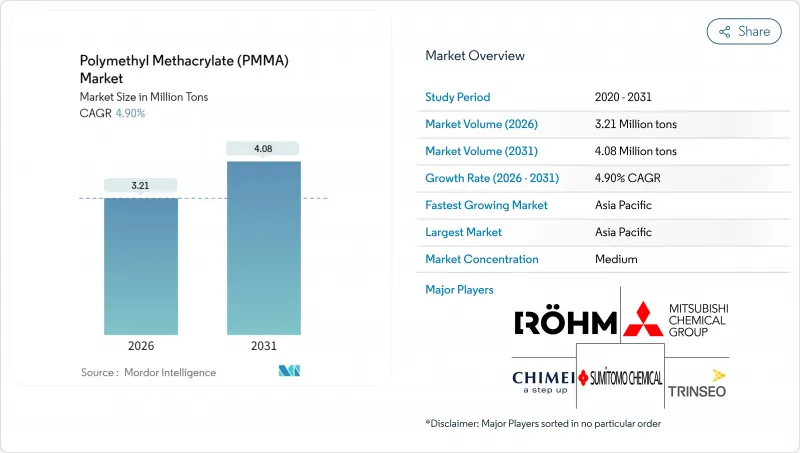
儘管甲基丙烯酸甲酯 (MMA) 原材料成本持续波动,但汽车轻量化、建筑玻璃和 LED 显示器的强劲需求支撑着 PMMA 市场的成长。 PMMA 的光学透明度、紫外线稳定性和易加工性使其在众多竞争聚合物中脱颖而出,并在许多关键应用领域保护了其产能免受替代压力。区域产能过剩(尤其是在中国)使价格保持竞争力,而创新的化学回收先导计画正在为循环生产模式铺平道路。生产商正将垂直整合和特种等级产品的开发作为 PMMA 市场的防御策略。
全球聚甲基丙烯酸甲酯(PMMA)市场趋势与洞察
汽车轻量化和照明需求
电动车製造商指定使用PMMA(聚甲基丙烯酸甲酯)製造全景天窗、尾灯罩和感测器外壳,因为这种聚合物比玻璃轻50%,同时又具有很高的光学品质。向自适应LED系统的技术转型推动了对ROHM光管理等级产品的需求,这些产品能够产生精确的光束模式。此外,自动驾驶汽车的雷射雷达透镜也需要低屈光,这进一步增加了对PMMA的需求。儘管新型抗衝击聚碳酸酯(PC)共聚物不断涌现,但在成本和抗紫外线性能比强度提升幅度更大的领域,PMMA市场依然保持着强劲的韧性。
在建筑嵌装玻璃和建筑幕墙的应用
智慧建筑外观采用内建感测器和加热元件的PMMA板材,可实现自然采光、冷凝管理和自清洁功能。 PMMA的可见光透过率高达92-93%(PC板材为86-89%),符合欧洲建筑标准的节能性能评估要求。 PMMA板材上的数位印刷技术无需使用复合材料即可实现复杂的建筑幕墙设计,从而缩短施工时间。虽然高层计划的消防法规仍限制了PMMA板材的广泛应用,但其长期保固和抗紫外线性能使其在註重透明度和美观性的领域保持竞争力。
MMA原物料价格波动
MMA价格的波动反映了石化原料的价格走势,并因该製程的高能耗特性而加剧。 2025年3月,由于丙烯成本大幅上涨,Trineo将欧洲市场的PMMA价格上调了250欧元/吨,挤压了加工商的利润空间。像欧洲这样依赖进口的地区,在生物基或再生MMA实现商业化普及之前,可能会持续受到影响。拥有后向整合丙酮生产製程的亚洲生产商获得了成本优势,进一步扩大了全球价格差距。
细分市场分析
预计到2025年,片材产品将占PMMA市场份额的38.19%,并在2031年之前以5.36%的复合年增长率增长。这将推动该品类美元收入的成长,并与PMMA整体市场规模保持一致。薄壁挤出生产线具有高机械稳定性,能够满足汽车天窗的负载要求,使汽车製造商能够在不影响安全裕度的前提下减轻重量。浇铸压克力板材因其严格的厚度公差可最大限度地减少光学缺陷,因此在LED侧发光面板领域,尤其是在LED侧发光面板领域,保持着高端地位。
珠粒和颗粒仍是射出成型镜片、电器旋钮和医疗组件的主要原料。衝击改质剂和紫外线吸收剂越来越多地被添加到配方中,提高了户外标誌的耐用性,但同时也牺牲了一些透明度。专为雷射雕刻设计的颗粒正在奖杯和礼品领域开闢新的收入来源。虽然树脂化合物的成长速度不如片材,但它们支援各种快速客製化产品的生产,从而支撑了PMMA市场的稳定需求。
PMMA市场报告按产品类型(片材、珠粒/颗粒、树脂化合物、颗粒剂)、终端用户行业(汽车、建筑、电气电子、航太、工业机械设备及其他)和地区(亚太、北美、欧洲、南美、中东和非洲)进行细分。市场预测以数量(吨)和价值(美元)为单位。
区域分析
预计到2025年,亚太地区将占据PMMA市场50.30%的份额,主要得益于中国庞大的加工基地和印度不断发展的基础设施。然而,中国的产能过剩正挤压利润空间,促使国内製造商转向出口特殊应用产品,并抑制新增产能。印度正投资11亿美元建造一座MMA-PMMA一体化工厂,旨在降低进口依赖度,并在2027年前提升区域市场份额。日本和韩国则立足于电子和光学等高附加价值细分市场,从而减轻了大宗商品价格下跌的影响。
北美市场成熟且盈利丰厚,永续性属性推动了其溢价。 LG化学计画于2025年开始生产生物丙烯酸,这将使北美加工商能够提供含有可再生原料的PMMA产品,用于化妆品包装。航太业的復苏和对电动车的投资支撑了潜在需求,儘管面临进口板材的竞争,但需求仍然强劲。
欧洲正着力发展循环经济,德国和荷兰的化学回收试点计画已获得政策支持,并开始生产符合再生材料含量标准的首批商业产品。然而,由于欧洲PMMA製造商高度依赖进口MMA原料,极易受到能源价格波动导致的成本飙升的影响。儘管规模较小,但南美和中东市场前景广阔,因为大型计划对透明隔音墙和大型标誌的需求旺盛。
其他福利:
- Excel格式的市场预测(ME)表
- 3个月的分析师支持
目录
第一章 引言
- 研究假设和市场定义
- 调查范围
第二章调查方法
第三章执行摘要
第四章 市场情势
- 市场概览
- 市场驱动因素
- 汽车产业的轻量化和照明需求
- 建筑玻璃和建筑幕墙采用
- LED标誌和显示器产业的扩张
- PMMA在医疗和牙科领域的应用日益广泛
- PMMA化学回收经济性取得突破
- 市场限制
- MMA原物料价格波动
- 聚碳酸酯和玻璃替代的威胁
- 严格的一次性塑胶製品法规
- 价值链分析
- 波特五力模型
- 新进入者的威胁
- 供应商的议价能力
- 买方的议价能力
- 替代品的威胁
- 竞争对手之间的竞争
- 进出口趋势
- 价格趋势
- 监管环境
- 终端用户产业趋势
- 航太(航太零件生产收入)
- 汽车(汽车生产)
- 建筑与施工(新增建筑面积)
- 电气电子设备(电气电子设备生产收入)
- 包装(塑胶包装数量)
第五章 市场规模与成长预测
- 按产品形式
- 床单
- 珠子和颗粒
- 树脂化合物和颗粒
- 按最终用户行业划分
- 车
- 建筑/施工
- 电气和电子设备
- 航太
- 工业机械和设备
- 其他终端用户产业
- 按地区
- 亚太地区
- 中国
- 日本
- 印度
- 韩国
- 澳洲
- 马来西亚
- 亚太其他地区
- 北美洲
- 美国
- 加拿大
- 墨西哥
- 欧洲
- 德国
- 法国
- 义大利
- 英国
- 俄罗斯
- 其他欧洲地区
- 南美洲
- 巴西
- 阿根廷
- 南美洲其他地区
- 中东和非洲
- 沙乌地阿拉伯
- 南非
- 阿拉伯聯合大公国
- 奈及利亚
- 其他中东和非洲地区
- 亚太地区
第六章 竞争情势
- 市场集中度
- 策略趋势
- 市占率(%)/排名分析
- 公司简介
- Asahi Kasei Corporation
- CHIMEI
- Kuraray Co., Ltd.
- LOTTE MCC Corp.
- Lucite International Alpha BV
- LX MMA(LX Group)
- Mitsubishi Chemical Corporation
- Rohm GmbH
- Sanors
- Sumitomo Chemical Co., Ltd.
- Suzhou Double Elephant Optical Materials Co., Ltd.
- Trinseo
- Wanhua
第七章 市场机会与未来展望
第八章:执行长面临的关键策略挑战
Polymethyl Methacrylate (PMMA) market size in 2026 is estimated at 3.21 Million tons, growing from 2025 value of 3.06 Million tons with 2031 projections showing 4.08 Million tons, growing at 4.90% CAGR over 2026-2031.
Solid demand from automotive lightweighting, architectural glazing, and LED displays sustains growth even as methyl methacrylate (MMA) feedstock costs remain volatile. PMMA's optical clarity, UV stability, and straightforward processing differentiate it from competing polymers, shielding volumes from substitution pressure in many core uses. Regional overcapacity-especially in China-keeps pricing competitive, while breakthrough chemical-recycling pilots open a pathway to circular production models. Producers prioritize vertical integration and specialty-grade development as defensive strategies in the PMMA market.
Global Polymethyl Methacrylate (PMMA) Market Trends and Insights
Automotive lightweight and lighting demand
Electric-vehicle makers specify PMMA for panoramic sunroofs, tail-lamp covers, and sensor housings because the polymer weighs 50% less than glass yet offers high optical quality. The technology shift toward adaptive LED systems amplifies demand for Rohm's light-management grades that shape precise beam patterns. Additional pull comes from autonomous-vehicle LiDAR lenses requiring low birefringence. Despite new impact-resistant polycarbonate (PC) copolymers, PMMA market resilience persists where cost and UV durability outweigh marginal toughness gains.
Architectural Glazing and Facade Adoption
Smart-building envelopes now integrate PMMA sheets embedded with sensors and heating elements that manage daylight, condensation, and self-cleaning functions. PMMA transmits 92-93% visible light versus 86-89% for PC, supporting energy-efficiency credits under European building codes. Digital printing on PMMA panels enables complex facade designs without multi-material assemblies, reducing installation time. Fire-code restrictions in high-rise projects still cap penetration, yet long-term warranties and UV resistance keep PMMA competitive where clarity and aesthetics dominate.
Volatile MMA Feedstock Pricing
MMA price swings mirror petrochemical feedstock trends, magnified by energy-intensive processes. Trinseo raised European PMMA prices by EUR 250 / t in March 2025 after propylene costs surged, compressing converter margins. Import-dependent regions such as Europe remain exposed until bio-based or recycled MMA scales commercially. Asian producers with back-integrated acetone routes gain cost advantage, exacerbating global price disparities.
Other drivers and restraints analyzed in the detailed report include:
- Expansion of LED Signage & Display Industry
- Growth in Medical & Dental PMMA Use
- Substitution Threat from Polycarbonate and Glass
For complete list of drivers and restraints, kindly check the Table Of Contents.
Segment Analysis
Sheets captured 38.19% of PMMA market share in 2025 and will expand at a 5.36% CAGR through 2031, underpinning USD-denominated sales growth proportionate with the overall PMMA market size for this category. Thinner-gauge extrusion lines now deliver robust mechanical stability that satisfies automotive sunroof load requirements, enabling vehicle makers to shave weight without sacrificing safety margins. Cast-acrylic sheets retain premium positioning-especially in LED edge-lit panels-thanks to tighter thickness tolerances that minimize optical defects.
Beads and pellets follow as the workhorse feedstocks for injection-molded lenses, appliance knobs, and medical parts. Formulators increasingly incorporate impact modifiers and UV absorbers at the compounding stage, trading some transparency for higher durability in outdoor signage. Granules tailored for laser engraving open niche revenue streams in trophy and giftware segments. Although growth lags the sheet category, resin compounds support consistent PMMA market demand by serving a wider span of short-run customized products.
The PMMA Market Report is Segmented by Product Form (Sheets, Beads and Pellets, Resin Compounds and Granules), End-User Industry (Automotive, Building and Construction, Electrical and Electronics, Aerospace, Industrial Machinery and Equipment, and Others), and Geography (Asia-Pacific, North America, Europe, South America, and Middle East and Africa). The Market Forecasts are Provided in Terms of Volume (Tons) and Value (USD).
Geography Analysis
Asia-Pacific accounted for 50.30% of PMMA market share in 2025 on the strength of China's large converter base and India's infrastructure build-out. However, Chinese overcapacity compresses margins, pushing domestic players toward specialty exports and prompting new capacity curtailments. India's commitment of USD 1.1 billion to an integrated MMA-PMMA complex aims to cut import reliance and seize regional share by 2027. Japan and South Korea anchor high-value niches tied to electronics and optics, mitigating price erosion seen in commodity grades.
North America remains a mature but lucrative arena where sustainability attributes command premiums. LG Chem's 2025 bio-acrylic acid launch positions North American converters to offer renewable-content PMMA products in cosmetics packaging. Aerospace recovery and electric-vehicle investments bolster baseline volumes despite imported sheet competition.
Europe focuses on circularity; chemical-recycling pilots in Germany and the Netherlands receive policy support and generate early commercial lots that meet recycled-content quotas. Nevertheless, exposure to imported MMA feedstocks leaves European PMMA producers vulnerable to energy-driven cost spikes. South American and Middle-Eastern markets remain small but promising as infrastructure megaprojects demand transparent noise barriers and large-format signage.
- Asahi Kasei Corporation
- CHIMEI
- Kuraray Co., Ltd.
- LOTTE MCC Corp.
- Lucite International Alpha B.V.
- LX MMA (LX Group)
- Mitsubishi Chemical Corporation
- Rohm GmbH
- Sanors
- Sumitomo Chemical Co., Ltd.
- Suzhou Double Elephant Optical Materials Co., Ltd.
- Trinseo
- Wanhua
Additional Benefits:
- The market estimate (ME) sheet in Excel format
- 3 months of analyst support
TABLE OF CONTENTS
1 Introduction
- 1.1 Study Assumptions and Market Definition
- 1.2 Scope of the Study
2 Research Methodology
3 Executive Summary
4 Market Landscape
- 4.1 Market Overview
- 4.2 Market Drivers
- 4.2.1 Automotive lightweight and lighting demand
- 4.2.2 Architectural glazing and facade adoption
- 4.2.3 Expansion of LED signage and display industry
- 4.2.4 Growth in medical and dental PMMA use
- 4.2.5 Breakthroughs in PMMA chemical-recycling economics
- 4.3 Market Restraints
- 4.3.1 Volatile MMA feedstock pricing
- 4.3.2 Substitution threat from polycarbonate and glass
- 4.3.3 Stringent single-use plastics regulation
- 4.4 Value Chain Analysis
- 4.5 Porter's Five Forces
- 4.5.1 Threat of New Entrants
- 4.5.2 Bargaining Power of Suppliers
- 4.5.3 Bargaining Power of Buyers
- 4.5.4 Threat of Substitutes
- 4.5.5 Competitive Rivalry
- 4.6 Import and Export Trends
- 4.7 Pricing Trends
- 4.8 Regulatory Landscape
- 4.9 End-use Sector Trends
- 4.9.1 Aerospace (Aerospace Component Production Revenue)
- 4.9.2 Automotive (Automobile Production)
- 4.9.3 Building and Construction (New Construction Floor Area)
- 4.9.4 Electrical and Electronics (Electrical and Electronics Production Revenue)
- 4.9.5 Packaging(Plastic Packaging Volume)
5 Market Size and Growth Forecasts (Volume)
- 5.1 By Product Form
- 5.1.1 Sheets
- 5.1.2 Beads and Pellets
- 5.1.3 Resin Compounds and Granules
- 5.2 By End-user Industry
- 5.2.1 Automotive
- 5.2.2 Building and Construction
- 5.2.3 Electrical and Electronics
- 5.2.4 Aerospace
- 5.2.5 Industrial Machinery and Equipment
- 5.2.6 Other End-user Industries
- 5.3 By Geography
- 5.3.1 Asia-Pacific
- 5.3.1.1 China
- 5.3.1.2 Japan
- 5.3.1.3 India
- 5.3.1.4 South Korea
- 5.3.1.5 Australia
- 5.3.1.6 Malaysia
- 5.3.1.7 Rest of Asia-Pacific
- 5.3.2 North America
- 5.3.2.1 United States
- 5.3.2.2 Canada
- 5.3.2.3 Mexico
- 5.3.3 Europe
- 5.3.3.1 Germany
- 5.3.3.2 France
- 5.3.3.3 Italy
- 5.3.3.4 United Kingdom
- 5.3.3.5 Russia
- 5.3.3.6 Rest of Europe
- 5.3.4 South America
- 5.3.4.1 Brazil
- 5.3.4.2 Argentina
- 5.3.4.3 Rest of South America
- 5.3.5 Middle East and Africa
- 5.3.5.1 Saudi Arabia
- 5.3.5.2 South Africa
- 5.3.5.3 United Arab Emirates
- 5.3.5.4 Nigeria
- 5.3.5.5 Rest of Middle East and Africa
- 5.3.1 Asia-Pacific
6 Competitive Landscape
- 6.1 Market Concentration
- 6.2 Strategic Moves
- 6.3 Market Share (%)/Ranking Analysis
- 6.4 Company Profiles (includes Global-level Overview, Market-level Overview, Core Segments, Financials, Strategic Information, Market Rank/Share, Products and Services, Recent Developments)
- 6.4.1 Asahi Kasei Corporation
- 6.4.2 CHIMEI
- 6.4.3 Kuraray Co., Ltd.
- 6.4.4 LOTTE MCC Corp.
- 6.4.5 Lucite International Alpha B.V.
- 6.4.6 LX MMA (LX Group)
- 6.4.7 Mitsubishi Chemical Corporation
- 6.4.8 Rohm GmbH
- 6.4.9 Sanors
- 6.4.10 Sumitomo Chemical Co., Ltd.
- 6.4.11 Suzhou Double Elephant Optical Materials Co., Ltd.
- 6.4.12 Trinseo
- 6.4.13 Wanhua
7 Market Opportunities and Future Outlook
- 7.1 White-space and Unmet-need Assessment
8 Key Strategic Questions for CEOs

 全球聚甲基丙烯酸甲酯微球市场规模、份额、趋势和成长分析报告(2026-2034年)
 2026年全球聚甲基丙烯酸甲酯市场报告
 2026-2030年全球甲基丙烯酸甲酯(MMA)单体市场
 耐热聚甲基丙烯酸甲酯市场按形态、等级、最终用途产业、应用和分销管道划分-全球预测(2026-2032 年)
 聚甲基丙烯酸甲酯(PMMA)市场规模、份额和趋势分析报告:按类型、等级、应用、地区和细分市场预测(2025-2033 年)聚甲基丙烯酸甲酯市场:依生产技术、形态、应用和最终用途产业划分-2025-2032年全球预测
 全球生物基PMMA市场
 聚甲基丙烯酸甲酯(PMMA)产能、产量、供应、需求、价格、市场预测分析(2034年)
 甲基丙烯酸甲酯单体市场报告:趋势、预测与竞争分析(至2031年)
 2025 年至 2033 年聚甲基丙烯酸甲酯市场报告(按形式、等级、最终用途和地区)