


 |
市场调查报告书
商品编码
1907342
诈欺侦测与预防(FDP):市占率分析、产业趋势与统计、成长预测(2026-2031)Fraud Detection And Prevention (FDP) - Market Share Analysis, Industry Trends & Statistics, Growth Forecasts (2026 - 2031) |
||||||

※ 本网页内容可能与最新版本有所差异。详细情况请与我们联繫。
预计到 2026 年,诈欺侦测和预防 (FDP) 市值将达到 701.9 亿美元,从 2025 年的 586.9 亿美元成长到 2031 年的 1,718.4 亿美元。
预计2026年至2031年年复合成长率(CAGR)将达到19.6%。
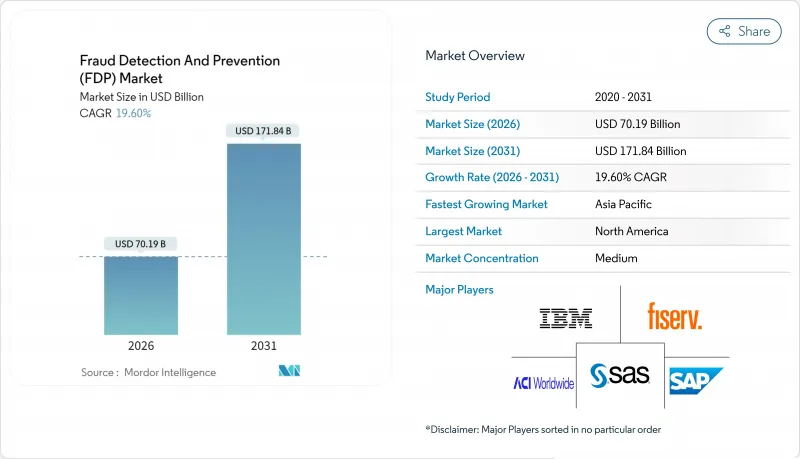
这种快速成长反映了深度造假诈骗、合成身分和其他人工智慧驱动的威胁的激增,而传统的基于规则的引擎无法应对这些威胁,从而推动了对自适应机器学习防御技术的需求。监管倡议,特别是欧盟PSD3和PSR一揽子计画中要求从2026年起实施强客户认证(SCA)的倡议,正在加速技术更新周期,因为银行正寻求即时协调安全性、合规性和客户体验。各国诈欺侦测和预防(FDP)市场的成长受到行动优先支付习惯和监管要求的推动,例如菲律宾的《金融帐户诈骗预防法》,该法案强制要求进行自动化即时监控。供应链诈骗的增加,包括假冒零件诈骗的三位数激增,进一步印证了这样一种观点:企业正在将安全视为一种收入保护工具,而不仅仅是合规成本。
全球诈欺检测与预防 (FDP) 市场趋势与洞察
数位支付和电子商务交易量正在上升
随着行动钱包、QR码和非接触感应卡在支付流程中占据主导地位,攻击面也随之扩大,超越了传统系统的处理能力。因此,对设备指纹和行为生物特征进行即时分析至关重要,以便区分合法客户与机器人和脚本化的刷卡攻击。预计到2023年,电子商务诈骗损失将达到480亿美元,主要驱动因素是非接触式交易(CNP)。这迫使公司转向基于云端的风险引擎,以在毫秒内完成交易评分。零售平台正越来越多地将这些引擎直接嵌入到付款闸道中,以在保持支付速度的同时降低扣回争议帐款风险。随着数位优先的消费者取代实体店客流量,全部区域对支援新型支付方式(例如后付款服务和即时信用额度)的可扩展检测技术的需求正在增长。
严格的监管合规压力
欧盟修订后的第三版支付服务指令 (PSD3) 和支付安全条例 (PSR) 将强客户认证 (SCA) 的范围从双因素认证扩展到强制收款人姓名验证和金融机构间即时诈欺资料共用。随着银行整合分散的产品以降低合规成本,提供单一平台认证、分析和报告服务的供应商正获得竞争优势。跨境贸易的全球化要求美国银行和支付服务供应商(PSP) 在服务欧盟客户时必须符合欧洲 SCA 标准,导致更严格的标准在全球推广。亚太地区也出现了类似的趋势,新加坡和澳洲的监管机构正在将营业执照与受监控的诈欺阈值挂钩。这缩短了合规实施的时间,并迫使即使是最规避风险的金融机构也转向云端基础设施,以便快速更新规则和模型,而无需冗长的变更管理週期。
高误报率会损害客户体验
过于敏感的规则集会将合法消费标记为可疑交易,触发人工审核,从而削弱即时支付的承诺。客户调查显示,连续两笔合法交易被拒绝会使客户在一年内更换银行的可能性增加两倍。现代人工智慧引擎透过分析个人的消费节奏、季节性出行模式和设备偏好来降低噪音,在不牺牲侦测率的前提下,将误报率降低一半。然而,即时支付的普及已将决策时间缩短至几秒,无需人工干预。因此,金融机构在调整风险阈值时更加谨慎,并愿意接受小额交易中的少量诈骗损失,以保障整体转换率和客户满意度。
细分市场分析
解决方案占据了诈欺侦测与预防 (FDP) 市场 63.25% 的份额,这印证了分析引擎、身分验证模组和调查仪表板的基础性作用。供应商正利用自适应机器学习技术不断完善规则库,使金融机构能够每天处理Terabyte的行为数据,并近乎即时地回应新的攻击特征。解决方案收入还包括监管报告模组,这些模组可将侦测资料转换为符合审核要求的格式,使风险负责人无需借助其他工具即可满足 PSD3、GDPR 和 OCC 的审查要求。
儘管服务领域规模较小,但随着董事会越来越多地将全天候监控外包给託管安全专家,该领域正以 20.95% 的复合年增长率快速成长。这些服务提供者提供已调整的模型、精心策划的全球威胁情报来源以及事后取证调查。资料科学和网路安全营运领域的人才短缺,使得基于绩效的合约更具吸引力,因为此类合约能够保证检测率的服务等级协定 (SLA)。同时,咨询解决方案也正在被应用,用于重新设计 KYC 流程、优化警报分级以及简化争议解决流程。预计到 2031 年,这种技术与专业知识的结合将占服务收入的三分之一左右,从而巩固其在更广泛的诈欺侦测和预防 (FDP) 市场中的策略地位。
到2025年,本地部署方案将占总收入的55.35%,大型银行利用其现有基础设施,透过在自有资料中心处理个人识别资讯(PII)来满足资料居住法规的要求。这些公司倾向于采用混合模式,将模型训练迁移到云端,同时将生产评分节点保留在私有丛集,以最大限度地降低延迟。在这种架构下,即使在尖峰时段,诈欺防制处理的延迟也能维持在10毫秒以下。
然而,云端原生平台将以 22.05% 的复合年增长率占据主导地位,并迅速缩小差距。订阅定价模式将授权费用与交易成长挂钩,使中型金融机构和金融科技公司能够避免资本支出。领先的供应商现在提供持续配置工具链,每週多次更新检测模型,从而降低新诈欺的风险。先进的加密技术和保密计算区域解决了剩余的主权问题。 ISO 27001 和 SOC 2 等认证确保了审核的信心。这些优势的综合作用使云端成为未来诈欺侦测和预防 (FDP) 市场的标准基础。
诈欺检测与预防 (FDP) 市场按组件(解决方案、服务)、部署模式(云端、本地部署)、组织规模(中小企业、大型企业)、最终用户行业(银行、金融服务和保险、零售/电子商务、医疗保健等)以及地区进行细分。市场预测以美元 (USD) 为单位。
区域分析
北美将占最大份额,到2025年将占总收入的27.10%。这得益于该地区早期采用云端运算、先进的威胁情报共用以及充足的技术预算。美国财政部等联邦机构在2024财年透过采用人工智慧驱动的异常检测技术,追回了10亿美元的支票诈骗损失,这既是公共部门的概念验证,也鼓励了私部门的进一步采用。同样,美国信用卡网路正在推广基于人工智慧的预核准评分,以减少非接触式支付(CNP)扣回争议帐款,并将诈欺检测逻辑直接嵌入付款基础中。加拿大各银行已组成联合联盟,共同打击新兴的即时支付欺诈,展现了区域间在信号交换方面的合作。
在欧洲,支付服务指示第三版 (PSD3) 和支付服务条例 (PSR) 正在迅速扩展监管范围,包括强制收款人姓名验证和引入即时风险资讯。一般资料保护规则(GDPR) 的限制推动了隐私保护型联邦学习的创新,该技术允许在不传输原始资料的情况下训练银行间模型。新的 eIDAS 修正案要求通讯业者过滤欺骗性电话和恶意短信,将诈骗检测和预防市场扩展到电信基础设施领域。西班牙等国对未实施这些措施的业者处以 200 万欧元(约 235 万美元)的罚款,并将安全要求更深入地纳入其营运许可证中。
亚太地区以19.95%的复合年增长率成为成长最快的地区,这主要得益于行动支付的高普及率和复杂的合规环境,后者迫使供应商提供可配置的策略引擎。菲律宾的《金融帐户诈骗预防法》强制要求金融机构实施规模化的诈骗侦测系统,而印度储备银行则强制要求对UPI即时支付进行基于人工智慧的交易监控。中国当地正在试行将人工智慧应用于福利金的腐败分析,这显示其在金融科技以外的公共资金监控领域也具有应用价值。这些趋势共同推动了亚太地区对灵活、即时解决方案的需求,使亚太地区在全球诈欺侦测和预防(FDP)市场中占据越来越重要的地位。
其他福利:
- Excel格式的市场预测(ME)表
- 3个月的分析师支持
目录
第一章 引言
- 研究假设和市场定义
- 调查范围
第二章调查方法
第三章执行摘要
第四章 市场情势
- 市场概览
- 市场驱动因素
- 数位支付和电子商务交易量增加
- 严格的监管合规压力
- 利用人工智慧/机器学习的分析技术提高了检测精度
- 令牌化和 3-D Secure 2.3 的采用
- 开放银行/即时支付基础设施—新的诈欺风险因素
- 人工智慧驱动的深度造假诈骗日益猖獗
- 市场限制
- 高误报率会损害客户体验
- 与旧有系统整合的复杂性
- 缺乏用于训练人工智慧模型的标记资料集
- 隐私法规下的资料共用限制
- 供应链分析
- 监管环境
- 技术展望
- 波特五力模型
- 供应商的议价能力
- 买方的议价能力
- 新进入者的威胁
- 替代品的威胁
- 竞争对手之间的竞争
- 评估市场中的宏观经济因素
第五章 市场规模与成长预测
- 按组件
- 解决方案
- 诈欺分析
- 认证
- 报告
- 视觉化
- 其他的
- 服务
- 解决方案
- 透过部署模式
- 云
- 本地部署
- 按组织规模
- 小型企业
- 大公司
- 按最终用户行业划分
- BFSI
- 零售与电子商务
- 资讯科技和电信
- 卫生保健
- 能源与公共产业
- 製造业
- 政府和公共部门
- 其他的
- 按地区
- 北美洲
- 美国
- 加拿大
- 墨西哥
- 南美洲
- 巴西
- 阿根廷
- 南美洲其他地区
- 欧洲
- 英国
- 德国
- 法国
- 义大利
- 西班牙
- 其他欧洲地区
- 亚太地区
- 中国
- 日本
- 韩国
- 印度
- 澳洲
- 亚太其他地区
- 中东和非洲
- 中东
- 沙乌地阿拉伯
- 阿拉伯聯合大公国
- 土耳其
- 其他中东地区
- 非洲
- 南非
- 奈及利亚
- 埃及
- 其他非洲地区
- 中东
- 北美洲
第六章 竞争情势
- 市场集中度
- 策略趋势
- 市占率分析
- 公司简介
- SAP SE
- IBM Corporation
- SAS Institute Inc.
- ACI Worldwide Inc.
- Fiserv Inc.
- Experian PLC
- DXC Technology Company
- BAE Systems PLC
- RSA Security LLC(Dell Technologies)
- Oracle Corporation
- NICE Ltd
- Equifax Inc.
- LexisNexis Risk Solutions
- Fair Isaac Corporation(FICO)
- Cybersource Corporation(Visa)
- Global Payments Inc.
- Feedzai SA
- Signifyd Inc.
- Riskified Ltd.
- Kount Inc.
第七章 市场机会与未来展望
Fraud detection and prevention market size in 2026 is estimated at USD 70.19 billion, growing from 2025 value of USD 58.69 billion with 2031 projections showing USD 171.84 billion, growing at 19.6% CAGR over 2026-2031.
This steep trajectory mirrors the surge in deepfake scams, synthetic identities, and other AI-enabled threats that overwhelm legacy rule engines and elevate demand for adaptive machine-learning defenses. Regulatory momentum, notably the European PSD3 and PSR package that tightens Strong Customer Authentication (SCA) from 2026, accelerates technology refresh cycles as banks look to align security, compliance, and customer experience in real time. Fraud detection and prevention market in various countries is fueled by mobile-first payment habits and laws such as the Philippines' Anti-Financial Account Scamming Act that mandates automated, real-time monitoring. Intensifying supply-chain fraud, evidenced by triple-digit spikes in counterfeit component scams, further underscores because organizations now treat security as a revenue-protection lever, not merely a compliance cost.
Global Fraud Detection And Prevention (FDP) Market Trends and Insights
Rising Digital Payments and E-commerce Volumes
Mobile wallets, QR codes, and contactless cards now dominate checkout flows, expanding attack surfaces that legacy systems cannot parse effectively. Real-time analysis of device fingerprinting and behavioral biometrics has therefore become mandatory to distinguish legitimate customers from bots or scripted card-testing attacks.E-commerce fraud losses reached USD 48 billion in 2023, with card-not-present (CNP) transactions as the chief culprit, pushing merchants toward cloud-based risk engines that score transactions in milliseconds. Retail platforms increasingly embed these engines directly in payment gateways to preserve checkout speed while reducing chargeback exposure. As digital-first consumers continue to displace in-store traffic, demand for scalable detection that adapts to novel payment formats-such as buy-now-pay-later and instant-credit lines-intensifies across every major geography.
Stringent Regulatory Compliance Pressures
Europe's PSD3 and PSR overhaul expands SCA beyond two-factor credentials to include mandatory payee name verification and real-time fraud data sharing among financial institutions. Vendors that deliver single platforms covering authentication, analytics, and reporting gain an edge as banks consolidate point products to rein in compliance overhead. The global nature of cross-border commerce compels US banks and PSPs to meet European SCA benchmarks when serving EU clients, effectively exporting stricter standards worldwide. Similar momentum appears in Asia-Pacific, where regulators in Singapore and Australia link operating licences to monitored fraud thresholds. Compliance thus compresses deployment timelines, pushing even risk-averse institutions toward cloud infrastructures that offer rapid rule and model updates without lengthy change-control cycles.
High False-Positive Rates Hurting Customer Experience
Overly sensitive rule sets can tag legitimate spend as suspicious, triggering manual reviews that stall instant-payment expectations. Customer surveys show that two consecutively declined genuine transactions triple the likelihood of switching banks within a year. Modern AI engines reduce noise by profiling individual spending rhythms, seasonal travel patterns, and device preferences, cutting false-positive counts by up to half without sacrificing catch rates. Yet the shift to real-time settlement compresses decision windows to mere seconds, leaving no room for human intervention. Institutions therefore calibrate risk thresholds more carefully, accepting marginally higher fraud loss on low-ticket items to protect overall conversion and satisfaction metrics.
Other drivers and restraints analyzed in the detailed report include:
- AI/ML-Enabled Analytics Improving Detection Accuracy
- Generative-AI Deepfake Fraud Escalation
- Integration Complexity with Legacy Systems
For complete list of drivers and restraints, kindly check the Table Of Contents.
Segment Analysis
Solutions hold 63.25% of the fraud detection and prevention market size, underscoring the foundational role of analytics engines, authentication modules, and investigator dashboards. Vendors refine rule libraries with adaptive machine learning, letting financial institutions ingest terabytes of behavioral data per day and respond to fresh attack signatures in near real time. Solutions revenue also reflects regulatory reporting modules that convert detection data into audit-ready formats, allowing risk officers to satisfy PSD3, GDPR, or OCC exams without separate tooling.
Services, although smaller, are expanding at 20.95% CAGR as boards delegate 24/7 monitoring to managed-security specialists that provide calibrated models, curated global threat feeds, and post-incident forensics. Talent shortages in data science and cyber-ops elevate the appeal of outcome-based contracts that guarantee detection-rate SLAs. In parallel, consulting wraps around solution deployments to re-engineer KYC flows, optimize alert triage, and streamline dispute resolution. This convergence of technology and expertise is expected to lift services to almost one-third of 2031 revenue, reinforcing their strategic position within the broader fraud detection and prevention market.
On-premises installations retained 55.35% of 2025 revenue as tier-one banks leveraged sunk infrastructure and met data-residency statutes by processing PII in their own data centers. These firms favor hybrid patterns that shift model training to the cloud yet keep production scoring nodes in private clusters to minimize latency. Under such architectures, anti-fraud latency remains below 10 milliseconds even at holiday peak volumes.
Cloud-native platforms, however, outpace all others at a 22.05% CAGR and will narrow the share gap rapidly. Subscription pricing aligns license fees with transaction growth, letting mid-tier lenders and fintechs avoid capital outlays. Leading vendors now pre-package continuous deployment toolchains that refresh detection models multiple times per week, shortening exposure windows to novel frauds. Advanced encryption and confidential-compute zones address lingering sovereignty worries, while certifications like ISO 27001 and SOC 2 reassure auditors. These advantages collectively establish cloud as the future default for the fraud detection and prevention market.
Fraud Detection and Prevention Market is Segmented by Component (Solutions, Services), Deployment Mode (Cloud, On-Premises), Organization Size (SMEs, Large Enterprises), End-User Industry (BFSI, Retail and E-Commerce, Healthcare, and More), and by Geography. The Market Forecasts are Provided in Terms of Value (USD).
Geography Analysis
North America generated the largest regional slice at 27.10% of 2025 revenue, supported by early cloud adoption, sophisticated threat intelligence sharing, and sizeable technology budgets. Federal agencies such as the US Treasury recovered USD 1 billion in check fraud during fiscal 2024 after deploying AI-driven anomaly detection, signaling public-sector validation that further stimulates private-sector uptake. US card networks likewise advocate AI-based pre-authorization scoring to curb CNP chargebacks, embedding fraud logic directly in payment rails. Canadian banks collaborate in a joint consortium to combat emerging real-time rail fraud, demonstrating regional co-operation on signals exchange.
Europe follows with rapid regulatory expansion as PSD3 and PSR introduce mandatory payee-name matching and real-time risk feeds. GDPR constraints drive innovation in privacy-preserving federated learning, allowing banks to train cross-bank models without raw-data transfers. Telecom operators must filter spoofed calls and malware SMS under new eIDAS updates, broadening the fraud detection and prevention market into telco infrastructure. Nations such as Spain impose EUR 2 million (USD 2.35 million) fines on carriers that fail to implement these measures, embedding security requirements deep in operational licences.
Asia-Pacific records the fastest 19.95% CAGR, led by high mobile payment penetration and fragmented compliance terrain that forces vendors to offer configurable policy engines. The Philippines' Anti-Financial Account Scamming Act compels fraud systems scaled to institution size, while India's RBI mandates AI-powered transaction monitoring for UPI instant payments. Mainland China pilots AI corruption analytics on welfare distributions, proving applicability beyond fintech into public-fund oversight. Together, these dynamics amplify regional demand for flexible, real-time solutions, elevating APAC's weighting in the global fraud detection and prevention market.
- SAP SE
- IBM Corporation
- SAS Institute Inc.
- ACI Worldwide Inc.
- Fiserv Inc.
- Experian PLC
- DXC Technology Company
- BAE Systems PLC
- RSA Security LLC (Dell Technologies)
- Oracle Corporation
- NICE Ltd
- Equifax Inc.
- LexisNexis Risk Solutions
- Fair Isaac Corporation (FICO)
- Cybersource Corporation (Visa)
- Global Payments Inc.
- Feedzai SA
- Signifyd Inc.
- Riskified Ltd.
- Kount Inc.
Additional Benefits:
- The market estimate (ME) sheet in Excel format
- 3 months of analyst support
TABLE OF CONTENTS
1 INTRODUCTION
- 1.1 Study Assumptions and Market Definition
- 1.2 Scope of the Study
2 RESEARCH METHODOLOGY
3 EXECUTIVE SUMMARY
4 MARKET LANDSCAPE
- 4.1 Market Overview
- 4.2 Market Drivers
- 4.2.1 Rising digital payments and e-commerce volumes
- 4.2.2 Stringent regulatory compliance pressures
- 4.2.3 AI/ML-enabled analytics improving detection accuracy
- 4.2.4 Tokenization and 3-D Secure 2.3 boosting adoption
- 4.2.5 Open Banking/instant-payment rails - new fraud vectors
- 4.2.6 Generative-AI deepfake fraud escalation
- 4.3 Market Restraints
- 4.3.1 High false-positive rates hurting CX
- 4.3.2 Integration complexity with legacy systems
- 4.3.3 Lack of labelled data sets for AI model training
- 4.3.4 Data-sharing limits under privacy regulations
- 4.4 Supply-Chain Analysis
- 4.5 Regulatory Landscape
- 4.6 Technological Outlook
- 4.7 Porter's Five Forces
- 4.7.1 Bargaining Power of Suppliers
- 4.7.2 Bargaining Power of Buyers
- 4.7.3 Threat of New Entrants
- 4.7.4 Threat of Substitutes
- 4.7.5 Intensity of Competitive Rivalry
- 4.8 Assesment of Macroeconomic Factors on the market
5 MARKET SIZE AND GROWTH FORECASTS (VALUE)
- 5.1 By Component
- 5.1.1 Solutions
- 5.1.1.1 Fraud Analytics
- 5.1.1.2 Authentication
- 5.1.1.3 Reporting
- 5.1.1.4 Visualization
- 5.1.1.5 Others
- 5.1.2 Services
- 5.1.1 Solutions
- 5.2 By Deployment Mode
- 5.2.1 Cloud
- 5.2.2 On-premises
- 5.3 By Organization Size
- 5.3.1 Small and Medium Enterprises
- 5.3.2 Large Enterprises
- 5.4 By End-user Industry
- 5.4.1 BFSI
- 5.4.2 Retail and E-commerce
- 5.4.3 IT and Telecom
- 5.4.4 Healthcare
- 5.4.5 Energy and Utilities
- 5.4.6 Manufacturing
- 5.4.7 Government and Public Sector
- 5.4.8 Others
- 5.5 By Geography
- 5.5.1 North America
- 5.5.1.1 United States
- 5.5.1.2 Canada
- 5.5.1.3 Mexico
- 5.5.2 South America
- 5.5.2.1 Brazil
- 5.5.2.2 Argentina
- 5.5.2.3 Rest of South America
- 5.5.3 Europe
- 5.5.3.1 United Kingdom
- 5.5.3.2 Germany
- 5.5.3.3 France
- 5.5.3.4 Italy
- 5.5.3.5 Spain
- 5.5.3.6 Rest of Europe
- 5.5.4 Asia-Pacific
- 5.5.4.1 China
- 5.5.4.2 Japan
- 5.5.4.3 South Korea
- 5.5.4.4 India
- 5.5.4.5 Australia
- 5.5.4.6 Rest of Asia-Pacific
- 5.5.5 Middle East and Africa
- 5.5.5.1 Middle East
- 5.5.5.1.1 Saudi Arabia
- 5.5.5.1.2 United Arab Emirates
- 5.5.5.1.3 Turkey
- 5.5.5.1.4 Rest of Middle East
- 5.5.5.2 Africa
- 5.5.5.2.1 South Africa
- 5.5.5.2.2 Nigeria
- 5.5.5.2.3 Egypt
- 5.5.5.2.4 Rest of Africa
- 5.5.5.1 Middle East
- 5.5.1 North America
6 COMPETITIVE LANDSCAPE
- 6.1 Market Concentration
- 6.2 Strategic Moves
- 6.3 Market Share Analysis
- 6.4 Company Profiles (includes Global level Overview, Market level overview, Core Segments, Financials as available, Strategic Information, Market Rank/Share for key companies, Products and Services, and Recent Developments)
- 6.4.1 SAP SE
- 6.4.2 IBM Corporation
- 6.4.3 SAS Institute Inc.
- 6.4.4 ACI Worldwide Inc.
- 6.4.5 Fiserv Inc.
- 6.4.6 Experian PLC
- 6.4.7 DXC Technology Company
- 6.4.8 BAE Systems PLC
- 6.4.9 RSA Security LLC (Dell Technologies)
- 6.4.10 Oracle Corporation
- 6.4.11 NICE Ltd
- 6.4.12 Equifax Inc.
- 6.4.13 LexisNexis Risk Solutions
- 6.4.14 Fair Isaac Corporation (FICO)
- 6.4.15 Cybersource Corporation (Visa)
- 6.4.16 Global Payments Inc.
- 6.4.17 Feedzai SA
- 6.4.18 Signifyd Inc.
- 6.4.19 Riskified Ltd.
- 6.4.20 Kount Inc.
7 MARKET OPPORTUNITIES AND FUTURE OUTLOOK
- 7.1 White-space and Unmet-need Assessment

 诈欺侦测与预防市场:2026-2032年全球市场预测(依组件、部署模式、技术、组织规模及最终用途划分)
 2026年全球诈骗侦测与预防市场报告2026年全球智慧人工智慧(AI)诈骗侦测与预防市场报告
 客户转型过程中的诈欺侦测与预防:人为安全
 诈欺侦测与预防市场分析及预测(至 2035 年):按类型、产品类型、服务、技术、组件、应用、部署类型、最终用户和解决方案划分诈欺侦测与预防市场规模、份额、成长率及全球产业分析:按类型、应用和地区分類的洞察,2026-2034 年预测
 诈骗侦测与预防市场 - 全球产业规模、份额、趋势、机会及预测(按组件、解决方案、应用、产业垂直领域、地区和竞争格局划分,2021-2031年)
 日本诈欺侦测与预防市场报告(按组件、应用、组织规模、垂直行业和地区划分,2026-2034 年)
 全球诈骗侦测与预防市场:预测至 2032 年-按组件、部署方式、组织规模、诈欺类型、最终用户和地区进行分析全球诈欺侦测与预防,2025-2030 年