


 |
市场调查报告书
商品编码
1910468
冷媒:市场占有率分析、产业趋势与统计、成长预测(2026-2031)Refrigerants - Market Share Analysis, Industry Trends & Statistics, Growth Forecasts (2026 - 2031) |
||||||

※ 本网页内容可能与最新版本有所差异。详细情况请与我们联繫。
预计冷媒市场将从 2025 年的 209 万吨增长到 2026 年的 217 万吨,预计到 2031 年将达到 259 万吨,2026 年至 2031 年的复合年增长率为 3.66%。
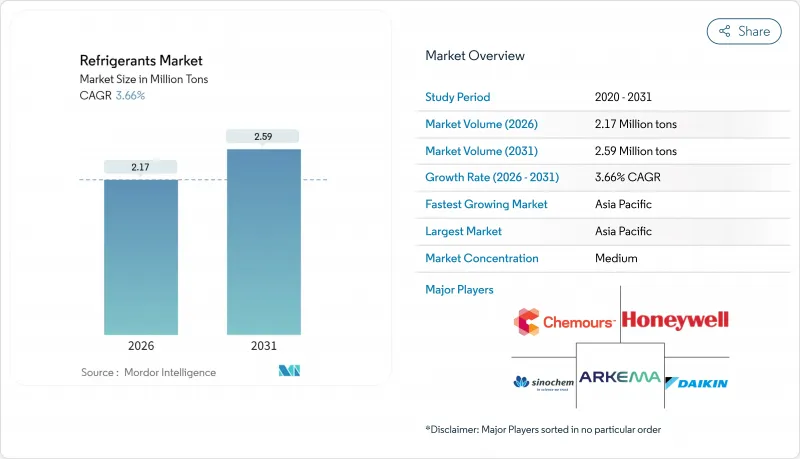
推动冷媒市场成长的关键因素包括:低全球暖化潜势(GWP)配方的加速普及、氢氟碳化合物(HFCs)的强制淘汰,以及冷冻、运输和低温运输物流领域对温度控管日益增长的需求。监管产品替代、电动车中热泵的整合以及多温区医药物流的扩张,都在扩大冷媒市场的机会,同时也加速了对天然冷媒和氢氟烯烃(HFO)替代品的需求。同时,原物料成本的波动以及配额导致的供应瓶颈加剧了价格波动,迫使製造商优化产能并调整产品系列。中游经销商正与领先的化学企业建立策略采购合作伙伴关係,以确保在区域监管过渡期限之前获得符合规定的分子。同时,下游设备製造商正在快速重新设计其係统,以符合A2L和A3分类标准。预计这些协同效应将推动冷媒市场在2030年之前保持个位数的温和成长。
全球冷媒市场趋势与洞察
新兴亚洲地区对室内空调和汽车空调的需求不断增长
快速的都市化正推动住宅冷冻设备进入二、三线城市的千家万户,同时,汽车产业正从内燃机平台转型为电动驱动系统。预计到2030年,中国热泵的年出货量将达到5,000万台,而印度家用空调的普及率仍低于10%,显示市场存在巨大的潜在需求。日本修订的《氟碳化合物法》和韩国的能源效率管理计画对全球暖化潜值(GWP)设定了上限,从而推动了丙烷、R-32和特定HFO混合物的采购。区域汽车製造商正在将R-1234yf作为车厢和电池迴路应用的标准冷媒,加速了亚太全部区域的分子转型。住宅的普及以及电动车的推广,将在预测期内推动冷媒市场实现最大的绝对吨位成长。
电动车的温度控管要求
电动车 (EV) 电池化学体系对工作温度范围的要求很高,以确保电池寿命和充电速度。 R-1234yf 冷媒在美国95% 的新型轻型车辆中使用,目前全球已有 2.2 亿辆汽车安装了该冷媒。同时,改装套件正被应用于现有车辆,以 R-1234yf 取代 R-134a。整合车厢供暖和电池冷却功能的热泵架构在量产车领域日益普及,推动了针对 -30°C 至 +45°C 效率曲线优化的 A2L 混合冷媒的消费。压缩机製造商透过机壳设计和变频器调校,将涡旋噪音降低了 6 分贝,这对于高阶电动车车型而言是一项关键指标。这些协同效应将推动冷媒在行动出行应用领域的潜在市场在 2020 年代中期持续成长。
严格在全球逐步淘汰氢氟碳化合物(《基加利协议》、欧盟氟碳化合物法规)
欧盟第2024/573号法规将氢氟碳化合物(HFC)配额从2025年基准值的60%降至2036年的15%,目标是在2050年之前完全淘汰。基加利修正案中类似的生产冻结措施将同时给所有生产商带来压力,导致供应紧张,并推高冷媒市场的现货价格。新系统的安装商将被要求在容量超过500吨二氧化碳当量(tCO2e)的系统上使用自动洩漏检测设备,这将增加合规预算,并将资金从销售成长转移到其他方面。这种不确定性将延缓大型安装专案的决策週期,使过渡期中期的预期复合年增长率(CAGR)下降约2个百分点。
细分市场分析
到2025年,碳氢化合物将占据冷媒市场49.02%的份额,这主要得益于其不受多项氟碳化合物监管规定的约束以及具有优势的拥有成本。市场领导报告称,住宅热泵和商用即插即用型空调机组的出货量实现了两位数的成长,而R-290分离式空调机组在全球采用MEPS修正案的地区正加速部署。氢氟烯烃将以9.86%的复合年增长率成为成长最快的冷媒,这主要得益于汽车和固定式空调产业的新应用,这两个产业即将禁止使用全球暖化潜势(GWP)超过750的冷媒。这两个低GWP冷媒细分市场将共同抵消氟碳冷媒吨位的下降,从而支撑整个冷媒市场的成长。
在下游市场,氨和二氧化碳等无机製冷剂在大型食品加工厂和超级市场的应用持续成长。为了提高效率,工程师们正在采用低压级二氧化碳与高压级合成冷媒结合的系统,近期针对不同级联组合的性能係数(COP)对比测试证实了这一优势。虽然资料中心浸没式冷却和製药冷冻库正在成为二氧化碳冷媒的成长领域,但氨冷媒在仓库冷库中仍然占据着稳固的地位。天然冷媒的排碳权计画进一步增强了其商业价值,推动市场份额持续从传统的氢氟碳化合物(HFC)冷媒转移到天然冷媒。
此冷媒市场报告按类型(氟碳化合物、无机化合物、碳氢化合物、其他)、应用(製冷、空调、其他)、终端用户行业(住宅和商业建筑、食品和饮料加工、製药和医疗保健、汽车和电动汽车、其他)以及地区(亚太地区、北美、欧洲、南美、中东和非洲)进行分析。
区域分析
亚太地区预计到2025年将占据全球冷媒市场50.10%的份额,这反映了该地区庞大的製造业基础、不断上升的都市区气温以及有利的政策框架。由于国内需求的成长,中国室内空调出口量不断增加,并透过其垂直整合的供应链确保了R-32和R-290冷媒的批量供应。印度针对白色家电的生产关联激励计画(PLI)包含对低全球暖化潜值(GWP)冷媒研发的津贴,加速了本地零件生态系统的建构。日本和韩国在A2L混合冷媒的先进材料开发方面处于领先地位,全部区域输出配方技术。东南亚国家也纷纷效仿,投资低温运输基础设施,进一步巩固在主导地位。
北美正处于平衡发展阶段,美国《AMIM法案》逐步实施氢氟碳化合物(HFC)消费量上限,同时推动暖通空调维修中氢氟烯烃(HFO)需求快速成长。科慕公司(Chemours)2025年第一季Option销售量成长40%,主要得益于其位于科珀斯克里斯蒂工厂的产能提升。加拿大的碳定价机制进一步推动食品零售业的设备规格向天然冷媒倾斜,而墨西哥的工业区则在过渡性全球暖化潜值(GWP)上限的限制下,要求製程冷却使用含氟冷媒。
欧洲正处于最严格的法律规范之下。 2024 年 F-Gas 法规的配额和生态设计规则正推动原始设备製造商 (OEM) 大规模采用 R-290 热泵,德国和法国的补贴计划也为此提供了支持。高温优化包装的普及使得超临界二氧化碳冷媒成为超级市场的标配,即使在气候温暖的地区也是如此。欧洲各地的冷媒市场前景趋于一致,英国在遵守欧盟时间表的同时,也维持自己的配额制度。
整个南美洲以及中东和非洲的新兴地区构成了冷媒市场的长尾部分。淘汰计画的延迟将继续推动氢氟碳化合物(HFC)的需求,但人均製冷需求的成长将为未来引进週期基础。多边开发银行专案正在透过结合低温运输物流和农业生产力提升的专案来弥补基础设施方面的不足。
其他福利:
- Excel格式的市场预测(ME)表
- 3个月的分析师支持
目录
第一章 引言
- 研究假设和市场定义
- 调查范围
第二章调查方法
第三章执行摘要
第四章 市场情势
- 市场概览
- 市场驱动因素
- 亚洲新兴地区对室内空调和汽车空调的需求量大
- 扩大冷藏仓库和第三方物流低温运输站点
- 电动汽车温度控管要求
- 用于mRNA疫苗的超低温冷冻库
- 天然冷媒排碳权货币化
- 市场限制
- 更严格的全球氢氟碳化合物淘汰计画(《基加利议定书》、欧盟氟碳化合物法规)
- A3/A2L 易燃气体的初始成本高且处理风险大
- 下一代HFO分子的价格波动迅速。
- 价值链分析
- 监管环境
- 波特五力模型
- 供应商的议价能力
- 买方的议价能力
- 新进入者的威胁
- 替代品的威胁
- 竞争对手之间的竞争
第五章 市场规模与成长预测
- 按类型
- 氟化合物
- 氟烃塑胶(HCFCs)
- 氢氟碳化合物(HFCs)
- 无机化学品
- 氨
- 二氧化碳
- 其他无机化合物
- 碳氢化合物
- 异丁烷
- 丙烷
- 其他碳氢化合物
- 其他类型(氢氟烯烃(HFO))
- 氟化合物
- 透过使用
- 冷冻
- 国内的
- 商业的
- 运输
- 产业
- 空调
- 固定/软体包类型
- 冷却器
- 移动的
- 其他用途
- 冷冻
- 按最终用户行业划分
- 住宅及商业建筑
- 食品/饮料加工
- 製药和医疗保健
- 汽车和电动旅行
- 化工/石油化工
- 其他行业
- 按地区
- 亚太地区
- 中国
- 印度
- 日本
- 韩国
- 东南亚国协
- 亚太其他地区
- 北美洲
- 美国
- 加拿大
- 墨西哥
- 欧洲
- 德国
- 法国
- 英国
- 义大利
- 俄罗斯
- 其他欧洲地区
- 南美洲
- 巴西
- 阿根廷
- 其他南美洲
- 中东和非洲
- 沙乌地阿拉伯
- 南非
- 其他中东和非洲地区
- 亚太地区
第六章 竞争情势
- 市场集中度
- 策略趋势
- 市占率/排名分析
- 公司简介
- A-Gas International Ltd
- AGC Inc.
- Arkema
- Brothers Gas
- Daikin Industries, Ltd.
- Dongyue Group
- Gulfcryo.
- Harp International Ltd
- Honeywell International Inc
- Linde PLC
- Messer SE & Co. KGaA
- Navin Fluorine International Ltd
- Orbia
- Shandong Yuean Chemical Industry Co., Ltd
- Sinochem Holdings Corporation Ltd
- SRF Limited
- The Chemours Company
- Zhejiang Juhua Co. Ltd.
第七章 市场机会与未来展望
The Refrigerants market is expected to grow from 2.09 million tons in 2025 to 2.17 million tons in 2026 and is forecast to reach 2.59 million tons by 2031 at 3.66% CAGR over 2026-2031.
The core growth engines are the accelerated adoption of low-global-warming-potential (GWP) formulations, mandatory phase-downs of hydrofluorocarbons (HFCs), and expanding thermal-management needs across cooling, transport, and cold-chain logistics. Regulation-driven product substitutions, electrified-vehicle heat-pump integration, and multi-temperature pharmaceutical logistics expand the refrigerant market opportunity while intensifying demand for natural and hydrofluoro-olefin (HFO) alternatives. At the same time, raw-material cost swings and quota-induced supply bottlenecks keep price volatility high, prompting manufacturers to optimize capacity footprints and portfolio mixes. Midstream distributors are forming strategic sourcing alliances with chemical majors to secure compliant molecules ahead of regional cut-off dates, while downstream equipment makers fast-track system redesigns compatible with A2L and A3 classifications. These converging forces collectively reinforce a medium-single-digit growth trajectory for the refrigerant market through 2030.
Global Refrigerants Market Trends and Insights
High Demand for Room and Car Air-Conditioners in Emerging Asia
Rapid urbanization is pushing residential cooling deeper into tier-2 and tier-3 city households while the automotive sector simultaneously swaps internal-combustion platforms for electric drivetrains. China's heat-pump shipments are projected to hit 50 million units annually by 2030, and India's household air-conditioner penetration remains under 10%, underscoring significant latent demand. Japan's revised F-Gas Law and South Korea's efficiency management program impose GWP ceilings that funnel procurement toward propane, R-32, and shortlisted HFO blends. Vehicle OEMs in the region are standardizing R-1234yf for cabin and battery loops, accelerating molecule transition volumes throughout Asia-Pacific. Together, residential uptake and e-mobility adoption underpin the largest absolute tonnage additions in the refrigerant market during the forecast window.
Electrified-Vehicle Thermal-Management Requirements
Electric vehicle (EV) battery chemistries demand narrow temperature windows for longevity and charging speed. R-1234yf enjoys 95% penetration in new U.S. light-duty vehicles, with 220 million cars worldwide now equipped, while legacy fleets adopt retrofit kits that swap out R-134a for the same molecule. Heat-pump architectures unifying cabin heating and battery cooling are spreading into mass-market segments, spurring consumption of blended A2L fluids optimized for -30 °C to +45 °C efficiency curves. Compressor suppliers have cut scroll noise by 6 dBA through housing and inverter tuning, a key specification for premium EV models. The aggregate effect widens the addressable refrigerant market for mobility applications through mid-decade.
Stringent Global HFC Phase-Down (Kigali, EU F-Gas)
EU Regulation 2024/573 cuts HFC quotas from 60% of baseline levels in 2025 to 15% in 2036, with full phase-out targeted by 2050. Similar freezes under the Kigali Amendment pressure all producers simultaneously, tightening supply and elevating spot prices across the refrigerant market. Operators installing new systems must adopt automated leak detection above 500 tCO2e capacity, raising compliance budgets and reallocating capital away from volume growth. The resulting uncertainty slows decision cycles for large installations, shaving nearly two percentage points from projected CAGR during mid-transition years.
Other drivers and restraints analyzed in the detailed report include:
- Ultralow-Temperature Freezers for mRNA-Type Vaccines
- Carbon-Credit Monetization for Natural Refrigerants
- High First-Cost and Handling Risk of Flammable A3/A2L Gases
For complete list of drivers and restraints, kindly check the Table Of Contents.
Segment Analysis
Hydrocarbons commanded 49.02% refrigerant market share in 2025 on the back of exemption status under multiple F-Gas schedules and compelling cost-of-ownership economics. Market leaders report double-digit shipment growth into residential heat-pumps and plug-in commercial cabinets, while global roll-outs of R-290 split units accelerate in regions adopting MEPS revisions. Hydrofluoro-olefins are delivering the fastest 9.86% CAGR, propelled by automotive and stationary HVAC debuts where regulatory cut-off dates for GWP greater than 750 fluids are imminent. Collectively, these two low-GWP segments offset contracting fluorocarbon tonnage, anchoring overall refrigerant market growth.
Downstream, the refrigerant market size for inorganic options such as ammonia and CO2 continues to expand in large food-processing plants and big-box supermarkets. Engineers pair CO2 in low-stage loops with synthetic high-stage fluids for efficiency gains, an architecture validated by recent COP comparisons across cascade permutations. Data-center immersion cooling and pharma freezers add pocket growth for CO2, while ammonia remains entrenched in warehouse chillers. Natural-refrigerant carbon-credit programs further sweeten the business case, ensuring sustained share migration away from legacy HFCs.
The Refrigerants Market Report is Segmented by Type (Fluorocarbons, Inorganics, Hydrocarbons, Other Types), Application (Refrigeration, Air-Conditioning, Other Applications), End-User Industry (Residential and Commercial Buildings, Food and Beverage Processing, Pharmaceuticals and Healthcare, Automotive and E-Mobility, and More), and Geography (Asia-Pacific, North America, Europe, South America, Middle-East and Africa).
Geography Analysis
Asia-Pacific's 50.10% refrigerant market share in 2025 reflects the region's outsized manufacturing base, urban temperature spikes, and supportive policy frameworks. China's room-air-conditioner exports grow with domestic uptake, locking in bulk R-32 and R-290 flows through vertically integrated supply chains. India's Production Linked Incentive (PLI) scheme for white goods includes grants for low-GWP refrigerant R&D, expediting local component ecosystems. Japan and South Korea anchor advanced-material development for A2L blends, exporting formulation know-how across the region. Southeast Asian economies follow with cold-chain infrastructure funding, reinforcing Asia-Pacific's reinforced leadership of the refrigerant market.
North America tracks a balanced path as the U.S. AIM Act mandates an HFC consumption-cap glide path while simultaneously turbo-charging demand for HFOs in HVAC retrofits. Chemours logged a 40% surge in Opteon sales during Q1 2025, enabled by its Corpus Christi capacity expansion. Canada's carbon-pricing architecture further skews equipment specifications toward natural refrigerants in food retail, whereas Mexico's industrial corridor demands process-cooling fluorocarbons under transitional GWP ceilings.
Europe navigates the tightest regulatory straitjacket. F-Gas 2024 quotas and eco-design rules push OEMs to deploy R-290 heat-pumps at scale, supported by German and French subsidy pools. Transcritical CO2 has become the default supermarket specification even in southern climates thanks to high-ambient optimization packages. The United Kingdom maintains an independent quota system but mirrors EU timelines, keeping the refrigerant market outlook convergent across the continent.
Emerging regions across South America and Middle East & Africa constitute the long-tail of the refrigerant market. Delayed phase-down schedules prolong HFC demand, yet rising per-capita cooling expectations seed future low-GWP adoption cycles. Infrastructure gaps are being addressed through multilateral development-bank programs that bundle cold-chain logistics with agricultural productivity mandates.
- A-Gas International Ltd
- AGC Inc.
- Arkema
- Brothers Gas
- Daikin Industries, Ltd.
- Dongyue Group
- Gulfcryo.
- Harp International Ltd
- Honeywell International Inc
- Linde PLC
- Messer SE & Co. KGaA
- Navin Fluorine International Ltd
- Orbia
- Shandong Yuean Chemical Industry Co., Ltd
- Sinochem Holdings Corporation Ltd
- SRF Limited
- The Chemours Company
- Zhejiang Juhua Co. Ltd.
Additional Benefits:
- The market estimate (ME) sheet in Excel format
- 3 months of analyst support
TABLE OF CONTENTS
1 Introduction
- 1.1 Study Assumptions and Market Definition
- 1.2 Scope of the Study
2 Research Methodology
3 Executive Summary
4 Market Landscape
- 4.1 Market Overview
- 4.2 Market Drivers
- 4.2.1 High demand for room and car air-conditioners in emerging Asia
- 4.2.2 Expansion of refrigerated warehousing and 3PL cold-chain nodes
- 4.2.3 Electrified-vehicle thermal-management requirements
- 4.2.4 Ultralow-temperature freezers for mRNA-type vaccines
- 4.2.5 Carbon-credit monetisation for natural refrigerants
- 4.3 Market Restraints
- 4.3.1 Stringent global HFC phase-down (Kigali, EU F-Gas)
- 4.3.2 High first-cost and handling risk of flammable A3/A2L gases
- 4.3.3 Boom-bust price swings for next-gen HFO molecules
- 4.4 Value Chain Analysis
- 4.5 Regulatory Landscape
- 4.6 Porter's Five Forces
- 4.6.1 Bargaining Power of Suppliers
- 4.6.2 Bargaining Power of Buyers
- 4.6.3 Threat of New Entrants
- 4.6.4 Threat of Substitutes
- 4.6.5 Competitive Rivalry
5 Market Size and Growth Forecasts (Volume)
- 5.1 By Type
- 5.1.1 Fluorocarbons
- 5.1.1.1 Hydrochlorofluorocarbons (HCFC)
- 5.1.1.2 Hydrofluorocarbons (HFC)
- 5.1.2 Inorganics
- 5.1.2.1 Ammonia
- 5.1.2.2 Carbon Dioxide
- 5.1.2.3 Other Inorganics
- 5.1.3 Hydrocarbons
- 5.1.3.1 Isobutane
- 5.1.3.2 Propane
- 5.1.3.3 Other Hydrocarbons
- 5.1.4 Other Types (Hydrofluoro-olefins (HFO))
- 5.1.1 Fluorocarbons
- 5.2 By Application
- 5.2.1 Refrigeration
- 5.2.1.1 Domestic
- 5.2.1.2 Commercial
- 5.2.1.3 Transportation
- 5.2.1.4 Industrial
- 5.2.2 Air-Conditioning
- 5.2.2.1 Stationary Room/Packaged
- 5.2.2.2 Chillers
- 5.2.2.3 Mobile
- 5.2.3 Other Applications
- 5.2.1 Refrigeration
- 5.3 By End-user Industry
- 5.3.1 Residential and Commercial Buildings
- 5.3.2 Food and Beverage Processing
- 5.3.3 Pharmaceuticals and Healthcare
- 5.3.4 Automotive and e-Mobility
- 5.3.5 Chemicals and Petrochemicals
- 5.3.6 Other Industries
- 5.4 By Geography
- 5.4.1 Asia-Pacific
- 5.4.1.1 China
- 5.4.1.2 India
- 5.4.1.3 Japan
- 5.4.1.4 South Korea
- 5.4.1.5 ASEAN Countries
- 5.4.1.6 Rest of Asia-Pacific
- 5.4.2 North America
- 5.4.2.1 United States
- 5.4.2.2 Canada
- 5.4.2.3 Mexico
- 5.4.3 Europe
- 5.4.3.1 Germany
- 5.4.3.2 France
- 5.4.3.3 United Kingdom
- 5.4.3.4 Italy
- 5.4.3.5 Russia
- 5.4.3.6 Rest of Europe
- 5.4.4 South America
- 5.4.4.1 Brazil
- 5.4.4.2 Argentina
- 5.4.4.3 Rest of South America
- 5.4.5 Middle-East and Africa
- 5.4.5.1 Saudi Arabia
- 5.4.5.2 South Africa
- 5.4.5.3 Rest of Middle-East and Africa
- 5.4.1 Asia-Pacific
6 Competitive Landscape
- 6.1 Market Concentration
- 6.2 Strategic Moves
- 6.3 Market Share**/Ranking Analysis
- 6.4 Company Profiles (includes Global level Overview, Market level overview, Core Segments, Financials as available, Strategic Information, Market Rank/Share for key companies, Products and Services, and Recent Developments)
- 6.4.1 A-Gas International Ltd
- 6.4.2 AGC Inc.
- 6.4.3 Arkema
- 6.4.4 Brothers Gas
- 6.4.5 Daikin Industries, Ltd.
- 6.4.6 Dongyue Group
- 6.4.7 Gulfcryo.
- 6.4.8 Harp International Ltd
- 6.4.9 Honeywell International Inc
- 6.4.10 Linde PLC
- 6.4.11 Messer SE & Co. KGaA
- 6.4.12 Navin Fluorine International Ltd
- 6.4.13 Orbia
- 6.4.14 Shandong Yuean Chemical Industry Co., Ltd
- 6.4.15 Sinochem Holdings Corporation Ltd
- 6.4.16 SRF Limited
- 6.4.17 The Chemours Company
- 6.4.18 Zhejiang Juhua Co. Ltd.
7 Market Opportunities and Future Outlook
- 7.1 White-space and Unmet-Need Assessment

 低全球暖化潜势浸没式冷却液市场:依最终用户、产品类型、成分、安装类型、黏度等级及应用划分,2026-2032年全球预测
 R402b冷媒市场规模、份额和成长分析:按冷媒类型、产品配方、应用、终端用户产业、分销通路、地区和产业预测划分,2026-2033年
 氟碳冷媒市场规模、份额和成长分析:按冷媒类型、配方类型、应用、终端用户产业、分销通路、地区和产业预测划分,2026-2033年
 2026年全球冷媒市场报告HFC-152a冷媒市场依纯度等级、形态、装置容量、应用、终端用户产业及通路划分-2026-2032年全球预测HFO-1234yf市场按产品类型、应用和最终用途产业划分,全球预测,2026-2032年R-1234yf冷媒市场依产品类型、应用、销售管道及最终用户划分,全球预测,2026-2032年零臭氧消耗潜值和低全球暖化潜值冷媒市场按产品类型、应用、终端用户产业和销售管道- 全球预测(2026-2032 年)
 冷媒市场规模、份额和趋势分析报告:按产品、应用、地区和细分市场预测(2026-2033 年)
 日本冷媒市场报告(按产品类型(氟碳化合物、无机化合物、碳氢化合物及其他)、应用(商业、工业、家庭及其他)和地区划分,2026-2034)