


 |
市场调查报告书
商品编码
1910472
聚天冬胺酸涂料:市场占有率分析、产业趋势与统计、成长预测(2026-2031)Polyaspartic Coatings - Market Share Analysis, Industry Trends & Statistics, Growth Forecasts (2026 - 2031) |
||||||

※ 本网页内容可能与最新版本有所差异。详细情况请与我们联繫。
2025年聚天门冬胺酸树脂涂料市场价值为3.8128亿美元,预计到2031年将达到5.1614亿美元,高于2026年的4.0103亿美元。
预计在预测期(2026-2031 年)内,复合年增长率将达到 5.18%。
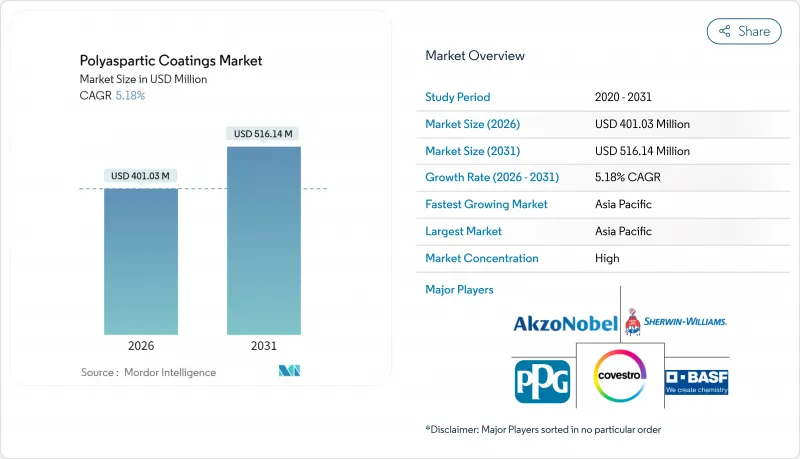
随着建筑商、製造商和资产所有者寻求能够减少停机时间、满足更严格的空气品质法规并延长使用寿命的快速固化、低VOC(挥发性有机化合物)系统,市场需求正在增长。地板承包商依靠这项技术来实现当日復一日復工,以缓解技术纯熟劳工短缺的问题;基础设施所有者也指定使用该技术,以最大限度地减少平台和坡道上的交通中断。水性化学品正在缩小与溶剂型系统的性能差距,并被更迅速地采用,以简化法规遵循流程。亚洲引领全球,占全球消费量的45%,这主要得益于中国和印度的大规模建设以及缩短敏捷计划前置作业时间的区域供应链。
全球聚天门冬胺酸涂料市场趋势及洞察
欧洲绿建筑认证正逐渐成为强制性要求
欧洲新的脱碳法规限制了建材中挥发性有机化合物(VOC)的含量,并鼓励使用符合BREEAM、DGNB和欧盟生态标籤计画的低排放涂料。能够证明其排放符合ISO标准的聚天冬胺酸酯涂料生产商具有竞争优势。开发商正将认证作为一项行销资产,并可获得更高的租金。弗劳恩霍夫WKI等实验室提供第三方检测服务,缩短了认证时间。由此带来的需求成长导致水性涂料和生物基涂料的订单增加,促使配方商加快在欧洲工厂扩大生产规模。为了保护市场份额,跨国公司正在用更环保的化学配方重新包装现有的溶剂型产品线,而区域性专业製造商则与树脂製造商合作推出喷涂套件。
建筑和建设产业的需求快速成长
由于聚天门冬胺酸树脂地板材料的安装时间比环氧树脂地板缩短一到两天,建筑商纷纷采用这种地板材料,使得固定施工团队每年能够完成更多面积的施工。在高人流量的零售和物流中心,业主们实现了15年以上的使用寿命,儘管初始材料成本高出30%至50%,但长期维修成本却得以降低。劳动力短缺也加速了聚天冬胺酸树脂地板的普及:一日安装系统解放了宝贵的施工人员,使他们能够更快地投入使用。建筑公司正在将聚天冬胺酸面涂层融入装饰性混凝土设计中,以兼顾美观和耐久性,从而拓展了聚天冬胺酸树脂地板的应用范围,从仓库、购物中心到体育场馆大厅,无所不包。
与替代方案相比高成本
纯聚天门冬胺酸酯涂料比同类环氧树脂产品贵30-50%,这限制了其在价格敏感的住宅领域的广泛应用。这种价格差异反映了其昂贵的胺酯原料和严格的加工公差。由于缺乏生命週期成本模型,施工人员往往会选择价格更低、使用寿命较短的系统。为了应对这一问题,供应商开发了采用丙烯酸和聚氨酯树脂配製的混合产品系列,在保持快速固化和抗紫外线性能的同时,将标价降低了15-20%,从而为随着经验的积累逐步过渡到纯聚天冬氨酸酯涂料铺平了道路。
细分市场分析
到2025年,溶剂型涂料将占总销售额的54.40%,但随着监管机构降低VOC(挥发性有机化合物)含量上限,水性涂料预计将以5.78%的复合年增长率增长,在所有技术类别中增速最高。水性分散剂,例如路博润的Solsperse W60,能够提高颜料稳定性,并实现以往只有溶剂型载体才能达到的色彩均匀性。製造商也正在采用生物基胺类物质来减少碳足迹。亚洲的市政绿建筑标准正在采纳欧洲的VOC法规,即使在没有联邦法规的经济体中,其应用也正在加速发展。大型建设公司看重聚天冬胺酸涂料易于水处理和低气味的特性,这降低了运作中现场的污染控製成本,使其成为医院和学校的首选解决方案。
持续的树脂研究正在缩小水性涂料和溶剂型涂料系统在机械性能方面的差距。与传统的溶剂型製程相比,科思创的INSQIN聚氨酯涂料可减少95%的製程用水量和45%的二氧化碳排放。这些优势使涂料供应商除了专注于固化速度和硬度之外,还能推广与环境相关的关键效能指标。因此,聚天门冬胺酸涂料市场正呈现出日益细分的趋势:入门级水性混合型产品适用于对成本敏感的室内应用;中檔通用型体系适用于商业地板材料;而高端水性纯级产品则适用于建筑幕墙应用。
到2025年,纯配方产品将占销售额的69.20%,而混合型系统预计将以6.14%的复合年增长率增长,因为施工人员正在寻求性能和价格之间的平衡。例如,Advanced Polymer Coatings公司的TriFLEX DTM产品,结合了聚氨酯的柔软性和聚天冬胺酸的抗紫外线性能,可直接涂覆于金属表面,并具有耐盐雾和抗褪色的特性。混合型产品通常具有更长的开放时间,便于在温暖气候下进行大面积施工,从而解决了纯配方产品凝胶过快的常见问题。
第二波混合涂料浪潮将聚天门冬胺酸酯和聚硅氧烷混合,以提高排气烟囱和海洋结构的耐热性。材料科学家正利用寡聚物设计来客製化固化曲线,从而可以使用标准的无气喷涂泵而非多成分设备,扩大了施工范围。混合涂料每加仑可降低两位数百分比的原料成本,使聚天冬胺酸酯涂料成为环氧树脂涂料的升级之选,让买家能够轻鬆过渡到高端产品类别,而无需承受价格衝击。
聚天冬氨酸涂料市场报告按技术(溶剂型、水性、粉末型、UV固化型)、类型(纯聚天冬氨酸涂料、混合聚天冬氨酸涂料)、应用(地板材料、防水/蒸汽屏障等)、最终用户行业(建筑/施工、船舶、基础设施等)和地区(亚太地区、北美、欧洲、南美、中东/非洲)进行细分。
区域分析
预计到2025年,亚太地区将占全球收入的44.70%,并在2031年之前以6.48%的复合年增长率增长,这主要得益于特大城市在交通运输、数据中心和智慧製造群的投资。中国从新建设转向维修工程的趋势,持续推动了对快速固化甲板维修的需求。同时,印度的智慧城市计画正将公共资金投入人行天桥和地铁站的建设中,并指定使用低维护涂料。印尼和越南正在崛起为第二大成长中心,这得益于混合涂料本地供应的扩大,从而降低了对进口的依赖。
北美市场的发展主要受仓库自动化、冷藏储存能力扩张以及2022年通过的1.2兆美元联邦基础设施计画的推动。桥樑业主正利用该涂料可在夜间施工并即时恢復通行的优势,最大限度地减少车道封闭;各州交通部门也正将其纳入资产维护指南。商业地产业主计划在夜间进行地面重新涂漆,以避免业务中断,从而即使在新建项目放缓的情况下也能维持售后市场需求。承包商认证计画的高普及率也推动了聚天冬胺酸涂料市场在加拿大和美国的扩张。
在欧洲,严格的空气品质法规和成熟的绿建筑认证系统为水性涂料的普及应用奠定了坚实的基础。在德国,工业地面维修巩固了当地市场;而在斯堪地那维亚,聚天冬氨酸膜被用于木结构建筑,以延长其在严酷的冻融气候下的维护週期。在南欧,人们正在试验将聚天冬胺酸黏合剂与红外线反射颜料结合的冷屋顶配方,以降低建筑能耗。在东欧国家,欧盟凝聚基金支持了快速固化过渡涂料的研发,以缩短紧张的施工週期,从而推动了市场渗透。
其他福利:
- Excel格式的市场预测(ME)表
- 3个月的分析师支持
目录
第一章 引言
- 研究假设和市场定义
- 调查范围
第二章调查方法
第三章执行摘要
第四章 市场情势
- 市场概览
- 市场驱动因素
- 欧洲强制性绿建筑认证加速了低VOC聚天门冬胺酸系统的采用。
- 建筑和建设产业的需求快速成长
- 新兴经济体基础建设的扩张
- 与传统涂料相比,性能更优
- 市场限制
- 与替代方案相比高成本
- 亚太地区原物料价格波动
- 新兴市场认知度低
- 价值链分析
- 监理展望
- 波特五力模型
- 供应商的议价能力
- 买方的议价能力
- 新进入者的威胁
- 替代品的威胁
- 竞争对手之间的竞争
第五章 市场规模与成长预测
- 透过技术
- 溶剂型
- 水溶液
- 粉末
- 紫外线固化
- 按类型
- 纯聚天门冬胺酸树脂涂层
- 混合聚天门冬胺酸树脂
- 透过使用
- 地板材料
- 防水防潮
- 防腐蚀面漆
- 按最终用途行业划分
- 建筑/施工
- 船
- 基础设施
- 发电
- 其他终端用户产业
- 按地区
- 亚太地区
- 中国
- 印度
- 日本
- 韩国
- 澳洲
- 纽西兰
- 亚太其他地区
- 北美洲
- 美国
- 加拿大
- 墨西哥
- 欧洲
- 德国
- 英国
- 义大利
- 法国
- 北欧国家
- 其他欧洲地区
- 南美洲
- 巴西
- 阿根廷
- 其他南美洲
- 中东和非洲
- 沙乌地阿拉伯
- 阿拉伯聯合大公国
- 南非
- 奈及利亚
- 其他中东和非洲地区
- 亚太地区
第六章 竞争情势
- 市场集中度
- 策略趋势
- 市占率分析
- 公司简介
- ADVACOAT
- Akzo Nobel NV
- BASF SE
- Carboline Company
- Citadel Floors
- Covestro AG
- Crown Polymers
- Duraamen Engineered Products Inc.
- Enviro Epoxy Products Inc.
- Flexmar Polyaspartics
- Hempel A/S
- Henkel AG & Co. KGaA
- Iron Man Coatings
- LATICRETE International Inc.
- Polyval Coatings Inc.
- PPG Industries Inc.
- RPM International Inc.
- Sika AG
- The Sherwin-Williams Company
- The VersaFlex Companies
第七章 市场机会与未来展望
The Polyaspartic Coatings Market was valued at USD 381.28 million in 2025 and estimated to grow from USD 401.03 million in 2026 to reach USD 516.14 million by 2031, at a CAGR of 5.18% during the forecast period (2026-2031).
Demand is expanding as builders, manufacturers, and asset owners search for fast-curing, low-VOC systems that reduce downtime, meet tightening air-quality rules, and prolong service life. Flooring contractors rely on the technology's one-day return-to-service to mitigate skilled-labor shortages, while infrastructure owners specify it to limit traffic closures on decks and ramps. Water-borne chemistries are narrowing the performance gap with solvent-borne systems and are scaling faster because they simplify regulatory compliance. Asia leads global consumption with a 45% share, propelled by high-volume construction in China and India and by regional supply chains that shorten lead times for fast-moving projects.
Global Polyaspartic Coatings Market Trends and Insights
Green-Building Certification Mandates in Europe
Europe's new decarbonization rules cap VOC content in construction products and reward low-emission coatings within BREEAM, DGNB, and EU Ecolabel schemes. Polyaspartic suppliers that document ISO-compliant emissions secure specification advantages because developers use certifications as marketing assets to command rent premiums. Laboratories such as Fraunhofer WKI provide third-party testing, shortening time to proof. The resulting pull-through boosts orders for water-borne and bio-content grades, prompting formulators to accelerate scale-up at European plants. Multinationals re-label existing solvent-based lines with greener chemistries to defend share, while regional specialists partner with resin producers to launch ready-to-spray kits.
Rapidly Increasing Demand from Building and Construction Industry
Builders embrace polyaspartic flooring because it cuts project schedules by one to two days over epoxy, enabling contractors to complete more square footage annually with fixed crews. Owners gain 15-plus-year service life in heavy-traffic retail and logistics centers, reducing lifetime maintenance costs even when initial material prices run 30-50% higher. Labor scarcity intensifies adoption: single-day systems free scarce applicators for the next job sooner. Architectural firms integrate polyaspartic topcoats into decorative concrete designs to meet both aesthetic and durability targets, expanding use cases from warehouses to shopping malls and stadium concourses.
High Cost Compared to Alternatives
Pure polyaspartic coatings cost 30-50% more than comparable epoxy, constraining penetration in price-sensitive housing segments. The premium reflects higher amine ester feedstock prices and tighter processing tolerances. Contractors without lifecycle-cost models default to cheaper systems despite shorter service life. Suppliers answer with hybrid lines that blend acrylic or polyurethane resins to shave 15-20% off list prices while retaining fast cure and UV resistance, planting a migration path toward pure grades as experience deepens.
Other drivers and restraints analyzed in the detailed report include:
- Rising Infrastructure Development in Emerging Economies
- Superior Performance over Traditional Coatings
- Feedstock Price Volatility in Asia-Pacific
For complete list of drivers and restraints, kindly check the Table Of Contents.
Segment Analysis
Solvent-borne grades held a 54.40% revenue share in 2025; however, water-borne products are forecast to register a 5.78% CAGR, the highest among technology categories, as regulators impose lower VOC ceilings. Water-based dispersants such as Lubrizol's Solsperse W60 improve pigment stability, delivering color consistency once achievable only with solvent carriers. Producers also introduce bio-content amines to cut carbon footprints. In Asia, municipal green-building codes adopt European VOC limits, accelerating specification even in economies without federal mandates. Large contractors appreciate water clean-up and lower odor, which reduces containment costs on occupied sites, turning the polyaspartic coatings market into a preferred solution in hospitals and schools.
Continuous resin research has narrowed mechanical-property gaps between water-borne and solvent-borne systems. Covestro's INSQIN polyurethane reduces process-water use by 95% and CO2 emissions by 45% compared with legacy solvent routes. These gains enable coating suppliers to promote environmental key-performance indicators alongside cure speed and hardness. As a result, the polyaspartic coatings market sees tiered product ladders: entry water-borne hybrids for cost-sensitive interiors, mid-tier universal systems for commercial flooring, and premium exterior water-borne pure grades for facade cladding.
Pure formulations generated 69.20% of 2025 sales, yet hybrid systems are projected to grow at 6.14% CAGR as applicators seek balanced performance and price. Products such as Advanced Polymer Coatings' TriFLEX DTM merge polyurethane flexibility with polyaspartic UV durability to create a direct-to-metal coating that withstands salt spray and color fade. Hybrids often lengthen open time to ease large-area application in warm climates, resolving a common complaint about rapid pure-grade gel.
A second hybrid wave blends polyaspartic with polysiloxane to improve heat resistance in flue-gas stacks and offshore structures. Material scientists leverage oligomer design to tune cure profiles, enabling use of standard airless pumps instead of plural-component rigs, thus broadening contractor acceptance. Because hybrids cut raw-material cost per gallon by double-digit percentages, the polyaspartic coatings industry positions them as step-up options from epoxy, easing buyers into the premium category without sticker shock.
The Polyaspartic Coatings Market Report is Segmented by Technology (Solvent-Borne, Water-Borne, Powder, and UV-Cured), Type (Pure Polyaspartic Coatings and Hybrid Polyaspartic), Application (Flooring, Waterproofing and Moisture-Barrier, and More), End-User Industry (Building and Construction, Marine, Infrastructure, and More), and Geography (Asia-Pacific, North America, Europe, South America, and Middle East and Africa).
Geography Analysis
Asia-Pacific generated 44.70% of global revenue in 2025 and is tracking a 6.48% CAGR through 2031 as megacities invest in transit, data centers, and smart manufacturing clusters. China's shift to renovation over greenfield builds sustains demand for rapid-cure deck refurbishment, while India's Smart Cities Mission channels public funds into pedestrian bridges and metro stations that specify low-maintenance coatings. Indonesia and Vietnam emerge as second-tier hotspots, aided by local suppliers scaling blended hybrids that lower import dependence.
North America's value is driven by warehouse automation, expansions in cold-storage capacity, and the USD 1.2 trillion federal infrastructure program enacted in 2022. Bridge owners exploit the chemistry's overnight return-to-service to minimize lane closures; state departments of transportation incorporate it into asset-management guidelines. Commercial real-estate owners schedule overnight floor recoats to sidestep business interruptions, which sustains aftermarket demand even during new-build slowdowns. High adoption of contractor certification programs accelerates the polyaspartic coatings market across Canada and the United States.
Europe's stringent air-quality statutes and mature green-building certification ecosystem create a stable platform for water-borne adoption. Germany anchors regional volume through industrial floor upgrades, while Scandinavia deploys polyaspartic membranes on timber structures to lengthen maintenance cycles in harsh freeze-thaw climates. Southern Europe experiments with cool-roof formulations that combine polyaspartic binders with infrared-reflective pigments to curb building energy use. Eastern European countries, encouraged by EU cohesion funds, specify rapid-cure bridge coatings to compress tight construction seasons, bolstering market penetration.
- ADVACOAT
- Akzo Nobel N.V.
- BASF SE
- Carboline Company
- Citadel Floors
- Covestro AG
- Crown Polymers
- Duraamen Engineered Products Inc.
- Enviro Epoxy Products Inc.
- Flexmar Polyaspartics
- Hempel A/S
- Henkel AG & Co. KGaA
- Iron Man Coatings
- LATICRETE International Inc.
- Polyval Coatings Inc.
- PPG Industries Inc.
- RPM International Inc.
- Sika AG
- The Sherwin-Williams Company
- The VersaFlex Companies
Additional Benefits:
- The market estimate (ME) sheet in Excel format
- 3 months of analyst support
TABLE OF CONTENTS
1 Introduction
- 1.1 Study Assumptions and Market Definition
- 1.2 Scope of the Study
2 Research Methodology
3 Executive Summary
4 Market Landscape
- 4.1 Market Overview
- 4.2 Market Drivers
- 4.2.1 Green-Building Certification Mandates in Europe Accelerating Adoption of Low-VOC Polyaspartic Systems
- 4.2.2 Rapidly Increasing Demand from the Building and Construction Industry
- 4.2.3 Rising Infrastructure Development in Emerging Economies
- 4.2.4 Superior Performance over Traditional Coatings
- 4.3 Market Restraints
- 4.3.1 High Cost Compared to Alternatives
- 4.3.2 Feedstock Price Volatility in Asia-Pacific
- 4.3.3 Limited Awareness in Developing Markets
- 4.4 Value Chain Analysis
- 4.5 Regulatory Outlook
- 4.6 Porter's Five Forces
- 4.6.1 Bargaining Power of Suppliers
- 4.6.2 Bargaining Power of Buyers
- 4.6.3 Threat of New Entrants
- 4.6.4 Threat of Substitutes
- 4.6.5 Competitive Rivalry
5 Market Size and Growth Forecasts (Value)
- 5.1 By Technology
- 5.1.1 Solvent-borne
- 5.1.2 Water-borne
- 5.1.3 Powder
- 5.1.4 UV-Cured
- 5.2 By Type
- 5.2.1 Pure Polyaspartic Coatings
- 5.2.2 Hybrid Polyaspartic
- 5.3 By Application
- 5.3.1 Flooring
- 5.3.2 Waterproofing and Moisture-Barrier
- 5.3.3 Anti-Corrosive Top-Coat
- 5.4 By End-Use Industry
- 5.4.1 Building and Construction
- 5.4.2 Marine
- 5.4.3 Infrastructure
- 5.4.4 Power Generation
- 5.4.5 Other End-user Industries
- 5.5 By Geography
- 5.5.1 Asia-Pacific
- 5.5.1.1 China
- 5.5.1.2 India
- 5.5.1.3 Japan
- 5.5.1.4 South Korea
- 5.5.1.5 Australia
- 5.5.1.6 New Zealand
- 5.5.1.7 Rest of Asia-Pacific
- 5.5.2 North America
- 5.5.2.1 United States
- 5.5.2.2 Canada
- 5.5.2.3 Mexico
- 5.5.3 Europe
- 5.5.3.1 Germany
- 5.5.3.2 United Kingdom
- 5.5.3.3 Italy
- 5.5.3.4 France
- 5.5.3.5 Nordics
- 5.5.3.6 Rest of Europe
- 5.5.4 South America
- 5.5.4.1 Brazil
- 5.5.4.2 Argentina
- 5.5.4.3 Rest of South America
- 5.5.5 Middle East and Africa
- 5.5.5.1 Saudi Arabia
- 5.5.5.2 United Arab Emirates
- 5.5.5.3 South Africa
- 5.5.5.4 Nigeria
- 5.5.5.5 Rest of Middle east and Africa
- 5.5.1 Asia-Pacific
6 Competitive Landscape
- 6.1 Market Concentration
- 6.2 Strategic Moves
- 6.3 Market Share Analysis
- 6.4 Company Profiles (includes Global Level Overview, Market Level Overview, Core Segments, Financials as available, Strategic Information, Market Rank/Share, Products and Services, Recent Developments)
- 6.4.1 ADVACOAT
- 6.4.2 Akzo Nobel N.V.
- 6.4.3 BASF SE
- 6.4.4 Carboline Company
- 6.4.5 Citadel Floors
- 6.4.6 Covestro AG
- 6.4.7 Crown Polymers
- 6.4.8 Duraamen Engineered Products Inc.
- 6.4.9 Enviro Epoxy Products Inc.
- 6.4.10 Flexmar Polyaspartics
- 6.4.11 Hempel A/S
- 6.4.12 Henkel AG & Co. KGaA
- 6.4.13 Iron Man Coatings
- 6.4.14 LATICRETE International Inc.
- 6.4.15 Polyval Coatings Inc.
- 6.4.16 PPG Industries Inc.
- 6.4.17 RPM International Inc.
- 6.4.18 Sika AG
- 6.4.19 The Sherwin-Williams Company
- 6.4.20 The VersaFlex Companies
7 Market Opportunities and Future Outlook
- 7.1 Increasing Demand for Bio-based Products
- 7.2 White-space and Unmet-need Assessment

 聚天冬胺酸涂料市场:2026-2032年全球市场预测(依产品类型、功能、基材、应用方法、最终用途产业及销售管道)
 聚天冬胺酸涂料市场规模、份额及成长分析(依技术、类型、应用、终端用户产业及地区划分)-2026-2033年产业预测