


 |
市场调查报告书
商品编码
1910483
塑合板:市场占有率分析、产业趋势与统计、成长预测(2026-2031)Particle Board - Market Share Analysis, Industry Trends & Statistics, Growth Forecasts (2026 - 2031) |
||||||

※ 本网页内容可能与最新版本有所差异。详细情况请与我们联繫。
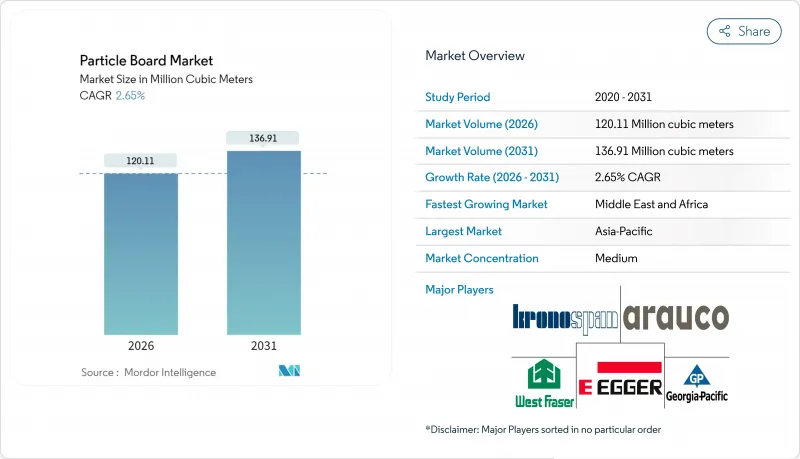
2025 年塑合板市场价值为 1.1702 亿立方米,预计到 2031 年将达到 1.3691 亿立方米,高于 2026 年的 1.2011 亿立方米,在预测期(2026-2031 年)内以 2.65% 的复合年增长率增长。
这种扩张速度固然印证了产业的成熟度,但也凸显了一个策略转折点。这些转折点包括原料多元化,转向农业残余物;全球排放法规日益严格;以及技术主导生产商与产能驱动型竞争对手之间日益扩大的绩效差距。为了因应北美和欧盟更严格的甲醛法规,产业领导企业正在投资低排放树脂系统、稳定的原料供应和製程自动化,以保障利润率。组装家具需求的成长、都市区中产阶级消费的增加以及新兴市场持续的基础设施投资,共同支撑着销售在竞争日益激烈的价格环境下持续成长。同时,製糖产业的脱碳进程正在释放甘蔗渣作为供应来源的潜力,使製造商能够对冲木纤维风险并提升其永续性形象。这些因素正日益影响建筑材料采购商和家具原始设备製造商的采购决策。
全球塑合板市场趋势与洞察
全球组装和RTA家具产量快速成长
组装家具需要可预测的基材厚度和密度,而塑合板在大规模生产中始终能满足这些规格要求。跨国零售商对板材要求进行标准化,以简化全球采购流程,从而使生产规模受区域住宅週期的影响较小,并更符合家具更换需求——家具的周转率率高于传统实木家具。均匀的密度有助于精确计算重量,提高货柜装载率,并将物流成本降低高达 20%。 RTA(即装即用)组装工厂的自动化钻孔和紧固设备进一步巩固了塑合板作为主要基材的地位,因为其结构能够承受反覆加工而不会造成明显的工具磨损。全球采购团队越来越多地透过谈判达成长期供应协议,以确保获得符合 CARB 2 或 EPA TSCA Title VI 认证的合格板材。这为受监管的製造商提供了更清晰的需求预测,使他们能够更有信心地投资产能扩张。
亚洲二、三线城市的快速都市化推动了价格适中的住宅用品需求。
印度、越南、印尼和菲律宾的二线城市丛集正吸引来自农村的移民,从而催生了对经济实惠的室内家具的需求。政府补贴的公寓项目指定采用模组化橱柜和衣柜系统,并因其成本、易加工性和与层压板的兼容性而青睐塑合板。随着每户平均居住面积的减少,设计师倾向于采用嵌入式储物空间,以最大限度地利用每一平方公尺的空间。塑合板易于加工,可以製作紧凑、多功能的家具,既能解决空间限制,又不会超出预算。位置家俱生产集群300公里范围内的本地板材厂缩短了前置作业时间,并降低了利润微薄的原始设备製造商(OEM)的库存持有成本。儘管都市区的住宅量出现週期性放缓,但这些趋势仍支撑着全部区域的稳定大规模生产成长。
超薄中密度纤维板在组装家具领域竞争。
精炼和压制技术的进步使中密度纤维板 (MDF) 生产商能够生产厚度为 4-6 毫米的板材。与同等厚度的塑合板相比,MDF 具有更优异的边缘强度和螺丝固定力。家具设计师利用这些特性来减少包装尺寸和运输重量,从而在全球物流链中节省成本。随着 MDF 工厂扩大薄板生产,传统的价格差异正在缩小,RTA(即装即用)品牌开始将 MDF 用于可见零件,而将塑合板仅用于隐藏区域。塑合板供应商正在透过投资更细的表层和后压表面抛光生产线来提高层压板的黏合力,但预计在薄板尺寸稳定性达到可比水平之前,竞争压力将持续存在。
细分市场分析
到2025年,木材残渣将占全球产量的76.20%,从而支撑起一条连接同一工业园区内锯木厂和压板厂的成熟供应链。这条原料供应路线降低了运输成本,并确保了纤维的均质性,使连续压机操作员运作高速生产线。依赖木材残渣的塑合板市场规模预计将以2.25%的复合年增长率温和增长,这反映了成熟经济体住宅维修活动的整体趋势。甘蔗渣目前占市场份额的12.15%,预计将以3.38%的复合年增长率实现最高增长,这主要得益于糖业的政策奖励以及对低碳材料日益增长的需求。这些因素综合起来,预计到2031年,甘蔗渣的市占率将达到13.10%,吸收约335万立方公尺的新增产能。原料多元化有助于生产商降低原木价格波动,并符合欧盟的实质审查法规,该法规对与森林砍伐相关的纤维材料进行严格审查。虽然以小麦秸秆、油棕榈叶和椰子壳等替代农业废弃物为原料製成的塑合板市场份额小规模,但加拿大和马来西亚的先导工厂已证明其技术可行性,这表明一旦供应集中度瓶颈得到解决,该领域仍有长期增长空间。
转向非木质原料也影响资本投资模式。甘蔗渣优化型工厂正在安装去屑滚筒、额外的干燥区域和高通量分类机,以弥补水分含量和髓心含量的差异。製程改善所需的额外资本投资为每立方公尺年产能80-100美元,考虑到该原料良好的生命週期碳排放特性,此可控范围有助于扩大绿色债券资金筹措。领先采用这些技术的工厂正在为那些寻求LEED和BREEAM认证积分的建筑商提供出口溢价,凸显了农业废弃物板材在小众市场之外的战略重要性。
塑合板市场报告按原料(木屑、甘蔗渣及其他原料)、应用领域(家具、建筑、基础设施及其他应用)和地区(亚太、北美、欧洲、南美、中东和非洲)进行细分。市场预测以体积(立方米)为单位。
区域分析
至2025年,亚太地区将占全球刨花板产量的45.30%,约约5,300万立方公尺。这得归功于密集的製造群,这些集群将木材特许经营权、树脂厂和家具出口商与高效的物流走廊连接起来。中国地方政府持续鼓励将产能从沿海省份转移到内陆地区,以使产业成长与区域发展政策相契合。同时,由于模组化厨房在中等收入家庭的普及,印度国内塑合板需求正以每年4.1%的速度成长。越南将作为加工中心,在2024年1月至11月期间进口508万立方公尺的刨花板和木片,并将其加工成家具后再出口。
北美和欧洲合计占全球产量的38.20%,但成长较为温和,预计2031年年复合成长率(CAGR)仅1.5%。与室内空气品质标准相关的监管要求促使锯木厂优先考虑树脂排放技术的资本支出,而非新的资本投资,这限制了供应,并在住宅开工量低迷的情况下支撑了价格稳定。在美国,对加拿大软木材征收的关税促使一些建筑商转向工程板材,这有利于符合加州空气资源委员会(CARB)2标准的美国本土製造商。欧洲的需求呈现两极化:一是注重价格的东欧买家,二是注重永续性的西方市场,这推动了再生木材含量达到30%或以上的板材的普及。中东和非洲地区的成长速度最快,复合年增长率为3.55%,但基础产量仍较低,仅555万立方公尺。由于沙乌地阿拉伯的NEOM计划等大型经济多元化项目以及国际盛事前饭店建筑的扩张,室内装饰板材的需求保持稳定。儘管沙乌地阿拉伯森林资源有限,依赖进口不可避免,但埃及和海湾国家的合资企业已开始运作连续压机生产线,将人工林木材与进口木片混合使用,这表明向本地化生产的过渡尚处于初期阶段。
其他福利:
- Excel格式的市场预测(ME)表
- 3个月的分析师支持
目录
第一章 引言
- 研究假设和市场定义
- 调查范围
第二章调查方法
第三章执行摘要
第四章 市场情势
- 市场概览
- 市场驱动因素
- 全球平板包装和组装式家具产量激增
- 亚洲二、三线城市的快速都市化推动了价格适中的住宅用品需求。
- 在非承重应用中,与中密度纤维板和胶合板相比,具有成本优势
- 排放标准的脲醛树脂推动了欧盟和北美地区的进口需求。
- 製糖业脱碳将释放甘蔗渣的原料。
- 市场限制
- 组装家具中超薄中密度纤维板带来的竞争威胁
- 树脂和甲醇价格波动对利润率造成压力。
- 水分膨胀限制了户外应用
- 价值链分析
- 波特五力模型
- 供应商的议价能力
- 买方的议价能力
- 新进入者的威胁
- 替代品的威胁
- 竞争程度
第五章 市场规模与成长预测
- 按原料
- 木材残渣
- 渣
- 其他成分
- 透过使用
- 家具
- 建造
- 基础设施
- 其他用途
- 按地区
- 亚太地区
- 中国
- 印度
- 日本
- 韩国
- 东南亚国协
- 亚太其他地区
- 北美洲
- 美国
- 加拿大
- 墨西哥
- 欧洲
- 德国
- 英国
- 法国
- 义大利
- 俄罗斯
- 北欧国家
- 其他欧洲地区
- 南美洲
- 巴西
- 阿根廷
- 其他南美洲
- 中东和非洲
- 沙乌地阿拉伯
- 南非
- 其他中东和非洲地区
- 亚太地区
第六章 竞争情势
- 市场集中度
- 策略趋势
- 市占率/排名分析
- 公司简介
- ARAUCO
- Associate Decor
- Boise Cascade Company
- Century Prowud
- Century Plyboards(India)Ltd
- EGGER
- Georgia-Pacific
- Kastamonu Entegre
- Krifour Industries Pvt. Ltd.
- Kronoplus Limited
- Roseburg Forest Products
- Siam Riso Wood Products Co., Ltd.
- Sonae Arauco
- SWISS KRONO Group
- Timber Products Company
- West Fraser Timber Co.
第七章 市场机会与未来展望
The Particle Board Market was valued at 117.02 Million cubic meters in 2025 and estimated to grow from 120.11 Million cubic meters in 2026 to reach 136.91 Million cubic meters by 2031, at a CAGR of 2.65% during the forecast period (2026-2031).
The expansion pace confirms a maturing industry yet highlights strategic inflection points: raw-material diversification toward agricultural residues, stricter global emission rules, and a widening performance gap between technology-enabled producers and capacity-driven competitors. Segment leaders channel capital into low-emission resin systems, feedstock security, and process automation to defend margins as formaldehyde regulations tighten in North America and the EU. Elevated demand from flat-pack furniture, rising urban middle-class consumption, and ongoing infrastructure investments in emerging economies combine to sustain volume growth even as price competition intensifies. Meanwhile, sugar-sector decarbonization frees up bagasse, allowing manufacturers to hedge wood-fiber risk and bolster sustainability credentials, factors that increasingly influence procurement decisions among construction buyers and furniture OEMs.
Global Particle Board Market Trends and Insights
Surging Global Flat-Pack and RTA Furniture Production
Flat-pack furniture relies on predictable substrate thickness and density, specifications that particle board delivers consistently across large-scale production runs. Multinational retailers standardize panel requirements to streamline global sourcing; as a result, volumes remain less sensitive to regional housing cycles and more aligned with replacement furniture demand that turns faster than traditional solid-wood pieces. Uniform density permits precise weight calculations, raising container utilization rates and lowering logistics expenses by up to 20%. Automated boring and fastening equipment in RTA assembly plants further entrenches particle board as the primary substrate because its structure tolerates repeat machining without significant tool wear. Global procurement teams increasingly negotiate long-term supply contracts to secure qualified boards certified under CARB 2 or EPA TSCA Title VI, reinforcing demand visibility for compliant producers and allowing them to invest confidently in capacity upgrades.
Rapid Urbanisation in Tier-2/3 Asian Cities Boosting Affordable Housing Interiors
Secondary urban clusters in India, Vietnam, Indonesia, and the Philippines absorb rural migration and generate demand for cost-effective interior fixtures. Government-subsidized apartment schemes specify modular cabinetry and wardrobe systems that favor particle board for its balance of cost, machinability, and laminate compatibility. As average living space per household declines, designers favor built-in storage that maximizes every square meter; particle board's ease of profiling enables compact, multifunctional furniture that meets space constraints without inflating budgets. Local panel mills, often located within 300 km of furniture clusters, shorten lead times and reduce inventory carrying costs for OEMs that operate on slim margins. These dynamics underpin stable, volume-driven growth across the region despite periodic slowdowns in tier-1 metropolitan housing starts.
Competitive Threat from Ultra-Thin MDF in Ready-To-Assemble Furniture
Advances in refining and pressing allow MDF producers to manufacture 4-6 mm boards that maintain edge integrity and screw-holding capacity superior to particle board at equivalent thickness. Furniture designers exploit these attributes to shrink package dimensions and shipping weight, driving incremental cost savings across global logistics chains. As MDF mills scale thin-panel output, the historical price gap narrows, prompting RTA brands to shift visible components to MDF while relegating particle board to concealed parts. Particle board suppliers respond by investing in finer-particle surface layers and post-press surface sanding lines to improve laminate adhesion, yet competitive pressure persists until they achieve comparable thin-panel dimensional stability.
Other drivers and restraints analyzed in the detailed report include:
- Cost Advantage vs. MDF and Plywood for Non-Load-Bearing Uses
- Emission-Compliant Urea-Formaldehyde Resins Unlocking Import Demand in EU and NA
- Volatile Resin and Methanol Prices Squeezing Margins
For complete list of drivers and restraints, kindly check the Table Of Contents.
Segment Analysis
Wood residue controlled 76.20% of global volume in 2025, underscoring the entrenched supply chains that connect sawmills to board presses situated in the same industrial parks. This raw-material pathway lowers inbound freight outlays and secures fiber homogeneity, enabling continuous-press operators to run high-speed lines with minimal downtime. The particle board market size tied to wood residue is expected to edge up at 2.25% CAGR, mirroring overall housing refurbishment activity in mature economies. Bagasse, though currently at 12.15% share, posts the highest growth at 3.38% CAGR, propelled by sugar-sector policy incentives and rising buyer preference for low-carbon materials; together these factors could lift bagasse to 13.10% share by 2031, absorbing roughly 3.35 million m3 of incremental capacity. Greater feedstock plurality helps producers cushion log-price volatility and meet EU due-diligence regulations that scrutinize deforestation-linked fiber sources. The particle board market share for alternative agricultural residues such as wheat straw, oil-palm frond, and coconut husk remains modest, yet pilot plants in Canada and Malaysia demonstrate technical feasibility, suggesting long-term upside once supply aggregation bottlenecks resolve.
The transition toward non-wood inputs also influences capital-investment patterns. Mills optimized for bagasse integrate de-pithing drums, additional dryer zones, and higher-throughput classifiers to compensate for moisture and pith variability. Process modifications carry incremental capex of USD 80-100 per m3 of annual capacity, a manageable uplift that is increasingly financed through green-bond instruments given the feedstock's favorable life-cycle carbon profile. Early-adopter mills secure export premiums in markets where builders pursue LEED or BREEAM points, validating the strategic relevance of agricultural-waste panels beyond niche positioning.
The Particle Board Market Report is Segmented by Raw Material (Wood Residue, Bagasse, and Other Raw Materials), Application (Furniture, Construction, Infrastructure, and Other Applications), and Geography (Asia-Pacific, North America, Europe, South America, and Middle East and Africa). The Market Forecasts are Provided in Terms of Volume (Cubic Meters).
Geography Analysis
Asia-Pacific contributed 45.30% of global volume in 2025, translating to roughly 53.0 million m3, underpinned by dense manufacturing clusters that link timber concessions, resin plants, and furniture exporters along efficient logistics corridors. Provincial governments in China continue to incentivize capacity relocation from coastal provinces to inland sites, aiming to align industrial growth with regional development policies. India, meanwhile, logs a 4.1% annual uptick in domestic particle board demand as modular kitchen penetration rises among middle-income households. Vietnam functions as a processing hub, importing 5.08 million m3 of raw panels and chips during January-November 2024 for re-export as fabricated furniture.
North America and Europe together account for 38.20% of global output but deliver subtler growth, averaging 1.5% CAGR through 2031. Regulatory strings attached to indoor-air-quality standards motivate mills to channel capex toward resin-emission abatement rather than new capacity, thereby constraining supply and supporting price stability even amid subdued housing starts. In the U.S., tariffs on Canadian softwood lumber shift some builders toward engineered panels, benefiting domestic mills that maintain CARB 2 compliance. European demand bifurcates between price-sensitive Eastern European buyers and Western European markets that prioritize sustainability credentials, stimulating uptake of panels with >=30% recycled wood content. The Middle East and Africa register the fastest regional expansion at 3.55% CAGR, albeit from a lower base of 5.55 million m3. Mega-projects tied to economic diversification-such as Saudi Arabia's NEOM-and widespread hotel pipeline growth ahead of global events channel steady demand for interior panels. Limited indigenous forest resources compel reliance on imports; however, joint ventures in Egypt and the Gulf are commissioning continuous-press lines using a blend of plantation wood and imported chips, signaling an embryonic shift toward local production.
- ARAUCO
- Associate Decor
- Boise Cascade Company
- Century Prowud
- Century Plyboards (India) Ltd
- EGGER
- Georgia-Pacific
- Kastamonu Entegre
- Krifour Industries Pvt. Ltd.
- Kronoplus Limited
- Roseburg Forest Products
- Siam Riso Wood Products Co., Ltd.
- Sonae Arauco
- SWISS KRONO Group
- Timber Products Company
- West Fraser Timber Co.
Additional Benefits:
- The market estimate (ME) sheet in Excel format
- 3 months of analyst support
TABLE OF CONTENTS
1 Introduction
- 1.1 Study Assumptions and Market Definition
- 1.2 Scope of the Study
2 Research Methodology
3 Executive Summary
4 Market Landscape
- 4.1 Market Overview
- 4.2 Market Drivers
- 4.2.1 Surging Global Flat-Pack and RTA Furniture Production
- 4.2.2 Rapid Urbanisation in Tier-2/3 Asian Cities Boosting Affordable Housing Interiors
- 4.2.3 Cost Advantage Vs. MDF and Plywood for Non-Load-Bearing Uses
- 4.2.4 Emission-Compliant Urea-Formaldehyde Resins Unlocking Import Demand in EU And NA
- 4.2.5 Sugar-Industry Decarbonisation Policy Freeing Up Bagasse Feedstock
- 4.3 Market Restraints
- 4.3.1 Competitive Threat from Ultra-Thin MDF in Ready-To-Assemble Furniture
- 4.3.2 Volatile Resin and Methanol Prices Squeezing Margins
- 4.3.3 Moisture-Related Swelling Limiting Exterior Applications
- 4.4 Value Chain Analysis
- 4.5 Porter's Five Forces
- 4.5.1 Bargaining Power of Suppliers
- 4.5.2 Bargaining Power of Buyers
- 4.5.3 Threat of New Entrants
- 4.5.4 Threat of Substitutes
- 4.5.5 Degree of Competition
5 Market Size and Growth Forecasts (Volume)
- 5.1 By Raw Material
- 5.1.1 Wood Residue
- 5.1.2 Bagasse
- 5.1.3 Other Raw Materials
- 5.2 By Application
- 5.2.1 Furniture
- 5.2.2 Construction
- 5.2.3 Infrastructure
- 5.2.4 Other Applications
- 5.3 By Geography
- 5.3.1 Asia-Pacific
- 5.3.1.1 China
- 5.3.1.2 India
- 5.3.1.3 Japan
- 5.3.1.4 South Korea
- 5.3.1.5 ASEAN Countries
- 5.3.1.6 Rest of Asia-Pacific
- 5.3.2 North America
- 5.3.2.1 United States
- 5.3.2.2 Canada
- 5.3.2.3 Mexico
- 5.3.3 Europe
- 5.3.3.1 Germany
- 5.3.3.2 United Kingdom
- 5.3.3.3 France
- 5.3.3.4 Italy
- 5.3.3.5 Russia
- 5.3.3.6 NORDIC Countries
- 5.3.3.7 Rest of Europe
- 5.3.4 South America
- 5.3.4.1 Brazil
- 5.3.4.2 Argentina
- 5.3.4.3 Rest of South America
- 5.3.5 Middle East and Africa
- 5.3.5.1 Saudi Arabia
- 5.3.5.2 South Africa
- 5.3.5.3 Rest of Middle East and Africa
- 5.3.1 Asia-Pacific
6 Competitive Landscape
- 6.1 Market Concentration
- 6.2 Strategic Moves
- 6.3 Market Share/Ranking Analysis
- 6.4 Company Profiles (includes Global level Overview, Market level overview, Core Segments, Financials as available, Strategic Information, Market Rank/Share, Products and Services, Recent Developments)
- 6.4.1 ARAUCO
- 6.4.2 Associate Decor
- 6.4.3 Boise Cascade Company
- 6.4.4 Century Prowud
- 6.4.5 Century Plyboards (India) Ltd
- 6.4.6 EGGER
- 6.4.7 Georgia-Pacific
- 6.4.8 Kastamonu Entegre
- 6.4.9 Krifour Industries Pvt. Ltd.
- 6.4.10 Kronoplus Limited
- 6.4.11 Roseburg Forest Products
- 6.4.12 Siam Riso Wood Products Co., Ltd.
- 6.4.13 Sonae Arauco
- 6.4.14 SWISS KRONO Group
- 6.4.15 Timber Products Company
- 6.4.16 West Fraser Timber Co.
7 Market Opportunities and Future Outlook
- 7.1 White-space and Unmet-Need Assessment

 日本塑合板市场规模、份额、趋势和预测:按应用、行业和地区划分,2026-2034年
 2026年全球塑合板市场报告
 塑合板市场规模、份额和成长分析(按原料、产品类型、安装方式、应用、最终用途产业和地区划分)-2026-2033年产业预测
 刨花板市场-全球产业规模、份额、趋势、机会和预测,按原料(木材、甘蔗渣、其他)、应用(建筑、家具、基础设施、其他)、地区、竞争细分,2020-2030 年预测
 刨花板市场机会、成长动力、产业趋势分析与 2024 - 2032 年预测
 全球塑合板市场
 全球塑合板市场(2024-2028)
 刨花板市场(产品类型:裸板和层压刨花板;最终用途:住宅、商业和工业)- 2024-2034 年全球产业分析、规模、份额、成长、趋势和预测