


 |
市场调查报告书
商品编码
1910530
盐酸:市场占有率分析、产业趋势与统计、成长预测(2026-2031)Hydrochloric Acid - Market Share Analysis, Industry Trends & Statistics, Growth Forecasts (2026 - 2031) |
||||||

※ 本网页内容可能与最新版本有所差异。详细情况请与我们联繫。
预计到 2026 年,盐酸市场规模将达到 768 万吨,高于 2025 年的 729 万吨。预计到 2031 年,市场规模将达到 999 万吨,2026 年至 2031 年的复合年增长率为 5.39%。
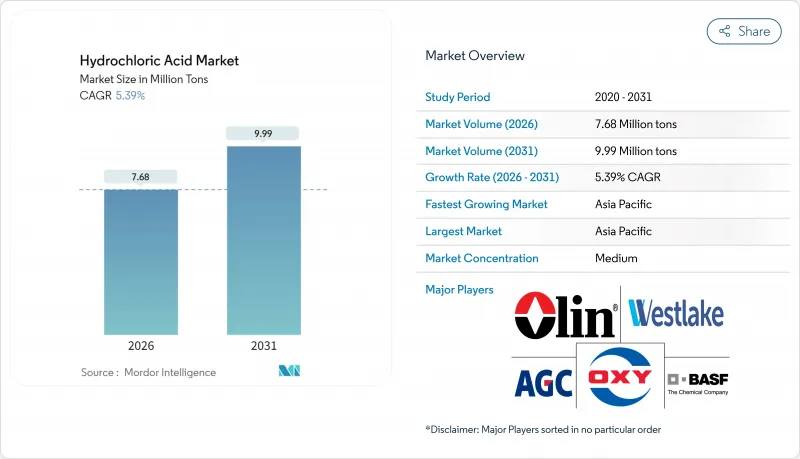
该化合物在油气井增产处理、半导体製造、水处理以及众多中间体合成中的效用,为全球需求提供了坚实支撑。盐酸的双重作用确保了其供应的稳定性:它既是专用装置的主要产品,也是氯碱电解的辅助产品,这使得生产商能够灵活应对苛性钠和氯循环的波动。儘管墨西哥湾沿岸停产和亚洲半导体产能扩张会吸收部分现货需求,造成短期供应紧张,但凭藉规模经济、可靠的原料供应和分散的物流网络,一体化生产商在长期合约市场仍保持优势。
全球盐酸市场趋势及展望
油气井增产需求激增
传统型油气储存的开发为盐酸市场奠定了坚实的基础,压裂和基质酸处理计画推动了这个市场的发展。作业者使用浓度在15%至28%之间的酸来溶解碳酸盐、重新开启堵塞的射孔并延长油井寿命。在二迭纪盆地和阿曼进行的现场测试表明,与未经处理的储存井相比,处理后的油井流量提高了18%。乳化和延迟酸处理技术使得在高温深层地层中作业成为可能,从而扩大了传统上难以开采的油藏对盐酸的需求。综合服务公司现在将腐蚀抑制剂、除铁剂和界面活性剂打包出售,虽然增加了油井成本,但提高了基质渗透效率,间接提高了单井盐酸消费量。随着页岩油生产商实施增产技术以抵消自然衰减曲线,儘管新完井数量下降,但盐酸的基准采购量仍在增加,预计这种成长趋势至少会持续到2029年。
水处理和食品加工中的卫生需求
由于盐酸在常用剂量下不会产生氯酸盐或溴酸盐等副产物,因此地方政府和食品加工商继续采用盐酸进行pH值调节和二氧化氯生成。澳洲饮用水指南强制要求使用盐酸进行絮凝和软化,这反映了全球监管机构的普遍认可。在肉类加工和乳製品生产线中,电解水系统将盐与稀盐酸混合,现场生成次氯酸。这可在不到60秒的时间内实现5个对数单位的细菌减少,并将残留氯化物含量保持在1 ppm以下,符合洁净标示的要求。小规模加工商则采用滑座式电解按需产生10-15%的盐酸,进而降低酸的运输成本(最高可达150美元/吨)。
工人安全与环境毒理学法规
美国职业安全与健康管理局 (OSHA) 将 15 分钟容许暴露限值收紧至 2 ppm,要求钢铁厂和食品厂升级局部排气通风系统和耐酸地板材料,导致每个场所的合规相关资本投资增加 20 万至 50 万美元。欧洲化学品管理局的候选清单遴选程序将高氯化物含量的废物流置于严格审查之下,迫使生产商证明其在整个生产过程中都采取了负责任的管理措施,否则将面临认证障碍。德国和义大利的小规模镀锌厂已开始将酸洗製程外包给第三方承包商,而不是维修其老化的酸洗槽,从而减少了直接购买酸的需求。
细分市场分析
工业级产品是钢材酸洗、氧化铝分解和大宗有机合成的关键试剂,在2025年占盐酸出货量的52.90%。这一细分市场保护了盐酸市场免受高纯度下游产品週期性疲软的影响。即使在2024年半导体产业调整期间,建筑用钢的订单也维持了工业级盐酸出货量的正成长。浓度为33-35%的盐酸在细分市场,特别是内陆油田,保持需求,因为在这些地区,单位酸度的运输成本决定了采购量。超高纯度产品仅占供应量的4.14%,但其价格溢价超过普通级产品的12倍,占总价值的18%。在亚洲晶圆厂扩张的带动下,超高纯度盐酸市场预计将以5.71%的复合年增长率成长,到2031年达到38.9万吨。
数字背后,等级体係正在改变。在欧洲三个工厂维修节能型膜电解槽,使变动成本降低了28%,并在无需新增资本投资的情况下,巧妙地突破了工业级到电子级之间的瓶颈。 De Nora公司的双极板电极将每吨35%盐酸的单位能耗降低至2000千瓦时,为剩余工业废液的升级改造开闢了道路。此外,该综合炼油厂还安装了真空蒸馏塔,从先前被视为中和废酸的酸中回收了价值。
盐酸市场报告按等级(工业级、浓缩级、超纯级)、终端用户行业(化学、石油天然气、钢铁冶金、食品饮料、纺织皮革及其他终端用户行业)和地区(亚太、北美、欧洲、南美、中东和非洲)进行细分。市场预测以吨为单位。
区域分析
中国在亚太地区的主导地位归功于其覆盖Delta和Delta的氯碱一体化生产网络。此网路不仅为自用提供盐酸,还为氯乙烯、聚碳酸酯和环氧氯丙烷生产线提供原料。中国的「双重替代」计画淘汰了汞电解槽,同时核准了一个膜分离计划,该项目每年可生产超过300万吨盐酸,从而实现了区域自给自足。印度阿图尔化学公司(Atul Chemicals)的投资使该地区每天新增100吨商用盐酸,降低了该地区对海湾地区昂贵进口盐酸的依赖。韩国和台湾透过与半导体生产指数挂钩的长期合约采购高纯度盐酸,这种避险结构在大宗化学品领域较为罕见。
在北美,受提高石油采收率技术推广的宣传活动,压裂酸的需求稳定成长。飓风艾达暴露了该行业的脆弱性。其三次登陆导緻美国沿岸地区超过80%的氯碱名目产能停产,现货价格指数在不到两週的时间内飙升了40%。地域多元化是关键的因应措施。 Chloram Solutions公司在亚利桑那州卡萨格兰德投资7000万美元建造了一座膜分离装置,以供应西部石化和矿业丛集。能源紧张的欧洲正在转向更高价值的应用,例如PFAS树脂回收和医药中间体。预计2025年经由安特卫普-鹿特丹港的进口量将成长12%,加拿大产量将填补德国电解运作下降期间的季节性供不应求。东欧的镀锌钢生产商继续采购大宗商品级氯碱,但正在投资建造零排放酸洗设施,以符合更严格的氯化物排放法规。由于采矿、油砂和海水淡化计划的增加,南美洲、中东和非洲的石油产量虽小规模但正在成长。
其他福利:
- Excel格式的市场预测(ME)表
- 3个月的分析师支持
目录
第一章 引言
- 研究假设和市场定义
- 调查范围
第二章调查方法
第三章执行摘要
第四章 市场情势
- 市场概览
- 市场驱动因素
- 油气井增产需求激增
- 水处理和食品加工中的卫生需求
- 用于先进製程(蚀刻)的半导体级盐酸
- PFAS去除树脂再生要求
- 锂离子电池回收浸出化学
- 市场限制
- 工人安全与环境毒理学法规
- 氯碱产品价格波动
- 酸洗浴中有机酸的替代品
- 价值链分析
- 波特五力模型
- 供应商的议价能力
- 买方的议价能力
- 新进入者的威胁
- 替代品的威胁
- 竞争程度
第五章 市场规模与成长预测
- 按年级
- 产业
- 集中
- 超高纯度
- 按最终用户行业划分
- 化学
- 石油和天然气
- 钢铁冶金
- 食品/饮料
- 纺织品和皮革
- 其他终端用户产业
- 按地区
- 亚太地区
- 中国
- 印度
- 日本
- 韩国
- 东南亚国协
- 亚太其他地区
- 北美洲
- 美国
- 加拿大
- 墨西哥
- 欧洲
- 德国
- 英国
- 法国
- 义大利
- 俄罗斯
- 北欧国家
- 其他欧洲地区
- 南美洲
- 巴西
- 阿根廷
- 其他南美洲
- 中东和非洲
- 沙乌地阿拉伯
- 南非
- 其他中东和非洲地区
- 亚太地区
第六章 竞争情势
- 市场集中度
- 策略趋势
- 市占率(%)/排名分析
- 公司简介
- AGC Inc.
- BASF SE
- Coogee
- Covestro AG
- Detrex Corporation
- DONGYUE GROUP
- ERCO Worldwide
- Ercros SA
- INEOS Group
- Jones-Hamilton Co.
- Merck KGaA
- Occidental Petroleum Corporation(OxyChem)
- Olin Corporation
- TOAGOSEI CO.,LTD.
- Vynova Group
- Westlake Corporation
第七章 市场机会与未来展望
Hydrochloric Acid Market size in 2026 is estimated at 7.68 Million tons, growing from 2025 value of 7.29 Million tons with 2031 projections showing 9.99 Million tons, growing at 5.39% CAGR over 2026-2031.
The compound's utility in oil-and-gas well stimulation, semiconductor fabrication, water treatment, and countless intermediate syntheses places a durable floor under global demand. Supply resilience derives from the dual role hydrochloric acid plays: it is both a primary product in dedicated units and a co-product of chlor-alkali electrolyzers, giving producers flexibility to respond to shifts in caustic-soda and chlorine cycles. Short-term tightness appears whenever Gulf-Coast outages or Asian semiconductor expansions absorb spot volumes, yet integrated producers continue to dominate long-term contracts thanks to scale economics, secure feedstock access, and distributed logistics networks.
Global Hydrochloric Acid Market Trends and Insights
Oil and Gas Well-Stimulation Demand Surge
Unconventional oil and gas reservoir development keeps the hydrochloric acid market firmly anchored to fracturing and matrix-acidizing programs. Operators employ 15%-28% acid concentrations to dissolve carbonates, reopen plugged perforations, and extend well life; field trials in the Permian and in Oman show 18% higher flow rates versus untreated offsets. Emulsified-acid and retarded-acid chemistries allow work in high-temperature, deep formations, pushing demand into reservoirs once considered too challenging. Integrated service companies now bundle corrosion inhibitors, iron controllers, and surfactants that raise well-cost line items but improve matrix penetration efficiency, indirectly lifting per-well HCl consumption. As shale producers pursue enhanced oil recovery to offset natural decline curves, baseline purchasing volumes rise despite fewer new completions, sustaining volume growth through at least 2029.
Water-Treatment and Food-Processing Hygiene Needs
Municipal utilities and food processors continue adopting HCl for pH adjustment and chlorine-dioxide generation because the acid leaves no chlorate or bromate by-products at typical dosing rates. Australia's drinking-water guidelines codify its use for coagulation and softening, reflecting worldwide regulatory acceptance. In meat-packing and dairy lines, electrolyzed-water systems combine salt and dilute HCl to form on-site hypochlorous acid that delivers five-log bacterial reductions in under 60 seconds while leaving sub-1 ppm residual chloride, satisfying clean-label expectations. Smaller processors embrace skid-mounted electrolyzers that generate 10-15% HCl on demand, cutting transport-cost premiums of up to USD 150 per ton for packaged acid.
Worker-Safety and Environmental-Toxicity Regulations
OSHA's tightened permissible-exposure limit of 2 ppm over 15 minutes compels steel mills and food plants to upgrade local exhaust ventilation and acid-proof flooring, raising compliance capex by USD 200,000-USD 500,000 per site. The European Chemical Agency's candidate-list process channels scrutiny toward chloride-rich waste streams, obliging producers to demonstrate cradle-to-gate stewardship or face authorization hurdles. Smaller galvanizers in Germany and Italy now outsource pickling to third-party tollers rather than retrofit aging on-site tanks, trimming direct acid purchases.
Other drivers and restraints analyzed in the detailed report include:
- Semiconductor-Grade HCl for Advanced Node Etching
- PFAS-Removal Resin Regeneration Requirements
- Chlor-Alkali Co-Product Price Volatility
For complete list of drivers and restraints, kindly check the Table Of Contents.
Segment Analysis
Industrial-grade product anchored 52.90% of 2025 shipments as the workhorse reagent for steel pickling, alumina digestion, and bulk organic synthesis. The segment cushioned the hydrochloric acid market against cyclical softness in high-purity downstreams: even during 2024's semiconductor correction, construction steel orders kept industrial-grade volumes positive. Concentrated 33%-35% grades retain niche appeal where freight cost per unit of acidity dictates sourcing, especially in inland oilfields. Ultra-high-purity supply, although just 4.14% of tonnage, now captures 18 % of total value thanks to premium pricing that exceeds commodity grades by 12-fold. The hydrochloric acid market size for ultra-high-purity is projected to reach 389 kt in 2031 on a 5.71% CAGR anchored in Asia's fab expansions.
Behind headline numbers, the grade hierarchy is fluid. Energy-efficient membrane-cell retrofits at three European sites shaved variable cost by 28%, enabling strategic debottlenecking from industrial to electronic quality without new greenfield units. De Nora's bipolar-plate electrodes reduced specific power consumption to 2 000 kWh per ton of 35% HCl, opening space to upgrade surplus industrial streams. Integrated refineries also deploy vacuum-distillation polishing columns, capturing value from what was formerly neutralized waste acid.
The Hydrochloric Acid Market Report is Segmented by Grade (Industrial, Concentrated, and Ultra-High Purity), End-User Industry (Chemical, Oil and Gas, Steel and Metallurgy, Food and Beverage, Textiles and Leather, and Other End-User Industries), and Geography (Asia-Pacific, North America, Europe, South America, and Middle East and Africa). The Market Forecasts are Provided in Terms of Volume (Tons).
Geography Analysis
Asia-Pacific's leadership stems from the integrated chlor-alkali grids along the Yangtze and Pearl River Deltas, where captive hydrochloric acid volumes feed vinyl chloride, polycarbonate, and epichlorohydrin lines. China's dual-replacement program has shut mercury-cell units yet simultaneously green-lighted membrane projects topping 3 million tpa HCl co-product, locking in regional self-reliance. India's Atul Ltd. investment added 100 TPD of merchant acid, cutting western-India's dependence on high-freight Gulf imports. Korea and Taiwan draw in high-purity barrels via term contracts that link to semiconductor output indexes, a hedging structure seldom seen in bulk chemicals.
North America posts steady growth where enhanced-oil-recovery campaigns require stable fracturing acid volumes. Hurricane Ida spotlighted vulnerability: three successive landfalls shuttered more than 80% of U.S. Gulf Coast chlor-alkali nameplate capacity, jolting spot price indices by 40% in under two weeks. Response strategies now include regional diversification: Chlorum Solutions chose Casa Grande, Arizona, for a USD 70 million membrane plant serving western petrochem and mining clusters. Europe, constrained by energy costs, pivots toward secondary uses that command premium pricing, such as PFAS-resin regeneration and pharmaceutical intermediates. Import flows through Antwerp and Rotterdam rose 12% in 2025, with Canadian cargoes filling seasonal gaps when German electrolyzers throttled down. Eastern-European steel galvanizers still lift commodity grades but invest in zero-liquid-discharge pickling to navigate tightening chloride-emission limits. South America and Middle-East-and-Africa remain volume-small but trend-positive as mining, oil-sands, and desalination projects proliferate.
- AGC Inc.
- BASF SE
- Coogee
- Covestro AG
- Detrex Corporation
- DONGYUE GROUP
- ERCO Worldwide
- Ercros S.A
- INEOS Group
- Jones-Hamilton Co.
- Merck KGaA
- Occidental Petroleum Corporation (OxyChem)
- Olin Corporation
- TOAGOSEI CO.,LTD.
- Vynova Group
- Westlake Corporation
Additional Benefits:
- The market estimate (ME) sheet in Excel format
- 3 months of analyst support
TABLE OF CONTENTS
1 Introduction
- 1.1 Study Assumptions and Market Definition
- 1.2 Scope of the Study
2 Research Methodology
3 Executive Summary
4 Market Landscape
- 4.1 Market Overview
- 4.2 Market Drivers
- 4.2.1 Oil and Gas Well-Stimulation Demand Surge
- 4.2.2 Water-Treatment and Food-Processing Hygiene Needs
- 4.2.3 Semiconductor-Grade HCL for Advanced Node Etching
- 4.2.4 PFAS-Removal Resin Regeneration Requirements
- 4.2.5 Lithium-Ion Battery Recycling Leaching Chemistry
- 4.3 Market Restraints
- 4.3.1 Worker-Safety and Environmental-Toxicity Regulations
- 4.3.2 Chlor-Alkali Co-Product Price Volatility
- 4.3.3 Organic-Acid Substitution in Pickling Baths
- 4.4 Value Chain Analysis
- 4.5 Porter's Five Forces
- 4.5.1 Bargaining Power of Suppliers
- 4.5.2 Bargaining Power of Buyers
- 4.5.3 Threat of New Entrants
- 4.5.4 Threat of Substitutes
- 4.5.5 Degree of Competition
5 Market Size and Growth Forecasts (Volume)
- 5.1 By Grade
- 5.1.1 Industrial
- 5.1.2 Concentrated
- 5.1.3 Ultra-high Purity
- 5.2 By End-user Industry
- 5.2.1 Chemical
- 5.2.2 Oil and Gas
- 5.2.3 Steel and Metallurgy
- 5.2.4 Food and Beverage
- 5.2.5 Textiles and Leather
- 5.2.6 Other End-user Industries
- 5.3 By Geography
- 5.3.1 Asia-Pacific
- 5.3.1.1 China
- 5.3.1.2 India
- 5.3.1.3 Japan
- 5.3.1.4 South Korea
- 5.3.1.5 ASEAN Countries
- 5.3.1.6 Rest of Asia-Pacific
- 5.3.2 North America
- 5.3.2.1 United States
- 5.3.2.2 Canada
- 5.3.2.3 Mexico
- 5.3.3 Europe
- 5.3.3.1 Germany
- 5.3.3.2 United Kingdom
- 5.3.3.3 France
- 5.3.3.4 Italy
- 5.3.3.5 Russia
- 5.3.3.6 NORDIC Countries
- 5.3.3.7 Rest of Europe
- 5.3.4 South America
- 5.3.4.1 Brazil
- 5.3.4.2 Argentina
- 5.3.4.3 Rest of South America
- 5.3.5 Middle East and Africa
- 5.3.5.1 Saudi Arabia
- 5.3.5.2 South Africa
- 5.3.5.3 Rest of Middle East and Africa
- 5.3.1 Asia-Pacific
6 Competitive Landscape
- 6.1 Market Concentration
- 6.2 Strategic Moves
- 6.3 Market Share (%)/Ranking Analysis
- 6.4 Company Profiles (includes Global overview, Market level overview, Core segments, Financials, Strategic information, Market rank/share, Products and services, Recent developments)
- 6.4.1 AGC Inc.
- 6.4.2 BASF SE
- 6.4.3 Coogee
- 6.4.4 Covestro AG
- 6.4.5 Detrex Corporation
- 6.4.6 DONGYUE GROUP
- 6.4.7 ERCO Worldwide
- 6.4.8 Ercros S.A
- 6.4.9 INEOS Group
- 6.4.10 Jones-Hamilton Co.
- 6.4.11 Merck KGaA
- 6.4.12 Occidental Petroleum Corporation (OxyChem)
- 6.4.13 Olin Corporation
- 6.4.14 TOAGOSEI CO.,LTD.
- 6.4.15 Vynova Group
- 6.4.16 Westlake Corporation
7 Market Opportunities and Future Outlook
- 7.1 White-space and Unmet-need Assessment

 盐酸市场:2026-2032年全球市场预测(依等级、生产流程、浓度、包装、分销通路及最终用途产业划分)
 盐酸市场规模、份额和成长分析(按纯度、通路、形态、应用、最终用途产业和地区划分)-2026-2033年产业预测
 全球盐酸市场规模、份额、趋势和成长分析报告(2026-2034年)
 日本盐酸市场规模、份额、趋势和预测:按等级、应用、最终用户和地区划分,2026-2034年
 全球盐酸市场报告(2026)
 盐酸市场-全球产业规模、份额、趋势、机会、预测:按等级、最终用途产业、销售管道、地区和竞争格局划分,2021-2031年
 盐酸市场:2025-2029年全球市场
 全球盐酸市场:按等级、按应用、按最终用途行业、按地区 - 预测至 2029 年
 盐酸全球市场分析:工厂产能、产量、运营效率、对外贸易、需求/供应、最终用户行业、公司份额、销售渠道、等级、按地区划分的需求(2015-2032 年)