


 |
市场调查报告书
商品编码
1910536
照明控制系统:市场占有率分析、产业趋势与统计、成长预测(2026-2031)Lighting Control System - Market Share Analysis, Industry Trends & Statistics, Growth Forecasts (2026 - 2031) |
||||||

※ 本网页内容可能与最新版本有所差异。详细情况请与我们联繫。
照明控制系统市场预计将从 2025 年的 454.3 亿美元成长到 2026 年的 511.5 亿美元,预计到 2031 年将达到 925.3 亿美元,2026 年至 2031 年的复合年增长率为 12.6%。
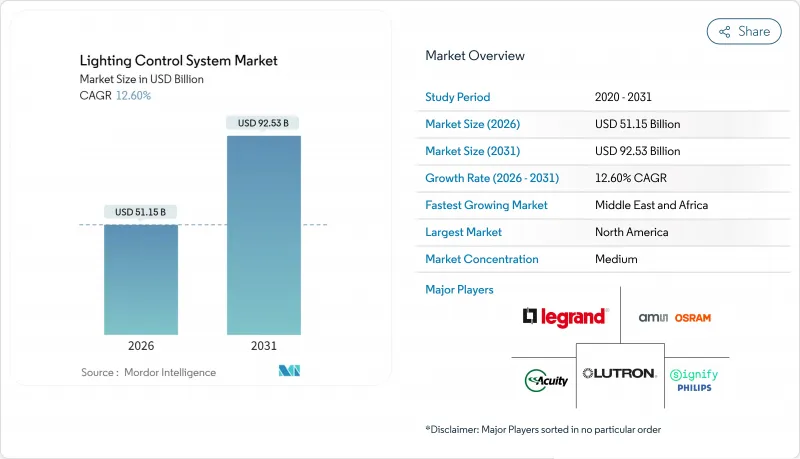
这种加速成长反映了强制性的节能要求、智慧城市计画的激增以及物联网赋能的建筑自动化的广泛应用,这些技术将照明设备转化为资料来源。各国政府目前正将自动调光、日光调光和人员占用侦测功能纳入建筑规范,从而创造了不可或缺的需求。 LED组件价格的下降缩短了投资回收期,使得即使对于小规模的设施,全面的控制系统也变得经济可行。无线网状网路通讯协定的广泛应用降低了安装的复杂性,为2020年之前建造的现有设施的维修提供了更多机会。然而,日益严重的网路安全威胁和持续的半导体供应瓶颈给供应商和设施业主带来了短期营运风险。
全球照明控制系统市场趋势与洞察
节能照明系统的需求日益增长
世界各地的设施都在寻求透过将LED与智慧控制系统结合来降低营运成本和碳排放,与传统萤光具相比,LED照明能耗最多可降低80%。已验证的工业计划表明,安装后12个月内照明能耗降低了87%,证实即使对于大型工厂,也能快速收回成本。人员占用侦测、自然光利用和定时功能可实现持续最佳化,而不会影响业务流程,即使在能源成本不断上涨的环境下,也能促进资本投资核准。业主们欣喜地看到,许多计划在一个财政年度内即可收回成本,这有助于在其他建设支出受到严格审查的情况下维持市场需求。
严格的建筑能源标准和绿色认证要求
2021年国际节能规范(IECC 2021)强制要求商业建筑配备自动调光和日光响应控制系统,使其从可选升级变为强制性要求。加州第24号法规(2022年)提倡对4kW以上的计划采用需量反应调光,确保几乎所有大型建筑都实施控制系统。 LEED认证体系对先进的照明控制系统给予加分,使监管压力与资本市场对符合ESG(环境、社会和治理)标准的资产的偏好相一致。由于合规性已成为不可协商的要求,照明控制系统市场获得了一个能够抵御宏观经济波动的稳健成长平台。
较高的初始实施和整合成本
一套完整的控制系统维修所需的资金是更换基本LED灯的两到三倍,这对中小企业构成了障碍。复杂的计划需要熟练的试运行技术人员,而人才短缺推高了人事费用,尤其是在成熟地区以外的地区。即使是每年节省100,831美元的知名饭店维修也需要大量资金,投资回收期长达1.62年,凸显了中小企业面临的资金筹措障碍。由于能源融资的匮乏,新兴市场仍是最大的资金筹措缺口地区。
细分市场分析
到2025年,硬体将占总收入的56.80%,因为驱动程式、感测器和网关是任何智慧升级的基础。服务业务将以12.83%的复合年增长率快速成长,因为大规模部署需要设计咨询、现场试运行和定期优化。基于人工智慧的分析需要持续调整,预计将进一步扩大照明控制系统服务市场规模。诸如能源管理计划(EMC)蓝牙Mesh计划(在43个地区部署了3685个控制器)等全球部署案例,展现了服务的复杂性和持续收入潜力。
专业服务能够确保长期合约的签订,将一次性资本计划转化为可预测的现金流。韧体更新、故障分析和能源报告等服务越来越多地被纳入企业外包的託管服务合约中。因此,硬体供应商正在将生命週期合约打包,推动照明控制系统市场从单纯的零件销售模式转向解决方案生态系统。这种策略转变提高了缺乏设计和支援资源的企业的进入门槛。
到2025年,有线通讯协定将保持63.40%的市场份额,这主要得益于其抗电磁干扰能力和稳定的延迟,而这些特性对于关键任务型工厂至关重要。医院和资料中心等网路停机时间不可接受的场所,将继续对采用有线DALI-2安装的照明控制系统保持强劲的需求。工程师重视专用布线的确定性性能和固有的物理安全性。
无线部署正以14.85%的复合年增长率迅速缩小差距。蓝牙Mesh提供自癒功能和基于智慧型手机的性能验证,显着降低了人事费用。整合到Matter生态系统后,住宅和商业设备可以在通用的管理平台下协同工作,从而加速规范制定者的采用。计画于2026年推出的Thread 1.4升级将增加边界路由器的柔软性,使设施管理团队无需重新布线即可扩展网路。在停机时间至关重要的环境中,例如历史建筑和开放式零售场所,减少中断是一项极具吸引力的优势。
照明控制系统市场按产品类型(硬体、软体、服务)、通讯协定(有线、无线)、安装类型(新建、维修)、应用领域(室外、室内)和地区进行细分。市场预测以美元计价。
区域分析
预计到2025年,北美地区的市占率将达到34.10%,这主要得益于严格的节能标准和智慧城市建设的领先。照明控制系统市场正受益于联邦政府的节能计画和税收优惠政策,这些政策加速了投资回报。公共产业对感测器组件的补贴进一步提升了商业房地产维修的经济效益。加拿大各省正在效仿美国的标准,而墨西哥的工业走廊则将照明控制系统整合到加工厂的扩建项目中,以最大限度地降低营运成本。
欧洲保持强劲势头,并制定了2030年实现脱碳的宏伟目标。德国、法国和英国已将智慧照明纳入公共部门采购规则。欧盟分类揭露要求业主证明其能源强度降低,从而引导资金流向配备丰富感测器的升级改造专案。 DALI-2 和新兴的 ETSI EN 303 645 安全框架的标准化工作正在降低多供应商部署的风险,并促进单一市场内的普及应用。
预计中东和非洲地区将实现最快成长,到2031年复合年增长率将达到12.74%。沙乌地阿拉伯和阿联酋正在建造的特大城市从一开始就将智慧照明系统纳入总体规划。儘管石油收入波动,但政府对智慧基础设施的预算将确保计划储备充足。在撒哈拉以南非洲,电网不稳定促使人们采用电压下降时自动调暗负载的感测器,从而保护资产并延长灯具的使用寿命。开发银行的融资支援将有助于消除初期成本障碍,确保销售持续成长。
其他福利:
- Excel格式的市场预测(ME)表
- 3个月的分析师支持
目录
第一章 引言
- 研究假设和市场定义
- 调查范围
第二章调查方法
第三章执行摘要
第四章 市场情势
- 市场概览
- 市场驱动因素
- 节能照明系统的需求日益增长
- 严格的建筑能源标准和绿色认证要求
- LED价格快速下降导致投资报酬率提高。
- 利用自适应路灯进行智慧城市规划
- ESG挂钩融资加速智慧维修
- 为Li-Fi部署做好准备,将开启新的收入来源。
- 市场限制
- 较高的初始实施和整合成本
- 多厂商环境下的互通性挑战
- 网路安全与资料隐私风险
- 合格试运行专业人员短缺
- 供应链分析
- 监管环境
- 技术展望(物联网边缘控制、人工智慧、Li-Fi)
- 波特五力模型
- 新进入者的威胁
- 买方的议价能力
- 供应商的议价能力
- 替代品的威胁
- 竞争对手之间的竞争
- 对影响市场的宏观经济因素进行评估
第五章 市场规模与成长预测
- 报价
- 硬体
- LED驱动器
- 感应器
- 开关和调光器
- 继电器单元
- 网关和控制面板
- 软体
- 服务
- 硬体
- 透过通讯协定
- 有线
- 无线的
- 按安装类型
- 新建工程
- 维修
- 透过使用
- 室内的
- 销售办事处
- 工业和仓储
- 住宅
- 饭店及休閒
- 其他的
- 户外
- 道路和街道
- 建筑和建筑幕墙
- 体育场馆
- 其他的
- 室内的
- 地区
- 北美洲
- 美国
- 加拿大
- 墨西哥
- 南美洲
- 巴西
- 阿根廷
- 其他南美洲
- 欧洲
- 德国
- 英国
- 法国
- 义大利
- 西班牙
- 其他欧洲
- 亚太地区
- 中国
- 日本
- 印度
- 韩国
- 东南亚
- 亚太其他地区
- 中东和非洲
- 中东
- 沙乌地阿拉伯
- 阿拉伯聯合大公国
- 土耳其
- 其他中东地区
- 非洲
- 南非
- 奈及利亚
- 埃及
- 其他非洲地区
- 埃及
- 中东
- 北美洲
第六章 竞争情势
- 市场集中度
- 市占率分析
- 策略趋势
- 公司简介
- Signify(Philips Lighting)
- Acuity Brands
- Legrand
- Lutron Electronics
- ams OSRAM
- Schneider Electric
- Eaton(Cooper Lighting)
- Hubbell Lighting
- Honeywell
- Cisco Systems
- Siemens(Enlighted)
- Delta Electronics
- Panasonic
- Zumtobel Group
- Helvar
- Synapse Wireless
- WAGO
- Cree Lighting
- Leviton Manufacturing
- Digital Lumens
- ABB
第七章 市场机会与未来展望
The lighting control system market is expected to grow from USD 45.43 billion in 2025 to USD 51.15 billion in 2026 and is forecast to reach USD 92.53 billion by 2031 at 12.6% CAGR over 2026-2031.
Accelerated growth reflects mandated energy-efficiency requirements, the spread of smart city programs, and wider use of IoT-enabled building automation that turns luminaires into data sources. Governments now anchor automatic shut-off, daylight-responsive dimming, and occupancy sensing in building standards, which creates non-discretionary demand. Price erosion in LED components has shortened payback periods, making comprehensive controls economically viable even for smaller facilities. Wireless mesh protocols have reduced installation complexity, opening retrofit opportunities in stock built before 2020. At the same time, escalating cybersecurity threats and lingering semiconductor supply bottlenecks present near-term operational risks for suppliers and facility owners.
Global Lighting Control System Market Trends and Insights
Growing Demand for Energy-Efficient Lighting Systems
Facilities worldwide pursue lower operating costs and carbon footprints by pairing LEDs with intelligent controls that trim lighting energy as much as 80% compared with legacy fluorescent installations. Documented industrial projects have reached 87% lighting-energy savings in the first twelve months, underscoring quick payback even in large plants. Occupancy sensing, daylight harvesting, and scheduling allow continuous optimisation without impacting workflow, which makes capital approval easier when utility prices keep rising. Building owners value that many projects now return cash within a single fiscal year, creating momentum that sustains demand when other construction outlays are under scrutiny.
Stringent Building-Energy Codes and Green Certification Mandates
The International Energy Conservation Code 2021 requires automatic shut-off and daylight-responsive controls in commercial spaces, converting optional upgrades into mandatory scope. California Title 24 (2022) pushes demand-responsive dimming on projects above 4 kW, guaranteeing control deployment in virtually every large build. LEED rating systems award points for advanced lighting controls, aligning regulatory pressure with capital markets that now prioritise ESG-ready assets. Because compliance is non-negotiable, the lighting control system market gains a defensive growth pillar that softens macro-economic swings.
High Upfront Installation and Integration Cost
Comprehensive control retrofits still command two- to three-times the capital of basic LED lamp swaps, which discourages smaller businesses. Complex projects rely on skilled commissioning engineers whose limited availability inflates labour fees, especially outside mature regions.Even high-profile hotel retrofits that now yield USD 100,831 annual savings required sizeable capital and a 1.62-year payback, highlighting the cash hurdle that smaller enterprises face. Financing gaps remain widest in emerging markets where energy loans are scarce.
Other drivers and restraints analyzed in the detailed report include:
- Rapid LED Price Erosion Expanding ROI
- Smart-City Programs Using Adaptive Street Lighting
- Interoperability Issues Across Multi-Vendor Ecosystems
For complete list of drivers and restraints, kindly check the Table Of Contents.
Segment Analysis
Hardware captured 56.80% revenue in 2025 as drivers, sensors, and gateways form the backbone of any intelligent upgrade. Services are poised for the fastest 12.83% CAGR because every significant deployment requires design consultation, site commissioning, and periodic optimisation. The lighting control system market size for services is projected to gain momentum as AI-based analytics demand continuous tuning. Global roll-outs such as Energy Management Collaborative's Bluetooth Mesh project, which involved 3,685 controllers in 43 areas, illustrate service-heavy complexity and recurring revenue potential.
Professional services secure long-term contracts that convert one-time capital projects into predictable cash flows. Firmware updates, fault analytics, and energy reporting increasingly fall under managed-service agreements that enterprises outsource. As a result, hardware vendors bundle lifecycle contracts, pushing the lighting control system market toward solution ecosystems rather than component sales. This strategic shift raises entry barriers for firms that lack design and support resources.
Wired protocols preserved 63.40% share in 2025, valued for EMI immunity and stable latency that mission-critical factories demand. The lighting control system market size tied to wired DALI-2 installations remains considerable among hospitals and data centres where network downtime is unacceptable. Engineers favour deterministic performance and inherent physical security of dedicated cabling.
Wireless deployments are closing the gap at a 14.85% CAGR. Bluetooth Mesh offers self-healing paths and smartphone-based commissioning that slash labour costs. Integration into the Matter ecosystem aligns residential and commercial devices under common management shells, which accelerates specifier acceptance. Thread 1.4 upgrades planned by 2026 will add border-router flexibility, allowing facility teams to scale networks without rewiring. Reduced disruption is compelling for heritage sites and live retail stores where shutdown time is limited.
Lighting Control System Market is Segmented by Offering (Hardware, Software, Services), Communication Protocol (Wired, Wireless), Installation Type (New Construction, Retrofit), Application (Outdoor, Indoor) and by Geography. The Market Forecasts are Provided in Terms of Value (USD).
Geography Analysis
North America commanded 34.10% revenue in 2025 due to strict energy codes and early smart-city adoption. The lighting control system market benefits from federal efficiency programmes and tax incentives that improve investment payback. Utility rebate schemes covering sensor packages further sweeten economics for commercial retrofits. Canadian provinces mirror United States standards, while Mexico's industrial corridors integrate lighting controls into maquiladora expansions to minimise operational spend.
Europe maintains momentum with firm decarbonisation targets set for 2030. Germany, France, and the United Kingdom embed intelligent lighting in public-sector procurement rules. EU taxonomy disclosures oblige property owners to prove energy intensity reductions, which steers capital toward sensor-rich upgrades. Standardisation efforts through DALI-2 and the emerging ETSI EN 303 645 security framework make multi-vendor deployments less risky, reinforcing uptake across the single market.
The Middle East and Africa post the fastest 12.74% CAGR through 2031. Mega-cities under construction in Saudi Arabia and the UAE incorporate control-ready luminaires into master plans from the start. Government budgets earmarked for smart infrastructure keep project pipelines robust even when oil revenues fluctuate. In sub-Saharan Africa, grid instability motivates adoption of sensors that dim loads during voltage dips, protecting equipment and extending luminaire life. Financing backed by development banks helps bridge initial cost hurdles, ensuring sustained volume growth.
- Signify (Philips Lighting)
- Acuity Brands
- Legrand
- Lutron Electronics
- ams OSRAM
- Schneider Electric
- Eaton (Cooper Lighting)
- Hubbell Lighting
- Honeywell
- Cisco Systems
- Siemens (Enlighted)
- Delta Electronics
- Panasonic
- Zumtobel Group
- Helvar
- Synapse Wireless
- WAGO
- Cree Lighting
- Leviton Manufacturing
- Digital Lumens
- ABB
Additional Benefits:
- The market estimate (ME) sheet in Excel format
- 3 months of analyst support
TABLE OF CONTENTS
1 INTRODUCTION
- 1.1 Study Assumptions and Market Definition
- 1.2 Scope of the Study
2 RESEARCH METHODOLOGY
3 EXECUTIVE SUMMARY
4 MARKET LANDSCAPE
- 4.1 Market Overview
- 4.2 Market Drivers
- 4.2.1 Growing demand for energy-efficient lighting systems
- 4.2.2 Stringent building-energy codes and green certification mandates
- 4.2.3 Rapid LED price erosion expanding ROI
- 4.2.4 Smart-city programs using adaptive street lighting
- 4.2.5 ESG-linked finance accelerating smart retrofits
- 4.2.6 Li-Fi readiness unlocking new revenue streams
- 4.3 Market Restraints
- 4.3.1 High upfront installation and integration cost
- 4.3.2 Interoperability issues across multi-vendor ecosystems
- 4.3.3 Cyber-security and data-privacy risks
- 4.3.4 Shortage of qualified commissioning professionals
- 4.4 Supply-Chain Analysis
- 4.5 Regulatory Landscape
- 4.6 Technological Outlook (IoT-edge controls, AI, Li-Fi)
- 4.7 Porter's Five Forces
- 4.7.1 Threat of New Entrants
- 4.7.2 Bargaining Power of Buyers
- 4.7.3 Bargaining Power of Suppliers
- 4.7.4 Threat of Substitutes
- 4.7.5 Intensity of Competitive Rivalry
- 4.8 Assesment of Macroeconomic Factors on the market
5 MARKET SIZE AND GROWTH FORECASTS (VALUE)
- 5.1 By Offering
- 5.1.1 Hardware
- 5.1.1.1 LED Drivers
- 5.1.1.2 Sensors
- 5.1.1.3 Switches and Dimmers
- 5.1.1.4 Relay Units
- 5.1.1.5 Gateways and Control Panels
- 5.1.2 Software
- 5.1.3 Services
- 5.1.1 Hardware
- 5.2 By Communication Protocol
- 5.2.1 Wired
- 5.2.2 Wireless
- 5.3 By Installation Type
- 5.3.1 New Construction
- 5.3.2 Retrofit
- 5.4 By Application
- 5.4.1 Indoor
- 5.4.1.1 Commercial Offices
- 5.4.1.2 Industrial and Warehousing
- 5.4.1.3 Residential
- 5.4.1.4 Hospitality and Leisure
- 5.4.1.5 Others
- 5.4.2 Outdoor
- 5.4.2.1 Roadway and Street
- 5.4.2.2 Architectural and Facade
- 5.4.2.3 Sports and Stadium
- 5.4.2.4 Others
- 5.4.1 Indoor
- 5.5 Geography
- 5.5.1 North America
- 5.5.1.1 United States
- 5.5.1.2 Canada
- 5.5.1.3 Mexico
- 5.5.2 South America
- 5.5.2.1 Brazil
- 5.5.2.2 Argentina
- 5.5.2.3 Rest of South America
- 5.5.3 Europe
- 5.5.3.1 Germany
- 5.5.3.2 United Kingdom
- 5.5.3.3 France
- 5.5.3.4 Italy
- 5.5.3.5 Spain
- 5.5.3.6 Rest of Europe
- 5.5.4 Asia-Pacific
- 5.5.4.1 China
- 5.5.4.2 Japan
- 5.5.4.3 India
- 5.5.4.4 South Korea
- 5.5.4.5 Southeast Asia
- 5.5.4.6 Rest of Asia-Pacific
- 5.5.5 Middle East and Africa
- 5.5.5.1 Middle East
- 5.5.5.1.1 Saudi Arabia
- 5.5.5.1.2 United Arab Emirates
- 5.5.5.1.3 Turkey
- 5.5.5.1.4 Rest of Middle East
- 5.5.5.2 Africa
- 5.5.5.2.1 South Africa
- 5.5.5.2.2 Nigeria
- 5.5.5.2.3 Egypt
- 5.5.5.2.4 Rest of Africa
- 5.5.5.2.5 Egypt
- 5.5.5.1 Middle East
- 5.5.1 North America
6 COMPETITIVE LANDSCAPE
- 6.1 Market Concentration
- 6.2 Market Share Analysis
- 6.3 Strategic Moves
- 6.4 Company Profiles {(includes Global level Overview, Market level overview, Core Segments, Financials as available, Strategic Information, Market Rank/Share for key companies, Products and Services, and Recent Developments)}
- 6.4.1 Signify (Philips Lighting)
- 6.4.2 Acuity Brands
- 6.4.3 Legrand
- 6.4.4 Lutron Electronics
- 6.4.5 ams OSRAM
- 6.4.6 Schneider Electric
- 6.4.7 Eaton (Cooper Lighting)
- 6.4.8 Hubbell Lighting
- 6.4.9 Honeywell
- 6.4.10 Cisco Systems
- 6.4.11 Siemens (Enlighted)
- 6.4.12 Delta Electronics
- 6.4.13 Panasonic
- 6.4.14 Zumtobel Group
- 6.4.15 Helvar
- 6.4.16 Synapse Wireless
- 6.4.17 WAGO
- 6.4.18 Cree Lighting
- 6.4.19 Leviton Manufacturing
- 6.4.20 Digital Lumens
- 6.4.21 ABB
7 MARKET OPPORTUNITIES AND FUTURE OUTLOOK
- 7.1 White-space and Unmet-need Assessment

 LED照明组件市场预测至2034年:全球产品类型、组件类型、安装类型、分销管道、技术、应用、最终用户和地区分析
 全球照明灯具及照明控制市场规模、份额、趋势及成长分析报告(2026-2034)
 2026年全球工厂照明市场报告2026年全球照明控制系统市场报告
 剧院主机市场按主机类型、控制技术、安装类型、应用、最终用户和分销渠道划分 - 全球预测 2026-2032
 照明控制系统市场规模、份额及成长分析(按组件、类型、应用、最终用户和地区划分)-2026-2033年产业预测
 调光器市场规模、份额和成长分析(按类型、控制通讯协定、应用和地区划分)—2026-2033年产业预测照明控制系统市场预测至2032年:按组件、通讯协定、安装类型、最终用户和地区分類的全球分析照明控制市场按产品、技术、控制模式、光源相容性、安装类型、最终用途和分销管道划分 - 全球预测 2025-2030
 全球调光器市场:产业分析、规模、占有率、成长、趋势、预测(2024-2031)