


 |
市场调查报告书
商品编码
1910548
智慧虚拟助理(IVA)-市场占有率分析、产业趋势与统计、成长预测(2026-2031)Intelligent Virtual Assistant (IVA) - Market Share Analysis, Industry Trends & Statistics, Growth Forecasts (2026 - 2031) |
||||||

※ 本网页内容可能与最新版本有所差异。详细情况请与我们联繫。
智慧虚拟助理市场预计将从 2025 年的 196 亿美元成长到 2026 年的 257 亿美元,到 2031 年将达到 996.1 亿美元,2026 年至 2031 年的复合年增长率为 31.12%。
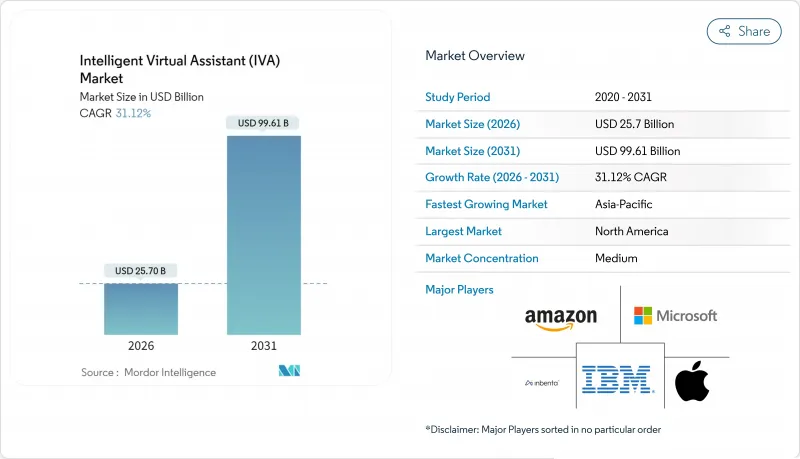
这种快速扩张主要得益于支援多种语言的大规模语言模型、由专用人工智慧晶片驱动的设备端推理(每台设备售价约4万美元)以及企业为控制不断上涨的云端成本而施加的压力。由于生成式人工智慧展现出明显的成本节约优势,企业仍持续投资于此。例如,一家大型旅行社在实施主导智慧虚拟助理(IVA)的自助服务管道后,每年节省了1000万美元的成本。儘管云端仍然占据主导地位,但避免向超大规模服务供应商持续付费的边缘和本地部署方案正日益受到重视。这种趋势在消费硬体领域同样明显,智慧音箱和车载助手的普及正在重塑人们对始终在线对话服务的期望。
全球智慧虚拟助理(IVA)市场趋势与洞察
全通路客户服务聊天机器人的普及率不断提高
预计到2025年,全球银行将在聊天机器人技术方面投资94亿美元,显示控製成本的需求与全天候服务的期望高度契合。自助解决问题的比例正日益接近80-90%,早期采用者已记录高达40%的生产力提升。零售商透过将文字、语音和视讯管道整合到单一流程中,并在适当时无缝转接至人工客服,实现了客户参与提升40%。基于记忆的个人化功能可跨装置保存对话历史记录,让客户无需重复操作即可继续互动。最终,客户满意度分数提升,客服中心的工作量也显着降低。
智慧音箱和物联网语音设备的普及
汽车製造商正利用 Cerence、微软和 NVIDIA 的语音平台,将 ChatGPT 式服务直接整合到车载资讯娱乐系统中。大众汽车的欧洲车型已经配备了五种语言的云端语音助理。在汽车领域之外,消费性电子产品製造商和穿戴式装置品牌也在采用本地语音辨识,以保护用户隐私并降低延迟。驾驶调查显示,77% 的驾驶表示,如果车载语音控制功能更强大,他们会选择使用。随着供应商将相同的核心模型移植到嵌入式晶片上,智慧虚拟助理市场正在家庭、汽车和工业等日常环境中拓展新的应用领域。
持续存在的隐私和资料安全问题
欧盟人工智慧法律中的隐私权条款要求供应商从设计初就证明其资料最小化和加密措施的有效性。在医疗保健领域,美国医疗资讯科技协调办公室 (ONC) 的法规要求预测演算法的决策日誌必须透明。金融机构正在实施可追溯的管道和差分隐私技术,但这些投资推高了计划成本并延长了引进週期。因此,许多高阶主管倾向于采用本地部署架构,将所有客户话语保留在内部,据报道,与同等云端费用相比,这种方式可节省高达 80% 的成本,同时满足主权法规的要求。
细分市场分析
到2025年,智慧音箱将占总收入的45.68%,大规模的用户群将透过与音乐和影片服务捆绑销售而持续成长。儘管成熟市场的成长速度有所放缓,但供应商提升销售配备高保真麦克风和本地语言模型推理功能的升级版套餐来减少云端呼叫。同时,车载助理到2031年的复合年增长率将达到32.58%,在所有硬体类别中位居榜首。大众和雷诺等汽车製造商使用Cerence的白牌产品,为使用者提供行动互动式导航、空调控制和电子商务服务。
用于扩增实境(AR)头戴装置和工业扫描器的可穿戴/嵌入式智慧虚拟助理(IVA)模组开闢了新的切入点,使工人在物流和现场维护任务中能够透过语音指令解放双手。这些设备将语音与注视、手势和触觉回馈结合,从而提升使用者的人体工学体验。智慧虚拟助理市场如今涵盖了从固定扬声器到完全行动装置的各种产品,其神经网路架构也针对每种外形规格的运算能力限制进行了最佳化。
由于云端部署易于扩展、模型更新以及与企业软体集成,因此仍占支出的 67.35%。然而,成本可预测性和资料在地化方法正推动着向本地部署和边缘部署的显着转变,这些部署方式正以每年 33.72% 的速度成长。在本地部署生成式 AI 晶片的公司发现,其推理成本已降至同等云端使用成本的五分之一。随着受监管行业将敏感语音日誌转移到防火墙后,本地智慧虚拟助理市场预计将迅速扩张。
边缘原生智慧语音助理 (IVA) 支援汽车、航太和医疗设备等产业中对延迟低于 100 毫秒的要求极高的即时工作负载。目前,供应商正在交付记忆体小于 8GB 的神经处理单元 (NPU) 内核,这些内核搭载了量化逻辑层级模型 (LLM)。这种专用设计能够在降低能耗的同时保留对话上下文,这对于在驾驶或手术辅助等场景下实现不间断运行至关重要。
区域分析
北美占36.55%的市场份额,主要得益于早期企业投资、充裕的创业投资以及成熟的供应商生态系统。犹他州、科罗拉多和加州的州法律强调透明度,而联邦政府的NIST框架则提供了一套通用的风险管理术语。医疗智慧语音助理(IVA)必须记录可解释性证据以符合ONC标准,这鼓励医疗服务提供者选择能够发布完整决策轨迹的平台。加拿大的无障碍标准EN 301 549:2024进一步巩固了对能够满足残障使用者需求的包容性语音技术的需求。该地区强大的研发能力以及健全的合规文化,使其在商业部署方面保持优势。
亚太地区是成长最快的地区,复合年增长率高达34.05%。各国政府的人工智慧策略,例如中国的《国家蓝图》和新加坡10亿新元的预算拨款,都在支持人才培育和试验计画。印度银行业对互动式人工智慧的应用表明,多语言智慧虚拟助理能够以低成本实现分店的扩张。日本汽车製造商正在将车载助手作为品牌差异化优势进行推广,并透过整合边缘人工智慧晶片来克服行动电话网路不稳定的问题。儘管语言多样性仍然是一个障碍,但多语言语言学习模型(LLM)的最新突破正在缩短开发週期,并向中型企业开放智慧虚拟助理市场。
欧洲在平衡创新与严格管治发挥关键作用。欧盟人工智慧法制定了涵盖分类、文件和人工监督的统一规则,鼓励供应商采用透明的模型架构。汽车製造商正与人工智慧专家合作,以符合功能安全标准和新的可解释性条款。 EN 301 549 无障碍指南确保了包容性设计,医疗机构只有在经过严格的偏见审核后才会采用 IVA 工具。拥有隐私和公平性认证的供应商在公共部门竞标中享有优先权,从而塑造了整个欧洲的竞争格局。
其他福利:
- Excel格式的市场预测(ME)表
- 3个月的分析师支持
目录
第一章 引言
- 研究假设和市场定义
- 调查范围
第二章调查方法
第三章执行摘要
第四章 市场情势
- 市场概览
- 市场驱动因素
- 全通路客户服务聊天机器人的普及率不断提高
- 智慧音箱和物联网语音设备的普及
- 多语言大规模语言模式自然语言处理突破
- 客服中心成本压力
- 在老年护理和数位疗法中采用情绪感知型智慧语音助手
- 公共部门数位服务的可访问性要求
- 市场限制
- 持续存在的隐私和资料安全问题
- 客户在处理复杂咨询时更倾向于选择人工客服
- 对人工智慧可解释性和暗黑模式的监管审查
- 幻觉导致的品牌声誉风险
- 价值链分析
- 监管环境
- 技术展望
- 波特五力分析
- 供应商的议价能力
- 买方的议价能力
- 新进入者的威胁
- 替代品的威胁
- 竞争对手之间的竞争
第五章 市场规模与成长预测
- 副产品
- 聊天机器人
- 智慧音箱
- 车载智慧虚拟助手
- 穿戴式/嵌入式设备
- 透过部署模式
- 云
- 本地部署/边缘部署
- 透过使用者介面技术
- 基于文本(文本到文本)
- 基于语音(ASR+TTS)
- 多模态(音讯+视讯)
- 最终用户
- 零售与电子商务
- BFSI
- 卫生保健
- 通信/IT
- 旅游与饭店
- 其他行业
- 按地区
- 北美洲
- 美国
- 加拿大
- 墨西哥
- 南美洲
- 巴西
- 阿根廷
- 其他南美洲
- 欧洲
- 德国
- 英国
- 法国
- 西班牙
- 荷兰
- 其他欧洲
- 亚太地区
- 中国
- 日本
- 印度
- 韩国
- 亚太其他地区
- 中东和非洲
- 阿拉伯聯合大公国
- 沙乌地阿拉伯
- 南非
- 其他中东和非洲地区
- 北美洲
第六章 竞争情势
- 市场集中度
- 策略趋势
- 市占率分析
- 公司简介
- Amazon.com Inc.
- Google LLC(Alphabet)
- Apple Inc.
- Microsoft Corp.
- IBM Corp.
- Meta Platforms Inc.
- Alibaba Group
- Baidu Inc.
- Samsung Electronics Co. Ltd.
- Xiaomi Inc.
- OpenAI
- Anthropic
- Harman International
- Nuance Communications Inc.
- Avaamo Inc.
- EdgeVerve Systems Ltd.
- Ipsoft Inc.(Amelia)
- Kore.ai Inc.
- Inbenta Technologies Inc.
- Creative Virtual Ltd.
- Serviceaide Inc.
- Rasa Technologies GmbH
- SoundHound AI Inc.
- Tencent Holdings Ltd.
第七章 市场机会与未来展望
The intelligent virtual assistant market is expected to grow from USD 19.60 billion in 2025 to USD 25.7 billion in 2026 and is forecast to reach USD 99.61 billion by 2031 at 31.12% CAGR over 2026-2031.
Multilingual large-language models, on-device inference enabled by specialized AI chips that retail for about USD 40,000 per unit, and corporate pressure to curb expanding cloud costs are the primary forces behind this rapid expansion. Enterprises continue to invest because generative AI deployments are demonstrating clear savings; a major travel company, for example, reports USD 10 million in annual cost reductions after introducing an IVA-led self-service channel. Edge and on-premise options that avoid recurring hyperscale fees are moving up the priority list, even though cloud remains dominant. The momentum is equally visible in consumer hardware, as the popularity of smart speakers and in-car assistants reshapes expectations for always-on conversational services.
Global Intelligent Virtual Assistant (IVA) Market Trends and Insights
Rising Adoption of Omnichannel Customer-Service Chatbots
Global banks expect to invest USD 9.4 billion in chatbot technology by 2025, a sign of how strongly cost-containment needs align with 24/7 service expectations. Autonomous resolution rates of 80-90% are increasingly common, and productivity gains reaching 40% have been logged by early banking adopters. Retailers cite engagement lifts of 40% when text, voice, and visual channels are fused into a single flow, creating smooth hand-offs to human agents when context demands. Memory-based personalization now preserves conversation history across devices, allowing customers to resume interactions without repetition. The result is higher customer-satisfaction scores alongside measurable savings in contact-center workloads.
Proliferation of Smart Speakers and IoT Voice End-Points
Automotive OEMs tap voice platforms from Cerence, Microsoft, and NVIDIA to add ChatGPT-style services directly to infotainment stacks.Volkswagen's European models already ship with a cloud-updated assistant that supports five languages. Beyond cars, appliance makers and wearable brands embed local speech recognition to protect privacy and cut latency. Driver surveys find that 77% would choose in-vehicle voice control when advanced features are available. As vendors port the same core models to embedded silicon, the intelligent virtual assistant market gains new daily-use entry points inside homes, cars, and industrial settings.
Persistent Privacy and Data-Security Concerns
The EU AI Act's privacy-preserving clauses force suppliers to demonstrate data-minimization and encryption by design. In healthcare, U.S. ONC rules demand transparent decision logs for predictive algorithms. Financial institutions add traceable pipelines and differential-privacy techniques, but those investments raise project costs and lengthen deployment cycles. Many chiefs therefore favor on-premise stacks that keep all customer utterances in situ, reporting cost reductions of up to 80% versus equivalent cloud bills while satisfying sovereignty rules.
Other drivers and restraints analyzed in the detailed report include:
- Breakthroughs in Multilingual Large-Language-Model NLP
- Contact-Center Cost-Containment Pressure
- Regulatory Scrutiny on AI Explainability and Dark-Patterns
For complete list of drivers and restraints, kindly check the Table Of Contents.
Segment Analysis
Smart speakers generated 45.68% of 2025 revenue, underscoring the sizeable installed base that continues to expand through bundling with music or video services. Although growth moderates in mature markets, vendors are upselling premium tiers that feature high-fidelity microphones and local language-model inference to reduce cloud calls. At the same time, in-car assistants are on track to post 32.58% CAGR through 2031, the fastest among hardware categories. Automakers such as Volkswagen and Renault use white-label offerings from Cerence to deliver conversational navigation, climate control, and e-commerce services on the road.
Wearable and embedded IVA modules for AR headsets and industrial scanners supply a fresh entry path, enabling voice commands that free workers' hands in logistics and field maintenance. These devices often combine voice with gaze, gesture, or haptic feedback, elevating user ergonomics. The intelligent virtual assistant market now spans a continuum from stationary speakers to fully mobile endpoints, and suppliers are tailoring neural-network footprints to the computational limits of each form factor.
Cloud deployment still accounts for 67.35% of current spend because of easy scaling, model updates, and integration with enterprise software. Yet, cost predictability and data-localization laws are driving a decisive turn to on-prem and edge deployments that are growing 33.72% annually. Enterprises deploying generative AI chips on site report overall inference expenses as low as one-fifth of comparable cloud bills. The intelligent virtual assistant market size for on-prem projects is forecast to expand sharply as regulated verticals move sensitive voice logs inside the firewall.
Edge-native IVAs support real-time workloads in automotive, aerospace, and healthcare devices where sub-100-millisecond latency is mandatory. Suppliers are now shipping neural-processing-unit cores that host quantized LLMs with less than 8 GB of memory. This specialization lowers energy draw while keeping conversational context intact, a key requirement for uninterrupted driving or surgical assistance scenarios.
The AI Virtual Assistant Market Report is Segmented by Product (Chatbot, Smart Speaker, and More), Deployment Mode (Cloud and On-Premise), User Interface Technology (Text-Based (Text-To-Text), Voice-Based (ASR + TTS), and More), End-User (BFSI, Healthcare, Telecom and IT, and More), and Geography. The Market Forecasts are Provided in Terms of Value (USD).
Geography Analysis
North America holds 36.55% share on the strength of early enterprise investment, a deep venture capital pool, and a maturing vendor ecosystem. State-level laws in Utah, Colorado, and California emphasize transparency, while the federal NIST framework offers a common risk-management vocabulary. Healthcare IVAs must log explainability evidence to meet ONC standards, prompting providers to choose platforms that expose full decision traces. Canada's accessibility mandate EN 301 549:2024 further cements demand for inclusive voice technologies that work for users with disabilities. The region's R&D capability combined with a robust compliance culture maintains a lead in commercial deployments.
Asia Pacific is the fastest-expanding region at 34.05% CAGR. Government AI strategies, such as China's national roadmap and Singapore's SGD 1 billion allocation, underwrite talent development and pilot programs. Conversational AI adoption in India's banking arena demonstrates how multilingual IVAs extend branch reach at lower cost. Japanese automakers push in-car assistants as brand differentiators, integrating edge AI chips to overcome patchy cellular coverage. Linguistic diversity remains a hurdle, but recent multilingual LLM breakthroughs shrink development timelines and open the intelligent virtual assistant market to mid-tier enterprises.
Europe occupies a pivotal role, balancing innovation with stringent governance. The EU AI Act imposes harmonized rules that cover classification, documentation, and human oversight, nudging suppliers toward transparent model architectures. Automotive firms collaborate with AI specialists to comply with both functional safety norms and new explainability clauses. Accessibility guidance in EN 301 549 ensures inclusive design, while healthcare institutions adopt IVA tools only after rigorous bias audits. Vendors that can certify privacy and fairness gain preferred status in public-sector tenders, shaping competitive dynamics across the continent.
- Amazon.com Inc.
- Google LLC (Alphabet)
- Apple Inc.
- Microsoft Corp.
- IBM Corp.
- Meta Platforms Inc.
- Alibaba Group
- Baidu Inc.
- Samsung Electronics Co. Ltd.
- Xiaomi Inc.
- OpenAI
- Anthropic
- Harman International
- Nuance Communications Inc.
- Avaamo Inc.
- EdgeVerve Systems Ltd.
- Ipsoft Inc. (Amelia)
- Kore.ai Inc.
- Inbenta Technologies Inc.
- Creative Virtual Ltd.
- Serviceaide Inc.
- Rasa Technologies GmbH
- SoundHound AI Inc.
- Tencent Holdings Ltd.
Additional Benefits:
- The market estimate (ME) sheet in Excel format
- 3 months of analyst support
TABLE OF CONTENTS
1 INTRODUCTION
- 1.1 Study Assumptions and Market Definition
- 1.2 Scope of the Study
2 RESEARCH METHODOLOGY
3 EXECUTIVE SUMMARY
4 MARKET LANDSCAPE
- 4.1 Market Overview
- 4.2 Market Drivers
- 4.2.1 Rising adoption of omnichannel customer-service chatbots
- 4.2.2 Proliferation of smart speakers and IoT voice end-points
- 4.2.3 Breakthroughs in multilingual large-language-model NLP
- 4.2.4 Contact-center cost-containment pressure
- 4.2.5 Emotion-aware IVA uptake in elder-care and digital therapeutics
- 4.2.6 Accessibility mandates for public-sector digital services
- 4.3 Market Restraints
- 4.3.1 Persistent privacy and data-security concerns
- 4.3.2 Customer preference for human agents in complex queries
- 4.3.3 Regulatory scrutiny on AI explainability and dark-patterns
- 4.3.4 Hallucination-driven brand-reputation risk
- 4.4 Value Chain Analysis
- 4.5 Regulatory Landscape
- 4.6 Technological Outlook
- 4.7 Porter's Five Forces Analysis
- 4.7.1 Bargaining Power of Suppliers
- 4.7.2 Bargaining Power of Buyers
- 4.7.3 Threat of New Entrants
- 4.7.4 Threat of Substitutes
- 4.7.5 Competitive Rivalry
5 MARKET SIZE AND GROWTH FORECASTS (VALUE)
- 5.1 By Product (Value)
- 5.1.1 Chatbots
- 5.1.2 Smart Speakers
- 5.1.3 In-Car IVAs
- 5.1.4 Wearable / Embedded Devices
- 5.2 By Deployment Mode (Value)
- 5.2.1 Cloud
- 5.2.2 On-premise / Edge
- 5.3 By User Interface Technology (Value)
- 5.3.1 Text-based (Text-to-Text)
- 5.3.2 Voice-based (ASR + TTS)
- 5.3.3 Multimodal (Voice + Visual)
- 5.4 By End-User
- 5.4.1 Retail and eCommerce
- 5.4.2 BFSI
- 5.4.3 Healthcare
- 5.4.4 Telecom and IT
- 5.4.5 Travel and Hospitality
- 5.4.6 Other Industries
- 5.5 By Geography (Value)
- 5.5.1 North America
- 5.5.1.1 United States
- 5.5.1.2 Canada
- 5.5.1.3 Mexico
- 5.5.2 South America
- 5.5.2.1 Brazil
- 5.5.2.2 Argentina
- 5.5.2.3 Rest of South America
- 5.5.3 Europe
- 5.5.3.1 Germany
- 5.5.3.2 United Kingdom
- 5.5.3.3 France
- 5.5.3.4 Spain
- 5.5.3.5 Netherlands
- 5.5.3.6 Rest of Europe
- 5.5.4 Asia-Pacific
- 5.5.4.1 China
- 5.5.4.2 Japan
- 5.5.4.3 India
- 5.5.4.4 South Korea
- 5.5.4.5 Rest of Asia-Pacific
- 5.5.5 Middle East and Africa
- 5.5.5.1 United Arab Emirates
- 5.5.5.2 Saudi Arabia
- 5.5.5.3 South Africa
- 5.5.5.4 Rest of Middle East and Africa
- 5.5.1 North America
6 COMPETITIVE LANDSCAPE
- 6.1 Market Concentration
- 6.2 Strategic Moves
- 6.3 Market Share Analysis
- 6.4 Company Profiles (includes Global level Overview, Market level overview, Core Segments, Financials as available, Strategic Information, Market Rank/Share for key companies, Products and Services, and Recent Developments)
- 6.4.1 Amazon.com Inc.
- 6.4.2 Google LLC (Alphabet)
- 6.4.3 Apple Inc.
- 6.4.4 Microsoft Corp.
- 6.4.5 IBM Corp.
- 6.4.6 Meta Platforms Inc.
- 6.4.7 Alibaba Group
- 6.4.8 Baidu Inc.
- 6.4.9 Samsung Electronics Co. Ltd.
- 6.4.10 Xiaomi Inc.
- 6.4.11 OpenAI
- 6.4.12 Anthropic
- 6.4.13 Harman International
- 6.4.14 Nuance Communications Inc.
- 6.4.15 Avaamo Inc.
- 6.4.16 EdgeVerve Systems Ltd.
- 6.4.17 Ipsoft Inc. (Amelia)
- 6.4.18 Kore.ai Inc.
- 6.4.19 Inbenta Technologies Inc.
- 6.4.20 Creative Virtual Ltd.
- 6.4.21 Serviceaide Inc.
- 6.4.22 Rasa Technologies GmbH
- 6.4.23 SoundHound AI Inc.
- 6.4.24 Tencent Holdings Ltd.
7 MARKET OPPORTUNITIES AND FUTURE OUTLOOK
- 7.1 White-space and Unmet-need Assessment

 2026年全球智慧虚拟助理软体市场报告
 2026-2030年全球虚拟助理市场2026年全球数位人市场报告
 3D数位人技术市场:按应用、技术、组件、交付模式、最终用户、身临其境型环境和解析度模式划分——全球预测,2026-2032年
 虚拟人市场分析及预测(至2035年):依类型、产品类型、服务、技术、组件、应用、最终用户、功能、部署类型及解决方案划分虚拟数位助理 (VDA) 市场分析及至 2035 年预测:按类型、产品类型、服务、技术、组件、应用、部署类型、最终用户和功能划分
 虚拟人市场按组件、技术、应用和地区划分虚拟助理外包市场按类型、服务类型、组织规模、部署类型和最终用户划分 - 全球预测 2026-2032 年
 智慧顾问市场规模、份额和成长分析(按部署类型、技术、应用、最终用途和地区划分)-2026-2033年产业预测
 智慧语音助理音箱:全球市场份额和排名、总收入和需求预测(2025-2031 年)