


 |
市场调查报告书
商品编码
1910614
量子感测器:市场份额分析、产业趋势与统计、成长预测(2026-2031)Quantum Sensors - Market Share Analysis, Industry Trends & Statistics, Growth Forecasts (2026 - 2031) |
||||||

※ 本网页内容可能与最新版本有所差异。详细情况请与我们联繫。
预计到 2026 年,量子感测器市场价值将达到 8.6 亿美元,高于 2025 年的 7.6 亿美元,预计到 2031 年将达到 15.6 亿美元。
预计2026年至2031年年复合成长率(CAGR)为12.72%。
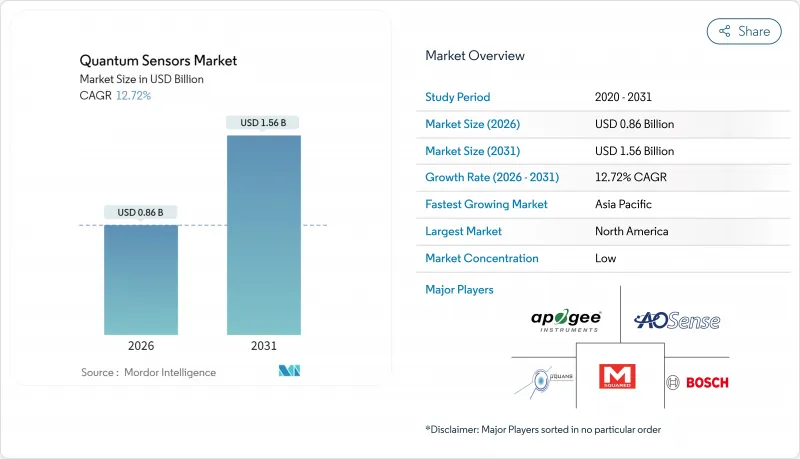
这项快速发展得益于政府和私人部门的共同投资,旨在克服传统感测技术在授时、导航和原位测量任务方面的限制。美国打击GPS欺骗的计画、中国和欧洲的旗舰计划以及波音公司的量子惯性系统飞行测试都表明,市场对具备战略级性能的可靠设备有着迫切的需求。超过250亿美元的国家量子预算加剧了国内供应链的竞争。同时,晶圆级製造技术的进步正在降低单位成本,并开闢新的商业性途径。航太机构、通讯业者、自动驾驶汽车开发商和云端资料中心所有者正在探索从奈秒同步到地下资源测绘等系统级优势。儘管仍存在一些挑战,例如冷原子元件的退相干、出口管制条例和碱金属蒸气池瓶颈等,但误差补偿演算法和CMOS相容製程的进步正在不断降低部署风险。
全球量子感测器市场趋势及展望
增加对量子定位、导航和授时(PNT)技术的国防投入
美国自2024年起签订的总额达27亿美元的合约表明,即使在GPS讯号受到干扰或欺骗的情况下,量子定位、导航和授时系统仍能保持精度,这体现了战略上对此类系统的迫切需求。北约国防创新加速器也表达了类似的优先事项,英国在2024年累计1.85亿英镑用于量子授时和导航技术的研究与开发。澳洲也承诺追加1.27亿澳元用于类似工作,显示全球已达成共识,认为量子定位、导航和授时是自主武器、弹性通讯和远征后勤保障的关键基础技术。因此,各国国防部目前正在并行采购手錶、量子加速计和量子磁力计,从而形成长尾需求,以稳定早期供应链。供应商的蓝图也日益强调抗辐射封装、抗衝击性和现场校准工具的重要性,以满足严格的军用标准。
国家量子倡议和预算
中国耗资150亿美元的国家量子资讯科学实验室、美国重启的120亿美元国家量子倡议以及欧盟70亿欧元的量子旗舰计划,都是致力于将量子感测器製度化为一项自主技术的倡议。日本耗资1兆日圆的「登月计画」明确设定了2030年实现商业化里程碑的目标,旨在将学术突破与企业生产线连结起来。这些多年预算拨款为大学、国防主要企业和Start-Ups提供可预测的资金,促进合作先导计画和交叉授权协议的达成。同时,这些拨款也触发了出口管制法规,鼓励国内采购蒸气池组件、雷射和真空子组件。由此产生的政策组合虽然增加了短期合规成本,但确保了开发平臺的持续畅通,从而为量子感测器市场提供充足的供应。
安装和维修成本高昂
冷原子干涉仪需要超高真空腔、雷射频率锁定和磁屏蔽,这些加起来导致每个站点的资本支出高达200万美元——比传统加速计高出几个数量级。氮气填充钻石元件可能需要低温运行,这需要额外的氦气处理系统和伺服控制子系统。精通原子物理和光学的工程师供不应求,他们的人事费用推高了营运成本。行动和机载用户还面临着在严格的尺寸、重量和功耗(SWaP)限制下进行隔振、增压和温度控管的额外负担,这限制了其应用范围,使其仅限于量子性能具有明确商业价值的高端应用。
细分市场分析
到2025年,手錶仍将占据量子感测器市场31.45%的最大份额,因为电信营运商和资料中心营运商需要同步其网络,从而对纳秒级精度提出要求。量子重力仪和梯度仪是成长最快的产品类别,预计到2031年将以15.92%的复合年增长率成长,因为地球观测卫星和油气探勘计划需要高解析度的质量密度图。量子磁力计应用于神经学、矿产探勘和电子战任务,而量子加速计和陀螺仪则支援在GPS不可用环境下进行惯性导航。 PAR量子感测器和各种细分领域的设备完善了日益多元化的产品线。供应商正在将多种感测器类型整合到混合有效载荷中,从而能够从单一模组获取时间、惯性和磁性资料流,以支援自主系统的融合演算法。这种融合有望实现规模经济和扩大基本客群,从而支撑量子感测器市场的持续收入成长。
第二波创新浪潮聚焦于晶圆级製造技术,可将蒸气单元和光子波导管直接嵌入CMOS背板。早期原型已实现组件成本降低40%,并提升了热稳定性。掌握这些製程的供应商将能够提供晶粒级子系统用于大规模生产,从而加速其在工业自动化、精密农业和智慧电网监控等领域的应用。Start-Ups、国防主要企业和半导体代工厂之间的交叉授权表明,标准化外形规格的转变即将到来,这将与传统MEMS感测器的商业化进程相呼应。
由于数十年的实验室检验和日益成熟的雷射冷却技术,冷原子干涉仪在2025年占据了量子感测器市场44.35%的份额。它们在重力和惯性测量方面无与伦比的灵敏度,仍然是大地测量和国防项目的核心。氮空位钻石感测器具有室温工作和生物相容性,为心磁图、脑磁图和奈米材料研究铺平了道路,并创下了16.63%的年复合成长率,成为成长最快的领域。里德堡原子电场感测器具有100 MHz的瞬时频宽,能够应用于先前量子技术无法触及的雷达和频谱分析领域。光机器零件和光子装置实现了与现有光学仪器的晶片级集成,而超导干涉仪系统则实现了亚飞特斯拉级的灵敏度,可用于低温物理研究。
虽然机制的多样化扩大了目标市场,但也给零件供应链带来了压力。钻石生长室、铯/铷蒸气池和高相干雷射二极体都需要专用的生产设备。生态系统参与者正透过组成联盟来应对这一挑战,共用智慧财产权并共同投资建设联合设施,以期获得规模经济效益,从而满足量子感测器市场多学科领域需求的激增。
量子感测器市场按产品类型(手錶、量子磁力计等)、感测机制(冷原子干涉法、氮空位钻石等)、部署平台(地面、机载、天基等)、最终用户(国防安全、航太卫星等)和地区进行细分。市场预测以美元价值为单位。
区域分析
预计到2025年,北美将占全球收入的36.40%,这得益于DARPA、NASA和美国国家科学基金会(NSF)资助的研究丛集,以及国防部源源不断的合同,这些合同降低了供应商在加固型设计方面的投资风险。诸如ITAR之类的出口管制框架在保护本地智慧财产权的同时,也施加了许可方面的负担,并将初始生产集中在美国本土的晶圆厂。围绕加拿大滑铁卢形成的量子研究走廊正在引入互补的光子整合技术,并扩展区域生态系统。
亚太地区预计将以15.95%的复合年增长率成为成长最快的地区,这主要得益于中国150亿美元的量子计画以及日本雄心勃勃的倡议旨在连接学术联盟与电子和材料领域的工业巨头。澳洲正在资助一个商业化中心,以连接Start-Ups与采矿和国防领域的终端用户;而韩国正在製定蓝图,为能够製造沉淀单元和钻石缺陷的半导体代工厂提供税收优惠。这波投资浪潮使该地区成为量子感测器市场供需两端的关键参与者,并巩固了其在量子感测器市场的地位。
在70亿欧元的「量子技术旗舰计画」的推动下,欧洲保持着稳健而适度的成长态势。德国、法国和荷兰分别专注于半导体製造设备、雷射系统和原子晶片封装,从而建构了跨境供应链。欧洲太空总署(ESA)的一项太空感测器合约正在将大学和主要企业的航太公司聚集在一起,共同将冷原子有效载荷整合到先进的小型卫星载具。关于两用物项出口管制和资料主权问题的法规的明确,使得欧洲供应商能够瞄准民营市场的细分领域,例如精密农业和智慧电网监控,而无需受到同样程度的《国际武器贸易条例》(ITAR)的限制。
其他福利:
- Excel格式的市场预测(ME)表
- 3个月的分析师支持
目录
第一章 引言
- 研究假设和市场定义
- 调查范围
第二章调查方法
第三章执行摘要
第四章 市场情势
- 市场概览
- 市场驱动因素
- 增加对量子定位、导航和授时(PNT)技术的国防投入
- 国家量子倡议和预算
- 高精度自主导航的需求
- 量子手錶在通讯和资料中心领域的商业部署
- 星载气候监测重力仪
- 晶圆级製造技术推动成本降低
- 市场限制
- 高昂的实施和维修成本
- 冷原子系统中的环境敏感性/退相干
- 碱性蒸气电池供应链中的瓶颈(未被察觉)
- 对量子技术的出口管制限制(未引起太多关注)
- 产业价值链分析
- 监管环境
- 技术展望
- 波特五力分析
- 供应商的议价能力
- 买方的议价能力
- 新进入者的威胁
- 替代品的威胁
- 竞争程度
第五章 市场规模与成长预测
- 依产品类型
- 手錶
- 量子磁力计
- 量子加速计/陀螺仪
- 量子重力仪/梯度仪
- PAR量子感测器
- 其他产品类型
- 透过感测机制
- 冷原子干涉测量
- 氮空位(NV)钻石
- 里德堡原子电场感测器
- 光机/光电感测器
- 超导性量子干涉装置
- 透过部署平台
- 地面
- 机载
- 天基
- 海洋/地下
- 最终用户
- 国防与安全
- 太空/卫星
- 石油、天然气和采矿
- 医疗保健和生命科学
- 交通运输和汽车
- 电信和资料中心
- 按地区
- 北美洲
- 美国
- 加拿大
- 墨西哥
- 南美洲
- 巴西
- 智利
- 南美洲其他地区
- 欧洲
- 德国
- 英国
- 法国
- 义大利
- 俄罗斯
- 其他欧洲
- 亚太地区
- 中国
- 日本
- 韩国
- 澳洲
- 印度
- 亚太其他地区
- 中东和非洲
- 中东
- 沙乌地阿拉伯
- 阿拉伯聯合大公国
- 土耳其
- 其他中东地区
- 非洲
- 南非
- 奈及利亚
- 其他非洲地区
- 中东
- 北美洲
第六章 竞争情势
- 市场集中度
- 策略趋势
- 市占率分析
- 公司简介
- AOSense Inc.
- Robert Bosch GmbH
- Muquans SAS(iXblue)
- M Squared Lasers Ltd.
- Microchip Technology Inc.
- Apogee Instruments Inc.
- Campbell Scientific Inc.
- LI-COR Biosciences Inc.
- Skye Instruments Ltd.
- Q-CTRL Pty Ltd
- Infleqtion Inc.
- SBQuantum Inc.
- iXblue SAS
- Teledyne e2v Semiconductors
- Honeywell Quantum Solutions(Quantinuum)
- Surrey Satellite Technology Ltd.
- SiTime Corp.
- Micro-G LaCoste LLC
- Atomionics Pte Ltd.
- SBQ Instruments AB
第七章 市场机会与未来展望
The quantum sensors market size in 2026 is estimated at USD 0.86 billion, growing from 2025 value of USD 0.76 billion with 2031 projections showing USD 1.56 billion, growing at 12.72% CAGR over 2026-2031.
This rapid expansion stems from synchronized government and commercial investments aimed at overcoming the limits of classical sensing in timing, navigation, and field-measurement tasks. Pentagon programs that counter GPS spoofing, Chinese and European flagship projects, and Boeing's flight tests of quantum inertial systems validate near-term demand for ruggedized devices capable of strategic-grade performance. National quantum budgets topping USD 25 billion intensify the race to secure domestic supply chains, while wafer-scale fabrication lowers unit costs and opens fresh commercial pathways. Space agencies, telecom operators, autonomous vehicle developers, and cloud data-center owners now explore system-level benefits ranging from nanosecond synchronization to subsurface resource mapping. Headwinds persist-decoherence in cold-atom devices, export-control regimes, and alkali-vapor cell bottlenecks-but advances in error-compensation algorithms and CMOS-compatible processes continue to reduce deployment risk.
Global Quantum Sensors Market Trends and Insights
Growing Defense Funding for Quantum PNT
Pentagon contracts worth USD 2.7 billion issued since 2024 illustrate the strategic need for quantum positioning, navigation and timing systems that remain accurate when GPS signals are jammed or spoofed. NATO's Defence Innovation Accelerator echoes this priority, and the United Kingdom earmarked GBP 185 million for quantum timing and navigation R&D in 2024. Australia added AUD 127 million to similar efforts, underscoring a global consensus that quantum PNT is a critical enabler of autonomous weapons, resilient communications and expeditionary logistics. As a result, defense ministries now procure atomic clocks, quantum accelerometers and magnetometers in parallel, creating long-tail demand that stabilizes early-stage supply chains. Vendor roadmaps increasingly emphasize radiation-hardened packaging, shock tolerance and field-calibration tools to satisfy stringent military standards.
National Quantum Initiatives & Budgets
China's USD 15 billion National Laboratory for Quantum Information Sciences, the renewed USD 12 billion US National Quantum Initiative and the EU's EUR 7 billion Quantum Flagship collectively institutionalize quantum sensors as sovereignty technologies. Japan's trillion-yen moonshot program specifically targets commercialization milestones by 2030, linking academic breakthroughs to corporate manufacturing lines. Such multi-year appropriations deliver predictable funding for universities, defense primes and start-ups, stimulating joint pilot projects and cross-licensing agreements. They also trigger protective export-control regimes that encourage local sourcing of vapor-cell components, lasers and vacuum sub-assemblies. The resulting policy mix raises near-term compliance costs yet guarantees sustained R&D pipelines feeding the quantum sensors market.
High Deployment & Maintenance Costs
Cold-atom interferometers require ultra-high vacuum chambers, laser-frequency locks and magnetic shielding that together raise capital outlay to as much as USD 2 million per site-orders of magnitude above classical accelerometers. Nitrogen-vacancy diamond devices must sometimes operate at cryogenic temperatures, introducing helium handling and servo-control subsystems. Skilled technicians versed in atomic physics and optics are scarce, and their salaries amplify OPEX. Mobile and airborne users face additional burdens of vibration isolation, pressurization and thermal management within tight SWaP envelopes, limiting uptake to premium applications where quantum performance delivers clear ROI.
Other drivers and restraints analyzed in the detailed report include:
- Demand for High-Precision Autonomous Navigation
- Commercial Rollout of Quantum Clocks in Telecom/Datacenters
- Spaceborne Climate-Monitoring Gravimeters
- Environmental Sensitivity of Cold-Atom Systems
For complete list of drivers and restraints, kindly check the Table Of Contents.
Segment Analysis
Atomic clocks maintained the largest 31.45% share of the quantum sensors market in 2025 as telecom carriers and data-center operators synchronized networks requiring nanosecond accuracy. Quantum gravimeters and gradiometers are the fastest-growing product cohort, expanding at a 15.92% CAGR through 2031 as Earth-observation satellites and oil-and-gas exploration projects seek higher-resolution mass-density maps. Quantum magnetometers service neurology, mineral prospecting and electronic-warfare tasks, whereas quantum accelerometers and gyroscopes underpin inertial navigation when GPS is denied. PAR quantum sensors and miscellaneous niche devices round out an increasingly diversified catalogue. Vendors now integrate multiple sensor types into hybrid payloads, enabling single modules to output timing, inertial and magnetic data streams for autonomous-system fusion algorithms. This convergence promises economy of scale and a broader customer base, supporting sustained revenue lift for the quantum sensors market.
A second wave of innovation centers on wafer-scale fabrication that embeds vapor cells and photonic waveguides directly on CMOS backplanes. Early prototypes achieve 40% component cost reduction and improved thermal stability. Suppliers that master these processes can ship die-level subsystems for high-volume assembly, accelerating diffusion into industrial automation, precision agriculture and smart-grid monitoring. Cross-licensing among start-ups, defense primes and semiconductor foundries signals imminent shifts toward standardized form factors that mirror classical MEMS sensor commoditization.
Cold-atom interferometry led with 44.35% quantum sensors market share in 2025, benefiting from decades of lab validation and steadily maturing laser cooling techniques. Its unmatched sensitivity in gravimetry and inertial measurement remains central to geodesy and defense programs. Nitrogen-vacancy diamond sensors post the swiftest 16.63% CAGR thanks to room-temperature operation and biocompatibility that open paths in magnetocardiography, magnetoencephalography and nanoscale materials research. Rydberg-atom electric-field sensors, with 100 MHz instantaneous bandwidth, target radar and spectrum-analysis tasks formerly outside quantum reach. Optomechanical and photonic devices promise chip-level integration with existing optical equipment, while superconducting interference systems deliver sub-femtotesla sensitivity for cryogenic physics.
Diversification of mechanisms broadens addressable markets yet places pressure on component supply chains. Diamond growth chambers, cesium/rubidium vapor cells and high-coherence laser diodes each require specialized manufacturing setups. Ecosystem players respond by forming consortia that pool IP and co-invest in shared facilities, anticipating the economies of scale necessary to satisfy multi-sector demand spikes in the quantum sensors market.
Quantum Sensors Market Segmented by Product Type (Atomic Clocks, Quantum Magnetometers and More), Sensing Mechanism (Cold-Atom Interferometry, Nitrogen-Vacancy Diamond and More), Deployment Platform (Ground-Based, Airborne, Spaceborne, and More), End-User (Defense & Security, Space & Satellite and More), and Geography. The Market Forecasts are Provided in Terms of Value (USD).
Geography Analysis
North America held 36.40% of global revenue in 2025, anchored by DARPA, NASA and National Science Foundation-funded research clusters plus a steady flow of Pentagon contracts that de-risk supplier investment in ruggedized designs. Export-control frameworks such as ITAR impose licensing overhead but also protect local intellectual property, concentrating early production in US-based fabs. Canada's quantum research corridor around Waterloo adds complementary photonic-integration expertise, expanding the regional ecosystem.
Asia-Pacific is on track for the fastest 15.95% CAGR, driven by China's USD 15 billion quantum program and Japan's moonshot initiative that pairs academic consortia with industrial titans in electronics and materials. Australia funds commercialization centers that match start-ups with end users in mining and defense, while South Korea's roadmap allocates tax incentives for semiconductor foundries capable of vapor-cell and diamond-defect manufacture. This investment wave positions the region as both a demand and supply powerhouse, elevating its weight in the quantum sensors market.
Europe maintains a cohesive, moderate-growth trajectory under the EUR 7 billion Quantum Technologies Flagship. Germany, France and the Netherlands specialize respectively in semiconductor tooling, laser systems and atomic-chip packaging, forming a transnational supply chain. ESA's space-sensor contracts pull universities and aerospace primes into joint ventures that combine cold-atom payloads with advanced small-sat buses. Regulatory clarity on dual-use export and data-sovereignty issues helps European vendors target civil-market niches such as precision agriculture and smart-grid monitoring without facing the same degree of ITAR restraints.
- AOSense Inc.
- Robert Bosch GmbH
- Muquans SAS (iXblue)
- M Squared Lasers Ltd.
- Microchip Technology Inc.
- Apogee Instruments Inc.
- Campbell Scientific Inc.
- LI-COR Biosciences Inc.
- Skye Instruments Ltd.
- Q-CTRL Pty Ltd
- Infleqtion Inc.
- SBQuantum Inc.
- iXblue SAS
- Teledyne e2v Semiconductors
- Honeywell Quantum Solutions (Quantinuum)
- Surrey Satellite Technology Ltd.
- SiTime Corp.
- Micro-G LaCoste LLC
- Atomionics Pte Ltd.
- SBQ Instruments AB
Additional Benefits:
- The market estimate (ME) sheet in Excel format
- 3 months of analyst support
TABLE OF CONTENTS
1 INTRODUCTION
- 1.1 Study Assumptions and Market Definition
- 1.2 Scope of the Study
2 RESEARCH METHODOLOGY
3 EXECUTIVE SUMMARY
4 MARKET LANDSCAPE
- 4.1 Market Overview
- 4.2 Market Drivers
- 4.2.1 Growing defense funding for quantum PNT
- 4.2.2 National quantum initiatives and budgets
- 4.2.3 Demand for high-precision autonomous navigation
- 4.2.4 Commercial rollout of quantum clocks in telecom/datacenters
- 4.2.5 Spaceborne climate-monitoring gravimeters
- 4.2.6 Wafer-scale fabrication drives cost decline
- 4.3 Market Restraints
- 4.3.1 High deployment and maintenance costs
- 4.3.2 Environmental sensitivity/decoherence of cold-atom systems
- 4.3.3 Alkali-vapor cell supply-chain bottlenecks (under-radar)
- 4.3.4 Export-control restrictions on quantum tech (under-radar)
- 4.4 Industry Value Chain Analysis
- 4.5 Regulatory Landscape
- 4.6 Technological Outlook
- 4.7 Porter's Five Forces Analysis
- 4.7.1 Bargaining Power of Suppliers
- 4.7.2 Bargaining Power of Buyers
- 4.7.3 Threat of New Entrants
- 4.7.4 Threat of Substitutes
- 4.7.5 Degree of Competition
5 MARKET SIZE AND GROWTH FORECASTS (VALUE)
- 5.1 By Product Type
- 5.1.1 Atomic Clocks
- 5.1.2 Quantum Magnetometers
- 5.1.3 Quantum Accelerometers and Gyroscopes
- 5.1.4 Quantum Gravimeters and Gradiometers
- 5.1.5 PAR Quantum Sensors
- 5.1.6 Other Product Types
- 5.2 By Sensing Mechanism
- 5.2.1 Cold-Atom Interferometry
- 5.2.2 Nitrogen-Vacancy (NV) Diamond
- 5.2.3 Rydberg-Atom Electric-Field Sensors
- 5.2.4 Optomechanical / Photonic Sensors
- 5.2.5 Superconducting Quantum Interference Sensors
- 5.3 By Deployment Platform
- 5.3.1 Ground-based
- 5.3.2 Airborne
- 5.3.3 Spaceborne
- 5.3.4 Marine / Sub-surface
- 5.4 By End-user
- 5.4.1 Defense and Security
- 5.4.2 Space and Satellite
- 5.4.3 Oil, Gas and Mining
- 5.4.4 Healthcare and Life Sciences
- 5.4.5 Transportation and Automotive
- 5.4.6 Telecom and Datacenters
- 5.5 By Geography
- 5.5.1 North America
- 5.5.1.1 United States
- 5.5.1.2 Canada
- 5.5.1.3 Mexico
- 5.5.2 South America
- 5.5.2.1 Brazil
- 5.5.2.2 Chile
- 5.5.2.3 Rest of South America
- 5.5.3 Europe
- 5.5.3.1 Germany
- 5.5.3.2 United Kingdom
- 5.5.3.3 France
- 5.5.3.4 Italy
- 5.5.3.5 Russia
- 5.5.3.6 Rest of Europe
- 5.5.4 Asia-Pacific
- 5.5.4.1 China
- 5.5.4.2 Japan
- 5.5.4.3 South Korea
- 5.5.4.4 Australia
- 5.5.4.5 India
- 5.5.4.6 Rest of Asia Pacific
- 5.5.5 Middle East and Africa
- 5.5.5.1 Middle East
- 5.5.5.1.1 Saudi Arabia
- 5.5.5.1.2 United Arab Emirates
- 5.5.5.1.3 Turkey
- 5.5.5.1.4 Rest of Middle East
- 5.5.5.2 Africa
- 5.5.5.2.1 South Africa
- 5.5.5.2.2 Nigeria
- 5.5.5.2.3 Rest of Africa
- 5.5.5.1 Middle East
- 5.5.1 North America
6 COMPETITIVE LANDSCAPE
- 6.1 Market Concentration
- 6.2 Strategic Moves
- 6.3 Market Share Analysis
- 6.4 Company Profiles (includes Global level Overview, Market level overview, Core Segments, Financials as available, Strategic Information, Market Rank/Share for key companies, Products and Services, and Recent Developments)
- 6.4.1 AOSense Inc.
- 6.4.2 Robert Bosch GmbH
- 6.4.3 Muquans SAS (iXblue)
- 6.4.4 M Squared Lasers Ltd.
- 6.4.5 Microchip Technology Inc.
- 6.4.6 Apogee Instruments Inc.
- 6.4.7 Campbell Scientific Inc.
- 6.4.8 LI-COR Biosciences Inc.
- 6.4.9 Skye Instruments Ltd.
- 6.4.10 Q-CTRL Pty Ltd
- 6.4.11 Infleqtion Inc.
- 6.4.12 SBQuantum Inc.
- 6.4.13 iXblue SAS
- 6.4.14 Teledyne e2v Semiconductors
- 6.4.15 Honeywell Quantum Solutions (Quantinuum)
- 6.4.16 Surrey Satellite Technology Ltd.
- 6.4.17 SiTime Corp.
- 6.4.18 Micro-G LaCoste LLC
- 6.4.19 Atomionics Pte Ltd.
- 6.4.20 SBQ Instruments AB
7 MARKET OPPORTUNITIES AND FUTURE OUTLOOK
- 7.1 White-space and Unmet-need Assessment

 量子感测器市场预测至2034年—全球产品类型、检测机制、组件、部署平台、技术平台、应用、最终用户和区域分析
 量子感测器市场:按产品、应用和地区划分,2026-2034年
 量子感测器市场:2026-2032年全球市场预测(按感测器类型、组件类型、量子感测方法、终端用户产业、应用和分销管道划分)
 量子感测器:超越通讯和量子纠缠。
 2026年全球量子感测器市场报告
 全球量子感测器市场(2026-2046)
 量子感测器市场分析及预测(至2035年):依类型、产品类型、技术、组件、应用、材料类型、装置、最终用户、功能及部署方式划分量子感测器市场规模、占有率、成长及全球产业分析:依类型、应用和地区划分的洞察与预测(2026-2034)
 量子感测器市场-全球产业规模、份额、趋势、机会及预测(依产品、垂直产业、地区及竞争格局划分,2021-2031年)
 量子感测器市场规模、份额及成长分析(按平台、产品类型、应用、最终用户和地区划分)-2026-2033年产业预测