


 |
市场调查报告书
商品编码
1910632
塑胶薄膜:市场占有率分析、产业趋势与统计、成长预测(2026-2031)Plastic Film - Market Share Analysis, Industry Trends & Statistics, Growth Forecasts (2026 - 2031) |
||||||

※ 本网页内容可能与最新版本有所差异。详细情况请与我们联繫。
预计塑胶薄膜市场将从 2025 年的 703 亿美元成长到 2026 年的 725.3 亿美元,到 2031 年将达到 846.7 亿美元,2026 年至 2031 年的复合年增长率为 3.18%。
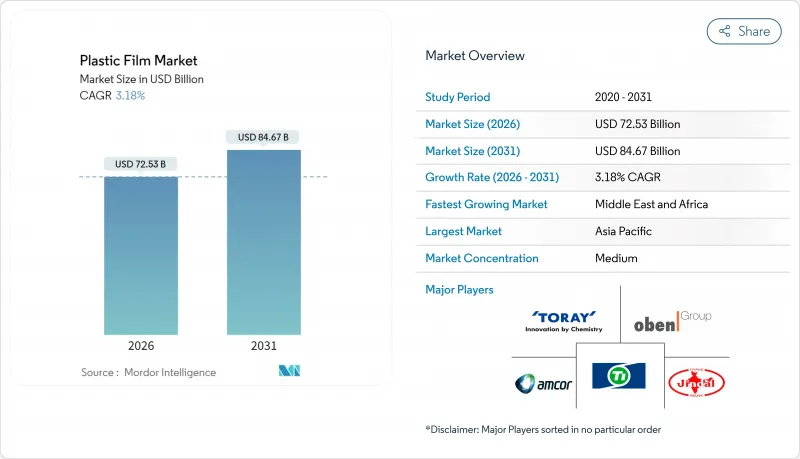
这一趋势反映出市场日趋成熟,以高附加价值特种高阻隔薄膜为主导,这些薄膜主要销往医疗、电子和电子商务产业。日益严格的监管压力推动了循环经济目标的实现,加速了向可回收的整体式结构和经认证的可堆肥等级产品的转变,而原材料价格的持续波动则给加工商的利润率带来了压力。那些对树脂和薄膜资产进行垂直管理的製造商,正透过减薄、阻隔涂层和回收等措施来降低价格波动的影响,并获得溢价。
全球塑胶薄膜市场趋势与洞察
向消费后单一材料可回收薄膜结构过渡
循环经济政策正迅速以单组分薄膜取代传统的多层结构,这些单组分薄膜既符合回收标准,又不影响性能。为了响应欧洲在2030年实现全面回收的法规,像Uzel Plastić这样的加工商已经推出了聚乙烯宠物食品薄膜,这种薄膜无需黏合剂层,同时仍能保持氧气阻隔性。品牌商正透过与永续性指标挂钩的多年供应合约来奖励早期采用者,但对新型挤出和黏合剂系统的初始投资正在挤压短期利润空间。製药业也在进行转型,Klöckner Pentaplast推出了一种单组分泡壳薄膜,这种薄膜简化了下游回收流程,同时又符合严格的医疗法规。预计到2030年,这种发展势头将推动单组分薄膜的市占率从2024年的60%成长到塑胶薄膜市场的三分之二。
由于监管更加严格,可生物降解和可堆肥薄膜的使用量增加。
各州和国家层级的法规交织在一起,推动了对经认证的可堆肥薄膜的需求,尤其是在餐饮服务和农产品包装领域。华盛顿州的标籤和工厂认证规定制定了全球供应商必须遵守的技术标准。明尼苏达州的工业可堆肥性强制令正在影响超级市场的自有品牌规格。像DNP集团这样拥有雄厚研发预算的供应商,正在将多层可堆肥结构商业化,这种结构能够在90天内完全分解,同时保持良好的气体阻隔性能,从而保护零食食品。缺乏统一的全球标准仍然是一个障碍,迫使加工商生产特定国家的产品,从而推高了合规成本。
聚烯和PET原料价格波动
现货PET和LDPE价格每季波动15-20%,对利润率带来压力,尤其是对于非一体化生产商的加工商而言。根据ChemOrbis的数据,2024年PET价格预计在每吨1200美元至1450美元之间波动,这使得依赖现货树脂的供应商签订长期合约风险较高。亚洲BOPET市场的供应过剩已将实际价格推至历史低点。 Firsta集团的部分产品利润率甚至低于每公斤15印度卢比,导致部分厂房暂时停产。更长的运输时间进一步加剧了库存管理的复杂性,迫使小规模加工商在价格回落时承担损失。
细分市场分析
到2025年,聚乙烯仍将占总产量的39.12%,这主要得益于茂金属触媒技术的进步。该技术可在不牺牲刚度和透明度的前提下,将薄膜厚度降低高达20%。即使在原物料价格受石油价格波动影响的时期,这项优势也能确保稳定的现金流。同时,生质塑胶虽然目前基数小规模,但预计将以5.87%的复合年增长率成长,因为品牌所有者正不断尝试使用可堆肥包装来实现其ESG(环境、社会和治理)目标。甘蔗渣和藻油等第二代原料供应量的增加,缩小了生物塑胶与传统树脂之间的价格差距。然而,由于水解稳定性方面的局限性,大多数生质塑胶在用于阻隔性的医疗和电子应用方面仍然面临挑战。
生质塑胶加工商正与树脂Start-Ups洽谈多年承购协议,以规避价格波动风险。欧盟和北美地区围绕堆肥设施形成的区域丛集也影响着工厂的位置决策。聚丙烯因其优异的耐热性和阻隔性,在杀菌袋应用领域持续扩张。同时,双向拉伸聚酯薄膜(BOPET)生产商正寻求在美国等市场获得反倾销保护,以避免亚洲市场供应过剩。环烯烃共聚物(COC)等特殊聚合物在医疗诊断领域发挥独特的作用,凸显了性能主导差异化在塑胶薄膜市场的重要性。
到2025年,袋装产品将占销售额的47.95%,这主要得益于其便捷的份量控制和能减少食物废弃物的密封强度。零食和宠物食品工厂常用的自动灌装封口生产线也对这种包装形式青睐有加,而数位印刷技术则能为短期宣传活动提供高度客製化的图案。然而,随着全通路杂货店和食材自煮包服务对耐穿孔薄膜的需求日益增长,预计外包装和覆膜包装的年复合成长率将达到4.56%,因为这些薄膜需要与高速装袋机器人相容。对低温运输支援日益增长的需求推动了对即使在零下温度下仍能保持延展性的防潮材料的需求,而基于双向拉伸聚丙烯(BOPP)的复合材料最近在该领域备受关注。
加工商正将资料矩阵码整合到二级包装中,以追踪最后一公里配送,从而在材料销售之外创造分析收入来源。无底纸标籤膜和多件装收缩商品搭售仍然很重要,但随着碳酸饮料市场的成熟,其成长速度正在放缓。在所有应用领域,资源高效的薄膜形式,例如具有可控透气性的穿孔农产品包装膜,都符合零售商的永续性,并确保产品在高价位上获得货架空间。
区域分析
亚太地区凭藉着规模经济和快速成长的国内消费,预计到2025年将占据塑胶薄膜市场37.98%的份额。中国在双向拉伸聚酯薄膜(BOPET)和双向拉伸聚丙烯薄膜(BOPP)领域保持领先地位,但产能成长速度比国内需求高出约26万吨/年,挤压了利润空间,并推动了中型加工商之间的併购活动。印度正利用茂金属触媒技术来支援先进的软包装规格,并快速引进新的BOPP生产线。日本成熟的先进技术生态系统为光学薄膜和电池隔膜的创新提供了支持。
北美市场需求更为稳定,而生产回流趋势和永续性正在推动电商领域对可再生聚乙烯(PE)包装的需求。 Polyplex计划在阿拉巴马州投资1亿美元扩建PET薄膜生产线,凸显了区域供应链以及贸易政策确定性的重要性。加工商正越来越多地位置基地迁至物流枢纽附近,以缩短前置作业时间,这对于食材自煮包和药品运输至关重要。
欧洲持续引领政策发展,透过生产者延伸责任制(EPR)附加税抑制不可可再生材料的使用,并鼓励对单一材料升级改造的研发投资。机械回收能力正在不断提升,同时创业投资资金也在支持针对硬质和软质混合原料的化学回收试点计画。
预计到2031年,中东和非洲地区的复合年增长率将达到7.86%,主要得益于进口替代计画和监管激励措施。埃及已启动一项合资项目,投资5,480万美元建造一条再生聚酯纤维生产线,显示当地对循环解决方案的需求日益增长。波湾合作理事会(GCC)成员国正利用油气整合优势,以具竞争力的价格供应聚乙烯(PE),并建立下游薄膜产业丛集,旨在保障区域粮食安全。撒哈拉以南非洲地区人口成长和消费品快速普及推动了需求成长。然而,有限的废弃物管理基础设施可能会限制高品质、永续薄膜的应用。
预计南美洲将实现中等个位数成长,因为品牌食品和个人保健产品跨国公司正在拓展其在农村零售市场的业务,从而带动包装需求成长。南方共同市场成员国之间的货币波动和监管差异使产能规划变得复杂,但家庭收入的成长有助于维持基准消费水准。
其他福利:
- Excel格式的市场预测(ME)表
- 3个月的分析师支持
目录
第一章 引言
- 研究假设和市场定义
- 调查范围
第二章调查方法
第三章执行摘要
第四章 市场情势
- 市场概览
- 市场驱动因素
- 向消费后单一材料可回收薄膜结构过渡
- 随着监管日益严格,可生物降解和可堆肥薄膜的应用范围不断扩大。
- 医疗和电子包装领域对高阻隔薄膜的需求不断增长
- 农业薄膜在垂直农业和温室自动化的应用日益广泛
- 先进的茂金属催化剂能够实现更薄的薄膜
- 由于该地区电子商务低温运输需求激增,对特种薄膜的需求正在扩大。
- 市场限制
- 聚烯和PET原料价格波动
- 新兴经济体严格禁止使用一次性塑胶製品
- 医用PVC树脂供应紧张
- 同步双轴拉伸线的资本密集度
- 产业价值链分析
- 波特五力分析
- 供应商的议价能力
- 买方和消费者的议价能力
- 新进入者的威胁
- 替代品的威胁
- 竞争对手之间的竞争
- 宏观经济因素如何影响市场
第五章 市场规模与成长预测
- 依树脂类型
- 聚丙烯(PP)
- 聚乙烯(PE)
- 聚对苯二甲酸乙二醇酯(BOPET)
- 聚苯乙烯(OPS)
- 生质塑胶
- 其他材料类型
- 透过使用
- 包装和覆材
- 袋装和衬里
- 小袋
- 其他用途
- 电影特辑
- 低阻隔单材料薄膜
- 中等阻隔金属化薄膜
- 高阻隔多层膜
- 用于特殊用途的活性抗菌膜
- 按最终用途行业划分
- 食物
- 糖果和糖果甜点
- 冷冻食品
- 生鲜食品
- 乳製品
- 肉类、家禽和鱼贝类
- 宠物食品
- 其他食品
- 饮料
- 医疗和药品
- 个人及居家护理
- 工业包装
- 其他终端用户产业
- 食物
- 按地区
- 北美洲
- 美国
- 加拿大
- 墨西哥
- 南美洲
- 巴西
- 阿根廷
- 智利
- 其他南美洲
- 欧洲
- 英国
- 德国
- 法国
- 西班牙
- 义大利
- 其他欧洲地区
- 亚太地区
- 中国
- 印度
- 日本
- 澳洲
- 韩国
- 越南
- 亚太其他地区
- 中东和非洲
- 中东
- 沙乌地阿拉伯
- 阿拉伯聯合大公国
- 土耳其
- 其他中东地区
- 非洲
- 南非
- 奈及利亚
- 埃及
- 其他非洲地区
- 中东
- 北美洲
第六章 竞争情势
- 市场集中度
- 策略趋势
- 市占率分析
- 公司简介
- Amcor plc
- Toray Industries, Inc.
- Oben Holding Group SA
- Taghleef Industries LLC
- Jindal Poly Films Limited
- Cosmo First Limited
- Uflex Limited
- DuPont Teijin Films Japan Ltd.
- Sealed Air Corporation
- Mondi plc
- Huhtamki Oyj
- Polifilm GmbH
- CCL Industries Inc.
- Klckner Pentaplast Group
- Innovia Films Ltd.
- Mitsui Chemicals Tohcello, Inc.
- Inteplast Group Corporation
- AR Metallizing NV
- Guangdong Decro Film New Materials Co., Ltd.
第七章 市场机会与未来展望
The plastic film market is expected to grow from USD 70.30 billion in 2025 to USD 72.53 billion in 2026 and is forecast to reach USD 84.67 billion by 2031 at 3.18% CAGR over 2026-2031.
This performance underscores a maturing landscape where incremental value now arises from specialty, high-barrier films sold into medical, electronics, and e-commerce channels. Heightened regulatory attention to circular-economy goals is accelerating a pivot toward recyclable mono-material structures and certified compostable grades, while persistent raw-material price swings continue to test converter margins. Integrated producers with vertical control over resin and film assets are mitigating volatility and capturing premium spreads through downgauging, barrier-coating, and recycling initiatives.
Global Plastic Film Market Trends and Insights
Consumer Shift Toward Mono-Material Recyclable Film Structures
Circular-economy policies are swiftly converting legacy multilayer formats into mono-material films that meet recyclability thresholds without sacrificing performance. European regulations mandating full recyclability by 2030 have already spurred converters such as Uzel Plastik to roll out polyethylene pet-food films that eliminate tie-layer adhesives while preserving oxygen barriers. Brand owners are rewarding early adopters with multi-year supply contracts linked to sustainability metrics, yet initial capital outlays for new extrusion and adhesive systems are trimming near-term margins. Pharmaceutical players are also transitioning; Klockner Pentaplast introduced a mono-material blister film that meets stringent medical compliance while simplifying downstream recycling. This momentum is expected to lift mono-material share from 60% in 2024 toward two-thirds of the plastic film market by 2030.
Growing Adoption of Biodegradable and Compostable Films Amid Regulations
A mosaic of state and national mandates is fueling demand for certified compostable films, particularly in food service and produce packaging. Washington State's labeling and facility-certification rules set a technical benchmark that global suppliers must now match. Minnesota's legislation requiring industrial-composting compatibility is influencing private-label specifications for supermarket chains. Suppliers with robust R&D budgets, such as DNP Group, are commercializing multilayer compostable structures capable of 90-day degradation while sustaining gas-barrier properties that protect snack foods. Lack of harmonized global standards remains a hurdle, forcing converters to produce country-specific SKUs and inflating compliance costs.
Volatility in Polyolefin and PET Feedstock Prices
Quarterly swings of 15-20% in PET and LDPE spot prices have compressed converter spreads, particularly among non-integrated players. ChemOrbis data show PET values oscillating between USD 1,200 and USD 1,450 per ton in 2024, making long-term contracts risky for suppliers dependent on spot resin. Overcapacity in Asia's BOPET segment has driven realizations to historical lows; Firsta Group recorded instances where margins dipped below INR 15/kg, triggering temporary plant shutdowns. Inventory management is further complicated by lengthy transit times, causing small converters to absorb losses during price retracements.
Other drivers and restraints analyzed in the detailed report include:
- Rising Demand for High-Barrier Films in Medical and Electronics Packaging
- Expansion of Agri-Film Usage in Vertical Farming and Greenhouse Automation
- Stringent Single-Use Plastic Bans in Emerging Economies
For complete list of drivers and restraints, kindly check the Table Of Contents.
Segment Analysis
Polyethylene retained 39.12% of 2025 volume, underpinned by metallocene catalyst technology that slashed film gauge by up to 20% without surrendering stiffness or clarity. This dominance supplied predictable cash flows even when oil-linked feedstock costs spiked. In contrast, bioplastics, though representing a modest baseline, are set to post a 5.87% CAGR as brand owners deploy compostable packaging pilots to meet ESG targets. Rising supply of second-generation feedstock, including sugarcane bagasse and algae oils, has clipped the cost premium to conventional resins. Still, high-barrier medical and electronics uses remain out of reach for most bioplastics due to hydrolytic-stability constraints.
Converters courting the bioplastic subsector are negotiating multi-year off-take pacts with resin start-ups to hedge price-volatility risk. Regional clustering around EU and North-American compost facilities also influences plant-location decisions. Polypropylene continues expanding within retort pouch applications, benefiting from heat-resistance and grease-barrier traits, while BOPET producers seek anti-dumping shelters in markets like the United States to escape Asian oversupply. Specialty polymers such as cyclic olefin copolymers fill niche roles in medical diagnostics, emphasizing the value of performance-led differentiation within the plastic film market.
The pouch format delivered 47.95% of 2025 sales thanks to portion-control convenience and seal-integrity that reduces food waste. Automated form-fill-seal lines, common in snack and pet-food factories, favor its geometry, while digital printing allows hyper-customized graphics for short campaigns. However, wraps and overwraps are forecast to grow at 4.56% CAGR as omnichannel grocery and meal-kit services demand puncture-resistant films compatible with high-speed bagging robots. Cold-chain compliance amplifies the need for moisture barriers that stay ductile at sub-zero temperatures, an area where BOPP-based laminates have recently gained traction.
Converters are integrating data-matrix codes into secondary wraps to track last-mile delivery conditions, creating analytics revenue streams beyond the material sale itself. Linerless label films and shrink-bundling for multipacks remain important, though growth is slower due to maturation in carbonated-drink markets. Across applications, film formats enabling resource efficiency such as perforated produce wraps that modulate respiration align with retailer sustainability pledges and thus secure shelf space despite premium pricing.
The Plastic Film Market Report is Segmented by Resin Type (Polypropylene, Polyethylene, BOPET, Polystyrene, Bioplastics, and More), Application (Wraps and Overwraps, Bags and Linings, and More), Film Functionality (Low-Barrier Mono-Material, Medium-Barrier Metallised, and More), End-Use Industry (Food, Beverages, Healthcare and Pharmaceutical, and More), and Geography. The Market Forecasts are Provided in Terms of Value (USD).
Geography Analysis
Asia-Pacific secured a 37.98% share of the plastic film market in 2025 by pairing scale economies with burgeoning domestic consumption. China maintains dominance in BOPET and BOPP, though capacity additions have outstripped local demand by roughly 260,000 t a year, pressing margins and catalyzing M&A among mid-tier converters. India leverages metallocene-catalyst technology to serve upgraded pouch formats and is onboarding new BOPP lines at a brisk pace. Japan's mature yet highly technical ecosystem sustains innovation in optical and battery-separator films.
North America's demand is steadier, buoyed by on-shoring trends and sustainability mandates that push recyclable PE wraps for e-commerce. Polyplex's USD 100 million PET-film expansion in Alabama illustrates the pull of regional supply chains aligned with trade-policy certainty. Converters increasingly co-locate with logistics hubs to shrink lead times, a factor critical for meal-kit and pharmaceutical shipments.
Europe continues to act as a policy bellwether; extended-producer-responsibility (EPR) fees penalize non-recyclable formats, driving R&D dollars into mono-material upgrades. Mechanical-recycling capacity additions are ramping, and venture funds are backing chemical-recycling pilots aimed at rigid-flexible feedstock mixes.
The Middle East and Africa is poised for a 7.86% CAGR through 2031 on the back of import-substitution plans and regulatory incentives. Egypt's joint venture to build a recycled-polyester fiber line worth USD 54.8 million signals rising local appetite for circular solutions. Gulf Cooperation Council members leverage hydrocarbon integration to supply competitively priced PE, spawning downstream film clusters that aim to capture regional food-security programs. Sub-Saharan Africa's demand growth is driven by population expansion and fast-moving consumer-goods uptake, though infrastructure gaps in waste management may moderate adoption of premium sustainable films.
South America delivers mid-single-digit growth as branded food and personal-care multinationals widen rural retail penetration, creating incremental packaging needs. Currency volatility and regulatory divergence between Mercosur nations complicate capacity planning, yet rising household incomes sustain baseline consumption.
- Amcor plc
- Toray Industries, Inc.
- Oben Holding Group S.A.
- Taghleef Industries LLC
- Jindal Poly Films Limited
- Cosmo First Limited
- Uflex Limited
- DuPont Teijin Films Japan Ltd.
- Sealed Air Corporation
- Mondi plc
- Huhtamki Oyj
- Polifilm GmbH
- CCL Industries Inc.
- Klckner Pentaplast Group
- Innovia Films Ltd.
- Mitsui Chemicals Tohcello, Inc.
- Inteplast Group Corporation
- AR Metallizing N.V.
- Guangdong Decro Film New Materials Co., Ltd.
Additional Benefits:
- The market estimate (ME) sheet in Excel format
- 3 months of analyst support
TABLE OF CONTENTS
1 INTRODUCTION
- 1.1 Study Assumptions and Market Definition
- 1.2 Scope of the Study
2 RESEARCH METHODOLOGY
3 EXECUTIVE SUMMARY
4 MARKET LANDSCAPE
- 4.1 Market Overview
- 4.2 Market Drivers
- 4.2.1 Consumer shift toward mono-material recyclable film structures
- 4.2.2 Growing adoption of biodegradable and compostable films amid regulations
- 4.2.3 Rising demand for high-barrier films in medical and electronics packaging
- 4.2.4 Expansion of agri-film usage in vertical farming and greenhouse automation
- 4.2.5 Film downgauging enabled by advanced metallocene catalysts
- 4.2.6 Surge in regional e-commerce cold-chain requiring specialty films
- 4.3 Market Restraints
- 4.3.1 Volatility in polyolefin and PET feedstock prices
- 4.3.2 Stringent single-use plastic bans in emerging economies
- 4.3.3 Supply tightness of medical-grade PVC resin
- 4.3.4 Capital intensity of synchronous biax orientation lines
- 4.4 Industry Value Chain Analysis
- 4.5 Porters Five Forces Analysis
- 4.5.1 Bargaining Power of Suppliers
- 4.5.2 Bargaining Power of Buyers/Consumers
- 4.5.3 Threat of New Entrants
- 4.5.4 Threat of Substitute Products
- 4.5.5 Intensity of Competitive Rivalry
- 4.6 Impact of Macroeconomic Factors on the Market
5 MARKET SIZE AND GROWTH FORECASTS (VALUE)
- 5.1 By Resin Type
- 5.1.1 Polypropylene (PP)
- 5.1.2 Polyethylene (PE)
- 5.1.3 Polyethylene-terephthalate (BOPET)
- 5.1.4 Polystyrene (OPS)
- 5.1.5 Bioplastics
- 5.1.6 Other Material Types
- 5.2 By Application
- 5.2.1 Wraps and Overwraps
- 5.2.2 Bags and Linings
- 5.2.3 Pouches
- 5.2.4 Other Applications
- 5.3 By Film Functionality
- 5.3.1 Low-Barrier Mono-material Films
- 5.3.2 Medium-Barrier Metallised Films
- 5.3.3 High-Barrier Multilayer Films
- 5.3.4 Specialty Active and Antimicrobial Films
- 5.4 By End-use Industry
- 5.4.1 Food
- 5.4.1.1 Candy and Confectionery
- 5.4.1.2 Frozen Foods
- 5.4.1.3 Fresh Produce
- 5.4.1.4 Dairy Products
- 5.4.1.5 Meat, Poultry and Seafood
- 5.4.1.6 Pet Food
- 5.4.1.7 Other Food Products
- 5.4.2 Beverages
- 5.4.3 Healthcare and Pharmaceutical
- 5.4.4 Personal Care and Home Care
- 5.4.5 Industrial Packaging
- 5.4.6 Other End-use Industries
- 5.4.1 Food
- 5.5 By Geography
- 5.5.1 North America
- 5.5.1.1 United States
- 5.5.1.2 Canada
- 5.5.1.3 Mexico
- 5.5.2 South America
- 5.5.2.1 Brazil
- 5.5.2.2 Argentina
- 5.5.2.3 Chile
- 5.5.2.4 Rest of South America
- 5.5.3 Europe
- 5.5.3.1 United Kingdom
- 5.5.3.2 Germany
- 5.5.3.3 France
- 5.5.3.4 Spain
- 5.5.3.5 Italy
- 5.5.3.6 Rest of Europe
- 5.5.4 Asia-Pacific
- 5.5.4.1 China
- 5.5.4.2 India
- 5.5.4.3 Japan
- 5.5.4.4 Australia
- 5.5.4.5 South Korea
- 5.5.4.6 Vietnam
- 5.5.4.7 Rest of Asia-Pacific
- 5.5.5 Middle East and Africa
- 5.5.5.1 Middle East
- 5.5.5.1.1 Saudi Arabia
- 5.5.5.1.2 United Arab Emirates
- 5.5.5.1.3 Turkey
- 5.5.5.1.4 Rest of Middle East
- 5.5.5.2 Africa
- 5.5.5.2.1 South Africa
- 5.5.5.2.2 Nigeria
- 5.5.5.2.3 Egypt
- 5.5.5.2.4 Rest of Africa
- 5.5.5.1 Middle East
- 5.5.1 North America
6 COMPETITIVE LANDSCAPE
- 6.1 Market Concentration
- 6.2 Strategic Moves
- 6.3 Market Share Analysis
- 6.4 Company Profiles (includes Global level Overview, Market level overview, Core Segments, Financials as available, Strategic Information, Market Rank/Share for key companies, Products and Services, and Recent Developments)
- 6.4.1 Amcor plc
- 6.4.2 Toray Industries, Inc.
- 6.4.3 Oben Holding Group S.A.
- 6.4.4 Taghleef Industries LLC
- 6.4.5 Jindal Poly Films Limited
- 6.4.6 Cosmo First Limited
- 6.4.7 Uflex Limited
- 6.4.8 DuPont Teijin Films Japan Ltd.
- 6.4.9 Sealed Air Corporation
- 6.4.10 Mondi plc
- 6.4.11 Huhtamki Oyj
- 6.4.12 Polifilm GmbH
- 6.4.13 CCL Industries Inc.
- 6.4.14 Klckner Pentaplast Group
- 6.4.15 Innovia Films Ltd.
- 6.4.16 Mitsui Chemicals Tohcello, Inc.
- 6.4.17 Inteplast Group Corporation
- 6.4.18 AR Metallizing N.V.
- 6.4.19 Guangdong Decro Film New Materials Co., Ltd.
7 MARKET OPPORTUNITIES AND FUTURE OUTLOOK
- 7.1 White-space and Unmet-Need Assessment

 APET薄膜市场:2026年至2032年全球预测(依材料类型、厚度、製造流程、应用及终端用户产业划分)非成型薄膜市场:依材料、产品、应用和厚度划分,全球预测(2026-2032)
 塑胶薄膜市场规模、份额、趋势及预测(按产品类型、应用和地区划分,2026-2034年)
 2026年全球塑胶薄膜和片材市场报告2026年全球挤塑板市场报告PET功能薄膜材料市场:按薄膜类型、功能、製造流程、厚度和应用划分,全球预测(2026-2032年)数位特种铝塑薄膜市场:依产品形式、涂层、材料类型、製程、厚度和应用划分-全球预测(2026-2032年)软包锂离子电池以铝塑薄膜市场:依材料结构、薄膜厚度、电池容量、应用和通路划分,全球预测(2026-2032年)
 电容器产业用塑胶介质薄膜:全球市场、技术与机会(2025-2030)PET收缩膜市场按薄膜类型、应用、终端用户产业、厚度和分销管道划分-2025-2032年全球预测