


 |
市场调查报告书
商品编码
1910639
北美全地形车和多用途车市场:市场份额分析、行业趋势、统计数据和成长预测(2026-2031 年)North America ATV And UTV - Market Share Analysis, Industry Trends & Statistics, Growth Forecasts (2026 - 2031) |
||||||

※ 本网页内容可能与最新版本有所差异。详细情况请与我们联繫。
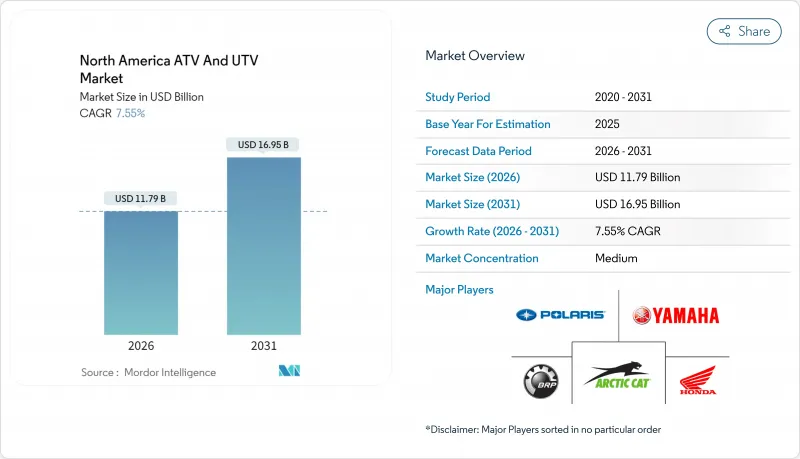
预计到 2026 年,北美 ATV 和 UTV 市场价值将达到 117.9 亿美元。
这代表着从 2025 年的 109.6 亿美元成长到 2031 年的 169.5 亿美元,2026 年至 2031 年的复合年增长率为 7.55%。
强劲的需求源自于休閒步道的扩张、精密农业的兴起以及持续的军事采购。同时,原始设备製造商(OEM)的设计蓝图强调电动动力系统和数位化控制的安全系统。多用途越野车(UTV)的持续成长确保了收入的稳定性,这些平台现在整合了工厂出货时装载的远端资讯处理系统、支援自动驾驶的线束和模组化货物解决方案,从而降低了农场和公共机构的整体拥有成本。电动并排式越野车在对噪音敏感的旅游目的地和保护区越来越受欢迎。然而,由于汽油动力系统前期成本低且加油基础设施完善,它们在价格敏感型细分市场中仍占据主导地位。随着德事隆出售北极猫以及北极星在2024年第三季零售下滑,竞争日益激烈。这促使各厂商积极进行车型更新、推出经销商奖励计画并建立在地化的零件供应链。
北美全地形车及多用途车市场趋势及分析
农业机械化的需求不断增长
安装在UTV上的基于机器学习的作物监测附件结合了频谱成像和人工智慧视觉分析技术,能够即时检测养分缺乏情况,从而提高15-20%的产量。农民将耐用性视为关键的购买标准,促使原始设备製造商(OEM)加固卡车货厢,使其能够承受450公斤重的干草捆。配备亚米级精度GPS的精准导航套件可作为经销商安装的选配方案,实现不平坦地形喷洒和土壤采样的自动化。农业占全地形车(ATV)工作相关死亡事故的五分之三,因此提高安全性至关重要,这促使翻车检测系统的引入,该系统可在传感器激活后200毫秒内切断发动机动力。目前正在爱荷华州测试的一款自主原型车以「跟随我」模式运行,跟随联合运作,从而降低收穫高峰期的人事费用。诸如此类的创新正在将UTV定位为必不可少的农业设备,而非可有可无的配件,并支撑着北美ATV和UTV市场的长期需求。
扩大休閒赛车运动
由各州旅游机构资助的全地形车(ATV)越野道总长度持续增长,宾州的区域越野道连接线目前已将1200英里的多用途路线与区域住宿目的地连接起来。租赁业者报告称,年收入超过8.5万美元,因为导游业者将设备租赁、越野道许可证和安全装备打包成週末套餐。在威斯康辛州,允许在指定的县级道路上行驶全地形车和多用途越野车的立法变更促进了当地旅游业的发展,并增加了当地住宿设施的收入。设备製造商正在联合举办一些节日活动,例如犹他州的2025年派尤特越野车节,以展示新车型并透过远端资讯处理技术收集即时性能数据。因此,北美全地形车和多用途越野车市场正在满足全球对全地形车的巨大需求,并支撑着售后市场零件和服装销售的持续成长。
高昂的购置和维修成本
高阶UTV的价格现已超过3万美元,一辆配置齐全的2025年北极星Ranger XP Kinetic售价高达37,499美元。对于商业车队所有者而言,不断上涨的保险成本和零件库存占用了大量营运资金,因为传动系统、悬吊和电池模组都是品牌特定的。虽然预计电动车型将在五年内降低五分之一以上的营运成本,但经销商有限的服务能力可能意味着高压零件故障时会造成长时间的停机。融资的复杂性给管理季节性现金流的小规模农场带来了挑战。贷款机构通常要求20%的首付以及车辆以外的抵押品。价格压力减缓了车辆的更换週期,抑制了短期销售成长,儘管北美ATV和UTV市场的长期基本面依然强劲。
细分市场分析
到2025年,多用途越野车(UTV)将占据北美全地形车(ATV)和UTV市场71.18%的份额,复合年增长率(CAGR)为7.66%。多用途应用(包括建筑、紧急应变和山地旅游)的高需求推动了这一市场主导地位。这项优势增强了货箱衬垫、驾驶室封闭装置和液压升降套件供应商的规模经济效益。预计到2031年,北美多用途UTV配置的市场份额将快速成长,这主要得益于经销商安装的远端资讯处理技术,该技术将规范市政车队的监控。运动型UTV车型,例如Yamaha的Wolverine RMAX4 1000,帮助製造商在保持高利润率的同时,展示了可应用于工作车型的悬吊技术。
全地形车 (ATV) 在一些细分市场中仍然保持着重要地位,这些市场尤其註重单人驾驶的操控性、轻量化车身和窄轮距,特别是那些要求车辆宽度小于 50 英寸的越野路段。原始设备製造商 (OEM) 的蓝图图显示,到 2025 年将推出六款新型 ATV,这些车型将整合线传油门、盲点雷达和原厂绞车,以抵御快速发展的 UTV 对市场份额的衝击。 ATV 翻滚标准和 UTV 乘员保护通讯协定的监管协调可能会模糊传统的车型分类界限。预计未来的车型将共用底盘部件和电力电子设备。由此产生的模组化平台架构有望缩短开发週期,在保持创新步伐的同时,缓解北美 ATV 和 UTV 市场不断上涨的零件成本。
截至2025年,汽油引擎将占据北美全地形车(ATV)和多用途车(UTV)市场62.67%的份额。然而,受更严格的排放气体法规和消费者对更安静驾驶体验的偏好推动,电动动力系统将以7.62%的复合年增长率成长。本田在北卡罗来纳州的扩张计划旨在确保电池组和整车组装能力,这标誌着电动动力系统正逐渐被主流市场所接受。假设电池价格持续下降,预计到2031年,北美ATV和UTV市场的电动车型规模将大幅成长。同时,柴油动力仍将局限于重型农场和林业应用领域,在这些领域,高扭矩牵引力超过了能量密度的限制。
像HuntVe的Switchback这样的混合动力增程概念车代表了一种过渡架构。 72V锂电池组可提供25英哩的静音续航里程,之后708cc汽油引擎才会启动。加州政策制定者已经强制实施了相当于第五阶段排放标准的非道路排放标准,加速了公共车辆的电气化。然而,电动车要在大众市场广泛应用,还必须等到在越野路段和农场附近建立起完善的240V二级充电基础设施。目前,中西部各州的公用事业公司和经销商正在透过一项联合计划来满足这一需求。在这些电网升级改造完成之前,汽油动力车辆仍将继续主导北美全地形车和多用途车的销售市场。
其他福利:
- Excel格式的市场预测(ME)表
- 3个月的分析师支持
目录
第一章 引言
- 研究假设和市场定义
- 调查范围
第二章调查方法
第三章执行摘要
第四章 市场情势
- 市场概览
- 市场驱动因素
- 农业机械化的需求不断增长
- 休閒和赛车运动活动增加
- 自然保护和狩猎领域对安静的电动并排式车辆的需求
- 悬吊和安全技术的进步
- 步道旅游奖励计划
- 乡村地区的宽频车辆连接
- 市场限制
- 高昂的购置和维修成本
- 锂供应链波动
- 加强对排放气体和噪音的监管
- 土地所有者责任诉讼
- 价值/供应链分析
- 监管环境
- 技术展望
- 波特五力模型
- 供应商的议价能力
- 买方的议价能力
- 新进入者的威胁
- 替代品的威胁
- 竞争对手之间的竞争
第五章 市场规模与成长预测
- 按车辆类型
- 全地形车(ATV)
- 运动型全地形车
- 多用途/工作用全地形车
- 多用途越野车(UTV/并排式越野车)
- 运动型多用途越野车
- 多用途UTV
- 全地形车(ATV)
- 按推进方式和燃料类型
- 汽油
- 柴油引擎
- 电动车
- 杂交种
- 按最终用途行业划分
- 休閒与体育
- 农业/林业
- 工业与建筑
- 军事和政府机构
- 搜救和紧急服务
- 按座位数和容量
- 单人座
- 2-3座
- 4-6座
- 按驱动类型
- 两轮驱动
- 四轮驱动
- 全轮驱动
- 按国家/地区
- 美国
- 加拿大
- 北美其他地区
第六章 竞争情势
- 市场集中度
- 策略趋势
- 市占率分析
- 公司简介
- Polaris Inc.
- BRP Inc.(Can-Am)
- American Honda Motor Co.
- Yamaha Motor Co.
- Kawasaki Heavy Industries
- Textron Inc.(Arctic Cat & Tracker Off-Road)
- Suzuki Motor Corp.
- CF Moto Powersports
- Kubota Corp.
- Deere & Company(Gator)
- Mahindra Automotive NA(ROXOR)
- Segway Powersports
- Hisun Motors Corp.
- DRR USA Inc.
- Intimidator/BAD BOY Off-Road
- ODES Powersports
- Club Car LLC
- Toro Co.
- Kioti(Daedong-USA)
第七章 市场机会与未来展望
The North America ATV and UTV market size in 2026 is estimated at USD 11.79 billion, growing from 2025 value of USD 10.96 billion with 2031 projections showing USD 16.95 billion, growing at 7.55% CAGR over 2026-2031.
Robust demand is rooted in recreational trail expansion, precision-farming uptake, and ongoing military procurement, while OEM design roadmaps emphasize electrified drivetrains and digitally controlled safety systems. Persistent growth of utility terrain vehicles (UTVs) safeguards revenue stability as these platforms now integrate factory-installed telematics, autonomous-ready wire-harnesses, and modular cargo solutions that lower the total cost of ownership for farms and public agencies. Electric side-by-sides gain traction in noise-sensitive tourism zones and conservation areas. Yet, gasoline powertrains remain dominant among price-sensitive segments because of their lower upfront cost and established refueling infrastructure. Competitive intensity has heightened after Textron divested Arctic Cat and Polaris confronted retail decline in Q3 2024, prompting aggressive model refreshes, dealer incentive programs, and localization of component supply chains.
North America ATV And UTV Market Trends and Insights
Growing Agricultural Mechanization Needs
Machine-learning-based crop-scouting attachments mounted on UTVs deliver 15-20% yield gains by combining multispectral imaging and AI vision analytics that flag nutrient deficiencies in real time. Farmers cite durability as their prime purchase criterion, pushing OEMs to reinforce cargo beds to withstand 450 kg hay bale loads. Precision guidance kits with sub-meter GPS accuracy now ship as dealer-installed options, automating spraying and soil sampling on irregular fields. Safety enhancements remain critical because agriculture accounts for three-fifth of work-related ATV fatalities, prompting roll-over detection systems that cut engine power within 200 ms of sensor activation. Autonomous prototypes undergoing pilot trials in Iowa operate follow-me modes behind combines, reducing hired-hand costs during peak harvest. Such innovations position UTVs as integral field assets rather than discretionary purchases, supporting long-run demand for the North America ATV and UTV market.
Rising Recreational & Motorsports Activities
ATV trail mileage funded by state tourism boards keeps expanding, exemplified by Pennsylvania's Regional Trail Connector that now links 1,200 miles of mixed-use routes to local lodging hubs. Rental fleets report annual profits topping USD 85,000 as guided tour operators bundle equipment hire, trail permits, and safety gear in weekend packages. Wisconsin's statutory update allowing ATVs and UTVs on designated county roads bolsters ride-in/ride-out tourism, lifting rural hospitality revenue. Equipment OEMs co-sponsor festivals such as Utah's 2025 Paiute Trail Jamboree to showcase new models and collect real-time performance data through telematics. As a result, the North America ATV and UTV market captures significant global ATV demand, underpinning sustained aftermarket parts and apparel sales.
High Purchase & Maintenance Costs
Premium UTV stickers now eclipse USD 30,000 with the 2025 Polaris RANGER XP Kinetic topping USD 37,499 in fully optioned trim. For commercial fleet owners, high insurance costs and parts inventory tie up working capital because driveline, suspension, and battery modules remain brand-specific. Electric models promise more than one-fifth lower running costs over five years, yet limited dealership service capability prolongs downtime when high-voltage components fail. Financing complexities emerge for small farms that manage seasonal cash flows; lenders often require 20% down payments and collateral beyond the vehicle. Price pressure delays replacement cycles, muting short-term unit sales despite robust long-term fundamentals for the North America ATV and UTV market.
Other drivers and restraints analyzed in the detailed report include:
- Silent Electric SxS Demand in Conservation & Hunting
- Technological Advances in Suspension & Safety
- Lithium Supply-Chain Volatility
For complete list of drivers and restraints, kindly check the Table Of Contents.
Segment Analysis
Utility terrain vehicles commanded 71.18% of the North America ATV and UTV market share in 2025 and growing at a 7.66% CAGR, underscoring their multi-purpose appeal across construction, emergency response, and back-country tourism. This dominance-reinforcing scale advantages for cargo-bed liners, cab enclosures, and hydraulic lift kits suppliers. The North America ATV and UTV market size allocated to multi-purpose UTV configurations is set to grow exponentially by 2031, supported by dealer-installed telematics that standardize fleet monitoring for municipalities. Sport-oriented UTV models such as Yamaha's Wolverine RMAX4 1000 help manufacturers defend high-margin niches while showcasing suspension technology transferable to work-focused trims.
All-terrain vehicles maintain niche relevance where single-rider agility, lower curb weight, and narrower track widths matter, particularly on trail systems mandating sub-50-inch vehicles. OEM roadmaps reveal six new ATV variants for 2025, integrating ride-by-wire throttles, blind-spot radar, and factory-installed winches to protect share against rapidly advancing UTVs. Regulatory alignment of ATV rollover standards with UTV occupant-protection protocols could blur historic category boundaries, with future models sharing chassis components and power electronics. Consequently, platform modularity is poised to reduce development cycles, sustaining innovation cadence while tempering bill-of-materials inflation across the North America ATV and UTV market.
Gasoline engines held 62.67% of the North America ATV and UTV market share in 2025. Yet, electrified drivetrains are advancing at a 7.62% CAGR, reflecting tightening emission caps and user preference for low-noise operation. Honda's expansion in North Carolina earmarks battery packs and final vehicle assembly capacity, signaling mainstream adoption. The North America ATV and UTV market size attributable to electric units is projected to grow drastically by 2031, assuming pack prices decline. Meanwhile, diesel remains confined to heavy-duty ranch and forestry applications where high-torque hauling supersedes energy-density constraints.
Hybrid range-extended concepts such as HuntVe's Switchback illustrate transitional architectures: a 72-V lithium pack supplies 40 km silent range before a 708 cc gasoline engine engages. Policymakers in California already mandate stage-V-equivalent off-road emission limits, hastening fleet electrification among public agencies. Yet mass-market electric penetration awaits infrastructure build-out of 240-V Level-2 chargers across trailheads and farmsteads, a requirement now tackled by cooperative utility-dealer programs in Midwestern states. Until such grid upgrades materialize, gasoline will sustain its majority hold on unit volumes within the North America ATV and UTV market.
The North America ATV & UTV Market Report is Segmented by Vehicle Type (All-Terrain Vehicles and Utility Terrain Vehicles), Propulsion/Fuel Type (Gasoline, Diesel, and More), End-Use Industry (Hybrid, and More), Seating/Capacity (Single-Seat, 2-3 Seat, and 4-6 Seat), Drive Type (2-Wheel Drive and More), and Geography (United States and More). The Market Forecasts are Provided in Terms of Value (USD) and Volume (Units).
List of Companies Covered in this Report:
- Polaris Inc.
- BRP Inc. (Can-Am)
- American Honda Motor Co.
- Yamaha Motor Co.
- Kawasaki Heavy Industries
- Textron Inc. (Arctic Cat & Tracker Off-Road)
- Suzuki Motor Corp.
- CF Moto Powersports
- Kubota Corp.
- Deere & Company (Gator)
- Mahindra Automotive NA (ROXOR)
- Segway Powersports
- Hisun Motors Corp.
- DRR USA Inc.
- Intimidator/BAD BOY Off-Road
- ODES Powersports
- Club Car LLC
- Toro Co.
- Kioti (Daedong-USA)
Additional Benefits:
- The market estimate (ME) sheet in Excel format
- 3 months of analyst support
TABLE OF CONTENTS
1 Introduction
- 1.1 Study Assumptions & Market Definition
- 1.2 Scope of the Study
2 Research Methodology
3 Executive Summary
4 Market Landscape
- 4.1 Market Overview
- 4.2 Market Drivers
- 4.2.1 Growing agricultural mechanisation needs
- 4.2.2 Rising recreational & motorsports activities
- 4.2.3 Silent electric SxS demand in conservation & hunting
- 4.2.4 Technological advances in suspension & safety
- 4.2.5 Trail-tourism incentive programs
- 4.2.6 Rural broadband-enabled fleet connectivity
- 4.3 Market Restraints
- 4.3.1 High purchase & maintenance costs
- 4.3.2 Lithium supply-chain volatility
- 4.3.3 Emission & noise regulation tightening
- 4.3.4 Land-owner liability litigation
- 4.4 Value / Supply-Chain Analysis
- 4.5 Regulatory Landscape
- 4.6 Technological Outlook
- 4.7 Porter's Five Forces
- 4.7.1 Bargaining Power of Suppliers
- 4.7.2 Bargaining Power of Buyers
- 4.7.3 Threat of New Entrants
- 4.7.4 Threat of Substitutes
- 4.7.5 Intensity of Competitive Rivalry
5 Market Size & Growth Forecasts (Value (USD) and Volume (Units))
- 5.1 By Vehicle Type
- 5.1.1 All-Terrain Vehicles (ATVs)
- 5.1.1.1 Sport ATVs
- 5.1.1.2 Utility/Work ATVs
- 5.1.2 Utility Terrain Vehicles (UTVs/Side-by-Sides)
- 5.1.2.1 Sport UTVs
- 5.1.2.2 Multi-purpose UTVs
- 5.1.1 All-Terrain Vehicles (ATVs)
- 5.2 By Propulsion/Fuel Type
- 5.2.1 Gasoline
- 5.2.2 Diesel
- 5.2.3 Electric
- 5.3 By End-use Industry
- 5.3.1 Hybrid
- 5.3.2 Recreation & Sports
- 5.3.3 Agriculture & Forestry
- 5.3.4 Industrial & Construction
- 5.3.5 Military & Government
- 5.3.6 Search, Rescue & Emergency Services
- 5.4 By Seating/Capacity
- 5.4.1 Single-seat
- 5.4.2 2 - 3 seat
- 5.4.3 4 - 6 seat
- 5.5 By Drive Type
- 5.5.1 2-Wheel Drive
- 5.5.2 4-Wheel Drive
- 5.5.3 All-Wheel Drive
- 5.6 By Country
- 5.6.1 United States
- 5.6.2 Canada
- 5.6.3 Rest of North America
6 Competitive Landscape
- 6.1 Market Concentration
- 6.2 Strategic Moves
- 6.3 Market Share Analysis
- 6.4 Company Profiles (Includes Global Level Overview, Market Level Overview, Core Segments, Financials as Available, Strategic Information, Market Rank/Share for Key Companies, Products and Services, SWOT Analysis, and Recent Developments)
- 6.4.1 Polaris Inc.
- 6.4.2 BRP Inc. (Can-Am)
- 6.4.3 American Honda Motor Co.
- 6.4.4 Yamaha Motor Co.
- 6.4.5 Kawasaki Heavy Industries
- 6.4.6 Textron Inc. (Arctic Cat & Tracker Off-Road)
- 6.4.7 Suzuki Motor Corp.
- 6.4.8 CF Moto Powersports
- 6.4.9 Kubota Corp.
- 6.4.10 Deere & Company (Gator)
- 6.4.11 Mahindra Automotive NA (ROXOR)
- 6.4.12 Segway Powersports
- 6.4.13 Hisun Motors Corp.
- 6.4.14 DRR USA Inc.
- 6.4.15 Intimidator/BAD BOY Off-Road
- 6.4.16 ODES Powersports
- 6.4.17 Club Car LLC
- 6.4.18 Toro Co.
- 6.4.19 Kioti (Daedong-USA)
7 Market Opportunities & Future Outlook
- 7.1 White-space & Unmet-need Assessment

 全地形车(ATV)市场机会、成长要素、产业趋势分析及2026-2035年预测
 全地形防洪车辆市场按推进系统、车辆类型、应用、终端用户产业和分销管道划分,全球预测(2026-2032年)全球全地形车和多用途车市场(按车轮配置、推进方式、车辆类型、发动机排气量、应用、分销渠道和最终用户划分)预测,2026-2032年数位驱动系统市场(按马达类型、齿轮类型、分销管道、终端用户产业和车辆类型划分)-全球预测(2026-2032年)
 全地形车市场-全球产业规模、份额、趋势、机会及预测,依产品类型、引擎排气量、应用、地区及竞争格局划分,2021-2031年预测
 多用途地形车(UTV)市场规模、份额和成长分析(按引擎排气量、引擎类型、乘客容量、推进方式、应用和地区划分)-2026-2033年产业预测
 全地形车(ATV)市场规模、份额和成长分析(按产品类型、引擎排气量、应用、动力方式和地区划分)-2026-2033年产业预测电动全地形车市场按推进类型、电池类型、电池容量、应用、最终用户和销售管道划分-2025-2030 年全球预测
 全球电动全地形车市场全地形车市场-全球产业规模、份额、趋势、机会和预测(按类型、应用、地区和竞争细分,2020-2030 年)