


 |
市场调查报告书
商品编码
1910685
工业大麻:市场占有率分析、产业趋势与统计、成长预测(2026-2031)Industrial Hemp - Market Share Analysis, Industry Trends & Statistics, Growth Forecasts (2026 - 2031) |
||||||

※ 本网页内容可能与最新版本有所差异。详细情况请与我们联繫。
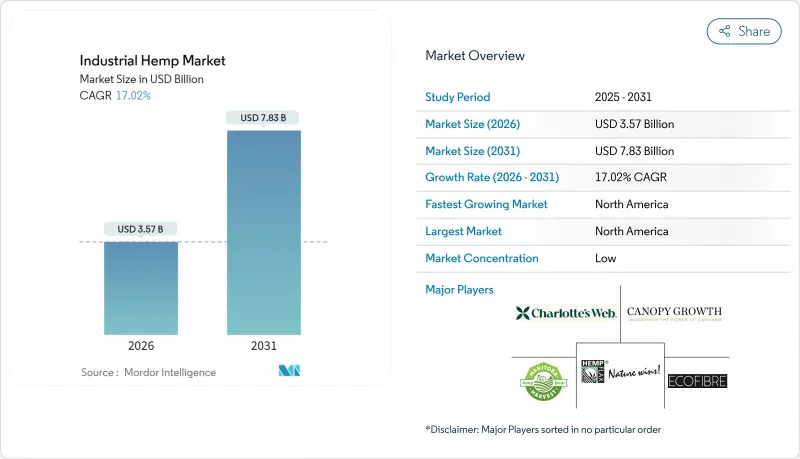
预计到 2025 年,工业大麻市场价值将达到 30.5 亿美元,到 2026 年将成长至 35.7 亿美元,到 2031 年将成长至 78.3 亿美元,在预测期(2026-2031 年)内复合年增长率为 17.02%。
预计包括食品饮料、膳食补充剂、永续建材、纺织品和饲料在内的众多行业都将对大麻产生强劲需求,这得益于2018年美国农业法案等相关立法的支持,该法案已在多个州实现了工业种植合法化。在供应方面,德国的《2024年医用大麻法案》以及日本和法国的类似进展正在加速推进,刺激了全球大麻市场的扩张,同时也为加工商提供了更大的政策确定性。垂直整合企业之间日益激烈的竞争正在推动种植、脱壳和配方工艺的效率提升,而新参与企业则专注于麻石和大麻衍生机能性食品等细分领域。市场相关人员预计,价格调控将主要受降低单位成本的技术创新以及千禧世代和Z世代愿意为可追溯的低碳产品支付溢价的意愿所驱动。预计这一趋势将在本世纪推动整个大麻市场保持两位数的成长。
全球工业大麻市场趋势与洞察
主要经济体的合法化
激进的监管改革持续重塑大麻市场。德国的两项法规——《医用大麻法》和《消费大麻法》——于2024年生效,为工业大麻的种植、加工和分销制定了透明的要求,加速了对欧洲供应链的投资。在美国,2018年农业法案维持了基本框架,但企业仍然对2024年计画修订的法案中可能对「致幻」大麻素做出更严格的定义持谨慎态度。在日本,2024年12月的修订案建立了工业大麻分级许可製度,为规范低THC含量的种植铺平了道路,同时保持了对医用大麻的监管。法国拥有1.5万公顷的大麻种植面积,巩固了主导地位,并受益于欧盟0.3%的THC基准值。该标准协调了贸易规则,并促进了跨境协议的达成。监管趋势表明,随着越来越多的司法管辖区采用基于科学的 THC 限制和明确的合规要求,大麻市场将继续扩张。
对植物来源食品和饮料的需求不断增长
向植物性饮食的转变正在推动大麻市场的发展,尤其是在蛋白质饮料、强化零食和乳製品替代品领域。大麻籽富含完整的氨基酸,且ω-6与Omega-3的比例约为3:1,使其成为大豆和杏仁的营养替代品。美国饲料管理协会(AAFCO)于2024年核准大麻籽粕用于蛋鸡饲料,这不仅开闢了新的大众市场,也证明了其在整个家禽饲料链中的安全性。製程优化研究表明,9小时的浸泡时间和48°C下60分钟的加热时间是生产营养丰富的大麻籽牛奶的理想条件,从而降低了饮料开发商的成本。这些营养和永续性趋势的结合,将持续扩大大麻的潜在消费族群。
THC/CBD含量监管方面的不确定性
政策波动持续对大麻市场构成短期不利影响。 2024年美国农业法案的潜在修正案可能将Delta-8-THC和THCA从联邦大麻定义中移除,这将威胁到估计价值280亿美元的含致幻剂产品的灰色市场。加州的紧急合成大麻素禁令在2025年5月前实现了99.7%的合规率,但缺乏资金进行配方调整的小规模品牌遭受了库存减损损失。在欧洲,欧盟新食品体系的实施时间表因国家而异,迫使出口商应对一系列复杂的上市前核准程序。这些监管波动使长期供应协议复杂化,并延缓了资本投资,限制了大麻市场的全面加速发展。
细分市场分析
CBD大麻油目前占工业大麻市场50.68%的份额,预计到2031年将以17.96%的复合年增长率增长,巩固其作为规模最大、增长最快的品类的地位。该细分市场受益于不断扩大的非处方药分销网络和符合药品级标准的生产工艺,这些因素推动了大麻市场中高端产品定价和品牌差异化的发展。消费者对压力管理、睡眠改善和恢復支援产品的兴趣日益浓厚,Charlotte's Web推出的CBN软糖及类似产品正是基于此,这些产品结合了多种次要大麻素,进一步针对特定功效。
富含Omega-3和Omega-6脂肪酸的营养丰富的麻籽油,在沙拉酱、即饮奶昔和外用护肤品中越来越受欢迎。麻蛋白粉(部分产品蛋白质含量高达93.01%)也因其不含大豆成分、低致敏性而受到素食运动员的青睐。不含CBD的萃取物适用于生物塑胶和润滑剂等工业应用,在这些领域,任何精神活性风险都是不可接受的。随着植物化学研究的深入,我们预计未来会出现更多更精细的功能性宣称,麻市场将根据其治疗功效进一步细分。
区域分析
到2025年,北美将占全球工业大麻收入的55.28%,其市场规模以17.71%的复合年增长率成长,增幅超过其他地区。在美国,快速的机械化进程以及像熊猫生物科技(Panda Biotech)这样的跨州加工企业的崛起,使得32,694英亩土地上的大麻面积达到4.45亿美元。该公司位于德克萨斯的工厂每小时可脱粒10吨。在加拿大,大麻食品的出货收益达到2.09亿加元,目前正在讨论放宽处方笺CBD的管制。这些发展有望为大麻市场开闢新的通路。
在欧洲,监管协调性令人瞩目,儘管各成员国的进展不尽相同。法国以1.5万公顷的面积主导,这得益于法国大麻合作社(Interchambre)的支持,该合作社提供农业指导和销售担保合约。德国2024年的立法方案将明确THC基准值,并实现从种子到销售的全程可追溯性,从而增强机构投资者对大型温室计划的信心。同时,瑞士正在试验成人用大麻项目,这可能会间接刺激人们对工业大麻衍生的兴趣,因为这些产品与工业大麻共用加工基础设施。
亚太地区的工业大麻市场正从供应型转变为需求型。中国决定自2024年9月起限制CBD作为前驱化学品的使用,这将导致出口文件要求更加严格,但也规范了生产标准,并可能为全球买家提供保障。日本的分级许可证制度预计在2027年前促成国内药用CBD製剂的研发,进而打造高端都市区消费群。印度和巴基斯坦正在製定全面的工业大麻发展框架,旨在创造就业机会和促进农村经济多元化,但繁琐的官僚程序可能会限制短期内面积的扩张。
其他福利:
- Excel格式的市场预测(ME)表
- 3个月的分析师支持
目录
第一章 引言
- 研究假设和市场定义
- 调查范围
第二章调查方法
第三章执行摘要
第四章 市场情势
- 市场概览
- 市场驱动因素
- 主要经济体的合法化趋势
- 对植物来源食品和饮料的需求不断增长
- CBD在健康与非处方药通路的应用
- 净零能耗建筑对麻石混凝土的需求
- 纤维脱壳和加工的自动化
- 市场限制
- THC/CBD含量监管方面的不确定性
- 供应链中断和品质不稳定
- 土地利用与特色作物的衝突
- 价值链分析
- 波特五力模型
- 供应商的议价能力
- 消费者议价能力
- 新进入者的威胁
- 替代品的威胁
- 竞争程度
第五章 市场规模与成长预测
- 按类型
- 大麻籽
- 大麻籽油
- 大麻二酚 (CBD) 大麻油
- 大麻蛋白
- 大麻萃取物(不含CBD)
- 透过使用
- 食品/饮料
- 保健品
- 其他用途(个人护理、纺织品、建筑、动物饲料等)
- 地区
- 亚太地区
- 中国
- 印度
- 日本
- 韩国
- 泰国
- 印尼
- 越南
- 马来西亚
- 亚太其他地区
- 北美洲
- 美国
- 加拿大
- 墨西哥
- 欧洲
- 德国
- 英国
- 法国
- 义大利
- 西班牙
- 北欧国家
- 土耳其
- 俄罗斯
- 其他欧洲地区
- 南美洲
- 巴西
- 阿根廷
- 哥伦比亚
- 南美洲其他地区
- 中东和非洲
- 沙乌地阿拉伯
- 阿拉伯聯合大公国
- 卡达
- 埃及
- 奈及利亚
- 南非
- 其他中东和非洲地区
- 亚太地区
第六章 竞争情势
- 市场集中度
- 策略趋势
- 市占率(%)/排名分析
- 公司简介
- 33 Supply LLC
- Bedrocan
- Bulk Hemp Warehouse LLC
- Canopy Growth Corporation
- CANWAY Holdings Ltd.
- Charlotte's Web, Inc
- Colorado Breeders Depot
- Cornbread Hemp
- Ecofibre
- Entoura Pty Ltd
- Fresh Hemp Foods Ltd
- GenCanna
- Hemp Acres USA
- HempFlax Group BV
- Ilesol Pharmaceuticals doo
- International Flavors & Fragrances Inc.
- Manitoba Harvest Hemp Foods.
- Nutiva LLC
- PharmaCielo
- Puricon
- Robertet SA
- Signature Products GmbH
- Silver Lion Farms
- True Terpenes
- Victory Hemp Foods
第七章 市场机会与未来展望
The Industrial Hemp Market was valued at USD 3.05 billion in 2025 and estimated to grow from USD 3.57 billion in 2026 to reach USD 7.83 billion by 2031, at a CAGR of 17.02% during the forecast period (2026-2031).
Robust demand spans food and beverages, wellness supplements, sustainable construction materials, textiles, and animal feed, underpinned by enabling legislation such as the 2018 U.S. Farm Bill that unlocked industrial cultivation across multiple states. Supply-side momentum is reinforced by Germany's 2024 Medical Cannabis Act and parallel advances in Japan and France, collectively broadening the global hemp market footprint while providing processors with greater policy certainty. Intensifying competition among vertically integrated companies is pushing efficiencies in cultivation, decortication, and formulation, while new entrants focus on niche verticals such as hempcrete and hemp-derived functional foods. Market watchers expect pricing discipline as technological upgrades lower unit costs and as millennial and Gen Z consumers demonstrate willingness to pay premiums for traceable, low-carbon products, a dynamic likely to sustain double-digit value growth across the hemp market in the current decade.
Global Industrial Hemp Market Trends and Insights
Legalization in Major Economies
Sweeping regulatory reforms continue to reshape the hemp market. Germany's twin statutes, the Medical Cannabis Act and the Consumer Cannabis Act, entered into force in 2024, creating transparent requirements for cultivation, processing, and distribution of industrial hemp, accelerating investment in European supply chains. In the United States, the 2018 Farm Bill remains the anchor framework, yet pending 2024 amendments that may tighten definitions around "intoxicating" cannabinoids keep operators vigilant. Japan's December 2024 reforms established tiered industrial hemp licences, opening a regulated path for low-THC cultivation while preserving pharmaceutical oversight. France consolidated its leadership with 15,000 ha under hemp, benefiting from the EU's 0.3% THC threshold that harmonises trade rules and encourages cross-border contracting. The regulatory trend signals continued expansion of the hemp market as more jurisdictions opt for science-based THC limits and clearer compliance requirements.
Rising Demand for Plant-Based Food and Beverages
Shifts toward plant-centric diets are fuelling the hemp market, particularly in protein drinks, fortified snacks, and dairy substitutes. Hemp seeds provide a complete amino acid profile and an optimal omega-6 to omega-3 ratio of roughly 3:1, positioning them as a nutrient-dense alternative to soy or almond. The Association of American Feed Control Officials' 2024 approval of hempseed meal for laying hens added a new high-volume outlet and signalled safety across poultry feed chains. Process optimisation studies now pinpoint 9-hour soaking and 48 °C heating for 60 minutes as ideal parameters for nutrient-rich hemp milk, thereby lowering development costs for beverage formulators. Collectively, these nutritional and sustainability tailwinds continue to widen the addressable consumer base of the hemp market.
Regulatory Uncertainty on THC/CBD Limits
Policy volatility remains a near-term headwind for the hemp market. The anticipated 2024 U.S. Farm Bill revisions could remove delta-8 THC and THCA from the federal hemp definition, jeopardising an estimated USD 28 billion gray channel for intoxicating products. California's emergency ban on synthetic cannabinoids achieved 99.7% compliance by May 2025, but created inventory write-downs for smaller brands that lacked the capital for reformulation. Europe also faces divergent implementation timelines for the EU Novel Foods regime, compelling exporters to navigate a patchwork of pre-market authorisations. These shifting rules complicate long-term supply contracts and delay capital expenditure, restraining the full acceleration of the hemp market.
Other drivers and restraints analyzed in the detailed report include:
- CBD Adoption in Wellness & OTC Channels
- Hempcrete Demand in Net-Zero Construction
- Fragmented Supply Chain and Quality Variability
For complete list of drivers and restraints, kindly check the Table Of Contents.
Segment Analysis
CBD hemp oil currently represents 50.68% of the Industrial Hemp Market share and is slated to log a 17.96% CAGR through 2031, underscoring its status as the largest and fastest-growing product class. The segment benefits from expanding OTC distribution and pharma-grade manufacturing standards, factors that encourage premium pricing and brand differentiation within the hemp market. Heightened consumer interest in stress, sleep and recovery products is reflected in Charlotte's Web CBN-infused gummies and similar SKUs that bundle multiple minor cannabinoids for targeted benefits.
Hemp seed oil follows as a nutritionally rich alternative containing omega-3 and omega-6 fatty acids, driving adoption in salad dressings, ready-to-drink shakes and topical skincare. Hemp protein powders, some of which now achieve 93.01% protein content, enjoy traction among vegan athletes seeking soy-free, allergen-light formulas. Extracts without CBD address industrial applications that require zero psychoactive risk, notably in bioplastics and lubricants. Continued phytochemical research will likely spawn nuanced functional claims, further segmenting the hemp market by therapeutic outcome.
The Industrial Hemp Market Report is Segmented by Type (Hemp Seed, Hemp Seed Oil, Cannabidiol (CBD) Hemp Oil, Hemp Protein, Hemp Extract Without CBD), Application (Food and Beverages, Healthcare Supplements, Other Applications), and Geography (Asia-Pacific, North America, Europe, South America, Middle East and Africa). The Market Forecasts are Provided in Terms of Value (USD).
Geography Analysis
North America retained 55.28% of the global revenue in 2025, with the region's industrial hemp market size rising at a 17.71% CAGR that outpaces every other geography. The United States recorded USD 445 million in farm-gate production on 32,694 harvested acres, helped by rapid mechanisation and the emergence of multistate processors such as Panda Biotech, whose Texas facility decorticates 10 metric tons hourly. Canada complements this momentum with CAD 209 million in hemp food retail sales and ongoing consultation to liberalise non-prescription CBD, actions that could unlock fresh distribution channels for the hemp market.
Europe stands out for regulatory cohesion, even as individual member states move at varied speeds. France leads cultivation with 15,000 ha, supported by InterChanvre cooperatives that provide agronomic guidance and guaranteed offtake contracts. Germany's 2024 legislative package establishes clear THC thresholds and seeds-to-sale traceability, creating confidence for institutional investors contemplating large-scale greenhouse projects. Switzerland, meanwhile, is piloting adult-use cannabis programs that could indirectly spur interest in industrial hemp derivatives due to shared processing infrastructure.
Asia-Pacific is evolving from a supply-centric to a dual supply-and-demand region within the hemp market. China's decision to regulate CBD as a precursor chemical from September 2024 introduces tighter export documentation but also formalises production standards that could reassure global buyers. Japan's tiered licensing system is expected to yield domestic pharmaceutical CBD formulations by 2027, creating a premium urban consumer segment. India and Pakistan are progressing toward full industrial hemp frameworks, aiming to capture employment and rural diversification benefits, though bureaucratic processes may temper near-term acreage growth.
- 33 Supply LLC
- Bedrocan
- Bulk Hemp Warehouse LLC
- Canopy Growth Corporation
- CANWAY Holdings Ltd.
- Charlotte's Web, Inc
- Colorado Breeders Depot
- Cornbread Hemp
- Ecofibre
- Entoura Pty Ltd
- Fresh Hemp Foods Ltd
- GenCanna
- Hemp Acres USA
- HempFlax Group BV
- Ilesol Pharmaceuticals doo
- International Flavors & Fragrances Inc.
- Manitoba Harvest Hemp Foods.
- Nutiva LLC
- PharmaCielo
- Puricon
- Robertet SA
- Signature Products GmbH
- Silver Lion Farms
- True Terpenes
- Victory Hemp Foods
Additional Benefits:
- The market estimate (ME) sheet in Excel format
- 3 months of analyst support
TABLE OF CONTENTS
1 Introduction
- 1.1 Study Assumptions & Market Definition
- 1.2 Scope of the Study
2 Research Methodology
3 Executive Summary
4 Market Landscape
- 4.1 Market Overview
- 4.2 Market Drivers
- 4.2.1 Legalization in major economies
- 4.2.2 Rising demand for plant-based food & beverages
- 4.2.3 CBD adoption in wellness and OTC channels
- 4.2.4 Hempcrete demand in net-zero construction
- 4.2.5 Automation in fiber decortication & processing
- 4.3 Market Restraints
- 4.3.1 Regulatory uncertainty on THC/CBD limits
- 4.3.2 Fragmented supply chain & quality variability
- 4.3.3 Land-use competition with specialty crops
- 4.4 Value Chain Analysis
- 4.5 Porter's Five Forces
- 4.5.1 Bargaining Power of Suppliers
- 4.5.2 Bargaining Power of Consumers
- 4.5.3 Threat of New Entrants
- 4.5.4 Threat of Substitutes
- 4.5.5 Degree of Competition
5 Market Size & Growth Forecasts (Value)
- 5.1 By Type
- 5.1.1 Hemp Seed
- 5.1.2 Hemp Seed Oil
- 5.1.3 Cannabidiol (CBD) Hemp Oil
- 5.1.4 Hemp Protein
- 5.1.5 Hemp Extract (without CBD)
- 5.2 By Application
- 5.2.1 Food & Beverages
- 5.2.2 Healthcare Supplements
- 5.2.3 Other Applications (Personal Care, Textile, Construction, Animal Feed, etc)
- 5.3 Geography
- 5.3.1 Asia-Pacific
- 5.3.1.1 China
- 5.3.1.2 India
- 5.3.1.3 Japan
- 5.3.1.4 South Korea
- 5.3.1.5 Thailand
- 5.3.1.6 Indonesia
- 5.3.1.7 Vietnam
- 5.3.1.8 Malaysia
- 5.3.1.9 Rest of Asia-Pacific
- 5.3.2 North America
- 5.3.2.1 United States
- 5.3.2.2 Canada
- 5.3.2.3 Mexico
- 5.3.3 Europe
- 5.3.3.1 Germany
- 5.3.3.2 United Kingdom
- 5.3.3.3 France
- 5.3.3.4 Italy
- 5.3.3.5 Spain
- 5.3.3.6 NORDIC Countries
- 5.3.3.7 Turkey
- 5.3.3.8 Russia
- 5.3.3.9 Rest of Europe
- 5.3.4 South America
- 5.3.4.1 Brazil
- 5.3.4.2 Argentina
- 5.3.4.3 Colombia
- 5.3.4.4 Rest of South America
- 5.3.5 Middle East and Africa
- 5.3.5.1 Saudi Arabia
- 5.3.5.2 United Arab Emirates
- 5.3.5.3 Qatar
- 5.3.5.4 Egypt
- 5.3.5.5 Nigeria
- 5.3.5.6 South Africa
- 5.3.5.7 Rest of Middle East and Africa
- 5.3.1 Asia-Pacific
6 Competitive Landscape
- 6.1 Market Concentration
- 6.2 Strategic Moves
- 6.3 Market Share (%)/Ranking Analysis
- 6.4 Company Profiles (includes Global level Overview, Market level overview, Core Segments, Financials as available, Strategic Information, Market Rank/Share, Products & Services, Recent Developments)
- 6.4.1 33 Supply LLC
- 6.4.2 Bedrocan
- 6.4.3 Bulk Hemp Warehouse LLC
- 6.4.4 Canopy Growth Corporation
- 6.4.5 CANWAY Holdings Ltd.
- 6.4.6 Charlotte's Web, Inc
- 6.4.7 Colorado Breeders Depot
- 6.4.8 Cornbread Hemp
- 6.4.9 Ecofibre
- 6.4.10 Entoura Pty Ltd
- 6.4.11 Fresh Hemp Foods Ltd
- 6.4.12 GenCanna
- 6.4.13 Hemp Acres USA
- 6.4.14 HempFlax Group BV
- 6.4.15 Ilesol Pharmaceuticals doo
- 6.4.16 International Flavors & Fragrances Inc.
- 6.4.17 Manitoba Harvest Hemp Foods.
- 6.4.18 Nutiva LLC
- 6.4.19 PharmaCielo
- 6.4.20 Puricon
- 6.4.21 Robertet SA
- 6.4.22 Signature Products GmbH
- 6.4.23 Silver Lion Farms
- 6.4.24 True Terpenes
- 6.4.25 Victory Hemp Foods
7 Market Opportunities & Future Outlook
- 7.1 White-space & unmet-need assessment

 2026-2030年全球工业大麻市场
 工业大麻市场规模、份额、成长及全球产业分析:按类型、应用和地区划分,并预测至2026-2034年全球工业大麻市场规模、份额、趋势和成长分析报告(2026-2034年)
 工业大麻:全球市场份额和排名、总收入和需求预测(2025-2031年)
 2025 年至 2033 年工业大麻市场规模、份额、趋势及预测(按类型、来源、应用和地区)
 工业大麻市场:2033 年市场分析与预测 - 按类型、产品、应用、形式、原料类型、製程、最终用户、技术
 全球工业大麻市场:按类型、原产地、应用、地区 - 预测至 2029 年工业大麻市场:预测(2025-2030)
 工业大麻市场规模、份额、成长分析,按类型、原产地、应用、地区 - 产业预测,2024-2031
 工业大麻市场机会、成长动力、产业趋势分析与预测 2024 - 2032