


 |
市场调查报告书
商品编码
1910807
浮法玻璃:市场占有率分析、产业趋势与统计、成长预测(2026-2031)Float Glass - Market Share Analysis, Industry Trends & Statistics, Growth Forecasts (2026 - 2031) |
||||||

※ 本网页内容可能与最新版本有所差异。详细情况请与我们联繫。
预计到2026年,浮法玻璃市场规模将达到7,686万吨,高于2025年的7,427万吨。预测2031年,市场规模将达到9,118万吨,2026年至2031年的复合年增长率为3.48%。
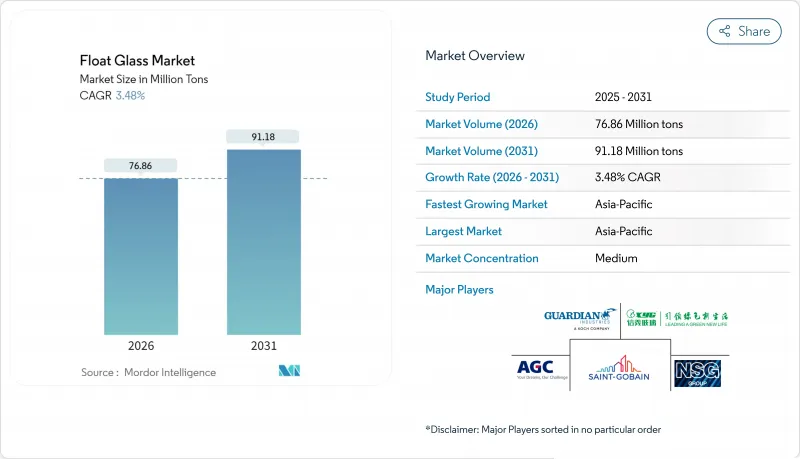
儘管传统建筑应用日趋成熟,但太阳能光电、汽车和节能建筑幕墙等高性能基板的强劲需求仍支撑着市场销售的稳定成长。製造商正利用製程自动化和炉窑升级来缓解碱灰和天然气等原料成本波动的影响。同时,脱碳投资有助于确保企业能够进入面临碳基贸易障碍的出口市场。竞争优势日益依赖精度、可靠性以及供给能力,而非产量。北美大规模太阳能光电装置的快速部署以及欧洲向低碳建筑围护结构的转型正在重塑全球采购模式,迫使亚洲供应商加快减排蓝图以维持市场份额。随着中国和美国数十亿美元的排放能扩张计划,浮法玻璃市场正持续向区域化供应链转型,优先考虑韧性和碳效率。
全球浮法玻璃市场趋势及展望
扩大新兴经济体的建筑业
在南亚和东南亚,公共部门在交通、住宅和工业走廊建设方面的持续投入,推动了建筑玻璃的持续成长。印度的建筑计划总量相当于该行业年营业收入的3.5倍。儘管由于劳动力短缺导致计划执行延误,泰国东部经济走廊仍持续吸收大量的平板玻璃。区域性浮法玻璃生产线的产运转率已低于80%,这使得靠近这些需求中心的生产商无需新的投资即可迅速提高出货量。因此,浮法玻璃市场将依靠快速成长的新兴经济体来弥补成熟西方国家消费停滞的情况。
车身越轻,每辆车的玻璃面积。
电气化法规使得车身重量成为汽车製造商最重要的关键绩效指标 (KPI),同时,先进驾驶辅助系统、全景天窗和身临其境型资讯娱乐萤幕的普及却增加了每辆车的玻璃表面积。这种矛盾的局面推动了浮法玻璃市场的结构性成长,汽车製造商 (OEM) 指定使用更薄、更大尺寸的夹层钢化玻璃,以整合天线、加热器和抬头显示器涂层。福耀玻璃决定投资 58 亿元人民币(约 8.04 亿美元)新建一条专门用于电动车平台的浮法玻璃生产线,凸显了这一市场机会的巨大规模。由此产生的对光学透明度和电磁渗透性的要求支撑了高价位,确保产量的增加能够直接转化为技术供应商更高的收入和利润率。
安全玻璃中的聚合物和聚碳酸酯替代品
汽车和建筑规范现在允许使用聚碳酸酯解决方案,其抗衝击性可与夹层玻璃媲美,但重量却轻40-50%。注重轻量化的原始设备製造商(OEM)正在尝试使用聚合物车顶和后窗。然而,诸如耐刮擦性、紫外线稳定性和光学畸变等挑战限制了其应用范围,使其仅限于小众领域。玻璃製造商正在透过采用先进的PVB中间层来生产更薄、更轻的夹层玻璃,伊士曼公司扩大在欧洲的产能便证明了这一点。虽然这场材料之争限制了浮法玻璃市场的复合年增长率(CAGR),但也刺激了创新,拓展了产品功能,并提高了市场进入门槛。
细分市场分析
2025年,透明平板玻璃占据浮法玻璃市场62.70%的份额,预计到2031年将以3.79%的复合年增长率保持最高增长。这一主导地位反映了其无与伦比的多功能性,对于建筑幕墙玻璃、汽车挡风玻璃和低铁太阳能罩等应用至关重要,这些应用需要着色或图案产品无法达到的清晰度。製造商正投入大量研发预算,致力于改进精炼和熔体均质化技术,以减少气泡含量和铁残留,从而确保利润率,抵消商业化进程中的阻力。着色和图案平板玻璃仍然是一个以设计主导的小众市场,但其应用更与週期性的建筑趋势相关,而非结构性的技术变革。
超白低铁玻璃在高端市场占据主导地位,这主要得益于太阳能产业蓬勃发展带来的经济效益以及高端建筑幕墙的美学需求。 NSG 的 Pilkington Mirai™ 和 Shin-i 的 2.0mm 玻璃系列便是兼顾碳减排和超薄设计的典范。随着 N 型太阳能组件生产线的扩张,平板玻璃的废品率不断上升,而每吉瓦装置容量所需的透明玻璃用量却出乎意料地增加。这使得整合式砂矿和即时杂质检测成为浮法玻璃市场中的关键竞争优势。
本浮法玻璃报告按产品类型(透明、有色、花纹、钢丝、超白/低铁)、应用领域(建筑、汽车、太阳能玻璃及其他应用)和地区(亚太、北美、欧洲、南美、中东和非洲)进行细分。市场预测以吨为单位。
区域分析
预计亚太地区将主导浮法玻璃市场,到2025年将占全球产量的62.65%,并在2031年之前以3.92%的复合年增长率持续成长。中国正大力发展其巨型窑炉集群,而印度则正经历前所未有的1.5兆美元建设热潮,以满足住宅大楼和物流园区对大尺寸面板的需求。在泰国,东部经济走廊週边的基础设施投资正在缓解住宅市场放缓导致的本地需求下降。然而,亚洲出口商必须应对不断上涨的运费和即将实施的CBAM课税,这促使他们尝试投资混合式窑炉和屋顶太阳能发电系统,以减少每吨运输产品的二氧化碳排放量。
欧洲历来是浮法创新的发源地,如今已成为低碳製造的标竿:圣戈班的 ORAE 系列产品兼具高回收率和摇篮到摇篮认证,而 AGC Interpane 在德国和奥地利的升级改造正在住宅开工放缓的情况下提高生产线效率。
北美正利用近岸外包趋势和清洁能源激励政策。福耀玻璃在伊利诺州投资4亿美元兴建浮法玻璃厂,确保为中西部电动车工厂提供及时供应。加上《通货膨胀控制法案》提供的製造业税额扣抵,这些措施正促使企业减少对进口的依赖,转向国内熔炼平板玻璃,从而减少延误和碳排放。在南美洲以及中东和非洲,体育场馆建设、海水淡化计划和智慧城市计画的推出推动了产量成长,但当地产能有限,导致人均消费量低于成熟市场。
其他福利:
- Excel格式的市场预测(ME)表
- 分析师支持(3个月)
目录
第一章 引言
- 研究假设和市场定义
- 调查范围
第二章调查方法
第三章执行摘要
第四章 市场情势
- 市场概览
- 市场驱动因素
- 扩大新兴经济体的建筑业
- 车身越轻,每辆车的玻璃面积多。
- 大型太阳能发电厂建设的扩张将提振对低铁浮法玻璃的需求。
- 都市更新要求采用节能型建筑幕墙
- 光电建筑建筑幕墙规范推广超透明低铁基板
- 市场限制
- 碱灰和天然气价格波动
- 安全玻璃中的聚合物和聚碳酸酯替代品
- 遵守欧盟碳边境调节机制的成本(未受到太多关注)
- 价值链分析
- 原料分析
- 沙
- 石灰石
- 碱灰
- 白云石
- 波特五力模型
- 供应商的议价能力
- 买方的议价能力
- 新进入者的威胁
- 替代品的威胁
- 竞争程度
第五章 市场规模及成长预测(价值及数量)
- 依产品类型
- 清除
- 有色
- 模式
- 有线
- 超白/低铁浮法玻璃
- 透过使用
- 建筑/施工
- 车
- 太阳能玻璃
- 其他用途
- 按地区
- 亚太地区
- 中国
- 印度
- 日本
- 韩国
- 越南
- 泰国
- 印尼
- 马来西亚
- 亚太其他地区
- 北美洲
- 美国
- 加拿大
- 墨西哥
- 欧洲
- 德国
- 英国
- 法国
- 义大利
- 西班牙
- 俄罗斯
- 北欧国家
- 其他欧洲地区
- 南美洲
- 巴西
- 阿根廷
- 哥伦比亚
- 南美洲其他地区
- 中东和非洲
- 沙乌地阿拉伯
- 奈及利亚
- 卡达
- 阿拉伯聯合大公国
- 埃及
- 南非
- 其他中东和非洲地区
- 亚太地区
第六章 竞争情势
- 市场集中度
- 策略趋势
- 市占率(%)/排名分析
- 公司简介
- AGC Inc.
- BG
- CARDINAL GLASS INDUSTRIES, INC
- China Glass Holding
- China Luoyang Float Glass Group Co., Ltd.
- Flat Glass Group Co., Ltd
- Fuyao Group
- Guardian Industries Holdings
- Kibing Group
- Nippon Sheet Glass Co., Ltd
- PRESS GLASS Holding SA
- PT Mulia Industrindo Tbk
- Saint-Gobain
- SCHOTT
- Sisecam
- Taiwan Glass Ind. Corp.
- Vitro
- Xinyi Glass Holdings Limited
第七章 市场机会与未来展望
Float Glass Market size in 2026 is estimated at 76.86 million tons, growing from 2025 value of 74.27 million tons with 2031 projections showing 91.18 million tons, growing at 3.48% CAGR over 2026-2031.
Surging demand for high-performance substrates in solar, automotive, and energy-efficient facades supports steady volume gains even as traditional construction end-uses mature. Manufacturers leverage process automation and furnace upgrades to curb the volatility stemming from soda-ash and natural-gas input costs, while decarbonization investments safeguard access to export markets facing carbon-based trade barriers. Competitive differentiation now rests less on throughput and more on precision, reliability, and the capacity to deliver ultra-clear, thin, or multi-functional sheets that command premium margins. Rapid installations of utility-scale solar arrays in North America and the shift toward low-carbon building envelopes in Europe are reshaping global procurement models, forcing Asian suppliers to accelerate emission-reduction roadmaps to maintain share. With multibillion-dollar capacity additions scheduled in both China and the United States, the float glass market continues to rebalance toward regionalized supply chains that prioritize resilience and carbon efficiency.
Global Float Glass Market Trends and Insights
Construction-Sector Expansion in Emerging Economies
Decisive public-sector outlays on transport, housing, and industrial corridors are fueling sustained purchases of architectural glass across South and Southeast Asia. India's construction pipeline equals 3.5 times the sector's annual operating revenue. Thailand's Eastern Economic Corridor continues to absorb large sheet volumes even as labor shortages slow project execution. With regional float lines already running at utilization rates below 80%, producers situated near these demand hubs can ramp shipments swiftly without green-field investments. As a result, the float glass market will rely on fast-growing emerging economies to offset plateauing consumption in mature Western countries.
Automotive Lightweighting Raises Glazing M2 Per Vehicle
Electrification mandates have made weight a premium KPI for automakers, yet advanced driver-assistance systems, panoramic roofs, and immersive infotainment screens are simultaneously expanding the glass surface area per car. This paradox underpins a structural upswing for the float glass market, as OEMs specify thinner yet larger laminated or tempered panes that integrate antennas, heaters, and head-up-display coatings. Fuyao's decision to inject CNY 5.8 billion (USD 804 million) into new float lines dedicated to electrified vehicle platforms illustrates the scale of the opportunity. The resulting requirement for optical clarity and electromagnetic transparency supports premium pricing, ensuring that volume growth feeds directly into revenue and margin expansion for technologically capable suppliers.
Polymer and Polycarbonate Substitutes in Safety Glazing
Automotive and architectural standards permit polycarbonate solutions that weigh 40-50% less than laminated glass while matching impact resistance. Weight-sensitive OEMs therefore experiment with polymer roofs and rear windows; however, scratch performance, UV stability, and optical distortion issues still confine usage to niche placements. Glass makers answer with thinner, lighter laminates using advanced PVB interlayers, as evidenced by Eastman's European capacity expansion. The resulting material joust moderates the float glass market CAGR but also catalyzes innovation, widening the product envelope and raising entry barriers.
Other drivers and restraints analyzed in the detailed report include:
- Utility-Scale Solar Build-Outs Boost Demand for Low-Iron Float Glass
- BIPV Facade Regulations Spur Ultra-Clear Low-Iron Substrates
- EU Carbon Border Adjustment Mechanism Compliance Costs
For complete list of drivers and restraints, kindly check the Table Of Contents.
Segment Analysis
Clear sheet controlled 62.70% of the float glass market share in 2025 and will register the highest 3.79% CAGR through 2031. This dominance reflects unrivaled versatility: facade glazing, automotive windscreens, and low-iron solar covers all demand transparency levels unattainable by tinted or patterned variants. Manufacturers channel research and development budgets into purification and melt-homogeneity technologies that suppress bubble content and iron residue, securing margins that offset commodity headwinds. Tinted and patterned sheets persist as design-driven niches, yet their uptake follows cyclical architectural trends rather than structural technology shifts.
Extra-clear low-ferrous grades sit at the premium apex, powered by solar boom economics and luxury facade aesthetics. NSG's Pilkington Mirai(TM) and Xinyi's 2.0 mm glass lines exemplify the emphasis on both embodied-carbon cuts and extreme thinness. As N-type solar modules cascade through production lines, sheet rejection rates rise, paradoxically lifting clear-glass tonnage per installed gigawatt. Integrated sand quarries and real-time impurity scanners thus become critical competitive assets across the float glass market.
The Float Glass Report is Segmented by Product Type (Clear, Tinted, Patterned, Wired, and Extra Clear/Low Ferrous), Application (Building and Construction, Automotive, Solar Glass, and Other Applications), and Geography (Asia-Pacific, North America, Europe, South America, and Middle-East and Africa). The Market Forecasts are Provided in Terms of Volume (Tons).
Geography Analysis
Asia-Pacific dominates the float glass market, supplying 62.65% of global output in 2025 and advancing at a 3.92% CAGR to 2031. China anchors the base with mega-scale kiln clusters, while India rides an unprecedented USD 1.5 trillion construction upcycle that absorbs large sheets for residential towers and logistics parks. Thailand's infrastructure spend around the Eastern Economic Corridor cushions regional demand dips tied to residential slowdowns. Yet Asian exporters must navigate rising freight charges and looming CBAM levies, prompting pilot investments in hybrid furnaces and rooftop solar to reduce shipped-ton CO2.
Europe, historically the cradle of float innovation, is now the crucible for low-carbon manufacturing. Saint-Gobain's ORAE series combines high recycled content with cradle-to-cradle certification, while AGC Interpane's upgrades in Germany and Austria elevate line efficiencies despite weak housing starts.
North America capitalizes on nearshoring dynamics and clean-energy incentives. Fuyao's USD 400 million boost to its Illinois float facility ensures just-in-time supply for Midwest EV plants. Combined with the Inflation Reduction Act's manufacturing tax credits, these moves shift import reliance toward domestically melted sheets, narrowing latency and carbon footprints. South America and the Middle East and Africa deliver incremental tonnage via stadium builds, desalination projects, and smart-city launches, but limited local capacity keeps per-capita consumption below mature-market norms.
- AGC Inc.
- BG
- CARDINAL GLASS INDUSTRIES, INC
- China Glass Holding
- China Luoyang Float Glass Group Co., Ltd.
- Flat Glass Group Co., Ltd
- Fuyao Group
- Guardian Industries Holdings
- Kibing Group
- Nippon Sheet Glass Co., Ltd
- PRESS GLASS Holding SA
- PT Mulia Industrindo Tbk
- Saint-Gobain
- SCHOTT
- Sisecam
- Taiwan Glass Ind. Corp.
- Vitro
- Xinyi Glass Holdings Limited
Additional Benefits:
- The market estimate (ME) sheet in Excel format
- 3 months of analyst support
TABLE OF CONTENTS
1 Introduction
- 1.1 Study Assumptions and Market Definition
- 1.2 Scope of the Study
2 Research Methodology
3 Executive Summary
4 Market Landscape
- 4.1 Market Overview
- 4.2 Market Drivers
- 4.2.1 Construction Sector Expansion in Emerging Economies
- 4.2.2 Automotive Lightweighting Raises Glazing M2 Per Vehicle
- 4.2.3 Utility-Scale Solar Buildouts Boost Demand for Low-Iron Float Glass
- 4.2.4 Urban Regeneration Mandates Energy-Efficient Facades
- 4.2.5 BIPV Facade Regulations Spur Ultra-Clear Low-Iron Substrates
- 4.3 Market Restraints
- 4.3.1 Volatile Soda-Ash and Natural-Gas Prices
- 4.3.2 Polymer and Polycarbonate Substitutes in Safety Glazing
- 4.3.3 EU Carbon Border Adjustment Mechanism Compliance Costs (under-radar)
- 4.4 Value Chain Analysis
- 4.5 Raw Material Analysis
- 4.5.1 Sand
- 4.5.2 Limestone
- 4.5.3 Soda Ash
- 4.5.4 Dolomite
- 4.6 Porter's Five Forces
- 4.6.1 Bargaining Power of Suppliers
- 4.6.2 Bargaining Power of Buyers
- 4.6.3 Threat of New Entrants
- 4.6.4 Threat of Substitutes
- 4.6.5 Degree of Competition
5 Market Size and Growth Forecasts (Value and Volume)
- 5.1 By Product Type
- 5.1.1 Clear
- 5.1.2 Tinted
- 5.1.3 Patterned
- 5.1.4 Wired
- 5.1.5 Extra Clear/Low Ferrous Floated Glass
- 5.2 By Application
- 5.2.1 Building and Construction
- 5.2.2 Automotive
- 5.2.3 Solar Glass
- 5.2.4 Other Applications
- 5.3 By Geography
- 5.3.1 Asia-Pacific
- 5.3.1.1 China
- 5.3.1.2 India
- 5.3.1.3 Japan
- 5.3.1.4 South Korea
- 5.3.1.5 Vietnam
- 5.3.1.6 Thailand
- 5.3.1.7 Indonesia
- 5.3.1.8 Malaysia
- 5.3.1.9 Rest of Asia-Pacific
- 5.3.2 North America
- 5.3.2.1 United States
- 5.3.2.2 Canada
- 5.3.2.3 Mexico
- 5.3.3 Europe
- 5.3.3.1 Germany
- 5.3.3.2 United Kingdom
- 5.3.3.3 France
- 5.3.3.4 Italy
- 5.3.3.5 Spain
- 5.3.3.6 Russia
- 5.3.3.7 Nordic Countries
- 5.3.3.8 Rest of Europe
- 5.3.4 South America
- 5.3.4.1 Brazil
- 5.3.4.2 Argentina
- 5.3.4.3 Colombia
- 5.3.4.4 Rest of South America
- 5.3.5 Middle-East and Africa
- 5.3.5.1 Saudi Arabia
- 5.3.5.2 Nigeria
- 5.3.5.3 Qatar
- 5.3.5.4 United Arab Emirates
- 5.3.5.5 Egypt
- 5.3.5.6 South Africa
- 5.3.5.7 Rest of Middle-East and Africa
- 5.3.1 Asia-Pacific
6 Competitive Landscape
- 6.1 Market Concentration
- 6.2 Strategic Moves
- 6.3 Market Share (%)/Ranking Analysis
- 6.4 Company Profiles (includes Global level Overview, Market level overview, Core Segments, Financials as available, Strategic Information, Market Rank/Share for key companies, Products and Services, and Recent Developments)
- 6.4.1 AGC Inc.
- 6.4.2 BG
- 6.4.3 CARDINAL GLASS INDUSTRIES, INC
- 6.4.4 China Glass Holding
- 6.4.5 China Luoyang Float Glass Group Co., Ltd.
- 6.4.6 Flat Glass Group Co., Ltd
- 6.4.7 Fuyao Group
- 6.4.8 Guardian Industries Holdings
- 6.4.9 Kibing Group
- 6.4.10 Nippon Sheet Glass Co., Ltd
- 6.4.11 PRESS GLASS Holding SA
- 6.4.12 PT Mulia Industrindo Tbk
- 6.4.13 Saint-Gobain
- 6.4.14 SCHOTT
- 6.4.15 Sisecam
- 6.4.16 Taiwan Glass Ind. Corp.
- 6.4.17 Vitro
- 6.4.18 Xinyi Glass Holdings Limited
7 Market Opportunities and Future Outlook
- 7.1 White-space and Unmet-need Assessment

 2026年全球建筑用透明浮法玻璃市场报告2026年全球浮法玻璃市场报告
 全球浮法玻璃市场:按厚度、产品、终端用途产业和地区分類的市场规模-预测至2030年
 浮法玻璃市场按产品类型、厚度、涂层类型、应用和分销管道划分-2025-2030 年全球预测
 浮法玻璃的全球市场的评估:各类型,各用途,各地区,机会,预测(2018年~2032年)浮法玻璃的印度市场评估:各类型,各用途,各地区,机会,预测(2019年度~2033年度)
 浮法玻璃机械市场、占有率、规模、趋势、行业分析报告(按类型、应用和地区)- 市场预测,2025-2034 年
 全球浮法玻璃市场规模、份额和趋势分析:按最终用途、产品和地区分類的展望和预测(2024-2031)
 2030 年浮法玻璃市场预测:按产品类型、原料、应用和地区分類的全球分析