


 |
市场调查报告书
商品编码
1910943
人工智慧:市场占有率分析、产业趋势与统计、成长预测(2026-2031)Artificial Intelligence - Market Share Analysis, Industry Trends & Statistics, Growth Forecasts (2026 - 2031) |
||||||

※ 本网页内容可能与最新版本有所差异。详细情况请与我们联繫。
人工智慧市场预计将从 2025 年的 3,060.4 亿美元成长到 2026 年的 4,344.2 亿美元,到 2031 年达到 2,5031.3 亿美元,2026 年至 2031 年的复合年增长率为 41.95%。
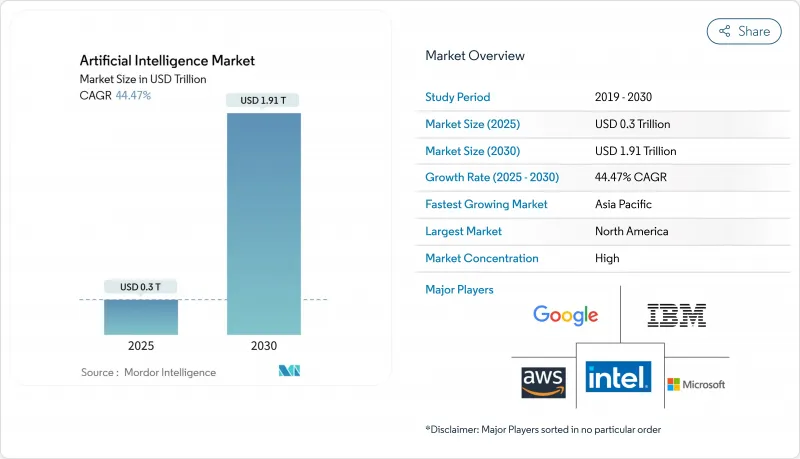
自主人工智慧专案、企业成本优化以及硬体的快速创新正推动这项技术从实验性试点走向核心生产工作流程,从而在各个主要行业持续推动需求成长。大型企业希望直接掌控整体拥有成本和资料管治,这导致本地部署模式的復兴。同时,云端超大规模资料中心业者云端服务商正大力投资新增容量,以确保开发环境的便利存取。 GPU 的进步、节能架构的改进以及软硬体堆迭之间更紧密的集成,正在加速价值实现,并增强竞争优势。
全球人工智慧市场趋势与洞察
主权人工智慧和国家计算计划
政府资金正在塑造本地生态系统。印度的「印度人工智慧使命」正投资1,037.2亿卢比(约1.245亿美元)用于开发本土大规模语言模型,以满足本地语言需求。日本已投入10兆日圆用于人工智慧和半导体技术研发,展现了对自主研发的长期承诺。这些投资将为能够满足本地化法规要求的国内硬体供应商和系统整合商创造稳定的市场需求。
资料量和资料种类爆炸性成长
工业IoT的普及每天都在产生Terabyte的感测器数据,迫使企业采用人工智慧驱动的分析技术。西门子报告称,将机器学习应用于其财务运营后,实现了90%的非接触式发票处理,并获得了565万美元的年化投资回报。医疗影像、自动驾驶汽车和即时零售交易也在推动资料洪流,进而刺激了对可扩展储存、边缘处理和合成资料生成工具的需求。
GPU和电网供电瓶颈
NVIDIA 在 2026 财年展望中指出,H100 的供不应求。这项限制导致现货价格比厂商建议零售价 (MSRP) 高出 30% 至 50%,减缓了企业引进週期。公用事业公司预测,到 2026 年,资料中心电力需求可能达到 1050兆瓦时 (TWh),超过几个主要地区的计画扩张。这给新建 AI丛集的计划进度带来了压力。
细分市场分析
到2025年,软体收入将维持61.35%的份额,巩固其在人工智慧市场的基础地位。然而,随着企业将重心从实验阶段转向全面实施,预计到2031年,服务领域将以40.85%的复合年增长率快速成长。许多受监管行业需要能够解读合规要求并重新设计工作流程的供应商,而不仅仅是提供许可。因此,合格整合商的短缺使得服务供应商能够收取高价,尤其是在医疗保健和金融服务等特定领域的计划中。
在咨询、整合和管理服务领域,拥有垂直行业专业知识的供应商正日益受到青睐。在放射学领域,一项结合资料管治、演算法检验和临床医生工作流程重组的服务合作,帮助一家医院集团在五年内实现了 451% 的投资报酬率。随着客户开始以具体的生产力目标而不是抽象的模型精度来衡量计划,那些将硬体、软体和咨询服务打包成基本契约的专业公司正在价值链上向上攀升。
到2025年,公共云端将占据人工智慧市场43.72%的份额,这反映了其作为预设开发环境的地位。然而,随着企业在生产环境中寻求延迟优化和成本可视性,预计到2031年,混合模式将以45.55%的复合年增长率成长。早期采用者正在超大规模丛集上进行训练,并将推理过程推送到本地或边缘设备以实现即时回应。汽车製造商正在透过在工厂车间运行毫秒级视觉任务来展示这种架构,同时保持云弹性以进行模型重新训练。
在资源受限的环境中,例如海上钻井平台和零售商店,边缘部署同样重要,因为频宽至关重要。在金融和公共部门,由于面临严格的资料居住法规,本地部署再次兴起。硬体供应商现在将编配软体与产品捆绑销售,该软体可以根据策略规则在云端、本地机架和边缘设备之间迁移容器,从而推动混合解决方案的人工智慧市场规模不断增长。
这份人工智慧市场报告按组件(硬体、软体、服务)、部署模式(公共云端、本地部署、混合部署)、技术(机器学习、深度学习、自然语言处理、电脑视觉、生成式云端、情境感知运算等)、最终用户垂直产业(银行、金融服务和保险、IT和电信、医疗保健和生命科学、製造业等)以及地区对产业进行细分。
区域分析
北美地区在创业投资充裕、云端生态系成熟以及企业快速采用云端运算的推动下,维持了其领先的营收成长势头,预计到2025年将占据37.12%的市场份额。联邦项目,例如《晶片和科学法案》,正在为人工智慧晶片製造厂注入更多资金,从而支持国内硬体供应并增强人工智慧市场。维吉尼亚州、德克萨斯州和奥勒冈州的高效能运算丛集持续吸引软体Start-Ups,这些公司选择在靠近云端可用区的位置部署,以实现低延迟。
欧洲的成长格局受两大因素影响:严格的资料隐私法规和大规模的政府计算预算。符合GDPR标准的架构促使供应商将推理工作负载在地化到欧洲地区,从而创造了对本地GPU设备的需求。法国公私合作计划Mistral AI预计到2025年估值将达到20亿欧元,并寻求资金筹措10亿美元以扩展多语言模型训练。德国和北欧国家也开展了类似的计划,专注于建立符合雄心勃勃的碳减排目标的绿色资料中心,这些计划正在维持人工智慧市场两位数的区域成长。
亚太地区预计将成为全球成长最快的地区,到2031年复合年增长率将达到40.75%。中国的国家半导体计画到2030年拨款1兆元人民币用于晶片及相关基础设施建设,而印度已拨款1037.2亿印度卢比用于国家人工智慧运算,这将推动国内整合商跻身全球前列。日本数兆日圆的基金将加速晶圆厂升级,而放宽的人工智慧监管也将缩短商业部署时间。包括新加坡和马来西亚在内的东南亚国家已推出资料中心税收优惠政策,以吸引超大规模资料中心业者进驻区域中心,进一步扩大了该地区的人工智慧市场。
其他福利:
- Excel格式的市场预测(ME)表
- 3个月的分析师支持
目录
第一章 引言
- 研究假设和市场定义
- 调查范围
第二章调查方法
第三章执行摘要
第四章 市场情势
- 市场概览
- 市场驱动因素
- 对预测分析的需求日益增长
- 数据量和数据多样性的爆炸性增长
- 快速采用云端为基础的人工智慧服务
- 主权人工智慧和国家计算倡议
- 转向本地部署/私有人工智慧以实现总体拥有成本管理
- 节能型人工智慧硬体的需求
- 市场限制
- 高额资本投入与劳力短缺
- 资料隐私和合规障碍
- GPU/电源网路供电瓶颈
- 资料中心碳排放上限
- 关键法规结构评估
- 价值链分析
- 技术展望
- 波特五力模型
- 供应商的议价能力
- 买方的议价能力
- 新进入者的威胁
- 替代品的威胁
- 竞争对手之间的竞争
- 关键相关人员影响评估
- 主要用例和案例研究
- 宏观经济因素对市场的影响
- 投资分析
第五章 市场区隔
- 按组件
- 硬体
- 软体
- 服务
- 透过部署模式
- 公共云端
- 本地部署
- 杂交种
- 透过技术
- 机器学习
- 深度学习
- 自然语言处理
- 电脑视觉
- 人工智慧世代
- 情境感知计算及其他
- 按最终用户行业划分
- BFSI
- 资讯科技/通讯
- 医疗保健和生命科学
- 製造业
- 零售与电子商务
- 汽车/运输设备
- 政府和国防部
- 能源与公共产业
- 媒体与娱乐
- 建造
- 按地区
- 北美洲
- 美国
- 加拿大
- 墨西哥
- 南美洲
- 巴西
- 阿根廷
- 其他南美洲
- 欧洲
- 英国
- 德国
- 法国
- 义大利
- 西班牙
- 北欧国家
- 其他欧洲地区
- 中东和非洲
- 中东
- 沙乌地阿拉伯
- 阿拉伯聯合大公国
- 土耳其
- 其他中东地区
- 非洲
- 南非
- 埃及
- 奈及利亚
- 其他非洲地区
- 中东
- 亚太地区
- 中国
- 印度
- 日本
- 韩国
- ASEAN
- 澳洲
- 纽西兰
- 亚太其他地区
- 北美洲
第六章 竞争情势
- 市场集中度
- 策略趋势
- 市占率分析
- 公司简介
- International Business Machines Corporation
- Intel Corporation
- Microsoft Corporation
- Google LLC(Alphabet Inc.)
- Amazon Web Services, Inc.(Amazon.com, Inc.)
- Oracle Corporation
- Salesforce, Inc.
- SAP SE
- SAS Institute Inc.
- Cisco Systems, Inc.
- Siemens AG
- NVIDIA Corporation
- Hewlett Packard Enterprise Company
- Accenture plc
- Baidu, Inc.
- Alibaba Cloud(Intelligent Cloud Business of Alibaba Group Holding Limited)
- Palantir Technologies Inc.
- OpenAI, Inc.
- Meta Platforms, Inc.
- Huawei Technologies Co., Ltd.
- Tencent Holdings Limited
- ServiceNow, Inc.
- Snowflake Inc.
第七章 市场机会与未来展望
The artificial intelligence market is expected to grow from USD 306.04 billion in 2025 to USD 434.42 billion in 2026 and is forecast to reach USD 2,503.13 billion by 2031 at 41.95% CAGR over 2026-2031.
Sovereign AI programs, enterprise cost-optimization, and rapid hardware innovation are moving the technology from experimental pilots into core production workflows, fuelling sustained demand across every major sector. On-premise deployments are regaining traction because large organisations want direct control over total cost of ownership and data governance. At the same time, cloud hyperscalers are investing heavily in new capacity, ensuring that development environments remain easily accessible. GPU advances, energy-efficient architectures, and tighter integration between hardware and software stacks are shortening time to value and sharpening competitive differentiation.
Global Artificial Intelligence Market Trends and Insights
Sovereign AI and national compute programs
Government funding is shaping local ecosystems. India's IndiaAI Mission is channeling INR 10,372 crore (USD 124.5 million) into indigenous large language models that meet local language needs. Japan is mobilising JPY 10 trillion for AI and semiconductor capacity, signalling a long-term commitment to self-reliance. Such investments create protected demand for domestic hardware vendors and systems integrators that can comply with localisation rules.
Explosive growth in data volume and variety
Industrial IoT rollouts generate terabytes of sensor data daily, pushing enterprises to adopt AI-driven analytics. Siemens reports 90% touchless invoice processing and USD 5.65 million annual ROI after embedding machine learning into its finance operations. Healthcare imaging, autonomous vehicles, and real-time retail transactions all add to the data deluge, driving up demand for scalable storage, edge processing, and synthetic data generation tools.
GPU and power-grid supply bottlenecks
NVIDIA cited persistent H100 shortages in its FY 2026 outlook, a constraint that has inflated spot prices 30-50% above MSRP and slowed enterprise deployment cycles. Power utilities forecast that data-center electricity demand could hit 1,050 TWh by 2026, exceeding planned capacity additions in several major regions, which in turn pressures project timelines for new AI clusters.
Other drivers and restraints analyzed in the detailed report include:
- Surging adoption of cloud-based AI services
- Shift toward on-prem or private AI for TCO control
- High capex and talent shortages
For complete list of drivers and restraints, kindly check the Table Of Contents.
Segment Analysis
Software retained 61.35% revenue share in 2025, reinforcing its foundational role in the artificial intelligence market. Yet the Services segment is forecast to race ahead at 40.85% CAGR through 2031 as enterprises shift focus from experimentation to full-scale implementation. Many regulated industries now require vendors that can interpret compliance mandates and redesign workflows, rather than merely deliver licenses. The scarcity of qualified integrators, therefore, enables service providers to command premium pricing, especially for domain-specific projects in healthcare and financial services.
Across consulting, integration, and managed-services lines, vendors with vertical expertise are preferred. In radiology, service partnerships that combine data-governance, algorithm validation, and clinician workflow redesign are returning 451% ROI for hospital groups over five years. Specialists that package hardware, software, and advisory support into outcome-based contracts are moving up the value chain as customers measure projects against concrete productivity targets rather than abstract model accuracy.
Public Cloud held 43.72% of artificial intelligence market share in 2025, reflecting its role as the default development environment. Hybrid models, however, are projected to compound at 45.55% CAGR to 2031 as organizations seek latency optimization and cost visibility in production. Early adopters run training on hyperscale clusters then push inferencing to on-prem or edge devices for real-time response. Automotive OEMs validate this architecture by executing millisecond-level vision tasks on factory floors while retaining cloud elasticity for model retraining.
Edge rollouts are equally important in resource-constrained settings such as offshore rigs or retail outlets where bandwidth is expensive. On-prem deployments are resurging within finance and public-sector agencies that face strict data-residency mandates. Hardware suppliers now bundle orchestration software that migrates containers across clouds, on-prem racks, and edge devices based on policy rules, ensuring the artificial intelligence market size for hybrid solutions remains on an upward trajectory.
The AI Market Report Segments the Industry Into by Component (Hardware, Software, and Services), Deployment Mode (Public Cloud, On-Premise, and Hybrid), Technology (Machine Learning, Deep Learning, Natural Language Processing, Computer Vision, Generative AI, and Context-Aware Computing and Others), End-User Industry (BFSI, IT and Telecommunications, Healthcare and Life Sciences, Manufacturing, and More), and Geography.
Geography Analysis
North America remained the revenue leader with 37.12% share in 2025 thanks to deep venture capital pools, mature cloud ecosystems, and rapid enterprise adoption. Federal programs such as the CHIPS and Science Act funnel additional funding into AI-ready fabs, supporting domestic hardware supply and reinforcing the artificial intelligence market. High-performance computing clusters in Virginia, Texas, and Oregon continue to attract software start-ups that co-locate near cloud availability zones for lower latency.
Europe's growth profile is shaped by the twin forces of strict data-privacy regulation and sizable sovereign compute budgets. GDPR compliant architectures push vendors to localize inference workloads inside regional borders, creating demand for on-prem GPU appliances. France's public-private initiative around Mistral AI gained a €2 billion valuation in 2025 and aims to raise USD 1 billion to scale multilingual model training. Similar programs in Germany and the Nordics focus on green-data-center footprints that align with ambitious carbon-reduction targets, sustaining double-digit regional growth for the artificial intelligence market.
Asia-Pacific is projected to register a 40.75% CAGR through 2031, the fastest worldwide. China's National Semiconductor Mission allocates RMB 1 trillion by 2030 for chips and supporting infrastructure, while India earmarks INR10,372 crore for national AI compute, propelling domestic integrators into global rankings. Japan's multi-trillion-yen fund fast-tracks fab upgrades and light-touch AI regulation that accelerates time to commercial deployment. Southeast Asian economies, including Singapore and Malaysia, are introducing data-center tax incentives that entice hyperscalers to anchor regional hubs, further enlarging the artificial intelligence market size in the region.
- International Business Machines Corporation
- Intel Corporation
- Microsoft Corporation
- Google LLC (Alphabet Inc.)
- Amazon Web Services, Inc. (Amazon.com, Inc.)
- Oracle Corporation
- Salesforce, Inc.
- SAP SE
- SAS Institute Inc.
- Cisco Systems, Inc.
- Siemens AG
- NVIDIA Corporation
- Hewlett Packard Enterprise Company
- Accenture plc
- Baidu, Inc.
- Alibaba Cloud (Intelligent Cloud Business of Alibaba Group Holding Limited)
- Palantir Technologies Inc.
- OpenAI, Inc.
- Meta Platforms, Inc.
- Huawei Technologies Co., Ltd.
- Tencent Holdings Limited
- ServiceNow, Inc.
- Snowflake Inc.
Additional Benefits:
- The market estimate (ME) sheet in Excel format
- 3 months of analyst support
TABLE OF CONTENTS
1 INTRODUCTION
- 1.1 Study Assumptions and Market Definition
- 1.2 Scope of the Study
2 RESEARCH METHODOLOGY
3 EXECUTIVE SUMMARY
4 MARKET LANDSCAPE
- 4.1 Market Overview
- 4.2 Market Drivers
- 4.2.1 Rising demand for predictive analytics
- 4.2.2 Explosive growth in data volume/variety
- 4.2.3 Surging adoption of cloud-based AI services
- 4.2.4 Sovereign AI and national compute initiatives
- 4.2.5 Shift toward on-prem/private AI for TCO control
- 4.2.6 Demand for energy-efficient AI hardware
- 4.3 Market Restraints
- 4.3.1 High capex and talent shortages
- 4.3.2 Data-privacy and compliance barriers
- 4.3.3 GPU / power-grid supply bottlenecks
- 4.3.4 Data-center carbon-emission caps
- 4.4 Evaluation of Critical Regulatory Framework
- 4.5 Value Chain Analysis
- 4.6 Technological Outlook
- 4.7 Porter's Five Forces
- 4.7.1 Bargaining Power of Suppliers
- 4.7.2 Bargaining Power of Buyers
- 4.7.3 Threat of New Entrants
- 4.7.4 Threat of Substitutes
- 4.7.5 Competitive Rivalry
- 4.8 Impact Assessment of Key Stakeholders
- 4.9 Key Use Cases and Case Studies
- 4.10 Impact on Macroeconomic Factors of the Market
- 4.11 Investment Analysis
5 MARKET SEGMENTATION
- 5.1 By Component
- 5.1.1 Hardware
- 5.1.2 Software
- 5.1.3 Services
- 5.2 By Deployment Mode
- 5.2.1 Public Cloud
- 5.2.2 On-Premise
- 5.2.3 Hybrid
- 5.3 By Technology
- 5.3.1 Machine Learning
- 5.3.2 Deep Learning
- 5.3.3 Natural Language Processing
- 5.3.4 Computer Vision
- 5.3.5 Generative AI
- 5.3.6 Context-Aware Computing and Others
- 5.4 By End-user Industry
- 5.4.1 BFSI
- 5.4.2 IT and Telecommunications
- 5.4.3 Healthcare and Life Sciences
- 5.4.4 Manufacturing
- 5.4.5 Retail and E-commerce
- 5.4.6 Automotive and Transportation
- 5.4.7 Government and Defense
- 5.4.8 Energy and Utilities
- 5.4.9 Media and Entertainment
- 5.4.10 Construction
- 5.5 By Geography
- 5.5.1 North America
- 5.5.1.1 United States
- 5.5.1.2 Canada
- 5.5.1.3 Mexico
- 5.5.2 South America
- 5.5.2.1 Brazil
- 5.5.2.2 Argentina
- 5.5.2.3 Rest of South America
- 5.5.3 Europe
- 5.5.3.1 United Kingdom
- 5.5.3.2 Germany
- 5.5.3.3 France
- 5.5.3.4 Italy
- 5.5.3.5 Spain
- 5.5.3.6 Nordics
- 5.5.3.7 Rest of Europe
- 5.5.4 Middle East and Africa
- 5.5.4.1 Middle East
- 5.5.4.1.1 Saudi Arabia
- 5.5.4.1.2 United Arab Emirates
- 5.5.4.1.3 Turkey
- 5.5.4.1.4 Rest of Middle East
- 5.5.4.2 Africa
- 5.5.4.2.1 South Africa
- 5.5.4.2.2 Egypt
- 5.5.4.2.3 Nigeria
- 5.5.4.2.4 Rest of Africa
- 5.5.4.1 Middle East
- 5.5.5 Asia-Pacific
- 5.5.5.1 China
- 5.5.5.2 India
- 5.5.5.3 Japan
- 5.5.5.4 South Korea
- 5.5.5.5 ASEAN
- 5.5.5.6 Australia
- 5.5.5.7 New Zealand
- 5.5.5.8 Rest of Asia-Pacific
- 5.5.1 North America
6 COMPETITIVE LANDSCAPE
- 6.1 Market Concentration
- 6.2 Strategic Moves
- 6.3 Market Share Analysis
- 6.4 Company Profiles (includes Global level Overview, Market level overview, Core Segments, Financials as available, Strategic Information, Market Rank/Share for key companies, Products and Services, and Recent Developments)
- 6.4.1 International Business Machines Corporation
- 6.4.2 Intel Corporation
- 6.4.3 Microsoft Corporation
- 6.4.4 Google LLC (Alphabet Inc.)
- 6.4.5 Amazon Web Services, Inc. (Amazon.com, Inc.)
- 6.4.6 Oracle Corporation
- 6.4.7 Salesforce, Inc.
- 6.4.8 SAP SE
- 6.4.9 SAS Institute Inc.
- 6.4.10 Cisco Systems, Inc.
- 6.4.11 Siemens AG
- 6.4.12 NVIDIA Corporation
- 6.4.13 Hewlett Packard Enterprise Company
- 6.4.14 Accenture plc
- 6.4.15 Baidu, Inc.
- 6.4.16 Alibaba Cloud (Intelligent Cloud Business of Alibaba Group Holding Limited)
- 6.4.17 Palantir Technologies Inc.
- 6.4.18 OpenAI, Inc.
- 6.4.19 Meta Platforms, Inc.
- 6.4.20 Huawei Technologies Co., Ltd.
- 6.4.21 Tencent Holdings Limited
- 6.4.22 ServiceNow, Inc.
- 6.4.23 Snowflake Inc.
7 MARKET OPPORTUNITIES AND FUTURE OUTLOOK
- 7.1 White-space and Unmet-need Assessment

 执行功能培训专案市场预测至2032年:按专案类型、年龄层、交付方式、最终用户和地区分類的全球分析生成式人工智慧平台市场预测至2032年:全球分析,按组件、组织规模、部署类型、技术、最终用户和地区划分
 人工智慧和数据平台:全球市场占有率(2024 年)
 2025年虚拟室内设计人工智慧(AI)全球市场报告2025年人工智慧(AI)产生播客主机全球市场报告2025年人工智慧(AI)合成测试数据全球市场报告2025年人工智慧(AI)模型水印技术全球市场报告2025年人工智慧(AI)简报产生全球市场报告2025年人工智慧(AI)资料集搜寻平台全球市场报告2025年全球人工智慧市场报告:提案请求(RFP)回应自动化