


 |
市场调查报告书
商品编码
1931743
工业帮浦:市场占有率分析、产业趋势与统计、成长预测(2026-2031)Industrial Pump - Market Share Analysis, Industry Trends & Statistics, Growth Forecasts (2026 - 2031) |
||||||

※ 本网页内容可能与最新版本有所差异。详细情况请与我们联繫。
预计到 2025 年,工业帮浦市场价值将达到 482 亿美元,从 2026 年的 504.6 亿美元成长到 2031 年的 634.5 亿美元。
预计在预测期(2026-2031 年)内,复合年增长率将达到 4.69%。
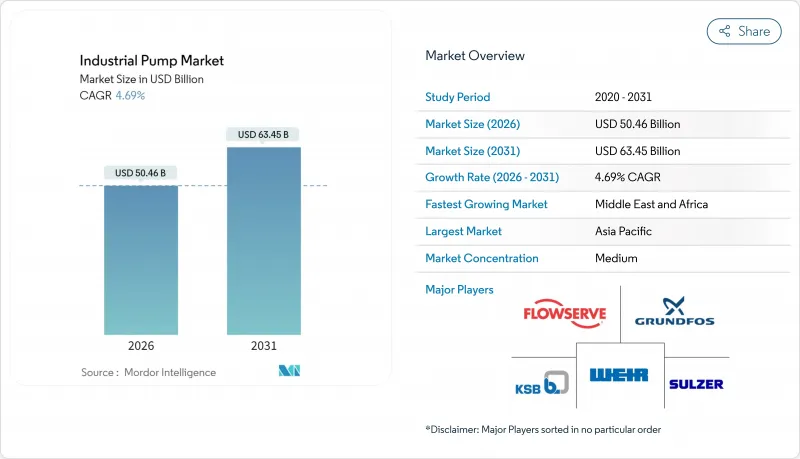
在供应链长期波动的情况下,老旧城市管网的持续更新、石化工厂的扩张以及日益严格的能源效率法规支撑了市场的韧性。水处理产业的资本支出仍是最大的需求推动要素,光是美国在2022年至2026年间累计超过500亿美元用于水基础设施升级。卡达和沙乌地阿拉伯的大型企划持续推动了能够处理乙烯裂解装置和天然气处理厂中腐蚀性和高温介质的高规格泵浦的订单。亚太地区凭藉中国、印度和东南亚的大规模工业化,继续保持主导地位,而中东和非洲地区则由于其石化行业的加速多元化而实现了最快的增长。
全球工业帮浦市场趋势及展望
全球对用水和污水处理的投资不断增加
2024 年和 2025 年初创纪录的市政预算导致大容量离心式帮浦和潜水式污水泵的竞标量激增。美国环保署 (EPA) 估计,长期维修需求超过 7,440 亿美元,推动了多阶段升级项目,例如耗资 4.65 亿美元的苏城区域设施和耗资 2.39 亿美元的卡罗来纳州费尔角南区污水处理厂。先进的污水处理要求推动了对高压逆渗透设备的需求,苏尔寿的垂直多级系统被选中用于埃及的马赫萨马污水回收计划。供水事业越来越多地采用无线感测器,将振动和温度数据传输到云端控制面板,以缩短关键资产的平均维修时间。采购框架强调总拥有成本 (TCO) 计算,并鼓励采用节能设计,促使采购者选择能够轻鬆满足欧盟 MEI 标准的高效率马达。加强监控要求也扩大了售后市场的收入来源,并为原始设备製造商 (OEM) 的持续服务合约提供了基础。
中东和非洲的石化工厂扩建
海湾产油国正在实现下游业务多元化,透过授予EPC合约的方式建造裂解装置、聚合物装置和天然气处理厂,这些项目都需要总合台耐腐蚀泵。卡达耗资60亿美元的拉斯拉凡聚合物综合体计画包括一套日产208万吨乙烷的裂解装置,计画于2027年运作。沙乌地阿拉伯耗资110亿美元的阿米拉尔计划将新增165万吨/日的乙烯产能,并与SATORP炼油厂整合,这显着增加了对符合API 610标准、能够承受400°F(约204°C)排放温度的泵浦的需求。采购竞标中的在地采购条款增强了国际原始设备製造商(OEM)本地化泵壳加工和最终组装的奖励。终端用户优先考虑使用变频驱动装置以降电力消耗,这推动了智慧马达控制技术的应用,符合区域节能目标。
钢铁和铜价波动会推高总拥有成本。
2024年,由于对供不应求,铜价飙升至每吨1万美元以上,逼近1.1万美元,导致铜密集型定子和绕组部件的生产成本上涨3.5%至4.2%。碳中和钢铁倡议进一步加剧了不确定性,因为钢厂将与氢基生产相关的绿色溢价转嫁给了消费者。製造商采取的应对措施包括加强避险计画、重新设计泵壳以节省材料,以及在供应合约中引入浮动价格条款。同时,终端用户推迟了自愿更换计划,延长了设备的使用寿命,并抑制了工业泵市场的短期出货量。
细分市场分析
2025年,离心式帮浦浦机组占总收入的61.85%,凭藉其在供水、化学品输送和空调迴路中久经考验的成本绩效,为工业泵浦市场提供了有力支撑。市政系统平均三年一次的大修週期,为细分市场带来了稳定的售后需求。然而,由于高黏度浆料处理的特殊需求,渐进式溶洞帮浦的市占率有所成长,预计到2031年,其复合年增长率将达到7.45%。随着石化和矿业客户优先考虑低剪切输送,渐进式溶洞泵在工业泵市场的份额正在扩大。同时,往復泵和隔膜泵分别在高压注入和卫生生产领域继续发挥重要作用,但其应用领域较为细分。物联网改造在传统离心式帮浦机组中也得到了广泛应用,能够进行振动分析以实现预测性维护,并将计划外停机时间减少高达30%。
一家单轴偏心螺桿帮浦製造商大力投资耐磨转子涂层,将磨损负荷下的维护週期延长至8000小时以上。旋转齿轮帮浦和蠕动帮浦满足了电池材料生产线中新兴的微量计量需求,展现了终端应用领域的广泛创新。基于感测器遥测技术建构的数位双胞胎使操作人员能够模拟整个液压范围内的空化风险,从而改善製程控制以保护叶轮。供应商继续强调模组化盒式密封的重要性,这种密封件简化了维护并减少了备件库存。随着监管机构日益关注能源强度,提高泵壳蜗壳和扩散叶片的效率已成为整个工业泵市场所有类型泵的竞争要务。
预计到2025年,电动驱动装置将占77.95%的市场份额,这得益于已开发国家近乎普及的电网接入以及变频驱动装置带来的效率提升。格雷科QUANTM平台记录的现场数据显示,采用横向磁通拓朴结构的马达效率最高可达85%,进一步印证了电动驱动的全生命週期成本优势。然而,太阳能驱动解决方案已成为工业泵浦产业成长最快的细分市场,年复合成长率高达11.1%,这主要得益于非洲和南亚农村灌溉计划的推动。太阳能驱动解决方案的安装成本从76.23欧元(89.13美元)到1219.59欧元(1425.95美元)不等,具有强大的平准化成本竞争力,尤其是在考虑到柴油发电机的燃料物流成本之后。
在电力系统可靠性仍存疑的油田压裂和紧急雨水排放领域,柴油引擎组仍具有重要的战略意义。液压和气动驱动装置继续应用于危险区域设施和移动设备,因为这些场所对功率密度和防火安全要求较高。结合太阳能光电阵列和锂离子储能的混合微电网解决方案已在印尼多家矿场进入试点阶段,实现了无需柴油辅助的24小时运作。在连续运转的海水淡化厂中,对现有电气设备进行变频驱动装置(VFD)改造,已实现了高达20%的能源成本节约。总体而言,这种电力供应组合对终端用户来说是一个切实可行的选择,但预计在预测期内,电力驱动装置在工业泵市场的主导地位仍将持续。
工业泵市场按泵类型(离心泵、往復泵、旋转泵等)、动力来源(电力、柴油、太阳能等)、终端用户行业(石油和天然气、水和用水和污水、化工和石化、发电、采矿、食品和饮料等)、泵安装类型(潜水式、地面安装式)和地区(北美、南美、欧洲、亚太、中东和非洲)进行细分。
区域分析
亚太地区受益于数十年的工业基础设施建设、大规模的城市基础设施改造以及政策主导的製造地本地化,预计到2025年将以44.85%的市场份额引领市场。福建省新建的乙烯裂解装置和澳洲的大型海水淡化专案推动了高效多级泵浦的采购。中国推广污水回用以及印度针对化学工业的生产关联激励计画(PLI)持续推动国内外泵製造商的订单成长。日益严格的电力消耗强度和碳足迹监管促使营运商采用变频驱动装置(VFD)进行维修,从而扩大了工业泵浦市场中高效产品线的市场份额。
中东和非洲地区复合年增长率最高,达6.05%,主要得益于沙乌地阿拉伯、卡达和阿联酋总合170亿美元的石化投资。海水淡化项目,例如NEOM公司日处理量达100万立方公尺的海水处理计划,需要耐氯化物应力腐蚀的高压双相不锈钢帮浦。赞比亚和刚果民主共和国的非洲采矿业扩张,带动了耐磨浆料泵订单的成长。在地采购框架使得原始设备製造商(OEM)得以在阿曼和南非建立服务基地,从而缩短了检修週期,并增强了品牌忠诚度。受《水利基础设施法案》的推动,北美地区持续保持稳定的更新换代,加州、德克萨斯州和佛罗里达州收到了大量离心式帮浦和立式涡轮泵的更换竞标。能源政策激励措施促进了氢电解的早期应用,从而带来了耐腐蚀循环泵的利基订单。欧洲严格的MEI法规刺激了对超高效设计的需求,并促使工厂业主重新评估整体拥有成本指标。儘管拉丁美洲面积较小,但智利和秘鲁的农业灌溉帮浦需求以及采矿相关需求均稳定成长。在所有地区,包含预测性维护的数位化服务提案都是竞标评估中的决定性因素,进一步塑造了工业泵浦市场的竞争格局。
其他福利:
- Excel格式的市场预测(ME)表
- 3个月的分析师支持
目录
第一章 引言
- 研究假设和市场定义
- 调查范围
第二章调查方法
第三章执行摘要
第四章 市场情势
- 市场概览
- 市场驱动因素
- 全球水和污水处理支出不断成长
- 扩大中东和非洲的石化产品产能
- 亚太地区工业基础建设的快速发展
- 绿色氢电解对耐腐蚀泵浦的需求
- 预测性维护物联网服务模式创造售后市场收入
- 市场限制
- 钢铁和铜价波动推高了总拥有成本(TCO)。
- 由于泵浦效率法规更加严格,资本投资週期放缓。
- 在干旱经济中向无动力重力式微灌系统过渡
- 价值链分析
- 技术展望
- 监管环境
- 波特五力分析
- 供应商的议价能力
- 买方的议价能力
- 新进入者的威胁
- 替代品的威胁
- 竞争对手之间的竞争
- 宏观经济因素的影响
第五章 市场规模与成长预测
- 按泵类型
- 离心式
- 往復式
- 旋转
- 隔膜
- 单轴偏心螺丝
- 其他的
- 透过电源
- 电
- 柴油引擎
- 太阳能发电
- 油压
- 气动
- 按最终用户行业划分
- 石油和天然气
- 水和污水
- 化学品和石油化工
- 发电
- 矿业
- 食品/饮料
- 製药
- 纸浆和造纸
- 其他的
- 按泵浦位置
- 水下
- 在水上
- 按地区
- 北美洲
- 我们
- 加拿大
- 墨西哥
- 南美洲
- 巴西
- 阿根廷
- 其他南美洲
- 欧洲
- 德国
- 英国
- 法国
- 义大利
- 俄罗斯
- 其他欧洲地区
- 亚太地区
- 中国
- 日本
- 韩国
- 印度
- 台湾
- 亚太其他地区
- 中东和非洲
- 中东
- 土耳其
- 以色列
- 海湾合作委员会国家
- 其他中东地区
- 非洲
- 南非
- 奈及利亚
- 其他非洲地区
- 中东
- 北美洲
第六章 竞争情势
- 市场集中度
- 策略趋势
- 市占率分析
- 公司简介
- Flowserve Corporation
- Grundfos Holding A/S
- Xylem Inc.
- Sulzer Ltd.
- KSB SE & Co. KGaA
- ITT Inc.
- Ebara Corporation
- The Weir Group PLC
- Schlumberger NV(REDA Pump)
- Baker Hughes Company
- SPX FLOW Inc.
- Wilo SE
- Dover Corporation
- Pentair plc
- Franklin Electric Co. Inc.
- Tsurumi Manufacturing Co. Ltd.
- Kirloskar Brothers Ltd.
- Atlas Copco AB
- Ruhrpumpen Group
- Zoeller Company
- Roto Pumps Ltd.
- Gardner Denver LLC(Ingersoll Rand)
- ClydeUnion Pumps(Celeros Flow Tech)
- LEWA GmbH
- Graco Inc.
第七章 市场机会与未来展望
The industrial pump market was valued at USD 48.2 billion in 2025 and estimated to grow from USD 50.46 billion in 2026 to reach USD 63.45 billion by 2031, at a CAGR of 4.69% during the forecast period (2026-2031).
Sustained replacement of aging municipal networks, petrochemical capacity additions, and tighter efficiency rules underpinned the market's resilience through prolonged supply-chain volatility. Capital spending on water treatment remained the single largest pull-forward of demand, with the United States alone earmarking more than USD 50 billion for water infrastructure upgrades between 2022 and 2026. Mega-projects in Qatar and Saudi Arabia continued to lift orders for high-specification pumps capable of handling corrosive, high-temperature media in ethylene crackers and gas-processing trains. Asia-Pacific retained volumetric leadership on the back of large-scale industrialization across China, India, and Southeast Asia, while the Middle East and Africa posted the fastest growth trajectory as petrochemical diversification accelerated.
Global Industrial Pump Market Trends and Insights
Rising Water and Wastewater Treatment Spending Globally
Record municipal budgets released in 2024 and early 2025 translated into larger tender volumes for high-capacity centrifugal and submersible sewage pumps. The US Environmental Protection Agency estimated long-term rehabilitation needs above USD 744 billion, prompting multi-phase upgrades such as Sioux City's USD 465 million regional facility and Cape Fear's USD 239 million Southside plant. Advanced treatment mandates drove interest in high-pressure reverse-osmosis trains, with Sulzer's vertical multistage systems underpinning Egypt's Al Mahsama drainage reclamation project. Utilities are increasingly embedding wireless sensors that stream vibration and temperature data into cloud dashboards, shortening mean-time-to-repair on critical units. Procurement frameworks began weighting total-cost-of-ownership calculations that favor energy-efficient designs, nudging buyers toward premium efficiency motors that comfortably clear EU MEI thresholds. Heightened monitoring obligations also expanded aftermarket revenue pools, anchoring recurring service contracts for OEMs.
Expansion of Petrochemical Capacity in MEA
Gulf producers pushed downstream diversification agendas, awarding EPC contracts for crackers, polymer units, and gas-processing trains that collectively require thousands of corrosion-resistant pumps. Qatar's Ras Laffan polymers complex, budgeted at USD 6 billion, incorporated a 2,080 KTA ethane cracker slated for 2027 on-stream dates. Saudi Arabia's USD 11 billion Amiral project added 1.65 million tons of ethylene nameplate capacity integrated with SATORP's refinery, multiplying demand for API 610 compliant pumps that withstand 400°F discharge temperatures. Local-content clauses inside procurement tenders intensified incentives for international OEMs to localize casing machining and final assembly. End-users prioritized variable-frequency drives to curb power draw, reinforcing adoption of smart motor controls that align with regional energy-efficiency ambitions.
Volatility in Steel and Copper Prices Inflating TCO
Copper cleared USD 10,000 per metric ton in 2024 and flirted with USD 11,000 amid looming supply deficits, hiking producer input costs by 3.5%-4.2% on copper-intensive stators and windings. Carbon-neutral steel initiatives added further unpredictability as mills passed on green-premium surcharges linked to hydrogen-based production. Manufacturers responded by tightening hedging programs, redesigning casings for material thrift, and introducing dynamic price clauses into supply contracts. End-users, meanwhile, deferred discretionary replacements, stretching the mean equipment life and tempering near-term shipment volumes in the industrial pump market.
Other drivers and restraints analyzed in the detailed report include:
- Rapid Industrial Infrastructure Build-out Across Asia-Pacific
- Demand for Corrosion-Resistant Pumps in Green-Hydrogen Electrolyzers
- Stricter Pump-Efficiency Directives Delaying Cap-ex Cycles
For complete list of drivers and restraints, kindly check the Table Of Contents.
Segment Analysis
Centrifugal units retained 61.85% of 2025 revenue, anchoring the industrial pump market through their proven cost-performance balance in water supply, chemical transfer, and HVAC loops. The segment generated steady aftermarket volumes, given typical mean-time-between-overhauls of three years in municipal duty cycles. However, specialty demands in viscous slurry handling shifted incremental share toward progressing cavity designs, which are projected to clock 7.45% CAGR through 2031. The progressing cavity cohort captured a rising slice of the industrial pump market size for petrochemical and mining customers that prize low-shear conveyance. Meanwhile, reciprocating and diaphragm pumps preserved critical roles in high-pressure injection and sanitary production, respectively, albeit with niche footprints. IoT retrofits became common even on legacy centrifugal sets, enabling predictive vibration analytics that cut unscheduled downtime by up to 30%.
Progressing cavity manufacturers invested heavily in wear-resistant rotor coatings to extend service intervals beyond 8,000 hours under abrasive duty. Rotary gear and peristaltic pumps addressed emerging micro-dosing tasks within battery-materials manufacturing lines, underscoring the breadth of end-use innovation. Digital twins built from sensor telemetry allowed operators to simulate cavitation risk across the hydraulic envelope, driving process-control refinements that protect impellers. Suppliers continued to emphasize modular cartridge seals that simplify maintenance and shrink spare inventory. With regulatory spotlight fixed on energy intensity, efficiency upgrades in casing volutes and diffuser vanes became a competitive must-have across all pump types in the broader industrial pump market.
Electric-driven assemblies held a commanding 77.95% share in 2025, benefitting from near-universal grid access in industrialized economies and the incremental efficiency yields of variable-frequency drives. Field data logged by Graco's QUANTM platform demonstrated up to 85% motor efficiency thanks to transverse-flux topology, reinforcing the narrative of electricity-based lifecycle cost advantage. Solar-powered solutions, however, emerged as the fastest expanding slice of the industrial pump industry, advancing at an 11.1% CAGR on the back of rural irrigation projects in Africa and South Asia. Installation costs ranging from EUR 76.23 (USD 89.13) to EUR 1,219.59 (USD 1,425.95) translated to competitive levelized costs, particularly once fuel-logistics premiums on diesel sets were factored in.
Diesel-engine packages retained strategic relevance for oilfield fracturing and emergency stormwater evacuation, where grid resilience remained questionable. Hydraulic and pneumatic drives continued to serve hazardous-area placements and mobile plant equipment that prized power density and ignition safety. Hybrid microgrid solutions that pair PV arrays with lithium-ion storage entered the pilot stage at several Indonesian mines, offering 24/7 uptime without diesel supplementation. VFD retrofits on existing electric fleets shaved energy bills by up to 20% in continuous-duty desalination applications. Altogether, the power-source mix illustrated end-user pragmatism, but electric leadership in the industrial pump market is expected to persist through the forecast horizon.
Industrial Pump Market is Segmented by Pump Type (Centrifugal, Reciprocating, Rotary, and More), Power Source (Electric, Diesel, Solar, and More), End-User Industry (Oil and Gas, Water and Waste-Water, Chemicals and Petrochemicals, Power Generation, Mining, Food and Beverage, and More), Pump Orientation (Submersible, and Surface), and Geography (North America, South America, Europe, Asia-Pacific, and Middle East and Africa).
Geography Analysis
Asia-Pacific dominated with 44.85% revenue in 2025 after decades of industrial build-out, extensive municipal upgrades, and policy-driven manufacturing localization. New ethylene cracker complexes in Fujian and large-scale desalination schemes in Australia magnified the procurement of high-efficiency multistage pumps. China's stimulus for wastewater reuse and India's Production Linked Incentive program for chemicals continued to channel orders toward both global and domestic pump manufacturers. Regulatory pushes around electricity intensity and carbon footprints incentivized operators to retrofit VFDs, nudging market volume toward premium-efficiency product lines within the industrial pump market.
The Middle East and Africa posted the fastest 6.05% CAGR, propelled by USD 17 billion in combined petrochemical investments across Saudi Arabia, Qatar, and the United Arab Emirates. Desalination, such as NEOM's 1 million m3/day seawater project, demanded high-pressure duplex-steel pumps tolerant to chloride stress-corrosion. African mining expansions in Zambia and the Democratic Republic of Congo increased orders for abrasion-resistant slurry units. Local content frameworks pushed OEMs to open service hubs in Oman and South Africa, shortening turnaround times on overhauls and reinforcing brand loyalty. North America experienced a steady replacement cycle driven by water infrastructure bills, with California, Texas, and Florida aggregating the bulk of tenders for replacement centrifugal and vertical turbine pumps. Energy policy incentives supported early adoption of hydrogen electrolysis, sparking niche orders for corrosion-resistant circulation pumps. Europe's stringent MEI regulations stimulated demand for ultra-high-efficiency designs and encouraged plant owners to reassess total-cost-of-ownership metrics. Latin America, though smaller, witnessed steady uptake in agricultural irrigation pumps and mining-related demand in Chile and Peru. Across all regions, digital service propositions featuring predictive maintenance became a decisive factor in bid evaluations, further shaping competitive standings in the industrial pump market.
- Flowserve Corporation
- Grundfos Holding A/S
- Xylem Inc.
- Sulzer Ltd.
- KSB SE & Co. KGaA
- ITT Inc.
- Ebara Corporation
- The Weir Group PLC
- Schlumberger NV (REDA Pump)
- Baker Hughes Company
- SPX FLOW Inc.
- Wilo SE
- Dover Corporation
- Pentair plc
- Franklin Electric Co. Inc.
- Tsurumi Manufacturing Co. Ltd.
- Kirloskar Brothers Ltd.
- Atlas Copco AB
- Ruhrpumpen Group
- Zoeller Company
- Roto Pumps Ltd.
- Gardner Denver LLC (Ingersoll Rand)
- ClydeUnion Pumps (Celeros Flow Tech)
- LEWA GmbH
- Graco Inc.
Additional Benefits:
- The market estimate (ME) sheet in Excel format
- 3 months of analyst support
TABLE OF CONTENTS
1 INTRODUCTION
- 1.1 Study Assumptions and Market Definition
- 1.2 Scope of the Study
2 RESEARCH METHODOLOGY
3 EXECUTIVE SUMMARY
4 MARKET LANDSCAPE
- 4.1 Market Overview
- 4.2 Market Drivers
- 4.2.1 Rising water and waste-water treatment spending globally
- 4.2.2 Expansion of petrochemical capacity in MEA
- 4.2.3 Rapid industrial infrastructure build-out across Asia-Pacific
- 4.2.4 Demand for corrosion-resistant pumps in green-hydrogen electrolyzers
- 4.2.5 Predictive-maintenance IoT service models unlocking aftermarket revenue
- 4.3 Market Restraints
- 4.3.1 Volatility in steel and copper prices inflating TCO
- 4.3.2 Stricter pump-efficiency directives delaying cap-ex cycles
- 4.3.3 Shift to motor-less gravity micro-irrigation systems in arid economies
- 4.4 Value Chain Analysis
- 4.5 Technological Outlook
- 4.6 Regulatory Landscape
- 4.7 Porter's Five Forces Analysis
- 4.7.1 Bargaining Power of Suppliers
- 4.7.2 Bargaining Power of Buyers
- 4.7.3 Threat of New Entrants
- 4.7.4 Threat of Substitutes
- 4.7.5 Intensity of Competitive Rivalry
- 4.8 Impact of Macroeconomic Factors
5 MARKET SIZE AND GROWTH FORECASTS (VALUE)
- 5.1 By Pump Type
- 5.1.1 Centrifugal
- 5.1.2 Reciprocating
- 5.1.3 Rotary
- 5.1.4 Diaphragm
- 5.1.5 Progressing Cavity
- 5.1.6 Others
- 5.2 By Power Source
- 5.2.1 Electric
- 5.2.2 Diesel
- 5.2.3 Solar
- 5.2.4 Hydraulic
- 5.2.5 Pneumatic
- 5.3 By End-user Industry
- 5.3.1 Oil and Gas
- 5.3.2 Water and Waste-water
- 5.3.3 Chemicals and Petrochemicals
- 5.3.4 Power Generation
- 5.3.5 Mining
- 5.3.6 Food and Beverage
- 5.3.7 Pharmaceuticals
- 5.3.8 Pulp and Paper
- 5.3.9 Others
- 5.4 By Pump Orientation
- 5.4.1 Submersible
- 5.4.2 Surface
- 5.5 By Geography
- 5.5.1 North America
- 5.5.1.1 United States
- 5.5.1.2 Canada
- 5.5.1.3 Mexico
- 5.5.2 South America
- 5.5.2.1 Brazil
- 5.5.2.2 Argentina
- 5.5.2.3 Rest of South America
- 5.5.3 Europe
- 5.5.3.1 Germany
- 5.5.3.2 United Kingdom
- 5.5.3.3 France
- 5.5.3.4 Italy
- 5.5.3.5 Russia
- 5.5.3.6 Rest of Europe
- 5.5.4 Asia-Pacific
- 5.5.4.1 China
- 5.5.4.2 Japan
- 5.5.4.3 South Korea
- 5.5.4.4 India
- 5.5.4.5 Taiwan
- 5.5.4.6 Rest of Asia-Pacific
- 5.5.5 Middle East and Africa
- 5.5.5.1 Middle East
- 5.5.5.1.1 Turkey
- 5.5.5.1.2 Israel
- 5.5.5.1.3 GCC Countries
- 5.5.5.1.4 Rest of Middle East
- 5.5.5.2 Africa
- 5.5.5.2.1 South Africa
- 5.5.5.2.2 Nigeria
- 5.5.5.2.3 Rest of Africa
- 5.5.5.1 Middle East
- 5.5.1 North America
6 COMPETITIVE LANDSCAPE
- 6.1 Market Concentration
- 6.2 Strategic Moves
- 6.3 Market Share Analysis
- 6.4 Company Profiles (includes Global level Overview, Market level overview, Core Segments, Financials as available, Strategic Information, Market Rank/Share for key companies, Products and Services, and Recent Developments)
- 6.4.1 Flowserve Corporation
- 6.4.2 Grundfos Holding A/S
- 6.4.3 Xylem Inc.
- 6.4.4 Sulzer Ltd.
- 6.4.5 KSB SE & Co. KGaA
- 6.4.6 ITT Inc.
- 6.4.7 Ebara Corporation
- 6.4.8 The Weir Group PLC
- 6.4.9 Schlumberger NV (REDA Pump)
- 6.4.10 Baker Hughes Company
- 6.4.11 SPX FLOW Inc.
- 6.4.12 Wilo SE
- 6.4.13 Dover Corporation
- 6.4.14 Pentair plc
- 6.4.15 Franklin Electric Co. Inc.
- 6.4.16 Tsurumi Manufacturing Co. Ltd.
- 6.4.17 Kirloskar Brothers Ltd.
- 6.4.18 Atlas Copco AB
- 6.4.19 Ruhrpumpen Group
- 6.4.20 Zoeller Company
- 6.4.21 Roto Pumps Ltd.
- 6.4.22 Gardner Denver LLC (Ingersoll Rand)
- 6.4.23 ClydeUnion Pumps (Celeros Flow Tech)
- 6.4.24 LEWA GmbH
- 6.4.25 Graco Inc.
7 MARKET OPPORTUNITIES AND FUTURE OUTLOOK
- 7.1 White-space and Unmet-Need Assessment

 集中式冷却液分配单元市场:依产品类型、流量、压力、控制类型、部署方式、应用、最终用户产业、通路划分,全球预测,2026-2032年定排量柱塞泵市场:按类型、流量、排气量范围、材质、驱动方式、压力、应用、最终用户划分,全球预测(2026-2032年)矿用喷雾泵市场:按泵类型、动力源、材质、压力范围、应用、分销管道、最终用户划分,全球预测(2026-2032年)高压轴柱塞泵市场:按类型、设计、驱动系统、压力范围、流量、应用和分销管道划分,全球预测,2026-2032年无轴轮缘驱动推进器市场:船舶、额定功率、螺旋桨直径、推力能力、最终用户、全球预测,2026-2032年水泵控制面板市场:按类型、水泵类型、电压、安装方式、应用、最终用户、分销管道划分,全球预测(2026-2032年)全球热交换油泵市场(按泵类型、驱动频率、额定功率、流量和最终用途产业划分),2026-2032年预测
 工业泵浦市场:依类型、安装位置、驱动类型和行业划分 - 全球预测至 2036 年
 日本工业泵浦市场规模、份额、趋势及预测(按产品、通路、应用及地区划分,2026-2034年)日本工业泵阀市场规模、份额、趋势及预测(按产品类型、安装位置、驱动因素、最终用途和地区划分,2026-2034年)