


 |
市场调查报告书
商品编码
1934593
数位鑑识:市场占有率分析、产业趋势与统计、成长预测(2026-2031)Digital Forensics - Market Share Analysis, Industry Trends & Statistics, Growth Forecasts (2026 - 2031) |
||||||

※ 本网页内容可能与最新版本有所差异。详细情况请与我们联繫。
数位鑑识市场预计到 2026 年价值将达到 84.6 亿美元,高于 2025 年的 75.1 亿美元。
预计到 2031 年将达到 153.7 亿美元,2026 年至 2031 年的复合年增长率为 12.68%。
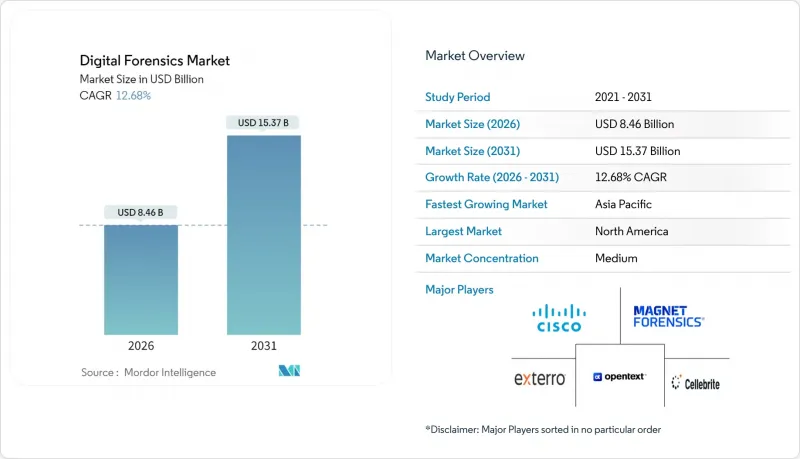
数位取证技术与云端原生SaaS调查、深度造假防范措施以及扩展的检测和回应平台相融合,推动了市场成长。法律强制要求的移动取证以及公共部门的持续投资进一步支撑了市场需求。同时,预设加密和调查人员短缺造成了营运摩擦,并推动了自动化、基于云端的证据保存技术的创新。由于现有供应商纷纷采用人工智慧和区块链技术来增强自身竞争力,市场竞争格局仍保持中等程度的分散。
全球数位鑑识市场趋势与洞察
云端原生SaaS的快速普及催生了对云端取证的需求。
云端迁移正在取代传统的磁碟镜像,推动了取证平台的普及。这些平台能够在分散式、多租户环境中撷取易失性数据,同时满足 ISO/IEC 27035-4:2024 证据可采纳性标准。证据隔离要求以及自动化证据管理和追踪的需求,促使市场对预先整合超大规模资料中心业者保全服务的解决方案产生需求。因此,提供云端原生采集 API 的供应商正加速被企业采用,尤其是在那些跨越复杂司法管辖区的跨国公司中。
深度造假诈骗的激增推动了对高级多媒体分析的需求。
随着机器产生的音讯和影片诈骗渗透到即时互动中,实验室不得不以神经检测演算法取代传统的认证技术,这些演算法在低解析度内容上也能达到 91.82% 的准确率。银行、金融服务和保险 (BFSI) 机构正在整合区块链溯源方案以保护高价值交易,而执法机关则在投资即时筛检工具,以便在调查取证过程中保存证据。
iOS/Android 的预设加密增加了证据收集的复杂性和成本。
基于硬体的加密已将现代设备上的资料提取成功率降低至 40% 以下,迫使人们依赖昂贵的解密工具和基于云端的证据替代方案。小规模的机构面临预算限制,这加剧了调查方面的差距,并引发了关于合法访问合作的政策讨论。
细分市场分析
到2025年,软体将维持44.62%的数位取证市场份额,这主要得益于针对加密和云端证据的高级分析技术。虽然实体取证对硬体的使用有限,但解密加速器将为调查处理提供支援。寻求承包扩展服务的企业将受益于託管服务,而专业服务在持续的人才短缺环境下将以14.43%的复合年增长率成长。
服务供应商正利用中小企业对取证即服务(Fensics-as-a-Service)的接受度,将事件回应和专家证词打包提供。供应商正在整合区块链谱系追踪和人工智慧驱动的故障分类功能,以缩短分析週期,从而增强其软体优势。平台授权和持续服务的策略性互动提高了收入的可预测性,并使供应商能够交叉销售相关的安全功能。
到2025年,电脑鑑识将占总营收的36.55%,其中云端取证目前正经历最快的复合年增长率(CAGR),达到12.96%,这主要得益于企业工作负载在多重云端环境中的成长。儘管面临加密方面的挑战,行动取证仍将保持成长,这得益于不断演进的绕过工具包。随着零信任架构的普及和联网设备的增加,网路、资料库和物联网调查将会扩展,因为这些调查会产生多样化的证据流。
银行、金融服务和保险 (BFSI) 领域的监管审核正在推动对持续云端取证支援的需求,从而为专业的云端原生供应商拓展了机会。随着对软体即服务 (SaaS) 的依赖日益加深,预计到 2031 年,云端调查的数位取证市场规模将与电脑取证市场规模相近。因此,供应商正优先考虑基于 API 的资料收集、挥发性资料储存以及按司法管辖区分類的资料细分,以推动云端取证技术的普及。
区域分析
北美地区将占2025年收入的34.65%,这得益于第14144号行政命令和强劲的联邦预算,这些措施加速了人工智慧驱动型研究的普及。以Palantir 12亿美元的政府收入为代表的公共部门平台采购,正在推动更广泛的生态系统现代化。
亚太地区以 13.16% 的复合年增长率引领成长,这反映了电子商务的扩张和网路犯罪成本的上升,预计到 2025 年,网路犯罪成本将达到 3.3 兆美元。监管方面的改进,例如中国放宽跨境转移豁免,正在逐步减少跨国取证服务提供者的调查摩擦。
在欧盟人工智慧法律和资料隐私法规的推动下,欧洲维持了均衡成长;中东和非洲地区正在拨出网路安全预算来保护能源和金融走廊;拉丁美洲在区域数位化政策的支持下取得了逐步进展,但受到人才短缺的限制。
其他福利:
- Excel格式的市场预测(ME)表
- 3个月的分析师支持
目录
第一章 引言
- 研究假设和市场定义
- 调查范围
第二章调查方法
第三章执行摘要
第四章 市场情势
- 市场概览
- 市场驱动因素
- 云端原生SaaS的快速普及催生了对云端取证的需求。
- 深度造假诈骗的激增推动了对高级多媒体分析的需求。
- 扩展型检测与回应 (XDR) 部署需要整合式数位取证与事件回应 (DFIR) 平台。
- 美国和欧盟对执法机关的行动装置分析要求
- 基于区块链的证据链试点计画推动取证软体升级
- 联邦政府加大网路安全投资和监管合规要求推动了取证技术的应用
- 市场限制
- iOS/Android 的预设加密会增加部署的复杂性和成本。
- 主要城市以外地区法院认证的专家证人短缺
- 工具分散和互通性差会增加中小企业的整体拥有成本。
- 由于资料居住规则(例如,中国CSL)对跨境证据转移的限制
- 价值链分析
- 监理展望
- 技术展望
- 波特五力分析
- 买方的议价能力
- 供应商的议价能力
- 新进入者的威胁
- 替代品的威胁
- 竞争对手之间的竞争
第五章 市场规模与成长预测
- 按组件
- 硬体
- 取证系统、设备和写入保护设备
- 影像处理和复製设备
- 其他硬体
- 软体
- 法医数据分析与视觉化
- 审查和报告
- 法证解密
- 其他软体模组
- 服务
- 专业服务
- 事件回应和违规分析
- 咨询和培训
- 託管取证服务
- 专业服务
- 硬体
- 按类型
- 电脑取证
- 行动装置取证
- 网路取证
- 云取证
- 资料库取证
- 物联网和嵌入式设备取证
- 透过工具
- 资料收集和存储
- 资料恢復与重建
- 法医数据分析
- 审查和报告
- 法证解密与密码破解
- 按组织规模
- 大公司
- 小型企业
- 终端用户产业
- 政府和执法机关
- BFSI
- 资讯科技和电信
- 卫生保健
- 零售与电子商务
- 能源与公共产业
- 製造业
- 运输/物流
- 国防/航太
- 教育
- 按地区
- 北美洲
- 我们
- 加拿大
- 墨西哥
- 南美洲
- 巴西
- 阿根廷
- 其他南美洲
- 欧洲
- 英国
- 德国
- 法国
- 西班牙
- 义大利
- 其他欧洲地区
- 亚太地区
- 中国
- 印度
- 日本
- 澳洲
- 韩国
- 亚太其他地区
- 中东和非洲
- 中东
- 沙乌地阿拉伯
- 阿拉伯聯合大公国
- 土耳其
- 其他中东地区
- 非洲
- 南非
- 肯亚
- 其他非洲地区
- 中东
- 北美洲
第六章 竞争情势
- 市场集中度
- 策略趋势
- 市占率分析
- 公司简介
- OpenText Corporation
- Cellebrite DI Ltd.
- Exterro Inc.
- Magnet Forensics Inc.
- Cisco Systems Inc.
- FireEye Inc.(Mandiant)
- LogRhythm Inc.
- KLDiscovery Inc.
- Paraben Corporation
- MSAB AB
- Oxygen Forensics Inc.
- Kroll LLC
- Hexagon AB(Qognify)
- ADF Solutions Inc.
- BAE Systems plc
- Broadcom Inc.(Symantec Enterprise DFIR Tools)
- Micro Systemation AB
- Digital Detective Group
- Nuix Pty Ltd
- Passware Inc.
第七章 市场机会与未来展望
Digital forensics market size in 2026 is estimated at USD 8.46 billion, growing from 2025 value of USD 7.51 billion with 2031 projections showing USD 15.37 billion, growing at 12.68% CAGR over 2026-2031.
Growth pivots on cloud-native Software-as-a-Service investigations, deepfake countermeasures, and the integration of digital forensics within Extended Detection and Response platforms. Legislated mobile device extraction mandates and steady public-sector investments further underpin demand. Conversely, encryption-by-default and examiner shortages introduce operational friction yet also spur innovation in automated, cloud-based evidence preservation. Competitive dynamics remain moderately fragmented as established vendors embed artificial intelligence and blockchain-enabled chain-of-custody features to secure differentiation.
Global Digital Forensics Market Trends and Insights
Rapid Proliferation of Cloud-Native SaaS Creating Demand for Cloud Forensics
Cloud migrations are displacing traditional disk imaging, prompting the deployment of forensic platforms that capture volatile data across distributed, multi-tenant environments while meeting ISO/IEC 27035-4:2024 admissibility standards. Evidence isolation requirements and automated chain-of-custody tracking elevate demand for solutions pre-integrated with hyperscaler security services. As a result, vendors offering cloud-native acquisition APIs experience accelerated adoption among enterprises, particularly multinational corporations that navigate complex jurisdictional boundaries.
Surge in Deepfake-Enabled Fraud Driving Advanced Multimedia Analysis Needs
Machine-generated audio and video fraud now penetrates live interactions, forcing laboratories to replace legacy authentication with neural detection algorithms that achieve 91.82% accuracy on low-resolution content. BFSI institutions integrate blockchain provenance schemes to secure high-value transactions, while law-enforcement agencies invest in real-time screening tools to preserve evidentiary integrity during investigative interviews.
Encryption-by-Default on iOS/Android Elevating Acquisition Complexity and Cost
Hardware-backed encryption reduces extraction success to below 40% on recent devices, forcing reliance on premium decryption utilities and cloud-based evidence substitutes. Small agencies face budgetary barriers, widening investigative disparity and prompting policy debate on lawful access collaboration.
Other drivers and restraints analyzed in the detailed report include:
- Extended Detection and Response Adoption Necessitating Integrated DFIR Platforms
- Legislated Mobile Device Extraction Mandates in U.S. and EU Law-Enforcement
- Shortage of Court-Certified Examiners Outside Tier-1 Cities
For complete list of drivers and restraints, kindly check the Table Of Contents.
Segment Analysis
Software retained 44.62% of the digital forensics market share in 2025, underpinned by advanced analytics for encrypted and cloud evidence. Hardware usage remains niche for physical acquisitions, yet decryption accelerators support investigative throughput. Managed offerings capture enterprises seeking turnkey scalability, while professional services climb 14.43% CAGR as talent shortages persist.
Service providers capitalize on forensic-as-a-service adoption among SMEs, bundling incident response and expert testimony. Vendors integrate blockchain lineage and AI triage to compress analysis cycles, reinforcing software primacy. The strategic interplay between platform licensing and recurring services broadens revenue predictability, positioning vendors for cross-sell of adjacent security capabilities.
Computer forensics controlled 36.55% of 2025 revenue; however, cloud forensics now logs the fastest 12.96% CAGR amid multi-cloud enterprise workloads. Mobile forensics sustains growth despite encryption headwinds, supported by evolving bypass toolkits. Network, database, and IoT investigations expand as zero-trust architectures and connected devices generate diversified evidence streams.
Regulatory audits in BFSI amplify demand for continuous cloud evidence readiness, widening opportunities for specialized cloud-native vendors. Digital forensics market size for cloud investigations is poised to narrow the gap with computer forensics by 2031 as SaaS reliance deepens. Tool vendors therefore prioritize API-based collection, volatility preservation, and jurisdictional segmentation to boost adoption.
The Digital Forensics Market Report is Segmented by Component (Hardware, Software, and More), Type (Computer Forensics, Mobile Device Forensics, and More), Tool (Data Acquisition and Preservation, Forensic Data Analysis, and More), Organization Size (Large Enterprises, and Small and Medium Enterprises), End-User Vertical (BFSI, IT and Telecom and More), and Geography. The Market Forecasts are Provided in Terms of Value (USD).
Geography Analysis
North America held 34.65% of 2025 revenue, aided by Executive Order 14144 and robust federal budgets that accelerate AI-driven investigative adoption. Public-sector platform procurements, exemplified by Palantir's USD 1.20 billion government revenue, cascade into broader ecosystem modernization.
Asia Pacific leads in growth at 13.16% CAGR, reflecting e-commerce expansion and rising cybercrime costs forecast at USD 3.3 trillion by 2025. Regulatory refinements, such as China's eased cross-border transfer exemptions, gradually reduce investigative friction for multinational forensics providers.
Europe sustains balanced expansion through the EU AI Act and data-privacy mandates driving privacy-preserving forensic tool demand. Middle East and Africa allocate cybersecurity budgets to defend energy and financial corridors, while Latin America shows incremental progress constrained by skill shortages yet supported by regional digitalization policies.
- OpenText Corporation
- Cellebrite DI Ltd.
- Exterro Inc.
- Magnet Forensics Inc.
- Cisco Systems Inc.
- FireEye Inc. (Mandiant)
- LogRhythm Inc.
- KLDiscovery Inc.
- Paraben Corporation
- MSAB AB
- Oxygen Forensics Inc.
- Kroll LLC
- Hexagon AB (Qognify)
- ADF Solutions Inc.
- BAE Systems plc
- Broadcom Inc. (Symantec Enterprise DFIR Tools)
- Micro Systemation AB
- Digital Detective Group
- Nuix Pty Ltd
- Passware Inc.
Additional Benefits:
- The market estimate (ME) sheet in Excel format
- 3 months of analyst support
TABLE OF CONTENTS
1 INTRODUCTION
- 1.1 Study Assumptions and Market Definition
- 1.2 Scope of the Study
2 RESEARCH METHODOLOGY
3 EXECUTIVE SUMMARY
4 MARKET LANDSCAPE
- 4.1 Market Overview
- 4.2 Market Drivers
- 4.2.1 Rapid Proliferation of Cloud-Native SaaS Creating Demand for Cloud Forensics
- 4.2.2 Surge in Deepfake-Enabled Fraud Driving Advanced Multimedia Analysis Needs
- 4.2.3 Extended Detection and Response (XDR) Adoption Necessitating Integrated DFIR Platforms
- 4.2.4 Legislated Mobile Device Extraction Mandates in U.S. and EU Law-Enforcement
- 4.2.5 Blockchain-Based Evidence Chain-of-Custody Pilots Boosting Forensic Software Upgrades
- 4.2.6 Federal Cybersecurity Investments and Regulatory Compliance Requirements Expanding Forensic Deployments
- 4.3 Market Restraints
- 4.3.1 Encryption-by-Default on iOS/Android Elevating Acquisition Complexity and Cost
- 4.3.2 Shortage of Court-Certified Examiners Outside Tier-1 Cities
- 4.3.3 Fragmented Tool Inter-Operability Increasing Total Cost of Ownership for SMEs
- 4.3.4 Data-Residency Rules Limiting Cross-Border Evidence Transfers (e.g., China CSL)
- 4.4 Value Chain Analysis
- 4.5 Regulatory Outlook
- 4.6 Technological Outlook
- 4.7 Porter's Five Forces Analysis
- 4.7.1 Bargaining Power of Buyers
- 4.7.2 Bargaining Power of Suppliers
- 4.7.3 Threat of New Entrants
- 4.7.4 Threat of Substitutes
- 4.7.5 Intensity of Competitive Rivalry
5 MARKET SIZE AND GROWTH FORECASTS (VALUE)
- 5.1 By Component
- 5.1.1 Hardware
- 5.1.1.1 Forensic Systems, Devices and Write Blockers
- 5.1.1.2 Imaging and Duplication Devices
- 5.1.1.3 Other Hardware
- 5.1.2 Software
- 5.1.2.1 Forensic Data Analysis and Visualization
- 5.1.2.2 Review and Reporting
- 5.1.2.3 Forensic Decryption
- 5.1.2.4 Other Software Modules
- 5.1.3 Services
- 5.1.3.1 Professional Services
- 5.1.3.1.1 Incident Response and Breach Analysis
- 5.1.3.1.2 Consulting and Training
- 5.1.3.2 Managed Forensic Services
- 5.1.3.1 Professional Services
- 5.1.1 Hardware
- 5.2 By Type
- 5.2.1 Computer Forensics
- 5.2.2 Mobile Device Forensics
- 5.2.3 Network Forensics
- 5.2.4 Cloud Forensics
- 5.2.5 Database Forensics
- 5.2.6 IoT and Embedded Device Forensics
- 5.3 By Tool
- 5.3.1 Data Acquisition and Preservation
- 5.3.2 Data Recovery and Reconstruction
- 5.3.3 Forensic Data Analysis
- 5.3.4 Review and Reporting
- 5.3.5 Forensic Decryption and Password Cracking
- 5.4 By Organization Size
- 5.4.1 Large Enterprises
- 5.4.2 Small and Medium Enterprises
- 5.5 By End-user Vertical
- 5.5.1 Government and Law Enforcement Agencies
- 5.5.2 BFSI
- 5.5.3 IT and Telecom
- 5.5.4 Healthcare
- 5.5.5 Retail and E-commerce
- 5.5.6 Energy and Utilities
- 5.5.7 Manufacturing
- 5.5.8 Transportation and Logistics
- 5.5.9 Defense and Aerospace
- 5.5.10 Education
- 5.6 By Geography
- 5.6.1 North America
- 5.6.1.1 United States
- 5.6.1.2 Canada
- 5.6.1.3 Mexico
- 5.6.2 South America
- 5.6.2.1 Brazil
- 5.6.2.2 Argentina
- 5.6.2.3 Rest of South America
- 5.6.3 Europe
- 5.6.3.1 United Kingdom
- 5.6.3.2 Germany
- 5.6.3.3 France
- 5.6.3.4 Spain
- 5.6.3.5 Italy
- 5.6.3.6 Rest of Europe
- 5.6.4 Asia-Pacific
- 5.6.4.1 China
- 5.6.4.2 India
- 5.6.4.3 Japan
- 5.6.4.4 Australia
- 5.6.4.5 South Korea
- 5.6.4.6 Rest of Asia-Pacific
- 5.6.5 Middle East and Africa
- 5.6.5.1 Middle East
- 5.6.5.1.1 Saudi Arabia
- 5.6.5.1.2 United Arab Emirates
- 5.6.5.1.3 Turkey
- 5.6.5.1.4 Rest of Middle East
- 5.6.5.2 Africa
- 5.6.5.2.1 South Africa
- 5.6.5.2.2 Kenya
- 5.6.5.2.3 Rest of Africa
- 5.6.5.1 Middle East
- 5.6.1 North America
6 COMPETITIVE LANDSCAPE
- 6.1 Market Concentration
- 6.2 Strategic Moves
- 6.3 Market Share Analysis
- 6.4 Company Profiles (includes Global level Overview, Market level overview, Core Segments, Financials as available, Strategic Information, Market Rank/Share for key companies, Products and Services, and Recent Developments)
- 6.4.1 OpenText Corporation
- 6.4.2 Cellebrite DI Ltd.
- 6.4.3 Exterro Inc.
- 6.4.4 Magnet Forensics Inc.
- 6.4.5 Cisco Systems Inc.
- 6.4.6 FireEye Inc. (Mandiant)
- 6.4.7 LogRhythm Inc.
- 6.4.8 KLDiscovery Inc.
- 6.4.9 Paraben Corporation
- 6.4.10 MSAB AB
- 6.4.11 Oxygen Forensics Inc.
- 6.4.12 Kroll LLC
- 6.4.13 Hexagon AB (Qognify)
- 6.4.14 ADF Solutions Inc.
- 6.4.15 BAE Systems plc
- 6.4.16 Broadcom Inc. (Symantec Enterprise DFIR Tools)
- 6.4.17 Micro Systemation AB
- 6.4.18 Digital Detective Group
- 6.4.19 Nuix Pty Ltd
- 6.4.20 Passware Inc.
7 MARKET OPPORTUNITIES AND FUTURE OUTLOOK
- 7.1 White-space and Unmet-Need Assessment

 数位取证市场报告:按组件、类型、工具、最终用户和地区划分(2026-2034 年)
 数位取证工具市场预测至2034年:按组件、取证类型、部署模式、组织规模、应用、最终用户和地区分類的全球分析
 数位取证市场分析及预测(至2035年):按类型、产品类型、服务、技术、组件、应用、设备、流程、部署模式和最终用户划分
 数位取证市场:2026-2032年全球市场预测(按解决方案、取证类型、应用、部署模式和最终用户产业划分)
 2026年全球数位鑑识市场报告无人机取证市场:按组件、部署方式、资料类型、无人机类型和应用程式划分,全球预测(2026-2032年)品牌建立服务市场:全球预测(2026-2032 年),按服务类型、交付管道、合作模式、组织规模、最终用户产业和应用程式划分日本数位鑑识市场报告(按组件、类型、工具、最终用户和地区划分,2026-2034 年)
 数位取证市场规模、份额和成长分析(按组件、类型、部署模式、垂直产业和地区划分)-2026-2033年产业预测
 数位取证市场-全球产业规模、份额、趋势、机会及预测(按产品、类型、最终用户、地区和竞争格局划分,2020-2030 年预测)