


 |
市场调查报告书
商品编码
1934615
化妆品包装器材:市场占有率分析、产业趋势与统计、成长预测(2026-2031)Cosmetic Packaging Machinery - Market Share Analysis, Industry Trends & Statistics, Growth Forecasts (2026 - 2031) |
||||||

※ 本网页内容可能与最新版本有所差异。详细情况请与我们联繫。
预计到 2026 年,化妆品包装器材市场规模将达到 34.1 亿美元,高于 2025 年的 32.7 亿美元。
预计到 2031 年将达到 42.1 亿美元,2026 年至 2031 年的复合年增长率为 4.29%。
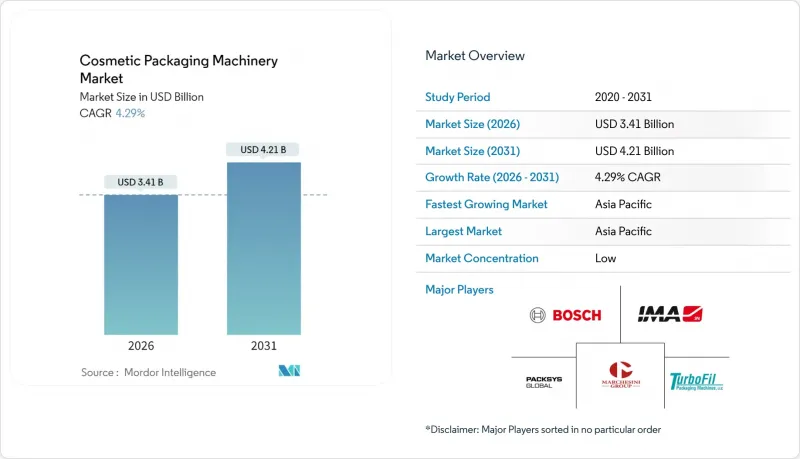
稳定成长反映出市场对能够适应各种包装材料和产品规格的自动化、永续性线的需求日益增长。电子商务对轻巧、易于运输包装的需求,以及日益严格的回收目标,迫使製造商部署能够快速切换柔性薄膜、可重复填充罐和高檔玻璃容器的设备。投资重点集中在人工智慧驱动的检测设备和电动伺服驱动器上,这些设备能够提高运转率、减少对劳动力的依赖并降低能源消耗。竞争活动主要围绕着收购展开,旨在扩展填充、密封和视觉检测能力。同时,零件价格波动和出口限制带来了成本和前置作业时间的风险。
全球化妆品包装器材市场趋势与洞察
对个人护理和美容产品的需求不断增长
预计2024年至2025年,香水、护肤和高端彩妆系列将实现两位数的销售成长,因为製造商正致力于瓶型、瓶盖和装饰效果的多样化。诸如Lumson的1500种设计组合等新产品,需要具备水性漆涂层、全像图应用和符合人体工学的填充功能的机器。雅诗兰黛在2024年向生物基聚合物的转型表明,市场需要能够处理非常规树脂并同时确保产品完整性的精密填充、密封和贴标设备。设备供应商正越来越多地提供承包模组,使化妆品製造商能够在广泛的黏度范围内同步进行填充、封盖和检测。持续的奢侈品趋势将继续推动对能够灵活处理从高端玻璃容器到轻质包装袋等各种产品的多功能生产线的高需求。
扩大工业自动化和智慧包装生产线
由于85%的自动化公司都面临熟练工人短缺的问题,化妆品製造商正在加速推进生产线的全面自动化。 Syntegon的SPC 1000系统减少了80%的人工干预,每年节省300小时的生产时间。电动线性致动器降低了能耗并缩小了安装空间。玫琳凯2024年睫毛膏生产线安装案例研究显示:整合式机器人、分散式驱动装置和数数位双胞胎缩短了产品规格切换时间,并提高了设备综合效率(OEE)。对即插即用模组日益增长的需求,促使中型企业也开始引入协作机器人进行检测、码垛和清洁等工序,在扩展自动化能力的同时,降低了再培训成本。
高初始资本投入
一条完整的高速生产线造价在 50 万美元到 200 万美元之间,迫使许多中小型製造商分阶段购买或租赁。儘管 PMMI 预测到 2027 年订单将保持强劲增长,但不断上涨的利率将投资回收期延长至三到五年。根据 2024 年高峰会 Packaging 的一项调查,企业目前正着眼于逐步实现自动化,优先考虑贴标和装箱,而非目视检测。为此,设备开发商正在提供入门级热成型机和风险共担服务合同,以降低准入门槛。
细分市场分析
到2025年,受乳霜、精华液和擦拭巾产品对集称重、封口和製袋于一体的设备需求的推动,成型-灌装-封口一体机将占据化妆品包装器材市场28.03%的份额。 IMA的小袋线拥有16条生产线,每分钟可完成80个循环,充分满足护肤和香水填充所需的产能。包装和捆扎设备将以6.56%的复合年增长率成为成长最快的设备,这主要得益于电商通路对具有抗衝击保护功能的多件装产品的需求。目前,所有灌装机均已整合人工智慧检测模组,确保产品达到高端品质。随着可重复填充产品的普及,封盖、装盒和装箱设备的需求将保持稳定。
对柔软性薄膜的持续投资促使机械製造商改进生物基复合材料的温度控制和封条轮廓。雷射划线技术的进步提高了开启性,同时又不影响阻隔性。随着硬质包装向柔性包装的转变加速,化妆品包装器材市场受益于能够在单一机架上同时处理三边封小袋和立式袋的生产线。安装在每个模组后面的视觉侦测摄影机将资料传输到分析仪表板,从而引导即时速度调整。
预计到2025年,全自动化生产线将占总营收的64.87%,维持5.58%的复合年增长率,继续保持领先地位。整合的机器人拣选、定向和封盖速度可确保零售产品的美观性和卫生性。 Syntegon的RMA(退货、再製造和维护)设备支援受控的小批量生产,并允许生产商透过将人工送料器与机器人组装相结合,逐步过渡到全自动化生产。基于振动感测器的预测性维护可减少非计划性停机时间并延长零件寿命。
半自动化平台对于手工製品和季节性产品仍然至关重要,但随着用户友好型程式设计降低了全线应用的技术门槛,其成长已趋于平缓。自动化促进协会 (Automation Advancement Association) 的专案旨在协助营运商从外挂式填充机过渡到可与上游工程共用生产资料的全连网单元。云端仪錶板能够提醒管理人员注意阻塞风险,让小规模品牌无需增加人手即可达到量贩店品质。
化妆品包装器材市场按机器类型(填充封口机、贴标机等)、自动化程度(全自动系统、半自动系统)、包装类型(硬质容器/罐、软管、小袋/包装袋等)、化妆品类型(护肤品、护髮品等)和地区进行细分。市场预测以美元计价。
区域分析
到2025年,亚太地区将占全球营收的38.05%,年复合成长率将达到7.03%,成为成长最快的地区。该地区的生产商正在整合工业4.0改装,以保持成本优势并满足全球品牌审核。中国、韩国和印度的强劲内需正在推动工厂扩张,并引进西方和本地采购的机械设备。政府对智慧製造的激励措施进一步加速了人工智慧检测和节能驱动装置的应用。
北美仍然是高端设备的主要采购地区。独立品牌正涌入市场,快速印刷机、模组化灌装机和视觉系统等产品广受欢迎,使企业能够以工业化的速度实现精湛的工艺创作。再生材料含量法规正推动跨国公司和合约包装商升级设备,采用PCR树脂和单材料复合生产线。零件生产的回流在一定程度上抵消了关税带来的成本上涨。
欧洲拥有最严格的永续性法规。当地品牌正在逐步淘汰含 PFAS 的阻隔材料,并采用数位护照进行包装追踪,这需要将高速数据载体整合到印刷、灌装和封口机中。当地的原始设备製造商 (OEM) 正在率先采用伺服马达驱动和封闭回路型CIP 清洗系统,以减少水和化学品的使用。新的化妆品工厂正在南欧和东欧兴建,这些工厂既能享受税收优惠,又能接近性欧盟市场。
在中东和非洲,随着当地化妆品品牌从高端香水领域拓展至护肤,设备安装量正在持续成长。针对高温环境稳定性优化的承包线越来越受欢迎。在南美洲,巴西对低维护成本的柔版贴标机和製袋机的需求日益增长,这些设备即使在间歇性断电的情况下也能运作。由于外汇波动,远距离诊断和本地备件供应对于设备安装至关重要。
其他福利:
- Excel格式的市场预测(ME)表
- 3个月的分析师支持
目录
第一章 引言
- 研究假设和市场定义
- 调查范围
第二章调查方法
第三章执行摘要
第四章 市场情势
- 市场概览
- 市场驱动因素
- 个人护理和美容产品需求不断增长
- 工业自动化和智慧包装生产线的兴起
- 电子商务转向更小的 SKU 和更灵活的包装形式
- 永续性法规对环保包装提出了压力。
- 人工智慧驱动的视觉检测可提高生产力
- 独立化妆品品牌需要灵活、快速週转的设备
- 市场限制
- 高初始投资
- 精密零件和钢材价格波动
- 熟练的机电工程师短缺
- 先进伺服驱动器和感测器的出口限制
- 供应链分析
- 监管环境
- 技术展望
- 波特五力分析
- 供应商的议价能力
- 买方的议价能力
- 新进入者的威胁
- 竞争对手之间的竞争
- 替代品的威胁
- 主要宏观经济趋势的影响
第五章 市场规模与成长预测
- 按模型
- 灌装/封口机
- 贴标机
- 封盖机
- 包装和装订机械
- 装盒和装箱包装器材
- 检测和视觉系统
- 其他机器类型
- 按自动化级别
- 全自动系统
- 半自动化系统
- 按包装类型
- 硬质容器和罐子
- 管状、袋状、小袋状
- 瓶子、泵浦、分配器
- 柔性薄膜和包装
- 透过化妆品
- 护肤品
- 护髮产品
- 化妆品和彩妆品
- 香水和除臭剂
- 其他个人保健产品
- 按地区
- 北美洲
- 我们
- 加拿大
- 墨西哥
- 欧洲
- 德国
- 法国
- 英国
- 义大利
- 俄罗斯
- 其他欧洲地区
- 亚太地区
- 中国
- 日本
- 韩国
- 印度
- 亚太其他地区
- 中东和非洲
- 中东
- 沙乌地阿拉伯
- 阿拉伯聯合大公国
- 其他中东地区
- 非洲
- 南非
- 肯亚
- 其他非洲地区
- 中东
- 南美洲
- 巴西
- 阿根廷
- 其他南美洲
- 北美洲
第六章 竞争情势
- 市场集中度
- 策略趋势
- 市占率分析
- 公司简介
- Syntegon Technology GmbH
- IMA Industria Macchine Automatiche SpA
- Marchesini Group SpA
- Coesia SpA(PackSys Global etc.)
- ProMach Inc.
- Accutek Packaging Equipment Co.
- Krones AG
- Sidel Group
- Optima Packaging Group GmbH
- Norden Machinery AB
- Barry-Wehmiller(Pneumatic Scale Angelus)
- Uhlmann Packaging Systems
- ProSys Innovative Packaging Equipment
- TurboFil Packaging Machines LLC
- Vetraco Group
- Zhejiang Rigao Machinery Corp.
- Wimco Ltd
- Liquid Packaging Solutions Inc.
- APACKS
- Shemesh Automation
第七章 市场机会与未来展望
The cosmetic packaging machinery market size in 2026 is estimated at USD 3.41 billion, growing from 2025 value of USD 3.27 billion with 2031 projections showing USD 4.21 billion, growing at 4.29% CAGR over 2026-2031.
Steady growth mirrors rising demand for automated, sustainability-ready lines that support a widening mix of packaging materials and product formats. E-commerce pressure for lightweight, shipment-friendly packs, coupled with stricter recyclability targets, compels manufacturers to install equipment that can switch rapidly between flexible films, refillable jars, and premium glass. Investments concentrate on AI-enabled inspection and electric servo drives that lift uptime, curb labor dependence, and reduce energy use. Competitive activity centers on acquisitions that extend filling, sealing, and vision capabilities, while component price volatility and export controls create cost and lead-time risk.
Global Cosmetic Packaging Machinery Market Trends and Insights
Growing Demand for Personal Care and Beauty Products
Fragrance, skincare, and premium color lines recorded double-digit sales in 2024-2025, pushing producers to widen bottle shapes, caps, and decoration effects. New launches such as Lumson's 1,500 design combinations require machinery capable of water-based lacquering, hologram application, and ergonomic refillable features. Estee Lauder's 2024 switch to bio-based polymers illustrates the need for precise form/fill/seal and labeling units that protect product integrity while handling non-traditional resins. Equipment suppliers increasingly package turnkey modules so that beauty houses can synchronize filling, capping, and inspection across wider viscosity ranges. Continuous premiumization keeps demand high for versatile lines that can flex between luxury glass and lightweight pouches.
Increasing Industrial Automation and Smart Packaging Lines
With 85% of automation employers reporting technician shortages, beauty manufacturers accelerate full-line automation. Syntegon's SPC 1000 reduced manual interventions by 80% and freed 300 production hours annually, while electric linear actuators lowered energy use and installation space. Case implementations such as Mary Kay's 2024 mascara line show how integrated robots, decentralized drives, and digital twins shorten format changeovers and raise OEE. Growing preference for plug-and-play modules means medium-sized firms adopt collaborative robots for inspection, palletizing, and wash-down cleaning, making automated capacity accessible without prohibitive retraining.
High Upfront Capital Expenditure
Complete high-speed lines cost USD 500,000-2 million, forcing many small producers to stagger purchases or lease. While PMMI projects strong order books through 2027, higher interest rates lengthen payback periods to 3-5 years. Summit Packaging's 2024 survey showed that firms now favor phased automation where labeling and case-packing receive priority before vision inspection. Equipment developers respond with entry-level thermoformers and shared-risk service contracts to lower barriers.
Other drivers and restraints analyzed in the detailed report include:
- E-commerce Shift Toward Smaller SKUs and Flexible Formats
- Sustainability Regulations Pressuring Eco-friendly Packaging
- Volatile Prices of Precision Components and Steel
For complete list of drivers and restraints, kindly check the Table Of Contents.
Segment Analysis
Form/fill/seal equipment accounted for 28.03% of cosmetic packaging machinery market share in 2025, supported by demand for integrated dosing, sealing, and pouch forming across creams, serums, and wipes. IMA's sachet line reaches 80 cycles per minute on 16 lanes, illustrating throughput that skincare and fragrance fillers require. Wrapping and bundling units post the highest 6.56% CAGR because e-commerce channels need protective multi-packs that withstand shipping shocks. Inspection modules equipped with AI now pair with every filler to guarantee luxury finish. Capping, cartoning, and case packing maintain stable uptake as refillable formats enter the mainstream.
Continuous investment in flexible films means machine builders refine temperature control and seal-bar profiles for bio-based laminates. Advance in laser-score technology eases openability without sacrificing barrier. As rigid-to-flexible conversions accelerate, the cosmetic packaging machinery market benefits from lines that handle both 3-side sachets and stand-up pouches on a single frame. Vision inspection cameras mounted after each module feed analytics dashboards that guide real-time speed balancing.
Fully automatic lines held 64.87% revenue in 2025 and will keep the lead with a 5.58% CAGR. Integrated robots pick, orient, and cap at rates that preserve retail aesthetics and hygiene. Syntegon's RMA machine covers regulated microlot runs, linking manual feeders with robotic assembly so producers transition to full automation in stages. Predictive maintenance based on vibration sensors trims unplanned downtime and extends part life.
Semi-automatic platforms still matter for artisan and seasonal products but growth plateaus as user-friendly programming lowers the skill barrier for full lines. Association for Advancing Automation programs help operators move from bolt-on fillers to fully networked cells that share production data upstream. Cloud dashboards alert supervisors to jam risk, ensuring smaller brands can reach mass-retail quality without high headcount.
Cosmetic Packaging Machinery Market is Segmented by Machine Type (Form/Fill/Seal Machinery, Labeling Machinery, and More), Automation Level (Fully-Automatic Systems, Semi-Automatic Systems), Packaging Type (Rigid Containers and Jars, Tubes, Sachets and Pouches, and More), Cosmetic Product (Skin-Care Products, Hair-Care Products, and More), and by Geography. The Market Forecasts are Provided in Terms of Value (USD).
Geography Analysis
Asia-Pacific holds 38.05% of 2025 revenue and records the fastest 7.03% CAGR. Regional producers integrate Industry 4.0 retrofits to comply with global brand audits while maintaining cost leadership. Strong domestic demand in China, South Korea, and India fuels factory expansions that source both Western and local machinery. Government incentives for intelligent manufacturing further accelerate adoption of AI inspection and energy-efficient drives.
North America remains a premium equipment buyer. Indie labels crowd the market and encourage short-run presses, modular fillers, and vision systems that maintain artisanal creativity at industrial speed. Regulations on recycled content push both multinationals and contract packers to upgrade lines for PCR resins and monomaterial laminates. Domestic reshoring of component production partially offsets tariff-related cost spikes.
Europe enforces the strictest sustainability rules. The continent's brands replace PFAS barriers and add digital passports for pack traceability, requiring printers, fillers, and sealers to integrate data carriers at high speed. OEMs here pioneer servo-electric actuation and closed-loop CIP that lower water and chemical use. Southern and Eastern Europe see green-field cosmetic plants that combine tax incentives with proximity to EU markets.
The Middle East and Africa register rising installations as local cosmetic brands expand beyond premium fragrances into skincare. Turnkey lines optimized for hot climate stability gain traction. In South America, Brazil leads demand for low-maintenance flexo labelers and pouch formers that thrive despite episodic power outages. Exchange-rate volatility makes remote diagnostic and local spares hubs critical to adoption.
- Syntegon Technology GmbH
- IMA Industria Macchine Automatiche SpA
- Marchesini Group SpA
- Coesia S.p.A (PackSys Global etc.)
- ProMach Inc.
- Accutek Packaging Equipment Co.
- Krones AG
- Sidel Group
- Optima Packaging Group GmbH
- Norden Machinery AB
- Barry-Wehmiller (Pneumatic Scale Angelus)
- Uhlmann Packaging Systems
- ProSys Innovative Packaging Equipment
- TurboFil Packaging Machines LLC
- Vetraco Group
- Zhejiang Rigao Machinery Corp.
- Wimco Ltd
- Liquid Packaging Solutions Inc.
- APACKS
- Shemesh Automation
Additional Benefits:
- The market estimate (ME) sheet in Excel format
- 3 months of analyst support
TABLE OF CONTENTS
1 INTRODUCTION
- 1.1 Study Assumptions and Market Definition
- 1.2 Scope of the Study
2 RESEARCH METHODOLOGY
3 EXECUTIVE SUMMARY
4 MARKET LANDSCAPE
- 4.1 Market Overview
- 4.2 Market Drivers
- 4.2.1 Growing demand for personal care and beauty products
- 4.2.2 Increasing industrial automation and smart packaging lines
- 4.2.3 E-commerce shift toward smaller SKUs and flexible formats
- 4.2.4 Sustainability regulations pressuring eco-friendly packaging
- 4.2.5 AI-enabled vision inspection boosts throughput
- 4.2.6 Indie cosmetic brands need agile short-run equipment
- 4.3 Market Restraints
- 4.3.1 High upfront capital expenditure
- 4.3.2 Volatile prices of precision components and steel
- 4.3.3 Shortage of skilled mechatronics technicians
- 4.3.4 Export controls on advanced servo drives and sensors
- 4.4 Supply-Chain Analysis
- 4.5 Regulatory Landscape
- 4.6 Technological Outlook
- 4.7 Porter's Five Forces Analysis
- 4.7.1 Bargaining Power of Suppliers
- 4.7.2 Bargaining Power of Buyers
- 4.7.3 Threat of New Entrants
- 4.7.4 Intensity of Competitive Rivalry
- 4.7.5 Threat of Substitutes
- 4.8 Impact of Key Macroeconomic Trends
5 MARKET SIZE AND GROWTH FORECASTS (VALUE)
- 5.1 By Machine Type
- 5.1.1 Form/Fill/Seal Machinery
- 5.1.2 Labelling Machinery
- 5.1.3 Capping Machinery
- 5.1.4 Wrapping and Bundling Machinery
- 5.1.5 Cartoning and Case-Packing Machinery
- 5.1.6 Inspection and Vision Systems
- 5.1.7 Other Machine Types
- 5.2 By Automation Level
- 5.2.1 Fully-Automatic Systems
- 5.2.2 Semi-Automatic Systems
- 5.3 By Packaging Type
- 5.3.1 Rigid Containers and Jars
- 5.3.2 Tubes, Sachets and Pouches
- 5.3.3 Bottles, Pumps and Dispensers
- 5.3.4 Flexible Films and Wraps
- 5.4 By Cosmetic Product
- 5.4.1 Skin-care Products
- 5.4.2 Hair-care Products
- 5.4.3 Make-up and Color Cosmetics
- 5.4.4 Fragrances and Deodorants
- 5.4.5 Other Personal-care Products
- 5.5 By Geography
- 5.5.1 North America
- 5.5.1.1 United States
- 5.5.1.2 Canada
- 5.5.1.3 Mexico
- 5.5.2 Europe
- 5.5.2.1 Germany
- 5.5.2.2 France
- 5.5.2.3 United Kingdom
- 5.5.2.4 Italy
- 5.5.2.5 Russia
- 5.5.2.6 Rest of Europe
- 5.5.3 Asia-Pacific
- 5.5.3.1 China
- 5.5.3.2 Japan
- 5.5.3.3 South Korea
- 5.5.3.4 India
- 5.5.3.5 Rest of Asia-Pacific
- 5.5.4 Middle East and Africa
- 5.5.4.1 Middle East
- 5.5.4.1.1 Saudi Arabia
- 5.5.4.1.2 UAE
- 5.5.4.1.3 Rest of Middle East
- 5.5.4.2 Africa
- 5.5.4.2.1 South Africa
- 5.5.4.2.2 Kenya
- 5.5.4.2.3 Rest of Africa
- 5.5.4.1 Middle East
- 5.5.5 South America
- 5.5.5.1 Brazil
- 5.5.5.2 Argentina
- 5.5.5.3 Rest of South America
- 5.5.1 North America
6 COMPETITIVE LANDSCAPE
- 6.1 Market Concentration
- 6.2 Strategic Moves
- 6.3 Market Share Analysis
- 6.4 Company Profiles (includes Global level Overview, Market level overview, Core Segments, Financials as available, Strategic Information, Market Rank/Share for key companies, Products and Services, and Recent Developments)
- 6.4.1 Syntegon Technology GmbH
- 6.4.2 IMA Industria Macchine Automatiche SpA
- 6.4.3 Marchesini Group SpA
- 6.4.4 Coesia S.p.A (PackSys Global etc.)
- 6.4.5 ProMach Inc.
- 6.4.6 Accutek Packaging Equipment Co.
- 6.4.7 Krones AG
- 6.4.8 Sidel Group
- 6.4.9 Optima Packaging Group GmbH
- 6.4.10 Norden Machinery AB
- 6.4.11 Barry-Wehmiller (Pneumatic Scale Angelus)
- 6.4.12 Uhlmann Packaging Systems
- 6.4.13 ProSys Innovative Packaging Equipment
- 6.4.14 TurboFil Packaging Machines LLC
- 6.4.15 Vetraco Group
- 6.4.16 Zhejiang Rigao Machinery Corp.
- 6.4.17 Wimco Ltd
- 6.4.18 Liquid Packaging Solutions Inc.
- 6.4.19 APACKS
- 6.4.20 Shemesh Automation
7 MARKET OPPORTUNITIES AND FUTURE OUTLOOK
- 7.1 White-space and Unmet-need Assessment

