


 |
市场调查报告书
商品编码
1934639
云端迁移服务:市场占有率分析、产业趋势与统计、成长预测(2026-2031)Cloud Migration Services - Market Share Analysis, Industry Trends & Statistics, Growth Forecasts (2026 - 2031) |
||||||

※ 本网页内容可能与最新版本有所差异。详细情况请与我们联繫。
预计到 2025 年,云端迁移服务市场规模将达到 3,000 亿美元,到 2031 年将达到 1,2994.8 亿美元,高于 2026 年的 3,830.4 亿美元。
预计在预测期(2026-2031 年)内,复合年增长率将达到 27.68%。
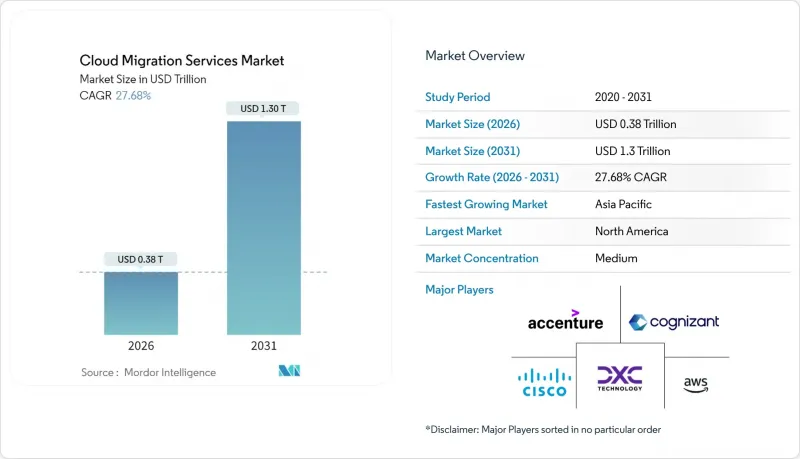
这种快速成长反映了企业从资本密集型本地资产迁移到可扩展云端环境的当前趋势,后者能够实现快速创新週期和更好的成本控制。这一趋势的驱动力来自生成式人工智慧工作负载的加速发展、混合云策略的扩展以及日益严格的范围 3 碳排放报告要求,这些要求都有利于云端原生架构。儘管公共云端仍保持主导地位,但随着企业在效能、合规性和成本优化目标之间寻求平衡,混合云模式正在兴起。大型企业仍然是最大的支出方,但随着自动化迁移工具链降低技术门槛,中小企业正在缩小差距。从行业垂直领域来看,银行、金融服务和保险 (BFSI) 以及医疗保健行业正在推动云端采用,超大规模云端服务提供商和垂直领域专家在持续关注供应商锁定和数据传输费用问题的同时,仍在不断扩展其服务组合。
全球云端迁移服务市场趋势与洞察
云端部署具有成本效益和扩充性优势。
将工作负载迁移到云端的公司透过消除资本密集的硬体更新週期并按需调整资源规模,持续降低营运成本 20% 至 30%。 Infomart 将其 B2B 平台迁移到 Oracle 云端基础架构后,在提升效能柔软性的同时,资料中心成本降低了 38%。弹性资源配置使企业能够应对意外的需求高峰,而无需像实体资料中心环境那样经历 6 至 12 个月的采购延迟。从基础设施维护中节省下来的预算越来越多地被重新投入到创新计划中,从而增强竞争优势。这些累积效益使得成本合理化策略成为对预期复合年增长率 (CAGR) 影响最大的正面因素。
远距办公和自备设备办公(BYOD)的普及率不断提高。
随着混合办公模式的普及,企业面临着将协作套件、身分识别服务和安全控制迁移到云端的压力,以确保无论使用者身处何地或使用何种设备,都能获得一致的使用者体验。最近的一项调查发现,89% 的 IT 领导者计划在 2025 年增加云端支出,以支援分散式团队。自带装置办公室 (BYOD) 让边界安全变得更加复杂,促使企业转向云端原生且易于部署的零信任架构。因此,这项转型越来越多地包含安全存取服务边际、端点管理和即时分析层,以确保员工随时随地都能有效运作。这一趋势正在推动计划储备在短期内获得强劲成长,尤其是在北美和欧洲。
资料安全和监管合规风险
欧洲企业在将《一般资料保护规则》(GDPR) 与公共云端服务模式相协调方面举步维艰。同时,全球金融机构必须应对重迭的司法管辖区规则,这些规则并未明确规范云端资料流。责任共担模式往往导致加密、日誌和事件回应等方面的责任划分不清。在某些情况下,主权云端要求迫使企业为本地化容量支付额外费用或维护本地基础设施,从而延长迁移时间。这些因素几乎限制了所有行业的成长,尤其是在医疗保健、银行和政府部门。
细分市场分析
混合部署是成长最快的部署方式,年复合成长率高达 18.35%,企业需要在满足本地部署的低延迟需求和公共云端的扩充性之间取得平衡。公共云端仍占据云端迁移服务市场 54.82% 的份额,这主要得益于超大规模云端服务供应商成熟的安全态势。边缘云端整合正在推动运算资源更靠近用户,同时保持弹性后端分析连线。未来的架构趋势是将多个执行环境整合到单一工作流程中。能够协调工作负载在这些节点间部署的迁移专家仍供不应求。
企业不再将配置视为非此即彼的选择。金融机构正在私有丛集上部署交易引擎,以实现亚毫秒级的延迟,同时将监管报告卸载到成本效益更高的公共储存桶中。医疗机构在本地处理影像数据,然后将匿名化后的数据路由到云端的AI管道。这些细緻入微的部署方案凸显了混合部署方案在云端迁移服务市场持续成长的原因。
到2025年,大型企业将占据云端迁移服务市场规模的61.20%,反映出它们拥有多年转型预算和全球布局。同时,中小企业将呈现17.65%的复合年增长率,这主要得益于打包式迁移工具链的普及,这些工具链能够缩短设定时间并降低专业知识门槛。云端服务供应商目前正在对其产品进行细分,一方面为财富500强企业提供深度咨询服务,另一方面为中小企业提供操作手册模板,从而在不损害利润率的前提下扩大了其能够满足的需求。
中小企业越来越多地选择SaaS替代方案和託管服务,以避免高成本的内部营运团队;而大型企业则在数十个业务部门推进渐进式重组,通常会设立专门团队(卓越中心)来製定管治和安全蓝图。这种两极化迫使供应商制定差异化的销售策略,以适应每个客户群的预算週期和合规要求。
区域分析
到2025年,北美将占全球云端支出的37.10%,这主要得益于早期采用者目前专注于人工智慧优化和多重云端成本管治。美国凭藉联邦云端计画处于领先地位,其中包括83亿美元的主导预算;而加拿大和墨西哥则利用其强大的网路基础加速云端采用。在全部区域,预测性工作负载部署引擎的整合正在推动更精细的消费模式和更低的资料传输费用,从而巩固北美作为云端迁移服务市场核心参与者的地位。
亚太地区预计到2031年将维持18.15%的复合年增长率,主要得益于国家级数位转型基金和超大规模资料中心业者服务商的投资。微软已拨款29亿美元用于日本扩建资料中心,显示对日本云端运算发展前景充满信心。预计到2028年,印度将形成255亿美元的云端运算市场,主要得益于银行、金融和保险(BFSI)、零售和政府部门的广泛现代化。在中国,在数据本地化政策的支持下,本土云端服务供应商透过客製化的自主服务不断扩大市场份额。该地区多元化的监管环境造就了混合云端和多重云端架构的复杂局面,企业在迁移过程中必须应对这些挑战。
欧洲在严格的数据主权控制下,正经历稳定成长。德国和英国是最大的采用者,而法国和西班牙则在推广主权云端框架,以赋予本土供应商。 GDPR 的实施要求所有计划都必须进行细緻的资料居住映射和加密管治。因此,混合云策略正成为主流,它将敏感工作负载保留在国内,同时利用扩充性的区域节点执行分析和人工智慧任务。在整个预测期内,此趋势将使欧洲的云端迁移模式与合规优先的架构保持高度一致。
其他福利:
- Excel格式的市场预测(ME)表
- 3个月的分析师支持
目录
第一章 引言
- 研究假设和市场定义
- 调查范围
第二章调查方法
第三章执行摘要
第四章 市场情势
- 市场概览
- 市场驱动因素
- 云端部署的成本效益和扩充性优势
- 远距办公和自备设备办公(BYOD)模式日益普及。
- 政府为数位转型提供资金
- 混合/多重云端策略的兴起
- 利用生成式人工智慧加速重构工作负载
- 范围 3 报告推动碳意识转型
- 市场限制
- 资料安全和监管合规风险
- 旧有应用程式的复杂性和互通性
- 云端资料传输费用上涨影响整体拥有成本 (TCO)
- 强制性主权云引发了对供应商锁定的担忧
- 价值/供应链分析
- 监管环境
- 技术展望
- 宏观经济因素的影响
- 投资分析
- 波特五力模型
- 新进入者的威胁
- 买方的议价能力
- 供应商的议价能力
- 替代品的威胁
- 竞争对手之间的竞争
第五章 市场规模与成长预测
- 依部署类型
- 公共云端
- 私有云端
- 混合云端
- 多重云端
- 按公司规模
- 中小企业
- 大公司
- 按服务类型
- Infrastructure-as-a-Service(IaaS)
- Platform-as-a-Service(PaaS)
- Software-as-a-Service(SaaS)
- 透过迁移方法
- 迁移和重新託管
- 平台更新
- 重构/重新设计
- 替代方案(SaaS 替代方案)
- 终端用户产业
- 银行、金融服务和保险(BFSI)
- 医疗保健和生命科学
- 零售与电子商务
- 政府/公共部门
- IT/通讯
- 製造业
- 能源与公共产业
- 其他的
- 按地区
- 北美洲
- 我们
- 加拿大
- 墨西哥
- 南美洲
- 巴西
- 阿根廷
- 欧洲
- 德国
- 英国
- 法国
- 俄罗斯
- 其他欧洲地区
- 亚太地区
- 中国
- 印度
- 日本
- 韩国
- 亚太其他地区
- 中东和非洲
- 中东
- 沙乌地阿拉伯
- 阿拉伯聯合大公国
- 土耳其
- 非洲
- 南非
- 奈及利亚
- 中东
- 北美洲
第六章 竞争情势
- 市场集中度
- 策略趋势
- 市占率分析
- 公司简介
- Accenture plc
- Amazon Web Services Inc.
- Cisco Systems Inc.
- Cognizant Technology Solutions Corporation
- DXC Technology Company
- Evolve IP LLC
- Google LLC
- International Business Machines Corporation(IBM)
- Microsoft Corporation
- Oracle Corporation
- Rackspace Technology Inc.
- Flexera Software LLC(RightScale)
- Tech Mahindra Limited
- VMware Inc.
- WSM International LLC
- Infosys Limited
- HCL Technologies Limited
- Capgemini SE
- Atos SE
- Fujitsu Limited
- Alibaba Cloud(Alibaba Group Holding Limited)
- Kyndryl Holdings Inc.
- Tata Consultancy Services Limited
- NTT Data Corporation
第七章 市场机会与未来展望
The cloud migration services market was valued at USD 300 billion in 2025 and estimated to grow from USD 383.04 billion in 2026 to reach USD 1299.48 billion by 2031, at a CAGR of 27.68% during the forecast period (2026-2031).
This rapid upside reflects how enterprises are shifting from capital-intensive on-premises assets toward scalable cloud environments that permit faster innovation cycles and superior cost control. Momentum is fueled by generative-AI workload acceleration, expanding hybrid strategies, and mounting Scope-3 carbon-reporting obligations that favor cloud-native architectures. Public cloud keeps its leadership position, yet hybrid patterns are gaining ground as firms work to balance performance with compliance and cost-optimization goals. Large enterprises remain the biggest spenders, but small and medium enterprises (SMEs) are closing the gap as automated migration toolchains lower technical barriers. Across industries, Banking, Financial Services and Insurance (BFSI) and Healthcare are pacing adoption, while hyperscale providers and niche specialists continue to broaden service portfolios amid vendor-lock-in and egress-fee concerns.
Global Cloud Migration Services Market Trends and Insights
Cost-efficiency and Scalability Advantages of Cloud Adoption
Enterprises continue to realize 20-30% operational-expenditure savings after moving workloads to the cloud, primarily by eliminating capital-intensive hardware refresh cycles and right-sizing resources on demand. Infomart's business-to-business platform migration to Oracle Cloud Infrastructure cut data-center costs by 38% while boosting performance flexibility. Elastic resource provisioning now allows organizations to handle unexpected demand spikes without the six-to-twelve-month procurement delays common in physical data-center environments. Budget freed from infrastructure upkeep is increasingly redirected toward innovation initiatives that sharpen competitive differentiation. These cumulative benefits give cost-rationalization strategies the highest positive impact on the forecast CAGR.
Rising Remote-work and BYOD Penetration
Hybrid work models have solidified, prompting organizations to migrate collaboration suites, identity services and security controls to the cloud to guarantee consistent user experiences across locations and devices. A recent survey shows 89% of IT leaders intend to raise cloud spending in 2025 to support distributed teams. BYOD complicates perimeter security, steering enterprises toward zero-trust architectures that are easier to enforce in cloud-native form. Consequently, migrations increasingly encompass secure access service edge, endpoint management and real-time analytics layers that maintain workforce productivity from any location. This trend exerts a strong, near-term pull on project pipelines, particularly in North America and Europe.
Data-security and Regulatory-compliance Risks
European firms struggle to reconcile General Data Protection Regulation (GDPR) stipulations with public-cloud service models, while global financial institutions juggle overlapping jurisdictional rules that rarely address cloud data flows explicitly. The shared-responsibility model often blurs accountability for encryption, logging and incident response. In some cases, sovereign-cloud requirements force organizations to pay premiums for localized capacity or retain on-premises infrastructure, extending migration timelines. These factors temper growth across nearly every industry, especially healthcare, banking and government.
Other drivers and restraints analyzed in the detailed report include:
- Government Digital-transformation Funding
- Proliferation of Hybrid / Multi-cloud Strategies
- Legacy-application Complexity and Interoperability
For complete list of drivers and restraints, kindly check the Table Of Contents.
Segment Analysis
Hybrid deployments are the fastest riser, advancing at an 18.35% CAGR as enterprises balance low-latency on-premises demands with public-cloud scale. Public cloud still holds 54.82% cloud migration services market share due to the mature security posture of hyperscale providers. Edge-cloud integrations now push compute closer to the user while maintaining elastic backend analytics connectivity, signaling that future architectures will combine multiple execution venues within a single workflow. Migration specialists able to orchestrate workload placement across these nodes remain in high demand.
Enterprises no longer view deployment as a binary choice. Financial institutions position trading engines on private clusters for sub-millisecond latency while offloading regulatory reporting to cost-efficient public buckets. Healthcare groups process imaging data on-site, then route anonymized sets to AI pipelines in the cloud. These nuanced blueprints underline why hybrid options will keep expanding their footprint within the cloud migration services market.
Large enterprises accounted for 61.20% of cloud migration services market size in 2025, reflecting multi-year transformation budgets and global rollouts. Yet SMEs exhibit an 17.65% CAGR, propelled by packaged migration toolchains that cut setup time and lower expertise thresholds. Cloud providers now segment offerings-white-glove consulting for Fortune 500 clients versus prescriptive templates for smaller firms-thereby widening addressable demand without eroding margins.
SMEs gravitate toward SaaS replacements and managed services to avoid staffing expensive in-house operations teams. Conversely, large entities pursue phased re-architecting across dozens of business units, often underpinned by center-of-excellence teams that codify governance and security blueprints. This bifurcation requires service vendors to maintain differentiated go-to-market motions tailored to each cohort's budget cycles and compliance obligations.
The Cloud Migration Services Market Report is Segmented by Deployment Type (Public Cloud, and More), Enterprise Size (Small and Medium Enterprises, and More), Service Type (IaaS, Paas, Saas), Migration Approach (Lift-And-Shift, Re-Platform, Refactor/Re-architect, Replace), End-User Vertical (BFSI, Healthcare, Retail, and More), and Geography. The Market Forecasts are Provided in Terms of Value (USD).
Geography Analysis
North America captured 37.10% of 2025 spend, anchored by early adopters that now focus on AI optimization and multi-cloud cost governance. The United States leads through federal cloud programs such as the USD 8.3 billion modernization budget, while Canada and Mexico leverage improved network backbones to accelerate adoption. Across the region, organizations are integrating predictive workload placement engines to refine consumption models and curb egress charges, reinforcing North America's position at the core of the cloud migration services market.
Asia-Pacific is projected to post an 18.15% CAGR to 2031, propelled by state-level digital-transformation funds and hyperscaler investments. Microsoft earmarked USD 2.9 billion for data-center expansion in Japan, demonstrating confidence in Japan's cloud trajectory. India is on course for a USD 25.5 billion cloud sector by 2028, reflecting widespread modernization across BFSI, retail and government. China's domestic providers, supported by data-localization rules, continue to grow market share via tailored sovereign offerings. The region's diverse regulatory landscape shapes a patchwork of hybrid and multi-cloud designs that migration firms must navigate.
Europe pairs steady growth with stringent data-sovereignty controls. Germany and the United Kingdom remain the largest adopters, yet France and Spain are championing sovereign-cloud frameworks that bolster domestic vendors. GDPR enforcement compels meticulous residency mapping and encryption governance across every project. Consequently, hybrid strategies dominate, allowing sensitive workloads to stay on national soil while analytics and AI tasks harness scalable regional nodes. This dynamic will keep Europe's migration profile firmly tied to compliance-first architectures throughout the forecast period.
- Accenture plc
- Amazon Web Services Inc.
- Cisco Systems Inc.
- Cognizant Technology Solutions Corporation
- DXC Technology Company
- Evolve IP LLC
- Google LLC
- International Business Machines Corporation (IBM)
- Microsoft Corporation
- Oracle Corporation
- Rackspace Technology Inc.
- Flexera Software LLC (RightScale)
- Tech Mahindra Limited
- VMware Inc.
- WSM International LLC
- Infosys Limited
- HCL Technologies Limited
- Capgemini SE
- Atos SE
- Fujitsu Limited
- Alibaba Cloud (Alibaba Group Holding Limited)
- Kyndryl Holdings Inc.
- Tata Consultancy Services Limited
- NTT Data Corporation
Additional Benefits:
- The market estimate (ME) sheet in Excel format
- 3 months of analyst support
TABLE OF CONTENTS
1 INTRODUCTION
- 1.1 Study Assumptions and Market Definition
- 1.2 Scope of the Study
2 RESEARCH METHODOLOGY
3 EXECUTIVE SUMMARY
4 MARKET LANDSCAPE
- 4.1 Market Overview
- 4.2 Market Drivers
- 4.2.1 Cost-efficiency and scalability advantages of cloud adoption
- 4.2.2 Rising remote-work and BYOD penetration
- 4.2.3 Government digital-transformation funding
- 4.2.4 Proliferation of hybrid / multi-cloud strategies
- 4.2.5 Generative-AI workload acceleration of refactoring
- 4.2.6 Scope-3 reporting pushes carbon-aware migrations
- 4.3 Market Restraints
- 4.3.1 Data-security and regulatory-compliance risks
- 4.3.2 Legacy-application complexity and interoperability
- 4.3.3 Escalating cloud-egress fees impact TCO
- 4.3.4 Vendor lock-in fears amid sovereign-cloud mandates
- 4.4 Value / Supply-Chain Analysis
- 4.5 Regulatory Landscape
- 4.6 Technological Outlook
- 4.7 Impact of Macro-Economic Factors
- 4.8 Investment Analysis
- 4.9 Porter's Five Forces
- 4.9.1 Threat of New Entrants
- 4.9.2 Bargaining Power of Buyers
- 4.9.3 Bargaining Power of Suppliers
- 4.9.4 Threat of Substitutes
- 4.9.5 Intensity of Competitive Rivalry
5 MARKET SIZE AND GROWTH FORECASTS (VALUE)
- 5.1 By Deployment Type
- 5.1.1 Public Cloud
- 5.1.2 Private Cloud
- 5.1.3 Hybrid Cloud
- 5.1.4 Multi-Cloud
- 5.2 By Enterprise Size
- 5.2.1 Small and Medium Enterprises (SMEs)
- 5.2.2 Large Enterprises
- 5.3 By Service Type
- 5.3.1 Infrastructure-as-a-Service (IaaS)
- 5.3.2 Platform-as-a-Service (PaaS)
- 5.3.3 Software-as-a-Service (SaaS)
- 5.4 By Migration Approach
- 5.4.1 Lift-and-Shift (Re-hosting)
- 5.4.2 Re-platform
- 5.4.3 Refactor / Re-architect
- 5.4.4 Replace (SaaS Substitution)
- 5.5 By End-user Vertical
- 5.5.1 Banking, Financial Services and Insurance (BFSI)
- 5.5.2 Healthcare and Life Sciences
- 5.5.3 Retail and E-commerce
- 5.5.4 Government and Public Sector
- 5.5.5 IT and Telecommunication
- 5.5.6 Manufacturing
- 5.5.7 Energy and Utilities
- 5.5.8 Others
- 5.6 By Geography
- 5.6.1 North America
- 5.6.1.1 United States
- 5.6.1.2 Canada
- 5.6.1.3 Mexico
- 5.6.2 South America
- 5.6.2.1 Brazil
- 5.6.2.2 Argentina
- 5.6.3 Europe
- 5.6.3.1 Germany
- 5.6.3.2 United Kingdom
- 5.6.3.3 France
- 5.6.3.4 Russia
- 5.6.3.5 Rest of Europe
- 5.6.4 Asia-Pacific
- 5.6.4.1 China
- 5.6.4.2 India
- 5.6.4.3 Japan
- 5.6.4.4 South Korea
- 5.6.4.5 Rest of Asia-Pacific
- 5.6.5 Middle East and Africa
- 5.6.5.1 Middle East
- 5.6.5.1.1 Saudi Arabia
- 5.6.5.1.2 UAE
- 5.6.5.1.3 Turkey
- 5.6.5.2 Africa
- 5.6.5.2.1 South Africa
- 5.6.5.2.2 Nigeria
- 5.6.5.1 Middle East
- 5.6.1 North America
6 COMPETITIVE LANDSCAPE
- 6.1 Market Concentration
- 6.2 Strategic Moves
- 6.3 Market Share Analysis
- 6.4 Company Profiles (includes Global-level Overview, Market-level Overview, Core Segments, Financials as available, Strategic Information, Market Rank/Share for key companies, Products and Services, Recent Developments)
- 6.4.1 Accenture plc
- 6.4.2 Amazon Web Services Inc.
- 6.4.3 Cisco Systems Inc.
- 6.4.4 Cognizant Technology Solutions Corporation
- 6.4.5 DXC Technology Company
- 6.4.6 Evolve IP LLC
- 6.4.7 Google LLC
- 6.4.8 International Business Machines Corporation (IBM)
- 6.4.9 Microsoft Corporation
- 6.4.10 Oracle Corporation
- 6.4.11 Rackspace Technology Inc.
- 6.4.12 Flexera Software LLC (RightScale)
- 6.4.13 Tech Mahindra Limited
- 6.4.14 VMware Inc.
- 6.4.15 WSM International LLC
- 6.4.16 Infosys Limited
- 6.4.17 HCL Technologies Limited
- 6.4.18 Capgemini SE
- 6.4.19 Atos SE
- 6.4.20 Fujitsu Limited
- 6.4.21 Alibaba Cloud (Alibaba Group Holding Limited)
- 6.4.22 Kyndryl Holdings Inc.
- 6.4.23 Tata Consultancy Services Limited
- 6.4.24 NTT Data Corporation
7 MARKET OPPORTUNITIES AND FUTURE OUTLOOK
- 7.1 White-space and Unmet-Need Assessment

 云端迁移服务市场:2026-2032年全球市场预测(依服务类型、企业规模、服务供应商、部署模式和产业划分)持续智慧市场:按元件、资料类型、应用、产业、部署模式和组织规模划分-2026年至2032年全球市场预测
 2026年全球云端迁移服务市场报告
 云端迁移服务市场分析及预测(至 2035 年):按类型、产品、服务、技术、元件、应用、部署、最终用户、解决方案和模式划分
 全球云端迁移软体市场规模、份额、趋势和成长分析报告(2026-2034)
 云端迁移服务市场(至 2035 年):按服务类型、迁移类型、部署模型、应用程式、产业和地区划分:产业趋势和全球市场预测
 云端迁移服务市场 - 全球产业规模、份额、趋势、机会及预测(按服务类型、组织规模、应用程式、最终用户产业、地区和市场竞争划分),2021-2031年
 云端迁移服务市场规模、份额和成长分析(按平台类型、部署类型、企业规模、最终用户和地区划分)-2026-2033年产业预测
 云端迁移服务市场预测至 2032 年:按平台、部署模式、企业规模、最终用户和地区分類的全球分析
 云端迁移服务市场规模、份额、趋势和预测(按服务类型、企业规模、部署模式、应用程式、行业垂直和地区),2025 年至 2033 年