


 |
市场调查报告书
商品编码
1934672
电脑数值控制(CNC):市场占有率分析、产业趋势与统计资料、成长预测 (2026-2031)Computer Numerical Controls (CNC) - Market Share Analysis, Industry Trends & Statistics, Growth Forecasts (2026 - 2031) |
||||||

※ 本网页内容可能与最新版本有所差异。详细情况请与我们联繫。
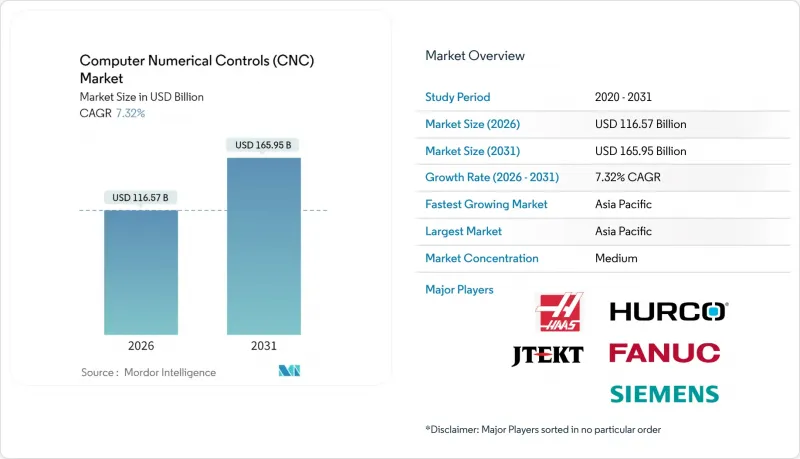
电脑数值控制(CNC) 市场预计到 2026 年价值 1,165.7 亿美元,从 2025 年的 1,086.3 亿美元成长到 2031 年的 1,659.5 亿美元。
预计2026年至2031年年复合成长率(CAGR)为7.32%。
持续的劳动力短缺、生产近岸外包以及工业4.0自动化浪潮的推动,正促使製造商加速投资多轴加工和数位化互联设备。美国和欧洲的回流政策正将资本从低成本地区转移到能够加快生产週转时间的弹性加工设施。日益增强的互联性也带来了网路安全风险,促使供应商在新控制器中融入安全设计特性。同时,持续高企的钢铝价格也推动了对能够最大限度减少废料的精密加工流程的需求。儘管零件短缺导致短期供应摩擦,但这些因素共同推动了电脑数值控制(CNC) 市场的强劲成长。
全球电脑数值控制(CNC) 市场趋势与洞察
北美和欧洲因製造业回流而对柔性数控设备的需求主导
2023年,美国从中国进口的成品下降了13%,而由于基础设施和半导体产业的优惠政策,国内工厂投资大幅成长。由于订单波动,买家更青睐能够处理各种零件组合的灵活五轴机床和模组化机器人单元。生产地点越靠近市场,运输风险越低,交货时间越短,因此更高的资本支出也越合理。能够提供快速改造和数位化配置能力的供应商获得了竞争优势。这种生产回流的趋势,将数十年来外包的生产模式转变为扩大的本地製造能力,从而直接扩大了电脑数值控制(CNC)市场。
引入主导4.0驱动的兼容数位双胞胎的控制设备
数位双胞胎技术使程式设计人员能够虚拟检验刀具路径,从而在西门子Sinumerik 828D硬体上将实体设定时间缩短20%。研究表明,当机器与其虚拟对应物运作封闭回路型协作时,生产率可提高14.53%,能耗可降低13.9%。航太和汽车产业的应用最为广泛,因为这些产业需要即时补偿热漂移和刀具磨损。控制设备供应商正在整合云端连接和人工智慧分析技术,将数控市场转变为以软体为中心的领域。随着授权收入的成长,机器製造商越来越重视经常性收入来源,而非一次性硬体利润。
半导体运动控制晶片短缺限制了供应
精密伺服驱动器依赖专用ASIC晶片,但供不应求持续存在,导致高阶机器的前置作业时间长达九个月甚至更久。一些製造商正在利用现有晶片进行设计变更,但这需要昂贵的重新认证。已获得配额的OEM厂商正在扩大市场份额,而后进企业正在失去订单。儘管订单充足,但这种瓶颈在短期内限制了CNC市场的规模。
细分市场分析
到2025年,CNC车床将占据CNC工具机市场22.95%的份额,是加工轴和轮毂等圆形零件的关键设备。随着电动车(EV)动力传动系统的发展,公差要求日益严格,许多加工厂正在对传统车削中心进行改造,加装动力刀具和Y轴功能。铣床将成为CNC工具机市场中第二大份额的工具机,主要负责加工航太零件和医疗植入所需的复杂模腔。电池机壳钣金设计的增加将推动对雷射切割机和电浆切割机的需求,而电火花加工(EDM)在加工硬化工具钢方面继续发挥关键作用。由于单次装夹功能显着缩短了夹具使用时间并消除了重新装夹误差,预计五轴平台数控工具机的市场规模将以10.35%的复合年增长率增长。研磨和焊接机则为细分市场增添了深度:摩擦搅拌焊接无需填充材即可连接电池外壳,而研磨则可在涡轮盘上实现镜面抛光效果。
5轴及以上加工中心类别充分说明了价值正从单纯的主轴功率转向柔软性。整合式刀库可在单一加工週期内管理数百种不同的刀具,加工铝、钛和复合材料。利用探针程序进行现场几何检验,虽然会增加材料成本,但可以减少废弃物。早期采用者发现,一旦操作员掌握了同步轴控制,生产效率就能提高18%。这促使零件供应商将多轴加工定位为应对劳动力风险的策略手段,从而推动数控市场朝着更高复杂度的方向发展,而这与车间规模无关。
三轴机床仍占总装机量的45.35%,巩固了其作为简单加工经济高效成本绩效的地位。然而,对于涉及倒扣或螺旋槽的零件加工,则需要加装旋转工作台或引入完整的五轴工具机。五轴及以上工具机市场正以10.35%的复合年增长率增长,这主要得益于铣削和车削加工的集成,使得无需重新装夹即可进行全方位加工。 CAM软体的改进和培训补贴的增加正在促进中端市场对技术的接受,进一步推动高轴数数控工具机市场的扩张。
安装在四轴系统上的旋转倾斜工作台为定位加工提供了一种经济实惠的入门途径,填补了技术空白。然而,领先的航太製造商越来越需要只有真正的五轴机床才能提供的同步运动能力。 FANUC的500i-A 控制器可将 CPU 效能提升 2.7 倍,并针对复杂的刀具路径最佳化轴间插补。随着 OEM 厂商展示其缩短的加工週期和更佳的表面光洁度,即使是较保守的机械加工厂也在重新考虑其设备采购计画。这一趋势确保了 CNC 市场在传统模式之外的稳定扩张。
区域分析
亚太地区以51.40%的营收份额领先数控工具机市场,这主要得益于中国庞大的供应商生态系统和日本领先的多轴技术。北京的「双循环」政策促进了国产化,主导了对国产主轴和回馈编码器的需求。东京透过投资镁合金加工技术(用于航太运载火箭),进一步巩固了主导在轻量材料领域的领先地位。韩国政府主导的驱动系统研发正在减少对进口伺服的依赖,并推动全部区域的自主化策略。东南亚国协正受益于供应链多元化,吸引需要入门级但可升级设备的工厂。
根据《基础设施投资与就业法案》和《晶片製造与生产法案》(CHIPS Act),北美地区的製造业回流项目正在蓬勃发展。西门子正投资超过100亿美元,扩建其在美国的电气化硬体生产线,并新增900个技术岗位。FANUC在密西根州投资1.1亿美元的园区每年培训数千名工程师,缓解了劳动力短缺问题。加拿大魁北克的航太丛集正在引进高速钛合金刀具,而墨西哥的汽车产业基地则在投资柔性加工技术,以满足电动车组装的需求。这些政策和私人投资的共同作用,正推动数控(电脑数值控制)市场的发展。
在永续性和电气化进程的推动下,欧洲经济正稳定成长。法国航太的补助加速了混合增材-减材机床的试点部署,提升了本土原始设备製造商(OEM)的竞争力。一家德国中型企业正在对老旧铣床进行改造,加装封闭回路型驱动装置,以降低能耗,符合欧盟绿色交易的目标。发那FANUC)在伊比利亚半岛的办公室扩张表明,西班牙和葡萄牙对机器人加工单元的需求正在增长。东欧国家正在接手西欧工厂的剩余产能,从而推动了中型三轴加工中心的订单成长。儘管面临宏观经济逆风,欧洲仍是塑造未来数控(CNC)市场规格的技术试验场。
其他福利:
- Excel格式的市场预测(ME)表
- 3个月的分析师支持
目录
第一章 引言
- 研究假设和市场定义
- 调查范围
第二章调查方法
第三章执行摘要
第四章 市场情势
- 市场概览
- 市场驱动因素
- 北美和欧洲因企业回流而对柔性数控设备的需求主导
- 引入由工业4.0主导的兼容数位双胞胎技术的CNC控制器
- 电动动力传动系统日益复杂,推动了亚洲多轴CNC订单的成长。
- 政府对航太精密加工的奖励措施(日本、法国)
- 自动化数控加工单元可解决全球技术纯熟劳工短缺问题。
- 高成长医疗设备领域对微型CNC工具机的需求趋势
- 市场限制
- 半导体运动控制晶片短缺限制了供应。
- 对五轴加工中心及积层製造/减材混合加工中心的高额资本投入
- 网路化数控系统中的网路安全问题
- 钢铁和铝价波动对中小企业投资收益(ROI) 的影响
- 价值/供应链分析
- 监理与技术展望
- 波特五力分析
- 新进入者的威胁
- 买方的议价能力
- 供应商的议价能力
- 替代品的威胁
- 竞争对手之间的竞争
- 投资趋势与资本投资分析
第五章 市场规模与成长预测
- 按模型
- CNC车床
- CNC铣床
- 数控雷射切割机
- 数控等电浆切割机
- CNC电火花加工工具机(EDM)
- CNC研磨
- CNC绕线机
- 数控焊接机
- 其他机器类型
- 按轴类型
- 三轴
- 第四轴
- 5个或更多轴
- 按组件
- CNC控制器
- 伺服马达驱动装置
- 感测器和回馈
- 其他的
- 透过控制系统
- 开放回路
- 封闭回路型
- 透过部署
- 独立式CNC工具工具机
- 整合生产单元(CNC工具机+机器人)
- 最终用户
- 汽车(包括电动车)
- 航太/国防
- 电力和能源
- 工业机械
- 医疗设备
- 电子装置和半导体
- 其他最终用户
- 按地区
- 北美洲
- 我们
- 加拿大
- 拉丁美洲
- 墨西哥
- 巴西
- 阿根廷
- 其他拉丁美洲地区
- 欧洲
- 德国
- 英国
- 法国
- 义大利
- 西班牙
- 其他欧洲地区
- 中东和非洲
- 亚太地区
- 中国
- 日本
- 韩国
- 印度
- 澳洲
- 亚太其他地区
- 北美洲
第六章 竞争情势
- 市场集中度
- 策略趋势
- 市占率分析
- 公司简介
- Fanuc Corporation
- Siemens AG
- DMG Mori Seiki Co., Ltd.
- Haas Automation, Inc.
- Mitsubishi Electric Corporation
- Okuma Corporation
- Yamazaki Mazak Corporation
- Hurco Companies, Inc.
- JTEKT Corporation
- Dr. Johannes Heidenhain GmbH
- Trumpf Group
- Bosch Rexroth AG
- GSK CNC Equipment Co., Ltd.
- Dalian Machine Tool Group
- Makino Milling Machine Co., Ltd.
- Hyundai Wia Corporation
- Fagor Automation
- Brother Industries, Ltd.
- Amera-Seiki, Inc.
- Fair Friend Group(FFG)
- Doosan Machine Tools Co., Ltd.
- Hardinge Inc.
- TAKISAWA Machine Tool Co., Ltd.
- Protomatic Inc.
- Metal Craft AMS
- Micromedical LLC
第七章 市场机会与未来展望
The computer numerical controls market size in 2026 is estimated at USD 116.57 billion, growing from 2025 value of USD 108.63 billion with 2031 projections showing USD 165.95 billion, growing at 7.32% CAGR over 2026-2031.
Persistently tight labor markets, near-shoring of production, and the push for Industry 4.0 automation are converging, prompting manufacturers to accelerate investments in multi-axis and digitally connected equipment. Reshoring legislation in the United States and Europe is shifting capital away from low-cost regions toward flexible machining assets that support short lead times in production. Cybersecurity risk is rising in parallel with connectivity, motivating vendors to embed security-by-design features in new controllers. At the same time, sustained high steel and aluminum prices are driving demand for precision processes that minimize scrap. Together, these forces keep the computer numerical controls (CNC) market on a solid growth trajectory even as component shortages create near-term supply friction.
Global Computer Numerical Controls (CNC) Market Trends and Insights
Reshoring-led Demand for Flexible CNC Equipment in North America and Europe
U.S. imports of finished goods from China fell 13% in 2023 while domestic factory investment rose sharply after infrastructure and semiconductor incentives. Incoming work is highly variable, so buyers prefer adaptable 5-axis machines and modular robot cells that handle diverse part families. Near-market production justifies higher capital outlays because freight risks fall and delivery speed improves. Vendors that offer rapid re-tooling and digital setup features gain a competitive edge. This reshoring vector directly enlarges the computer numerical controls market by converting decades of outsourced volumes into local capacity growth.
Industry 4.0-Driven Adoption of Digital-Twin-Enabled CNC Controllers
Digital twins let programmers validate tool paths virtually, cutting physical setup time by 20% with Siemens Sinumerik 828D hardware. Studies show 14.53% productivity gains and 13.9% lower energy use when machines run in closed-loop coordination with their virtual counterparts. Adoption is strongest in aerospace and automotive sectors that need real-time compensation for thermal drift and tool wear. Controller suppliers embed cloud connectivity and AI analytics, turning the computer numerical controls market into a software-centric arena. As license revenues grow, machine builders look to recurring income rather than one-time hardware margin.
Semiconductor Motion-Control Chip Shortages Constraining Supply
Precision servo drives rely on specialty ASICs that remain in short supply, stretching lead times for premium machines to more than nine months. Some builders redesign around available chips, but that demands costly re-qualification. OEMs with secured allocations win share while latecomers lose backlog. The bottleneck suppresses the near-term computer numerical controls market volume despite solid order books.
Other drivers and restraints analyzed in the detailed report include:
- EV Power-train Complexity Boosting Multi-Axis CNC Orders in Asia
- Government Incentives for Aerospace Precision Machining (Japan, France)
- High CAPEX of 5-Axis and Hybrid Additive-Subtractive Machines
For complete list of drivers and restraints, kindly check the Table Of Contents.
Segment Analysis
CNC lathes held 22.95% of the computer numerical controls market share in 2025 and remain indispensable for round parts such as shafts and hubs. Continuing EV power-train development raises tolerance demands, so many shops retrofit live tooling and Y-axis capability to conventional turning centers. Milling machines form the next largest slice of the CNC machine market, serving complex mold cavities for aerospace and medical implants. Laser and plasma cutters grow as sheet-metal designs multiply in battery enclosures, and EDM stays relevant for hardened tool steels. The CNC machine market size for 5-axis platforms is poised to grow 10.35% CAGR because single-setup capability slashes fixture time and eliminates reposting errors. Grinding and welding machines add niche depth: friction-stir welding joins battery shells without filler metal, while grinding delivers mirror finishes on turbine discs.
The 5-axis and above category illustrates why value is shifting toward flexibility rather than raw spindle horsepower. Integrated tool changers allow several hundred cutters that handle aluminum, titanium, and composites in one cycle. Probing routines verify geometry in situ, reducing scrap despite high material costs. Early adopters report 18% throughput gains once operators master simultaneous axis commands. Component suppliers therefore treat multi-axis as a strategic hedge against labor risk, pushing the computer numerical controls market toward higher complexity tiers regardless of plant size.
Three-axis units still anchor the installed base with a 45.35% share and attractive price-performance ratios for simple work. Yet part programs with undercuts and helical flutes drive shops to add rotary tables or invest in full five-axis machines. The 5-axis and above segment posts a 10.35% CAGR because it merges milling and turning, enabling machining from all directions without reclamping. Improved CAM software plus training subsidies make the technology accessible to mid-market buyers, widening the computer numerical controls market size for advanced axis counts.
Rotary-tilt tables on 4-axis systems bridge the gap and allow affordable entry into positional machining. However, aerospace primes increasingly require simultaneous motion capability that only true 5-axis delivers. FANUC's 500i-A controller, with 2.7 times CPU power, optimizes axis interpolation for complex tool paths. As OEMs validate shorter cycle times and better surface finishes, even conservative job shops reconsider equipment roadmaps. This dynamic ensures a steady migration that enlarges the computer numerical controls market beyond conventional formats.
The Computer Numerical Controls Market Report is Segmented by Machine Type (CNC Lathe Machines, CNC Milling Machines, and More), Axis Type (3-Axis, and More), Component (CNC Controller, Servo Motor Drive, and More), Control System (Open-Loop, Closed-Loop), Deployment (Stand-Alone CNC Machines, and More), End User (Automotive, Aerospace and Defense, and More), and Geography. The Market Forecasts are Provided in Terms of Value (USD).
Geography Analysis
Asia-Pacific leads the CNC machine market with a 51.40% revenue share, anchored by China's vast supplier ecosystem and Japan's trail-blazing multi-axis technology. Beijing's dual-circulation policy encourages local content, spurring demand for domestic spindle makers and feedback encoders. Tokyo's investment in magnesium alloy machining for space launch widens its leadership in lightweight materials. South Korea's state-funded drive system advances cut reliance on imported servos, underlining a regional strategy toward self-sufficiency. ASEAN countries benefit from supply-chain diversification, attracting greenfield plants that require entry-level yet upgradeable equipment.
North America gains momentum as reshoring projects proliferate under the Infrastructure Investment and Jobs Act and the CHIPS Act. Siemens earmarked over USD 10 billion to expand U.S. production lines for electrification hardware, adding 900 skilled roles. FANUC's USD 110 million campus in Michigan trains thousands of technicians annually, alleviating talent shortages. Canadian aerospace clusters in Quebec adopt high rpm titanium cutters, while Mexican automotive hubs invest in flexible machining to service near-term EV assembly demand. The computer numerical controls market thus benefits from synchronized policy and private investment.
Europe shows steady growth amid sustainability mandates and push for electric mobility. French aerospace subsidies accelerate hybrid additive-subtractive machine trials, boosting local OEM competitiveness. Germany's Mittelstand firms retrofit legacy mills with closed-loop drives to cut energy use, aligning with EU Green Deal goals. FANUC's Iberia office expansion signals rising demand in Spain and Portugal for robotized machining cells. Eastern European countries capture overflow work from Western plants, driving orders for mid-range 3-axis centers. Despite macro headwinds, Europe remains a technology testbed that shapes future computer numerical controls market specifications.
- Fanuc Corporation
- Siemens AG
- DMG Mori Seiki Co., Ltd.
- Haas Automation, Inc.
- Mitsubishi Electric Corporation
- Okuma Corporation
- Yamazaki Mazak Corporation
- Hurco Companies, Inc.
- JTEKT Corporation
- Dr. Johannes Heidenhain GmbH
- Trumpf Group
- Bosch Rexroth AG
- GSK CNC Equipment Co., Ltd.
- Dalian Machine Tool Group
- Makino Milling Machine Co., Ltd.
- Hyundai Wia Corporation
- Fagor Automation
- Brother Industries, Ltd.
- Amera-Seiki, Inc.
- Fair Friend Group (FFG)
- Doosan Machine Tools Co., Ltd.
- Hardinge Inc.
- TAKISAWA Machine Tool Co., Ltd.
- Protomatic Inc.
- Metal Craft AMS
- Micromedical LLC
Additional Benefits:
- The market estimate (ME) sheet in Excel format
- 3 months of analyst support
TABLE OF CONTENTS
1 INTRODUCTION
- 1.1 Study Assumptions and Market Definition
- 1.2 Scope of the Study
2 RESEARCH METHODOLOGY
3 EXECUTIVE SUMMARY
4 MARKET LANDSCAPE
- 4.1 Market Overview
- 4.2 Market Drivers
- 4.2.1 Reshoring-led Demand for Flexible CNC Equipment in North America and Europe
- 4.2.2 Industry 4.0-Driven Adoption of Digital-Twin-Enabled CNC Controllers
- 4.2.3 EV Power-train Complexity Boosting Multi-Axis CNC Orders in Asia
- 4.2.4 Government Incentives for Aerospace Precision Machining (Japan, France)
- 4.2.5 Automated CNC Cells Addressing Global Skilled-Labor Shortages
- 4.2.6 Micro-CNC Demand from High-Growth Medical Device Segment
- 4.3 Market Restraints
- 4.3.1 Semiconductor Motion-Control Chip Shortages Constraining Supply
- 4.3.2 High CAPEX of 5-Axis and Hybrid Additive-Subtractive Machines
- 4.3.3 Cyber-Security Concerns with Networked CNC Systems
- 4.3.4 Volatile Steel and Aluminum Prices Impacting SME ROI
- 4.4 Value / Supply-Chain Analysis
- 4.5 Regulatory and Technological Outlook
- 4.6 Porter's Five Forces Analysis
- 4.6.1 Threat of New Entrants
- 4.6.2 Bargaining Power of Buyers
- 4.6.3 Bargaining Power of Suppliers
- 4.6.4 Threat of Substitute Products
- 4.6.5 Intensity of Competitive Rivalry
- 4.7 Investment Trends and Capital Expenditure Analysis
5 MARKET SIZE AND GROWTH FORECASTS (VALUE)
- 5.1 By Machine Type
- 5.1.1 CNC Lathe Machines
- 5.1.2 CNC Milling Machines
- 5.1.3 CNC Laser Cutting Machines
- 5.1.4 CNC Plasma Cutting Machines
- 5.1.5 CNC Electric Discharge Machines (EDM)
- 5.1.6 CNC Grinding Machines
- 5.1.7 CNC Winding Machines
- 5.1.8 CNC Welding Machines
- 5.1.9 Other Machine Types
- 5.2 By Axis Type
- 5.2.1 3-Axis
- 5.2.2 4-Axis
- 5.2.3 5-Axis and Above
- 5.3 By Component
- 5.3.1 CNC Controller
- 5.3.2 Servo Motor Drive
- 5.3.3 Sensors and Feedback
- 5.3.4 Others
- 5.4 By Control System
- 5.4.1 Open-loop
- 5.4.2 Closed-loop
- 5.5 By Deployment
- 5.5.1 Stand-alone CNC Machines
- 5.5.2 Integrated Production Cells (CNC + Robotics)
- 5.6 By End User
- 5.6.1 Automotive (incl. EV)
- 5.6.2 Aerospace and Defense
- 5.6.3 Power and Energy
- 5.6.4 Industrial Machinery
- 5.6.5 Medical Devices
- 5.6.6 Electronics and Semiconductor
- 5.6.7 Other End Users
- 5.7 By Geography
- 5.7.1 North America
- 5.7.1.1 United States
- 5.7.1.2 Canada
- 5.7.2 Latin America
- 5.7.2.1 Mexico
- 5.7.2.2 Brazil
- 5.7.2.3 Argentina
- 5.7.2.4 Rest of Latin America
- 5.7.3 Europe
- 5.7.3.1 Germany
- 5.7.3.2 United Kingdom
- 5.7.3.3 France
- 5.7.3.4 Italy
- 5.7.3.5 Spain
- 5.7.3.6 Rest of Europe
- 5.7.4 Middle East and Africa
- 5.7.5 Asia-Pacific
- 5.7.5.1 China
- 5.7.5.2 Japan
- 5.7.5.3 South Korea
- 5.7.5.4 India
- 5.7.5.5 Australia
- 5.7.5.6 Rest of Asia-Pacific
- 5.7.1 North America
6 COMPETITIVE LANDSCAPE
- 6.1 Market Concentration
- 6.2 Strategic Moves
- 6.3 Market Share Analysis
- 6.4 Company Profiles (includes Global?level Overview, Market level Overview, Core Segments, Financials as available, Strategic Information, Market Rank/Share for key companies, Products and Services, Recent Developments)
- 6.4.1 Fanuc Corporation
- 6.4.2 Siemens AG
- 6.4.3 DMG Mori Seiki Co., Ltd.
- 6.4.4 Haas Automation, Inc.
- 6.4.5 Mitsubishi Electric Corporation
- 6.4.6 Okuma Corporation
- 6.4.7 Yamazaki Mazak Corporation
- 6.4.8 Hurco Companies, Inc.
- 6.4.9 JTEKT Corporation
- 6.4.10 Dr. Johannes Heidenhain GmbH
- 6.4.11 Trumpf Group
- 6.4.12 Bosch Rexroth AG
- 6.4.13 GSK CNC Equipment Co., Ltd.
- 6.4.14 Dalian Machine Tool Group
- 6.4.15 Makino Milling Machine Co., Ltd.
- 6.4.16 Hyundai Wia Corporation
- 6.4.17 Fagor Automation
- 6.4.18 Brother Industries, Ltd.
- 6.4.19 Amera-Seiki, Inc.
- 6.4.20 Fair Friend Group (FFG)
- 6.4.21 Doosan Machine Tools Co., Ltd.
- 6.4.22 Hardinge Inc.
- 6.4.23 TAKISAWA Machine Tool Co., Ltd.
- 6.4.24 Protomatic Inc.
- 6.4.25 Metal Craft AMS
- 6.4.26 Micromedical LLC
7 MARKET OPPORTUNITIES AND FUTURE OUTLOOK
- 7.1 White-space and Unmet-Need Assessment

 电脑数值控制(CNC) 机械市场分析及预测(至 2035 年):依类型、产品类型、服务、技术、组件、应用、材质、製程及最终使用者划分
 2026年全球电脑数值控制市场报告2026年全球电脑数值控制(CNC)机械市场报告2026年全球电脑数值控制(CNC)缝纫机市场报告2026年全球精密车削产品製造市场报告
 全球CNC工具机市场:市场规模、占有率、成长率、产业分析、依类型、应用和地区划分的分析及预测(2026-2034年)
 全球电脑数值控制解决方案市场,2026-2030年
 线切割放电加工市场:按产品类型、机器类型、应用、最终用途和产业细分划分-2026-2032年全球预测
 精密车削产品製造:市场占有率分析、产业趋势与统计、成长预测(2026-2031)
 电脑数控市场-全球产业规模、份额、趋势、机会和预测,依机器类型、最终用户、地区和竞争格局划分,2021-2031年预测