


 |
市场调查报告书
商品编码
1934706
新加坡废弃物管理市场:市场占有率分析、产业趋势与统计、成长预测(2026-2031年)Singapore Waste Management - Market Share Analysis, Industry Trends & Statistics, Growth Forecasts (2026 - 2031) |
||||||

※ 本网页内容可能与最新版本有所差异。详细情况请与我们联繫。
预计新加坡废弃物管理市场将从 2025 年的 13.4 亿美元成长到 2026 年的 14 亿美元,到 2031 年将达到 17.3 亿美元,2026 年至 2031 年的复合年增长率为 4.35%。
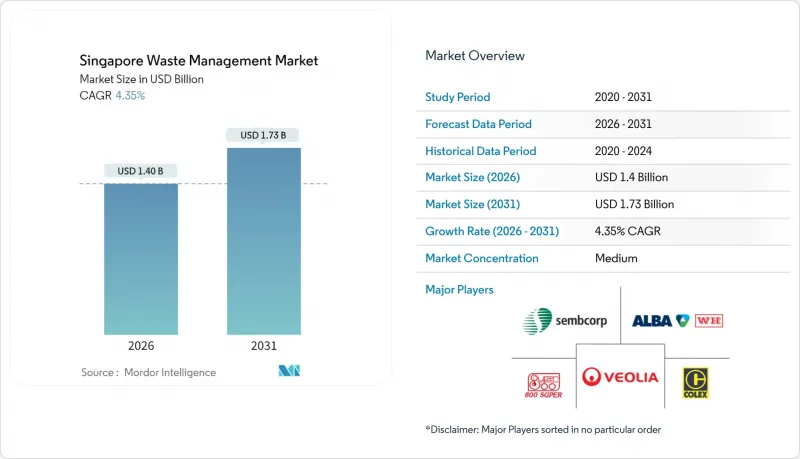
这种稳定扩张反映了经济模式向循环经济的转变,循环经济强调资源回收而非废弃物处置。有限的土地资源推动了对垃圾焚化发电(WTE)设施的投资,而《资源永续性法案》(RSA)和《零废弃物总体规划》则对食品废弃物、包装废弃物和电子废弃物的回收利用能力提出了强制性要求。随着公共机构将专业服务外包,私营业者的地位日益凸显。国家氢能目标也促进了对废弃物衍生燃料的探索。不断上涨的营运成本、燃料成本、人事费用和碳排放税正推动市场向自动化、数据驱动的路线优化和综合处理设施发展。
新加坡废弃物管理市场趋势与洞察
零废弃物总体规划与强制性循环经济
新加坡的「零废弃物总体规划」要求在2030年实现全国70%的回收率和30%的废弃物掩埋量,这将重塑新加坡废弃物管理市场的现金流结构。电子废弃物、食物废弃物和包装垃圾这三大优先处理类别占总废弃物的40%以上,因此,监管合规将推动对分类、堆肥和先进回收设备的需求。食物废弃物分类强制令(RSA)要求从2024年起在大型设施中进行分类,这将推动对现场消化器和生物製浆设备的需求。新建建筑将为这些设施提供空间,从而确保技术供应商的供应管道。每月报告要求和逐步加强的执法体系(包括逐步提高的处罚)将提高收入的可预测性。 「大士枢纽计画」将使综合性废弃物发电(WTE)和水回收服务提供者获得最佳的政策成果。
掩埋容量的限制推动了对焚烧和回收的需求。
预计实马高掩埋将于2035年达到设计容量,因此新加坡必须转移或减少废弃物。目前运作中的四座垃圾焚化发电厂每年处理380万吨垃圾,提供电网2%的电力。同时,于2021年投入运作的大士湾垃圾焚化厂每天处理3,600吨垃圾,并向电网输送120兆瓦电力。计划在大士Nexus建造的综合废弃物管理设施(IWMF)日处理能力将达到5800吨,使其成为世界上最大的单体废弃物处理中心。稳定的原料供应支撑着私部门对长期建设-营运-移转(BOT)合约的需求,因为每增加一座焚化厂,就能释放宝贵的土地。
缺乏新建设施所需的土地
土地用途的竞争增加了机会成本,导致只有少数工业用地被指定用于产生异味或潜在危险的活动。多层或地下设计可以减少用地面积,但会增加资本投资以及营运和维护的复杂性。营运商被迫在同一场地内设计更高的吞吐量,这增加了技术风险和保险费用。回收中心需要存放打包物料,但靠近收集区的低成本土地稀缺,限制了新进入者的数量。
细分市场分析
截至2025年,住宅废弃物在新加坡的废弃物管理市场占据主导地位,市占率高达39.12%,这主要得益于住宅发展局(HDB)组屋区和公寓产生的稳定日垃圾量。商业废弃物是成长最快的细分市场,年复合成长率达6.31%,这主要得益于强制性厨余废弃物分类(RSA)、电子垃圾收集亭以及绿色租赁要求(要求购物中心提交废弃物减量计画)。虽然住宅废弃物在公共部门的收集管道中已获得一定的基础需求,但私人垃圾收集公司目前正致力于透过计量型的收费系统,结合堆肥设备和即时垃圾桶液位感测器,来吸引饭店和商业园区。
商业领域的成长也反映出服务业的积极多元化发展。连锁餐厅已开始安装本地Start-Ups(例如 Westcom Bio-Chem)生产的日处理量两吨的厌氧消化器,以从源头减少垃圾;而办公大楼则在安装配备蓝牙功能的垃圾压缩机,以便将数据应用于 ESG(环境、社会和治理)仪錶板。这些创新超越了传统的上门收集模式,使营运商能够获得利润丰厚的合同,从而提升新加坡废弃物管理市场的未来价值。
2025年,收集、运输和分类服务将占总收入的47.15%,并构成新加坡废弃物管理市场的物流基础。配备远端资讯处理技术以减少等待时间的卡车在都市区内短途行驶,将废弃物运送到转运站。然而,回收和资源再利用领域预计到2031年将以6.42%的复合年增长率成长。例如,Remex公司的炉底灰处理厂可以从焚化灰中回收90%的铁金属,进而将原本会被丢弃的废弃物变现。
技术创新正助力提升回收利用的获利能力。壳牌公司位于布科姆岛的新型热解油平土机将把5万吨难以回收的塑胶转化为裂解原料,这为资源回收成为价值驱动因素指明了方向。此类倡议正在将新加坡重新定义为高价值系统材料的区域中心,并将该国的废弃物管理市场规模融入石化价值链。
新加坡废弃物管理报告按来源(住宅、商业、工业等)、服务类型(收集、运输、分类/分类等)、废弃物类型(生活废弃物、工业危险废弃物、电子废弃物、塑胶等)和合约模式(私人/公共)进行细分。市场预测以美元计价。
其他福利:
- Excel格式的市场预测(ME)表
- 3个月的分析师支持
目录
第一章 引言
- 研究假设和市场定义
- 调查范围
第二章调查方法
第三章执行摘要
第四章 市场情势
- 市场概览
- 市场驱动因素
- 零浪费基本计画与强制性循环经济
- 强制性生产者延伸责任制(EPR)
- 有限的掩埋能力推动了对焚烧和回收的需求。
- 国家环境局激励计画加速私部门回收能力的扩张
- 气动废弃物处理系统(PWCS)引入趋势
- Tuas Nexus废弃物氢化先导计画
- 市场限制
- 对先进加工基础设施的大量资本投资
- 缺乏新建设施所需的土地
- 营运成本上升(人事费用、燃料、碳排放税)
- 小规模国内市场再生材料价格波动
- 价值/供应链分析
- 监管环境
- 技术展望
- 产业吸引力-波特五力分析
- 新进入者的威胁
- 供应商的议价能力
- 买方的议价能力
- 替代品的威胁
- 竞争对手之间的竞争
第五章 市场规模及成长预测(价值,单位:十亿美元)
- 按来源
- 住宅
- 商业设施(零售商店、办公室等)
- 产业
- 医疗保健(医疗保健和药品)
- 建筑和废弃物废弃物
- 其他(机构、农业等)
- 按服务类型
- 收集、运输、分类和分离
- 处理/处置
- 掩埋处置
- 回收和资源回收
- 焚烧和废弃物发电
- 其他(化学处理、堆肥等)
- 其他(咨询、审核、训练等)
- 依废物类型
- 都市固态废弃物
- 工业用危险废弃物
- 电子废弃物
- 塑胶废弃物
- 医疗废弃物
- 建筑和拆除废弃物
- 农业废弃物
- 其他特殊废弃物(放射性废弃物等)
- 按合约类型
- 民众
- 私人的
第六章 竞争情势
- 市场集中度
- 策略趋势
- 市占率分析
- 公司简介
- SembWaste(Sembcorp)
- Veolia Singapore
- ALBA W&H Smart City
- Colex Holdings Ltd.
- 800 Super Holdings
- ECO Industrial Environmental Engineering
- Wah & Hua Pte Ltd.
- TES-AMM Singapore
- Ramky Cleantech Services
- Enviro-Hub Holdings
- Cleanway Disposal Services
- ChemCollect Services
- Envipure
- Rictec Pte Ltd.
- CH E-Recycling
- Indsutrial Wastes Auction
- Citic Envirotech
- IUT Global
- ENVAC Singapore
- Zero Waste SG(Services arm)
第七章 市场机会与未来展望
The Singapore Waste Management Market is expected to grow from USD 1.34 billion in 2025 to USD 1.4 billion in 2026 and is forecast to reach USD 1.73 billion by 2031 at 4.35% CAGR over 2026-2031.
This steady expansion reflects Singapore's pivot toward circular-economy practices that prize material recovery over disposal. Tight land availability reinforces investment in waste-to-energy (WTE) assets, while the Resource Sustainability Act (RSA) and the Zero-Waste Masterplan create compulsory demand for recycling capacity across food, packaging, and electronic waste streams. Private operators gain ground as public agencies outsource specialized services, and national hydrogen ambitions underpin research into waste-derived fuels. Rising operating costs, fuel, labor, and carbon taxes are nudging the market toward automation, data-driven route optimization, and integrated processing complexes.
Singapore Waste Management Market Trends and Insights
Zero-Waste Masterplan and Circular-Economy Mandates
The Zero-Waste Masterplan sets a mandatory 70% national recycling rate and orders a 30% cut in landfill waste by 2030, reshaping the cash-flow logic of the Singapore waste management market. Three priority streams, e-waste, food waste, and packaging, together generate more than 40% of total waste, so compliance drives demand for sorting, composting, and advanced recycling kits. The RSA makes food-waste segregation compulsory for large premises from 2024, funneling business toward on-site digesters and bio-pulpers. A new build must now reserve space for such equipment, guaranteeing pipeline projects for technology vendors. Revenue predictability rises because enforcement includes mandatory monthly reporting and escalating penalties. Operators that supply integrated WTE and water recovery, as seen in the Tuas Nexus concept, sit in the policy sweet spot.
Limited Landfill Capacity Driving Incineration and Recycling Demand
Semakau Landfill may reach its design limit by 2035, so the island republic must divert waste or miniaturize it. Four WTE plants currently vaporize 3.8 million t annually and supply 2% of the grid, while the 2021-commissioned TuasOne unit processes 3,600 t per day and delivers 120 MW to the network. The coming Integrated Waste Management Facility (IWMF) at Tuas Nexus will be able to handle 5,800 t per day, becoming the largest single waste complex worldwide. Each incremental tonne incinerated frees scarce land, so feedstock certainty underwrites private-sector appetite for long-term build-operate-transfer deals.
Scarcity of Land for New Facilities
Competing land uses raise opportunity costs, and only a handful of industrial plots remain zoned for odorous or potentially hazardous activities. Multi-story or subterranean designs can compress footprints but raise capex and O&M intricacy. Operators must design for higher throughput in the same envelope, which in turn raises technology risk and insurance premiums. Recycling centers need lay-down yards for baled goods, yet affordable space near collection zones is scarce, limiting new entrants.
Other drivers and restraints analyzed in the detailed report include:
- Mandatory Extended Producer Responsibility Schemes
- NEA Incentive Grants Accelerating Private-Sector Recycling Capacity
- High Capital Expenditure of Advanced Treatment Assets
For complete list of drivers and restraints, kindly check the Table Of Contents.
Segment Analysis
Residential streams captured a commanding 39.12% share of the Singapore waste management market in 2025 as Housing Development Board estates and condominiums generated steady daily tonnage. Commercial waste is the fastest riser, expanding at a 6.31% CAGR on the back of RSA-mandated food-waste segregation, electronics take-back kiosks, and green-lease requirements that compel malls to file waste-reduction plans. The residential backbone ensures base-load demand for public-sector collection routes, yet private haulers now court hotels and business parks with pay-as-you-throw schemes that bundle composters and real-time bin-level sensors.
Growth in the commercial slice also reflects aggressive service diversification. Chain eateries have begun installing 2 t-per-day digesters sourced from local start-ups such as Westcom Bio-Chem, shrinking disposal volumes at source. Office towers adopt Bluetooth-enabled compactors to unlock data that feeds ESG dashboards. Because these innovations go beyond traditional curbside pickup, operators secure higher-margin contracts that underpin the future value of the Singapore waste management market.
Collection, transport, and sorting still represent 47.15% of 2025 revenue, embodying the logistics backbone of the Singapore waste management market. Trucks make short urban hops to transfer stations, supported by Telematics that cut idle time. Yet the recycling and resource-recovery cluster is on a 6.42% CAGR trajectory through 2031. One example is REMEX's bottom-ash processing plant that recovers 90% of ferrous metals from incinerator ash, monetizing an otherwise wasted stream.
Technology upgrades lift margins in recycling. Shell's new pyrolysis oil upgrader turns 50,000 t of hard-to-recycle plastics into cracker feedstock at Pulau Bukom, signaling how resource recovery will dominate incremental dollar value. These moves reposition Singapore as a regional node for high-value circular materials, and they embed the Singapore waste management market size into the petrochemical supply chain.
The Singapore Waste Management Report is Segmented by Source (Residential, Commercial, Industrial, and More), by Service Type (Collection, Transportation, Sorting & Segregation, and More), by Waste Type (Municipal Solid, Industrial Hazardous, E-Waste, Plastic, and More), and by by Contract Model (Private and Public). The Market Forecasts are Provided in Terms of Value (USD).
List of Companies Covered in this Report:
- SembWaste (Sembcorp)
- Veolia Singapore
- ALBA W&H Smart City
- Colex Holdings Ltd.
- 800 Super Holdings
- ECO Industrial Environmental Engineering
- Wah & Hua Pte Ltd.
- TES-AMM Singapore
- Ramky Cleantech Services
- Enviro-Hub Holdings
- Cleanway Disposal Services
- ChemCollect Services
- Envipure
- Rictec Pte Ltd.
- CH E-Recycling
- Indsutrial Wastes Auction
- Citic Envirotech
- IUT Global
- ENVAC Singapore
- Zero Waste SG (Services arm)
Additional Benefits:
- The market estimate (ME) sheet in Excel format
- 3 months of analyst support
TABLE OF CONTENTS
1 Introduction
- 1.1 Study Assumptions & Market Definition
- 1.2 Scope of the Study
2 Research Methodology
3 Executive Summary
4 Market Landscape
- 4.1 Market Overview
- 4.2 Market Drivers
- 4.2.1 Zero-Waste Masterplan & Circular Economy mandates
- 4.2.2 Mandatory Extended Producer Responsibility (EPR) schemes
- 4.2.3 Limited landfill capacity driving incineration & recycling demand
- 4.2.4 NEA incentive grants accelerating private-sector recycling capacity
- 4.2.5 Pneumatic Waste Conveyance Systems (PWCS) deployment momentum
- 4.2.6 Tuas Nexus waste-to-hydrogen pilot projects
- 4.3 Market Restraints
- 4.3.1 High capex of advanced treatment infrastructure
- 4.3.2 Scarcity of land for new facilities
- 4.3.3 Rising operating costs (labour, fuel, carbon tax)
- 4.3.4 Volatile recyclables prices in a small domestic market
- 4.4 Value / Supply-Chain Analysis
- 4.5 Regulatory Landscape
- 4.6 Technological Outlook
- 4.7 Industry Attractiveness - Porter's Five Force Analysis
- 4.7.1 Threat of New Entrants
- 4.7.2 Bargaining Power of Suppliers
- 4.7.3 Bargaining Power of Buyers
- 4.7.4 Threat of Substitutes
- 4.7.5 Intensity of Competitive Rivalry
5 Market Size & Growth Forecasts (Values, In USD Billion)
- 5.1 By Source
- 5.1.1 Residential
- 5.1.2 Commercial (retail, office, etc.)
- 5.1.3 Industrial
- 5.1.4 Medical (Health and Pharmaceutical)
- 5.1.5 Construction & Demolition
- 5.1.6 Others (institutional, agricultural, etc)
- 5.2 By Service Type
- 5.2.1 Collection, Transportation, Sorting & Segregation
- 5.2.2 Disposal / Treatment
- 5.2.2.1 Landfill
- 5.2.2.2 Recycling & Resource Recovery
- 5.2.2.3 Incineration & Waste-to-Energy
- 5.2.2.4 Others (Chemical Treatment, Composting, etc.)
- 5.2.3 Others (Consulting, Audit & Training, etc.)
- 5.3 By Waste Type
- 5.3.1 Municipal Solid Waste
- 5.3.2 Industrial Hazardous Waste
- 5.3.3 E-waste
- 5.3.4 Plastic Waste
- 5.3.5 Biomedical Waste
- 5.3.6 Construction & Demolition Waste
- 5.3.7 Agricultural Waste
- 5.3.8 Other Specialized Waste (radio active, etc)
- 5.4 By Contract Model
- 5.4.1 Public
- 5.4.2 Private
6 Competitive Landscape
- 6.1 Market Concentration
- 6.2 Strategic Moves
- 6.3 Market Share Analysis
- 6.4 Company Profiles (includes Global level Overview, Market level overview, Core Segments, Financials as available, Strategic Information, Products & Services, and Recent Developments)
- 6.4.1 SembWaste (Sembcorp)
- 6.4.2 Veolia Singapore
- 6.4.3 ALBA W&H Smart City
- 6.4.4 Colex Holdings Ltd.
- 6.4.5 800 Super Holdings
- 6.4.6 ECO Industrial Environmental Engineering
- 6.4.7 Wah & Hua Pte Ltd.
- 6.4.8 TES-AMM Singapore
- 6.4.9 Ramky Cleantech Services
- 6.4.10 Enviro-Hub Holdings
- 6.4.11 Cleanway Disposal Services
- 6.4.12 ChemCollect Services
- 6.4.13 Envipure
- 6.4.14 Rictec Pte Ltd.
- 6.4.15 CH E-Recycling
- 6.4.16 Indsutrial Wastes Auction
- 6.4.17 Citic Envirotech
- 6.4.18 IUT Global
- 6.4.19 ENVAC Singapore
- 6.4.20 Zero Waste SG (Services arm)
7 Market Opportunities & Future Outlook
- 7.1 White-space & Unmet-need Assessment

 废弃物管理市场:依服务类型、废弃物类型、处理技术和最终用户划分-2026-2032年全球市场预测
 智慧废弃物管理市场预测至2034年-全球分析(按组件、废弃物类型、解决方案类型、技术、最终用户和地区划分)
 全球 PFAS废弃物管理市场:按处理技术、服务类型、最终用途产业和地区划分 - 预测(至 2031 年)
 2026年全球多氟烷基物质(PFAS)废弃物管理市场报告2026年全球废弃物管理与回收服务市场报告2026年全球纺织废弃物管理市场报告2026年全球废弃物管理软体市场报告2026年全球放射性废弃物管理系统市场报告2026年全球水务和废弃物管理咨询服务市场报告
 全球废弃物管理软体市场规模、份额、趋势和成长分析报告(2026-2034年)