


 |
市场调查报告书
商品编码
1934732
建筑隔热材料:市场占有率分析、产业趋势与统计、成长预测(2026-2031)Building Insulation Materials - Market Share Analysis, Industry Trends & Statistics, Growth Forecasts (2026 - 2031) |
||||||

※ 本网页内容可能与最新版本有所差异。详细情况请与我们联繫。
预计建筑隔热材料市场将从 2025 年的 311.9 亿美元成长到 2026 年的 324.3 亿美元,到 2031 年将达到 393.9 亿美元,2026 年至 2031 年的复合年增长率为 3.97%。
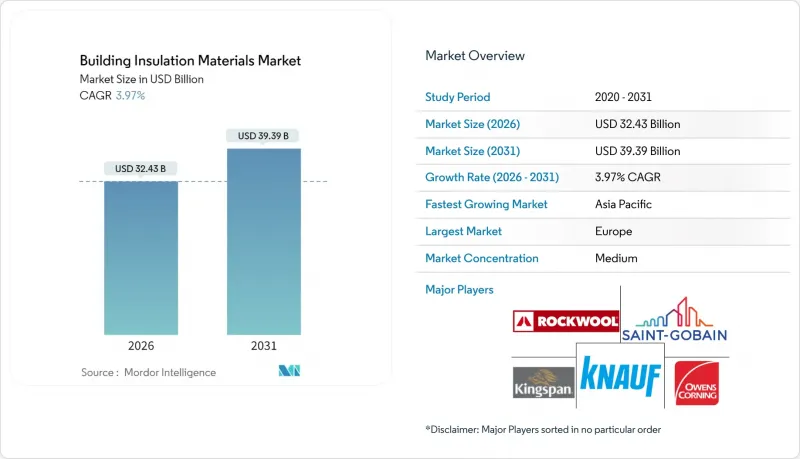
欧洲和北美日益严格的法规、亚太地区的快速都市化以及住宅节能意识的增强,共同推动了先进隔热隔音解决方案市场的潜在成长。随着製造商竞相开发出隔热性能(R值)更高、厚度更薄、生产过程中碳排放量更低、防火性能更优异的产品系列,材料创新正在加速发展。竞争排放主要围绕着收购展开,以扩大地域和产品覆盖范围,例如欧文斯科宁以39亿美元收购美森耐国际,此举不仅增加了互补的建筑外墙产品,还预计将带来1.25亿美元的成本协同效应。
全球建筑隔热材料市场趋势与洞察
节能建筑的需求日益增长
新的建筑规范,例如2024年国际节能规范(IECC),要求美国2-3气候区的阁楼隔热材料R值达到49,4-8气候区的阁楼隔热层R值达到60,这迫使设计师选择性能更高的产品。在大西洋彼岸,欧洲修订后的《建筑能源性能指令》设定了2030年能源消耗降低16%的具有法律约束力的目标,进一步推动了欧洲住宅存量的维修。随着商业地产业主努力达到ANSI/ASHRAE/IES 90.1-2022标准(与2019版相比,该标准意味着场地能耗降低9.8%),他们越来越倾向于寻找能够在更薄的结构中提供同等隔热性能(R值)的材料,以保留可出租面积。製造商正在提供混合解决方案,将低导热芯材与反射面结合,以最大限度地提高每毫米的隔热性能。
扩大北美绿色维修奖励
美国节能住宅维修税额扣抵可报销高达30%的符合条件的隔热材料费用,有效缩短住宅的投资回收期。经济适用住宅的补充标准促进了家庭年度支出的大幅降低,从而刺激了低收入群体采用节能改造。这些项目,加上地方气候计画强制要求对超过规定占地面积标准的建筑物进行节能维修,正在形成一系列计划,这将支撑未来十年的材料需求。专为维修空腔优化的吹入式和喷涂式泡棉隔热系统製造商已做好准备,把握这一成长机会。
材料和施工高成本
在许多价格敏感型市场,儘管气凝胶毯等先进隔热系统具有卓越的隔热性能,但由于其特殊的处理工艺,总安装成本增加,因此仍然被认为过于昂贵。大规模社会住宅计画的资金限制进一步减缓了高级产品的发展势头,迫使设计师重新选择中等价位的玻璃纤维和聚苯乙烯材料,即使这些材料更高的生命週期成本节约足以抵消其支出。除非透过扩大生产规模来降低单位成本,或透过奖励消除价格差异,否则高端材料仍将仅限于以性能为主要考量的小众计划。
细分市场分析
截至2025年,玻璃纤维将占据建筑隔热材料市场34.62%的份额,这得益于其成熟的供应链和具有竞争力的价格。玻璃纤维芯材具有可靠的耐热性和阻燃性,使其成为所有气候区的主要保温材料。聚苯乙烯预计将以4.16%的复合年增长率快速增长,这主要得益于产能扩张,其中包括BASF维希港工厂的扩建,旨在提高珠粒的均匀性和隔热性能。矿物棉在防火和隔音性能至关重要的应用领域保持着领先地位,而纤维素保温材料则受益于永续性的提升和强调再生材料的区域性项目,持续增长。聚氨酯(PUR)和聚异氰酸酯酸酯(PIR)泡沫材料适用于对隔热性能要求极高的高端应用,但成本和易燃性问题限制了其市场份额的成长。气凝胶目前仍处于小众市场,但如果透过製程改进缩短超临界干燥週期来降低成本,则有望颠覆整个市场。
成本、碳足迹减少目标以及日益严格的消防法规,如今已不再仅仅关注R值,而是促使人们在选择建筑保温材料时更加註重性能。这种转变催生了对兼具多种性能(例如防潮性和结构刚度)的复合芯材的需求。製造商正投资于黏合剂化学技术,以减少甲醛和酚类排放,从而应对日益严格的室内空气品质标准。因此,建筑隔热材料市场呈现两种平行的趋势:成熟的通用产品销售趋于稳定,而高性能产品则在较小的基数上实现了更快的成长。
到2025年,屋顶组件将占总收入的29.12%,因为建筑围护结构顶部集中的热通量使其成为节能维修的首选目标。屋顶组件安装相对简便,而且太阳能屋顶的补贴通常包含隔热组件,支撑了市场需求。在建筑隔热材料市场中,随着人们越来越认识到噪音污染是一个公共卫生问题,预计到2031年,隔音隔间和空调管道的市场规模将以4.85%的复合年增长率成长。紧随其后的是内墙空间和外墙保温饰面系统,因为维修项目优先考虑能够改善外观和隔热性能的建筑幕墙维修。在气候寒冷的地区,楼板和地下室解决方案预计将会成长,因为楼板边缘的热损失会降低建筑物的整体隔热性能。
一体化设计正变得越来越普遍:建筑师指定使用能够同时实现隔热、隔音和防潮目标的系统,从而简化详细设计并缩短施工时间。这种整体方法推动了对多功能板材的需求,这些板材无需使用易穿孔的防潮层,或整合了隔音垫。因此,产品讯息越来越强调系统相容性,而非单一的隔热性能指标,而咨询式销售方法也越来越受到主要供应商的青睐。
区域分析
2025年,欧洲在全球建筑材料市场中维持了37.88%的份额,这主要得益于具有约束力的气候变迁立法,该立法旨在到2030年将建筑排放减少60%,并到2050年使现有建筑实现零排放。该指令转化为各国法律正在加速对外部保温饰面系统、矿棉和高性能硬质板材的需求。生产商正在扩大区域产能,例如克瑙夫(Knauf)投资1.72亿英镑在英国的岩绒工厂,预计2026年投产。
亚太地区将成为成长最快的地区,到2031年复合年增长率将达到4.88%。这主要得益于中国、印度和东南亚市场正努力使其本地法规与国际最佳实践接轨。政府对高效率节能家电和绿色建筑的奖励策略,以及快速的都市化,正在强化潜在的人口需求。产能扩张,例如岩绒位于泰米尔纳德邦的工厂,将透过缩短前置作业时间和实现在地化定价,推动成本敏感型细分市场对高效节能家电和绿色建筑的需求。
在北美,联邦税额扣抵和公共产业补贴推动了强劲的维修活动,加上稳定的新建设,共同促进了市场活跃。市场兴趣正转向低挥发性有机化合物(VOC)产品,推动了暖通空调管道和生活空间材料的替代。企业环境、社会和治理(ESG)资讯揭露规则提高了环境透明度,有利于那些能够透过经检验的环境产品声明(EPD)证明其低碳绩效的供应商。
其他福利:
- Excel格式的市场预测(ME)表
- 分析师支持(3个月)
目录
第一章 引言
- 研究假设和市场定义
- 调查范围
第二章调查方法
第三章执行摘要
第四章 市场情势
- 市场概览
- 市场驱动因素
- 节能建筑的需求日益增长
- 北美绿色维修奖励增加
- 政府加强对使用环保永续材料的支持力度
- 消费者越来越倾向选择低VOC生物基泡沫材料
- 亚太地区的基础建设和工业化
- 市场限制
- 高昂的材料和安装成本
- 价格合理的替代品
- 对发泡全球暖化潜能的监管。
- 价值链分析
- 监理展望
- 波特五力模型
- 供应商的议价能力
- 买方的议价能力
- 新进入者的威胁
- 替代品的威胁
- 竞争程度
第五章 市场规模与成长预测
- 依材料类型
- 玻璃纤维
- 矿物棉
- 纤维素
- 聚氨酯/聚异氰酸酯泡沫(PUR/PIR)
- 聚苯乙烯
- 其他材质(软木、气凝胶及真空绝热板、喷涂泡沫、麻、硅酸钙等)
- 透过使用
- 屋顶
- 墙体(外墙和中空墙)
- 楼层和地下室
- 天花板和阁楼
- 隔音隔间和空调管道
- 最终用户
- 住宅
- 非住宅
- 商业的
- 基础设施
- 其他非住宅产业(教育、医疗保健、公共和宗教设施等)
- 透过安装
- 新建工程
- 维修
- 按地区
- 亚太地区
- 中国
- 印度
- 日本
- 韩国
- 东南亚国协
- 亚太其他地区
- 北美洲
- 我们
- 加拿大
- 墨西哥
- 欧洲
- 德国
- 英国
- 法国
- 义大利
- 西班牙
- 北欧国家
- 其他欧洲地区
- 南美洲
- 巴西
- 阿根廷
- 其他南美洲
- 中东和非洲
- 沙乌地阿拉伯
- 南非
- 其他中东和非洲地区
- 亚太地区
第六章 竞争情势
- 市场集中度
- 策略趋势
- 市占率(%)/排名分析
- 公司简介
- Armacell
- Aspen Aerogels Inc.
- Atlas Roofing Corporation
- BASF SE
- Beijing New Building Materials Public Limited Company
- Cellofoam North America Inc.
- Covestro AG
- Dow
- DuPont
- GAF Materials LLC
- Holcim
- Huntsman International LLC
- Johns Manville
- Kingspan Group
- Knauf Group
- Owens Corning
- Recticel NV/SA
- ROCKWOOL A/S
- Saint-Gobain
- Synthos
第七章 市场机会与未来展望
The Building Insulation Materials Market is expected to grow from USD 31.19 billion in 2025 to USD 32.43 billion in 2026 and is forecast to reach USD 39.39 billion by 2031 at 3.97% CAGR over 2026-2031.
Heightened regulatory stringency in Europe and North America, rapid urbanization in Asia-Pacific, and growing homeowner awareness of utility savings are together expanding the addressable base for advanced thermal and acoustic solutions. Material innovation intensifies as manufacturers race to deliver higher R-values in slimmer profiles, lower embodied carbon, and superior fire performance-often within a single product family. Competitive strategies revolve around acquisitions that broaden geographic reach and product scope, illustrated by Owens Corning's USD 3.9 billion purchase of Masonite International that added complementary building envelope products while promising USD 125 million in cost synergies.
Global Building Insulation Materials Market Trends and Insights
Growing demand for energy-efficient buildings
New codes, such as the 2024 International Energy Conservation Code, require R49 attic insulation in US Climate Zones 2-3 and R60 in Zones 4-8, tightening thermal envelope thresholds that push specifiers toward higher-performance products. Across the Atlantic, the revised Energy Performance of Buildings Directive sets a binding 16% reduction in energy use by 2030, reinforcing momentum for upgrades in European housing stock. As commercial owners strive to meet ANSI/ASHRAE/IES 90.1-2022, which yields 9.8% site energy savings versus the 2019 edition, demand is shifting toward materials that deliver equivalent R-values in thinner assemblies to preserve rentable area. Manufacturers are responding with hybrid solutions that pair low-conductivity cores with reflective facers to maximize thermal performance per millimeter.
Increasing green retrofitting incentives in North America
The US Energy Efficient Home Improvement Credit reimburses up to 30% of qualifying insulation expenses, effectively narrowing payback periods for homeowners. Complementary standards for affordable housing are driving significant annual household savings, encouraging adoption among lower-income brackets. These programs coincide with municipal climate plans that mandate energy retrofits for buildings above defined floor-area thresholds, creating a pipeline of projects that sustain material demand through the decade. Manufacturers with blown-in and spray foam systems tailored to retrofit cavities are positioned to capture this incremental volume.
High materials and installation cost
Many price-sensitive markets still perceive advanced systems such as aerogel blankets as cost-prohibitive despite superior thermal resistance, because specialized handling elevates total installed cost. Capital constraints in large-scale social housing programs further dampen momentum for premium products, forcing specifiers to revert to mid-range fiberglass or polystyrene even when lifecycle savings justify higher outlays. Until manufacturing scale lowers unit price or incentives bridge the gap, premium materials will remain confined to niche projects where performance drives specification.
Other drivers and restraints analyzed in the detailed report include:
- Increasing government support for eco-friendly and sustainable materials
- Growing preference for low-VOC bio-based foams
- Availability of affordable alternatives
For complete list of drivers and restraints, kindly check the Table Of Contents.
Segment Analysis
Fiberglass held 34.62% of the building insulation materials market in 2025, anchored by long-established supply chains and competitive pricing. Its glass-fiber core delivers reliable thermal resistance and non-combustibility, making it a staple across climate zones. Polystyrene is the fastest climber at 4.16% CAGR thanks to capacity expansions such as BASF's upgrade in Ludwigshafen that improves bead consistency and thermal performance. Mineral wool retains traction where fire rating and sound attenuation are paramount, while cellulose growth rides sustainability credentials and regional programs that value recycled content. PUR and PIR foams address premium applications requiring high R-value per inch, yet their share is checked by cost and flammability perceptions. Aerogels remain niche but could disrupt as costs fall due to process improvements that shorten supercritical drying cycles.
Cost, embodied-carbon targets and tightening fire regulations now shape specification more than R-value alone. This shift is creating space for hybrid panels that laminate different cores to combine strengths such as moisture tolerance and structural rigidity. Manufacturers are investing in binder chemistries that lower formaldehyde and phenol emissions, anticipating stricter indoor-air-quality standards. As a result, the building insulation materials market sees parallel tracks: mature commodities stabilize on volume, while high-performance classes grow faster albeit from a smaller base.
Roof assemblies captured 29.12% of 2025 revenue because heat-flux concentration through the top of the envelope makes them the first target for energy upgrades. Installation is comparatively straightforward, and subsidies for solar-ready roofs often bundle thermal packages, which sustains volume. The building insulation materials market size for acoustic partition and HVAC ducts is forecast to expand at a 4.85% CAGR to 2031 as health authorities recognize noise pollution as a public health issue. Wall cavities and external insulation finish systems follow closely because renovation programs prioritize facade upgrades that boost both aesthetics and thermal performance. Floor and basement solutions grow in colder climates where slab-edge losses weaken overall envelope performance.
Integrated design is gaining ground: architects specify systems that address thermal, acoustic and moisture objectives simultaneously to simplify detailing and shorten construction schedules. This holistic mindset drives demand for multi-functional boards that eliminate puncture-prone vapor barriers or incorporate acoustic mats. Consequently, product messaging increasingly highlights system compatibility rather than stand-alone thermal metrics, reinforcing a consultative selling approach among leading suppliers.
The Building Insulation Materials Market Report is Segmented by Material Type (Fiberglass, Mineral Wool, Cellulose, and More), Application (Roof, Wall, Floor and Basement, and More), End-User (Residential and Non-Residential), Installation (New Construction and Renovation), and Geography (Asia-Pacific, North America, Europe, South America, and Middle East and Africa). The Market Forecasts are Provided in Terms of Value (USD).
Geography Analysis
Europe maintained 37.88% share in 2025, driven by binding climate legislation that targets a 60% emission cut in buildings by 2030 and a zero-emission stock by 2050. National transposition of the directive accelerates demand for exterior insulation and finish systems, mineral wool, and high-performance rigid boards. Producers are scaling regional capacity, evidenced by Knauf's GBP 172 million rock mineral wool factory in the United Kingdom that will start operations in 2026.
Asia-Pacific is the fastest-growing region with a 4.88% CAGR to 2031 as China, India, and Southeast Asian markets align local codes with international best practice. Government stimulus for efficient appliances and green buildings reinforces underlying demographic demand from rapid urbanization. Capacity additions such as Rockwool's Tamil Nadu plant shorten lead times and localize pricing, which improves adoption in cost-sensitive segments.
North America combines a steady new-build pipeline with robust retrofit activity catalyzed by federal tax credits and utility rebates. Market interest is shifting to lower-VOC products, spurring material substitution in HVAC ducts and occupied spaces. Corporate ESG disclosure rules are advancing environmental transparency, favoring suppliers that can prove low embodied carbon through verified EPDs.
- Armacell
- Aspen Aerogels Inc.
- Atlas Roofing Corporation
- BASF SE
- Beijing New Building Materials Public Limited Company
- Cellofoam North America Inc.
- Covestro AG
- Dow
- DuPont
- GAF Materials LLC
- Holcim
- Huntsman International LLC
- Johns Manville
- Kingspan Group
- Knauf Group
- Owens Corning
- Recticel NV/SA
- ROCKWOOL A/S
- Saint-Gobain
- Synthos
Additional Benefits:
- The market estimate (ME) sheet in Excel format
- 3 months of analyst support
TABLE OF CONTENTS
1 Introduction
- 1.1 Study Assumptions and Market Definition
- 1.2 Scope of the Study
2 Research Methodology
3 Executive Summary
4 Market Landscape
- 4.1 Market Overview
- 4.2 Market Drivers
- 4.2.1 Growing Demand for Energy Efficient Buildings
- 4.2.2 Increasing Green Retrofitting Incentives in North America
- 4.2.3 Increasing Governemnt Support for the Usage of Eco-Friendly and Sustainable Materials
- 4.2.4 Growing Preference for Low-VOC Bio-based Foams
- 4.2.5 Rising Infrastructure and Industrialization in Asia-Pacific
- 4.3 Market Restraints
- 4.3.1 High Materials and Installation Cost
- 4.3.2 Availability of Affordable Alternatives
- 4.3.3 Regulatory Scrutiny on Global Warming Potential of Blowing Agents
- 4.4 Value Chain Analysis
- 4.5 Regulatory Outlook
- 4.6 Porter's Five Forces
- 4.6.1 Bargaining Power of Suppliers
- 4.6.2 Bargaining Power of Buyers
- 4.6.3 Threat of New Entrants
- 4.6.4 Threat of Substitutes
- 4.6.5 Degree of Competition
5 Market Size and Growth Forecasts (Value)
- 5.1 By Material Type
- 5.1.1 Fiberglass
- 5.1.2 Mineral Wool
- 5.1.3 Cellulose
- 5.1.4 Polyurethane/Polyisocyanurate Foams (PUR/PIR)
- 5.1.5 Polystyrene
- 5.1.6 Other Materials (Cork, Aerogel and Vacuum Insulation Panels, Spray Foams, Hemp, Calcium-Silicate, etc.)
- 5.2 By Application
- 5.2.1 Roof
- 5.2.2 Wall (External and Cavity)
- 5.2.3 Floor and Basement
- 5.2.4 Ceiling and Attic
- 5.2.5 Acoustic Partition and HVAC Duct
- 5.3 By End-User
- 5.3.1 Residential
- 5.3.2 Non-Residential
- 5.3.2.1 Commercial
- 5.3.2.2 Infrastructure
- 5.3.2.3 Other Non-Residential Industries (Education, Healthcare, Civic and Religious,etc.)
- 5.4 By Installation
- 5.4.1 New Construction
- 5.4.2 Renovation
- 5.5 By Geography
- 5.5.1 Asia-Pacific
- 5.5.1.1 China
- 5.5.1.2 India
- 5.5.1.3 Japan
- 5.5.1.4 South Korea
- 5.5.1.5 ASEAN Countries
- 5.5.1.6 Rest of Asia-Pacific
- 5.5.2 North America
- 5.5.2.1 United States
- 5.5.2.2 Canada
- 5.5.2.3 Mexico
- 5.5.3 Europe
- 5.5.3.1 Germany
- 5.5.3.2 United Kingdom
- 5.5.3.3 France
- 5.5.3.4 Italy
- 5.5.3.5 Spain
- 5.5.3.6 Nordics Countries
- 5.5.3.7 Rest of Europe
- 5.5.4 South America
- 5.5.4.1 Brazil
- 5.5.4.2 Argentina
- 5.5.4.3 Rest of South America
- 5.5.5 Middle East and Africa
- 5.5.5.1 Saudi Arabia
- 5.5.5.2 South Africa
- 5.5.5.3 Rest of Middle East and Africa
- 5.5.1 Asia-Pacific
6 Competitive Landscape
- 6.1 Market Concentration
- 6.2 Strategic Moves
- 6.3 Market Share (%)/Ranking Analysis
- 6.4 Company Profiles {(includes Global-level Overview, Market-level Overview, Core Segments, Financials as available, Strategic Information, Market Rank/Share for key companies, Products and Services, and Recent Developments)}
- 6.4.1 Armacell
- 6.4.2 Aspen Aerogels Inc.
- 6.4.3 Atlas Roofing Corporation
- 6.4.4 BASF SE
- 6.4.5 Beijing New Building Materials Public Limited Company
- 6.4.6 Cellofoam North America Inc.
- 6.4.7 Covestro AG
- 6.4.8 Dow
- 6.4.9 DuPont
- 6.4.10 GAF Materials LLC
- 6.4.11 Holcim
- 6.4.12 Huntsman International LLC
- 6.4.13 Johns Manville
- 6.4.14 Kingspan Group
- 6.4.15 Knauf Group
- 6.4.16 Owens Corning
- 6.4.17 Recticel NV/SA
- 6.4.18 ROCKWOOL A/S
- 6.4.19 Saint-Gobain
- 6.4.20 Synthos
7 Market Opportunities and Future Outlook
- 7.1 White-space and Unmet-Need Assessment
- 7.2 Technological Advancements in Green Insulation Materials

 门窗隔热材料市场:2026-2032年全球市场预测,依材料、产品类型、应用及安装方式划分屋顶隔热市场:依屋顶结构、安装类型、材料类型、技术、应用、最终用户和销售管道,全球预测,2026-2032年
 全球建筑隔热材料市场规模、份额、趋势及成长分析报告(2026-2034年)
 日本建筑隔热材料市场规模、份额、趋势及预测(按类型、应用、最终用户和地区划分),2026-2034年
 2026年全球耐火材料市场报告
 屋顶隔热市场-全球产业规模、份额、趋势、机会、预测:按类型、材料、应用、地区和竞争格局划分,2021-2031年全球建筑隔热材料市场(2024-2031年)
 建筑隔热材料市场规模、份额及成长分析(按类型、材质、应用及地区划分)-2026-2033年产业预测
 建筑保温材料市场规模、份额和趋势分析报告:按材料、产品、地区和细分市场预测(2025-2033 年)软木建筑材料市场规模、份额和趋势分析报告:按产品、最终用途、地区和细分市场预测(2025-2033 年)