


 |
市场调查报告书
商品编码
1934775
智慧追踪器:市场占有率分析、产业趋势与统计、成长预测(2026-2031)Smart Tracker - Market Share Analysis, Industry Trends & Statistics, Growth Forecasts (2026 - 2031) |
||||||

※ 本网页内容可能与最新版本有所差异。详细情况请与我们联繫。
智慧追踪器市场预计将从 2025 年的 7.2 亿美元成长到 2026 年的 8.1 亿美元,预计到 2031 年将达到 14.7 亿美元,2026 年至 2031 年的复合年增长率为 12.58%。
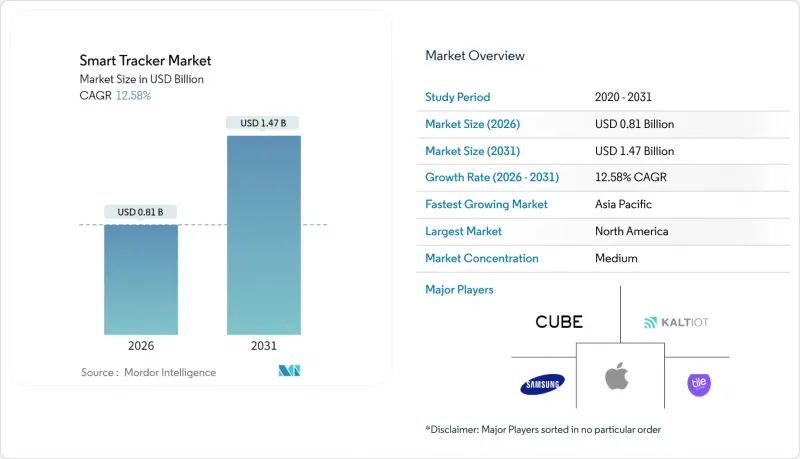
智慧型手机的快速普及、超宽频 (UWB) 高精度测距技术以及与智慧家庭生态系统的集成,正在拓展追踪器的应用场景,使其从失物找回扩展到医疗保健和企业资产管理。消费者越来越将追踪器视为避免时间损失、压力和生产力下降的低成本保障,而企业则认为即时可见性和降低合规成本是采用追踪器的理由。供应商之间的差异不仅体现在硬体上,也体现在其生态系统的广度上。例如,苹果的「查找我的」和三星的「SmartThings」利用网路效应来提高定位精度和覆盖范围。同时,监管机构强制执行的隐私保护措施推高了开发成本,并有助于建立人们对资料密集型服务的信任。
全球智慧追踪器市场趋势与洞察
超宽频 (UWB) 和低功耗蓝牙 (Bluetooth LE) 技术的快速发展
超宽频 (UWB) 技术使追踪器从近距离通知发展到公分级精度,从而实现了室内导航和高价值资产的监控。苹果已在其 AirTag 更新中整合了第二代 UWB 晶片,三星公司也已将其整合到 Galaxy 装置的 SmartTag 2 中,进一步推动了 UWB 技术的普及。 FiRa 联盟的互通性规范正在消除传统的碎片化问题,使工厂和医院等企业先导计画更具可行性。同时,蓝牙低功耗 (Bluetooth LE) 技术的进步使电池寿命延长了两年以上,在理想条件下传输距离超过 100 公尺。这些通讯协定共同实现了多重通讯协定协定设备,这些设备可以无缝切换到最高效的无线电,从而降低了设备拥有成本,并扩大了智慧追踪器市场的潜在基本客群。
智慧型手机日益普及,使其能够进行追踪和监控
每部新智慧型手机实际上都成为了全球众包定位网路中的一个节点。苹果的「寻找我的设备」功能覆盖超过10亿台设备,三星的SmartThings网路也不断扩展,覆盖安卓设备。售价低于100美元的安卓设备正在帮助印度、奈及利亚和印尼的用户初步连接到互联网,从而显着提高了追踪器讯号的接收机率。网路外部性提升了追踪器的效用。智慧型手机的普及缩短了寻找遗失物品所需的时间,吸引了更多用户加入这个生态系统。行动网路业者意识到流量商机的商机,正将追踪服务捆绑到5G物联网套餐中。 Verizon的车队追踪服务就是一个典型的例子。
资料隐私和网路追踪问题
诸如GDPR之类的法规要求用户明确同意并尽可能缩短资料保存,这使得全球范围内的众包定位技术变得复杂。针对AirTags可能被滥用的追踪行为,苹果和谷歌推出了定期发出蜂鸣声、轮换识别码以及自动通知附近用户等措施。虽然这些措施有助于建立信任,但也缩短了电池续航时间并降低了位置更新的准确性,从而略微降低了使用者体验。网际网路工程任务小组(IETF)正在进行关于恶意追踪侦测通讯协定的工作,旨在统一各厂商的因应措施,但合规性工作会增加开发成本,并减缓智慧追踪器市场的功能部署速度。
细分市场分析
截至2025年,蓝牙在智慧追踪器市场保持了54.10%的份额,并与几乎所有现代智慧型手机和智慧型手錶相容。超宽频(UWB)作为一项新兴技术,正以13.02%的复合年增长率快速增长,因为消费者愿意为10厘米以下的定位精度买单,以便在家具底下或拥挤的仓库中定位物品。 GPS和蜂窝网路技术则主要针对行动电话覆盖不佳的户外资产追踪,以更高的电力消耗为代价换取全球覆盖。整合蓝牙、UWB和GPS的多重通讯协定晶片组如今已成为高级产品设计的主流,使装置能够根据实际情况切换无线连接方式,从而节省电池电量。
随着UWB晶片实现规模经济,平均售价呈下降趋势,这促使中端厂商更多地采用通讯协定。然而,蓝牙仍然是大规模生产的基础技术,尤其是在新兴经济体,而价格亲民的行动电话正在推动UWB技术的初期普及。企业先导计画越来越多地将UWB和蓝牙技术结合使用,以实现面向未来的部署,从而推动了该技术在智慧追踪器市场的成长。
区域分析
到2025年,北美将占据智慧追踪器市场37.10%的份额,这主要得益于成熟的智慧型手机生态系统、高收入消费者以及支援高更新频率的5G网路部署。美国法规在隐私和创新之间取得了平衡,从而促进了功能的快速改进。企业需求涵盖车队管理物流、医疗资产追踪以及保险公司主导的损失预防项目。
亚太地区预计将成为全球成长最快的地区,到2031年复合年增长率将达到13.55%。印度和中国每年新增数百万智慧型手机用户,提高了网路密度和追踪器的精准度。政府主导的智慧城市示范计画正在为物联网感测器提供资金,以支持公共和老年护理。日本的超老龄化社会预计到2040年将出现57万名看护者的缺口,这正在加速医疗和家庭监测领域的应用。在东南亚,电子商务的成长进一步推动了对包裹追踪的需求,增强了全部区域智慧追踪器市场的发展势头。
欧洲保持温和成长,这得益于严格的《一般资料保护规则》(GDPR)保障措施,这些措施增强了使用者对资料密集型服务的信任。成员国之间标准的协调统一简化了跨境物流追踪。随着电信基础设施的现代化,中东和非洲地区率先采用了智慧追踪器,但射频(RF)组件的进口关税抑制了其高端价格。在南美洲,汇率波动导致设备成本上升,构成了一项挑战,但都市区的安全顾虑正在推动中产阶级消费者对追踪器的接受度。各大洲成熟市场和新兴市场并存的格局,为智慧追踪器市场维持了平衡的全球前景。
其他福利:
- Excel格式的市场预测(ME)表
- 分析师支持(3个月)
目录
第一章 引言
- 研究假设和市场定义
- 调查范围
第二章调查方法
第三章执行摘要
第四章 市场情势
- 市场概览
- 市场驱动因素
- 智慧型手机日益普及,使其能够进行追踪和监控
- 个人物品遗失案件增多
- 超宽频 (UWB) 和低功耗蓝牙 (Bluetooth LE) 技术的快速发展
- 低功耗无线晶片组的平均售价正在下降。
- 将追踪器整合到多重通讯协定智慧家庭生态系统中
- 行动网路业者扩大物品追踪服务
- 市场限制
- 缺乏全球互通性标准
- 对资料隐私和网路追踪的担忧
- 由于产品寿命缩短,电子废弃物增加
- 新兴市场关键射频元件的进口关税
- 产业价值链分析
- 宏观经济因素的影响
- 技术展望
- 智慧家庭物联网整合趋势
- 监管环境
- 波特五力分析
- 供应商的议价能力
- 买方的议价能力
- 新进入者的威胁
- 替代品的威胁
- 竞争对手之间的竞争
- 投资分析
第五章 市场规模与成长预测
- 透过技术
- 行动电话
- Bluetooth
- GPS
- UWB
- NFC
- 透过使用
- 个人物品追踪服务
- 行李追踪服务
- 宠物追踪
- 儿童和老年人的安全措施
- 企业库存管理和资产跟踪
- 车辆追踪
- 最终用户
- 消费者
- 商业的
- 工业与物流
- 卫生保健
- 政府/国防
- 按地区
- 北美洲
- 我们
- 加拿大
- 墨西哥
- 欧洲
- 德国
- 法国
- 英国
- 义大利
- 西班牙
- 俄罗斯
- 其他欧洲地区
- 亚太地区
- 中国
- 日本
- 印度
- 韩国
- 澳洲
- 东南亚
- 亚太其他地区
- 南美洲
- 巴西
- 阿根廷
- 其他南美洲
- 中东
- 沙乌地阿拉伯
- 阿拉伯聯合大公国
- 土耳其
- 其他中东地区
- 非洲
- 南非
- 奈及利亚
- 肯亚
- 其他非洲地区
- 北美洲
第六章 竞争情势
- 市场集中度
- 策略趋势
- 市占率分析
- 公司简介
- Tile Inc.
- Samsung Electronics Co., Ltd.
- Apple Inc.
- Cube Tracker Inc.
- Kaltio Technologies Oy
- PB Inc.(Pebblebee)
- Chipolo doo
- XY Labs, Inc.
- Garmin Ltd.
- Jiobit Inc.
- Invoxia SA
- HButler International Pty. Ltd.(Orbit)
- Wistiki SAS
- Nut Technology Co., Ltd.
- Filo Srl
- Satotech Limited(TagoBee)
- Trackimo Inc.
- Loc8tor Ltd.
- Rinex Technology Co., Ltd.
第七章 市场机会与未来展望
The smart tracker market is expected to grow from USD 0.72 billion in 2025 to USD 0.81 billion in 2026 and is forecast to reach USD 1.47 billion by 2031 at 12.58% CAGR over 2026-2031.
Rapid smartphone penetration, ultra-wideband (UWB) precision ranging, and integration with smart-home ecosystems are expanding use cases from lost-item recovery to healthcare and enterprise asset management. Consumers increasingly view trackers as inexpensive insurance against time, stress, and productivity losses, while enterprises justify deployments through real-time visibility and regulatory compliance savings. Vendors differentiate through ecosystem breadth rather than hardware alone, as Apple's Find My and Samsung's SmartThings leverage network effects to boost location accuracy and coverage. Meanwhile, privacy safeguards mandated by regulators keep development costs elevated but also build trust in data-rich services.
Global Smart Tracker Market Trends and Insights
Rapid Advancements in Ultra-Wideband and Bluetooth LE Technologies
UWB has shifted trackers from proximity alerts to centimeter-level precision, enabling indoor navigation and high-value asset monitoring. Apple embedded second-generation UWB chips in AirTag updates, while Samsung integrated UWB into SmartTag 2 for Galaxy devices, signaling mainstream adoption. The FiRa Consortium's interoperability profiles address earlier fragmentation, making enterprise pilots viable for factories and hospitals. Parallel gains in Bluetooth LE lengthen battery life beyond two years and push range past 100 meters in ideal conditions. Together, these protocols unlock multiprotocol devices that switch seamlessly to the most efficient radio, reducing cost of ownership and widening the addressable base for the smart tracker market.
Growing Penetration of Smartphones Enabling Tracking and Monitoring
Each new smartphone effectively becomes a node in a global crowd-sourced location network. Apple's Find My spans more than 1 billion devices, and Samsung's SmartThings network continues to grow across Android hardware. Affordable sub-USD 100 Android handsets ignite first-time internet access across India, Nigeria, and Indonesia, multiplying potential tracker pings. Network externalities elevate tracker utility: denser smartphone clusters shorten the time to locate a lost item, which in turn pulls more users into the ecosystem. Mobile network operators recognize the traffic-driven revenue opportunity and now bundle tracking services into 5G IoT plans, exemplified by Verizon's fleet offerings.
Data-Privacy and Cyber-Stalking Concerns
Regulations such as GDPR require explicit consent and minimal data retention, complicating global crowd-location features. Following reports of AirTags enabling unauthorized tracking, Apple and Google introduced periodic beeps, rotating identifiers, and automatic notifications to nearby users. These measures build trust but reduce battery life and granularity of location updates, slightly dampening user experience. Ongoing IETF work on unwanted-tracking detection protocols aims to standardize mitigations across vendors, but compliance increases development cost and slows feature rollouts in the smart tracker market.
Other drivers and restraints analyzed in the detailed report include:
- Integration of Trackers into Multiprotocol Smart-Home Ecosystems
- Rising Incidences of Misplaced Personal Items
- Lack of Global Interoperability Standards
For complete list of drivers and restraints, kindly check the Table Of Contents.
Segment Analysis
Bluetooth retained 54.10% smart tracker market share in 2025, aligned with nearly every modern smartphone and smartwatch. UWB, although nascent, is accelerating at a 13.02% CAGR as consumers pay for sub-10-centimeter precision that pinpoints items under furniture or within crowded warehouses. GPS and cellular variants target outdoor asset tracking where phone density is sparse, accepting higher power draw in exchange for global reach. Multiprotocol chipsets combining Bluetooth, UWB, and GPS now dominate premium product designs, letting devices switch radios based on context to conserve battery.
As UWB chips reach economies of scale, average selling prices are falling, encouraging mid-tier vendors to include the protocol. Nevertheless, Bluetooth remains the volume cornerstone, especially in emerging economies where affordable phones anchor initial adoption. Enterprise pilots increasingly specify UWB plus Bluetooth to future-proof deployments, reinforcing the technology's climb within the smart tracker market.
The Smart Tracker Market Report is Segmented by Technology (Cellular, Bluetooth, GPS, UWB, and NFC), Application (Personal Item Tracking, Luggage Tracking, Pet Tracking, Kids and Senior Safety, Enterprise Inventory and Asset Tracking, and Vehicle Tracking), End User (Consumer, Commercial, Industrial and Logistics, Healthcare, and Government and Defense), and Geography. The Market Forecasts are Provided in Terms of Value (USD).
Geography Analysis
North America commanded 37.10% smart tracker market share in 2025, buoyed by mature smartphone ecosystems, affluent consumers, and 5G rollouts that support high update frequencies. U.S. regulations strike a balance between privacy and innovation, allowing rapid feature iterations. Enterprise demand spans fleet logistics, healthcare asset tracking, and insurance-sponsored loss-prevention programs.
Asia Pacific is projected to log a 13.55% CAGR through 2031, the fastest worldwide. India and China add millions of first-time smartphone users annually, elevating network density and tracker accuracy. Government-backed smart city pilots allocate funding for IoT sensors, supporting public safety and elderly care. Japan's super-aged society drives healthcare and home-monitoring deployments as the nation grapples with a forecast 570,000 caregiver shortfall by 2040. Southeast Asian e-commerce growth further increases parcel-tracking demand, reinforcing region-wide momentum in the smart tracker market.
Europe maintains moderate expansion, aided by stringent GDPR safeguards that engender user trust in data-heavy services. Standards harmonization across member states simplifies cross-border logistics tracking. Middle East and Africa witness early-stage adoption tied to telecom infrastructure modernization, though import tariffs on RF components temper premium pricing. South America faces currency fluctuations that raise device costs, but urban safety concerns propel tracker uptake among middle-class consumers. The blend of mature and emerging scenarios across continents preserves a balanced global outlook for the smart tracker market.
- Tile Inc.
- Samsung Electronics Co., Ltd.
- Apple Inc.
- Cube Tracker Inc.
- Kaltio Technologies Oy
- PB Inc. (Pebblebee)
- Chipolo d.o.o.
- XY Labs, Inc.
- Garmin Ltd.
- Jiobit Inc.
- Invoxia SA
- HButler International Pty. Ltd. (Orbit)
- Wistiki SAS
- Nut Technology Co., Ltd.
- Filo S.r.l.
- Satotech Limited (TagoBee)
- Trackimo Inc.
- Loc8tor Ltd.
- Rinex Technology Co., Ltd.
Additional Benefits:
- The market estimate (ME) sheet in Excel format
- 3 months of analyst support
TABLE OF CONTENTS
1 INTRODUCTION
- 1.1 Study Assumptions and Market Definition
- 1.2 Scope of the Study
2 RESEARCH METHODOLOGY
3 EXECUTIVE SUMMARY
4 MARKET LANDSCAPE
- 4.1 Market Overview
- 4.2 Market Drivers
- 4.2.1 Growing penetration of smartphones enabling tracking and monitoring
- 4.2.2 Rising incidences of misplaced personal items
- 4.2.3 Rapid advancements in ultra-wideband and Bluetooth LE technologies
- 4.2.4 Declining average selling prices of low-power wireless chipsets
- 4.2.5 Integration of trackers into multiprotocol smart-home ecosystems
- 4.2.6 Expansion of item tracking services bundled by mobile network operators
- 4.3 Market Restraints
- 4.3.1 Lack of global interoperability standards
- 4.3.2 Data-privacy and cyber-stalking concerns
- 4.3.3 Short product replacement cycles increasing e-waste
- 4.3.4 Import tariffs on key RF components in emerging markets
- 4.4 Industry Value Chain Analysis
- 4.5 Impact of Macroeconomic Factors
- 4.6 Technological Outlook
- 4.6.1 Smart-home IoT integration trends
- 4.7 Regulatory Landscape
- 4.8 Porter's Five Forces Analysis
- 4.8.1 Bargaining Power of Suppliers
- 4.8.2 Bargaining Power of Buyers
- 4.8.3 Threat of New Entrants
- 4.8.4 Threat of Substitute Products
- 4.8.5 Intensity of Competitive Rivalry
- 4.9 Investment Analysis
5 MARKET SIZE AND GROWTH FORECASTS (VALUE)
- 5.1 By Technology
- 5.1.1 Cellular
- 5.1.2 Bluetooth
- 5.1.3 GPS
- 5.1.4 UWB
- 5.1.5 NFC
- 5.2 By Application
- 5.2.1 Personal Item Tracking
- 5.2.2 Luggage Tracking
- 5.2.3 Pet Tracking
- 5.2.4 Kids and Senior Safety
- 5.2.5 Enterprise Inventory and Asset Tracking
- 5.2.6 Vehicle Tracking
- 5.3 By End User
- 5.3.1 Consumer
- 5.3.2 Commercial
- 5.3.3 Industrial and Logistics
- 5.3.4 Healthcare
- 5.3.5 Government and Defense
- 5.4 By Geography
- 5.4.1 North America
- 5.4.1.1 United States
- 5.4.1.2 Canada
- 5.4.1.3 Mexico
- 5.4.2 Europe
- 5.4.2.1 Germany
- 5.4.2.2 France
- 5.4.2.3 United Kingdom
- 5.4.2.4 Italy
- 5.4.2.5 Spain
- 5.4.2.6 Russia
- 5.4.2.7 Rest of Europe
- 5.4.3 Asia Pacific
- 5.4.3.1 China
- 5.4.3.2 Japan
- 5.4.3.3 India
- 5.4.3.4 South Korea
- 5.4.3.5 Australia
- 5.4.3.6 Southeast Asia
- 5.4.3.7 Rest of Asia Pacific
- 5.4.4 South America
- 5.4.4.1 Brazil
- 5.4.4.2 Argentina
- 5.4.4.3 Rest of South America
- 5.4.5 Middle East
- 5.4.5.1 Saudi Arabia
- 5.4.5.2 United Arab Emirates
- 5.4.5.3 Turkey
- 5.4.5.4 Rest of Middle East
- 5.4.6 Africa
- 5.4.6.1 South Africa
- 5.4.6.2 Nigeria
- 5.4.6.3 Kenya
- 5.4.6.4 Rest of Africa
- 5.4.1 North America
6 COMPETITIVE LANDSCAPE
- 6.1 Market Concentration
- 6.2 Strategic Moves
- 6.3 Market Share Analysis
- 6.4 Company Profiles (includes Global level overview, Market level overview, Core Segments, Financials as available, Strategic Information, Market Rank/Share for key companies, Products and Services, and Recent Developments)
- 6.4.1 Tile Inc.
- 6.4.2 Samsung Electronics Co., Ltd.
- 6.4.3 Apple Inc.
- 6.4.4 Cube Tracker Inc.
- 6.4.5 Kaltio Technologies Oy
- 6.4.6 PB Inc. (Pebblebee)
- 6.4.7 Chipolo d.o.o.
- 6.4.8 XY Labs, Inc.
- 6.4.9 Garmin Ltd.
- 6.4.10 Jiobit Inc.
- 6.4.11 Invoxia SA
- 6.4.12 HButler International Pty. Ltd. (Orbit)
- 6.4.13 Wistiki SAS
- 6.4.14 Nut Technology Co., Ltd.
- 6.4.15 Filo S.r.l.
- 6.4.16 Satotech Limited (TagoBee)
- 6.4.17 Trackimo Inc.
- 6.4.18 Loc8tor Ltd.
- 6.4.19 Rinex Technology Co., Ltd.
7 MARKET OPPORTUNITIES AND FUTURE OUTLOOK
- 7.1 White-space and unmet-need assessment

 智慧追踪器市场规模、份额、趋势及预测(按技术、应用和地区划分,2026-2034年)
 全球个人安全追踪设备市场
 个人安全追踪设备市场:全球 2025-2029
 个人安全追踪设备市场报告:趋势、预测和竞争分析(至 2031 年)智慧追踪器的全球市场
 2024-2028年智慧追踪器全球市场