


 |
市场调查报告书
商品编码
1934873
跨文化培训:市场占有率分析、产业趋势与统计、成长预测(2026-2031)Cross-Cultural Training - Market Share Analysis, Industry Trends & Statistics, Growth Forecasts (2026 - 2031) |
||||||

※ 本网页内容可能与最新版本有所差异。详细情况请与我们联繫。
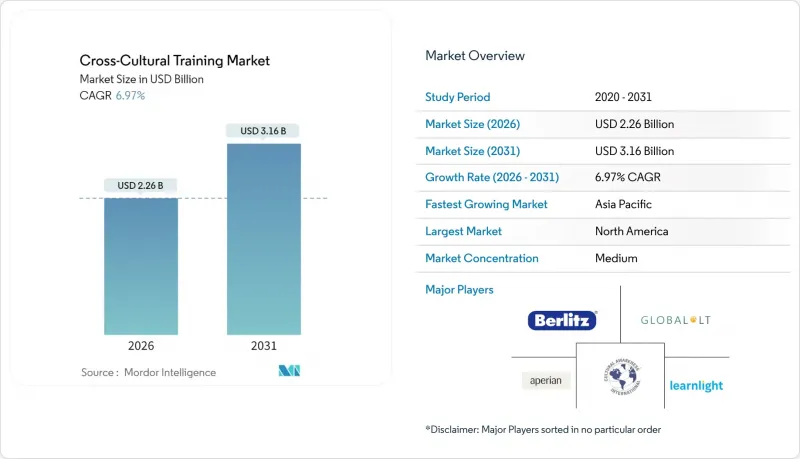
预计到 2026 年,跨文化培训市场价值将达到 22.6 亿美元,高于 2025 年的 21.1 亿美元。
预计到 2031 年将达到 31.6 亿美元,2026 年至 2031 年的复合年增长率为 6.97%。
全球计划扩张、日益严格的多元化法规以及学习的快速数位化正在推动市场需求,而併购后的整合计划和对远距团队的支持则进一步强化了通用文化素养的商业价值。大型企业仍然是收入的主要来源,但中小企业正在采用云端优先的学习套件,缩小传统的预算差距,并将跨文化培训市场进一步渗透到美国企业的长尾部分。科技正在成为一种均衡器。人工智慧客製化的微课程和虚拟实境角色扮演能够加快学习者达到熟练程度的速度,并带来可衡量的学习投资回报,使文化智能成为提高生产力的核心要素。竞争依然适中,现有企业正在增加分析功能以捍卫市场占有率。同时,SaaS原生公司正瞄准医疗保健、国防和教育等尚未开发的细分市场。
全球跨文化培训市场趋势与洞察
全球化推动了外派人员海外派遣。
如今,企业不仅轮调高阶主管,还轮调技术专家、计划经理和职能部门负责人等跨国工作,从而缩短了文化适应所需的时间。美国国防部已扩大其特种作战部队的权限,将文化适应训练纳入对台湾及其盟国的管辖范围,这表明即使是国防机构也认为文化适应能力至关重要。企业也同样感受到这种迫切性。能源、製药和资讯通信技术行业的快速部署计划需要将当地规范和监管要求融入工作流程的即时微学习模组。行动学习应用和虚拟实境场景正在取代为期一周的岗前培训研讨会,在保持学员满意度的同时,将准备成本降低了一半以上。这些灵活的培训形式正在提升跨文化培训市场的重要性,即使是那些先前因差旅成本和日程安排问题而犹豫不决的行业也开始重视跨文化培训。
财富1000强企业的多元化和包容性要求
投资者压力、资讯揭露法规和相关人员的积极行动,已将文化能力从一项自愿性倡议转变为董事会层面的风险指标。 《哈佛商业评论》指出,《财星》世界500强企业如今将跨文化协作视为人才保留、创新和品牌价值的决定性因素。微软已透过其内部学习平台,为全公司提供关于无意识偏见和盟友关係的培训,从而将此方法制度化。这些强制性要求也已扩展到供应链法规和客户导向的部门,促使供应商采用类似的培训标准,以保持在优先供应商名单中的地位。随着欧盟和美国多个州的资讯揭露框架不断完善,文化能力指标正被纳入ESG(环境、社会和治理)记分卡,能够将培训成果与企业多元化KPI挂钩的供应商正成为采购的优先考虑对象。
中小企业的预算限制
儘管中小企业认识到文化智能的战略价值,但它们的年度多元化、公平和包容性(DEI)预算通常不足2.5万美元,这迫使它们只能在基础偏见培训模组和高级情景式培训项目之间做出选择。缺乏普遍认可的投资报酬率(ROI)指标,使得预算论证变得复杂,人力资源主管难以以营运指标量化行为改变。供应商正透过分级许可、基于用户的定价以及即插即用的行动内容来降低准入门槛,但采用週期仍然很长。儘管有这些限制,同行评审的研究表明,即使在资源有限的环境下,多元化团队在产品发布速度和本地市场渗透率方面也优于同质化团队,这些论点正在逐渐削弱财务长们的抵触情绪。然而,资金短缺阻碍了中小企业采用文化智能,并限制了价格敏感地区跨文化培训市场的短期成长潜力。
细分市场分析
截至2025年,文化意识课程将占据跨文化培训市场33.22%的份额,凸显其作为监管合规计画重要基础的地位。该领域的吸引力在于其广泛的适用性。文化规范、礼仪和偏见意识原则能够为从工厂第一线到经营团队提供可复製的价值。预计从2026年到2031年,跨国公司将更新相关内容,纳入最新的地缘政治情势和特定产业案例研究,以维持该领域强劲的收入基础。儘管规模较小,但跨国领导力发展预计将以7.10%的复合年增长率成长,显着高于整体跨文化培训市场。日益复杂的计划、矩阵式管理结构以及全球范围内的混合型员工模式,正在推动对融合文化智慧和敏捷决策的领导框架的需求。服务提供者透过 360 度评估、同侪辅导圈和人工智慧辅助的自我反思日誌来脱颖而出,这些工具可以将文化见解转化为日常管理行为。
新兴的细分市场,例如特定用途语言模组和搬迁准备课程,有望利用类似的自适应学习引擎。跨学科整合能够实现规模经济,企业买家重视能够追踪学员从行前速成课程到回国后评估的一体化解决方案。因此,领先的供应商正在将外派人员准备影片、行业术语表和领导力进修内容整合到订阅式资源库中,以提高客户留存率。随着治理机构不断协调反歧视法律,统一的报告要求将进一步推动先前分散的培训内容的整合,从而支持跨文化领导力培训市场规模持续两位数成长。
到2025年,数位管道将占据39.80%的收入份额,这主要得益于可扩展的学习管理系统(LMS)整合和能够适应不同时区的非同步内容。企业指出,与纯课堂教学模式相比,数位管道的优势在于每位学习者的成本降低了35%至50%,其分析仪錶板能够将完成数据与绩效指标关联起来。然而,学习理论表明,持久的行为改变依赖于练习和回馈,这负责人转向混合式教学模式,将同步辅导融入电子模组中。因此,混合式解决方案预计将以7.25%的复合年增长率(CAGR)成为所有教学模式中成长最快的。供应商正在投资云端架构平台,这些平台会在演算法设定的评估里程碑之后启动促进者主导的分组讨论室,从而将成本效益与社交学习的优势相结合。
对于高风险受训人员、外交官、现场工程师和军事教官而言,课堂研讨会仍然至关重要,因为沉浸式模拟和细緻的回馈对于任务的成功至关重要。然而,即使在这些情况下,携带式虚拟实境设备也能让参与者在正式简报前演练谈判和衝突解决场景,从而将课程时间缩短多达30%,并减轻教员的负担。因此,交付模式正朝着模组化生态系统的方向发展,人工智慧负责规划个人化学习路径,而人类的专业知识则在关键转折点上发挥补充作用。正是这种相互作用将成为预测期内跨文化培训市场规模持续成长的核心驱动力。
区域分析
北美地区在2025年之前保持了35.28%的收入份额,这主要得益于具有约束力的多元化法规和已实施十余年的供应商包容性框架。联邦承包商必须记录其文化能力建设方面的努力,而加州、纽约州和伊利诺伊州的州级强制性规定正在扩大其适用范围,惠及中型企业。加拿大的多元文化政策和墨西哥以出口为导向的供应链正在增强週边地区的需求。柏林茨完善的培训体系,包括其位于纽约和多伦多的培训中心,确保了内容的快速在地化和讲师的充足供应。儘管围绕多元化课程的政治辩论造成了短期波动,但企业合规部门正在维持预算的连续性,从而支撑了北美地区与全球平均水平相符的稳定复合年增长率。
亚太地区是成长最快的市场,预计到2031年将以7.58%的复合年增长率成长,这主要得益于东协经济一体化以及中国和印度企业集团加速海外投资,从而扩大了采购基础。总部位于新加坡的共用服务中心正在为多区域员工推出一站式文化门户网站,而一家日本製造商则在具有里程碑意义的移民政策放宽后,引入了一个入职培训模组,以帮助外籍技术人员更好地适应新环境。该地区以行动优先的学习理念与供应商的蓝图相契合,能够透过低频宽网路内容传送,并增强包容性存取。本地语言差异和特定产业的礼仪案例研究是重要的采购驱动因素,供应商正在投资在吉隆坡、首尔和班加罗尔建立合资内容工作室。
欧洲市场虽已成熟,但在欧盟多元化报告指令和难民融合框架的推动下,仍保持着个位数的温和成长。欧盟的这两项指令均要求对员工进行文化培训。英国脱欧后,英国企业面临日益复杂的行政管理,因为它们必须同时满足国内和欧盟的要求,这为拥有跨司法管辖区合规专业知识的供应商创造了更多机会。南美洲和中东/非洲市场发展程度较低,但也蕴藏大量机会。巴西的出口扩张和在中东的大型企划正在吸收大量跨国人才,这需要他们快速适应不同的文化环境。预算限制、宽频部署不均衡以及缺乏本地促进者限制了近期的收入成长,但与通讯业者和职业培训机构建立的策略伙伴关係正在为2028年以后的快速普及奠定基础。
其他福利:
- Excel格式的市场预测(ME)表
- 3个月的分析师支持
目录
第一章 引言
- 研究假设和市场定义
- 调查范围
第二章调查方法
第三章执行摘要
第四章 市场情势
- 市场概览
- 市场驱动因素
- 由于全球化,将外派人员派往海外
- 财富1000强企业的多元化和包容性要求
- 学生和研究人员的国际流动迅速增加
- 合併后文化融合计划
- 远距、零工经济与跨境敏捷团队的兴起
- 利用人工智慧驱动的自适应学习平台进行内容在地化
- 市场限制
- 中小企业的预算限制
- 身临其境型教师主导课程高成本
- 民族主义对「外国」影响的反弹
- 量化行为ROI的困难
- 价值/供应链分析
- 监管环境
- 技术展望
- 波特五力分析
- 新进入者的威胁
- 供应商的议价能力
- 买方的议价能力
- 替代品的威胁
- 竞争对手之间的竞争
第五章 市场规模及成长预测(以金额为准,2021-2030 年)
- 按培训类型
- 文化理解培训
- 语言和沟通培训
- 多元化、公平性和包容性 (DEI) 培训
- 跨境领导力发展
- 外派/调任准备
- 按配送方式
- 面对面
- 电子学习/线上
- 研讨会和讲座
- 混合式学习(混合式)
- 按最终用户行业划分
- 公司/跨国公司
- 教育机构(小学、国中、高中和高等教育机构)
- 政府和非营利组织
- 军事/国防
- 其他(旅馆及旅游业、医疗保健)
- 按公司规模
- 大公司
- 中小企业
- 按地区
- 北美洲
- 加拿大
- 我们
- 墨西哥
- 南美洲
- 巴西
- 秘鲁
- 智利
- 阿根廷
- 其他南美洲
- 欧洲
- 英国
- 德国
- 法国
- 西班牙
- 义大利
- 比荷卢经济联盟(比利时、荷兰、卢森堡)
- 北欧国家(丹麦、芬兰、冰岛、挪威、瑞典)
- 其他欧洲地区
- 亚太地区
- 印度
- 中国
- 日本
- 澳洲
- 韩国
- 东南亚(新加坡、马来西亚、泰国、印尼、越南、菲律宾)
- 亚太其他地区
- 中东和非洲
- 阿拉伯聯合大公国
- 沙乌地阿拉伯
- 南非
- 奈及利亚
- 其他中东和非洲地区
- 北美洲
第六章 竞争情势
- 市场集中度
- 策略趋势
- 市占率分析
- 公司简介
- Berlitz Corporation
- Learnlight
- Aperian Global
- Cultural Awareness International
- Global LT
- Anderson Intercultural
- RW3 CultureWizard
- Commisceo Global Consulting
- Cartus Corporation
- IOR Global Services
- Language & Culture Worldwide(LCW)
- Brookfield Global Relocation Services
- TMC-A Berlitz Company
- Skillsoft
- ELM Learning
- Global Integration
- Rosetta Stone(ICL)
- Cultural Intelligence Center
- CrossCulture GmbH
- Hofstede Insights
第七章 市场机会与未来展望
Cross-Cultural Training market size in 2026 is estimated at USD 2.26 billion, growing from 2025 value of USD 2.11 billion with 2031 projections showing USD 3.16 billion, growing at 6.97% CAGR over 2026-2031.
A widening footprint of global projects, tighter diversity mandates and rapid digitization of learning are catalyzing demand, while merger integration programs and remote-team enablement strengthen the business case for universal cultural fluency. Large enterprises continue to anchor revenue, yet small and mid-sized firms are adopting cloud-first learning suites that narrow historical budget gaps and push the Cross-Cultural Training market deeper into the long-tail of corporate America. Technology is an equalizer: AI-curated micro-lessons and VR-enabled role plays shorten learner time-to-competence, driving measurable return on learning investment and making cultural intelligence a core productivity lever. Competitive intensity remains moderate, with incumbents adding analytics layers to defend share and a cadre of SaaS natives targeting unserved niches across healthcare, defense and education.
Global Cross-Cultural Training Market Trends and Insights
Globalization-Driven Expatriate Deployments
Organizations now rotate not only senior executives but also technical specialists, project managers, and functional leaders across borders, compressing lead times for cultural preparedness. The United States Department of Defense broadened special-operator authorities to include culture-readiness training for Taiwan and allied nations, demonstrating that even defense agencies treat cultural fluency as mission-critical. Corporates mirror that urgency: rapid-deployment projects in energy, pharma, and ICT demand just-in-time micro-learning modules that embed local norms and regulatory cues into task workflows. Mobile learning apps and VR scenarios are replacing week-long pre-departure workshops, cutting preparation costs by more than half while maintaining learner satisfaction. These agile formats raise the Cross-Cultural Training market's relevance for industries previously deterred by travel expense and scheduling friction.
Diversity & Inclusion Mandates Across Fortune 1000
Investor pressure, disclosure regulations, and stakeholder activism have transformed cultural competency from a voluntary initiative to a board-level risk metric. Harvard Business Review notes that Fortune-ranked firms now view intercultural collaboration as a determinant of retention, innovation, and brand equity. Microsoft institutionalized the approach with enterprise-wide courses on unconscious bias and allyship delivered through its internal learning hub. Such mandates spill into supply-chain protocols and customer-facing functions, prompting suppliers to adopt comparable training standards to remain in preferred-vendor pools. As disclosure frameworks tighten in the European Union and several US states, cultural-fluency metrics are entering ESG scorecards, lifting procurement priority for providers able to map training outcomes to enterprise diversity KPIs.
Budget Limitations in SMEs
Small and mid-sized firms recognize the strategic value of cultural intelligence, yet often operate with annual DEI allocations below USD 25,000, forcing trade-offs between foundational bias modules and more advanced scenario-based programs. The absence of universally accepted ROI metrics complicates budget justification, as HR leaders struggle to quantify behavioral change in operating terms. Vendors are responding with tiered licensing, seat-based pricing, and plug-and-play mobile content that lower adoption thresholds, but conversion cycles remain prolonged. Despite constraints, peer-reviewed studies show diverse teams in resource-constrained environments surpass homogeneous peers on product-launch speed and local-market penetration, arguments that gradually soften CFO resistance. Nonetheless, the funding gap depresses penetration rates in the fragmented SME layer, dampening the Cross-Cultural Training market's immediate runway in price-sensitive geographies.
Other drivers and restraints analyzed in the detailed report include:
- Surge in International Student & Scholar Mobility
- Rise of Remote Cross-Border Agile Teams
- High Cost of Instructor-Led Immersive Courses
For complete list of drivers and restraints, kindly check the Table Of Contents.
Segment Analysis
Cultural awareness curricula captured 33.22% of the Cross-Cultural Training market share in 2025, underscoring their role as the mandated foundation for enterprise compliance programs. The segment's appeal lies in broad applicability: principles of cultural norms, etiquette, and bias recognition deliver repeatable value from the factory floor to the C-suite. Over 2026-2031, multinationals will refresh this content to incorporate up-to-date geopolitical scenarios and industry-specific case studies, keeping the segment's revenue line resilient. Cross-border leadership development, though smaller, is forecast to grow at 7.10% CAGR, well outpacing the overall Cross-Cultural Training market. Global project complexity, matrix management structures, and hybrid workforce models elevate demand for leadership frameworks that integrate cultural intelligence with agile decision-making. Providers differentiate through 360° assessments, peer coaching circles, and AI-assisted reflective journals that translate cultural insight into day-to-day managerial action.
Emerging micro-segments-including language-for-specific-purposes modules and relocation readiness packages-are positioned to leverage the same adaptive learning engines. Integration across curricula creates economies of scale: enterprise buyers value single-suite solutions that track a learner from pre-departure crash courses through repatriation debriefs. Large vendors therefore bundle expatriate-preparation videos, sector-specific language glossaries and leadership refreshers into subscription libraries, cementing account stickiness. As governance bodies harmonize anti-discrimination statutes, unified reporting requirements will spur further convergence among once-discrete training titles, sustaining double-digit expansion of the Cross-Cultural Training market size for leadership-oriented offerings.
Digital channels secured 39.80% revenue share in 2025, powered by scalable LMS integrations and asynchronous content that fits variable time zones. Enterprises cite 35-50% lower per-learner costs relative to pure classroom formats, alongside analytics dashboards that connect completion data to performance metrics. However, learning theory underscores that sustained behavioral change hinges on practice and feedback, prompting buyers to shift toward blended formats that weave synchronous coaching into e-modules. Consequently, hybrid solutions are projected to clock at a 7.25% CAGR, the highest within delivery modes. Vendors invest in cloud-architected platforms that trigger facilitator-led breakout rooms after algorithm-flagged assessment milestones, combining cost efficiency with social learning reinforcement.
Classroom-based workshops remain indispensable for high-stakes cohorts, diplomats, field engineers, and military trainers, where kinesthetic simulations and nuanced feedback carry mission-critical importance. Yet even here, portable VR kits allow cohort members to rehearse negotiation or conflict-resolution scenes before the live debrief, reducing session lengths by up to 30% and freeing instructor bandwidth. The delivery landscape is thus converging on modular ecosystems where AI curates individualized paths, and human expertise punctuates key inflection points. This interplay is central to the sustained expansion of the Cross-Cultural Training market size across the forecast horizon.
The Cross-Cultural Training Market Report is Segmented by Training Type (Cultural Awareness Training and More), Delivery Mode (Classroom-Based and More), End-User Industry (Corporates & Multinational Companies and More), Organisation Size (Large Enterprises and Small & Mid-Sized Enterprises (SMEs)), and Geography (North America, South America, and More). The Market Forecasts are Provided in Terms of Value (USD).
Geography Analysis
North America retained 35.28% revenue share in 2025 on the back of binding diversity regulations and decade-old supplier-inclusion frameworks. Federal contractors must document cultural-competency initiatives, while state mandates in California, New York and Illinois expand coverage to mid-market employers. Canadian multicultural policies and Mexico's export-oriented supply chains reinforce contiguous demand. Established training infrastructure, such as Berlitz's multicultural hubs in New York and Toronto, ensures rapid content localization and instructor deployment. Political debate over diversity curricula introduces near-term noise, yet enterprise compliance departments maintain budget continuity, underpinning steady North American CAGR in line with global averages.
Asia-Pacific is the fastest-growing arena, charting a 7.58% CAGR through 2031 as ASEAN economic integration and accelerating outbound investment by Chinese and Indian conglomerates expand the buyer universe. Singapore-based shared-service centers roll out one-stop culture portals for staff serving mixed regional portfolios, while Japanese manufacturers adopt onboarding modules to acclimate migrant engineers amid landmark immigration relaxations. Mobile-first learning preference in the region dovetails with vendor roadmaps, allowing content streaming on low-bandwidth networks and reinforcing inclusive access. Local language variants and industry-specific etiquette case studies are decisive purchase factors, prompting providers to invest in joint-venture content studios across Kuala Lumpur, Seoul and Bangalore.
Europe, though mature, sustains mid-single-digit growth thanks to EU directives that codify diversity reporting and refugee-integration frameworks requiring workforce cultural training. Post-Brexit UK corporations align with both domestic and EU expectations, adding administrative complexity but enlarging advisory opportunities for vendors versed in multi-jurisdiction compliance. South America and the Middle East & Africa remain nascent but opportunity-rich. Brazilian export growth and Middle Eastern megaprojects recruit transnational workforces that need rapid cultural onboarding. Budget constraints, patchy broadband and limited local facilitator pools temper near-term revenue; nonetheless, strategic partnerships with telecom operators and vocational institutes lay a foundation for accelerated uptake beyond 2028.
- Berlitz Corporation
- Learnlight
- Aperian Global
- Cultural Awareness International
- Global LT
- Anderson Intercultural
- RW3 CultureWizard
- Commisceo Global Consulting
- Cartus Corporation
- IOR Global Services
- Language & Culture Worldwide (LCW)
- Brookfield Global Relocation Services
- TMC - A Berlitz Company
- Skillsoft
- ELM Learning
- Global Integration
- Rosetta Stone (ICL)
- Cultural Intelligence Center
- CrossCulture GmbH
- Hofstede Insights
Additional Benefits:
- The market estimate (ME) sheet in Excel format
- 3 months of analyst support
TABLE OF CONTENTS
1 Introduction
- 1.1 Study Assumptions & Market Definition
- 1.2 Scope of the Study
2 Research Methodology
3 Executive Summary
4 Market Landscape
- 4.1 Market Overview
- 4.2 Market Drivers
- 4.2.1 Globalization-driven expatriate deployments
- 4.2.2 Diversity & inclusion mandates across Fortune 1000
- 4.2.3 Surge in international student & scholar mobility
- 4.2.4 Post-merger cultural integration programs
- 4.2.5 Rise of remote, gig-based cross-border agile teams
- 4.2.6 AI-driven adaptive learning platforms localising content
- 4.3 Market Restraints
- 4.3.1 Budget limitations in SMEs
- 4.3.2 High cost of instructor-led immersive courses
- 4.3.3 Nationalist backlash against "foreign" influence
- 4.3.4 Difficulty in quantifying behavioural ROI
- 4.4 Value / Supply-Chain Analysis
- 4.5 Regulatory Landscape
- 4.6 Technological Outlook
- 4.7 Porter's Five Forces Analysis
- 4.7.1 Threat of New Entrants
- 4.7.2 Bargaining Power of Suppliers
- 4.7.3 Bargaining Power of Buyers
- 4.7.4 Threat of Substitutes
- 4.7.5 Competitive Rivalry
5 Market Size & Growth Forecasts (Value, 2021-2030)
- 5.1 By Training Type
- 5.1.1 Cultural Awareness Training
- 5.1.2 Language & Communication Training
- 5.1.3 Diversity, Equity & Inclusion (DEI) Training
- 5.1.4 Cross-Border Leadership Development
- 5.1.5 Expatriate & Relocation Preparation
- 5.2 By Delivery Mode
- 5.2.1 Classroom-Based
- 5.2.2 E-learning / Online
- 5.2.3 Workshops & Seminars
- 5.2.4 Blended Learning (Hybrid)
- 5.3 By End-User Industry
- 5.3.1 Corporates & Multinational Companies
- 5.3.2 Education (K-12 & Higher-Ed)
- 5.3.3 Government & Non-Profit
- 5.3.4 Military & Defense
- 5.3.5 Others (Hospitality & Tourism,Healthcare)
- 5.4 By Organisation Size
- 5.4.1 Large Enterprises
- 5.4.2 Small & Mid-Sized Enterprises (SMEs)
- 5.5 By Geography
- 5.5.1 North America
- 5.5.1.1 Canada
- 5.5.1.2 United States
- 5.5.1.3 Mexico
- 5.5.2 South America
- 5.5.2.1 Brazil
- 5.5.2.2 Peru
- 5.5.2.3 Chile
- 5.5.2.4 Argentina
- 5.5.2.5 Rest of South America
- 5.5.3 Europe
- 5.5.3.1 United Kingdom
- 5.5.3.2 Germany
- 5.5.3.3 France
- 5.5.3.4 Spain
- 5.5.3.5 Italy
- 5.5.3.6 BENELUX (Belgium, Netherlands, Luxembourg)
- 5.5.3.7 NORDICS (Denmark, Finland, Iceland, Norway, Sweden)
- 5.5.3.8 Rest of Europe
- 5.5.4 Asia-Pacific
- 5.5.4.1 India
- 5.5.4.2 China
- 5.5.4.3 Japan
- 5.5.4.4 Australia
- 5.5.4.5 South Korea
- 5.5.4.6 South-East Asia (SG, MY, TH, ID, VN, PH)
- 5.5.4.7 Rest of Asia-Pacific
- 5.5.5 Middle East & Africa
- 5.5.5.1 United Arab Emirates
- 5.5.5.2 Saudi Arabia
- 5.5.5.3 South Africa
- 5.5.5.4 Nigeria
- 5.5.5.5 Rest of Middle East & Africa
- 5.5.1 North America
6 Competitive Landscape
- 6.1 Market Concentration
- 6.2 Strategic Moves
- 6.3 Market Share Analysis
- 6.4 Company Profiles (includes Global level Overview, Market level overview, Core Segments, Financials as available, Strategic Information, Market Rank/Share for key companies, Products & Services, and Recent Developments)
- 6.4.1 Berlitz Corporation
- 6.4.2 Learnlight
- 6.4.3 Aperian Global
- 6.4.4 Cultural Awareness International
- 6.4.5 Global LT
- 6.4.6 Anderson Intercultural
- 6.4.7 RW3 CultureWizard
- 6.4.8 Commisceo Global Consulting
- 6.4.9 Cartus Corporation
- 6.4.10 IOR Global Services
- 6.4.11 Language & Culture Worldwide (LCW)
- 6.4.12 Brookfield Global Relocation Services
- 6.4.13 TMC - A Berlitz Company
- 6.4.14 Skillsoft
- 6.4.15 ELM Learning
- 6.4.16 Global Integration
- 6.4.17 Rosetta Stone (ICL)
- 6.4.18 Cultural Intelligence Center
- 6.4.19 CrossCulture GmbH
- 6.4.20 Hofstede Insights
7 Market Opportunities & Future Outlook
- 7.1 White-space & Unmet-Need Assessment


