


 |
市场调查报告书
商品编码
1934880
数位线程:市占率分析、产业趋势与统计、成长预测(2026-2031)Digital Thread - Market Share Analysis, Industry Trends & Statistics, Growth Forecasts (2026 - 2031) |
||||||

※ 本网页内容可能与最新版本有所差异。详细情况请与我们联繫。
预计到 2026 年,数位线程市场价值将达到 178.8 亿美元,高于 2025 年的 149.1 亿美元。
预计到 2031 年将达到 443.4 亿美元,2026 年至 2031 年的复合年增长率为 19.9%。
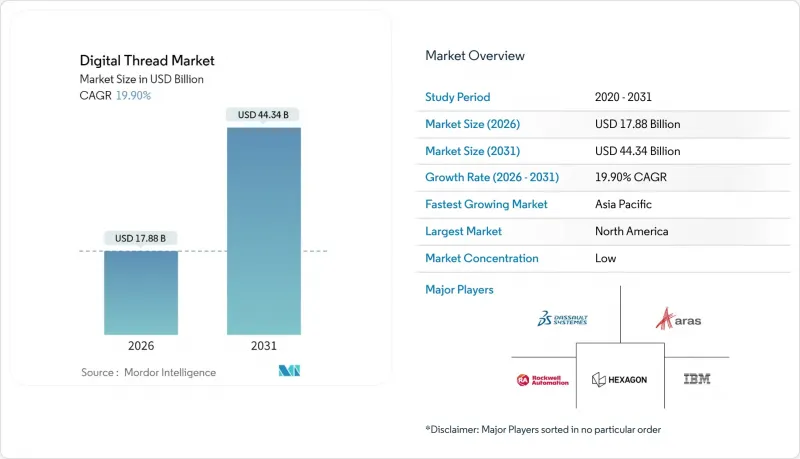
随着製造商透过贯穿设计、生产和服务的单一、持久的数据流,将设计意图与即时营运相结合,市场需求日益增长。云端原生产品生命週期管理平台创造了一个全天候运作环境,同时降低了IT成本。低成本的工业物联网感测器将详细的现场资料传输到模拟模型中,使工程师能够更好地连接虚拟资产和实体资产。生成式人工智慧透过自动标註CAD模型进一步缩短了设计週期,而永续性法规则推动了对生命週期碳排放追踪的需求。网路攻击风险是推动建构安全架构以保护互联生产线的另一个重要因素。
全球数位线程市场趋势与洞察
云端原生PLM采用率激增
云端平台透过 API 优先的环境消除了本地资料孤岛,整合了设计、执行和服务资料。 Aras 展示了区域託管如何为全球团队提供安全的共用工作空间,同时满足资料主权法规的要求。 PTC 的云端部署将医疗设备的上市时间缩短了 40%,带来了实际的经济效益。降低的升级成本使得预算可以分配给模拟和分析模组,从而扩展数位线程的价值。然而,欧洲企业面临严格的 GDPR 要求,对供应商锁定的担忧正在推迟最终的采购决策。
工业物联网感测器成本下降
感测器的平均价格已降至0.38美元,大规模生产正迅速接近0.30美元的关键价位,届时工厂即可为其所有资产配备智慧感测器。亚太地区44%的工厂计划在未来12个月内采用智慧製造,比美国计画高出10个百分点。低成本的感测器和边缘网关可将即时指标传输到数位双胞胎模型中,从而缩短品质干预的反应时间并降低废品率。随着硬体成本的下降,软体订阅和网路安全工具在计划总预算中所占的比例越来越大。
中小企业在基于模型的工程领域面临技能短缺问题
到2030年,製造业将有200万个职缺,而目前三分之一的劳动力缺乏数位化技能。中小企业无法与大型企业相比提高薪资水平,并且在采用先进的产品生命週期管理(PLM)模组方面进展缓慢。社区大学正在增设基于模型的系统工程(MBSE)课程,但毕业生需要四年才能找到相关工作。人工智慧驱动的设计助理可以简化技术应用,但文化变革仍然是企业主经营工厂面临的一大障碍。
细分市场分析
到2025年,PLM将占据数位线程市场27.80%的份额,并继续成为企业数位化策略的支柱。随着企业将设计和执行数据连接起来,以PLM为中心的技术堆迭中的数位线程市场规模预计将稳定成长。然而,ALM 21.7%的复合年增长率表明,市场正向软体定义产品转变,这需要程式码和硬体之间的紧密同步。据Triebwerk称,生成式人工智慧透过将文字提示转换为参数化模型,减少了70%的初始设计工作,从而推动了这一趋势。 CAD和CAM领域正呈现缓慢但稳定的成长,因为人工智慧外挂能够及早发现设计错误,而SLM在航太和医疗领域正获得发展动力,这些领域售后服务合规性要求严格。 ERP和MRP套件现在正在开放API,将营运交易与工程变更单连接起来,从而促进数位线程市场向传统PLM以外的领域扩展。其他模拟和分析工具也加入了这波整合浪潮,为工程师提供了一个统一的介面,可以查看从有限元素模型到现场感测器回馈的所有资讯。
企业越来越倾向于选择整合多个模组的平台供应商,而不是购买单一解决方案。西门子、PTC 和达梭系统在嵌入式模拟引擎和更靠近受监管用户的云端区域方面拥有优势,但它们正面临部署纯云端架构并付费使用制的新竞争对手。随着客户抵制专有技术锁定,开放标准资料格式预计将在蓝图中占据更有利的地位。竞争趋势表明,PLM(产品生命週期管理)收入趋于稳定,而能够自动化执行劳动密集型任务的人工智慧增强模组的扩展正在加速,这正在逐步改变数位线程市场的支出模式。
经过多年的SaaS普及,随着众多中小企业开始在完全託管的环境中部署数位线程,云端技术将在2025年占据53.85%的市场份额。大型企业则寻求折衷方案,将敏感的智慧财产权保留在内部,推动了20.6%的复合年增长率。预计到2031年,混合部署相关的数位线程市场规模将成长近三倍,因为企业需要兼顾传统设备、延迟要求和出口管制法规。国防相关企业正在利用FedRAMP高支援位置进行协作,同时在防火墙后镜像核心储存库以符合ITAR法规。在欧洲,由于GDPR中严格的居住要求,双栈部署正成为营运标准。
随着製造商从简单的文件复製转向微服务编配,混合部署模式日益成熟。云层负责处理模拟突发任务和人工智慧推理,而生产历史系统则驻留在本地资料中心,以实现毫秒级的回馈。供应商提供在两种环境中运行完全相同的容器化服务,从而简化了更新周期。对于核能、製药和关键基础设施营运商而言,本地部署仍然至关重要,因为软体变更认证是这些行业的必备条件。儘管本地部署的成长速度有所放缓,但它仍然影响着产品功能蓝图,并确保空气间隙功能仍然是主流产品的一部分。
区域分析
北美目前的优势源于其成熟的航太主承包商、国防预算以及与硅谷的软体伙伴关係。数位化工程的迫切需求正在推动对端到端资料连续性计划的投资,而云端超大规模资料中心业者营运符合FedRAMP标准、满足严格安全要求的区域。类似的实践正透过与美国飞机製造商的通用供应链在加拿大向北扩展,而墨西哥新兴的航太园区也在采用数位线程来赢得新契约。劳动力短缺是一个真正的限制因素,而人工智慧增强的设计工具正在缓解生产力下降的问题。
亚太地区的发展速度远超过其他地区。中国政府正在资助一条融合工业物联网、人工智慧和先进机器人技术的试点生产线,为本土原始设备製造商(OEM)带来成本和速度优势。日本电子製造商也正在运用类似的理念来维持其全球品质领先地位。韩国造船厂正在利用数位双胞胎技术预测船体应力并制定维护计画。印度正在将低成本感测器与云端资料中心结合,使中小企业能够跨越传统的製造执行系统(MES)架构。在东协内部,电子和医疗设备出口商正在采用数位线程平台,以透过西方客户的供应商审核。
在欧洲,数位线程正被用来满足碳排放报告义务。德国机械製造商正将能耗指标纳入所有资产记录。法国航太供应商正在将复合材料资料和零件护照互联互通,以实现合规性。义大利汽车零件产业丛集正专注于可追溯性,以维持其一级供应商的地位。 《一般资料保护规则》(GDPR) 正在推动多实例云端架构的发展,并增加对混合部署的需求。同时,欧盟的碳边境调节措施即将对缺乏检验的生命週期资料的进口产品处以附加税,迫使全球合作伙伴迁移到相容的平台。
其他福利:
- Excel格式的市场预测(ME)表
- 3个月的分析师支持
目录
第一章 引言
- 研究假设和市场定义
- 调查范围
第二章调查方法
第三章执行摘要
第四章 市场情势
- 市场概览
- 市场驱动因素
- 云端原生PLM采用率激增
- 工业物联网感测器成本低于 0.30 美元
- 促进航太领域遵守脱碳法规
- 快速循环积层製造迴路
- 国防数位线程指令(美国国防部模型驱动系统工程)
- 基于生成式人工智慧的自动模型标註引擎
- 市场限制
- 中小企业缺乏以模型为基础的工程人才
- 主权云端和资料居住障碍
- 对PLM/SaaS供应商锁定问题的担忧
- 网路攻击保险费飙升
- 监管环境
- 技术展望
- 波特五力分析
- 供应商的议价能力
- 买方的议价能力
- 新进入者的威胁
- 替代品的威胁
- 竞争对手之间的竞争
- 对宏观经济趋势的市场评估
第五章 市场规模与成长预测
- 透过技术
- 产品生命週期管理 (PLM)
- 电脑辅助设计 (CAD)
- 电脑辅助製造 (CAM)
- 服务生命週期管理 (SLM)
- ALM(应用程式生命週期管理)
- 物料需求计划 (MRP)
- ERP(企业资源计画)
- 其他技术
- 透过部署模式
- 云
- 本地部署
- 杂交种
- 按公司规模
- 大公司
- 中小企业
- 按行业
- 航太与国防
- 汽车与运输
- 工业机械
- 能源与公共产业
- 医疗和医疗设备
- 电子和半导体
- 其他行业部门
- 按地区
- 北美洲
- 我们
- 加拿大
- 墨西哥
- 南美洲
- 巴西
- 阿根廷
- 其他南美洲
- 欧洲
- 德国
- 英国
- 法国
- 义大利
- 西班牙
- 其他欧洲地区
- 亚太地区
- 中国
- 日本
- 印度
- 韩国
- ASEAN
- 亚太其他地区
- 中东和非洲
- 中东
- 沙乌地阿拉伯
- 阿拉伯聯合大公国
- 土耳其
- 其他中东地区
- 非洲
- 南非
- 奈及利亚
- 其他非洲地区
- 中东
- 北美洲
第六章 竞争情势
- 市场集中度
- 策略趋势
- 市占率分析
- 公司简介
- Dassault Systemes SE
- Aras Corporation
- Rockwell Automation, Inc.
- Hexagon AB
- International Business Machines Corporation
- Autodesk, Inc.
- Ansys, Inc.
- Siemens AG
- PTC Inc.
- Oracle Corporation
- SAP SE
- General Electric Company
- Honeywell International Inc.
- Microsoft Corporation
- Accenture plc
- Capgemini SE
- DXC Technology Company
- Tata Consultancy Services Limited
- ABB Ltd.
- Altair Engineering Inc.
第七章 市场机会与未来展望
digital thread market size in 2026 is estimated at USD 17.88 billion, growing from 2025 value of USD 14.91 billion with 2031 projections showing USD 44.34 billion, growing at 19.9% CAGR over 2026-2031.
Demand rises as manufacturers link engineering intent with real-time operations through a single, persistent data flow that spans design, production, and service. Cloud-native product lifecycle management platforms cut IT overhead while creating always-on collaboration environments. Cheaper IIoT sensors feed granular shop-floor data into simulation models, letting engineers close the loop between virtual and physical assets. Generative AI further trims design cycles by auto-annotating computer-aided models, and sustainability regulations intensify the need for lifecycle carbon tracking. Cyber-attack risks add a parallel push toward secure architectures that guard connected production lines.
Global Digital Thread Market Trends and Insights
Cloud-Native PLM Adoption Surge
Cloud platforms replace on-premises silos with API-first environments that unite design, execution, and service data. Aras shows how regional hosting satisfies data-sovereignty rules while giving global teams a secure shared workspace. PTC's cloud deployment cuts medical-device time to market by 40%, proving tangible financial benefit. Lower upgrade costs free budgets for simulation and analytics modules that extend digital thread value. Yet European firms face tougher GDPR hurdles, and the fear of vendor lock-in slows final purchase decisions.
IIoT Sensor Cost Decline
Average sensor pricing has dropped to USD 0.38, with volume production racing toward the pivotal USD 0.30 mark that lets factories instrument every asset. Forty-four percent of Asia-Pacific plants plan smart-manufacturing rollouts within 12 months, eclipsing U.S. intent by 10 percentage points. Cheap sensors plus edge gateways feed real-time metrics into digital twins, cutting response times for quality interventions and shrinking scrap rates. As hardware costs fall, software subscriptions and cybersecurity tools become the larger share of total project budgets.
SME Talent Gap in Model-Based Engineering
Two million manufacturing positions may stay vacant by 2030, and one-third of today's workforce lacks digital skills. Small firms cannot match enterprise salaries, so they lag in adopting advanced PLM modules. Community colleges add MBSE courses, but four years must pass before graduates fill shop floors. AI-guided design assistants ease onboarding, yet culture change remains a stumbling block for many owner-managed plants.
Other drivers and restraints analyzed in the detailed report include:
- Aerospace Decarbonization Compliance Push
- Rapid-Cycle Additive Manufacturing Loops
- Sovereign-Cloud and Data-Residency Barriers
For complete list of drivers and restraints, kindly check the Table Of Contents.
Segment Analysis
PLM commanded 27.80% of the digital thread market in 2025 and remains the backbone of enterprise digital strategies. The digital thread market size for PLM-centric stacks is projected to climb steadily as companies connect design vaults with execution data. However, ALM's 21.7% CAGR signals a pivot toward software-defined products that demand tighter code-hardware synchronization. Generative AI adds fuel by turning text prompts into parametric models, slashing initial design work by 70% according to Triebwerk. CAD and CAM segments show modest but consistent growth as AI plug-ins surface design errors early, while SLM picks up momentum in aerospace and healthcare, where after-sales compliance is strict. ERP and MRP suites now publish open APIs that join operational transactions with engineering change orders, expanding the addressable digital thread market beyond traditional PLM boundaries. Other simulation and analytics tools ride this integration wave, giving engineers a single pane of glass that stretches from finite-element models to field sensor feedback.
Enterprises increasingly choose platform vendors that fuse multiple modules rather than buying point solutions. Siemens, PTC, and Dassault lean on embedded simulation engines and cloud regions near regulated users, yet face new rivals who launch cloud-only stacks with consumption billing. Open-standard data formats appear on more roadmaps as customers push back against proprietary lock-ins. The competitive narrative suggests steady PLM revenue but faster expansion for AI-augmented modules that automate labor-intensive tasks, indicating a gradual redistribution of spending within the digital thread market.
Cloud held a 53.85% share in 2025 after years of software-as-a-service evangelism, and many SMEs began their digital thread journey in fully hosted environments. Large primes keep sensitive IP on site, driving hybrid's 20.6% CAGR as the preferred compromise. The digital thread market size associated with hybrid rollouts will nearly triple by 2031 as firms juggle legacy gear, latency demands, and export-control rules. Defense contractors rely on FedRAMP high-assurance regions for collaboration, yet mirror core repositories behind firewalls to meet U.S. International Traffic in Arms Regulations. In Europe, GDPR's strict residency clauses make dual-stack deployments an operational norm.
Hybrid adoption patterns mature as manufacturers shift from simple file replication to microservice orchestration. Cloud tiers now handle simulation bursts and AI inference, while production historians reside in local data centers for millisecond feedback. Vendors have responded with containerized services that run identically in both locations, simplifying update cycles. On-premises deployments remain relevant for nuclear, pharmaceutical, and critical-infrastructure operators who must certify every software change. Although their growth lags, they continue to influence feature roadmaps, ensuring that air-gapped functionality remains part of mainstream offerings.
The Digital Thread Market Report is Segmented by Technology (PLM, CAD, CAM, SLM, ALM, and More), Deployment Mode (Cloud, On-Premises, and Hybrid), Enterprise Size (Large Enterprises, and Small and Medium-Sized Enterprises), Industry Vertical (Aerospace and Defense, Automotive and Transportation, Industrial Machinery, Healthcare and Medical Devices, and More), and Geography. The Market Forecasts are Provided in Terms of Value (USD).
Geography Analysis
North America's current dominance stems from entrenched aerospace primes, defense budgets, and Silicon Valley software partnerships. Digital engineering mandates funnel investment into end-to-end data continuity projects, and cloud hyperscalers operate FedRAMP regions that satisfy strict security needs. Canada's shared supply chain with U.S. airframe builders spreads similar practices northward, while Mexico's rising aerospace parks embrace digital threads to win new contracts. Labor shortages pose a real constraint, yet AI-augmented design tools moderate the productivity hit.
Asia-Pacific advances faster than any other bloc. China's government funds pilot lines that integrate IIoT, AI, and advanced robotics, giving local OEMs cost and speed advantages. Japanese electronics makers apply the same principles to keep global quality leadership. South Korea's shipyards use digital twins to predict hull stress and schedule maintenance. India combines low sensor costs with cloud datacenters to let SMEs leapfrog older MES architectures. Across ASEAN, electronics and medical-device exporters adopt digital thread platforms to pass supplier audits from Western customers.
Europe relies on digital threads to meet carbon-reporting duties. German machine builders embed energy-consumption metrics in every asset record. French aerospace suppliers interlink composite material data with component passports for regulatory compliance. Italy's automotive parts clusters focus on traceability to maintain Tier-1 status. GDPR forces multi-instance cloud designs, boosting demand for hybrid deployments. In parallel, EU carbon border adjustments will soon penalize imports lacking verified lifecycle data, nudging global partners onto compatible platforms.
- Dassault Systemes SE
- Aras Corporation
- Rockwell Automation, Inc.
- Hexagon AB
- International Business Machines Corporation
- Autodesk, Inc.
- Ansys, Inc.
- Siemens AG
- PTC Inc.
- Oracle Corporation
- SAP SE
- General Electric Company
- Honeywell International Inc.
- Microsoft Corporation
- Accenture plc
- Capgemini SE
- DXC Technology Company
- Tata Consultancy Services Limited
- ABB Ltd.
- Altair Engineering Inc.
Additional Benefits:
- The market estimate (ME) sheet in Excel format
- 3 months of analyst support
TABLE OF CONTENTS
1 INTRODUCTION
- 1.1 Study Assumptions and Market Definition
- 1.2 Scope of the Study
2 RESEARCH METHODOLOGY
3 EXECUTIVE SUMMARY
4 MARKET LANDSCAPE
- 4.1 Market Overview
- 4.2 Market Drivers
- 4.2.1 Cloud-Native PLM Adoption Surge
- 4.2.2 IIoT Sensor Cost Declines Below USD 0.30
- 4.2.3 Aerospace Decarbonization Compliance Push
- 4.2.4 Rapid-Cycle Additive Manufacturing Loops
- 4.2.5 Defense Digital Thread Mandates (U.S. DoD MBSE)
- 4.2.6 Gen-AI Automated Model Annotation Engines
- 4.3 Market Restraints
- 4.3.1 SME Talent Gap in Model-Based Engineering
- 4.3.2 Sovereign-Cloud and Data-Residency Barriers
- 4.3.3 PLM/SaaS Vendor Lock-In Concerns
- 4.3.4 Cyber-Attack Insurance Premium Spikes
- 4.4 Regulatory Landscape
- 4.5 Technological Outlook
- 4.6 Porter's Five Forces Analysis
- 4.6.1 Bargaining Power of Suppliers
- 4.6.2 Bargaining Power of Buyers
- 4.6.3 Threat of New Entrants
- 4.6.4 Threat of Substitutes
- 4.6.5 Intensity of Competitive Rivalry
- 4.7 Assessment of Macro-economic Trends on the Market
5 MARKET SIZE AND GROWTH FORECASTS (VALUE)
- 5.1 By Technology
- 5.1.1 PLM (Product Lifecycle Management)
- 5.1.2 CAD (Computer-Aided Design)
- 5.1.3 CAM (Computer-Aided Manufacturing)
- 5.1.4 SLM (Service Lifecycle Management)
- 5.1.5 ALM (Application Lifecycle Management)
- 5.1.6 MRP (Material Requirements Planning)
- 5.1.7 ERP (Enterprise Resource Planning)
- 5.1.8 Other Technologies
- 5.2 By Deployment Mode
- 5.2.1 Cloud
- 5.2.2 On-Premises
- 5.2.3 Hybrid
- 5.3 By Enterprise Size
- 5.3.1 Large Enterprises
- 5.3.2 Small and Medium-Sized Enterprises (SMEs)
- 5.4 By Industry Vertical
- 5.4.1 Aerospace and Defense
- 5.4.2 Automotive and Transportation
- 5.4.3 Industrial Machinery
- 5.4.4 Energy and Utilities
- 5.4.5 Healthcare and Medical Devices
- 5.4.6 Electronics and Semiconductors
- 5.4.7 Other Industry Verticals
- 5.5 By Geography
- 5.5.1 North America
- 5.5.1.1 United States
- 5.5.1.2 Canada
- 5.5.1.3 Mexico
- 5.5.2 South America
- 5.5.2.1 Brazil
- 5.5.2.2 Argentina
- 5.5.2.3 Rest of South America
- 5.5.3 Europe
- 5.5.3.1 Germany
- 5.5.3.2 United Kingdom
- 5.5.3.3 France
- 5.5.3.4 Italy
- 5.5.3.5 Spain
- 5.5.3.6 Rest of Europe
- 5.5.4 Asia-Pacific
- 5.5.4.1 China
- 5.5.4.2 Japan
- 5.5.4.3 India
- 5.5.4.4 South Korea
- 5.5.4.5 ASEAN
- 5.5.4.6 Rest of Asia-Pacific
- 5.5.5 Middle East and Africa
- 5.5.5.1 Middle East
- 5.5.5.1.1 Saudi Arabia
- 5.5.5.1.2 United Arab Emirates
- 5.5.5.1.3 Turkey
- 5.5.5.1.4 Rest of Middle East
- 5.5.5.2 Africa
- 5.5.5.2.1 South Africa
- 5.5.5.2.2 Nigeria
- 5.5.5.2.3 Rest of Africa
- 5.5.5.1 Middle East
- 5.5.1 North America
6 COMPETITIVE LANDSCAPE
- 6.1 Market Concentration
- 6.2 Strategic Moves
- 6.3 Market Share Analysis
- 6.4 Company Profiles (includes Global level Overview, Market level overview, Core Segments, Financials as available, Strategic Information, Market Rank/Share for key companies, Products & Services, and Recent Developments)
- 6.4.1 Dassault Systemes SE
- 6.4.2 Aras Corporation
- 6.4.3 Rockwell Automation, Inc.
- 6.4.4 Hexagon AB
- 6.4.5 International Business Machines Corporation
- 6.4.6 Autodesk, Inc.
- 6.4.7 Ansys, Inc.
- 6.4.8 Siemens AG
- 6.4.9 PTC Inc.
- 6.4.10 Oracle Corporation
- 6.4.11 SAP SE
- 6.4.12 General Electric Company
- 6.4.13 Honeywell International Inc.
- 6.4.14 Microsoft Corporation
- 6.4.15 Accenture plc
- 6.4.16 Capgemini SE
- 6.4.17 DXC Technology Company
- 6.4.18 Tata Consultancy Services Limited
- 6.4.19 ABB Ltd.
- 6.4.20 Altair Engineering Inc.
7 MARKET OPPORTUNITIES AND FUTURE OUTLOOK
- 7.1 White-space and Unmet-Need Assessment

 2026年全球数位线程市场报告
 数位线程市场:按产品类型、业务功能、应用、部署模式和最终用户产业划分-2026-2032年全球预测
 数位线程市场分析及预测(至2035年):按类型、产品类型、技术、元件、应用、流程、部署类型、最终用户、功能和解决方案划分
 数位线程市场规模、占有率、成长及全球产业分析:依类型、应用和地区划分的洞察与预测(2026-2034)
 数位线程-全球市场份额和排名、总收入和需求预测(2025-2031 年)
 全球数位线程市场:未来预测(至2032年)-按模组、部署模式、技术、应用、最终用户和地区进行分析
 全球数位线程市场:依技术、部署类型、模组类型、应用、最终用户、地区、机会及预测,2018-2032
 数位线程市场规模、份额、趋势分析报告:按部署、最终用户、模组、技术、地区和细分市场预测,2025 年至 2030 年
 数位线程市场、规模、趋势和行业分析报告(按技术、模组、部署、最终用户和地区)- 市场预测,2025-2034 年
 全球数位线程市场:按技术、按模组、按部署、按应用、按行业、按地区 - 预测(~2030 年)