


 |
市场调查报告书
商品编码
1934883
锌:市场占有率分析、产业趋势与统计、成长预测(2026-2031)Zinc - Market Share Analysis, Industry Trends & Statistics, Growth Forecasts (2026 - 2031) |
||||||

※ 本网页内容可能与最新版本有所差异。详细情况请与我们联繫。
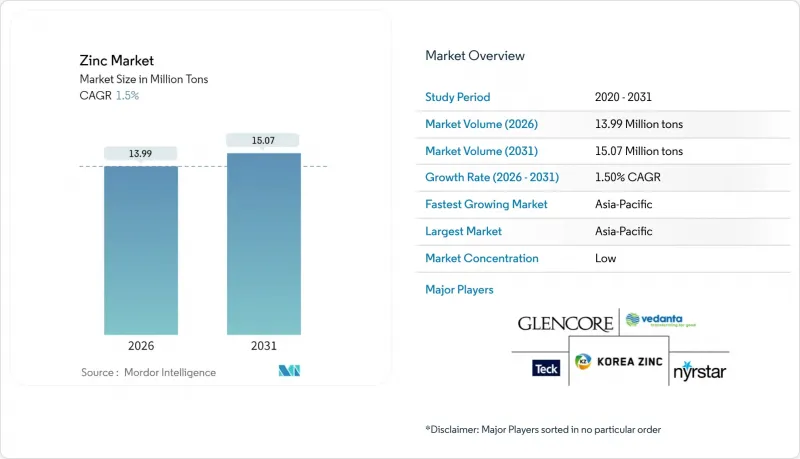
预计到 2026 年,锌市场规模将达到 1,399 万吨,高于 2025 年的 1,378 万吨。
预计到 2031 年将达到 1,507 万吨,2026 年至 2031 年的复合年增长率为 1.5%。
亚太地区的基础设施升级、锌基电池技术的进步以及锌强化肥料的日益普及正在重塑消费模式,抵消了传统镀锌行业成长放缓的影响。生产商正在平衡原生矿开采和二次回收,以符合更严格的环境、社会和治理(ESG)法规,同时冶炼技术的升级旨在减少排放并提高利润率。儘管供应过剩导致价格波动,但长期储能和农业生物强化代表着新的需求机会,并有望在本十年后半期收紧供需平衡。竞争格局有利于同时拥有矿产资源和回收能力的综合性公司,使它们能够在永续应用领域抓住溢价机会。
全球锌市场趋势及展望
基础建设主导锌电镀需求激增
新兴经济体创纪录的基础设施投资计画直接转化为镀锌钢消费量的成长,即便中国住宅房地产市场降温,锌的需求仍然强劲。每投资1兆美元用于公路、铁路和电网建设,镀锌过程中就会消耗约0.3公斤锌。政府的绿色基础设施政策也为此提供了进一步的支撑,因为太阳能板和离岸风力发电发电塔架都需要厚厚的锌涂层来确保数十年的防腐蚀性能。因此,到2030年,基础设施建设预计将占锌需求增长的一半以上,这在矿石和精矿供应紧张的情况下支撑了锌价,并促使冶炼厂采用低碳焙烧和浸出技术以获得环保认证。
耐腐蚀钢在电动车和可再生能源领域的应用日益广泛
电动车和风力发电机製造商正从传统的镀锌製程转向锌铝镁复合涂层。即使产量成长缓慢,这种复合涂层也能提供更长的使用寿命、更薄的涂层厚度以及更高的每公斤金属价值。高阶电动车平台要求在底盘零件和电池外壳上使用高锌涂层,以降低高压环境下的腐蚀风险。离岸风电结构进一步推动了锌的需求,因为塔架和过渡段需要能够承受25年以上海水喷溅的涂层。这将使每兆瓦的锌需求量比石化燃料发电厂增加约40%。随着电动车产量在2025年超过2,000万辆,市场渗透率每提高1%,车辆所需的锌量将增加15,000至2万吨。特种涂层的高价支撑了冶炼厂的利润,并鼓励合金製造商在汽车产业群附近扩大产能。
严格的环境和ESG法规
空气排放法规和碳足迹揭露要求正在增加合规成本。美国环保署 (EPA) 修订的标准已将颗粒物排放限值提高至 50 毫克/标准立方公尺 (mg/dscm),尤其针对欧洲和北美的冶炼厂。欧洲的《关键材料法》增加了回收配额和实质审查审核,有利于那些能够证明其低碳供应链的营运商。遵循成本使营运成本增加 5-8%,同时淘汰了获利能力的高排放设施,从而有效地收紧了精炼供应。像印度斯坦锌业这样的领先正在透过品牌化的低碳钢坯将其优势货币化,从而在汽车竞标中获得溢价。从中长期来看,更严格的 ESG 法规将重塑贸易格局,因为进口国将实施边境碳机制,迫使该地区的生产商加速脱碳进程。
细分市场分析
截至2025年,精炼锌产量占总供应量的71.58%。这主要得益于镀锌生产线优先使用标准化钢坯进行连续捲材生产,从而确保了建筑和汽车行业需求的稳定。这一优势使生产商免受短期需求衝击的影响,因为合约物流、品质保证和信贷条款已融入涵盖矿山、冶炼厂和线圈涂布的长期供应链中。因此,锌市场的精炼环节对于支持冶炼厂的营运资金计画至关重要,因为冶炼厂需要快速週转金属以支付矿石精矿的款项。
然而,随着化肥混合商、电子产品製造商和电池技术创新者寻求能够带来更高利润率和更低单位收入运输成本的高价值衍生产品,成长重心正转向化合物领域。在印度土壤改良计画和将高纯度氧化锌转化为锌空气电池正极材料的先导工厂的推动下,化合物领域预计到2031年将以2.73%的复合年增长率增长,成为整个锌市场中增长最快的细分领域之一。
到2025年,初级采矿和冶炼占总产量的65.10%。这主要得益于红狗矿、拉姆普拉阿古查矿和安塔米纳矿等具有全球重要性的矿山,这些矿山供应杂质含量可靠的精矿。这些资产能够促成长期精矿合同,支持下游一体化,并确保为与基础设施建设相关的镀锌企业提供稳定的原材料供应。然而,矿石品位下降和更严格的ESG(环境、社会和治理)资讯揭露规则正在推高维持性资本成本,而供应过剩时期加工效率的下降也对利润率构成压力。
同时,随着废钢消耗量的成长,城市矿山原料供应增加,包括炼钢粉尘、压铸废料和电弧炉残渣,二次生产正以每年2.55%的速度成长。欧盟和北美地区的回收网路每年已回收超过170万吨残渣,这使得回收商的总维修成本超过了大多数新建矿场。
此锌报告按形态(精炼锌(板条)、锌合金等)、生产工艺(初级生产(采矿和冶炼)和二级生产(回收))、应用(镀锌、压铸、黄铜等)、最终用户行业(建筑、运输、电气和电子等)以及地区(亚太地区、北美、欧洲、南美、中东和非洲)分析锌市场。
区域分析
到2025年,亚太地区将占全球出货量的62.25%,预计到2031年将以每年2.38%的速度成长,这主要得益于中国的基础建设规划和印度不断增长的化肥需求。当地冶炼厂享有向附近钢厂运输成本优势,这有助于在矿石进口日益紧张的情况下增强区域自给自足能力。政府鼓励低碳金属的政策为早期采用者创造了溢价,从而强化了垂直整合营运商的竞争优势。
儘管矿产资源长期短缺,北美仍是关键地区,美国对进口的依赖程度可透过阿拉斯加红狗矿等战略资产缓解。对赫莫萨矿计划的投资标誌着政策转向国内关键矿产生产能力,并可能推动2028年以后的贸易流量。加拿大和墨西哥可提供额外的矿产资源和冶炼能力,并利用接近性汽车和建筑中心的优势。
欧洲需求前景温和,且日益注重价值驱动,汽车製造商和可再生能源开发商优先考虑经认证的低碳钢坯。回收基础设施实现了全球领先的回收率,并将再生金属集中于主要镀锌产业丛集附近。能源价格波动仍是冶炼厂面临的不利因素,但优质化学衍生支撑着特种出口市场。
在中东和非洲,由于尚比亚和纳米比亚工业区和矿产资源的开发,锌需求正在加速成长。大规模海水淡化、电网升级和交通走廊建设都需要镀锌钢,沿岸地区的投资者正专注于下游合金厂,以创造本地附加价值。在南美洲,秘鲁和玻利维亚向亚洲冶炼厂供应优质精矿,从而维持了资源区和需求区之间平衡的锌市场结构。
其他福利:
- Excel格式的市场预测(ME)表
- 3个月的分析师支持
目录
第一章 引言
- 研究假设和市场定义
- 调查范围
第二章调查方法
第三章执行摘要
第四章 市场情势
- 市场概览
- 市场驱动因素
- 基础建设主导锌电镀需求激增
- 耐腐蚀钢在电动车和可再生能源领域的应用成长
- 使用大量锌的电子设备的微型化
- 扩大锌基肥料在缺乏微量元素的土壤中的使用
- 锌离子电池和锌空气电池的出现
- 市场限制
- 严格的环境和ESG法规
- 由于供应过剩导致价格波动
- 铝和复合材料替代
- 价值链分析
- 波特五力模型
- 供应商的议价能力
- 买方的议价能力
- 新进入者的威胁
- 替代品的威胁
- 竞争程度
第五章 市场规模与成长预测
- 按形式
- 精製锌(板条)
- 锌合金
- 锌化合物(氧化物、硫酸盐等)
- 再生/回收锌
- 透过製造工艺
- 初级生产(采矿和冶炼)
- 二次生产(回收利用)
- 透过使用
- 镀锌
- 压铸
- 黄铜
- 氧化锌及化学品
- 其他用途
- 按最终用户行业划分
- 建造
- 运输
- 电气和电子设备
- 消费品
- 其他终端用户产业
- 地区
- 亚太地区
- 中国
- 印度
- 日本
- 韩国
- 印尼
- 马来西亚
- 泰国
- 越南
- 亚太其他地区
- 北美洲
- 我们
- 加拿大
- 墨西哥
- 欧洲
- 法国
- 德国
- 义大利
- 北欧国家
- 俄罗斯
- 西班牙
- 土耳其
- 英国
- 其他欧洲地区
- 南美洲
- 巴西
- 阿根廷
- 哥伦比亚
- 其他南美洲
- 中东和非洲
- 沙乌地阿拉伯
- 阿拉伯聯合大公国
- 卡达
- 南非
- 埃及
- 奈及利亚
- 其他中东和非洲地区
- 亚太地区
第六章 竞争情势
- 市场集中度
- 策略趋势
- 市占率分析
- 公司简介
- Boliden Group
- Glencore
- Grupo Mexico
- Hindustan Zinc(Vedanta)
- Hudbay Minerals Inc.
- Korea Zinc
- MMG Australia Limited
- Nexa
- Nyrstar
- South32
- Teck Resources Limited
- Vedanta Limited
- Volcan
第七章 市场机会与未来展望
Zinc market size in 2026 is estimated at 13.99 Million tons, growing from 2025 value of 13.78 Million tons with 2031 projections showing 15.07 Million tons, growing at 1.5% CAGR over 2026-2031.
Infrastructure renewal across Asia-Pacific, breakthroughs in zinc-based batteries and rising use of zinc-fortified fertilizers are reshaping consumption patterns, offsetting slower growth in traditional galvanizing. Producers are balancing primary mining with secondary recovery to meet stricter ESG rules, while technology upgrades in smelting aim to curb emissions and improve margins. Supply surpluses have kept prices volatile, yet long-duration energy storage and agricultural biofortification point to fresh outlets that could tighten balances later in the decade. Competitive dynamics favor integrated players with both mine ownership and recycling capacity, positioning them to capture premium opportunities in sustainable applications.
Global Zinc Market Trends and Insights
Infrastructure-Led Galvanizing Demand Surge
Record infrastructure spending programs across emerging economies are translating directly into higher coated-steel offtake, lifting zinc demand even as residential real estate cools in China. Each USD 1 trillion allocated to roads, rail and power grids generates roughly 0.3 kg of zinc per dollar through galvanizing. Government green-infrastructure mandates add momentum because solar arrays and offshore wind towers rely on thick zinc coatings that ensure multi-decade corrosion protection. As a result, infrastructure accounts for more than half of projected incremental zinc demand to 2030, underpinning pricing during periods of mine-concentrate tightness and encouraging smelters to adopt low-carbon roasting and leaching technologies to secure environmental approvals.
Growth of Corrosion-Resistant Steel in EV and Renewables
Electric-vehicle makers and wind-turbine fabricators are shifting from conventional galvanizing toward zinc-aluminum-magnesium coatings that deliver longer service life at thinner coating weights, lifting the metal's value per kilogram even when volumes grow slowly. Premium EV platforms now specify zinc-rich layers for under-body components and battery housings to mitigate corrosion risk in high-voltage environments. Offshore wind structures intensify the pull because tower sections and transition pieces need coatings that withstand brine spray for more than 25 years, making zinc demand per megawatt roughly 40% higher than in fossil-fuel plants. As EV production tops 20 million units in 2025, each incremental point of market penetration embeds an additional 15-20 kilotons of zinc in the vehicle fleet. The premium commanded by specialized coatings supports smelter margins and encourages alloy makers to expand production capacity near automotive clusters.
Stringent Environmental and ESG Regulations
Air-emission limits and carbon-footprint disclosures are inflating compliance costs, particularly for smelters in Europe and North America where particulate thresholds now sit at 50 mg/dscm under updated U.S. EPA standards. The European Critical Raw Materials Act adds recycling quotas and due-diligence audits that favor operators able to certify low-carbon supply chains. Compliance spending raises operating costs by 5-8% but also filters out marginal, high-emission capacity, effectively tightening refined supply. Early adopters such as Hindustan Zinc monetize their advantage through branded low-carbon slabs that secure premiums in automotive tenders. Over the medium term, ESG stringency will reshape trade patterns as importers institute border-carbon mechanisms, compelling producers in all regions to accelerate decarbonization efforts.
Other drivers and restraints analyzed in the detailed report include:
- Zinc-Intensive Electronics Miniaturization
- Expansion of Zinc-Based Fertilizers in Micronutrient-Deficient Soils
- Material Substitution by Aluminum and Composites
For complete list of drivers and restraints, kindly check the Table Of Contents.
Segment Analysis
Refined output held 71.58% of total supply in 2025 as galvanizing lines favored standardized slabs for continuous-coil operations, locking in predictable off-take volumes across construction and auto sectors. This dominance shields producers from short-run demand shocks because contract logistics, quality assurance and credit terms are already embedded in long-standing supply chains that span mines, smelters and coil coaters. The refined slice of the zinc market therefore underpins working-capital planning for smelters that must move metal quickly to manage concentrate payables.
Growth, however, is tilting toward compounds as fertilizer blenders, electronics makers and battery innovators seek value-added derivatives that lift margins and cut shipping costs per dollar of revenue. A 2.73% CAGR through 2031 places compounds among the fastest-rising niches in the broader zinc market, helped by India's push to fortify soils and by pilot plants that turn high-purity oxide into zinc-air cathodes.
Primary mining and smelting accounted for 65.10% of 2025 tonnage, anchored by globally significant operations such as Red Dog, Rampura Agucha and Antamina that deliver concentrates with reliable impurity profiles. These assets enable long-term concentrate contracts that support downstream integration and provide feedstock security for galvanizers tied to infrastructure roll-outs. Even so, mine-grade deterioration and stricter ESG disclosure rules are inflating sustaining capital costs, pinching margins when spot treatment charges soften in surplus years.
Secondary production is meanwhile advancing 2.55% a year as urban-mine flows of steel-making dust, die-cast scrap and EAF residues expand in line with scrap-steel consumption. Collection networks across the European Union and North America already divert more than 1.7 million t of residues annually, giving recyclers a cost base that beats most greenfield mines on an all-in-sustaining-cost basis.
The Zinc Report is Segmented by Form (Refined Zinc (Slab), Zinc Alloys, and More), Production Process (Primary Production (Mining and Smelting) and Secondary Production (Recycling)), Application (Galvanizing, Die-Casting, Brass, and More), End-User Industry (Construction, Transportation, Electrical and Electronics, and More), and Geography (Asia-Pacific, North America, Europe, South America, and Middle-East and Africa).
Geography Analysis
Asia-Pacific controlled 62.25% of global shipments in 2025 and will expand by 2.38% annually to 2031, propelled by China's infrastructure pipeline and India's fertilizer push. Local smelters enjoy freight advantages to neighboring steel mills, strengthening regional self-sufficiency even as concentrate imports tighten. Government directives that favor low-carbon metal add premium layers for early adopters, reinforcing competitive moats for vertically integrated players.
North America maintains a meaningful role despite chronic concentrate deficits, with U.S. import reliance offset by strategic assets such as Red Dog in Alaska. Investment in the Hermosa project signals a policy turn toward domestic critical-mineral capacity, which could shift trade flows after 2028. Canada and Mexico provide additional mine supply and smelting output, leveraging proximity to automotive and construction hubs.
Europe's demand outlook is moderate but increasingly value-oriented, as automakers and renewable developers prioritize certified low-carbon slabs. Recycling infrastructure yields some of the globe's highest recovery ratios, keeping secondary metal close to major galvanizing clusters. Energy-price volatility remains a headwind for smelters; nonetheless, premium-grade chemical derivatives anchor specialty export niches.
Middle-East and Africa post accelerating demand tied to industrial-zone build-outs and mineral-resource development in Zambia and Namibia. Large-scale desalination, power-grid upgrades and transport corridors call for galvanized steel, while Gulf-based investors eye downstream alloy plants to add local value. South America rounds out the global map with Peru and Bolivia supplying high-grade concentrates to Asian smelters, sustaining a balanced portfolio of resource and demand centers for the zinc market.
- Boliden Group
- Glencore
- Grupo Mexico
- Hindustan Zinc (Vedanta)
- Hudbay Minerals Inc.
- Korea Zinc
- MMG Australia Limited
- Nexa
- Nyrstar
- South32
- Teck Resources Limited
- Vedanta Limited
- Volcan
Additional Benefits:
- The market estimate (ME) sheet in Excel format
- 3 months of analyst support
TABLE OF CONTENTS
1 Introduction
- 1.1 Study Assumptions and Market Definition
- 1.2 Scope of the Study
2 Research Methodology
3 Executive Summary
4 Market Landscape
- 4.1 Market Overview
- 4.2 Market Drivers
- 4.2.1 Infrastructure-led galvanizing demand surge
- 4.2.2 Growth of corrosion-resistant steel in EV and renewables
- 4.2.3 Zinc-intensive electronics miniaturisation
- 4.2.4 Expansion of zinc-based fertilisers in micronutrient-deficient soils
- 4.2.5 Emergence of zinc-ion and zinc-air batteries
- 4.3 Market Restraints
- 4.3.1 Stringent environmental and ESG regulations
- 4.3.2 Price volatility from supply surpluses
- 4.3.3 Material substitution by aluminium and composites
- 4.4 Value Chain Analysis
- 4.5 Porter's Five Forces
- 4.5.1 Bargaining Power of Suppliers
- 4.5.2 Bargaining Power of Buyers
- 4.5.3 Threat of New Entrants
- 4.5.4 Threat of Substitutes
- 4.5.5 Degree of Competition
5 Market Size and Growth Forecasts (Volume)
- 5.1 By Form
- 5.1.1 Refined Zinc (Slab)
- 5.1.2 Zinc Alloys
- 5.1.3 Zinc Compounds (Oxide, Sulfate, etc.)
- 5.1.4 Secondary/Recycled Zinc
- 5.2 By Production Process
- 5.2.1 Primary Production (Mining and Smelting)
- 5.2.2 Secondary Production (Recycling)
- 5.3 By Application
- 5.3.1 Galvanizing
- 5.3.2 Die-Casting
- 5.3.3 Brass
- 5.3.4 Zinc Oxide and Chemicals
- 5.3.5 Other Applications
- 5.4 By End-User Industry
- 5.4.1 Construction
- 5.4.2 Transportation
- 5.4.3 Electrical and Electronics
- 5.4.4 Consumer Goods
- 5.4.5 Other End-user Industries
- 5.5 Geography
- 5.5.1 Asia-Pacific
- 5.5.1.1 China
- 5.5.1.2 India
- 5.5.1.3 Japan
- 5.5.1.4 South Korea
- 5.5.1.5 Indonesia
- 5.5.1.6 Malaysia
- 5.5.1.7 Thailand
- 5.5.1.8 Vietnam
- 5.5.1.9 Rest of Asia-Pacific
- 5.5.2 North America
- 5.5.2.1 United States
- 5.5.2.2 Canada
- 5.5.2.3 Mexico
- 5.5.3 Europe
- 5.5.3.1 France
- 5.5.3.2 Germany
- 5.5.3.3 Italy
- 5.5.3.4 Nordic Countries
- 5.5.3.5 Russia
- 5.5.3.6 Spain
- 5.5.3.7 Turkey
- 5.5.3.8 United Kingdom
- 5.5.3.9 Rest of Europe
- 5.5.4 South America
- 5.5.4.1 Brazil
- 5.5.4.2 Argentina
- 5.5.4.3 Colombia
- 5.5.4.4 Rest of South America
- 5.5.5 Middle-East and Africa
- 5.5.5.1 Saudi Arabia
- 5.5.5.2 United Arab Emirates
- 5.5.5.3 Qatar
- 5.5.5.4 South Africa
- 5.5.5.5 Egypt
- 5.5.5.6 Nigeria
- 5.5.5.7 Rest of Middle-East and Africa
- 5.5.1 Asia-Pacific
6 Competitive Landscape
- 6.1 Market Concentration
- 6.2 Strategic Moves
- 6.3 Market Share Analysis
- 6.4 Company Profiles (includes Global level Overview, Market level overview, Core Segments, Financials as available, Strategic Information, Market Rank/Share for key companies, Products and Services, Recent Developments)
- 6.4.1 Boliden Group
- 6.4.2 Glencore
- 6.4.3 Grupo Mexico
- 6.4.4 Hindustan Zinc (Vedanta)
- 6.4.5 Hudbay Minerals Inc.
- 6.4.6 Korea Zinc
- 6.4.7 MMG Australia Limited
- 6.4.8 Nexa
- 6.4.9 Nyrstar
- 6.4.10 South32
- 6.4.11 Teck Resources Limited
- 6.4.12 Vedanta Limited
- 6.4.13 Volcan
7 Market Opportunities and Future Outlook
- 7.1 White-space and Unmet-Need Assessment

 ZDDP添加剂市场:依基础油类型、添加剂形式、锌浓度、应用和分销管道划分-2026-2032年全球预测锌市场:全球锌市场预测(依产品类型、形态、应用、终端用户产业和分销管道划分)-2026年至2032年镀锌市场:依技术、製程、镀层厚度、基材及应用划分-2026年至2032年全球预测
 2026年全球铜、镍、铅和锌市场报告2026年全球锌市场报告2026年全球热镀锌市场报告2026年全球柠檬酸锌市场报告涂料用锌粉市场:依树脂类型、粒径、物理形态、最终用途产业及通路划分-2026-2032年全球预测
 柠檬酸锌市场规模、份额及成长分析(按等级、应用、终端用户产业及地区划分)-2026-2033年产业预测
 锌市场规模、份额和成长分析(按形态、开采类型、销售管道、应用、最终用途和地区划分)-2026-2033年产业预测