


 |
市场调查报告书
商品编码
1937286
木浆:市场占有率分析、产业趋势与统计、成长预测(2026-2031)Wood Pulp - Market Share Analysis, Industry Trends & Statistics, Growth Forecasts (2026 - 2031) |
||||||

※ 本网页内容可能与最新版本有所差异。详细情况请与我们联繫。
预计木浆市场规模将从 2025 年的 1,820 亿美元成长到 2026 年的 1,888.1 亿美元,到 2031 年将达到 2,267.9 亿美元,2026 年至 2031 年的复合年增长率为 3.74%。
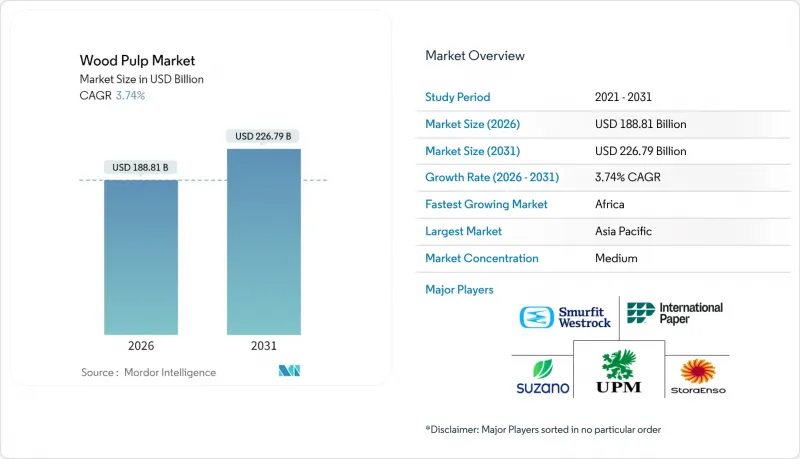
这一稳定成长主要得益于需求从印刷用纸转向瓦楞纸包装和吸水性卫生纸。生产商正日益关注电商主导的箱板纸、高檔卫生纸和特种纸浆,这些产品的利润率高于传统印刷用纸。儘管原材料价格波动,但造纸厂的持续升级、生物精炼厂的整合以及人工智慧驱动的流程管理进一步稳定了收入。区域需求模式差异显着,亚太地区引领销售成长,非洲持续以小规模扩张,而北美和欧洲则转向高价值的细分市场。跨境关税,特别是美国对加拿大纸浆进口征收的关税,正在扰乱现有的贸易格局,迫使生产商要么承受利润压缩,要么在亚太地区开发替代市场。
全球木浆市场趋势与洞察
电子商务推动瓦楞纸包装需求激增
线上零售的成长正在加速瓦楞纸箱的消费,而瓦楞纸箱需要大量使用牛皮纸衬里和由商品纸浆製成的瓦楞芯材。国际纸业指出,随着电商客户补充库存,箱板纸的需求将在2024年復苏。新成立的斯莫菲特-韦斯特洛克公司预计,其专注于包装业务的投资组合在2024年将实现47亿美元的调整后EBITDA。与传统零售相比,面向消费者的直接配送的保护性运输方式提高了每个包裹的纤维用量。这一趋势在中国、印度和美国最为显着,这些国家的大批量小包裹配送与优先使用纸张而非塑胶的永续性理念相契合。造纸厂正在透过将印刷纸机改造为箱板纸生产线来应对这一趋势,从而透过增加原材料供应来刺激木浆市场。数位贸易的结构性发展势头为纸浆的长期消费奠定了基础,即使在宏观经济週期波动的情况下也是如此。
新兴经济体纸巾和卫生用品消费成长
亚太和非洲的人均纸巾消费量仍远低于欧洲和北美。国际纸业公司约90%的吸水纸浆出口销往这些高成长地区,凸显了市场需求缺口。可支配收入的成长、都市化的加快以及卫生意识的提高,正在推动对高纯度纸浆製成的高檔纸巾和尿布产品的需求。由于家庭用纸的需求不受景气衰退的影响,这项需求因素正在推动木浆市场销售稳定成长,并与週期性更强的包装市场形成平衡。在新兴市场,供应量超过消费量,使得拥有绒毛浆产能的生产商能够获得可观的利润。长期人口趋势表明,这种成长势头将持续到预测期之后。
纸浆木材价格波动与气候变迁和物流中断有关
2024年,风暴、干旱和运输瓶颈导致北欧纸浆材价格飙升至历史新高,迫使比勒鲁德公司提高产品价格以维持利润。北美也遭遇了类似的供应衝击,暴露出对易受极端天气影响的卡车和铁路运输路线的依赖。价格飙升压缩了纸浆销售价格与原料成本之间的边际收益,导致造纸厂推迟自愿升级改造计画。中小企业缺乏避险工具和合约谈判能力,增加了破产风险。虽然长期植树造林计划可能缓解供应紧张,但短期价格波动仍是限制木浆市场成长的主要因素。
细分市场分析
木浆市场规模正受到纤维偏好变化和永续性趋势的影响。到2025年,硬木纤维将占木浆市场份额的47.25%,这主要得益于桉树和桦树人工林,它们提供的短纤维特性使其在卫生纸、印刷和轻质包装等领域备受青睐。亚太地区,特别是中国和印尼的人工林,透过向国内加工商和出口工厂提供价格具竞争力的硬木原料,进一步巩固了这一优势。来自北欧和北美森林的软木纤维对于箱板纸和麻袋纸等对长纤维强度要求极高的应用仍然至关重要。然而,生产商正日益精细地调整硬木与软木的混合比例,以在控制原材料成本的同时达到性能目标。随着工厂不断优化配比,即使整个木浆市场的筹资策略不断演变,硬木仍将继续保持其作为产量基础的地位。
预计非木材替代品将以最快的速度成长,在2026年至2031年间以5.07%的复合年增长率增长,因为永续性的迫切需求推动了资源多样化。在集约化耕作地区,小麦秸秆、稻壳和甘蔗渣等农业残余物提供了丰富的纤维来源,而竹子具有快速的再生週期,对注重环保的品牌和监管机构极具吸引力。 UPM与Sodra在木质素萃取方面的合作表明,生产商正在探索新的增值途径,以补充非木材纤维的利用。
区域分析
亚太地区占全球木浆市场的48.05%,支撑着全球需求。中国消耗了全球整体超过三分之一的箱板纸,印度的卫生纸市场正经历两位数的成长。巴西、印尼和越南的人工林为中国加工商提供低成本纤维,增强了该地区的规模优势。日本和韩国依赖进口高纯度纸浆用于特殊用途,而澳洲则向本国造纸厂出口人工林桉木片。投资改造现有造纸厂,消除产能瓶颈,并建造新的大型单一製程造纸厂,将确保亚太地区的供应安全,并使其在全球价格中保持影响力。
儘管非洲木浆市场规模相对小规模,但南非的综合林业和造纸资产为其在非洲大陆提供了战略基础。 Sappi公司108亿兰特(约6亿美元)的投资正在加速现代化进程,提升区域互联互通,改善原料供应链,并提高社会认可度。加强德班港和马布多的物流能力旨在缩短出口到欧洲和亚洲的前置作业时间。新兴的北非生产商正利用接近性欧洲终端用户中心的优势,助力非洲大陆实现2031年5.55%的复合年增长率。
北美和欧洲的需求结构已趋于成熟。美国纤维原料供应充足,但面临关税争端带来的挑战,导致分销管道转向亚洲。加拿大西部生产商正将业务拓展至美国以外的市场,以降低关税风险。欧洲优先发展生物精炼炼製和塑胶替代,儘管印刷用纸消费量下降,但特种纸仍保持成长。日益严格的环境法规增加了合规成本,但也刺激了创新,推动了木浆市场高级产品的差异化。
其他福利:
- Excel格式的市场预测(ME)表
- 3个月的分析师支持
目录
第一章 引言
- 研究假设和市场定义
- 调查范围
第二章调查方法
第三章执行摘要
第四章 市场情势
- 市场概览
- 市场驱动因素
- 电子商务推动纸板包装需求激增
- 新兴国家纸巾和卫生用品消费成长
- 由于永续性要求,用纤维取代塑料
- 亚太地区硬木牛皮纸浆厂扩建计划
- 透过生物精炼一体化开发木质素和半纤维素的收入来源
- 人工智慧驱动的预测性维护可提高工厂使用率和生产效率
- 市场限制
- 气候变迁和物流中断导致纸浆木材价格波动
- 加强废水和化学品排放的监管
- 由于技术纯熟劳工短缺,新建设和维修计划延误。
- 跨境关税重塑纸浆贸易流向
- 监管环境
- 技术展望
- 波特五力分析
- 新进入者的威胁
- 供应商的议价能力
- 买方的议价能力
- 替代品的威胁
- 竞争对手之间的竞争
第五章 市场规模与成长预测
- 按原料
- 针叶树
- 硬木
- 非木质纤维
- 按地区
- 北美洲
- 我们
- 加拿大
- 北美其他地区
- 欧洲
- 德国
- 英国
- 法国
- 芬兰
- 俄罗斯
- 其他欧洲地区
- 亚太地区
- 中国
- 印度
- 日本
- 澳洲
- 韩国
- 亚太其他地区
- 南美洲
- 巴西
- 阿根廷
- 其他南美洲
- 中东
- 沙乌地阿拉伯
- 阿拉伯聯合大公国
- 其他中东地区
- 非洲
- 南非
- 埃及
- 其他非洲地区
- 北美洲
第六章 竞争情势
- 市场集中度
- 策略趋势
- 市占率分析
- 公司简介
- Suzano SA
- International Paper Company
- Stora Enso Oyj
- UPM-Kymmene Oyj
- Smurfit WestRock plc
- Metsaliitto Cooperative
- Sappi Limited
- Celulosa Arauco y Constitucion SA(Empresas Copec SA)
- Asia Pulp & Paper Co. Ltd.(Sinar Mas Group)
- Mercer International Inc.
- Canfor Pulp Products Inc.(Canfor Corporation)
- Paper Excellence BV
- Klabin SA
第七章 市场机会与未来展望
The wood pulp market is expected to grow from USD 182.00 billion in 2025 to USD 188.81 billion in 2026 and is forecast to reach USD 226.79 billion by 2031 at 3.74% CAGR over 2026-2031.
A shift away from graphic paper and toward corrugated packaging and absorbent hygiene grades underpins this steady advance. Producers deepen their focus on e-commerce-driven containerboard, premium tissue, and specialty pulps that carry higher margins than legacy printing grades. Continual mill upgrades, bio-refinery integration, and AI-enabled process control further stabilize earnings despite raw-material volatility. Geographic demand patterns diverge sharply as Asia-Pacific drives volume, Africa expands from a small base, and North America and Europe pivot to value-added niches. Cross-border tariffs, particularly duties imposed on Canadian pulp imports to the United States, disrupt established trade patterns and force producers to absorb margin compression or seek alternative markets in Asia-Pacific regions.
Global Wood Pulp Market Trends and Insights
E-commerce-driven Corrugated-packaging Demand Surge
Online retail growth intensifies the consumption of corrugated boxes that use high volumes of kraft liner and medium produced from market pulp. International Paper noted containerboard volume recovery in 2024 as e-commerce clients replenished stocks, and the newly formed Smurfit WestRock projects USD 4.7 billion in adjusted EBITDA for 2024 from its packaging-heavy portfolio. Protective shipping formats for direct-to-consumer deliveries raise fiber intensity per package versus traditional retail. The trend is most pronounced in China, India, and the United States, where high parcel volumes intersect with sustainability mandates that favor paper over plastic. Mill operators respond by converting graphic-paper machines to containerboard, boosting the wood pulp market through incremental furnish demand. Digital trade's structural momentum supports long-run pulp consumption even as macro cycles fluctuate.
Growth in Tissue and Hygiene Consumption in Emerging Economies
Per-capita tissue use in Asia-Pacific and Africa remains well below levels observed in Europe and North America. International Paper directs roughly 90% of absorbent pulp exports to these high-growth regions, underscoring the demand gap. Rising disposable incomes, urbanization, and heightened hygiene awareness lift uptake of premium tissue and diaper products that rely on high-purity pulps. Because household paper demand is relatively recession-resilient, this driver provides consistent volume growth for the wood pulp market, balancing more cyclical packaging segments. Producers with fluff-pulp capacity enjoy favorable margins as supply lags consumption in emerging markets. Long-term demographic trends point to sustained expansion well beyond the forecast horizon.
Volatile Pulpwood Prices Tied to Climate and Logistics Shocks
Storm damage, drought, and transport bottlenecks lifted Nordic pulpwood prices to record levels in 2024, forcing Billerud to raise product prices to preserve margins. Similar supply shocks in North America exposed dependence on truck and rail corridors vulnerable to extreme weather. Price spikes compress spreads between pulp realizations and fiber costs, delaying discretionary mill upgrades. Smaller firms lack hedging tools and contractual leverage, heightening bankruptcy risk. While long-term plantation projects may ease tightness, near-term volatility remains a key brake on wood pulp market growth.
Other drivers and restraints analyzed in the detailed report include:
- Plastic-to-fiber Substitution Prompted by Sustainability Mandates
- Capacity Additions of Hardwood Kraft Mills in Asia-Pacific
- Tightening Wastewater and Chemical-emissions Regulations
For complete list of drivers and restraints, kindly check the Table Of Contents.
Segment Analysis
Wood pulp market size is being shaped by shifting fiber preferences and sustainability trends. Hardwood fibers captured 47.25% of the wood pulp market share in 2025, supported by eucalyptus and birch plantations that deliver short-fiber characteristics prized in tissue, printing, and lightweight packaging applications. Asia-Pacific plantations in China and Indonesia reinforce this advantage by supplying domestic converters and export mills with competitively priced hardwood furnish. Softwood fibers from Nordic and North American forests retain relevance where long-fiber strength is critical, such as containerboard and sack paper, yet producers increasingly fine-tune hardwood-softwood blends to hit performance targets while curbing raw-material costs. As mills optimize recipes, hardwood continues to anchor volume even as procurement strategies evolve across the wood pulp market.
Non-wood alternatives are set to grow fastest, advancing at a 5.07% CAGR from 2026 to 2031 as sustainability mandates push the industry toward resource diversification. Agricultural residues such as wheat straw, rice husks, and sugarcane bagasse supply abundant fiber streams in intensive farming regions, while bamboo offers rapid regrowth cycles attractive to environmentally conscious brands and regulators. UPM's collaboration with Sodra on lignin extraction underlines how producers explore new valorization pathways that complement non-wood fiber utilization.
The Wood Pulp Market Report is Segmented by Fiber Source (Hardwood, Softwood, Non-Wood Fibers) and Geography (North America, Europe, Asia-Pacific, South America, Middle East, and Africa). The Market Forecasts are Provided in Terms of Value (USD).
Geography Analysis
Asia-Pacific's 48.05% wood pulp market share anchors global demand, with China consuming more than one-third of worldwide corrugated liner shipments and India recording double-digit tissue growth. Plantation forestry across Brazil, Indonesia, and Vietnam channels low-cost fiber into Chinese converters, reinforcing the region's scale advantage. Japan and South Korea rely on high-purity imports for specialty applications, while Australia exports plantation eucalyptus chips to regional mills. Investments in brownfield debottlenecking and new single-phase mega-mills safeguard Asia-Pacific's supply security and global price influence.
Africa's wood pulp market size remains comparatively modest, yet South Africa's integrated forestry and mill assets give the continent a strategic foothold. Sappi's R10.8 billion (USD 600 million) commitment accelerates modernization and community engagement, improving raw-material flows and social license to operate. Logistical upgrades at Durban and Maputo ports aim to cut export lead times to Europe and Asia. Emerging North African producers leverage proximity to European end-users, supporting the continent's 5.55% CAGR through 2031.
North America and Europe exhibit mature demand profiles. The United States maintains surplus fiber availability but wrestles with tariff disputes that redirect flows toward Asia. Canada's Western producers diversify beyond U.S. markets to offset duty exposure. Europe prioritizes bio-refinery projects and plastic substitution, sustaining specialty-grade growth despite shrinking graphic-paper consumption. Stricter environmental regulations raise compliance costs but also encourage innovation that differentiates premium offerings within the wood pulp market.
- Suzano S.A.
- International Paper Company
- Stora Enso Oyj
- UPM-Kymmene Oyj
- Smurfit WestRock plc
- Metsaliitto Cooperative
- Sappi Limited
- Celulosa Arauco y Constitucion S.A. (Empresas Copec S.A.)
- Asia Pulp & Paper Co. Ltd. (Sinar Mas Group)
- Mercer International Inc.
- Canfor Pulp Products Inc. (Canfor Corporation)
- Paper Excellence B.V.
- Klabin S.A.
Additional Benefits:
- The market estimate (ME) sheet in Excel format
- 3 months of analyst support
TABLE OF CONTENTS
1 Introduction
- 1.1 Study Assumptions and Market Definition
- 1.2 Scope of the Study
2 Research Methodology
3 Executive Summary
4 Market Landscape
- 4.1 Market Overview
- 4.2 Market Drivers
- 4.2.1 E-commerce driven corrugated-packaging demand surge
- 4.2.2 Growth in tissue and hygiene consumption in emerging economies
- 4.2.3 Plastic-to-fiber substitution prompted by sustainability mandates
- 4.2.4 Capacity additions of hardwood kraft mills in Asia-Pacific
- 4.2.5 Bio-refinery integration unlocking lignin and hemicellulose revenue streams
- 4.2.6 AI-enabled predictive maintenance boosting mill uptime and yield
- 4.3 Market Restraints
- 4.3.1 Volatile pulpwood prices tied to climate and logistics shocks
- 4.3.2 Tightening wastewater and chemical-emissions regulations
- 4.3.3 Skilled-labor shortages delaying greenfield and retrofit projects
- 4.3.4 Cross-border tariffs reshaping pulp trade flows
- 4.4 Regulatory Landscape
- 4.5 Technological Outlook
- 4.6 Porter's Five Forces Analysis
- 4.6.1 Threat of New Entrants
- 4.6.2 Bargaining Power of Suppliers
- 4.6.3 Bargaining Power of Buyers
- 4.6.4 Threat of Substitutes
- 4.6.5 Intensity of Competitive Rivalry
5 Market Size and Growth Forecasts (Value, USD)
- 5.1 By Fiber Source
- 5.1.1 Softwood
- 5.1.2 Hardwood
- 5.1.3 Non-wood Fibers
- 5.2 By Geography
- 5.2.1 North America
- 5.2.1.1 United States
- 5.2.1.2 Canada
- 5.2.1.3 Rest of North America
- 5.2.2 Europe
- 5.2.2.1 Germany
- 5.2.2.2 United Kingdom
- 5.2.2.3 France
- 5.2.2.4 Finland
- 5.2.2.5 Russia
- 5.2.2.6 Rest of Europe
- 5.2.3 Asia-Pacific
- 5.2.3.1 China
- 5.2.3.2 India
- 5.2.3.3 Japan
- 5.2.3.4 Australia
- 5.2.3.5 South Korea
- 5.2.3.6 Rest of Asia-Pacific
- 5.2.4 South America
- 5.2.4.1 Brazil
- 5.2.4.2 Argentina
- 5.2.4.3 Rest of South America
- 5.2.5 Middle East
- 5.2.5.1 Saudi Arabia
- 5.2.5.2 United Arab Emirates
- 5.2.5.3 Rest of Middle East
- 5.2.6 Africa
- 5.2.6.1 South Africa
- 5.2.6.2 Egypt
- 5.2.6.3 Rest of Africa
- 5.2.1 North America
6 Competitive Landscape
- 6.1 Market Concentration
- 6.2 Strategic Moves
- 6.3 Market Share Analysis
- 6.4 Company Profiles (Includes Global Level Overview, Market Level Overview, Core Segments, Financials as Available, Strategic Information, Market Rank/Share, Products and Services, Recent Developments)
- 6.4.1 Suzano S.A.
- 6.4.2 International Paper Company
- 6.4.3 Stora Enso Oyj
- 6.4.4 UPM-Kymmene Oyj
- 6.4.5 Smurfit WestRock plc
- 6.4.6 Metsaliitto Cooperative
- 6.4.7 Sappi Limited
- 6.4.8 Celulosa Arauco y Constitucion S.A. (Empresas Copec S.A.)
- 6.4.9 Asia Pulp & Paper Co. Ltd. (Sinar Mas Group)
- 6.4.10 Mercer International Inc.
- 6.4.11 Canfor Pulp Products Inc. (Canfor Corporation)
- 6.4.12 Paper Excellence B.V.
- 6.4.13 Klabin S.A.
7 Market Opportunities and Future Outlook

 漂白桉树牛皮纸浆市场:依等级、产品形式、应用、通路,全球预测(2026-2032年)全球漂白硬木牛皮纸浆市场(按漂白技术、等级、纸浆形态、应用和分销管道划分)预测(2026-2032年)北方漂白软木牛皮纸市场按产品等级、认证、应用、最终用途和分销管道划分 - 全球预测(2026-2032 年)漂白软木牛皮纸市场按等级、应用、终端用户产业和销售管道,全球预测(2026-2032年)
 日本木浆市场规模、份额、趋势及预测(按类型、等级、最终用途行业和地区划分),2026-2034年
 木浆市场规模、份额和成长分析(按类型、製造流程、最终用途产业和地区划分)-2026-2033年产业预测
 漂白尤加利牛皮纸浆市场:全球2025-2029年
 全球木浆市场规模按产品类型、应用、最终用户产业、地区、范围和预测划分
 越南硫酸盐纸浆进口:2024-2033