


 |
市场调查报告书
商品编码
1937301
汽车用直流-直流转换器:市场占有率分析、产业趋势与统计、成长预测(2026-2031)Automotive Dc-Dc Converter - Market Share Analysis, Industry Trends & Statistics, Growth Forecasts (2026 - 2031) |
||||||

※ 本网页内容可能与最新版本有所差异。详细情况请与我们联繫。
汽车直流-直流转换器市场预计将从 2025 年的 32.8 亿美元成长到 2026 年的 38.7 亿美元,预计到 2031 年将达到 88.8 亿美元,2026 年至 2031 年的复合年增长率为 18.04%。
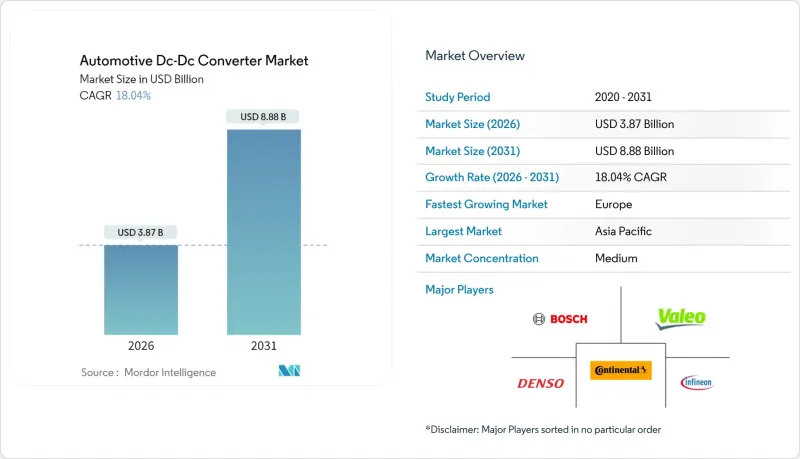
快速的电气化、向48V轻混架构的转变以及驱动电池从400V向800V的升级,都为这一显着增长提供了支撑。能够管理高压区和低压区之间能量流动的双向拓朴结构,构成了下一代电动平台的设计基础。诸如碳化硅(SiC)和氮化镓(GaN)等宽能带隙半导体不断提升功率密度和效率,从而能够製造更小更轻的转换器模组,并简化车辆封装要求。从区域来看,亚太地区凭藉中国的生产规模占据主导地位,而欧洲则由于严格的二氧化碳减排目标和碳中和政策,增长速度最快。竞争格局由全系统供应商和专业半导体製造商之间的合作所决定,这种合作不断突破性能极限,并加快了先进电力电子产品的上市速度。
全球汽车直流-直流转换器市场趋势及展望
纯电动车和插电式混合动力车产量快速成长
随着全球电动车生产计画的扩大,汽车製造商向800V动力传动系统转型,以缩短快速充电时间,因此对高效能转换器的需求也不断增长。特斯拉在其车队中采用48V配电系统,正是这种转变为简化布线和提高效率方向的体现。商用车製造商也在效仿,例如马克卡车整合了多区域转换器,在不牺牲可靠性的前提下,为动力系统、辅助设备和驾驶员舒适性供电。双向拓扑结构实现了日常的车网互动(V2G),将停放的车辆转化为能源资产。这进一步强化了对先进转换器大规模生产的需求。扩大生产规模将进一步降低单一晶片的成本,从而促进先进技术的普及应用。比亚迪2024年的销售预测表明,产量的增加直接提升了各个价位车型对转换器的需求。
全球趋势趋向强制性48V轻度混合动力
欧洲的二氧化碳排放最后期限和北美日益严格的CAFE标准正迫使汽车製造商采用48V系统,以在不投资全面电气化的情况下逐步降低排放。欧洲汽车零件供应商协会(ACEA)预测,到2025年,48V架构将在新型轻度混合动力车中近乎普及。重型车辆领域也在效法。国际汽车製造商也正在推广类似技术,以保持在受监管市场的出口竞争力。基于ISO 21780的统一标准有助于跨平台实施,大幅缩短开发时间,并支援近期内转换器出货量的增加。
功率密度的温度控管限制
功率超过数千瓦的转换器会在硅元件和磁芯中产生高温,而传统的铝製散热器无法承受这种高温,尤其是在商用车底盘等空间有限的场所。 Belle Firth公司推出了一款液冷式4kW转换器,旨在解决重型设备运作週期中结温过高的问题。儘管SiC和GaN装置效率很高,但在400kHz的开关频率下仍会产生大量的热量,因此需要使用精密的冷却板或介质油通道进行散热。
细分市场分析
商用平台的发展速度将超过乘用车,2026年至2031年的复合年增长率将达到19.50%。到2025年,商用平台将占据汽车直流-直流转换器市场63.55%的份额。车队采购商正在透过降低燃油和维护成本来评估电动出行的回报,这加速了对坚固耐用型转换器的需求,这些转换器用于为辅助液压泵、升降机和空调系统供电。在政府对零排放卡车的支援下,预计到2031年,商用车直流-直流转换器市场规模将超过21.8亿美元。乘用车在销量方面仍将保持领先地位,预计到2025年,全球轻型汽车产量将超过8000万辆,每辆汽车将配备两到四个低功耗主导,用于资讯娱乐、照明和ADAS域控制器。
采用模式正在分化。乘用车製造商优先考虑48V轻混系统以满足车队平均排放目标,而卡车製造商则越来越多地直接采用高压纯电动车(BEV)和燃料电池电动车(FCEV),以应对都市区禁怠速区的要求。商用车的运作週期对冷却板和灌封材料提出了更高的要求,这为导热介面材料供应商带来了售后市场机会。车网互动(V2G)带来的收益吸引了物流营运商,他们整合固定电力容量用于夜间充电,进一步推动了双向转换器的出货量。
到2025年,纯电动车(BEV)将占据汽车直流-直流转换器市场73.12%的份额,因为所有纯电动车都需要至少一个高压转换器来为车载负载供电。然而,与轻度混合动力车出货量相关的汽车直流-直流转换器市场规模预计到2031年将以21.95%的复合年增长率成长,因为对成本敏感的细分市场会采用48V系统以避免充电基础设施的限制。双向拓朴结构将12V铅酸电池配件与48V锂电池组连接起来,这需要严格的电压调节精度来保护现有电子元件。插电式混合动力汽车在有购车补贴的市场中仍占有一席之地,但其转换器的销售量和额定功率介于轻度混合动力车和纯电动车之间。
燃料电池电动车目前仍属于小众市场,但每个燃料电池堆都会输出高压直流电,需要将其降至 12V,有时还需要升压以负载平衡。这促使转换器供应商开发出具有可互换磁性元件的模组化基板,以适应 350V、450V 和 800V 的母线电压,而无需重新设计控制 ASIC,从而缩短了整个推进系统变体的设计时间。
到2025年,隔离式转换器将占据54.62%的市场份额,这主要得益于驱动电路和辅助电路之间电气隔离的安全要求。同时,双向转换器将以22.05%的复合年增长率成长,随着车载(V2L)和车网(V2G)功能从高阶配置走向主流配置,其市占率也将持续扩大。这些产品采用两相交错拓扑结构,以确保平稳的双向功率流动,并需要数位控制迴路和即时诊断功能。非隔离式升降压转换器则是面向成本受限的轻混车型,这类车型的电池组电压低于60V,且爬电距离易于控制。
采用碳化硅 (SiC) 可将开关频率提升至 200 kHz 以上,同时减少变压器匝数和磁铁体积。 Wolfspeed 的 22 kW 参考产品展示了 SiC 模组如何实现更小的双向封装并提高峰值效率。先进的韧体使转换器能够充当资料节点,透过 CAN-FD 总线报告效率、温度和故障代码,从而为预测性维护服务奠定基础。
区域分析
亚太地区将引领全球汽车直流-直流转换器市场,到2025年将占据46.92%的市场份额,这主要得益于中国汽车生产规模和日本的电力电子技术。预计中国电动车销量将从2024年的690万辆激增至2025年的1,100万辆,将显着增加乘用车和轻型商用车对转换器的需求。 TDK等日本公司提供的紧凑型平面磁性元件高度降低30%,进一步巩固了该地区的技术创新优势。韩国汽车製造商(OEM)根据政府蓝图,计划在2030年实现450万辆零排放汽车的目标,这推动了韩国国内半导体生态系统对用于汽车量产的碳化硅(SiC)晶圆进行认证。儘管补贴逐步减少,但由于城市级零排放区的建设以及对欧洲的出口需求,预计国内需求仍将保持强劲。
预计到2031年,欧洲将以21.24%的复合年增长率实现最快增长,这主要得益于2030年将车辆二氧化碳排放标准收紧至57.5克/公里。德国供应商正与欧盟合作设计不含稀土元素的电机,并结合针对800V电压优化的转换器,专注于提升系统整体效率。欧盟替代燃料基础设施法规要求使用双向充电器以支援电网服务通讯协定,这进一步增加了转换器规格的复杂性。法雷奥(Valeo)和罗姆(ROHM)等合作伙伴将热模拟软体和碳化硅(SiC)晶圆技术结合,加速产业化进程。基于联合国欧洲经济委员会(UNECE)R-100标准的标准化测试程序简化了转换器的跨境认证,使新参与企业更容易进入市场。
其他福利:
- Excel格式的市场预测(ME)表
- 3个月的分析师支持
目录
第一章 引言
- 研究假设和市场定义
- 调查范围
第二章调查方法
第三章执行摘要
第四章 市场情势
- 市场概览
- 市场驱动因素
- 纯电动车和插电式混合动力车产量快速成长
- 全球趋势:强制推行48V轻混动力系统
- 降低硅/镓奈米带元件的成本
- 向分区电气和电子架构过渡
- 车辆到负载 (V2L) 电源功能
- 商用电动车对电动电能输出装置(ePTO)的需求
- 市场限制
- 功率密度温度控管限制
- 汽车级被动元件供不应求
- 网路安全认证开销
- 400kHz电磁干扰(EMI)相容性
- 价值/供应链分析
- 监管环境
- 技术展望
- 波特五力模型
- 新进入者的威胁
- 买方的议价能力
- 供应商的议价能力
- 替代品的威胁
- 竞争对手之间的竞争
第五章 市场规模与成长预测
- 按车辆类型
- 搭乘用车
- 商用车辆
- 依推进类型
- 电池式电动车(BEV)
- 插电式混合动力汽车(PHEV)
- 燃料电池电动车(FCEV)
- 轻度混合动力(48V MHEV)
- 依产品类型
- 独立转换器
- 非隔离式转换器
- 双向转换器
- 按输入电压范围
- 低于40伏
- 40~70 V
- 70伏特或以上
- 按输出功率和额定功率
- 小于3千瓦
- 3~6 kW
- 6千瓦或以上
- 透过使用
- 12V辅助负载
- 48V/12V双向系统
- 高压牵引支撑
- ADAS和资讯娱乐系统
- 温度控管系统
- 最终用户
- 原厂配套
- 售后改装
- 按地区
- 北美洲
- 我们
- 加拿大
- 北美其他地区
- 南美洲
- 巴西
- 阿根廷
- 南美洲其他地区
- 欧洲
- 德国
- 英国
- 法国
- 义大利
- 俄罗斯
- 其他欧洲
- 亚太地区
- 中国
- 日本
- 印度
- 韩国
- 亚太其他地区
- 中东和非洲
- 阿拉伯聯合大公国
- 沙乌地阿拉伯
- 土耳其
- 埃及
- 南非
- 其他中东和非洲地区
- 北美洲
第六章 竞争情势
- 市场集中度
- 策略趋势
- 市占率分析
- 公司简介
- Bosch
- Denso
- Valeo
- Continental
- Infineon Technologies
- BorgWarner
- Toyota Industries
- TDK
- Panasonic
- Hella
- Aptiv
- Alps Alpine
- Marelli
- Hyundai Mobis
- Vicor
- Delta Electronics
- ZF Friedrichshafen
- onsemi
- Texas Instruments
- Littelfuse
第七章 市场机会与未来展望
The automotive DC-DC converter market is expected to grow from USD 3.28 billion in 2025 to USD 3.87 billion in 2026 and is forecast to reach USD 8.88 billion by 2031 at 18.04% CAGR over 2026-2031.
Rapid electrification, the shift to 48 V mild-hybrid architectures, and the move from 400 V to 800 V traction batteries underpin this substantial expansion. Bidirectional topologies that manage energy flow between high- and low-voltage domains now form the design baseline for next-generation electric platforms. Wide-bandgap semiconductors such as SiC and GaN continue to raise power density and efficiency, enabling smaller, lighter converter modules that simplify vehicle packaging requirements. Regionally, Asia-Pacific dominates due to Chinese production scale, while Europe grows fastest due to stringent CO2 targets and carbon-neutral mandates. Competitive dynamics are defined by collaboration between full-system suppliers and specialized semiconductor houses, pushing the performance envelope and accelerating time-to-market for advanced power electronics.
Global Automotive Dc-Dc Converter Market Trends and Insights
Surging BEV and PHEV Production
Global electric-vehicle build plans amplify demand for high-efficiency converters as automakers migrate to 800 V powertrains that shorten fast-charging times. Tesla's adoption of 48 V power distribution across its portfolio validates the shift toward slimmed-down wiring and better efficiency . Commercial players follow suit; Mack Trucks integrates multi-zone converters to supply traction, auxiliaries, and driver comforts without sacrificing reliability. Bidirectional topologies enable routine vehicle-to-grid export, turning parked fleets into energy assets and reinforcing volume pull for sophisticated converter designs. Higher production scale further drives down per-unit silicon cost, easing the pathway for advanced technology diffusion into mass-market segments. BYD's surge past Tesla in 2024 revenue underlines how production volume directly multiplies converter demand across vehicle price tiers.
Global 48 V Mild-Hybrid Mandates
CO2 compliance deadlines in Europe and tightening Corporate Average Fuel Economy targets in North America push OEMs to deploy 48 V systems that incrementally cut emissions without full electrification investment. The European Association of Automotive Suppliers projects the near-ubiquity of 48 V architectures in new mild-hybrid models by 2025. Heavy-duty segments follow: Eaton's 40-amp 48 V converters already power start-stop and e-PTO features in Class-8 trucks . Korean automakers are scaling similar technology to maintain export competitiveness in regulated markets. Harmonized standards under ISO 21780 ease cross-platform implementation, slashing development timelines and bolstering near-term converter shipments.
Thermal-Management Limits on Power Density
Converters exceeding a few kilowatts face silicon and magnetic core temperatures that can outpace traditional aluminum heat-sink solutions, especially in confined commercial-vehicle chassis. Bel Fuse introduced liquid-cooled 4 kW units to cope with junction-temperature constraints in heavy-equipment duty cycles. SiC and GaN devices, though efficient, still dissipate enough heat at 400 kHz switching to require advanced cooling plates or dielectric oil channels.
Other drivers and restraints analyzed in the detailed report include:
- Lower SiC/GaN Device Costs
- Vehicle-to-Load Functionality
- Automotive-Grade Passive-Component Shortages
For complete list of drivers and restraints, kindly check the Table Of Contents.
Segment Analysis
Commercial platforms recorded a 19.50% CAGR between 2026 and 2031, outpacing passenger models, holding 63.55% automotive DC-DC converter market share in 2025. Fleet buyers calculate payback on e-mobility through reduced fuel and maintenance bills, accelerating demand for rugged converters that power auxiliary hydraulic pumps, lifts, and climate control. The automotive DC-DC converter market size for commercial vehicles is projected to cross USD 2.18 billion by 2031, supported by state incentives for zero-emission trucks. Passenger cars retain volume leadership due to global light-vehicle output topping 80 million units in 2025, each embedding two to four low-power converters for infotainment, lighting, and ADAS domain controllers.
Adoption patterns differ: passenger car OEMs favor 48 V mild-hybrid systems to hit fleet-average emission targets, whereas truck makers leapfrog directly to high-voltage battery electrics or fuel cells to comply with urban no-idle zones. Commercial duty cycles also intensify stress on cooling plates and potting compounds, opening after-sales opportunities for thermal-interface material suppliers. Vehicle-to-grid revenue streams attract logistics operators that aggregate stationary power capacity during nightly depot charging, further lifting bidirectional converter shipments.
Battery electrics captured 73.12% of the automotive DC-DC converter market share in 2025 because every BEV needs at least one high-voltage converter for cabin loads. However, the automotive DC-DC converter market size tied to mild-hybrid shipments will post a 21.95% CAGR through 2031 as cost-sensitive segments adopt 48 V systems to skirt charging-infrastructure constraints. Bidirectional topologies bridge 12 V lead-acid accessories and 48 V lithium packs, demanding tight voltage-regulation accuracy to protect legacy electronics. Plug-in hybrids maintain relevance in markets with purchase incentives, but their converter count and rating sit between mild-hybrid and BEV extremes.
Fuel-cell electrics remain niche, yet each stack feeds high-voltage DC that must be down-converted to 12 V and sometimes boosted for battery load-leveling. Converter suppliers, therefore, develop modular boards that swap magnetics to suit 350 V, 450 V, or 800 V buses without re-spinning the control ASICs, compressing engineering timelines across propulsion variants.
Isolated converters held a 54.62% share in 2025, assured by safety requirements that galvanically separate traction and accessory circuits. Bidirectional units, however, will log a 22.05% CAGR, capturing incremental share as V2L and V2G features shift from premium to mainstream trims. These products integrate dual-phase interleaved topologies for smooth power flow in both directions, demanding digital control loops and real-time diagnostics. Non-isolated buck-boost stages target cost-constrained mild-hybrids where pack voltage stays below 60 V, easing creepage clearances.
Silicon carbide raises switching frequency above 200 kHz, trimming transformer turns and magnetic volume. Wolfspeed's 22 kW reference showcases how SiC modules shrink the bidirectional package, boosting peak efficiency. Firmware sophistication turns converters into data nodes that report efficiency, temperature, and fault codes over CAN-FD, laying the groundwork for predictive maintenance services.
The Automotive DC-DC Converter Market Report is Segmented by Vehicle Type (Passenger Vehicle, and More), Propulsion Type (BEV, and More), Product Type (Isolated Converter, and More), Input-Voltage Range (Below 40V, and More), Output-Power Rating (Below 3kW, and More), Application (12V Auxiliary Loads, and More), End-User (OEM Factory-Fit and More), and Geography. The Market Forecasts are Provided in Terms of Value (USD).
Geography Analysis
Asia-Pacific leads the automotive DC-DC converter market with a 46.92% revenue share in 2025, driven by China's vehicle manufacturing scale and Japan's power-electronics expertise. China's electric-vehicle sales jumped from 6.9 million units in 2024 to an expected 11 million units by 2025, multiplying converter content across passenger and light-commercial segments. Japanese firms such as TDK present miniaturized planar magnetics that cut height by 30%, reinforcing the region's innovation edge. South Korean OEMs target 4.5 million zero-emission vehicles by 2030 under government roadmaps, spurring local semiconductor ecosystems to qualify SiC wafers for automotive volume. Though subsidies taper, domestic demand remains buoyed by city-level zero-emission zones and export pull to Europe.
Europe records the fastest 21.24% CAGR through 2031 on the back of fleet CO2 caps tightening to 57.5 g/km 2030. German suppliers co-design rare-earth-free e-motors with converters optimized for 800 V operation, emphasizing full-system efficiency. The EU Alternative Fuels Infrastructure Regulation requires bidirectional chargers to support grid-service protocols, elevating converter specification complexity. Partnerships like Valeo-ROHM bring together thermal-simulation software and SiC wafer leadership to accelerate industrialization schedules . Standardized test procedures under UNECE R-100 streamline cross-border homologation for converters, easing market access for new entrants.
- Bosch
- Denso
- Valeo
- Continental
- Infineon Technologies
- BorgWarner
- Toyota Industries
- TDK
- Panasonic
- Hella
- Aptiv
- Alps Alpine
- Marelli
- Hyundai Mobis
- Vicor
- Delta Electronics
- ZF Friedrichshafen
- onsemi
- Texas Instruments
- Littelfuse
Additional Benefits:
- The market estimate (ME) sheet in Excel format
- 3 months of analyst support
TABLE OF CONTENTS
1 Introduction
- 1.1 Study Assumptions and Market Definition
- 1.2 Scope of the Study
2 Research Methodology
3 Executive Summary
4 Market Landscape
- 4.1 Market Overview
- 4.2 Market Drivers
- 4.2.1 Surging BEV and PHEV Production
- 4.2.2 Global 48 V Mild-Hybrid Mandates
- 4.2.3 Lower Sic / Gan Device Costs
- 4.2.4 Shift To Zonal E/E Architectures.
- 4.2.5 Vehicle-To-Load (V2L) Functionality
- 4.2.6 On-Board E-Power (ePTO) Demand in Commercial EVs
- 4.3 Market Restraints
- 4.3.1 Thermal-Management Limits on Power Density
- 4.3.2 Automotive-Grade Passive-Component Shortages
- 4.3.3 Cyber-Security Homologation Overheads
- 4.3.4 Electromagnetic-Interference (EMI) Compliance At 400 Khz
- 4.4 Value / Supply-Chain Analysis
- 4.5 Regulatory Landscape
- 4.6 Technological Outlook
- 4.7 Porter's Five Forces
- 4.7.1 Threat of New Entrants
- 4.7.2 Bargaining Power of Buyers
- 4.7.3 Bargaining Power of Suppliers
- 4.7.4 Threat of Substitutes
- 4.7.5 Intensity of Competitive Rivalry
5 Market Size and Growth Forecasts
- 5.1 By Vehicle Type
- 5.1.1 Passenger Vehicle
- 5.1.2 Commercial Vehicle
- 5.2 By Propulsion Type
- 5.2.1 Battery Electric Vehicle (BEV)
- 5.2.2 Plug-in Hybrid EV (PHEV)
- 5.2.3 Fuel-Cell EV (FCEV)
- 5.2.4 Mild-Hybrid (48 V MHEV)
- 5.3 By Product Type
- 5.3.1 Isolated Converter
- 5.3.2 Non-Isolated Converter
- 5.3.3 Bi-directional Converter
- 5.4 By Input-Voltage Range
- 5.4.1 Below 40 V
- 5.4.2 40 - 70 V
- 5.4.3 Above 70 V
- 5.5 By Output-Power Rating
- 5.5.1 Below 3 kW
- 5.5.2 3 - 6 kW
- 5.5.3 Above 6 kW
- 5.6 By Application
- 5.6.1 12 V Auxiliary Loads
- 5.6.2 48 V/12 V Bidirectional Systems
- 5.6.3 High-Voltage Traction Support
- 5.6.4 ADAS and Infotainment Power
- 5.6.5 Thermal-Management Systems
- 5.7 By End-User
- 5.7.1 OEM Factory-Fit
- 5.7.2 Aftermarket Retrofit
- 5.8 By Geography
- 5.8.1 North America
- 5.8.1.1 United States
- 5.8.1.2 Canada
- 5.8.1.3 Rest of North America
- 5.8.2 South America
- 5.8.2.1 Brazil
- 5.8.2.2 Argentina
- 5.8.2.3 Rest of South America
- 5.8.3 Europe
- 5.8.3.1 Germany
- 5.8.3.2 United Kingdom
- 5.8.3.3 France
- 5.8.3.4 Italy
- 5.8.3.5 Russia
- 5.8.3.6 Rest of Europe
- 5.8.4 Asia-Pacific
- 5.8.4.1 China
- 5.8.4.2 Japan
- 5.8.4.3 India
- 5.8.4.4 South Korea
- 5.8.4.5 Rest of Asia-Pacific
- 5.8.5 Middle-East and Africa
- 5.8.5.1 United Arab Emirates
- 5.8.5.2 Saudi Arabia
- 5.8.5.3 Turkey
- 5.8.5.4 Egypt
- 5.8.5.5 South Africa
- 5.8.5.6 Rest of Middle-East and Africa
- 5.8.1 North America
6 Competitive Landscape
- 6.1 Market Concentration
- 6.2 Strategic Moves
- 6.3 Market Share Analysis
- 6.4 Company Profiles (Includes Global level Overview, Market level overview, Core Segments, Financials as available, Strategic Information, Market Rank/Share for key companies, Products & Services, and Recent Developments)
- 6.4.1 Bosch
- 6.4.2 Denso
- 6.4.3 Valeo
- 6.4.4 Continental
- 6.4.5 Infineon Technologies
- 6.4.6 BorgWarner
- 6.4.7 Toyota Industries
- 6.4.8 TDK
- 6.4.9 Panasonic
- 6.4.10 Hella
- 6.4.11 Aptiv
- 6.4.12 Alps Alpine
- 6.4.13 Marelli
- 6.4.14 Hyundai Mobis
- 6.4.15 Vicor
- 6.4.16 Delta Electronics
- 6.4.17 ZF Friedrichshafen
- 6.4.18 onsemi
- 6.4.19 Texas Instruments
- 6.4.20 Littelfuse
7 Market Opportunities & Future Outlook

 AC-DC转换器市场:2026-2032年全球市场预测(依输出功率、输入电压、安装类型、拓朴结构及最终用户划分)
 全球汽车直流-直流转换器市场报告(2026 年)直流高压热熔断器市场(按额定电压、额定电流、绝缘类型、安装类型、安装环境、应用和最终用户划分)—2026-2032年全球预测
 汽车类比数位转换器 (ADC) 市场规模、份额和成长分析(按产品类型、解析度、取样率、介面、应用、最终用户和地区划分)—2026-2033 年产业预测
 电动车高压 DC-DC 转换器:市场占有率分析、行业趋势和统计、成长预测(2025-2030 年)
 汽车直流-直流转换器市场:按直流-直流转换器类型、按最终用户、按系统、按车辆类型、按地区
 汽车数位讯号控制器市场报告:2030 年趋势、预测与竞争分析
 汽车DC-DC转换器市场{产品类型:隔离型、非隔离型;安装类型:底盘安装、SMD/SMT、DIN导轨安装等; } - 全球产业分析、规模、份额、成长、趋势和预测,2024-2034