


 |
市场调查报告书
商品编码
1937333
陶瓷膜:市场占有率分析、产业趋势与统计、成长预测(2026-2031)Ceramic Membranes - Market Share Analysis, Industry Trends & Statistics, Growth Forecasts (2026 - 2031) |
||||||

※ 本网页内容可能与最新版本有所差异。详细情况请与我们联繫。
2025年陶瓷膜市值为81.3亿美元,预计到2031年将达到134.7亿美元,而2026年为88.4亿美元。
预计在预测期(2026-2031 年)内,复合年增长率将达到 8.78%。
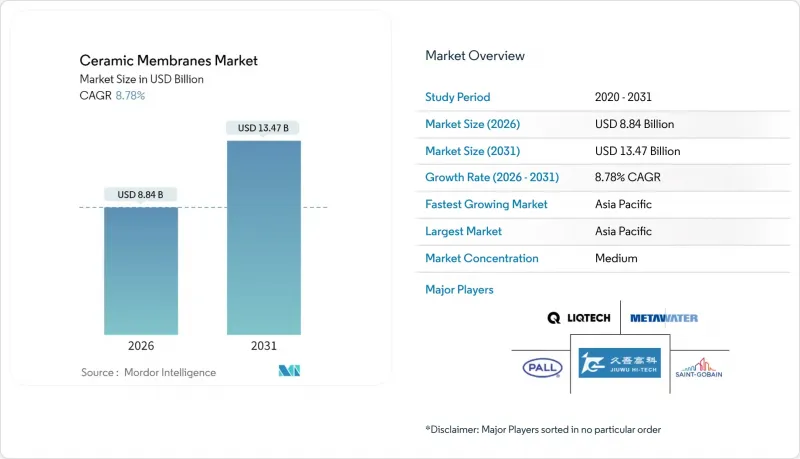
这一成长反映了工业水处理、食品加工和聚合物材料性能不足的严苛製程分离领域对高效过滤解决方案的快速需求。限制废水污染物排放的监管要求、不断上涨的能源价格促使低压运行,以及亚太地区基础设施建设支出的成长,都在推动产业结构向长寿命陶瓷装置转变。竞争的焦点在于製造流程的计划,证明了该技术的扩充性,并证实市政营运商已开始将陶瓷系统视为面向未来的资产。
全球陶瓷膜市场趋势及展望
对水和污水处理基础设施的需求不断增长
世界各地的供水事业正在用陶瓷组件替换老旧的过滤设备,这些陶瓷组件即使在严苛的清洗条件和原水水质波动的情况下也能保持水流稳定。中国和印度的国家奖励策略已拨款数十亿美元用于先进的水处理和再利用技术,而美国的《基础设施投资与就业法案》也优先考虑符合美国环保署(EPA)膜过滤指南的污染物去除技术。这些资金的涌入使供水事业更有信心选择价格较高的陶瓷组件。工程、采购和施工(EPC)承包商越来越多地预先指定使用碳化硅(SiC)或氧化铝撬装组件,以应对预计从2027年起实施的更严格的排放和微量污染物法规。系统整合商也指出,陶瓷元件可以与节省空间的薄膜生物反应器(MBR)无缝集成,从而释放土地资源有限的城市水厂的占地面积。
全球更严格的工业污水法规
根据美国环保署 (EPA) 40 CFR 法规和欧盟工业排放指令,工业业者面临日益严厉的处罚。这两项法规均将高选择性薄膜指定为处理难处理污水的最佳可行可用技术(BAT)。製药厂必须在排放前去除溶剂残留物和内分泌干扰物,而石化厂则面临含油生产废水快速堵塞聚合物纤维的挑战。陶瓷装置在反覆接触腐蚀性或氧化性清洁剂后仍能保持结构完整,从而减少了可能危及许可证合规性的非计划性停机时间。监管的确定性已将采购决策从可自由选择的升级转变为纳入定期工厂检修的风险缓解措施。由于更换期限明确,供应商可以拥有可预测的需求管道,并据此规划工厂使用率。
高昂的资本和营运成本
与同等容量的聚合物系统相比,陶瓷设备的成本可能是其两到三倍,这使得资金筹措有限的地区难以实施。小规模市政当局通常依赖最低竞标补贴机制,而这种机制并未考虑全生命週期成本。对于投资回收期严格限制在三年以内的工业企业而言,儘管陶瓷设备具有潜在的节能效果,但由于财务部门低估了避免停机带来的收益,他们可能会搁置陶瓷设备的安装计划。此外,由于需要储备备件(例如专用高压垫片和金属外壳),营运成本也会增加。然而,随着製程自动化和全球生产规模的扩大,陶瓷设备的价格将持续下降,预计从2027年起,这些限制将得到缓解。
细分市场分析
到2025年,氧化铝基膜将占据陶瓷膜市场44.12%的份额,这得益于成熟的窑炉生产计划、丰富的原材料以及在市政和食品应用微过滤的成功案例。供应商利用现有的隧道窑和挤出机来维持有利的成本结构,即使在能源价格上涨时期也是如此。这种规模优势促进了价格竞争,并推动陶瓷膜市场持续向对成本敏感的细分市场扩张。氧化铝的中性表面化学性质使其能够采用后处理涂层来调节选择性,而无需改变基材结构。同时,儘管二氧化钛薄膜的市场规模较小,但其复合年增长率却高达9.80%,成为成长最快的薄膜。二氧化钛膜的光催化和高通量特性使其非常适合去除新兴目标物质,例如药物和内分泌干扰物。
二氧化钛细分市场受益于研发进展,透过掺杂配方降低了煅烧温度,从而减少了生产过程中的能源投入和碳排放强度。碳化硅目前应用尚不广泛,但在油气生产水处理领域的需求量却高达两位数,因为该领域pH值波动和磨蚀性固态会损坏其他材料。氧化锆和二氧化硅变体则适用于一些特殊分离应用,例如高温苛性染料回收和低压食品澄清。
陶瓷膜市场报告按材料类型(氧化铝、二氧化硅、二氧化钛、氧化锆、碳化硅及其他)、终端用户产业(水及污水处理、食品饮料、化学、製药及其他)和地区(亚太、北美、欧洲、南美、中东和非洲)进行细分。市场预测以美元以金额为准。
区域分析
预计到2025年,亚太地区将占据陶瓷膜市场52.98%的收入份额,并在2031年之前保持10.02%的复合年增长率。中国的五年计画拨款940亿美元用于升级改造水资源再利用设施,将推动工业园区对氧化铝和碳化硅管材的批量采购。印度特伦甘纳邦和古吉拉突邦的製药产业丛集正在向陶瓷超过滤转型,以满足日益严格的零排放法规。同时,一个日本财团正在政府支持的先进材料计画下,致力于改善低缺陷碳化硅支撑体。
北美仍然是领先的部署区域,这主要得益于美国环保署 (EPA) 的严格执法以及成熟的油气生产水处理市场。德克萨斯州的页岩油气作业正在试验使用碳化硅膜进行耐盐盐水净化,据报道,该技术提高了处理能力,并减少了卡车运输量和深井注入量。美国也正在率先采用饮用水水资源再利用,加州的公共产业运作先进的陶瓷基水处理厂,以确保抗旱供水。
欧洲的份额既反映了其工业传统,也反映了其强有力的环保政策。德国、法国和荷兰正在食品级海水淡化厂进行改造,加装二氧化钛装置,与传统的螺旋缠绕式系统相比,可将苛性钠用量减少一半。中东和非洲地区对用于逆渗透的陶瓷海水预处理技术越来越感兴趣,尤其是在极端温度会对聚合物滤芯的耐久性构成挑战的地区。阿联酋的一条试点生产线已证明,该技术能够降低化学品消耗并延长清洗週期,为波湾合作理事会成员国从2026年起建设兆瓦级海水淡化厂铺平了道路。
其他福利:
- Excel格式的市场预测(ME)表
- 3个月的分析师支持
目录
第一章 引言
- 研究假设和市场定义
- 调查范围
第二章调查方法
第三章执行摘要
第四章 市场情势
- 市场概览
- 市场驱动因素
- 对用水和污水处理基础设施的需求不断增长
- 全球更严格的工业污水法规
- 与聚合物薄膜相比,使用寿命更长,生命週期成本更低。
- 扩大乳製品和饮料行业的蛋白质浓缩工艺
- PVDF膜的相关监管趋势推动了陶瓷膜的采用。
- 市场限制
- 高昂的资本和营运成本
- 低压聚合物替代品在低TDS应用中日益普及
- 地方政府供水事业缺乏操作人员专业技能
- 价值链分析
- 波特五力模型
- 供应商的议价能力
- 买方的议价能力
- 新进入者的威胁
- 替代品的威胁
- 竞争程度
第五章 市场规模与成长预测
- 依材料类型
- 氧化铝
- 二氧化硅
- 提泰妮娅
- 氧化锆
- 碳化硅
- 其他材质(玻璃材质、氧化镁、碳、玻璃陶瓷复合材料等)
- 按最终用户行业划分
- 水和污水处理
- 食品/饮料
- 化工
- 製药
- 其他(生物技术、纺织、石油化工等)
- 按地区
- 亚太地区
- 中国
- 印度
- 日本
- 韩国
- 马来西亚
- 泰国
- 印尼
- 越南
- 亚太其他地区
- 北美洲
- 我们
- 加拿大
- 墨西哥
- 欧洲
- 德国
- 英国
- 法国
- 义大利
- 西班牙
- 北欧国家
- 土耳其
- 俄罗斯
- 其他欧洲地区
- 南美洲
- 巴西
- 阿根廷
- 哥伦比亚
- 其他南美洲
- 中东和非洲
- 沙乌地阿拉伯
- 卡达
- 阿拉伯聯合大公国
- 奈及利亚
- 埃及
- 南非
- 其他中东和非洲地区
- 亚太地区
第六章 竞争情势
- 市场集中度
- 策略趋势
- 市占率(%)/排名分析
- 公司简介
- ALSYS
- atech innovations GmbH
- Ceraflo Pte Ltd
- GEA Group Aktiengesellschaft
- JIUWU HI-TECH
- Kovalus Separation Solutions
- LiqTech Holding A/S
- Membracon
- METAWATER. CO. LTD
- Nanostone
- Pall Corporation
- Qua Group LLC
- Saint-Gobain
- Sterlitech Corporation
- TAMI Industries
第七章 市场机会与未来展望
The Ceramic Membranes Market was valued at USD 8.13 billion in 2025 and estimated to grow from USD 8.84 billion in 2026 to reach USD 13.47 billion by 2031, at a CAGR of 8.78% during the forecast period (2026-2031).
This expansion reflects rapid uptake of robust filtration solutions in industrial water treatment, food processing, and harsh-process separation where polymeric materials underperform. Regulatory mandates that limit effluent contaminants, rising energy prices that reward low-pressure operation, and expanding infrastructure spending in Asia-Pacific collectively reinforce a secular shift toward long-life ceramic units. Competitive activity centers on manufacturing innovations that trim sintering temperatures, refine pore-size control, and embed photocatalytic surfaces, allowing suppliers to differentiate on total cost of ownership rather than headline capital outlay. Demonstration projects such as Singapore's 65 million-liter-per-day installation highlight technical scalability and underscore how municipal utilities now view ceramic systems as future-proof assets.
Global Ceramic Membranes Market Trends and Insights
Rising Demand for Water and Wastewater Treatment Infrastructure
Utilities worldwide are replacing aging filtration assets with ceramic designs that maintain flux under aggressive cleaning and variable feedwater quality. National stimulus programs in China and India allocate multibillion-dollar budgets to advanced treatment and reuse, while the U.S. Infrastructure Investment and Jobs Act prioritizes contaminant removal technologies aligned with EPA membrane guidance. These capital flows give utilities confidence to select ceramic modules despite higher ticket prices. Engineering-, procurement-, and construction-contractors increasingly pre-specify silicon carbide or alumina skids as a hedge against tightening discharge limits and micro-pollutant rules expected after 2027. Integrators also note that ceramic elements integrate smoothly with low-footprint membrane bioreactors, freeing floor space in land-constrained urban plants.
Stringent Industrial Effluent Regulations Worldwide
Industrial operators face rising penalties under EPA 40 CFR rules and the EU Industrial Emissions Directive, both of which identify high-selectivity membranes as best available technology for difficult waste streams. Pharmaceutical facilities must remove solvent traces and endocrine-disrupting compounds before discharge, while petrochemical sites contend with oil-laden produced water that quickly blinds polymeric fibers. Ceramic units remain structurally intact after repeated exposure to caustic or oxidizing cleaners, cutting unplanned downtime that would otherwise jeopardize permit compliance. Regulatory certainty has therefore shifted purchasing decisions from discretionary upgrades to risk-mitigation essentials that slot into cyclical plant turnarounds. Because replacement deadlines are codified, vendors enjoy a predictable demand pipeline and can plan factory utilization accordingly.
High Capital and Operating Costs
Ceramic equipment can cost two to three times as much as polymeric systems of equivalent capacity, discouraging adoption where funding windows are narrow. Smaller municipalities often rely on grant cycles that favor lowest-bid awards, which seldom account for lifecycle economics. Industrial plants with tight payback criteria under three years may shelve ceramic proposals despite potential energy savings because finance teams undervalue avoided downtime. Operating costs also climb when spare parts inventories must include specialty gaskets and metal housings rated for higher pressures. However, steady price erosion from process automation and increasing global production scale is expected to soften this restraint after 2027.
Other drivers and restraints analyzed in the detailed report include:
- Longer Service-Life and Lower Lifecycle Cost vs. Polymeric Membranes
- Expansion of Dairy and Beverage Protein-Concentration Processes
- Prevalence of Low-Pressure Polymeric Alternatives in Low-TDS Uses
For complete list of drivers and restraints, kindly check the Table Of Contents.
Segment Analysis
Alumina elements held 44.12% of the ceramic membranes market share in 2025 due to mature kiln schedules, abundant raw materials, and proven performance in microfiltration of municipal and food streams. Suppliers exploit existing tunnel kilns and extruders, driving cost positions that remain favorable even as energy prices climb. Such a scale underpins price competition that keeps the ceramic membranes market expanding into cost-sensitive verticals. Alumina's neutral surface chemistry also supports post-treatment coatings that tailor selectivity without altering base structure. In contrast, titania membranes, while accounting for a smaller revenue base, posted the fastest 9.80% CAGR because their photocatalytic and high-flux attributes align with emerging removal targets such as pharmaceuticals and endocrine disruptors.
The titania sub-segment benefits from research and development breakthroughs that lower firing temperatures through doped formulations, trimming energy input and shrinking carbon intensity of production. Silicon carbide options, though niche today, show double-digit demand from oil-and-gas produced-water treatment where pH swings and abrasive solids destroy other materials. Zirconia and silica variants satisfy specialty separations including hot caustic dye recovery and low-pressure food clarification.
The Ceramic Membranes Report is Segmented by Material Type (Alumina, Silica, Titania, Zirconium Oxide, Silicon Carbide, and Others), End-User Industry (Water and Wastewater Treatment, Food and Beverage, Chemical Industry, Pharmaceutical, and Others), and Geography (Asia-Pacific, North America, Europe, South America, and Middle-East and Africa). The Market Forecasts are Provided in Terms of Value (USD).
Geography Analysis
Asia-Pacific dominated the ceramic membranes market with 52.98% revenue share in 2025 and is projected to sustain a 10.02% CAGR through 2031. China's Five-Year Plan earmarks USD 94 billion for water-reuse upgrades, unlocking bulk purchases of alumina and silicon carbide tubes for industrial parks. Indian pharmaceutical clusters in Telangana and Gujarat switch to ceramic ultrafiltration to meet tightened zero-liquid-discharge mandates, while Japanese consortia refine low-defect silicon carbide supports under government-backed advanced-materials programs.
North America remains a key adopter owing to EPA enforcement vigor and a mature oil-and-gas produced-water treatment market. Texas shale operations trial silicon carbide membranes for salt-tolerant brine polishing, reporting throughput gains that reduce trucking and deep-well-injection volumes. The United States also hosts early adopters of potable reuse, with California utilities commissioning ceramic-based advanced treatment trains to secure a drought-resilient supply.
Europe's share reflects both industrial heritage and strong environmental policy alignment. Germany, France, and the Netherlands retrofit food-grade plants with titania units that halve caustic usage compared with legacy spiral-wound systems. The Middle East and Africa register growing interest in ceramic seawater pretreatment for reverse-osmosis desalination, especially where temperature extremes challenge polymeric cartridge endurance. Pilot lines in the United Arab Emirates have demonstrated lower chemical consumption and longer cleaning intervals, paving the way for multi-megawatt desal buildouts in the Gulf Cooperation Council states post-2026.
- ALSYS
- atech innovations GmbH
- Ceraflo Pte Ltd
- GEA Group Aktiengesellschaft
- JIUWU HI-TECH
- Kovalus Separation Solutions
- LiqTech Holding A/S
- Membracon
- METAWATER. CO. LTD
- Nanostone
- Pall Corporation
- Qua Group LLC
- Saint-Gobain
- Sterlitech Corporation
- TAMI Industries
Additional Benefits:
- The market estimate (ME) sheet in Excel format
- 3 months of analyst support
TABLE OF CONTENTS
1 Introduction
- 1.1 Study Assumptions and Market Definition
- 1.2 Scope of the Study
2 Research Methodology
3 Executive Summary
4 Market Landscape
- 4.1 Market Overview
- 4.2 Market Drivers
- 4.2.1 Rising Demand for Water and Wastewater Treatment Infrastructure
- 4.2.2 Stringent Industrial Effluent Regulations Worldwide
- 4.2.3 Longer Service-Life and Lower Lifecycle Cost Vs. Polymeric Membranes
- 4.2.4 Expansion of Dairy and Beverage Protein-Concentration Processes
- 4.2.5 Pending PVDF-Based Membrane Restrictions Driving Ceramic Adoption
- 4.3 Market Restraints
- 4.3.1 High Capital and Operating Costs
- 4.3.2 Prevalence of Low-Pressure Polymeric Alternatives in Low-TDS Uses
- 4.3.3 Limited Operator Expertise at Municipal Utilities
- 4.4 Value Chain Analysis
- 4.5 Porter's Five Forces
- 4.5.1 Bargaining Power of Suppliers
- 4.5.2 Bargaining Power of Buyers
- 4.5.3 Threat of New Entrants
- 4.5.4 Threat of Substitutes
- 4.5.5 Degree of Competition
5 Market Size and Growth Forecasts (Value)
- 5.1 By Material Type
- 5.1.1 Alumina
- 5.1.2 Silica
- 5.1.3 Titania
- 5.1.4 Zirconium Oxide
- 5.1.5 Silicon Carbide
- 5.1.6 Others (Glassy Materials, Magnesia, carbon, Glass-Ceramic composites, etc.)
- 5.2 By End-user Industry
- 5.2.1 Water and Wastewater Treatment
- 5.2.2 Food and Beverage
- 5.2.3 Chemical Industry
- 5.2.4 Pharmaceutical
- 5.2.5 Others (Biotechnology, Textile, Petrochemical, etc.)
- 5.3 By Geography
- 5.3.1 Asia-Pacific
- 5.3.1.1 China
- 5.3.1.2 India
- 5.3.1.3 Japan
- 5.3.1.4 South Korea
- 5.3.1.5 Malaysia
- 5.3.1.6 Thailand
- 5.3.1.7 Indonesia
- 5.3.1.8 Vietnam
- 5.3.1.9 Rest of Asia-Pacific
- 5.3.2 North America
- 5.3.2.1 United States
- 5.3.2.2 Canada
- 5.3.2.3 Mexico
- 5.3.3 Europe
- 5.3.3.1 Germany
- 5.3.3.2 United Kingdom
- 5.3.3.3 France
- 5.3.3.4 Italy
- 5.3.3.5 Spain
- 5.3.3.6 NORDIC Countries
- 5.3.3.7 Turkey
- 5.3.3.8 Russia
- 5.3.3.9 Rest of Europe
- 5.3.4 South America
- 5.3.4.1 Brazil
- 5.3.4.2 Argentina
- 5.3.4.3 Colombia
- 5.3.4.4 Rest of South America
- 5.3.5 Middle-East and Africa
- 5.3.5.1 Saudi Arabia
- 5.3.5.2 Qatar
- 5.3.5.3 United Arab Emirates
- 5.3.5.4 Nigeria
- 5.3.5.5 Egypt
- 5.3.5.6 South Africa
- 5.3.5.7 Rest of Middle-East and Africa
- 5.3.1 Asia-Pacific
6 Competitive Landscape
- 6.1 Market Concentration
- 6.2 Strategic Moves
- 6.3 Market Share (%)/Ranking Analysis
- 6.4 Company Profiles (includes Global level Overview, Market level overview, Core Segments, Financials as available, Strategic Information, Market Rank/Share, Products and Services, Recent Developments)
- 6.4.1 ALSYS
- 6.4.2 atech innovations GmbH
- 6.4.3 Ceraflo Pte Ltd
- 6.4.4 GEA Group Aktiengesellschaft
- 6.4.5 JIUWU HI-TECH
- 6.4.6 Kovalus Separation Solutions
- 6.4.7 LiqTech Holding A/S
- 6.4.8 Membracon
- 6.4.9 METAWATER. CO. LTD
- 6.4.10 Nanostone
- 6.4.11 Pall Corporation
- 6.4.12 Qua Group LLC
- 6.4.13 Saint-Gobain
- 6.4.14 Sterlitech Corporation
- 6.4.15 TAMI Industries
7 Market Opportunities and Future Outlook
- 7.1 White-space and Unmet-need Assessment

 全球陶瓷膜市场规模、份额、趋势和成长分析报告(2026-2034)
 2026年全球陶瓷膜市场报告
 氧化铝基陶瓷膜市场按孔径、材料类型、製造流程、膜结构、应用和终端用户产业划分,全球预测,2026-2032年陶瓷膜检测设备市场(按设备类型、检测技术、膜材料、检测参数、应用和最终用户划分)—2026-2032年全球预测饮用水用陶瓷平板膜市场:按膜材料、孔径、流道结构、组件类型、运行模式、应用和最终用户划分,全球预测(2026-2032年)
 陶瓷膜市场规模、份额及成长分析(按材料、应用、技术及地区划分)-2026-2033年产业预测陶瓷膜市场(按产品类型、技术和最终用户划分)—2025-2032 年全球预测
 陶瓷膜市场规模、份额、趋势分析报告:按技术、应用、地区、细分市场预测,2025-2030 年
 2030年陶瓷膜市场预测:按产品类型、材料、应用和地区进行的全球分析2026-2032年陶瓷膜市场类型、应用、材料、技术与地区分析