


 |
市场调查报告书
商品编码
1937338
阴极材料:市场占有率分析、产业趋势与统计、成长预测(2026-2031)Cathode Materials - Market Share Analysis, Industry Trends & Statistics, Growth Forecasts (2026 - 2031) |
||||||

※ 本网页内容可能与最新版本有所差异。详细情况请与我们联繫。
预计阴极材料市场将从 2025 年的 311 万吨增长到 2026 年的 386 万吨,到 2031 年将达到 1,133 万吨,2026 年至 2031 年的复合年增长率为 24.05%。
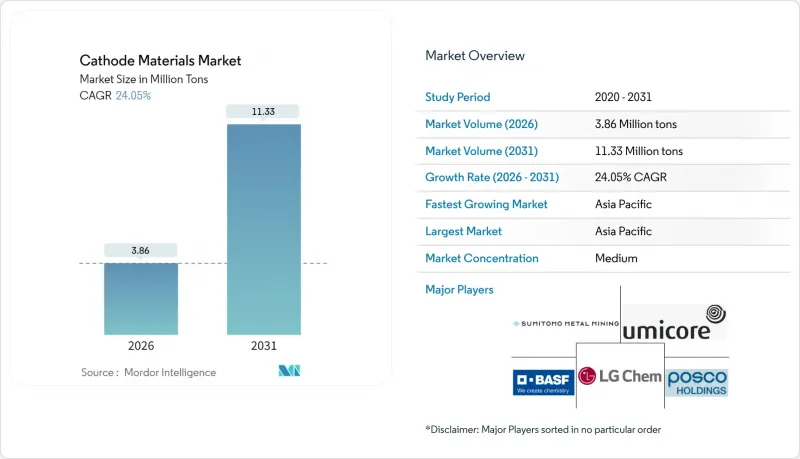
电动车产量不断增长、排放法规日益严格以及区域供应链投资,共同推动了正极材料市场的强劲成长。同时,诸如无前驱体合成等製造製程的进步,正逐步降低单位成本。儘管亚太地区仍占据全球产量的大部分,但北美和欧洲的政策奖励正在加速区域产能扩张,以降低供应安全风险。磷酸锂铁(LFP)的快速商业化以及镍锰钴(NMC)复合材料应用范围的不断扩大,正在推动固态电池原型的发展,预示着未来配方变化的到来。同时,回收基础设施的完善和强制性再生材料含量要求,正在重塑正极原料的经济格局,并为正极材料产业创造新的收入来源。
全球正极材料市场趋势与洞察
电动车产量快速成长
到2024年,全球电动车电池装置容量将超过1170吉瓦时,约占锂离子电池总产量的76%,这将直接推动对高能量密度正极材料(如NMC、LMFP和先进的LFP变体)的需求。汽车製造商签订的多年电池供应合同,正将车辆生产计划转化为可预测的正极材料订购模式,从而提高了正极材料市场的预测透明度。上游的连锁反应显而易见,例如KoBold Metals公司对其Manono锂矿床投资10亿美元,这预示着原材料扩张领域将迎来新的资金流入。电动车的应用范围已从乘用车扩展到公车、货车和固定式能源储存系统,显着扩大了正极材料的潜在市场。未来的发展动能将取决于消费者持续的接受度和全国充电基础设施的建设,而这两者在不同地区之间存在显着差异。
政府奖励和排放控制
诸如美国《通货膨胀控制法案》和欧盟《关键材料法案》等立法正在重塑筹资策略,它们强制规定了原始设备製造商(OEM)必须达到的国产和回收材料比例,才能获得财政奖励。与外国公司(FOC)条款挂钩的税额扣抵抵免有效地促使美国买家在2025年后避开中国供应商,从而为美国和加拿大的阴极材料行业新建阴极工厂创造了短期机会。欧洲计划在2030年实现锂和钴加工的完全自给自足,为此在采矿和精炼计划上投资了225亿欧元,从而为本地采购的阴极材料创造了高端市场。加拿大投资1亿加元建设钴精炼厂,显示西方国家正在支持关键的上游工程基础设施。合规成本预计将使本地采购的阴极材料价格上涨20-30%,但同时,它们也降低了长期供应风险。
关键矿产价格(镍、钴、锂)波动性
大宗商品价格的快速波动挤压了利润空间,并使长期合约的复杂性增加。 2024年钴价的突然暴跌导致多个重大计划延期,其中包括BASF和埃拉梅特取消了价值26亿美元的镍项目。碳酸锂市场也出现了类似的趋势,迫使企业对冲采购风险,并加速了对无钴化学技术的兴趣,例如麻省理工学院开发并授权给兰博基尼使用的TAQ有机阴极材料。价格的不确定性增加了回收的吸引力,但目前的再生材料产能不足以抵销原生材料供应的波动。
细分市场分析
预计到2025年,锂离子电池将占据正极材料市场88.20%的份额,并在2031年之前以25.62%的复合年增长率成长。这将巩固其在电动车、消费性电子产品和储能领域的平台主导地位,显示锂离子电池将在整个预测期内继续推动正极材料市场的发展。铅酸电池在汽车起动器领域仍保持其市场份额,但随着锂离子电池成本接近其水平,其市场份额正在逐渐下降。钠离子电池在固定式储能领域的早期应用已显示出商业化的迹象,但在整个市场中所占份额仍然很小。虽然液流电池由于初始成本高昂,目前仅限于一些特定的电网计划,但其能量密度的持续提升预计将在本世纪末为其开闢新的应用领域。
持续的规模经济效益、六倍的使用寿命提升以及诸如宁德时代6C超快充电磷酸铁锂电池架构等从电芯到电池组的创新,将使锂离子电池保持其性能和成本优势。回收材料含量法规的推进将透过确保原料循环利用,进一步巩固锂离子电池的安装基础。因此,锂离子电池将继续主导正极材料产业的价格、製造标准和研发方向。
阴极材料市场报告按电池类型(铅酸电池、锂离子电池、钠离子电池、液流电池)、材料(磷酸锂铁、钴酸锂、镍锰钴酸锂、锰酸锂等)、终端用户行业(汽车、家用电子电器、电动工具等)和地区(亚太地区、北美、欧洲、南美、中东和非洲)进行细分。
区域分析
亚太地区预计到2025年将占据79.10%的市场份额,并预计在2031年之前保持26.34%的复合年增长率,这反映了该地区在采矿、加工和电池製造方面的深度整合。中国凭藉其成本优势和独特的工艺技术,为这一生态系统提供动力,从而确保了持续的创新步伐。韩国和日本则提供互补的高精度製造和先进材料配方,进一步巩固了该地区的优势。
北美是关键区域市场,反通膨立法和国内含量要求推动了资本流入新建阴极钴工厂。美国政府提案萨克帕斯矿10%的股份,以及加拿大钴提炼的扩建,都显示企业正加速向上游资产领域投资,旨在降低供应风险。然而,高昂的投入成本和漫长的审批週期限制了企业近期的竞争力。
《欧洲关键材料法案》为47个计划提供总计225亿欧元的资金,旨在到2030年实现锂和钴的自给自足,并製定了严格的再生材料含量要求,以重组原材料采购结构。该地区以永续性中心的方针促进了循环供应链的发展,但与亚洲进口产品相比,成本竞争力仍面临挑战。中东和非洲是一个充满机会的新兴市场,正在进行的可再生能源项目正在形成区域需求中心,并有望发展成为未来的投资热点。
其他福利:
- Excel格式的市场预测(ME)表
- 3个月的分析师支持
目录
第一章 引言
- 研究假设和市场定义
- 调查范围
第二章调查方法
第三章执行摘要
第四章 市场情势
- 市场概览
- 市场驱动因素
- 电动车产量快速成长
- 政府奖励和排放控制
- 规模经济效应降低了电池组成本。
- 美国和欧盟阴极供应链的本地化
- 钠离子电池和LMFP电池的商业化将增加对正极材料的需求。
- 市场限制
- 关键矿产(镍、钴、锂)价格波动
- 中国供应链集中度
- 固态电池降低阴极材料用量/千瓦时
- 价值链分析
- 监管环境
- 波特五力模型
- 供应商的议价能力
- 买方的议价能力
- 新进入者的威胁
- 替代品的威胁
- 竞争程度
第五章 市场规模与成长预测
- 依电池类型
- 铅酸电池
- 锂离子
- 钠离子
- 液流电池
- 材料
- 磷酸锂铁
- 氧化钴锂
- 锂镍锰钴
- 锰酸锂
- 锂镍钴铝氧化物
- 二氧化铅
- 其他材料(磷酸铁钠、氢氧化钠和石墨)
- 按最终用户行业划分
- 车
- 家用电子电器
- 电动工具
- 储能
- 其他应用(医疗设备、航太零件等)
- 按地区
- 亚太地区
- 中国
- 日本
- 韩国
- 印度
- 印尼
- 越南
- 泰国
- 马来西亚
- 亚太其他地区
- 北美洲
- 我们
- 加拿大
- 墨西哥
- 欧洲
- 德国
- 英国
- 法国
- 义大利
- 西班牙
- 北欧国家
- 土耳其
- 俄罗斯
- 其他欧洲地区
- 南美洲
- 巴西
- 阿根廷
- 其他南美洲
- 中东和非洲
- 沙乌地阿拉伯
- 南非
- 其他中东和非洲地区
- 亚太地区
第六章 竞争情势
- 市场集中度
- 策略趋势
- 市占率/排名分析
- 公司简介
- BASF
- Contemporary Amperex Technology Co., Limited.
- Ecopro BM
- Eramet(Sandouville)
- Guangxi CNGR Advanced Material
- Himadri Speciality Chemical Ltd
- Huayou Cobalt Co., Ltd.
- IBU-tec
- LANDF CORP
- LG Chem
- MITSUI MINING & SMELTING CO.,LTD.
- NICHIA CORPORATION
- Nippon Chemical Industrial Co., Ltd.
- POSCO HOLDINGS.(POSCO FUTURE M)
- Shenzhen Dynanonic Co., Ltd.
- Showa Denko Materials
- Sumitomo Metal Mining Co., Ltd.
- Targray
- Umicore
- XTC New Energy Materials
第七章 市场机会与未来展望
The Cathode Materials Market is expected to grow from 3.11 Million tons in 2025 to 3.86 Million tons in 2026 and is forecast to reach 11.33 Million tons by 2031 at 24.05% CAGR over 2026-2031.
Rising electric-vehicle (EV) production, aggressive emissions regulations, and localized supply-chain investments anchor the robust growth trajectory of the cathode materials market, while advances in manufacturing processes, such as precursor-free synthesis, are gradually lowering unit costs. Asia-Pacific continues to contribute the bulk of global output, yet North American and European policy incentives are accelerating regional capacity additions to mitigate supply-security risks. Rapid commercialization of lithium-iron-phosphate (LFP) and evolving lithium-nickel-manganese-cobalt (NMC) blends broadens application windows, even as solid-state prototypes foreshadow future formulation shifts. Parallel development of recycling infrastructure and mandatory recycled-content quotas is recasting cathode feedstock economics and fostering new revenue pools in the cathode materials industry.
Global Cathode Materials Market Trends and Insights
Surging EV Production Volumes
Global EV battery installations surpassed 1,170 GWh in 2024, equaling roughly 76% of all lithium-ion battery output and directly driving demand for higher-energy cathodes such as NMC, LMFP, and advanced LFP variants. Automakers' multiyear battery-supply contracts are translating vehicle production schedules into predictable cathode ordering patterns, strengthening forecasting visibility in the cathode materials market. The upstream ripple is evident in KoBold Metals' USD 1 billion commitment to the Manono lithium deposit, signaling fresh capital flows into raw-material expansion. Adoption extends beyond passenger cars into buses, delivery fleets, and stationary energy-storage systems, substantially enlarging the addressable cathode materials market. Future momentum rests on sustained consumer acceptance and nationwide charging-infrastructure build-outs, which vary widely by region.
Government Incentives and Emissions Regulations
Legislation such as the U.S. Inflation Reduction Act and the EU Critical Raw Materials Act reshapes procurement strategies by imposing domestic-content and recycled-content thresholds that OEMs must meet to unlock financial incentives. Tax credits linked to Foreign Entity of Concern provisions effectively steer American buyers away from Chinese suppliers starting in 2025, opening near-term opportunities for new U.S. and Canadian cathode plants in the cathode materials industry. Europe's plan to achieve full processing self-sufficiency in lithium and cobalt by 2030 channels EUR 22.5 billion into extraction and refining projects, providing a premium market for regionally sourced cathode feedstock. Canada's CAD 100 million cobalt refinery investment demonstrates how Western governments are underwriting critical upstream infrastructure. Compliance costs are driving a price premium-estimated at 20-30%-for regionally sourced cathode materials but simultaneously de-risking long-term supply.
Critical Mineral Price Volatility (Ni, Co, Li)
Sharp commodity-price swings erode margins and complicate long-term contracts. Cobalt prices sank in 2024, prompting major project deferrals, including BASF-Eramet's USD 2.6 billion nickel venture cancellation. Similar patterns in lithium carbonate have forced procurement hedges and accelerated interest in cobalt-free chemistries like MIT's TAQ organic cathode licensed by Lamborghini. Price unpredictability amplifies the appeal of recycling, yet current secondary-material capacity is insufficient to offset primary-supply volatility.
Other drivers and restraints analyzed in the detailed report include:
- Battery-Pack Cost Decline from Scale Learning
- Localization of Cathode Supply Chains in US and EU
- Supply-Chain Concentration in China
For complete list of drivers and restraints, kindly check the Table Of Contents.
Segment Analysis
Lithium-ion batteries comprised 88.20% of the cathode materials market share in 2025 and are tracking a 25.62% CAGR to 2031, reinforcing the platform's primacy across EV, consumer electronics, and storage sectors. This dominance positions lithium-ion as the engine of the cathode materials through the forecast horizon. Lead-acid retains an automotive-starter niche but surrenders volume as lithium-ion approaches cost parity. Nascent sodium-ion deployments in stationary storage demonstrate early commercialization yet still represent a marginal slice of overall market size. Flow batteries remain confined to specialized grid projects due to higher upfront costs, but ongoing energy-density gains could unlock new opportunity strata by decade's end.
Continuing scale benefits, six-fold life-cycle improvements, and cell-to-pack innovations such as CATL's 6C ultra-fast-charging LFP architecture sustain lithium-ion's performance-cost momentum. Regulatory push for recycling content further cements lithium-ion's installed base by ensuring a circular raw-material loop. Consequently, lithium-ion will continue dictating pricing, manufacturing standards, and R&D direction within the cathode materials industry.
The Cathode Materials Market Report is Segmented by Battery Type (Lead-Acid, Lithium-Ion, Sodium-Ion, Flow Batteries), Materials (Lithium Iron Phosphate, Lithium Cobalt Oxide, Lithium-Nickel Manganese Cobalt, Lithium Manganese Oxide, and More), End-User Industry (Automotive, Consumer Electronics, Power Tools, and More), and Geography (Asia-Pacific, North America, Europe, South America, Middle-East and Africa).
Geography Analysis
Asia-Pacific commanded 79.10% of the market share in 2025 and is on a 26.34% CAGR trajectory to 2031, reflecting deep integration across mining, processing, and cell manufacturing. China anchors this ecosystem through cost advantages and proprietary process expertise, enabling sustained innovation velocity. South Korea and Japan provide complementary high-precision manufacturing and advanced material formulations, reinforcing regional dominance.
North America is a significant regional segment, catalyzed by the Inflation Reduction Act and domestic-content requirements funneling capital into new cathode plants. The U.S. government's proposed 10% stake in Thacker Pass and Canada's cobalt refinery build-out exemplify upstream asset acceleration aimed at de-risking supply. Nevertheless, higher input costs and lengthy permitting cycles temper short-term competitiveness.
Europe's Critical Raw Materials Act underwrites EUR 22.5 billion across 47 projects to achieve lithium and cobalt self-sufficiency by 2030, paired with stringent recycled-content mandates that reshape feedstock sourcing. The region's sustainability-centric approach fosters closed-loop supply chains but challenges cost parity with Asian imports. The Middle East and Africa remain emerging yet opportunity-rich, with ongoing renewable-energy initiatives creating localized demand nodes that could evolve into future investment hotspots.
- BASF
- Contemporary Amperex Technology Co., Limited.
- Ecopro BM
- Eramet (Sandouville)
- Guangxi CNGR Advanced Material
- Himadri Speciality Chemical Ltd
- Huayou Cobalt Co., Ltd.
- IBU-tec
- LANDF CORP
- LG Chem
- MITSUI MINING & SMELTING CO.,LTD.
- NICHIA CORPORATION
- Nippon Chemical Industrial Co., Ltd.
- POSCO HOLDINGS. (POSCO FUTURE M)
- Shenzhen Dynanonic Co., Ltd.
- Showa Denko Materials
- Sumitomo Metal Mining Co., Ltd.
- Targray
- Umicore
- XTC New Energy Materials
Additional Benefits:
- The market estimate (ME) sheet in Excel format
- 3 months of analyst support
TABLE OF CONTENTS
1 Introduction
- 1.1 Study Assumptions and Market Definition
- 1.2 Scope of the Study
2 Research Methodology
3 Executive Summary
4 Market Landscape
- 4.1 Market Overview
- 4.2 Market Drivers
- 4.2.1 Surging EV production volumes
- 4.2.2 Government incentives and emissions regulations
- 4.2.3 Battery-pack cost decline from scale learning
- 4.2.4 Localization of cathode supply chains in US and EU
- 4.2.5 Sodium-ion and LMFP commercialisation expanding cathode demand
- 4.3 Market Restraints
- 4.3.1 Critical mineral price volatility (Ni, Co, Li)
- 4.3.2 Supply-chain concentration in China
- 4.3.3 Solid-state batteries reducing cathode mass/kWh
- 4.4 Value Chain Analysis
- 4.5 Regulatory Landscape
- 4.6 Porter's Five Forces
- 4.6.1 Bargaining Power of Suppliers
- 4.6.2 Bargaining Power of Buyers
- 4.6.3 Threat of New Entrants
- 4.6.4 Threat of Substitutes
- 4.6.5 Degree of Competition
5 Market Size and Growth Forecasts (Volume)
- 5.1 By Battery Type
- 5.1.1 Lead-acid
- 5.1.2 Lithium-ion
- 5.1.3 Sodium-ion
- 5.1.4 Flow batteries
- 5.2 By Materials
- 5.2.1 Lithium Iron Phosphate
- 5.2.2 Lithium Cobalt Oxide
- 5.2.3 Lithium-Nickel Manganese Cobalt
- 5.2.4 Lithium Manganese Oxide
- 5.2.5 Lithium Nickel Cobalt Aluminium Oxide
- 5.2.6 Lead Dioxide
- 5.2.7 Other Materials (Sodium Iron Phosphate, Oxyhydroxide, and Graphite)
- 5.3 By End-user Industry
- 5.3.1 Automotive
- 5.3.2 Consumer Electronics
- 5.3.3 Power Tools
- 5.3.4 Energy Storage
- 5.3.5 Other Applications (Medical Devices, Aerospace Components, etc)
- 5.4 By Geography
- 5.4.1 Asia-Pacific
- 5.4.1.1 China
- 5.4.1.2 Japan
- 5.4.1.3 South Korea
- 5.4.1.4 India
- 5.4.1.5 Indonesia
- 5.4.1.6 Vietnam
- 5.4.1.7 Thailand
- 5.4.1.8 Malaysia
- 5.4.1.9 Rest of Asia-Pacific
- 5.4.2 North America
- 5.4.2.1 United States
- 5.4.2.2 Canada
- 5.4.2.3 Mexico
- 5.4.3 Europe
- 5.4.3.1 Germany
- 5.4.3.2 United Kingdom
- 5.4.3.3 France
- 5.4.3.4 Italy
- 5.4.3.5 Spain
- 5.4.3.6 Nordic Countries
- 5.4.3.7 Turkey
- 5.4.3.8 Russia
- 5.4.3.9 Rest of Europe
- 5.4.4 South America
- 5.4.4.1 Brazil
- 5.4.4.2 Argentina
- 5.4.4.3 Rest of South America
- 5.4.5 Middle-East and Africa
- 5.4.5.1 Saudi Arabia
- 5.4.5.2 South Africa
- 5.4.5.3 Rest of Middle-East and Africa
- 5.4.1 Asia-Pacific
6 Competitive Landscape
- 6.1 Market Concentration
- 6.2 Strategic Moves
- 6.3 Market Share**/Ranking Analysis
- 6.4 Company Profiles (includes Global level Overview, Market level overview, Core Segments, Financials as available, Strategic Information, Market Rank/Share for key companies, Products and Services, and Recent Developments)
- 6.4.1 BASF
- 6.4.2 Contemporary Amperex Technology Co., Limited.
- 6.4.3 Ecopro BM
- 6.4.4 Eramet (Sandouville)
- 6.4.5 Guangxi CNGR Advanced Material
- 6.4.6 Himadri Speciality Chemical Ltd
- 6.4.7 Huayou Cobalt Co., Ltd.
- 6.4.8 IBU-tec
- 6.4.9 LANDF CORP
- 6.4.10 LG Chem
- 6.4.11 MITSUI MINING & SMELTING CO.,LTD.
- 6.4.12 NICHIA CORPORATION
- 6.4.13 Nippon Chemical Industrial Co., Ltd.
- 6.4.14 POSCO HOLDINGS. (POSCO FUTURE M)
- 6.4.15 Shenzhen Dynanonic Co., Ltd.
- 6.4.16 Showa Denko Materials
- 6.4.17 Sumitomo Metal Mining Co., Ltd.
- 6.4.18 Targray
- 6.4.19 Umicore
- 6.4.20 XTC New Energy Materials
7 Market Opportunities and Future Outlook
- 7.1 White-space and Unmet-Need Assessment

 2026年全球尖晶石正极材料市场报告
 依纯度等级、涂布、形貌、製造方法、分销管道、电池规格和应用分類的钴酸锂正极粉末市场-全球预测,2026-2032年
 2026-2034年全球下一代负极材料市场规模、份额、趋势和成长分析报告阴极材料市场规模、份额、成长及全球产业分析:按类型、应用和地区划分,并预测至2026-2034年2026年全球正极材料市场报告硫化物正极材料市场:依材料类型、形态、应用、最终用户和分销管道划分-2026年至2032年全球预测
 替代正极材料市场-全球产业规模、份额、趋势、机会和预测,按电池类型、最终用户、材料类型、地区和竞争格局划分,2020-2030年预测
 NCA阴极:全球市场份额和排名、总收入和需求预测(2025-2031年)奈米磷酸铁锂正极材料:全球市占率及排名、总收入及需求预测(2025-2031年)磷酸铁锂电池正极材料:全球市占率及排名、总收入及需求预测(2025-2031年)