


 |
市场调查报告书
商品编码
1937339
烷基糖苷:市场占有率分析、产业趋势与统计、成长预测(2026-2031)Alkyl Polyglycoside - Market Share Analysis, Industry Trends & Statistics, Growth Forecasts (2026 - 2031) |
||||||

※ 本网页内容可能与最新版本有所差异。详细情况请与我们联繫。
预计到 2026 年,烷基聚醣苷市场规模将达到 99.28 千吨,高于 2025 年的 96.31 千吨。
预计到 2031 年,产量将达到 115.54 千吨,预计从 2026 年到 2031 年的复合年增长率为 3.08%。
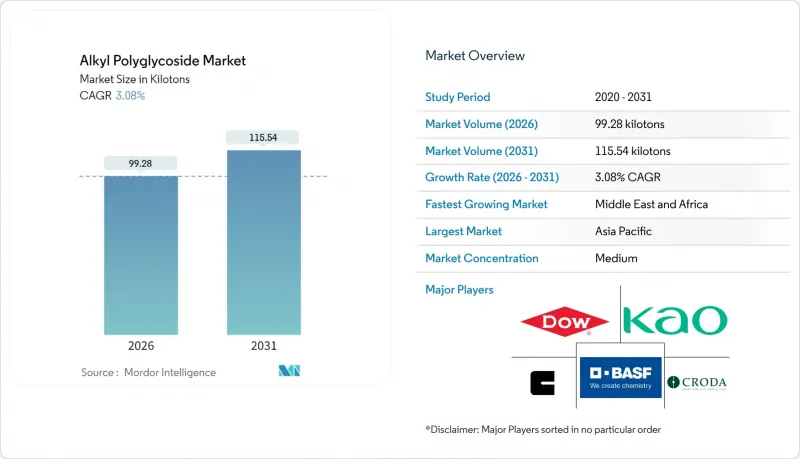
需求成长主要受以下因素驱动:有害非离子界面活性剂的逐步淘汰、配方快速转向生物基原料,以及产能的稳定扩张稳定了原料供应。家用和个人护理产品製造商越来越多地指定使用烷基聚葡萄糖苷界面活性剂以满足生态标籤标准,而油田服务公司则采用APG可湿性粉剂来满足环境排放限制。亚洲製造商正利用其在棕榈油和椰子油衍生脂醇类采购方面的地理优势来确保出口合同,而欧洲供应商则透过强调永续性的品牌建设来确立高端市场地位。儘管原物料价格波动,且面临来自甜菜碱和氨基氧化物的竞争,但随着大型综合化工企业扩大生产规模和共用製程技术,成本曲线仍在持续改善。
全球烷基糖苷市场趋势及洞察
家用和个人保健产品对生物基界面活性剂的需求不断增长
为了获得生态标籤认证和优质货架空间,品牌所有者正在调整产品系列,专注于无硫酸盐和植物来源成分。来自跨国消费品製造商的大订单确保了未来需求的稳定,促使供应商扩大产能,并改善用于冲洗型和免冲洗型产品的专用等级。配方师们看重烷基聚葡萄糖苷界面活性剂的温和性、酵素协同作用和无硫酸盐特性,同时也能保持高效的去污能力。精通数位技术的消费者正在仔细查看成分标籤,这给零售商施加了压力,要求他们储备含有可识别的糖基界面活性剂的成品。亚洲契约製造正在积极回应,提供整合烷基多醣苷的承包解决方案,从而缩短全球自有品牌零售商的创新前置作业时间。
逐步淘汰壬基酚聚氧乙烯醚(NPE)和其他有害界面活性剂
欧洲化学品管理局 (ECHA) 已禁止壬基酚聚氧乙烯醚 (NPE) 的大部分用途,从而推动了全球供应链加速替代计画的实施。美国《有毒物质管制法》(TSCA) 的风险评估和各州层级的倡议与欧洲的立场相呼应,缩短了替代品的检验週期。烷基聚葡萄糖苷乙烯醚残留,从而减轻了文件负担和下游废弃物处理风险。采购部门报告称,与根据例外条款维持 NPE 库存相比,过渡到 APG 可降低合规成本。明确的政策方向降低了人们对技术风险的认知,使 APG 成为设施清洁和纺织品加工领域非离子替代品的标准选择。
天然脂醇类与淀粉原料价格波动
脂醇类成本约占烷基聚葡萄糖苷变动成本的65%,这使得生产商极易受到原料价格波动的影响,而原料价格波动又受到生物柴油强制掺混政策和受天气影响的收割週期的影响。 2023年,C12-C14醇的价格跌至每吨1,467美元,随后在2024年反弹超过30%,这主要是由于厄尔尼诺现象导致棕榈油产量下降。现货价格的飙升迫使生产商每季调整价格,这给签订固定零售合约的清洁剂配方生产商带来了不确定性。虽然一些烷基多醣苷供应商透过签订长期人工林合约来对冲风险,但干旱、劳动力短缺和植物检疫限制仍然可能限制交付。投资者在为新建烷基多醣苷工厂分配资金时会考虑这些不确定性,这可能导致计划启动时间延长。
细分市场分析
到2025年,脂醇类类产品将占总产量的42.10%,这将支撑未来数十年的规模经济效益,并确保清洁剂醇裂解装置稳定供应月桂醇。精湛的生产流程可确保产品在颜色、气味和聚合度方面的一致性——这些都是大众市场浓缩清洁剂的关键特性。植物油基产品将以3.55%的复合年增长率(CAGR)实现最高增长,这得益于连续酯交换和酶促合成技术的进步,这些技术能够缩短生产週期并降低碳排放强度。预计到2031年,植物油衍生的烷基聚葡萄糖苷市场规模将从2025年的27.54千吨增长至33.92千吨,这反映了东盟和南美生物柴油丛集集群原料的快速多元化。
新兴的醣类和玉米粉基烷基聚葡萄糖苷产品,凭藉两位数的毛利率,为小众个人保健产品线提供服务,弥补了供应链不成熟和单位成本高的不足。同时,脂醇类生产商正在改进衝击流反应器,将醇与葡萄糖的摩尔比降低到3:1以下,从而减少5%的原料投入并提高产量。供应商正将这些工艺创新与基于区块链的溯源模组结合,追踪人工林的来源,以满足欧洲零售商的溯源要求。随着植物油技术的规模化应用,其与脂醇类产品的价格差异正在缩小,促使企业采取联合投资策略,模糊传统的细分市场界线。
烷基聚葡萄糖苷市场报告按产品类型(脂醇类、糖、玉米粉、植物油及其他)、应用领域(个人护理及化妆品、家居用品、工业清洁剂、农药及其他)和地区(亚太地区、北美地区、欧洲地区、南美地区、中东和非洲地区)进行细分。市场预测以吨为单位。
区域分析
到2025年,亚太地区将占全球产量的45.90%,这主要得益于中国一体化的石化产业群聚以及东南亚棕榈油资源的接近性。当地的税收优惠政策鼓励对磺基琥珀酸酯、APG和甜菜碱生产线的投资,从而在宁波和上海周边地区打造出具有竞争力的製造群。印度美容和个人护理市场(预计到2025年价值200亿美元)随着无硫酸盐洗髮精逐渐渗透到区域性城市,国内对APG的需求也不断增长。泰国和马来西亚已巩固其作为脂醇类原料供应中心的地位,透过位于邦巴功和关丹的製造地商(OEM)大量出口APG。
儘管中东和非洲地区的市场规模较小,但预计该地区将以3.52%的复合年增长率(CAGR)实现最快成长,直至2031年。这主要得益于石油公司对用于提高采收率试验井的环保添加剂的需求。沙乌地阿拉伯朱拜勒的一家下游企业正在运作一座APG中试工厂,该工厂毗邻一条乙氧基化物生产线,从而实现了表面活性剂在同一物流区域内的混合。一家南非商用清洁剂配方生产商正在使用本地配製的APG浓缩液,以满足超级市场自有品牌的永续性评分标准。地方政府的绿色采购政策正在公共清洁合约中优先考虑生物基表面活性剂,从而创造了稳定的需求基础。
北美和欧洲的需求量正以个位数的温和速度增长,这得益于积极的非离子介面活性剂剂(NPE)淘汰计划和零售商自愿加入的化学品监控清单。 Pilot Chemical公司获得在俄亥俄州独家生产Bio IOS技术的许可,该许可证将于2026年开始生效,这标誌着美国生物基界面活性剂领域将迎来新的资本投资。欧洲高端市场正在采用APG和氨基氧化物的混合物来平衡成本和发泡性能,而加州配方师则依靠APG来满足更严格的消费品安全法规。儘管南美洲的绝对销量落后于其他地区,但其在作物保护助剂领域正展现出强劲的增长势头,APG较低的植物毒性使其能够渗透到Glyphosate替代配方中。
其他福利:
- Excel格式的市场预测(ME)表
- 分析师支持(3个月)
目录
第一章 引言
- 研究假设和市场定义
- 调查范围
第二章调查方法
第三章执行摘要
第四章 市场情势
- 市场概览
- 市场驱动因素
- 家用和个人保健产品对生物基界面活性剂的需求不断增长
- 逐步淘汰壬基酚聚氧乙烯醚(NPE)和其他有害界面活性剂
- 脂醇类供应商的产能扩张与后向整合
- APG可湿性粉剂在碱性工业清洁剂和油田流体的应用日益广泛
- 低成本的高密度衝击流反应器可实现醇与葡萄糖比例小于 3:1。
- 市场限制
- 天然脂醇类与淀粉原料价格波动
- 可用的其他温和界面活性剂(例如,甜菜碱、氨基氧化物)
- 透过严格的RSPO/无毁林棕榈油供应审核,严格把控原料采购。
- 价值链分析
- 波特五力模型
- 供应商的议价能力
- 买方的议价能力
- 新进入者的威胁
- 替代品的威胁
- 竞争程度
第五章 市场规模与成长预测
- 依产品类型
- 脂醇类
- 糖
- 玉米粉
- 植物油
- 其他产品类型
- 透过使用
- 个人护理和化妆品
- 居家护理产品
- 工业用清洁剂
- 农业化学品
- 其他应用
- 按地区
- 亚太地区
- 中国
- 印度
- 日本
- 韩国
- 印尼
- 泰国
- 马来西亚
- 越南
- 亚太其他地区
- 北美洲
- 我们
- 加拿大
- 墨西哥
- 欧洲
- 德国
- 英国
- 法国
- 义大利
- 西班牙
- 北欧国家
- 土耳其
- 俄罗斯
- 其他欧洲地区
- 南美洲
- 巴西
- 阿根廷
- 哥伦比亚
- 其他南美洲
- 中东和非洲
- 沙乌地阿拉伯
- 阿拉伯聯合大公国
- 卡达
- 埃及
- 奈及利亚
- 南非
- 其他中东和非洲地区
- 亚太地区
第六章 竞争情势
- 市场集中度
- 策略趋势
- 市占率(%)/排名分析
- 公司简介
- BASF
- Brillachem
- Clariant
- Croda International plc
- Dow
- Evonik Industries
- FENCHEM
- Galaxy Surfactants
- Kao Corporation
- Pilot Chemical Corp.
- Seppic(Arkema Group)
- Shanghai Chenhua International Trade Co., Ltd.
- Shanghai Fine Chemical Co., Ltd.
- Shanghai Sunwise Chemical Co., Ltd
- Silver Fern Chemical LLC.
第七章 市场机会与未来展望
Alkyl Polyglycoside market size in 2026 is estimated at 99.28 kilotons, growing from 2025 value of 96.31 kilotons with 2031 projections showing 115.54 kilotons, growing at 3.08% CAGR over 2026-2031.
Demand is driven by regulatory phase-outs of hazardous non-ionic surfactants, rapid shifts in formulation toward bio-based ingredients, and steady capacity additions that stabilize the raw-material supply. Home-care and personal-care producers increasingly specify Alkyl polyglucoside surfactants to align with ecolabel criteria, while oil-field service companies adopt APG hydrotropes to meet environmental discharge limits. Asian manufacturers capitalize on their proximity to palm- and coconut-based fatty alcohols to secure export contracts, whereas European suppliers leverage sustainability branding to achieve premium positioning. Despite feedstock price fluctuations and competition from betaines and amino oxides, cost curves continue to improve as integrated chemical majors scale up production and share process expertise.
Global Alkyl Polyglycoside Market Trends and Insights
Growing Demand for Bio-Based Surfactants in Home and Personal-Care Formulations
Brand owners reposition product portfolios around non-sulfate, plant-derived ingredients to secure ecolabel certifications and capture premium shelf space. Volume commitments from multinational fast-moving consumer goods companies create forward visibility, encouraging suppliers to expand capacity and refine grades tailored to rinse-off and leave-on products. Formulators favor Alkyl polyglucoside surfactants for mildness, low irritation, and synergy with enzymes, enabling sulfate-free laundry detergents that still deliver high soil removal. Digital-savvy consumers scrutinize ingredient lists, pushing retailers to stock finished goods containing recognizable sugar-based surfactants. Asian contract manufacturers respond with turnkey offerings that integrate APGs, shortening innovation lead times for global private-label retailers.
Regulatory Phase-Out of Nonyl-Phenol Ethoxylates and Other Hazardous Surfactants
The European Chemicals Agency banned NPEs in most applications, triggering accelerated substitution programs that ripple across global supply chains. US TSCA risk evaluations and state-level initiatives mirror Europe's stance, compressing customer timelines to validate alternatives. Alkyl polyglucoside surfactants fulfill performance specifications without secondary alcohol ethoxylate residues, easing dossier preparation and reducing downstream disposal liabilities. Procurement teams cite lower compliance costs when transitioning to APGs versus maintaining NPE-based inventories under derogation clauses. The clear direction of policy lowers perceived technology risk, making APGs the default non-ionic replacement in institutional cleaning and textile processing.
Volatility in Natural Fatty-Alcohol and Starch Feedstock Prices
Fatty-alcohol costs represent roughly 65% of Alkyl polyglucoside variable expenses, leaving producers vulnerable to commodity swings tied to bio-diesel mandates and weather-linked harvest cycles. After dropping to USD 1,467 per ton in 2023, C12-C14 alcohols rebounded by more than 30% in 2024 due to El Nino-related palm-oil yield reductions. Spot spikes force quarterly price resets that unsettle detergent formulators operating under fixed retail contracts. Some APG suppliers hedge their risks with long-term plantation agreements; however, drought, labor shortages, and phytosanitary restrictions can still curtail deliveries. Investors weigh these uncertainties when allocating capital to greenfield APG plants, which can occasionally result in lengthened project gestation periods.
Other drivers and restraints analyzed in the detailed report include:
- Capacity Additions and Backward Integration of Fatty-Alcohol Suppliers
- Rising Adoption of APG Hydrotropes in Alkaline Industrial Cleaning and Oil-Field Fluids
- Availability of Alternative Mild Surfactants (e.g., Betaines, Amino-Oxides)
For complete list of drivers and restraints, kindly check the Table Of Contents.
Segment Analysis
Fatty alcohol-based grades captured 42.10% of 2025 volume, underscoring decades of scale efficiencies and readily available lauryl alcohol streams from detergent-alcohol crackers. Their process familiarity assures consistent color, odor, and degree of polymerization, features critical to mass-market detergent concentrates. Vegetable-oil-derived variants exhibit the highest 3.55% CAGR, as continuous transesterification and enzymatic synthesis technologies enable shorter cycle times and lower carbon intensity. The Alkyl polyglucoside market size associated with vegetable-oil pathways is projected to expand from 27.54 kilotons in 2025 to 33.92 kilotons by 2031, reflecting rapid feedstock diversification among ASEAN and South American biodiesel clusters.
Up-and-coming sugar- and corn-starch-based APGs service niche personal-care lines that command double-digit gross margins, compensating for immature supply chains and higher unit costs. Meanwhile, fatty-alcohol producers refine impinging-stream reactors that reduce the alcohol-to-glucose molar ratio below 3:1, slicing raw-material inputs by 5% and enhancing yield. Suppliers pair these process strides with blockchain-enabled traceability modules that map the origins of plantations, satisfying traceability mandates from European retailers. As vegetable-oil technologies scale, price differentials versus fatty-alcohol routes narrow, inviting co-investment strategies that blur traditional segment boundaries.
The Alkyl Polyglucoside Market Report is Segmented by Product Type (Fatty Alcohol, Sugar, Corn-Starch, Vegetable Oil, and Other Product Type), Application (Personal Care and Cosmetics, Home-Care Products, Industrial Cleaners, Agricultural Chemicals, and Other Application), and Geography (Asia-Pacific, North America, Europe, South America, and Middle East and Africa). The Market Forecasts are Provided in Terms of Volume (Tons).
Geography Analysis
The Asia-Pacific region retained 45.90% of the global volume in 2025, driven by integrated petrochemical complexes in China and the proximity of palm oil in Southeast Asia. Provincial tax incentives encourage investment in sulfosuccinate, APG, and betaine lines, fostering a competitive manufacturing cluster around Ningbo and Shanghai. India's beauty and personal care sector, valued at USD 20 billion for 2025, amplifies domestic APG pull-through as sulfate-free shampoos penetrate Tier-II cities. Thailand and Malaysia consolidate their role as fatty-alcohol feedstock hubs, supplying Bangpakong and Kuantan sites that dispatch bulk APG to Japanese OEMs.
The Middle East and Africa are projected to post the fastest 3.52% CAGR through 2031, albeit from a smaller base, as national oil companies seek environmentally compatible additives for enhanced-oil-recovery pilot wells. Saudi downstream initiatives in Jubail include pilot APG units adjacent to ethoxylate trains, enabling surfactant blending within a single logistical zone. South African formulators of institutional cleaners adopt locally blended APG concentrates to meet supermarket private-label sustainability scorecards. Regional governments use green-procurement policies to prioritize bio-based surfactants for municipal cleaning contracts, building steady baseline demand.
North American and European volumes grow at modest single-digit rates underpinned by aggressive NPE withdrawal schedules and voluntary retailer chemical watch lists. Pilot Chemical's exclusive license to manufacture Bio IOS technology in Ohio from 2026 signals fresh capital injection into U.S. bio-based surfactants. European premium segments feature APG blends with amino-oxides to balance cost and foaming, while California formulators lean on APG to comply with Safer Consumer Products regulations. South America trails in absolute volume but registers momentum in crop-protection adjuvants, leveraging APG's low phytotoxicity to penetrate glyphosate replacement formulations.
- BASF
- Brillachem
- Clariant
- Croda International plc
- Dow
- Evonik Industries
- FENCHEM
- Galaxy Surfactants
- Kao Corporation
- Pilot Chemical Corp.
- Seppic (Arkema Group)
- Shanghai Chenhua International Trade Co., Ltd.
- Shanghai Fine Chemical Co., Ltd.
- Shanghai Sunwise Chemical Co., Ltd
- Silver Fern Chemical LLC.
Additional Benefits:
- The market estimate (ME) sheet in Excel format
- 3 months of analyst support
TABLE OF CONTENTS
1 Introduction
- 1.1 Study Assumptions and Market Definition
- 1.2 Scope of the Study
2 Research Methodology
3 Executive Summary
4 Market Landscape
- 4.1 Market Overview
- 4.2 Market Drivers
- 4.2.1 Growing demand for bio-based surfactants in home and personal-care formulations
- 4.2.2 Regulatory phase-out of nonyl-phenol ethoxylates (NPEs) and other hazardous surfactants
- 4.2.3 Capacity additions and backward integration of fatty-alcohol suppliers
- 4.2.4 Rising adoption of APG hydrotropes in alkaline industrial cleaning and oil-field fluids
- 4.2.5 Cost-cutting high-gravity impinging-stream reactors enabling <3:1 alcohol-to-glucose ratios
- 4.3 Market Restraints
- 4.3.1 Volatility in natural fatty-alcohol and starch feedstock prices
- 4.3.2 Availability of alternative mild surfactants (e.g., betaines, amino-oxides)
- 4.3.3 Stringent RSPO/deforestation-free palm supply audits tightening raw-material access
- 4.4 Value Chain Analysis
- 4.5 Porter's Five Forces
- 4.5.1 Bargaining Power of Suppliers
- 4.5.2 Bargaining Power of Buyers
- 4.5.3 Threat of New Entrants
- 4.5.4 Threat of Substitutes
- 4.5.5 Degree of Competition
5 Market Size and Growth Forecasts (Volume)
- 5.1 By Product Type
- 5.1.1 Fatty Alcohol
- 5.1.2 Sugar
- 5.1.3 Corn-starch
- 5.1.4 Vegetable Oil
- 5.1.5 Other Product Type
- 5.2 By Application
- 5.2.1 Personal Care and Cosmetics
- 5.2.2 Home-care Products
- 5.2.3 Industrial Cleaners
- 5.2.4 Agricultural Chemicals
- 5.2.5 Other Application
- 5.3 By Geography
- 5.3.1 Asia-Pacific
- 5.3.1.1 China
- 5.3.1.2 India
- 5.3.1.3 Japan
- 5.3.1.4 South Korea
- 5.3.1.5 Indonesia
- 5.3.1.6 Thailand
- 5.3.1.7 Malaysia
- 5.3.1.8 Vietnam
- 5.3.1.9 Rest of Asia-Pacific
- 5.3.2 North America
- 5.3.2.1 United States
- 5.3.2.2 Canada
- 5.3.2.3 Mexico
- 5.3.3 Europe
- 5.3.3.1 Germany
- 5.3.3.2 United Kingdom
- 5.3.3.3 France
- 5.3.3.4 Italy
- 5.3.3.5 Spain
- 5.3.3.6 Nordic Countries
- 5.3.3.7 Turkey
- 5.3.3.8 Russia
- 5.3.3.9 Rest of Europe
- 5.3.4 South America
- 5.3.4.1 Brazil
- 5.3.4.2 Argentina
- 5.3.4.3 Colombia
- 5.3.4.4 Rest of South America
- 5.3.5 Middle East and Africa
- 5.3.5.1 Saudi Arabia
- 5.3.5.2 United Arab Emirates
- 5.3.5.3 Qatar
- 5.3.5.4 Egypt
- 5.3.5.5 Nigeria
- 5.3.5.6 South Africa
- 5.3.5.7 Rest of Middle East and Africa
- 5.3.1 Asia-Pacific
6 Competitive Landscape
- 6.1 Market Concentration
- 6.2 Strategic Moves
- 6.3 Market Share (%)/Ranking Analysis
- 6.4 Company Profiles (includes Global level Overview, Market level overview, Core Segments, Financials as available, Strategic Information, Market Rank/Share for key companies, Products and Services, and Recent Developments)
- 6.4.1 BASF
- 6.4.2 Brillachem
- 6.4.3 Clariant
- 6.4.4 Croda International plc
- 6.4.5 Dow
- 6.4.6 Evonik Industries
- 6.4.7 FENCHEM
- 6.4.8 Galaxy Surfactants
- 6.4.9 Kao Corporation
- 6.4.10 Pilot Chemical Corp.
- 6.4.11 Seppic (Arkema Group)
- 6.4.12 Shanghai Chenhua International Trade Co., Ltd.
- 6.4.13 Shanghai Fine Chemical Co., Ltd.
- 6.4.14 Shanghai Sunwise Chemical Co., Ltd
- 6.4.15 Silver Fern Chemical LLC.
7 Market Opportunities and Future Outlook
- 7.1 White-space and Unmet-need Assessment

 烷基聚葡萄糖苷市场按产品类型、最终用途和地区划分
 烷基聚葡萄糖苷市场规模、份额及成长分析(按产品、主要功能、应用及地区划分)-2026-2033年产业预测
 烷基聚醣(APG)-全球市场份额和排名、总收入和需求预测(2025-2031年)
 烷基多醣市场-全球产业规模、份额、趋势、机会及预测,依最终用途(个人护理及化妆品、居家护理产品、工业清洁剂、农业化学品、其他)细分,按地区及竞争情况,2020-2030 年预测
 全球烷基聚葡萄糖苷市场
 2018-2034年全球烷基多醣体(APG)市场需求及预测分析
 烷基聚葡萄糖苷(APG)生物界面活性剂市场报告:趋势、预测和竞争分析(至 2031 年)烷基聚葡萄糖苷界面活性剂市场报告:趋势、预测和竞争分析(至2031年)烷基多醣苷市场、规模、占有率、趋势、行业分析报告:依产品、原材料、功能、应用和地区 - 市场预测(2025-2034)