


 |
市场调查报告书
商品编码
1937349
欧洲电动巴士:市场占有率分析、产业趋势与统计、成长预测(2026-2031)Europe Electric Bus - Market Share Analysis, Industry Trends & Statistics, Growth Forecasts (2026 - 2031) |
||||||

※ 本网页内容可能与最新版本有所差异。详细情况请与我们联繫。
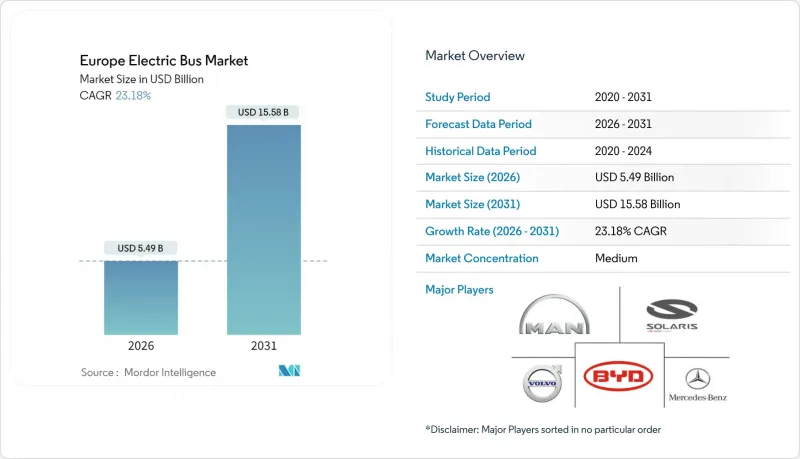
2025年欧洲电动巴士市场规模为44.6亿美元,预计从2026年的54.9亿美元成长到2031年的155.8亿美元。
预计在预测期(2026-2031 年)内,复合年增长率将达到 23.18%。
欧盟层面严格的二氧化碳排放标准、不断扩大的清洁车辆采购配额以及电动巴士与柴油巴士日益扩大的总拥有成本 (TCO) 差距,使得纯电动巴士成为市政车队的标配。电池价格的持续下降、欧盟10亿欧元的充电基础建设资金,以及预计自2027年起因欧盟碳排放交易体系(ETS-2)实施而导致的柴油燃料成本上涨,都在推动营运商对电动化的支持。在监管确定性、经济效益改善以及企业对永续性品牌日益增长的需求等因素的共同推动下,欧洲电动巴士市场有望迎来一个强劲的投资週期。
欧洲电动巴士市场趋势与洞察
从2026年起,与柴油车相比,总拥有成本将下降。
到2024年,由于磷酸铁锂电池的广泛应用,电池价格大幅下降,与镍钴锰酸锂电池相比,电池组成本降低了约20%。考虑到维护成本的降低以及欧盟排放交易体系第二阶段(ETS-2)碳课税的影响,预计2025年购买的电动公车将在运作四年内实现与柴油车相同的总拥有成本(TCO)。梅赛德斯-奔驰eCitaro在柏林和乌特勒支的初步部署,由于动力传动系统中易损件减少,年度维护成本降低了30%以上。车队营运商目前正在推广三班倒的运作模式,将电动利用率提高到96%以上,从而加快了投资回报。这些经济效益增强了私部门的信心,并解释了2025年专业电动公车业者的创业投资资金成长18%的原因。
欧盟清洁车辆指令截止日期
《清洁车辆指令》下的强制性采购目标消除了城市交通机构的不确定性,并有助于就整合车辆供应和充电解决方案的多年期合约竞标。德国的《清洁车辆采购法》规定,2026年至2030年间,清洁车辆的采购比例必须提高到65%,其中一半必须是零排放车辆。法国和西班牙也在製定类似的立法,将需求集中到可预测的大规模批量采购中,使製造商能够优化生产线并降低单位成本。各国在整合不同合约实体的目标方面柔软性,这也提高了采购能力,使小规模的城市能够享受批量折扣。因此,到2024年,欧盟都市区新增公车中已有超过49%是零排放车辆,预计到2027年这一比例将超过70%。
现有仓库併网瓶颈
由于公共产业面临长期审批积压,专为柴油车建造的设施的变电站和电缆升级工程仍然延误。米兰和慕尼黑的营运商报告称,他们等待2兆瓦的併网时间超过18个月,迫使他们暂时依赖行动充电器,这限制了夜间的用电量。欧盟委员会的电网行动计画预测,到2030年,电力需求将增加60%,但许多城市中心几乎没有剩余的电缆容量来支援集中充电。这些延误导致合约生效日期推迟,并可能推高车库改造预算,儘管交付充足,但短期订单计划仍面临不确定性。
细分市场分析
到2025年,纯电动车技术将占据欧洲电动巴士市场81.95%的份额,这主要得益于监管要求和成熟的供应链缩小了采购价格差距。强有力的政策支持、简化的动力系统以及电池成本的下降预计将推动该细分市场在2031年前实现24.10%的复合年增长率。燃料电池巴士仍然是日行驶里程超过400公里线路的战略选择,但氢气加註站的缺乏限制了其普及。插电式混合动力巴士目前主要以过渡性合约运营,因为其车库维修尚未完成。
製造商正在电动和氢燃料电池公车产品线中实现电力电子和温度控管系统的标准化,从而降低研发成本。索拉里斯公司订单,同时保持纯电动公车的量产,使其能够灵活应对不断变化的政策趋势。由于地方政府的大量补贴侧重于「零排放」目标而非特定技术,车队管理者仍然选择纯电动公车,因为它们符合短期监管要求且成本可靠,这将巩固其在未来五年内在该领域的主导地位。
2025年,磷酸锂铁锂电池组将占据欧洲电动巴士市场48.75%的份额,并以24.60%的复合年增长率(CAGR)成为该品类成长最快的市场,直到2031年。这主要得益于其成本优势和卓越的热稳定性,符合营运商的安全和经济效益考量。此电池化学体系拥有超过4000次充放电循环的寿命,无需中期更换电池即可实现长达12年的资产生命週期规划,进而降低全生命週期资本支出。雷诺选择从宁德时代(CATL)的匈牙利工厂采购磷酸铁锂电池模组,体现了整车製造商对欧洲供应稳定性的信心。对于需要高能量密度的铰接式巴士而言,镍锰钴酸锂(NiMCO)电池仍然是首选,但钴价上涨和日益严格的ESG(环境、社会和治理)审查对其构成了不利影响。
欧洲电动巴士市场的扩张得益于磷酸铁锂电池(LFP)的普及,而铁基复合材料(NMC)车辆相比,电池保固索赔数量呈下降趋势,这表明技术风险有所降低。钠离子电池的研究可能会在预测期内带来一种新的低成本电池方案,但商业化规模应用不太可能在2030年之前实现,预计磷酸铁锂电池仍将占据主导地位。
其他福利:
- Excel格式的市场预测(ME)表
- 分析师支持(3个月)
目录
第一章 引言
- 研究假设和市场定义
- 调查范围
第二章调查方法
第三章执行摘要
第四章 市场情势
- 市场概览
- 市场驱动因素
- 欧盟清洁车辆指令合规期限
- 自2026年起,柴油车的总拥有成本将降低
- 国内零排放公共采购分配
- 透过在仓库安装储能电池来降低尖峰时段的用电费用
- 利用电池即服务合约降低资本投资风险
- 欧盟排放交易体系(ETS-2)下不断上涨的碳价将增加柴油车的营运成本,并加速电动公车的转型。
- 市场限制
- 现有车辆段电网连接瓶颈
- 第一代电动公车的残值存在很大的不确定性。
- 欧盟可能对中国製造的电动公车征收关税,这可能会增加系统成本。
- 持证高压维修技术人员短缺
- 价值/供应链分析
- 监管环境
- 技术展望
- 波特五力模型
- 新进入者的威胁
- 买方的议价能力
- 供应商的议价能力
- 替代品的威胁
- 竞争对手之间的竞争
第五章 市场规模及成长预测(价值(美元))
- 依推进类型
- 电池电动巴士(BEB)
- 插电式混合动力电动巴士(PHEB)
- 燃料电池电动巴士(FCEB)
- 电池化学
- 磷酸锂铁(LFP)
- 锂镍锰钴氧化物(NMC)
- 镍氢电池(NiMH)
- 其他(钠离子电池、全固态电池)
- 按巴士长度
- 小于9米
- 9-14公尺(标准)
- 超过14公尺(铰接式巴士/双层巴士)
- 依消费者类型
- 政府/市政交通
- 私家车营运商
- 透过使用
- 城市交通
- 城际/区域间
- 机场和接驳车服务
- 按国家/地区
- 德国
- 英国
- 法国
- 义大利
- 西班牙
- 荷兰
- 挪威
- 波兰
- 瑞典
- 芬兰
- 比利时
- 瑞士
- 其他欧洲地区
第六章 竞争情势
- 市场集中度
- 策略趋势
- 市占率分析
- 公司简介
- Solaris Bus & Coach sp. z oo
- MAN Truck & Bus
- Mercedes-Benz Group AG
- Volvo Buses
- BYD Auto Co., Ltd
- VDL Bus & Coach
- Ebusco
- IVECO Group
- Scania
- Otokar
- Van Hool
- Yutong Europe
- Irizar e-mobility
- Wrightbus
- Karsan
- CaetanoBus
- Temsa
- Bozankaya
- Switch Mobility
第七章 市场机会与未来展望
The Europe electric bus market size was valued at USD 4.46 billion in 2025 and estimated to grow from USD 5.49 billion in 2026 to reach USD 15.58 billion by 2031, at a CAGR of 23.18% during the forecast period (2026-2031).
Aggressive EU-level CO2 standards, expanding clean-vehicle procurement quotas, and widening gaps in total cost of ownership versus diesel have converged to make battery-electric buses the default option for municipal fleets. Operators increasingly favor electrification because battery prices continue to fall, charging infrastructure is backed by a EUR 1 billion EU funding stream, and ETS-2 carbon pricing is set to raise diesel fuel costs from 2027. The Europe electric bus market, therefore, combines regulatory certainty with improving economics and rising corporate appetite for sustainability branding, reinforcing the investment cycle.
Europe Electric Bus Market Trends and Insights
Falling Total Cost of Ownership Versus Diesel After 2026
Battery prices fell sharply in 2024 on wider LFP adoption, cutting pack costs by about 20% compared with NMC. When maintenance savings and ETS-2 carbon charges are added, an electric bus purchased in 2025 is projected to reach TCO parity with a diesel unit within four years of service. Early deployments of the Mercedes-Benz eCitaro in Berlin and Utrecht reveal annual maintenance savings exceeding 30% thanks to fewer drivetrain wear parts. Fleet operators are now standardizing three-shift duty cycles that push electric utilization above 96%, which accelerates payback. Such economics underpin private-sector confidence and explain why venture funding for specialized e-bus operators climbed 18% in 2025 .
EU Clean-Vehicles Directive Deadlines
Binding procurement targets under the Clean-Vehicles Directive remove uncertainty for city transport agencies, prompting multi-year tenders that bundle vehicle supply and charging solutions. Germany's Saubere-Fahrzeuge-Beschaffungs-Gesetz lifts required clean-vehicle purchases to 65% for 2026-2030, half of which must be zero-emission. Similar transpositions in France and Spain are clustering demand into large, predictable tranches that let manufacturers optimize production lines and reduce per-unit costs. National flexibility to pool targets across contracting authorities also raises purchasing power, helping smaller cities gain volume discounts. As a result, more than 49% of new EU city buses were already zero-emission in 2024, a share expected to exceed 70% by 2027 .
Grid-Connection Bottlenecks at Legacy Depots
Upgrading substations and cabling at sites built for diesel fleets remains slow because utilities face long permitting backlogs. Operators in Milan and Munich report waits of 18 months or more for 2-MW connections, forcing interim reliance on mobile chargers that limit overnight energy intake. The European Commission's Action Plan for Grids identifies a 60% increase in electricity demand by 2030, yet many city centers have little spare cabling capacity to handle clustered charging. Delays can push back contract start dates and inflate depot conversion budgets, cooling near-term delivery schedules despite healthy order books.
Other drivers and restraints analyzed in the detailed report include:
- National Zero-Emission Public-Procurement Quotas
- On-Site Depot Battery-Storage Shaving Peak-Demand Charges
- Residual-Value Uncertainty for First-Generation E-Buses
For complete list of drivers and restraints, kindly check the Table Of Contents.
Segment Analysis
Battery-electric technology controlled 81.95% of the Europe electric bus market in 2025, driven by regulatory mandates and the maturing supply chain that reduce purchase price gaps. Strong policy backing, simpler drivetrains, and falling battery costs support a 24.10% CAGR for the segment through 2031. Fuel-cell buses remain a strategic hedge for routes exceeding 400 km daily, but scarce hydrogen refueling sites restrict widespread adoption. Plug-in hybrids now serve mostly in transitional contracts where depot upgrades are incomplete.
Manufacturers are standardizing power electronics and thermal-management systems across their electric and hydrogen lines, which lowers development expense. Solaris is executing a 130-unit hydrogen order for Bologna while maintaining battery-electric production at volume, ensuring flexibility if policy signals shift. Because heavy municipal subsidies target zero tailpipe emissions rather than a specific technology, fleet managers continue to pick battery-electric options for near-term compliance and cost reliability, cementing segment leadership for the next five years.
Lithium-iron-phosphate packs captured 48.75% Europe electric bus market share in 2025 and lead the category with the fastest projected expansion of 24.60% CAGR through 2031, driven by cost advantages and superior thermal stability that resonate with operator safety and economic priorities. The chemistry's cycle life of 4,000+ charge events helps operators plan for 12-year asset lives without mid-life battery swaps, cutting lifetime capex. Renault's decision to source LFP modules from CATL's Hungarian plant illustrates OEM confidence in European supply security. Lithium nickel manganese cobalt oxide remains the chemistry of choice for articulated buses that need high energy density, but rising cobalt prices and ESG scrutiny create headwinds.
Europe electric bus market size gains tied to LFP are reinforced by EU Battery Regulation recycled-content quotas that are easier to meet with iron-based cathodes. Operators in Helsinki and Vienna report battery warranty claims trending lower than early NMC fleets, signaling reduced technical risk. Over the forecast horizon, sodium-ion research may add yet another low-cost chemistry, but commercial scale is unlikely before 2030, leaving LFP dominant.
The Europe Electric Bus Market Report is Segmented by Propulsion Type (Battery Electric Bus (BEB), Plug-In Hybrid Electric Bus (PHEB), and More), Battery Chemistry (Lithium-Iron-Phosphate (LFP), Nickel-Metal Hydride (NiMH), and More), Bus Length (Less Than 9 M, 9-14 M (Standard), and More), Consumer Type, Application and Country. The Market Forecasts are Provided in Terms of Value (USD).
List of Companies Covered in this Report:
- Solaris Bus & Coach sp. z o.o.
- MAN Truck & Bus
- Mercedes-Benz Group AG
- Volvo Buses
- BYD Auto Co., Ltd
- VDL Bus & Coach
- Ebusco
- IVECO Group
- Scania
- Otokar
- Van Hool
- Yutong Europe
- Irizar e-mobility
- Wrightbus
- Karsan
- CaetanoBus
- Temsa
- Bozankaya
- Switch Mobility
Additional Benefits:
- The market estimate (ME) sheet in Excel format
- 3 months of analyst support
TABLE OF CONTENTS
1 Introduction
- 1.1 Study Assumptions & Market Definition
- 1.2 Scope of the Study
2 Research Methodology
3 Executive Summary
4 Market Landscape
- 4.1 Market Overview
- 4.2 Market Drivers
- 4.2.1 EU Clean-Vehicles Directive compliance deadlines
- 4.2.2 Falling total-cost-of-ownership versus diesel after 2026
- 4.2.3 National zero-emission public-procurement quotas
- 4.2.4 On-site depot battery-storage shaving peak-demand charges
- 4.2.5 Battery-as-a-Service contracts lowering capex risk
- 4.2.6 Escalating EU carbon-pricing under ETS-2 boosts diesel operating costs, accelerating e-bus switch
- 4.3 Market Restraints
- 4.3.1 Grid-connection bottlenecks at legacy depots
- 4.3.2 High residual-value uncertainty for first-generation e-buses
- 4.3.3 Potential EU tariffs on Chinese e-buses could raise system costs
- 4.3.4 Shortage of certified high-voltage maintenance technicians
- 4.4 Value / Supply-Chain Analysis
- 4.5 Regulatory Landscape
- 4.6 Technological Outlook
- 4.7 Porter's Five Forces
- 4.7.1 Threat of New Entrants
- 4.7.2 Bargaining Power of Buyers
- 4.7.3 Bargaining Power of Suppliers
- 4.7.4 Threat of Substitutes
- 4.7.5 Intensity of Competitive Rivalry
5 Market Size & Growth Forecasts (Value (USD))
- 5.1 By Propulsion Type
- 5.1.1 Battery Electric Bus (BEB)
- 5.1.2 Plug-in Hybrid Electric Bus (PHEB)
- 5.1.3 Fuel-Cell Electric Bus (FCEB)
- 5.2 By Battery Chemistry
- 5.2.1 Lithium-Iron-Phosphate (LFP)
- 5.2.2 Lithium Nickel Manganese Cobalt Oxide (NMC)
- 5.2.3 Nickel-Metal Hydride (NiMH)
- 5.2.4 Others (Sodium-ion, Solid-state)
- 5.3 By Bus Length
- 5.3.1 Less than 9 m
- 5.3.2 9-14 m (Standard)
- 5.3.3 Above 14 m (Articulated/Double-decker)
- 5.4 By Consumer Type
- 5.4.1 Government / Municipal Transit Agencies
- 5.4.2 Private Fleet Operators
- 5.5 By Application
- 5.5.1 Intra-city Urban Transit
- 5.5.2 Inter-city & Regional
- 5.5.3 Airport & Shuttle Services
- 5.6 By Country
- 5.6.1 Germany
- 5.6.2 United Kingdom
- 5.6.3 France
- 5.6.4 Italy
- 5.6.5 Spain
- 5.6.6 Netherlands
- 5.6.7 Norway
- 5.6.8 Poland
- 5.6.9 Sweden
- 5.6.10 Finland
- 5.6.11 Belgium
- 5.6.12 Switzerland
- 5.6.13 Rest of Europe
6 Competitive Landscape
- 6.1 Market Concentration
- 6.2 Strategic Moves
- 6.3 Market Share Analysis
- 6.4 Company Profiles (includes Global Level Overview, Market Level Overview, Core Segments, Financials as Available, Strategic Information, Market Rank/Share for Key Companies, Products and Services, SWOT Analysis, and Recent Developments)
- 6.4.1 Solaris Bus & Coach sp. z o.o.
- 6.4.2 MAN Truck & Bus
- 6.4.3 Mercedes-Benz Group AG
- 6.4.4 Volvo Buses
- 6.4.5 BYD Auto Co., Ltd
- 6.4.6 VDL Bus & Coach
- 6.4.7 Ebusco
- 6.4.8 IVECO Group
- 6.4.9 Scania
- 6.4.10 Otokar
- 6.4.11 Van Hool
- 6.4.12 Yutong Europe
- 6.4.13 Irizar e-mobility
- 6.4.14 Wrightbus
- 6.4.15 Karsan
- 6.4.16 CaetanoBus
- 6.4.17 Temsa
- 6.4.18 Bozankaya
- 6.4.19 Switch Mobility
7 Market Opportunities & Future Outlook
- 7.1 White-space & Unmet-need Assessment

 电动微型巴士市场:按动力系统、座位数、续航里程、电池容量和应用划分-2026-2032年全球市场预测电动校车市场:依推进系统、车身长度、电池容量和最终用户划分-2026-2032年全球市场预测电动巴士市场:2026-2032年全球市场预测(按推进系统、底盘类型、座位数、续航里程、应用程式和最终用户划分)
 2026年全球中大型(9-14公尺)电动客车市场报告2026年全球电动巴士市场报告2026年全球电动校车车辆管理市场报告
 学校和校园的电动出行解决方案市场预测(至2034年):按车辆类型、电池容量、驱动系统、乘客容量、应用和地区分類的全球分析电动接驳车和校园交通网络市场预测至2034年-全球分析(按组件、自动驾驶等级、推进方式、应用、最终用户和地区划分)电动中重型客车市场:依动力类型、车身尺寸、充电方式、所有权类型、电池容量和应用划分-2026-2032年全球市场预测
 电池驱动电动巴士市场:机会、成长要素、产业趋势分析以及 2026 年至 2035 年的预测。