


 |
市场调查报告书
商品编码
1937390
非洲润滑油市场:市场占有率分析、产业趋势与统计、成长预测(2026-2031)Africa Lubricants - Market Share Analysis, Industry Trends & Statistics, Growth Forecasts (2026 - 2031) |
||||||

※ 本网页内容可能与最新版本有所差异。详细情况请与我们联繫。
预计非洲润滑油市场将从 2025 年的 26.8 亿公升成长到 2026 年的 27.7 亿公升,到 2031 年将达到 32.7 亿公升,2026 年至 2031 年的复合年增长率为 3.36%。
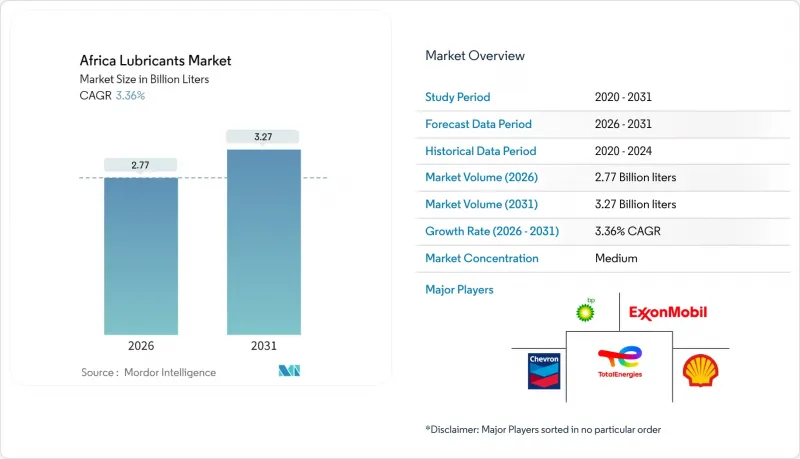
稳健的基础设施发展规划、加速成长的矿业生产以及区域内快速扩张的车辆保有量正在支撑销售成长。公共和私人对公路、铁路和能源资产的投资持续推动施工机械润滑油的需求成长,而从开罗到拉各斯等都市区车辆普及率的提高则支撑了汽车机油的持续消费。本地炼油厂的升级改造,特别是尼日利亚新增产能的基础油,正在增强区域供应的韧性并降低对进口的依赖。整车製造商对延长保养週期的需求正推动买家转向合成油,尤其是在实施欧4和欧5排放气体标准的市场;这一趋势在埃及、南非和摩洛哥最为显着。市场竞争依然适中,大型国际企业凭藉其品牌资产和技术优势占据主导地位,而本地供应商则透过提供灵活的包装规格、价格具有竞争力的矿物油基配方以及本地化的设施服务来提升市场份额。
非洲润滑油市场趋势与洞察
汽车消费量的快速成长正在推动对汽车润滑油的需求。
在主要大都市地区,车辆保有量的成长速度超过了人口成长速度,从而稳定扩大了对引擎油、变速箱油和煞车油的需求。拉各斯和约翰尼斯堡的商用卡车车队面临高强度的使用週期,导致换油週期缩短,油耗增加。北非各地的本土组装厂需要充足的出厂油量和稳定的售后市场供应,而在地采购法规也鼓励本土混合使用。随着现代引擎的普及,驾驶正逐渐从单一黏度等级的机油转向多层黏度等级的机油,而对小包装规格的偏好也符合私人汽车车主的购买力。原厂服务网推荐符合欧盟5排放气体标准的认证产品,加速了中型SAP合成混合油的普及。
基础设施主导的采矿和建筑热潮
南非、尚比亚和摩洛哥的铜矿、磷酸盐矿和关键矿产计划正在扩张,这些计画都高度依赖重型装载机和输送机。这些设备需要能够承受粉尘和重载的高级液压油和极压齿轮油。埃及和奈及利亚正在进行公路、港口和铁路的同步升级改造,这支撑了对大型土木机械和发电机组所用润滑脂和涡轮机油的需求。能够向偏远地区大批量供货的供应商正在运转率合同,而提供油液分析和状态监测服务的公司则在建立长期合作关係并确保产品销售量。建筑联合体可预测的运作计画带来了订单,即使在乘用车消费季节性低迷时期,也为调油机的稳定运作奠定了基础。
燃油补贴的持续波动扭曲了价格。
补贴的突然取消或恢復会间接影响润滑油需求,导致油价波动,迫使运输公司重新评估里程和维护预算。成本的突然上涨会促使业者延长换油週期或考虑改用价格更低的单一黏度润滑油,从而降低高端润滑油的销售量。外汇和补贴水准同步变动时,进口商难以预测到岸成本,这使得库存管理决策更加复杂。政策的不确定性会抑制对调配厂和仓储设施的大规模资本投资,从而延长对合约调配和第三方物流的依赖。
细分市场分析
截至2025年,汽车机油占非洲润滑油市场的36.05%,这主要得益于非洲大陆车辆老化以及恶劣的运作环境。商用卡车消耗的润滑油最多,频繁的换油需求推高了年度总消耗量。在埃及和奈及利亚工业多元化计画的推动下,橡胶、纺织和石化工厂的加工油预计将以4.25%的复合年增长率成长,在所有产品线中成长最高。齿轮油用于运作巨大衝击负荷的地下采矿设备,而变速箱油由于商用车自动变速箱的广泛应用而日益重要。液压油在西非和北非大型建筑工地的后铲和起重机中需求稳定。金属加工液与国内零件製造业的发展密切相关,特别是摩洛哥近期新建的煞车皮和滤清器工厂。
露天矿山和船舶推进器对润滑脂的需求不断增长,其中锂基复合润滑脂因其防水性能而备受青睐。煞车油的需求与新车组装同步线性成长,但向电动车的转型可能会限制其长期扩张。涡轮机油的需求主要来自国家电气化计划下运作的联合循环燃气发电厂,而变压器油则受益于电网强化计划旨在为快速都市化的地区供电。丰富的产品组合支撑着非洲润滑油市场的韧性。即使某些终端用户领域出现疲软,其他领域的成长也足以弥补这一不足。
非洲润滑油市场报告按产品类型(汽车引擎油、工业引擎油等)、终端用户产业(汽车、船舶、航太、重型机械、工业)、基础油类型(矿物油基、合成油、半合成油、生物基)和地区(尼日利亚、南非、埃及、阿尔及利亚、摩洛哥和非洲其他地区)进行细分。市场预测以公升为单位。
其他福利:
- Excel格式的市场预测(ME)表
- 3个月的分析师支持
目录
第一章 引言
- 研究假设和市场定义
- 调查范围
第二章调查方法
第三章执行摘要
第四章 市场情势
- 市场概览
- 市场驱动因素
- 汽车消费量的快速成长带动了对汽车润滑油的需求。
- 基础设施主导的采矿和建筑热潮
- 由于国内炼油厂设备升级,基油供应增加
- 原厂延长换油週期的做法倾向使用合成机油。
- 快速成长的电商车队需要高性能润滑油
- 市场限制
- 燃油补贴的持续波动扭曲了价格。
- 低品质I类进口产品的主导地位
- 非正式的假石油网络损害品牌价值
- 价值链分析
- 法律规范
- 终端用户趋势
- 汽车产业
- 製造业
- 发电业
- 波特五力模型
- 供应商的议价能力
- 买方的议价能力
- 新进入者的威胁
- 替代品的威胁
- 竞争程度
第五章 市场规模与成长预测
- 依产品类型
- 汽车引擎油
- 工业机油
- 变速箱油
- 齿轮油
- 煞车油
- 油压
- 润滑脂
- 加工油(包括橡胶加工油和白油)
- 金属加工油
- 涡轮机油
- 变压器油
- 其他产品类型
- 按最终用户行业划分
- 车
- 搭乘用车
- 商用车辆
- 摩托车
- 船舶
- 航太
- 重型机械
- 建造
- 矿业
- 农业
- 工业的
- 发电
- 冶金/金属加工
- 纺织业
- 石油和天然气
- 其他终端用户产业
- 车
- 依基础油类型
- 矿物油性润滑剂
- 合成润滑油
- 半合成润滑油
- 生物性润滑剂
- 按地区
- 奈及利亚
- 南非
- 埃及
- 阿尔及利亚
- 摩洛哥
- 其他非洲地区
第六章 竞争情势
- 市场集中度
- 策略趋势
- 市占率(%)/排名分析
- 公司简介
- Ardova Plc
- BP plc
- Chevron Corporation
- CONOIL GROUP PTY LTD.
- Engen Petroleum(PTY)LTD
- Exxon Mobil Corporation
- FUCHS
- Misr Petroleum
- MRS OIL NIGERIA PLC
- Oando PLC
- Sasol
- Shell plc
- TotalEnergies
- Vivo Energy Holding BV
第七章 市场机会与未来展望
第八章:执行长面临的关键策略挑战
The Africa Lubricants Market is expected to grow from 2.68 billion liters in 2025 to 2.77 billion liters in 2026 and is forecast to reach 3.27 billion liters by 2031 at 3.36% CAGR over 2026-2031.
Robust infrastructure programs, accelerating mining output, and the rapid expansion of regional vehicle fleets underpin this volume growth. Public and private investments in road, rail, and energy assets continue to drive higher demand for construction machinery lubricants, while rising motorization rates in cities, from Cairo to Lagos, support sustained consumption of automotive engine oils. Local refinery upgrades, notably the base-oil streams emerging from new Nigerian capacity, strengthen regional supply resilience and temper import dependence. OEM mandates for extended drain intervals are nudging buyers toward synthetic grades, especially in markets now enforcing Euro 4 and Euro 5 emission norms, and this transition is most evident in Egypt, South Africa, and Morocco. Competitive intensity remains moderate; international majors leverage brand equity and technical know-how, yet regionally rooted suppliers gain ground by offering flexible pack sizes, price-competitive mineral formulations, and on-site equipment services.
Africa Lubricants Market Trends and Insights
Rapid Motorization Driving Automotive Lubricant Demand
Vehicle ownership is rising faster than population growth in major urban centers, creating a steady pull for engine oils, transmission fluids, and brake fluids. Commercial truck fleets in Lagos and Johannesburg experience arduous duty cycles, which shorten oil change intervals and increase consumption. National assembly plants across North Africa now require factory-fill volumes and consistent aftermarket supply, with local content regulations encouraging in-country blending. Motorists are gradually shifting from monograde to multigrade formulations as modern engines become more prevalent, and the preference for smaller pack sizes aligns with the purchasing power of individual car owners. OEM service networks champion licensed products that meet Euro 5 emission requirements, thereby accelerating the uptake of mid-SAPs synthetic blends.
Infrastructure-Led Mining and Construction Boom
Copper, phosphate, and critical mineral projects are expanding in South Africa, Zambia, and Morocco, each utilizing heavy mechanical loaders and conveyors that require premium hydraulic fluids and EP gear oils capable of withstanding dust and high loads. Concurrent road, port, and rail upgrades across Egypt and Nigeria sustain demand for greases and turbine oils used in large earth-moving equipment and power generation sets. Suppliers able to deliver bulk volumes to remote sites win contracts, while those offering oil analysis and condition monitoring services secure long-term relationships that lock in product offtake. The predictable operating schedules of construction consortia create baseline orders that stabilize blender capacity utilization even during seasonal dips in passenger car consumption.
Persistent Fuel-Subsidy Volatility Distorting Prices
Abrupt subsidy removals or reinstatements shift pump prices and indirectly influence lubricant demand, as transporters recalibrate mileage and maintenance budgets. Sudden cost spikes prompt operators to stretch drain intervals or down-trade to cheaper monograde oils, eroding premium segment volumes. Importers struggle to forecast landed costs when exchange rates and subsidy levels change in tandem, complicating inventory decisions. Policy uncertainty discourages heavy capital investment in blending plants and storage, prolonging reliance on toll blending and third-party logistics.
Other drivers and restraints analyzed in the detailed report include:
- Local Refinery Upgrades Boosting Base-Oil Availability
- OEM Drain-Interval Extensions Favoring Synthetics
- Dominance of Low-Grade Group I Imports
For complete list of drivers and restraints, kindly check the Table Of Contents.
Segment Analysis
Automotive engine oil held 36.05% of Africa's lubricants market share in 2025, supported by a continent-wide vehicle fleet that continues to age under challenging operating conditions. Commercial trucks account for a sizable portion of sump volumes, and frequent oil changes increase the total liters consumed each year. Process oils, serving rubber, textile, and petrochemical plants, are forecast to grow at a 4.25% CAGR, the fastest among all product lines, thanks to industrial diversification programs in Egypt and Nigeria. Gear oils cater to underground mining machines that operate under extreme shock loads, while transmission fluids gain prominence as automatic gearboxes become more prevalent in commercial fleets. Hydraulic fluids experience steady demand from backhoes and cranes operating on large construction sites throughout West and North Africa. Metalworking fluids track the evolution of domestic component manufacturing, particularly the brake pad and filter plants that have recently been established in Morocco.
Demand for greases is rising in surface mining and marine thrusters, with lithium-complex products preferred for their water resistance. Brake fluids show linear growth in line with new vehicle assemblies, though the shift toward electric cars may curb long-term expansion. Turbine oils secure slots in combined-cycle gas plants commissioned under national electrification agendas, and transformer oils benefit from grid reinforcement projects feeding rapidly urbanizing regions. Collectively, the diversified product slate anchors the resilience of the Africa lubricants market, balancing cyclical softness in any single end-use with momentum in others.
The Africa Lubricants Market Report is Segmented by Product Type (Automotive Engine Oil, Industrial Engine Oil, and More), End-User Industry (Automotive, Marine, Aerospace, Heavy Equipment, and Industrial), Base Stock Type (Mineral Oil-Based, Synthetic, Semi-Synthetic, and Bio-Based), and Geography (Nigeria, South Africa, Egypt, Algeria, Morocco, and Rest of Africa). The Market Forecasts are Provided in Terms of Volume (Liters).
List of Companies Covered in this Report:
- Ardova Plc
- BP plc
- Chevron Corporation
- CONOIL GROUP PTY LTD.
- Engen Petroleum (PTY) LTD
- Exxon Mobil Corporation
- FUCHS
- Misr Petroleum
- MRS OIL NIGERIA PLC
- Oando PLC
- Sasol
- Shell plc
- TotalEnergies
- Vivo Energy Holding B.V.
Additional Benefits:
- The market estimate (ME) sheet in Excel format
- 3 months of analyst support
TABLE OF CONTENTS
1 Introduction
- 1.1 Study Assumptions and Market Definition
- 1.2 Scope of the Study
2 Research Methodology
3 Executive Summary
4 Market Landscape
- 4.1 Market Overview
- 4.2 Market Drivers
- 4.2.1 Rapid motorisation driving automotive lubricant demand
- 4.2.2 Infrastructure-led mining and construction boom
- 4.2.3 Local refinery upgrades boosting base-oil availability
- 4.2.4 OEM drain-interval extensions favouring synthetics
- 4.2.5 Fast-growing e-commerce fleet requiring high-performance fluids
- 4.3 Market Restraints
- 4.3.1 Persistent fuel-subsidy volatility distorting prices
- 4.3.2 Dominance of low-grade Group I imports
- 4.3.3 Informal counterfeit-oil networks eroding brand value
- 4.4 Value Chain Analysis
- 4.5 Regulatory Framework
- 4.6 End-User Trends
- 4.6.1 Automotive Industry
- 4.6.2 Manufacturing Industry
- 4.6.3 Power Generation Industry
- 4.7 Porter's Five Forces
- 4.7.1 Bargaining Power of Suppliers
- 4.7.2 Bargaining Power of Buyers
- 4.7.3 Threat of New Entrants
- 4.7.4 Threat of Substitutes
- 4.7.5 Degree of Competition
5 Market Size and Growth Forecasts (Volume)
- 5.1 By Product Type
- 5.1.1 Automotive Engine Oil
- 5.1.2 Industrial Engine Oil
- 5.1.3 Transmission Fluids
- 5.1.4 Gear Oil
- 5.1.5 Brake Fluids
- 5.1.6 Hydraulic Fluids
- 5.1.7 Greases
- 5.1.8 Process Oil (Including Rubber Process Oil and White Oil)
- 5.1.9 Metalworking Fluids
- 5.1.10 Turbine Oil
- 5.1.11 Transformer Oil
- 5.1.12 Other Product Types
- 5.2 By End-user Industry
- 5.2.1 Automotive
- 5.2.1.1 Passenger Vehicles
- 5.2.1.2 Commercial Vehicles
- 5.2.1.3 Two-Wheelers
- 5.2.2 Marine
- 5.2.3 Aerospace
- 5.2.4 Heavy Equipment
- 5.2.4.1 Construction
- 5.2.4.2 Mining
- 5.2.4.3 Agriculture
- 5.2.5 Industrial
- 5.2.5.1 Power Generation
- 5.2.5.2 Metallurgy and Metalworking
- 5.2.5.3 Textiles
- 5.2.5.4 Oil and Gas
- 5.2.5.5 Other End-Use Industries
- 5.2.1 Automotive
- 5.3 By Base Stock Type
- 5.3.1 Mineral Oil-Based Lubricants
- 5.3.2 Synthetic Lubricants
- 5.3.3 Semi-Synthetic Lubricants
- 5.3.4 Bio-Based Lubricants
- 5.4 By Geography
- 5.4.1 Nigeria
- 5.4.2 South Africa
- 5.4.3 Egypt
- 5.4.4 Algeria
- 5.4.5 Morocco
- 5.4.6 Rest of Africa
6 Competitive Landscape
- 6.1 Market Concentration
- 6.2 Strategic Moves
- 6.3 Market Share (%)/Ranking Analysis
- 6.4 Company Profiles (includes Global-level Overview, Market-level Overview, Core Segments, Financials, Strategic Information, Market Rank/Share, Products and Services, Recent Developments)
- 6.4.1 Ardova Plc
- 6.4.2 BP plc
- 6.4.3 Chevron Corporation
- 6.4.4 CONOIL GROUP PTY LTD.
- 6.4.5 Engen Petroleum (PTY) LTD
- 6.4.6 Exxon Mobil Corporation
- 6.4.7 FUCHS
- 6.4.8 Misr Petroleum
- 6.4.9 MRS OIL NIGERIA PLC
- 6.4.10 Oando PLC
- 6.4.11 Sasol
- 6.4.12 Shell plc
- 6.4.13 TotalEnergies
- 6.4.14 Vivo Energy Holding B.V.
7 Market Opportunities and Future Outlook
- 7.1 White-space and Unmet-need Assessment
8 Key Strategic Questions for CEOs

 拉丝润滑剂市场:2026-2032年全球市场预测(依产品类型、添加剂类型、线材类型、应用、终端用户产业和销售管道划分)外科润滑剂市场:按类型、应用、最终用户和分销管道划分-2026-2032年全球市场预测
 2026年全球润滑油市场报告润滑油市场:按产品类型、基础油、黏度等级、最终用户和分销管道分類的全球市场预测,2026-2032年大豆油基润滑剂市场:2026-2032年全球市场预测(依产品类型、包装、应用、终端用户产业及通路划分)纺织润滑剂市场:依产品类型、剂型、应用及最终用途划分-2026年至2032年全球预测金属切削润滑剂市场:依产品类型、金属类型、应用、终端用户产业和通路划分-2026-2032年全球预测
 润滑油过滤器市场规模、份额和成长分析:按过滤器类型、应用、材质、最终用户和地区划分 - 2026-2033 年产业预测
 2026-2034年全球纱线润滑剂市场规模、份额、趋势和成长分析报告
 玻璃润滑剂市场规模、份额和成长分析:按润滑剂基础类型、配方类型、应用方法、包装类型、最终用户产业和地区划分-2026-2033年产业预测