


 |
市场调查报告书
商品编码
1937423
ESG评估服务:市场占有率分析、产业趋势与统计、成长预测(2026-2031年)ESG Rating Services - Market Share Analysis, Industry Trends & Statistics, Growth Forecasts (2026 - 2031) |
||||||

※ 本网页内容可能与最新版本有所差异。详细情况请与我们联繫。
预计到 2026 年,ESG 评估服务市场规模将达到 126.9 亿美元,高于 2025 年的 117.2 亿美元。
预计到 2031 年将达到 188.8 亿美元,2026 年至 2031 年的复合年增长率为 8.28%。
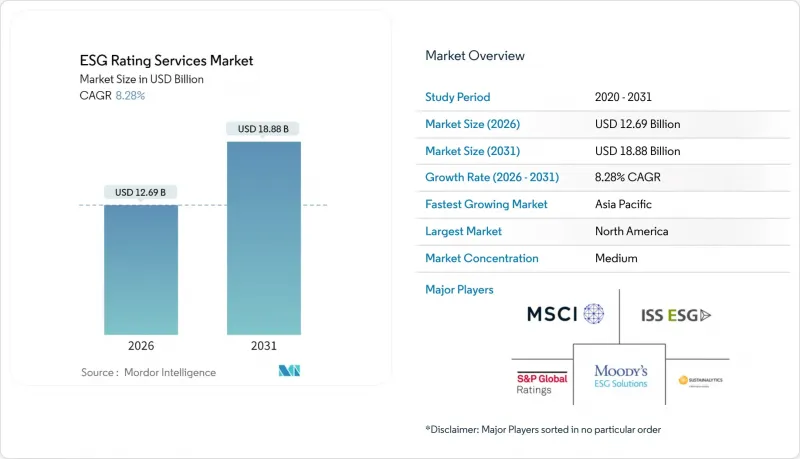
这项成长的驱动力来自强制性资讯揭露制度的普及,例如欧盟企业永续发展报告指令 (CSRD) 和美国证券交易委员会 (SEC) 的气候变迁规则,以及机构投资者对标准化永续发展指标日益增长的需求。资产管理公司正在增加对详细、机器可读的 ESG 资料集的预算,企业也争相获取第三方评估,以支持与相关人员的沟通和监管申报。数据供应商之间的整合使得主要供应商能够将评分和分析功能打包在一起,而诸如自然相关财务资讯揭露工作组 (TNFD) 等框架的扩展则推动了生物多样性指标方面的产品创新。然而,美国一些州的政治反对以及供应商之间持续存在的低相关性,都为这一领域的强劲前景蒙上了一层阴影。
全球ESG评级服务市场趋势与洞察
从2025年起,强制性资讯揭露制度的激增将重塑市场需求。
企业永续发展报告指令 (CSRD) 于 2025 年 1 月全面实施,要求约 5 万家公司发布双重重要性 ESG 报告,评级机构将这些报告转化为可供投资者参考的评分。同时,国际标准理事会 (ISSB) 的 IFRS S1 和 S2 标准在 15 个司法管辖区获得采纳,建立了一项全球报告标准,提高了发行人的合规门槛。 [3] 能够协调 CSRD、ISSB 和美国证券交易委员会 (SEC) 规则手册中调查方法的机构将获得竞争优势,因为企业更倾向于获得能够满足多个监管机构要求的单一评分。协调一致有助于揭露关于排放、员工多元化和管治结构的详细、审核的指标,从而提升资料深度。因此,ESG评级服务市场对将原始数据、检验和分析整合到单一订阅中的垂直整合解决方案的需求日益增长。韩国、巴西和加拿大持续的监管更新正在推动目标报告量的成长,确保资讯揭露主导的成长能够从西方扩展到全球中端市场。
资产管理公司利用人工智慧增强的ESG分析寻求超额收益
机构投资者正计划将2024年技术预算的15%至20%分配给ESG数据基础设施,这标誌着投资结构正从回顾性的合规转向追求超额收益的分析。贝莱德的Aladdin平台将ESG风险分析应用于其管理的21兆美元资产,而道富银行则利用机器学习技术每天处理4万个永续发展指标。评级机构目前正在发布基于API的“数据湖”,为即时摄取新闻、卫星数据和物联网感测器数据的量化模型提供数据。 MSCI报告称,在纳入衡量气候风险的另类资料集后,其ESG分析部门2024年的营收成长了40%。买方量化分析师越来越重视前瞻性指标,例如资本支出与净零排放路径的一致性,而这些领域需要强大且持续更新的资料流。因此,ESG评级服务市场正在奖励那些能够提供清晰、标准化、机器可读且整合到投资组合管理系统中的资料来源的供应商。
欧盟ESG评级规定限製经营模式整合
欧盟ESG评级条例将于2025年生效,届时将禁止向评级公司提供咨询服务,并强制要求咨询部门进行结构性分离。 ISS ESG和Sustainalytics等公司将被要求建立资讯隔离墙、审查管治并揭露利益衝突管理程序。据估计,主要供应商每年的合规成本将高达200万至500万欧元,这将挤压其营运利润空间并延缓产品推出。该条例还将限制对咨询客户所开发的内部研究成果的重复使用,迫使企业进行重复资料收集,从而减少交叉销售收入,并引发人们对综合解决方案有效性的质疑,进而推动了近期ESG评级服务市场的併购活动。
细分市场分析
到2025年,ESG评估将占ESG评估服务市场38.10%的份额,在使资本配置与永续性目标保持一致方面发挥着至关重要的作用。随着《企业永续发展报告指令》(CSRD)强制要求对永续发展报告进行第三方鑑证,以及国际永续发展标准理事会(ISSB)倡导审核层级的严谨性,检验和鑑证服务正以9.35%的复合年增长率快速成长。预计到2031年,检验ESG评估服务市场规模将达到48.1亿美元,巩固其作为企业进入受监管资讯揭露环境的最佳切入点的地位。四大审核事务所正在部署整合审核、气候科学和精算技能的多学科团队,加剧竞争并提高整体市场渗透率。对于寻求特定产业框架的发行人而言,咨询和客製化服务仍然至关重要,但避免利益衝突的压力正在限制欧洲的收入潜力。 ISSA 5000 将于 2025 年投入使用,届时标准制定将减少调查方法的碎片化,并减少采购保证方面的摩擦。
ESG评级服务市场正日益采用自动化资料撷取、利用自然语言处理(NLP)进行说明检验以及整合卫星影像进行现场验证等技术。即时保证缩短了报告週期,增强了投资人信心。全球企业正寻求将检验查核点嵌入其核心系统,以便将永续性绩效指标(KPI)自动反映在季度报告中。竞争格局有利于提供模组化保证方案的供应商,这些方案可从单一主题检验扩展到企业级永续性审核。新兴企业正在利用区块链时间戳来增强资料完整性,迫使现有企业加快创新步伐。从基于计划的合约模式转向基于订阅模式的转变,正在使ESG评级服务市场服务领域的收入来源更加多元化。
区域分析
北美地区创造了最大的区域收入,预计到2025年将占ESG评级服务市场规模的39.85%。这主要得益于该地区高达50兆美元的机构资产管理规模(AUM)以及美国证券交易委员会(SEC)气候报告规则的实施,该规则影响了7,000家发行人。加州公共僱员退休系统(CalPERS)等退休基金要求对超过20亿美元的股票持股进行ESG评级,大学捐赠基金也将ESG评分纳入其策略性资产配置。然而,24个州通过的反ESG法案加剧了政策的不确定性,迫使服务提供者发布免责声明,确保指数符合州法规,并应对政治争议带来的声誉风险。
亚太地区以8.78%的复合年增长率呈现最快成长态势,这主要得益于新加坡强制上市公司在2025年前提交气候报告的蓝图,以及日本对占该国市值70%的优质市场公司采用符合气候相关财务资讯揭露框架(TCFD)的资讯揭露要求。印度的企业责任与永续性报告架构涵盖了前1000家上市公司,其国内数据收集平台促进了与全球评级机构的合作。中国2060年净零排放承诺将环境、社会和治理(ESG)的重要性扩展到国有企业,而东协正在製定强调统一评级资讯的永续金融分类体系。这些发展势头使亚太地区成为ESG评级服务市场成长的关键驱动力。
在欧洲,《企业永续性报告指令》(CSRD)、欧盟分类法和《永续金融揭露条例》(SFDR)透过对约5万家公司施加ESG义务,支持了两位数的收入成长。该地区的双重重要性标准要求发行人同时报告财务重要性和影响重要性,提高了数据细分的标准,并塑造了全球最佳实践。拉丁美洲和中东/非洲等小规模的地区正在谨慎地取得进展。巴西的B3交易所强制要求揭露永续发展讯息,而阿联酋的绿色金融框架正在帮助石油出口经济体调整发展方向。新兴市场的数据匮乏、有限的鑑证能力以及信用风险问题仍然阻碍相关法规的采用。然而,随着监管要求的日益严格,在这些地区率先部署相关法规的供应商将有望获得先发优势。
其他福利:
- Excel格式的市场预测(ME)表
- 分析师支持(3个月)
目录
第一章:目录 - ESG评估服务市场
第二章 引言
- 研究假设和市场定义
- 调查范围
第三章调查方法
第四章执行摘要
第五章 市场情势
- 市场概览
- 市场驱动因素
- 2025 年后强制资讯揭露制度的激增(欧盟企业永续发展报告指令、美国证券交易委员会气候条例、国际永续发展准则理事会)
- 资产管理公司利用人工智慧驱动的、分解的ESG资料集寻求超额收益。
- 快速整合原始资料供应商可以实现捆绑式评级和资料产品。
- 扩展自然与生物多样性相关指标(TNFD)
- 将ESG API整合到交易/风险管理系统中的金融科技
- 民营市场投资者对可比较ESG评分的需求日益增长
- 市场限制
- 对混合估值和咨询模式的监管限制(欧盟ESG估值法规)
- 供应商之间持续的低相关性正在削弱投资者信心。
- 美国主要州的政治反弹和反ESG立法
- 新兴市场中小企业缺乏检验的范围3数据
- 价值/供应链分析
- 监管环境
- 技术展望
- 波特五力模型
- 新进入者的威胁
- 供应商的议价能力
- 买方的议价能力
- 替代品的威胁
- 竞争对手之间的竞争
第六章 市场规模与成长预测
- 按服务类型
- ESG评估
- ESG 数据和评分
- ESG分析工具
- ESG保证与检验
- 咨询/客製化
- 最终用户
- 资产管理公司
- 资产所有者和退休基金
- 银行和其他金融机构
- 非金融公司
- 保险公司
- 政府和公共机构
- 其他相关人员
- 资产类别覆盖范围
- 库存产品
- 固定收益(公司债/公债)
- 私募市场和替代投资
- 实体资产(基础设施/房地产)
- 多元资产组合
- 按地区
- 北美洲
- 我们
- 加拿大
- 墨西哥
- 南美洲
- 巴西
- 秘鲁
- 智利
- 阿根廷
- 其他南美洲
- 欧洲
- 英国
- 德国
- 法国
- 西班牙
- 义大利
- 比荷卢经济联盟
- 北欧国家
- 其他欧洲地区
- 亚太地区
- 印度
- 中国
- 日本
- 澳洲
- 韩国
- 东南亚
- 亚太其他地区
- 中东和非洲
- 阿拉伯聯合大公国
- 沙乌地阿拉伯
- 南非
- 奈及利亚
- 其他中东和非洲地区
- 北美洲
第七章 竞争情势
- 市场集中度
- 策略趋势
- 市占率分析
- 公司简介
- MSCI
- Sustainalytics/Morningstar
- ISS ESG
- S&P Global ESG Scores
- Moody's ESG Solutions
- LSEG Refinitiv
- Bloomberg ESG
- Fitch(Sustainable Fitch)
- FTSE Russell
- EcoVadis
- CDP
- Arabesque S-Ray
- Clarity AI
- RepRisk
- FactSet Truvalue Labs
- Vigeo Eiris
- GRESB
- Standard Ethics
- Inrate
- CSRHub
第八章:市场机会与未来展望
- 閒置频段与未满足需求评估
ESG rating services market size in 2026 is estimated at USD 12.69 billion, growing from 2025 value of USD 11.72 billion with 2031 projections showing USD 18.88 billion, growing at 8.28% CAGR over 2026-2031.
Growth is propelled by the convergence of mandatory disclosure regimes such as the EU Corporate Sustainability Reporting Directive (CSRD) and the U.S. Securities and Exchange Commission (SEC) climate rule, coupled with rising institutional investor demand for standardized sustainability metrics. Asset managers are widening budgets for granular, machine-readable ESG datasets, while corporates rush to secure third-party ratings that validate stakeholder communications and regulatory filings. Consolidation among data vendors lets leading providers package scores with analytics, and the expansion of frameworks like the Task Force on Nature-related Financial Disclosures (TNFD) is catalyzing product innovation around biodiversity metrics. Political pushback in several U.S. states and persistent low correlation across providers temper the otherwise robust outlook.
Global ESG Rating Services Market Trends and Insights
Post-2025 Surge in Mandatory Disclosure Regimes Reshapes Market Demand
The CSRD took full effect in January 2025, obliging roughly 50,000 companies to publish double-materiality ESG reports that rating providers convert into investor-grade scores. Simultaneously, the ISSB's IFRS S1 and S2 standards have been adopted in 15 jurisdictions, establishing a global reporting baseline that raises the compliance bar for issuers[3]. Providers able to synchronize methodologies across CSRD, ISSB, and the SEC rulebook win a competitive advantage because corporates prefer a single score that satisfies multiple regulators. Harmonization fuels data depth as firms disclose granular, audit-ready metrics on emissions, workforce diversity, and governance structures. Consequently, the ESG rating services market experiences heavier demand for vertically integrated offerings that bundle raw data, verification, and analytics into one subscription. Persistent regulatory updates in South Korea, Brazil, and Canada expand addressable volumes, ensuring that disclosure-driven growth extends beyond Europe and the United States into global mid-cap universes.
Asset Managers Pursue Alpha Through AI-Enhanced ESG Analytics
Institutional investors allocated 15-20% of 2024 technology budgets to ESG data infrastructure, signaling a structural pivot from backward-looking compliance toward alpha-seeking analytics. BlackRock's Aladdin platform applied ESG risk analytics across USD 21 trillion in AUM, while State Street processed 40,000 sustainability metrics daily using machine learning. Rating providers now release API-based "data lakes" that feed quantitative models ingesting news, satellite feeds, and IoT sensors in real time. MSCI reported 40% revenue growth in ESG analytics during 2024 after embedding alternative data sets measuring physical climate risk. Buy-side quants increasingly weight forward-looking metrics such as capital expenditure alignment to net-zero pathways, and these fields require robust, continuously updated data streams. The ESG rating services market, therefore, rewards providers capable of delivering clean, normalized, machine-readable feeds integrated into portfolio-management systems.
EU ESG Ratings Regulation Constrains Business-Model Integration
Entering force in 2025, the EU ESG Ratings Regulation bans providers from offering advisory services to rated entities, compelling structural separation of consulting arms. Firms such as ISS ESG and Sustainalytics must erect Chinese walls, overhaul governance, and disclose conflict-management procedures. Estimated compliance costs range from EUR 2 million to EUR 5 million annually for large vendors, eroding operating margins and delaying product roll-outs. The rule also restricts the reuse of internal research produced for consulting clients, forcing duplicative data collection. These constraints reduce cross-selling revenues and challenge the integrated-solutions thesis, driving recent M&A in the ESG rating services market.
Other drivers and restraints analyzed in the detailed report include:
- Rapid Consolidation of Raw-Data Vendors Enables Comprehensive Offerings
- TNFD Framework Drives Nature-Related Financial Disclosure Adoption
- Correlation Challenges Undermine Rating Credibility and Adoption
For complete list of drivers and restraints, kindly check the Table Of Contents.
Segment Analysis
ESG ratings captured 38.10% of the ESG rating services market in 2025, underscoring their foundational role in aligning capital allocation with sustainability objectives. Verification and assurance services rise at a 9.35% CAGR because CSRD mandates third-party assurance for sustainability statements while ISSB encourages audit-like rigor. The ESG rating services market size for verification is expected to reach USD 4.81 billion by 2031, cementing its position as the preferred gateway for corporates entering regulated disclosure landscapes. Big Four accounting firms deploy cross-disciplinary teams combining audit, climate science, and actuarial skill sets, which drives price competition but also increases overall market penetration. Advisory and customization maintain relevance among issuers seeking sector-specific frameworks, yet pressures to avoid conflicts of interest temper revenue potential in Europe. As ISSA 5000 becomes operative in 2025, standard-setting should reduce methodological fragmentation and lower assurance-procurement friction.
The ESG rating services market witnesses technology infusion as providers automate data ingestion, apply NLP for narrative verification, and integrate satellite imagery for onsite confirmation. Real-time attestations shorten reporting cycles and refine investor confidence. Global corporates aim to embed verification checkpoints inside enterprise resource-planning systems, ensuring that sustainability KPIs roll automatically into quarterly filings. Competitive dynamics favor vendors offering modular assurance packages that can range from single-topic verification to enterprise-wide sustainability audits. Emerging players leverage blockchain timestamps to enhance data integrity, challenging incumbents to accelerate innovation. Subscription-based models gradually replace project-based engagements, diversifying revenue streams within the ESG rating services market size for services.
The ESG Rating Services Market is Segmented by Service Type (ESG Ratings, ESG Data & Scores, and More), End-User (Asset Managers, Asset Owners & Pension Funds, and More), Asset-Class Coverage (Equity Instruments, Fixed-Income (Corporate & Sovereign), Private Markets & Alternatives, Real Assets (Infrastructure / Real Estate), and More), and Geography. The Market Forecasts are Provided in Value (USD).
Geography Analysis
North America generated the largest regional revenue in 2025 at 39.85% share of the ESG rating services market size, bolstered by institutional AUM of USD 50 trillion and imminent SEC climate reporting rules affecting 7,000 issuers [SEC]. Pension funds such as CalPERS mandate ESG ratings for equity holdings above USD 2 billion, while university endowments integrate scores into strategic asset allocations. Yet 24 state-level anti-ESG statutes inject policy uncertainty, compelling providers to issue disclaimers, maintain state-compliant indexes, and manage reputational exposure to political discourse.
Asia-Pacific exhibits the fastest expansion at 8.78% CAGR, driven by Singapore's roadmap requiring listed firms to publish climate reports by 2025 and Japan's adoption of TCFD-aligned disclosures for prime-market companies representing 70% of domestic capitalization. India's Business Responsibility and Sustainability Reporting framework covers the top 1,000 listed entities, prompting domestic data collection platforms to collaborate with global rating houses. China's 2060 net-zero pledge extends ESG relevance to state-owned enterprises, while ASEAN develops a sustainable finance taxonomy that favors harmonized rating inputs. The momentum positions Asia-Pacific as the focal engine for incremental growth within the ESG rating services market.
Europe sustains double-digit revenue streams anchored in the CSRD, EU Taxonomy, and SFDR, collectively imposing ESG obligations on roughly 50,000 companies. The bloc's double-materiality lens requires issuers to report on both financial and impact materiality, raising data granularity standards that shape global best practices. Smaller regions like Latin America and the Middle East & Africa proceed cautiously; Brazil's B3 exchange mandates sustainability disclosures, and the UAE's green-finance framework supports pathway alignment for oil-exporting economies. Data scarcity, limited assurance capacity, and emerging-market credit-risk concerns continue to slow penetration. Nonetheless, providers that pre-position in these regions stand to capture first-mover advantages once regulatory expectations tighten.
- MSCI
- Sustainalytics / Morningstar
- ISS ESG
- S&P Global ESG Scores
- Moody's ESG Solutions
- LSEG Refinitiv
- Bloomberg ESG
- Fitch (Sustainable Fitch)
- FTSE Russell
- EcoVadis
- CDP
- Arabesque S-Ray
- Clarity AI
- RepRisk
- FactSet Truvalue Labs
- Vigeo Eiris
- GRESB
- Standard Ethics
- Inrate
- CSRHub
Additional Benefits:
- The market estimate (ME) sheet in Excel format
- 3 months of analyst support
TABLE OF CONTENTS
1 Table of Contents - ESG Rating Services Market
2 Introduction
- 2.1 Study Assumptions & Market Definition
- 2.2 Scope of the Study
3 Research Methodology
4 Executive Summary
5 Market Landscape
- 5.1 Market Overview
- 5.2 Market Drivers
- 5.2.1 Post-2025 surge in mandatory disclosure regimes (EU CSRD, SEC climate rule, ISSB)
- 5.2.2 Asset-manager hunt for alpha via AI-ready granular ESG datasets
- 5.2.3 Rapid consolidation of raw-data vendors enabling bundled rating/data offers
- 5.2.4 Expansion of nature- and biodiversity-linked metrics (TNFD)
- 5.2.5 Fintech integration of ESG APIs into trading?/?risk systems
- 5.2.6 Rising demand from private-market investors for comparable ESG scores
- 5.3 Market Restraints
- 5.3.1 Regulatory caps on mixed rating-consulting models (EU ESG Ratings Regulation)
- 5.3.2 Persistent low correlation among providers eroding investor confidence
- 5.3.3 Political backlash & anti-ESG legislation in key U.S. states
- 5.3.4 Scarcity of verifiable Scope-3 data for SMEs in emerging markets
- 5.4 Value / Supply-Chain Analysis
- 5.5 Regulatory Landscape
- 5.6 Technological Outlook
- 5.7 Porter's Five Forces
- 5.7.1 Threat of New Entrants
- 5.7.2 Bargaining Power of Suppliers
- 5.7.3 Bargaining Power of Buyers
- 5.7.4 Threat of Substitute Products
- 5.7.5 Competitive Rivalry
6 Market Size & Growth Forecasts
- 6.1 By Service Type (Value)
- 6.1.1 ESG Ratings
- 6.1.2 ESG Data & Scores
- 6.1.3 ESG Analytics & Tools
- 6.1.4 ESG Assurance & Verification
- 6.1.5 Advisory / Customization
- 6.2 By End-User (Value)
- 6.2.1 Asset Managers
- 6.2.2 Asset Owners & Pension Funds
- 6.2.3 Banks & Other FIs
- 6.2.4 Corporates (Non-Financial)
- 6.2.5 Insurance Companies
- 6.2.6 Governments & Public Institutions
- 6.2.7 Other Stakeholders
- 6.3 By Asset-Class Coverage
- 6.3.1 Equity Instruments
- 6.3.2 Fixed-Income (Corp & Sovereign)
- 6.3.3 Private Markets & Alternatives
- 6.3.4 Real Assets (Infra / RE)
- 6.3.5 Multi-Asset Portfolios
- 6.4 By Geography (Value)
- 6.4.1 North America
- 6.4.1.1 United States
- 6.4.1.2 Canada
- 6.4.1.3 Mexico
- 6.4.2 South America
- 6.4.2.1 Brazil
- 6.4.2.2 Peru
- 6.4.2.3 Chile
- 6.4.2.4 Argentina
- 6.4.2.5 Rest of South America
- 6.4.3 Europe
- 6.4.3.1 United Kingdom
- 6.4.3.2 Germany
- 6.4.3.3 France
- 6.4.3.4 Spain
- 6.4.3.5 Italy
- 6.4.3.6 BENELUX
- 6.4.3.7 NORDICS
- 6.4.3.8 Rest of Europe
- 6.4.4 Asia-Pacific
- 6.4.4.1 India
- 6.4.4.2 China
- 6.4.4.3 Japan
- 6.4.4.4 Australia
- 6.4.4.5 South Korea
- 6.4.4.6 South-East Asia
- 6.4.4.7 Rest of Asia-Pacific
- 6.4.5 Middle East & Africa
- 6.4.5.1 United Arab Emirates
- 6.4.5.2 Saudi Arabia
- 6.4.5.3 South Africa
- 6.4.5.4 Nigeria
- 6.4.5.5 Rest of Middle East & Africa
- 6.4.1 North America
7 Competitive Landscape
- 7.1 Market Concentration
- 7.2 Strategic Moves
- 7.3 Market Share Analysis
- 7.4 Company Profiles (includes Global level Overview, Market level overview, Core Segments, Financials as available, Strategic Information, Market Rank/Share for key companies, Products & Services, and Recent Developments)
- 7.4.1 MSCI
- 7.4.2 Sustainalytics / Morningstar
- 7.4.3 ISS ESG
- 7.4.4 S&P Global ESG Scores
- 7.4.5 Moody's ESG Solutions
- 7.4.6 LSEG Refinitiv
- 7.4.7 Bloomberg ESG
- 7.4.8 Fitch (Sustainable Fitch)
- 7.4.9 FTSE Russell
- 7.4.10 EcoVadis
- 7.4.11 CDP
- 7.4.12 Arabesque S-Ray
- 7.4.13 Clarity AI
- 7.4.14 RepRisk
- 7.4.15 FactSet Truvalue Labs
- 7.4.16 Vigeo Eiris
- 7.4.17 GRESB
- 7.4.18 Standard Ethics
- 7.4.19 Inrate
- 7.4.20 CSRHub
8 Market Opportunities & Future Outlook
- 8.1 White-space & Unmet-Need Assessment

 绿色金融科技和ESG金融平台市场预测至2034年-全球分析(按组件、部署模式、技术、产品类型、应用、最终用户和地区划分)
 2026年全球环境、社会与管治(ESG)关联保险市场报告2026年全球太空法与管治市场报告
 ESG风险管理市场分析及预测(至2035年):依类型、产品类型、服务、技术、组件、应用、部署类型、最终用户及解决方案划分
 ESG投资市场规模、份额、成长及全球产业分析:按类型、应用和地区划分,并预测至2026-2034年
 ESG软体市场规模、份额和趋势分析报告:按部署模式、类型、组织规模、最终用途、地区和细分市场预测,2026-2033年
 ESG认证市场规模、份额和成长分析(按认证类型、产业垂直领域、最终用户、服务类型、环境影响和地区划分)-2026-2033年产业预测全球ESG投资平台市场:预测至2032年-按组件、ESG标准、部署方式、最终用户和地区分類的分析2025年ESG金融全球市场报告
 全球环境、社会与管治(ESG)金融市场