


 |
市场调查报告书
商品编码
1937428
越南电动车市场:市场占有率分析、产业趋势与统计、成长预测(2026-2031)Vietnam Electric Vehicle - Market Share Analysis, Industry Trends & Statistics, Growth Forecasts (2026 - 2031) |
||||||

※ 本网页内容可能与最新版本有所差异。详细情况请与我们联繫。
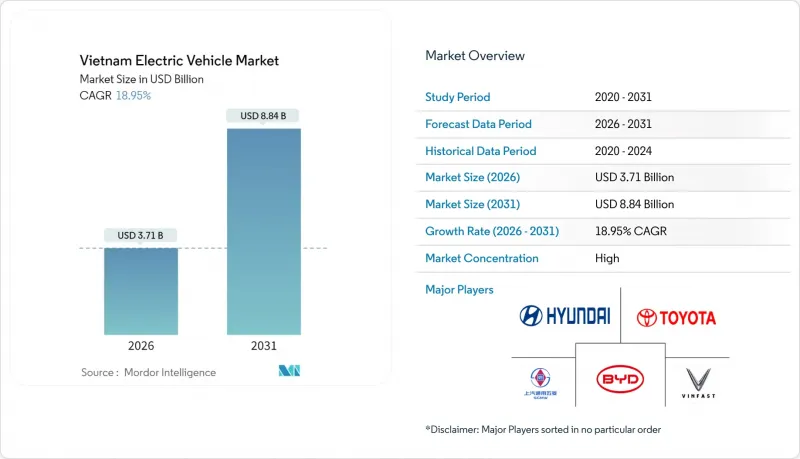
预计到 2026 年,越南电动车市场规模将达到 37.1 亿美元,高于 2025 年的 31.2 亿美元。
预计到 2031 年,该市场规模将达到 88.4 亿美元,2026 年至 2031 年的复合年增长率为 18.95%。
政府设定的2030年都市区电动车普及率达到50%、2050年达到净零排放的明确目标,推动了市场需求。 VinFast的本土化策略、外资OEM厂商的建厂计画以及优惠的电价政策,共同降低了电动车的整体拥有成本,加速了其普及。摩托车电动化的快速推进提升了消费者的环保意识,共用充电基础设施也正在向汽车市场扩展。同时,电池组价格的下降使得磷酸铁锂电池技术在对成本较为敏感的细分市场中成为主流。由于VinFast的市场主导地位抑制了价格战,市场竞争格局相对平静。但随着中国品牌和全球大众市场OEM厂商携具有成本竞争力的车型进入市场,整个生态系统正朝着车型多元化和价格下降的方向发展。
越南电动车市场趋势与洞察
扩大国内生产
VinFast的目标是到2026年达到80%的国产化率,到2027年年产量达到50万辆,到2030年达到100万辆。这项扩张将降低零件成本并减外汇风险。奇瑞和吉利的协同努力巩固了越南作为区域组装中心的地位,但先进的电子元件和电池管理系统仍然依赖进口。 VinFast的销售保障合约为本地供应商提供了需求可见性,从而鼓励新的资本投资并加速在地化进程。
政府激励措施和税收优惠
此奖励方案将免除电动车的註册费至2027年2月,并对东协地区生产的电动车维持零进口关税,使每辆车的购置成本降低超过1亿越南盾。优惠的充电费用(2204越南盾/千瓦时)进一步降低了电动车的总拥有成本。此外,地方政府还采取了其他措施,例如为胡志明市提案的40万辆摩托车改装计画提供税收减免和低利率贷款,这些措施凸显了多层次的政策协调。 2027年后的持续性取决于能否实现成本平价,这使得市场面临财政政策连续性的风险。
公共充电基础设施不足
虽然主要城市的公车系统覆盖全面,但遍远地区的公车密度迅速下降,限制了城际出行和200公里以下路段以外的公车路线发展。 V-Green计画拨款4.04亿美元用于兴建更多公车站,但由于前置作业时间较长,短期内仍将面临瓶颈问题。高峰用电月份电网压力日益加剧,促使政府下令优先保障电力供应的韧性。
细分市场分析
2025年,乘用车将占越南汽车市场总规模的67.65%,其中公车市场成长最快,大规模年增长率将达33.11%。在地方政府政策竞标下,越南电动公车市场预计将在2025年至2028年间翻倍。虽然目前私人用户占据了大部分市场份额,但商业用户将成为推动市场成长的主要力量。胡志明市计划在37条线路上引入电动公车,河内计划在市中心实现公车100%电动化,这些倡议都带来了巨大且可预测的需求。
商业用户将率先采用者新一代电池技术和快速充电解决方案,因为更高的车队利用率意味着更高的整体拥有成本优势。同时,两轮车仍将受到城乡通勤者需求的推动,这透过提升充电站的经济效益,间接促进了四轮车的普及。在预测期内,儘管乘用车销量成长,但其市场份额预计将温和下降,因为巴士和厢型车将在政策主导,在公共交通和最后一公里物流领域获得更大的份额。
截至2025年,电池式电动车(BEV)在越南电动车市场占有70.82%的份额,超过了混合动力汽车和插电混合动力汽车。随着政府推行动力传动系统转型跨越式发展策略,纯电动车的销售量预计将以27.85%的复合年增长率成长,进一步巩固其市场主导地位。混合动力汽车在需要续航里程柔软性的郊区通勤者中占有一席之地,但与纯电动车的税收不平等限制了其成长。由于基础设施不足,燃料电池汽车仍处于试验阶段。
VinFast 专注于纯电动车的产品策略正在塑造消费者的认知,而全国范围内的充电补贴政策也进一步强化了纯电动车的形象。儘管外国製造商可能会推出插电式混合动力汽车来缓解里程焦虑,但政策方向仍然倾向于将纯电动车视为主流。同时,电池技术的进步正在缩短充电时间,消除了过去混合动力汽车价格溢价所面临的实际限制。整体而言,越南电动车产业正坚持直接向纯电动车转型,避免了已开发市场逐步转向混合动力汽车的趋势。
其他福利:
- Excel格式的市场预测(ME)表
- 分析师支持(3个月)
目录
第一章 引言
- 研究假设和市场定义
- 调查范围
第二章调查方法
第三章执行摘要
第四章 市场情势
- 市场概览
- 市场驱动因素
- 扩大国内生产规模(VinFast 和进口车)
- 政府补助和税收优惠
- 日益增强的环保意识和净零排放目标
- 对电动摩托车生态系统的连锁反应
- 电池组价格下降
- 优惠电动车充电收费系统
- 市场限制
- 公共充电基础设施不足
- 相对于平均收入而言,购车的初始成本较高
- 中阶机型有限
- 尖峰时段电力系统容量限制
- 价值/价值链分析
- 监管环境
- 技术展望
- 波特五力模型
- 新进入者的威胁
- 买方的议价能力
- 供应商的议价能力
- 替代品的威胁
- 竞争对手之间的竞争
- 电动车充电基础设施建设
第五章 市场规模及成长预测(价值(美元)及销售量(单位))
- 按车辆类型
- 搭乘用车
- 商用车辆
- 摩托车
- 公车
- 透过推进力
- 电池式电动车(BEV)
- 插电式混合动力电动车(PHEV)
- 混合动力电动车(HEV)
- 燃料电池电动车(FCEV)
- 按里程
- 不到200公里
- 200~400km
- 超过400公里
- 依电池类型
- LFP
- NMC/NCA
- 其他的
- 最终用户
- 个人所有
- 商用车辆/叫车服务
- 政府和公共交通
- 按地区
- 越南北部
- 越南中部
- 越南南部
第六章 竞争情势
- 市场集中度
- 策略趋势
- 市占率分析
- 公司简介
- VinFast Motor Ltd.
- Hyundai Motor Corporation
- Toyota Motor Corporation
- BYD Auto Co. Ltd
- SAIC-GM-Wuling Automobile Co., Ltd.
- Tesla Inc.
- Mercedes-Benz Group AG
- Kia Corporation
- Nissan Motor Co. Ltd
- Honda Motor Co. Ltd
- MG Motor(China)
- Chery Automobile Co.
- Great Wall Motor(Haval)
- Volvo Car AB
- Selex Motors(VN)
- Dat Bike(VN)
- Foxconn EV Charging(VN)
- VinES Battery(VN)
- ABB Vietnam(Chargers)
- Delta Electronics(VN)
第七章 市场机会与未来展望
The Vietnam electric vehicle market size in 2026 is estimated at USD 3.71 billion, growing from 2025 value of USD 3.12 billion with 2031 projections showing USD 8.84 billion, growing at 18.95% CAGR over 2026-2031.
Demand is propelled by firm government targets that mandate 50% EV penetration in urban areas by 2030 and net-zero emissions by 2050. VinFast's localization drive, foreign OEM factory commitments, and preferential electricity tariffs collectively reduce the total cost of ownership, amplifying adoption. Rapid two-wheeler electrification creates consumer familiarity and shared charging infrastructure that spills over to four-wheelers, while falling battery pack prices allow LFP technology to dominate value-conscious segments. Competition remains moderate because VinFast's dominance deters price wars, yet Chinese brands and global mass-market OEMs are entering with cost-competitive models, nudging the ecosystem toward wider model variety and lower pricing.
Vietnam Electric Vehicle Market Trends and Insights
Domestic Manufacturing Scale-up
VinFast aims for 80% domestic content by 2026, with a goal to produce 500,000 vehicles by 2027 and reach 1 million vehicles annually by 2030, a scale that compresses component costs and mitigates exchange-rate exposure. Complementary commitments from Chery and Geely reinforce Vietnam's standing as a regional assembly hub, yet sophisticated electronics and battery management systems remain import-reliant. Guaranteed offtake contracts from VinFast give local suppliers demand visibility, prompting new capital investment that accelerates localisation.
Government Incentives and Tax Rebates
The incentive package waives registration fees for EVs until February 2027 and keeps import duties at zero on ASEAN-built cars, trimming purchase prices by more than VND 100 million per unit. Preferential charging tariffs of 2,204 VND/kWh further tilt the total cost of ownership in favor of electric models. Provincial add-ons, such as Ho Chi Minh City's proposed tax holidays and soft loans for its 400,000-unit motorcycle conversion program, underscore multi-tier policy coordination. Continuity beyond 2027 depends on reaching cost parity, exposing the market to fiscal-policy rollover risk.
Sparse Public Charging Infrastructure
Although dense in tier-one cities, the network thins rapidly in rural corridors, restricting inter-city travel and segment growth beyond sub-200 km models. V-Green has earmarked USD 404 million to deploy additional stations, yet lead times mean near-term bottlenecks persist. Grid stress surfaces during high-demand months, prompting government directives that prioritize power supply resilience.
Other drivers and restraints analyzed in the detailed report include:
- Rising Environmental Awareness and Net-zero Targets
- Electric Two-wheeler Ecosystem Spill-over
- High Up-front Vehicle Cost vs Average Income
For complete list of drivers and restraints, kindly check the Table Of Contents.
Segment Analysis
Passenger cars contributed 67.65% of overall revenue in 2025, while buses registered the quickest expansion at a 33.11% CAGR. The Vietnam electric vehicle market size for buses is projected to double between 2025 and 2028 as provincial mandates trigger large tender volumes. Private car buyers account for much of today's stock, yet commercial fleets tip the growth curve; Ho Chi Minh City's 37-route electric bus roll-out and Hanoi's 100% core-area bus electrification agenda inject predictable bulk demand.
Intense fleet utilisation magnifies total-cost benefits, making commercial buyers early adopters of newer battery chemistries and fast-charging solutions. Conversely, two-wheelers retain vitality through rural-urban commuter demand, indirectly bolstering charging-hub economics that benefit four-wheeler deployment. Over the forecast horizon, passenger-car share will erode modestly even as volumes rise, because buses and vans gain policy-driven ground in public transit and last-mile logistics.
Battery electric vehicles captured 70.82% of the Vietnam electric vehicle market share in 2025, eclipsing hybrid and plug-in alternatives. That dominance deepens as BEV volumes compound at 27.85% CAGR, propelled by a government strategy that leapfrogs transitional powertrains. Hybrids hold niche appeal for peri-urban commuters needing range flexibility, but a lack of tax parity with BEVs caps growth. Fuel-cell vehicles remain experimental due to infrastructure voids.
VinFast's single-minded BEV product map shapes consumer perception, while nationwide charging subsidies reinforce the pure-electric narrative. Foreign OEMs may inject plug-in variants to hedge range anxiety, yet policy signals keep BEVs on the mainstream trajectory. In tandem, battery advancements shorten charging times, shaving practical limitations that once justified hybrid premiums. Altogether, the Vietnam electric vehicle industry stays on a direct-to-BEV path, avoiding the incremental hybrid detour seen in developed markets.
The Vietnamese Electric Vehicle Market Report is Segmented by Vehicle Type (Passenger Cars, Commercial Vehicles, and More), Propulsion (Battery Electric Vehicles, Plug-In Hybrid Electric Vehicles, and More), Driving Range (Below 200 Km, 200 To 400 Km, and More), Battery Type (Private Ownership, and More), and Region (Northern Vietnam, and More). The Market Forecasts are Provided in Terms of Value (USD) and Volume (Units).
List of Companies Covered in this Report:
- VinFast Motor Ltd.
- Hyundai Motor Corporation
- Toyota Motor Corporation
- BYD Auto Co. Ltd
- SAIC-GM-Wuling Automobile Co., Ltd.
- Tesla Inc.
- Mercedes-Benz Group AG
- Kia Corporation
- Nissan Motor Co. Ltd
- Honda Motor Co. Ltd
- MG Motor (China)
- Chery Automobile Co.
- Great Wall Motor (Haval)
- Volvo Car AB
- Selex Motors (VN)
- Dat Bike (VN)
- Foxconn EV Charging (VN)
- VinES Battery (VN)
- ABB Vietnam (Chargers)
- Delta Electronics (VN)
Additional Benefits:
- The market estimate (ME) sheet in Excel format
- 3 months of analyst support
TABLE OF CONTENTS
1 Introduction
- 1.1 Study Assumptions and Market Definition
- 1.2 Scope of the Study
2 Research Methodology
3 Executive Summary
4 Market Landscape
- 4.1 Market Overview
- 4.2 Market Drivers
- 4.2.1 Domestic manufacturing scale-up (VinFast and imports)
- 4.2.2 Government incentives and tax rebates
- 4.2.3 Rising environmental awareness and net-zero targets
- 4.2.4 Electric two-wheeler ecosystem spill-over
- 4.2.5 Falling battery pack prices
- 4.2.6 Preferential EV-charging tariff structure
- 4.3 Market Restraints
- 4.3.1 Sparse public charging infrastructure
- 4.3.2 High up-front vehicle cost vs average income
- 4.3.3 Limited mid-range model availability
- 4.3.4 Grid capacity constraints at peak hours
- 4.4 Value/Supply-Chain Analysis
- 4.5 Regulatory Landscape
- 4.6 Technological Outlook
- 4.7 Porters Five Forces
- 4.7.1 Threat of New Entrants
- 4.7.2 Bargaining Power of Buyers
- 4.7.3 Bargaining Power of Suppliers
- 4.7.4 Threat of Substitutes
- 4.7.5 Competitive Rivalry
- 4.8 EV Charging Infrastructure Development
5 Market Size and Growth Forecasts (Value (USD) and Volume (Units))
- 5.1 By Vehicle Type
- 5.1.1 Passenger Cars
- 5.1.2 Commercial Vehicles
- 5.1.3 Two-Wheelers
- 5.1.4 Buses
- 5.2 By Propulsion
- 5.2.1 Battery Electric Vehicles (BEV)
- 5.2.2 Plug-in Hybrid Electric Vehicles (PHEV)
- 5.2.3 Hybrid Electric Vehicles (HEV)
- 5.2.4 Fuel-Cell Electric Vehicles (FCEV)
- 5.3 By Driving Range
- 5.3.1 Below 200 km
- 5.3.2 200 to 400 km
- 5.3.3 Above 400 km
- 5.4 By Battery Type
- 5.4.1 LFP
- 5.4.2 NMC/NCA
- 5.4.3 Others
- 5.5 By End User
- 5.5.1 Private Ownership
- 5.5.2 Commercial Fleet/Ride-Hailing
- 5.5.3 Government and Public Transport
- 5.6 By Region
- 5.6.1 Northern Vietnam
- 5.6.2 Central Vietnam
- 5.6.3 Southern Vietnam
6 Competitive Landscape
- 6.1 Market Concentration
- 6.2 Strategic Moves
- 6.3 Market Share Analysis
- 6.4 Company Profiles (Includes Global Level Overview, Market Level Overview, Core Segments, Financials as Available, Strategic Information, Market Rank/Share for Key Companies, Products and Services, SWOT Analysis, and Recent Developments)
- 6.4.1 VinFast Motor Ltd.
- 6.4.2 Hyundai Motor Corporation
- 6.4.3 Toyota Motor Corporation
- 6.4.4 BYD Auto Co. Ltd
- 6.4.5 SAIC-GM-Wuling Automobile Co., Ltd.
- 6.4.6 Tesla Inc.
- 6.4.7 Mercedes-Benz Group AG
- 6.4.8 Kia Corporation
- 6.4.9 Nissan Motor Co. Ltd
- 6.4.10 Honda Motor Co. Ltd
- 6.4.11 MG Motor (China)
- 6.4.12 Chery Automobile Co.
- 6.4.13 Great Wall Motor (Haval)
- 6.4.14 Volvo Car AB
- 6.4.15 Selex Motors (VN)
- 6.4.16 Dat Bike (VN)
- 6.4.17 Foxconn EV Charging (VN)
- 6.4.18 VinES Battery (VN)
- 6.4.19 ABB Vietnam (Chargers)
- 6.4.20 Delta Electronics (VN)
7 Market Opportunities and Future Outlook
- 7.1 White-space and Unmet-Need Assessment

 高性能电动车市场:按车辆类型、电池容量、动力传动系统和最终用户划分-2026-2032年全球市场预测小型电动车市场:按车辆类型、动力系统、电池容量、最终用户和销售管道划分-2026-2032年全球市场预测电动车市场:2026-2032年全球市场预测(按车辆类型、驱动系统、零件、电池技术、电池容量、续航里程、最终用户和销售管道)
 电动车市场规模、份额、趋势和预测:按组件、充电方式、驱动系统、车辆类型和地区划分,2026-2034 年
 电动车市场(至2035年):产业趋势与全球预测
 2026年全球小型电动车市场报告2026年全球搭乘用电动车市场报告2026年全球电动车市场报告2026年全球电动车虚拟原型製作市场报告
 800V电动车架构市场:策略洞察与预测(2026-2031年)