


 |
市场调查报告书
商品编码
1938986
沥青:市场占有率分析、产业趋势与统计、成长预测(2026-2031)Bitumen - Market Share Analysis, Industry Trends & Statistics, Growth Forecasts (2026 - 2031) |
||||||

※ 本网页内容可能与最新版本有所差异。详细情况请与我们联繫。
预计沥青市场将从 2025 年的 1.3395 亿吨成长到 2026 年的 1.409 亿吨,到 2031 年将达到 1.8137 亿吨,2026 年至 2031 年的复合年增长率为 5.19%。
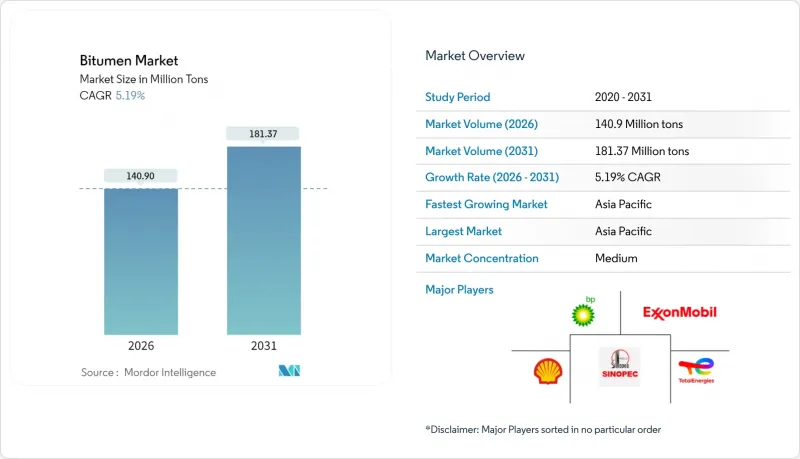
公共部门在高速公路、机场跑道和气候适应型路面方面的支出不断增加,支撑了长期需求,而聚合物改质复合技术则开闢了一片利润丰厚的市场。 2024年原油价格的稳定性为原料成本提供了可预测性,但预计到2026年原油价格将跌至每桶66美元,这可能会同时扩大生产利润空间并加剧价格竞争。亚太地区仍然是主要的消费中心,这得益于积极的基础设施投资和灵活的进口战略,该战略充分利用了中东产油国的价格优势。同时,日益严格的环境法规正在加速向冷乳化沥青和再生沥青技术的转型,从而微妙地改变沥青市场的供应链和产品规格。
全球沥青市场趋势与洞察
道路和高速公路维修成本增加
世界各国政府正在将预算从新建设重新分配到道路维护,从而带动透水性黏合剂和特殊路面处理材料的持续稳定消耗。美国《基础设施投资与就业法案》已启动超过6万个建设计划,仅魁北克省就在其2025-2026财年预算中累计358.68亿加元用于道路维护。各机构体认到,及时维护的每一美元投资都能减少未来4至7美元的重组成本,进而形成维护需求的良性循环。德国5000亿欧元的现代化基金将20%用于资产优化,并纳入耐久性标准,进一步提升了气候智慧型沥青的性能。随着路面管理系统的日趋成熟,采购模式正从週期性高峰转向可预测的多年期合同,从而稳定了整个沥青市场的采购量。
大型机场跑道扩建计划
跑道建设计划需要高品质的黏合剂,以承受高轮载、剪切应力和喷射机燃料洩漏。一项由沿岸地区和亚洲枢纽机场主导的、总额达7300亿美元的2030年前资本支出计划,将能源基础设施与航空设施扩建联繫起来。法兰克福机场一项为期两年的试验路段采用腰果壳生物沥青,显示航空公司希望在不影响性能的前提下使用低碳材料。苯乙烯-丁二烯-苯乙烯(SBSS)聚合物改质沥青的价格溢价高达15-25%,儘管产量仍然有限,但该细分市场的盈利却得到了提升。能够使其混合料设计符合国际民航组织(ICAO)标准的供应商,将更有机会赢得长期框架合同,从而加强沥青市场的垂直整合策略。
加强对铺路作业中温室气体 (GHG) 和多环芳烃 (PAH)排放的监管
监管机构正在收紧挥发性有机化合物 (VOC) 和多环芳烃 (PAH) 的暴露限值。加拿大将于 2025 年 10 月前禁止使用 PAH 含量超过 1000 ppm 的煤焦油基密封剂,这将有效地淘汰现有产品线并迫使其重新配方。结合气相层析法和监督学习的预测分析技术现在可以识别产生异味的烷烃,从而为符合监管要求提供途径。然而,这增加了分析成本,给小型生产商带来了负担。各机构也越来越多地采用温拌沥青技术,可将路面温度降低高达 40°C。这减少了现场排放,并缩小了热拌沥青的应用范围,限制了沥青市场的需求成长。
细分市场分析
2025年,渗透级沥青黏合剂占据了沥青市场66.52%的份额,预计到2031年将以5.62%的复合年增长率增长,这主要得益于其与传统热拌沥青搅拌站的兼容性以及广泛的气候适应性。氧化级沥青则用于防水和屋顶等特殊应用领域,其优异的氧化稳定性使其价格更高。沥青乳液在全球的年产量达800万吨,由于其排放更低、排放更少,在碎石封层和微表面处理应用中越来越受欢迎。
创新主要集中在黏度控制和环保添加剂方面。添加1%的聚磷酸盐可以提高高温稳定性,但超过2%则会降低储存稳定性。生物基因改质剂,例如伊朗天然沥青,可以提高黏度和热塑性,延长使用寿命并减少对合成聚合物的依赖。这些渐进式改善维持了针入度等级沥青的主导地位,同时也逐步将沥青市场的价值转移到特种混合料上。
沥青市场报告按产品类型(针入度等级、氧化等级、沥青乳液、聚合物改质沥青及其他产品)、应用领域(道路建设、屋顶工程、黏合剂和密封剂及其他应用)以及地区(亚太地区、北美地区、欧洲地区、南美地区以及中东和非洲地区)进行细分。市场预测以吨为单位。
区域分析
亚太地区将引领市场,到2025年将占据45.10%的市场份额,并在2031年之前以6.31%的复合年增长率增长,这主要得益于中国、印度和东南亚同步推进的基础设施建设规划。中国2023年原油日加工量将达到1,480万桶,这将支撑国内沥青供应和出口能力。
在北美,强劲的道路维修预算与不断变化的环境法规正在努力平衡。受《基础设施投资与就业法案》(IIJA) 的影响,管道需求保持稳定,而加拿大即将出台的多环芳烃(PAH)法规正推动沥青生产转向乳化沥青和冷加工製程。在欧洲,炼油厂的合理化和关闭导致区域供应趋紧,同时也为生物基替代品创造了市场机会。欧洲沥青市场吨位可能略有下降,但随着特种沥青的需求超过以金额为准沥青,预计其价值将会增加。
中东地区拥有丰富的原料和战略性航运路线,为亚洲提供供应。预计到2030年,海湾产油国与亚洲买家之间的贸易额将达到6,820亿美元,其中包括原油、成品黏合剂和改质剂。
作为新兴市场,非洲和南美洲的特征是週期性地大型企划,从而带动需求激增。随着这些地区扩大互联互通投资,拥有灵活物流和快速部署能力的供应商可能会变得更加重要。
其他福利:
- Excel格式的市场预测(ME)表
- 3个月的分析师支持
目录
第一章 引言
- 调查先决条件
- 调查范围
第二章调查方法
第三章执行摘要
第四章 市场情势
- 市场概览
- 市场驱动因素
- 道路和高速公路维修成本增加
- 大规模机场跑道扩建计划
- 新兴经济体政府主导的基础设施奖励策略
- 向聚合物改质沥青过渡,打造气候适应路面
- 透过推广循环经济来促进再生沥青路面(RAP)的采用。
- 市场限制
- 针对铺路作业制定严格的温室气体 (GHG) 和多环芳烃 (PAH)排放法规
- 原油价格波动影响原物料经济
- 城市计划中混凝土和复合材料路面的比例不断增加
- 价值链分析
- 原料分析
- 波特五力模型
- 供应商的议价能力
- 买方的议价能力
- 新进入者的威胁
- 替代品的威胁
- 竞争程度
第五章 市场规模与成长预测
- 依产品类型
- 渗透
- 氧化级
- 沥青乳化剂
- 聚合物改质沥青
- 其他产品(黏度等级、稀释等级、性能等级)
- 透过使用
- 道路建设
- 屋顶材料
- 黏合剂和密封剂
- 其他应用领域(石油和天然气领域的涂层、运河衬砌、储槽基础、铁路道安定器处理等)
- 按地区
- 北美洲
- 我们
- 加拿大
- 墨西哥
- 南美洲
- 巴西
- 阿根廷
- 哥伦比亚
- 其他南美洲
- 欧洲
- 德国
- 英国
- 法国
- 义大利
- 其他欧洲地区
- 亚太地区
- 中国
- 印度
- 日本
- 韩国
- ASEAN
- 亚太其他地区
- 中东和非洲
- 沙乌地阿拉伯
- 南非
- 其他中东和非洲地区
- 北美洲
第六章 竞争情势
- 市场集中度
- 策略性倡议(併购/合资/合约)
- 市占率(%)/排名分析
- 公司简介
- BMI Group Holdings UK Limited
- BP plc
- China Petroleum and Chemical Corporation(Sinopec)
- ENEOS Corporation
- Exxon Mobil Corporation
- Hindustan Petroleum Corporation Limited
- Indian Oil Corporation Ltd
- Kraton Corporation
- Mangalore Refinery and Petrochemicals Limited
- Marathon Petroleum Corporation
- Nynas AB
- Rosneft
- Shell plc
- Suncor Energy Inc.
- The Bouygues Group
- TotalEnergies
第七章 市场机会与未来展望
The Bitumen Market is expected to grow from 133.95 Million tons in 2025 to 140.9 Million tons in 2026 and is forecast to reach 181.37 Million tons by 2031 at 5.19% CAGR over 2026-2031.
Heightened public-sector spending on highways, airport runways, and climate-resilient pavements is sustaining long-run demand, while polymer-modified formulations open higher-margin niches. Stable crude-oil prices in 2024 created predictable feedstock economics, yet the projected slide to USD 66 per barrel by 2026 could both widen production margins and intensify price competition. Asia-Pacific remains the pivotal consumption hub, boosted by aggressive infrastructure outlays and flexible import strategies that exploit Middle-Eastern price discounts. Concurrently, environmental regulations accelerate the transition toward low-temperature emulsions and recycled asphalt technologies, subtly reshaping supply chains and product specifications within the bitumen market.
Global Bitumen Market Trends and Insights
Increasing Road and Highway Rehabilitation Spend
Governments are reallocating budgets from new builds toward preservation, leading to steady recurrent consumption of penetration-grade binders and specialty surface treatments. The U.S. Infrastructure Investment and Jobs Act has already launched more than 60,000 construction projects, and Quebec alone earmarked CAD 35.868 billion for roads in its 2025-2026 budget. Agencies recognize that every dollar invested in timely preservation avoids USD 4-7 in future reconstruction costs, locking in a virtuous cycle of maintenance demand. Germany's EUR 500 billion modernization fund assigns 20% to asset optimization, embedding resilience criteria that further elevate specifications for climate-adaptive bitumen grades. As pavement management systems mature, procurement shifts from cyclical surges to predictable multi-year contracts, stabilizing volume offtake across the bitumen market.
Large-Scale Airport Runway Expansion Programs
Runway projects require premium binders that tolerate high wheel loads, shear stresses, and jet-fuel spills. Gulf and Asian hubs are leading a USD 730 billion capex wave through 2030, intertwining energy infrastructure with aviation build-outs. Frankfurt Airport's two-year test strip using cashew-shell bio-bitumen illustrates airlines' push for lower-carbon materials without performance sacrifice. Polymer-modified grades with styrene-butadiene-styrene command price premiums of 15-25%, lifting segment profitability even though volumes remain modest. Suppliers capable of certifying mix designs to International Civil Aviation Organization standards are positioned to capture long-run framework agreements, reinforcing vertical integration strategies within the bitumen market.
Stringent GHG and PAH Emission Regulations on Paving Operations
Regulators are tightening exposure limits for volatile organic compounds and polycyclic aromatic hydrocarbons. Canada will prohibit coal-tar sealants exceeding 1,000 ppm PAHs by October 2025, effectively removing a traditional product class and forcing reformulations. Predictive analytics using gas chromatography coupled with supervised learning now pinpoint odor-causing alkanes, offering compliance pathways but raising analytical costs that smaller producers must absorb. Agencies also favor warm-mix technologies that lower placement temperatures by up to 40 °C, reducing on-site emissions and tightening the operating envelope for hot-mix asphalt, thereby constraining volume expansion in the bitumen market.
Other drivers and restraints analyzed in the detailed report include:
- Government Infrastructure Stimulus in Emerging Economies
- Shift to Polymer-Modified Bitumen for Climate-Resilient Pavements
- Crude-Oil Price Volatility Impacting Feedstock Economics
For complete list of drivers and restraints, kindly check the Table Of Contents.
Segment Analysis
Penetration-grade binders held 66.52% of the bitumen market share in 2025 and are projected to grow at a 5.62% CAGR through 2031, sustained by compatibility with conventional hot-mix plants and broad climatic tolerance. Oxidized grades occupy niche waterproofing and roofing roles where oxidation stability justifies premium pricing. Bitumen emulsions, totaling 8 million tons globally, are gaining favor for chip seals and microsurfacing because they reduce energy use and lower work-zone emissions.
Innovation centers on viscosity control and ecological additives. Polyphosphoric acid at 1% dosage improves high-temperature stability, though concentrations beyond 2% can undermine storage stability. Bio-based modifiers such as Iranian natural asphalt enhance viscosity and thermoplasticity, extending service life and reducing reliance on synthetic polymers. These incremental gains sustain penetration-grade primacy but gradually shift value toward specialty formulations inside the bitumen market.
The Bitumen Report is Segmented by Product Type (Penetration Grade, Oxidized Grade, Bitumen Emulsions, Polymer-Modified Bitumen, and Other Products), Application (Road Construction, Roofing, Adhesives and Sealants, and Other Applications), and Geography (Asia-Pacific, North America, Europe, South America, and Middle-East and Africa). The Market Forecasts are Provided in Terms of Volume (Tons).
Geography Analysis
Asia-Pacific led with 45.10% share in 2025 and is advancing at a 6.31% CAGR to 2031, anchored by synchronized infrastructure programs across China, India, and Southeast Asia. China's processing of 14.8 million barrels per day of crude in 2023 underpins both domestic asphalt supply and export capabilities.
North America balances robust rehabilitation budgets with evolving environmental mandates. The IIJA pipeline stabilizes demand, but Canada's impending PAH restrictions catalyze a shift to emulsions and cold processes. Europe confronts refinery rationalization; closures tighten regional supply yet open market space for bio-based alternatives. The bitumen market size in Europe could contract marginally in tonnage yet expand in value as specialty grades outpace generic ones.
The Middle East leverages abundant feedstock and strategic shipping lanes to supply Asia. Trade between Gulf producers and Asian buyers is forecast to touch USD 682 billion by 2030, with finished binders and modifiers joining crude flows.
Africa and South America remain emergent, characterized by episodic megaprojects that create demand surges. Suppliers attuned to flexible logistics and rapid deployment can gain traction as these regions scale connectivity investments.
- BMI Group Holdings UK Limited
- BP p.l.c.
- China Petroleum and Chemical Corporation (Sinopec)
- ENEOS Corporation
- Exxon Mobil Corporation
- Hindustan Petroleum Corporation Limited
- Indian Oil Corporation Ltd
- Kraton Corporation
- Mangalore Refinery and Petrochemicals Limited
- Marathon Petroleum Corporation
- Nynas AB
- Rosneft
- Shell plc
- Suncor Energy Inc.
- The Bouygues Group
- TotalEnergies
Additional Benefits:
- The market estimate (ME) sheet in Excel format
- 3 months of analyst support
TABLE OF CONTENTS
1 Introduction
- 1.1 Study Assumptions
- 1.2 Scope of the Study
2 Research Methodology
3 Executive Summary
4 Market Landscape
- 4.1 Market Overview
- 4.2 Market Drivers
- 4.2.1 Increasing road and highway rehabilitation spend
- 4.2.2 Large-scale airport runway expansion programs
- 4.2.3 Government infrastructure stimulus in emerging economies
- 4.2.4 Shift to polymer-modified bitumen for climate-resilient pavements
- 4.2.5 Circular-economy push for reclaimed asphalt pavement (RAP) adoption
- 4.3 Market Restraints
- 4.3.1 Stringent GHG and PAH emission regulations on paving operations
- 4.3.2 Crude-oil price volatility impacting feedstock economics
- 4.3.3 Rising share of concrete and composite pavements in urban projects
- 4.4 Value Chain Analysis
- 4.5 Feedstock Analysis
- 4.6 Porter's Five Forces
- 4.6.1 Bargaining Power of Suppliers
- 4.6.2 Bargaining Power of Buyers
- 4.6.3 Threat of New Entrants
- 4.6.4 Threat of Substitutes
- 4.6.5 Degree of Competition
5 Market Size and Growth Forecasts (Volume)
- 5.1 By Product Type
- 5.1.1 Penetration Grade
- 5.1.2 Oxidized Grade
- 5.1.3 Bitumen Emulsions
- 5.1.4 Polymer-Modified Bitumen
- 5.1.5 Other Products (Viscosity Grade, Cutback, and Performance Grade)
- 5.2 By Application
- 5.2.1 Road Construction
- 5.2.2 Roofing
- 5.2.3 Adhesives and Sealants
- 5.2.4 Other Applications (Coatings in Sectors such as Oil and Gas, Canal Lining, Tank Foundation, Railway Ballast Treatment, and Others)
- 5.3 By Geography
- 5.3.1 North America
- 5.3.1.1 United States
- 5.3.1.2 Canada
- 5.3.1.3 Mexico
- 5.3.2 South America
- 5.3.2.1 Brazil
- 5.3.2.2 Argentina
- 5.3.2.3 Colombia
- 5.3.2.4 Rest of South America
- 5.3.3 Europe
- 5.3.3.1 Germany
- 5.3.3.2 United Kingdom
- 5.3.3.3 France
- 5.3.3.4 Italy
- 5.3.3.5 Rest of Europe
- 5.3.4 Asia-Pacific
- 5.3.4.1 China
- 5.3.4.2 India
- 5.3.4.3 Japan
- 5.3.4.4 South Korea
- 5.3.4.5 ASEAN
- 5.3.4.6 Rest of Asia-Pacific
- 5.3.5 Middle East and Africa
- 5.3.5.1 Saudi Arabia
- 5.3.5.2 South Africa
- 5.3.5.3 Rest of Middle East and Africa
- 5.3.1 North America
6 Competitive Landscape
- 6.1 Market Concentration
- 6.2 Strategic Moves (MandA/JV/Agreements)
- 6.3 Market Share (%)/Ranking Analysis
- 6.4 Company Profiles (includes Global level Overview, Market level overview, Core Segments, Financials as available, Strategic Information, Market Rank/Share for key companies, Products and Services, and Recent Developments)
- 6.4.1 BMI Group Holdings UK Limited
- 6.4.2 BP p.l.c.
- 6.4.3 China Petroleum and Chemical Corporation (Sinopec)
- 6.4.4 ENEOS Corporation
- 6.4.5 Exxon Mobil Corporation
- 6.4.6 Hindustan Petroleum Corporation Limited
- 6.4.7 Indian Oil Corporation Ltd
- 6.4.8 Kraton Corporation
- 6.4.9 Mangalore Refinery and Petrochemicals Limited
- 6.4.10 Marathon Petroleum Corporation
- 6.4.11 Nynas AB
- 6.4.12 Rosneft
- 6.4.13 Shell plc
- 6.4.14 Suncor Energy Inc.
- 6.4.15 The Bouygues Group
- 6.4.16 TotalEnergies
7 Market Opportunities and Future Outlook
- 7.1 White-space and Unmet-Need Assessment

 沥青市场:2026-2032年全球市场预测(依产品类型、形态、原料、製造流程、通路、应用及最终用户划分)
 沥青乳化剂市场规模、份额、成长及全球产业分析:按类型、应用和地区划分,并预测至2026-2034年环保沥青市场:按类型、技术和应用划分-2026-2032年全球市场预测
 沥青乳化剂市场分析及预测(至2035年):类型、产品、应用、技术、组成成分、最终用户、剂型、材料类型、製程、解决方案沥青市场分析及预测(至2035年):依类型、产品类型、应用、技术、最终用户、形态、材质、製程及功能划分环保沥青生产市场分析及预测(至2035年):类型、产品、服务、技术、应用、形式、材料类型、製程、最终用户、设备
 2026年全球沥青市场报告
 沥青市场-全球产业规模、份额、趋势、机会、预测:按产品类型、应用、地区和竞争格局划分,2021-2031年
 沥青市场规模、份额和成长分析(按产品类型、形态、原材料、製造流程、等级、分销管道、应用和地区划分)-2026-2033年产业预测
![中国沥青市场评估:依类型[铺路沥青、氧化沥青、聚合物改质沥青、其他]、应用[道路建设、防水、黏合剂、其他]、地区、机会及预测(2018-2032)](/sample/img/cover/42/default_cover_mx.png) 中国沥青市场评估:依类型[铺路沥青、氧化沥青、聚合物改质沥青、其他]、应用[道路建设、防水、黏合剂、其他]、地区、机会及预测(2018-2032)
中国沥青市场评估:依类型[铺路沥青、氧化沥青、聚合物改质沥青、其他]、应用[道路建设、防水、黏合剂、其他]、地区、机会及预测(2018-2032)