


 |
市场调查报告书
商品编码
1938994
滑石粉:市场占有率分析、产业趋势与统计、成长预测(2026-2031)Talc - Market Share Analysis, Industry Trends & Statistics, Growth Forecasts (2026 - 2031) |
||||||

※ 本网页内容可能与最新版本有所差异。详细情况请与我们联繫。
预计滑石粉市场将从 2025 年的 807 万吨增长到 2026 年的 842 万吨,到 2031 年将达到 1,039 万吨,2026 年至 2031 年的复合年增长率为 4.29%。
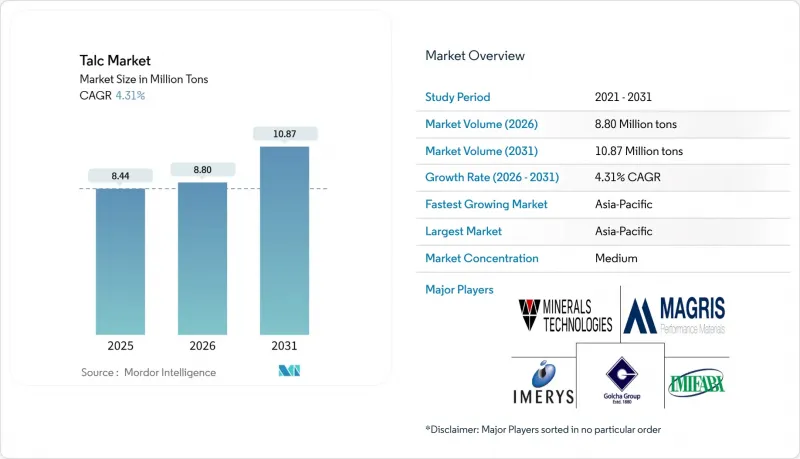
电动车产量不断增长、包装永续性目标日益严格以及水性涂料的广泛应用,正推动滑石粉市场稳步成长。含有高长宽比滑石粉的轻质聚丙烯复合材料正在取代玻璃纤维,应用于电动车内装板和电池外壳。同时,食品饮料生产商也开始采用公认安全(GRAS)滑石粉作为天然加工助剂。伊梅里斯公司对其年产3.5万吨芜湖工厂的投资,体现了其对特定应用产品的专注。此外,透过矿石分选技术提高资源利用率,也帮助生产者应对日益严格的法规所带来的成本压力。
全球滑石市场趋势及展望
电动车和电动出行对轻质聚合物的需求
汽车製造商正以滑石粉增强复合材料取代玻璃纤维增强聚丙烯,旨在透过降低成本和密度,在保持刚度的同时,实现15-25%的减重。滑石粉市场正受益于高长宽比)滑石粉,这种滑石粉可用于製造更薄、尺寸稳定的内装板和电池机壳。伊梅里斯(Imerys)的HAR产品采用经过优化的片状结构,可提高拉伸模量。电动车平台(包括需要保持负载容量的商用货车)在全球的普及,正在扩大特殊滑石粉的需求量。中国和美国的零排放法规进一步推动了这一趋势。因此,拥有混炼技术和聚丙烯配方专业知识的供应商正在滑石粉市场中获得更高的利润。
亚洲向水性建筑涂料的转变
中国和印度日益严格的低VOC法规正促使涂料製造商转向水性涂料,而水性涂料需要滑石粉来控制黏度并提高遮盖力。表面处理过的滑石粉可防止颜料悬浮和沈淀,保持光泽,同时为二氧化钛提供了经济高效的替代品。预计这些改质滑石粉将推动滑石粉市场价格上涨20-30%,儘管研磨和加工成本增加,但利润率仍将提升。东南亚地区不断加快的都市化和新房住宅量正在推动对中檔建筑涂料的需求。在该地区设有工厂的跨国涂料製造商正与能够可靠满足分散规格要求的滑石粉供应商签订长期承购协议。
石棉相关诉讼的遗留问题
强生公司提案的80亿至100亿美元的和解方案凸显了持续存在的责任风险,并继续抑制了化妆品级滑石粉的需求。美国食品药物管理局(FDA)新的强制性检测规定增加了中小型加工商的合规成本。食品药物管理局基于职业暴露将滑石粉重新归类为“致癌性致癌物”,导致对其的审查力度加大。这些因素共同导致滑石粉市场分化为两类供应商:一类是进行全面矿物学筛检的供应商,另一类则被限制在工业细分市场。保险费持续上涨,进一步挤压了利润空间。
细分市场分析
到2025年,碳酸滑石将占据滑石市场61.92%的份额,成为该细分市场的主要驱动力。这主要得益于印度和中国丰富的碳酸蕴藏量,以及适合高通量通用级滑石的加工成本结构。儘管绿泥石的供应有限,但由于其热稳定性,绿泥石的复合年增长率仍高达4.76%,使其适用于汽车引擎室零件和电子产品。利用机械化学活化技术的供应商可以根据客户规格调整表面能和粒度比例,使来自获利能力较低的矿床的碳酸盐矿石也能在中端应用领域占有一席之地。此外,投资喷射磨机技术将粗粒原料转化为亚2微米粉末(高光泽涂料的必要原料)也至关重要。
对超细和微层状滑石形态的持续研究和开发正在模糊传统矿床类型之间的界限,有可能使碳酸盐矿在某些应用中取代绿泥石矿。然而,关于残余矿物含量的监管阻力使得富含绿泥石的滑石矿对要求低杂质的原始设备製造商(OEM)更具吸引力。因此,滑石市场呈现双轨发展趋势:成本主导的碳酸盐矿主导着大批量应用,而价值主导的绿泥石矿则在高端细分市场中占据越来越大的份额。
本滑石市场报告按矿床类型(碳酸盐滑石和亚氯酸盐滑石)、终端用户行业(塑胶和橡胶、油漆和涂料、陶瓷、纸浆和造纸、个人护理和化妆品、食品和饮料以及其他行业)和地区(亚太地区、北美、欧洲、南美以及中东和非洲)进行分析。市场预测以公吨为单位。
区域分析
预计到2025年,亚太地区将占全球滑石粉市场规模的53.10%,并在2031年之前以5.18%的复合年增长率成长。这主要得益于印度在全球滑石粉产量中占比高达25%,以及连接中国加工商和下游塑胶出口商的完善供应链。中国、日本和韩国的电动车製造需要超细滑石粉母粒,从而确保了对高长宽比滑石粉的本地需求。同时,儘管监管趋势倾向于低挥发性有机化合物(VOC)配方,但东南亚的建筑热潮仍然推高了涂料级滑石粉的需求。
北美具有重要的战略意义,OEM厂商的轻量化措施推动了优质滑石粉的消费。然而,消费者对化妆品中滑石粉的谨慎态度,以及新矿开采面临环境审批障碍,预计将限制市场成长,使其仅为个位数。天气相关的供应中断凸显了风险,下游买家正在将采购来源分散到多个地区,以确保滑石粉市场的稳定供应。
在欧洲,针对结晶质二氧化硅的更严格法规以及拟议的REACH法规修订预计将增加检测成本,并修订工业用户的采购标准。德国和法国的买家已经开始要求进行ESG(环境、社会和管治)审核,预计这将增加对低碳供应来源的需求。儘管南美、中东和非洲的建筑和消费品生产正在成长,但分散的物流和本地加工能力的不足仍然是限制区域市场扩张的因素。瞄准这些地区的投资者通常会与现有的欧洲或亚洲加工商成立合资企业,以确保技术诀窍。
其他福利:
- Excel格式的市场预测(ME)表
- 3个月的分析师支持
目录
第一章 引言
- 研究假设和市场定义
- 调查范围
第二章调查方法
第三章执行摘要
第四章 市场情势
- 市场概览
- 市场驱动因素
- 电动车和电动出行对轻质聚合物的需求
- 亚洲向水性建筑涂料的转变
- 食品级滑石粉在胶基和肉类涂层的应用
- 利用人工智慧技术进行矿石分选,提高矿石回收率。
- 用于符合ESG目标采购的低碳滑石粉
- 市场限制
- 与石棉相关的诉讼的法律遗留问题
- 生物基填充材替代滑石粉用于高檔纸张
- 芬兰罢工后,欧洲高品位矿石短缺
- 价值链分析
- 波特五力模型
- 供应商的议价能力
- 消费者议价能力
- 新进入者的威胁
- 替代品的威胁
- 竞争程度
第五章 市场规模与成长预测
- 按矿床类型
- 滑石和碳酸盐
- 滑石绿泥石
- 按最终用户行业划分
- 塑胶和橡胶
- 油漆和涂料
- 陶瓷
- 纸浆和造纸
- 个人护理及化妆品
- 食品/饮料
- 其他行业
- 按地区
- 亚太地区
- 中国
- 印度
- 日本
- 韩国
- 亚太其他地区
- 北美洲
- 我们
- 加拿大
- 墨西哥
- 欧洲
- 德国
- 英国
- 法国
- 义大利
- 西班牙
- 其他欧洲地区
- 南美洲
- 巴西
- 阿根廷
- 其他南美洲
- 中东和非洲
- 沙乌地阿拉伯
- 南非
- 其他中东和非洲地区
- 亚太地区
第六章 竞争情势
- 市场集中度
- 策略趋势
- 市占率(%)/排名分析
- 公司简介
- AKJ MinChem
- ANAND TALC
- Chanda Minerals
- CIMBAR PERFORMANCE MINERALS
- euroMinerals GmbH
- Golcha Group
- Hayashi-Kasei
- Imerys
- IMI Fabi SpA
- LITHOS Industrial Minerals GmbH
- Magris Performance Materials
- Minerals Technologies Inc.
- Nippon Talc Co., Ltd.
- Sibelco
第七章 市场机会与未来展望
The Talc market is expected to grow from 8.07 million tons in 2025 to 8.42 million tons in 2026 and is forecast to reach 10.39 million tons by 2031 at 4.29% CAGR over 2026-2031.
Rising electric-vehicle production, stricter packaging sustainability targets, and a broad shift to water-based coatings keep the talc market on a steady upward path. Lightweight polypropylene compounds containing high-aspect-ratio talc grades are replacing glass fiber in electric vehicle (EV) interior panels and battery housings, while food and beverage firms are adopting Generally Recognized as Safe (GRAS)-certified talc as a natural processing aid. Investments such as Imerys' 35,000 tpa Wuhu plant underline the emphasis on application-specific products. Simultaneously, ore-sorting technology is lifting resource utilization, helping producers offset cost pressures tied to tightening regulatory frameworks.
Global Talc Market Trends and Insights
Light-weighting Demand from EV and E-mobility Polymers
Automakers are targeting 15-25% weight cuts by substituting glass-fiber polypropylene with talc-reinforced compounds that preserve stiffness while trimming cost and density. The talc market benefits because high-aspect-ratio grades support thinner, dimensionally stable interior panels and battery enclosures. Imerys' HAR products emphasize engineered plate-like morphologies optimized for tensile modulus improvement. Global EV platform proliferation, including commercial vans that demand payload retention, extends the addressable tonnage for specialty talc grades. Government zero-emission mandates in China and the U.S. further anchor this momentum. Suppliers with compounding knowledge and polypropylene formulation expertise thus capture premium margins in the talc market.
Shift to Water-based Architectural Paints in Asia
Stricter low-VOC rules in China and India push formulators toward water-borne coatings that need talc for viscosity control and hiding power. Surface-treated talc prevents pigment flooding and sedimentation, enabling cost-effective substitution for titanium dioxide while keeping gloss intact. The talc market sees 20-30% price uplifts for these modified grades, creating margin headroom despite higher grinding and treatment expenses. Urbanization across Southeast Asia is swelling new housing starts, expanding demand for mid-tier architectural paints. Multinational paint companies with regional plants are securing long-term offtake agreements with talc suppliers that can meet dispersion specifications reliably.
Litigation Legacy of Asbestos-related Claims
Johnson & Johnson's proposed USD 8-10 billion settlement underscores persistent liability overhang and keeps cosmetic-grade demand subdued. The FDA has outlined new mandatory testing rules, escalating compliance costs for smaller processors. The WHO's reclassification of talc to "probably carcinogenic" based on occupational exposure intensifies scrutiny. Collectively, these factors split the talc market between suppliers with full-spectrum mineralogical screening and those relegated to industrial niches. Insurance premiums continue to climb, further narrowing margins.
Other drivers and restraints analyzed in the detailed report include:
- Food-grade Talc Uptake in Gum Base and Meat Coatings
- AI-enabled Ore-sorting Boosting Ore Recovery Rates
- Bio-based Fillers Replacing Talc in Premium Papers
For complete list of drivers and restraints, kindly check the Table Of Contents.
Segment Analysis
Talc carbonate led the segment with 61.92% of the Talc market size in 2025, benefiting from abundant reserves in India and China and a processing cost structure that favors high-throughput commodity grades. Talc chlorite, though less available, is gaining traction at a 4.76% CAGR because its thermal stability suits under-hood automotive and electronics parts. Suppliers exploiting mechanochemical activation now tailor surface energy and particle aspect ratio to user specifications, enabling carbonate ore from marginal deposits to compete in mid-range applications. Investment in jet-mill fine grinding is equally pivotal, turning coarse feedstock into sub-2 µm powders critical for high-gloss coatings.
Continued R&D on ultrafine, micro-lamellar morphologies blurs traditional boundaries between deposit types, letting carbonate mines displace chlorite grades in some roles. Yet, regulatory headwinds related to residue mineral content make chlorite-rich ore attractive for OEMs demanding low impurities. The talc market, therefore, tracks a dual trajectory: cost-driven carbonate volumes dominate mass applications, while value-driven chlorite captures incremental share in premium niches.
The Talc Market Report is Segmented by Deposit Type (Talc Carbonate and Talc Chlorite), End-User Industry (Plastics and Rubber, Paints and Coatings, Ceramics, Pulp and Paper, Personal Care and Cosmetics, Food and Beverage, and Other Industries), and Geography (Asia-Pacific, North America, Europe, South America, and Middle East and Africa). The Market Forecasts are Provided in Terms of Volume (Tons).
Geography Analysis
Asia-Pacific commanded 53.10% of the Talc market size in 2025 and is projected to grow at a 5.18% CAGR through 2031, supported by India's 25% global production share and integrated supply chains linking Chinese processors to downstream plastics exporters. Domestic EV manufacturing in China, Japan, and South Korea requires ultrafine talc masterbatches, ensuring local offtake for high-aspect-ratio grades. Simultaneously, booming construction in Southeast Asia increases paint-grade demand despite regulatory moves toward low-VOC (Volatile Organic Compound) formulations.
North America remains strategically important, with original equipment manufacturer (OEM) lightweighting initiatives sustaining premium-grade consumption. Nonetheless, cautious consumer sentiment around talc cosmetics and environmental approval hurdles for new mines hold growth to mid-single digits. Weather-induced disruptions highlight supply risks, prompting downstream buyers to diversify procurement across multiple regions to stabilize talc market access.
Europe's stricter crystalline silica protocols and pending REACH revisions will likely raise testing costs and reshape purchasing criteria for industrial users. Buyers in Germany and France already request Environmental, Social, and Governance (ESG) audits, boosting prospects for low-carbon supply streams. South America and the Middle East & Africa show rising construction and consumer-goods output, yet fragmented logistics and limited local processing still constrain regional talc market scalability. Investors targeting these regions often form joint ventures with established European or Asian processors to lock in technological know-how.
- AKJ MinChem
- ANAND TALC
- Chanda Minerals
- CIMBAR PERFORMANCE MINERALS
- euroMinerals GmbH
- Golcha Group
- Hayashi-Kasei
- Imerys
- IMI Fabi SpA
- LITHOS Industrial Minerals GmbH
- Magris Performance Materials
- Minerals Technologies Inc.
- Nippon Talc Co., Ltd.
- Sibelco
Additional Benefits:
- The market estimate (ME) sheet in Excel format
- 3 months of analyst support
TABLE OF CONTENTS
1 Introduction
- 1.1 Study Assumptions and Market Definition
- 1.2 Scope of the Study
2 Research Methodology
3 Executive Summary
4 Market Landscape
- 4.1 Market Overview
- 4.2 Market Drivers
- 4.2.1 Light-weighting Demand from EV and E-mobility Polymers
- 4.2.2 Shift to Water-based Architectural Paints in Asia
- 4.2.3 Food-grade Talc Uptake in Gum Base and Meat Coatings
- 4.2.4 AI-enabled Ore-sorting Boosting Ore Recovery Rates
- 4.2.5 Low-carbon talc Grades for ESG-scoped Procurement
- 4.3 Market Restraints
- 4.3.1 Litigation Legacy of Asbestos-related Claims
- 4.3.2 Bio-based Fillers Replacing Talc in Premium Papers
- 4.3.3 High-purity Ore Shortages in Europe Post-Finnish Strike
- 4.4 Value Chain Analysis
- 4.5 Porter's Five Forces
- 4.5.1 Bargaining Power of Suppliers
- 4.5.2 Bargaining Power of Consumers
- 4.5.3 Threat of New Entrants
- 4.5.4 Threat of Substitutes
- 4.5.5 Degree of Competition
5 Market Size and Growth Forecasts (Volume)
- 5.1 By Deposit Type
- 5.1.1 Talc Carbonate
- 5.1.2 Talc Chlorite
- 5.2 By End-user Industry
- 5.2.1 Plastics and Rubber
- 5.2.2 Paints and Coatings
- 5.2.3 Ceramics
- 5.2.4 Pulp and Paper
- 5.2.5 Personal Care and Cosmetics
- 5.2.6 Food and Beverage
- 5.2.7 Other Industries
- 5.3 By Geography
- 5.3.1 Asia-Pacific
- 5.3.1.1 China
- 5.3.1.2 India
- 5.3.1.3 Japan
- 5.3.1.4 South Korea
- 5.3.1.5 Rest of Asia-Pacific
- 5.3.2 North America
- 5.3.2.1 United States
- 5.3.2.2 Canada
- 5.3.2.3 Mexico
- 5.3.3 Europe
- 5.3.3.1 Germany
- 5.3.3.2 United Kingdom
- 5.3.3.3 France
- 5.3.3.4 Italy
- 5.3.3.5 Spain
- 5.3.3.6 Rest of Europe
- 5.3.4 South America
- 5.3.4.1 Brazil
- 5.3.4.2 Argentina
- 5.3.4.3 Rest of South America
- 5.3.5 Middle East and Africa
- 5.3.5.1 Saudi Arabia
- 5.3.5.2 South Africa
- 5.3.5.3 Rest of Middle East and Africa
- 5.3.1 Asia-Pacific
6 Competitive Landscape
- 6.1 Market Concentration
- 6.2 Strategic Moves
- 6.3 Market Share (%)/Ranking Analysis
- 6.4 Company Profiles (includes Global level Overview, Market level overview, Core Segments, Financials as available, Strategic Information, Market Rank/Share, Products and Services, Recent Developments)
- 6.4.1 AKJ MinChem
- 6.4.2 ANAND TALC
- 6.4.3 Chanda Minerals
- 6.4.4 CIMBAR PERFORMANCE MINERALS
- 6.4.5 euroMinerals GmbH
- 6.4.6 Golcha Group
- 6.4.7 Hayashi-Kasei
- 6.4.8 Imerys
- 6.4.9 IMI Fabi SpA
- 6.4.10 LITHOS Industrial Minerals GmbH
- 6.4.11 Magris Performance Materials
- 6.4.12 Minerals Technologies Inc.
- 6.4.13 Nippon Talc Co., Ltd.
- 6.4.14 Sibelco
7 Market Opportunities and Future Outlook
- 7.1 White-space and Unmet-Need Assessment

 滑石市场报告:矿床类型、形态、终端用途产业及地区划分,2026-2034年
 2026-2034年全球叶蜡石市场规模、份额、趋势和成长分析报告日本滑石市场规模、份额、趋势和预测:按矿床类型、形态、最终用途行业和地区划分,2026-2034年
 2026年全球滑石市场报告
 超细滑石粉市场按等级、终端用途行业、应用和通路- 全球预测 2026-2032
 叶蜡石:市场占有率分析、产业趋势与统计、成长预测(2026-2031)
 叶蜡石市场规模、份额和趋势分析报告:按应用、地区和细分市场预测(2026-2033 年)
 滑石粉市场规模、份额和成长分析(按应用、等级、形态、通路、纯度和地区划分)-2026-2033年产业预测
 超细滑石粉:全球市占率及排名、总收入及需求预测(2025-2031年)美国滑石粉市场规模、份额和趋势分析报告:按产品、应用和细分市场预测(2025-2033 年)