


 |
市场调查报告书
商品编码
1939021
亚太网路安全:市场占有率分析、产业趋势与统计、成长预测(2026-2031)APAC Cybersecurity - Market Share Analysis, Industry Trends & Statistics, Growth Forecasts (2026 - 2031) |
||||||

※ 本网页内容可能与最新版本有所差异。详细情况请与我们联繫。
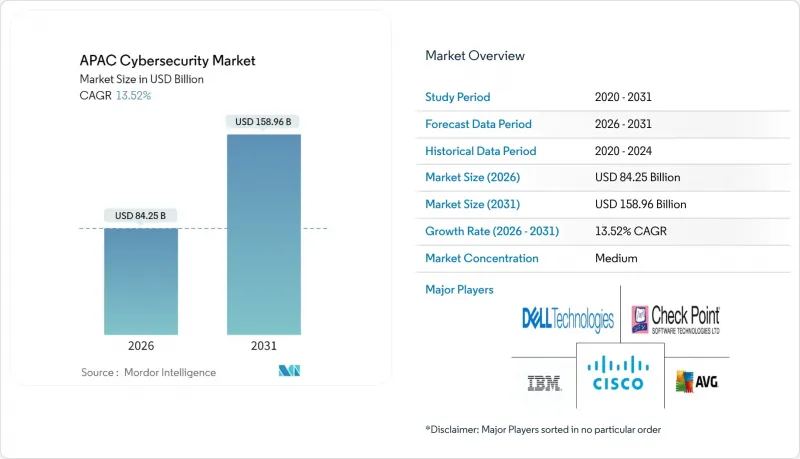
亚太地区网路安全市场在 2025 年的价值为 742.2 亿美元,预计到 2031 年将达到 1,589.6 亿美元,高于 2026 年的 842.5 亿美元。
预计在预测期(2026-2031 年)内,复合年增长率将达到 13.52%。
国家支持的网路攻击日益增多、5G网路加速部署、数位支付诈骗激增以及人才长期短缺,正在重塑预算优先事项;与此同时,区域资料保护法规的调整也促使采购决策倾向于本地供应商。竞争的焦点不再仅仅集中在产品功能上,而是更多地转向在法规环境分散的情况下,提供自主云架构、人工智慧驱动的託管检测以及整合式IT-OT安全解决方案的能力。对于那些能够将本地化威胁情报与可扩展的託管服务相结合的供应商而言,机会比比皆是,尤其是在内部安全专家匮乏的中端市场领域。
亚太网路安全市场趋势与洞察
亚太地区各国政府的资料主权要求推动了国内网路安全支出。
中国将于2025年生效的《网路资料安全管理条例》将强制要求在国内进行资料处理,并要求在华营运的跨国公司建立独立的安全体系。新加坡改进后的「网路安全基础认证」(Cyber Essentials)计划透过将政府合约与供应商认证挂钩,推动了对本地供应商的需求。澳洲的「REDSPICE」倡议已拨款20亿澳元用于情报机构的主权云,这表明政策如何直接影响网路安全支出。供应商正在将研发中心和安全营运中心(SOC)在地化,以维持市场进入,而本土专家也因此获得了合规优势。
5G部署为日本、韩国和印度的通讯业者带来了新的网路威胁面。
高吞吐量的5G架构引入了微切片和边缘运算节点,这些节点无法透过传统的边界防御工具进行保护。日本的《网路攻击预防法》允许对针对电信网路的网路威胁进行先发制人的干扰。韩国记录显示,2024年公共网路遭受了156万次骇客试验,其中80%的目标是5G和物联网终端。印度通讯业者报告称,57%的攻击事件导致了服务延迟,凸显了零信任和人工智慧驱动分析的紧迫性。因此,市场对安全存取服务边际(SASE)平台和针对通讯业者环境最佳化的虚拟化防火墙的需求日益增长。
亚太新兴经济体网路安全人才严重短缺,推高服务成本。
该地区网路安全领域存在280万个职缺,限制了託管服务的扩充性,并使薪资水平超出了中小企业的预算。菲律宾仅有200名认证专业人员,而新加坡则有3000名,加剧了计划延误。越南已累计1亿美元用于人才发展计划,目标是在2025年前培养1000名专业人员和5000名工程师。 OT安全和云端架构领域的人才短缺最为严重,迫使企业将部分职能外包或延迟实施,从而抑制了潜在需求。
细分市场分析
2025年,解决方案收入占比达到57.05%,但由于企业面临人才短缺,预计到2031年,资安管理服务将以20.86%的复合年增长率成长。亚太网路安全市场由提供全天候安全营运中心 (SOC) 监控、威胁搜寻和事件回应服务,并采用基于结果的服务等级协定 (SLA) 的供应商主导。 Ensign InfoSecurity 是唯一跻身2024年全球十大託管安全服务供应商 (MSSP) 之列的亚太公司,这标誌着该地区的託管服务日趋成熟。
内部分析师的人事费用不断上涨,加上董事会层面对安全漏洞的责任追究,正促使即使是大型企业也开始与外部安全营运中心 (SOC) 合作管理安全工具。人工智慧辅助的故障排除和自动化功能使託管安全服务提供者 (MSSP) 能够为中端市场客户提供更具盈利的服务,从而推动了这些技术的普及。因此,对基于平台的服务产品的投资正在加速成长,服务供应商正透过整合扩展灾难復原 (XDR)、安全营运自动化与回应 (SOAR) 和机器学习分析等技术来提升自身竞争力。
截至2025年,本地部署将占亚太地区网路安全市场份额的61.88%,因为受监管产业仍高度重视对资料的实体控制。然而,由于远距办公的普及和多重云端部署的日益普及,云端原生安全将以22.8%的复合年增长率成长。根据HashiCorp的一项调查,70%的区域企业正在透过多重云端实现其业务目标,90%的企业认为安全是其成功的关键因素。
为了保护跨云端服务供应商(CSP) 和边缘节点的工作负载,各组织正在采用零信任网路和容器安全。技能短缺仍然是一大挑战(31% 的组织表示缺乏云端专业知识),而供应商正透过低程式码策略编配和託管 SASE 服务来应对这项挑战。因此,云端技术在新计画中日益普及,混合架构也逐渐成为旧有系统的迁移路径。
亚太网路安全市场报告将该行业分为以下几个部分:按产品类型(解决方案、服务)、按部署模式(本地部署、云端部署)、按最终用户垂直行业(银行、金融服务和保险、医疗保健、IT 和电信、工业和国防、製造业、零售和电子商务、能源和公共产业、其他)、按最终用户公司规模(中小企业、大型企业)以及按国家/地区。
其他福利:
- Excel格式的市场预测(ME)表
- 3个月的分析师支持
目录
第一章 引言
- 研究假设和市场定义
- 调查范围
第二章调查方法
第三章执行摘要
第四章 市场情势
- 市场概览
- 市场驱动因素
- 政府资料主权要求加速亚太地区全部区域国内网路安全支出。
- 5G的推出为日本、韩国和印度的通讯业者带来了新的网路威胁。
- 数位支付和电子商务诈欺激增推动东南亚安全投资
- 亚太地区国家支持的关键基础设施攻击事件日益增多,推动了OT安全技术的普及应用
- 中国和东协中小企业的云端迁移浪潮对云端工作负载保护提出了更高的要求。
- 国家网路安全激励计划(例如,SG Cyber Safe、REDSPICE)将推动市场成长
- 市场限制
- 亚太新兴经济体网路安全人才严重短缺,推高服务成本。
- 分散的区域合规体系使解决方案的标准化变得复杂。
- 亚太地区中小企业对价格的高度敏感限制了先进解决方案的采用。
- 由于对安全硬体组件的出口限制,供应链中断
- 重要法规结构评估
- 价值链分析
- 技术展望
- 波特五力模型
- 供应商的议价能力
- 买方的议价能力
- 新进入者的威胁
- 替代品的威胁
- 竞争对手之间的竞争
- 主要用例和案例研究
- 宏观经济因素对市场的影响
- 投资分析
第五章 市场区隔
- 报价
- 解决方案
- 应用程式安全
- 云端安全
- 资料安全
- 身分和存取管理
- 基础设施保护
- 综合风险管理
- 网路安全设备
- 端点安全
- 其他服务
- 服务
- 专业服务
- 託管服务
- 解决方案
- 透过部署模式
- 本地部署
- 云
- 按最终用户行业划分
- BFSI
- 卫生保健
- 资讯科技和电信
- 工业与国防
- 製造业
- 零售与电子商务
- 能源与公共产业
- 製造业
- 其他的
- 按最终用户公司规模划分
- 中小企业
- 大公司
- 按国家/地区
- 中国
- 日本
- 印度
- 韩国
- 澳洲和纽西兰
- 新加坡
- 亚太其他地区
第六章 竞争情势
- 市场集中度
- 策略趋势
- 市占率分析
- 公司简介
- Cisco Systems, Inc.
- IBM Corporation
- Huawei Technologies Co., Ltd.
- Palo Alto Networks, Inc.
- Check Point Software Technologies Ltd.
- Fortinet, Inc.
- Kaspersky Lab
- Broadcom, Inc.(Symantec Enterprise Division)
- BAE Systems plc
- NEC Corporation
- Infosys Limited
- Tata Consultancy Services Limited
- Darktrace plc
- Zscaler, Inc.
- CrowdStrike Holdings, Inc.
- F5, Inc.
- Sophos Ltd.
- Okta, Inc.
- SentinelOne, Inc.
- Rapid7, Inc.
- Imperva, Inc
第七章 市场机会与未来展望
The APAC cybersecurity market was valued at USD 74.22 billion in 2025 and estimated to grow from USD 84.25 billion in 2026 to reach USD 158.96 billion by 2031, at a CAGR of 13.52% during the forecast period (2026-2031).
Heightened state-sponsored attacks, accelerating 5G roll-outs, surging digital-payment fraud, and chronic talent shortages are reshaping budget priorities, while local data-protection rules are recasting procurement in favor of regionally domiciled vendors. Competition now hinges less on product features and more on the ability to deliver sovereign-cloud architectures, AI-driven managed detection, and integrated IT-OT security across fragmented regulatory environments. Opportunities abound for providers that combine localized threat intelligence with scalable managed services, especially in mid-market segments underserved by in-house security expertise.
APAC Cybersecurity Market Trends and Insights
Government Data-Sovereignty Mandates Accelerating Domestic Cybersecurity Spend Across APAC
China's Network Data Security Management Regulations taking effect in 2025 require in-country data processing and create separate security stacks for multinationals operating inside China. Singapore's refreshed Cyber Essentials program ties government contracts to vendor certification, driving local provider demand. Australia's REDSPICE initiative allocates AUD 2 billion to a sovereign cloud for the intelligence community, illustrating how policy translates directly into cybersecurity outlays. Vendors now localize R&D centers and SOCs to preserve market access, while homegrown specialists gain a compliance-driven edge.
5G Roll-Outs Creating New Network Threat Surfaces for Telcos in Japan, South Korea and India
High-throughput 5G architectures introduce micro-slicing and edge-compute nodes that traditional perimeter tools cannot secure. Japan's Active Cyber Defense law authorizes pre-emptive disruption of cyber threats targeting telecom networks. South Korea logged 1.56 million hacking attempts on public networks in 2024, 80% aimed at 5G and IoT endpoints. India's operators report that 57% of breaches result in service slowdowns, highlighting the urgency for zero-trust and AI-driven analytics. Consequently, demand is rising for secure access service edge (SASE) platforms and virtualized firewalls optimized for carrier environments.
Acute Cybersecurity Talent Shortage Inflating Service Costs in Emerging APAC Economies
The region accounts for 2.8 million unfilled cyber roles, restricting managed-service scalability and pushing salaries beyond SME budgets. The Philippines counts only 200 certified specialists versus Singapore's 3,000, amplifying project delays. Vietnam earmarked USD 100 million for workforce programs to train 1,000 experts and 5,000 engineers by 2025. Scarcity is most severe in OT security and cloud architecture, forcing enterprises to outsource functions or postpone deployments, dampening addressable demand.
Other drivers and restraints analyzed in the detailed report include:
- Surge in Digital-Payment and E-Commerce Fraud Driving Security Investments in Southeast Asia
- Escalating State-Sponsored Attacks on APAC Critical Infrastructure Stimulating OT Security Adoption
- Fragmented Regional Compliance Regimes Complicating Solution Standardization
For complete list of drivers and restraints, kindly check the Table Of Contents.
Segment Analysis
Solutions retained 57.05% revenue in 2025, yet managed security services are projected to expand 20.86% CAGR through 2031 as enterprises confront staffing gaps. The APAC cybersecurity market favors providers that bundle 24X7 SOC monitoring, threat hunting, and incident response under outcome-based SLAs. Ensign InfoSecurity became the only APAC firm to reach the global top-10 MSSP list in 2024, signaling the region's ascent in managed-service maturity.
Rising wages for in-house analysts, coupled with board-level accountability for breaches, push even large enterprises to co-manage security tools with external SOCs. AI-assisted triage and automation enable MSSPs to serve mid-market clients profitably, widening adoption. As a result, investment in platform-based service delivery is accelerating, with providers embedding XDR, SOAR, and machine-learning analytics to differentiate.
On-premise installations held 61.88% of APAC cybersecurity market share in 2025 because regulated sectors still favor physical control over data. Cloud-native security, however, is growing at 22.8% CAGR, propelled by remote-work mandates and multi-cloud adoption. A HashiCorp survey showed 70% of regional firms hit business targets via multi-cloud, with 90% rating security the defining success factor.
Organizations are embracing zero-trust networking and container security to protect workloads that span CSPs and edge nodes. Skills shortages remain a headwind-31% cite limited cloud expertise-but vendors counter with low-code policy orchestration and managed SASE offerings. Consequently, cloud deployments increasingly win green-field projects, while hybrid architectures emerge as a transition path for legacy systems.
The APAC Cybersecurity Market Report Segments the Industry Into by Offering (Solutions, and Services), Deployment Mode (On-Premise, and Cloud), End-User Vertical (BFSI, Healthcare, IT and Telecom, Industrial and Defense, Manufacturing, Retail and E-Commerce, Energy and Utilities, Manufacturing, and Others), and End-User Enterprise Size (Small and Medium Enterprises (SMEs), and Large Enterprises), and Country.
List of Companies Covered in this Report:
- Cisco Systems, Inc.
- IBM Corporation
- Huawei Technologies Co., Ltd.
- Palo Alto Networks, Inc.
- Check Point Software Technologies Ltd.
- Fortinet, Inc.
- Kaspersky Lab
- Broadcom, Inc. (Symantec Enterprise Division)
- BAE Systems plc
- NEC Corporation
- Infosys Limited
- Tata Consultancy Services Limited
- Darktrace plc
- Zscaler, Inc.
- CrowdStrike Holdings, Inc.
- F5, Inc.
- Sophos Ltd.
- Okta, Inc.
- SentinelOne, Inc.
- Rapid7, Inc.
- Imperva, Inc
Additional Benefits:
- The market estimate (ME) sheet in Excel format
- 3 months of analyst support
TABLE OF CONTENTS
1 INTRODUCTION
- 1.1 Study Assumptions and Market Definition
- 1.2 Scope of the Study
2 RESEARCH METHODOLOGY
3 EXECUTIVE SUMMARY
4 MARKET LANDSCAPE
- 4.1 Market Overview
- 4.2 Market Drivers
- 4.2.1 Government Data-Sovereignty Mandates Accelerating Domestic Cybersecurity Spend Across APAC
- 4.2.2 5G Roll-Outs Creating New Network Threat Surfaces for Telcos in Japan, South Korea and India
- 4.2.3 Surge in Digital Payments and E-commerce Fraud Driving Security Investments in Southeast Asia
- 4.2.4 Escalating State-Sponsored Attacks on APAC Critical Infrastructure Stimulating OT Security Adoption
- 4.2.5 SME Cloud Migration Wave Necessitating Cloud Workload Protection in China and ASEAN
- 4.2.6 National Cybersecurity Incentive Programs (e.g., SG Cyber Safe, REDSPICE) Catalyzing Market Growth
- 4.3 Market Restraints
- 4.3.1 Acute Cybersecurity Talent Shortage Inflating Service Costs in Emerging APAC Economies
- 4.3.2 Fragmented Regional Compliance Regimes Complicating Solution Standardization
- 4.3.3 High Price Sensitivity Among APAC SMEs Limiting Adoption of Advanced Solutions
- 4.3.4 Supply-Chain Disruptions from Export Controls on Security Hardware Components
- 4.4 Evaluation of Critical Regulatory Framework
- 4.5 Value Chain Analysis
- 4.6 Technological Outlook
- 4.7 Porter's Five Forces
- 4.7.1 Bargaining Power of Suppliers
- 4.7.2 Bargaining Power of Buyers
- 4.7.3 Threat of New Entrants
- 4.7.4 Threat of Substitutes
- 4.7.5 Competitive Rivalry
- 4.8 Key Use Cases and Case Studies
- 4.9 Impact on Macroeconomic Factors of the Market
- 4.10 Investment Analysis
5 MARKET SEGMENTATION
- 5.1 By Offering
- 5.1.1 Solutions
- 5.1.1.1 Application Security
- 5.1.1.2 Cloud Security
- 5.1.1.3 Data Security
- 5.1.1.4 Identity and Access Management
- 5.1.1.5 Infrastructure Protection
- 5.1.1.6 Integrated Risk Management
- 5.1.1.7 Network Security Equipment
- 5.1.1.8 Endpoint Security
- 5.1.1.9 Other Services
- 5.1.2 Services
- 5.1.2.1 Professional Services
- 5.1.2.2 Managed Services
- 5.1.1 Solutions
- 5.2 By Deployment Mode
- 5.2.1 On-Premise
- 5.2.2 Cloud
- 5.3 By End-User Vertical
- 5.3.1 BFSI
- 5.3.2 Healthcare
- 5.3.3 IT and Telecom
- 5.3.4 Industrial and Defense
- 5.3.5 Manufacturing
- 5.3.6 Retail and E-commerce
- 5.3.7 Energy and Utilities
- 5.3.8 Manufacturing
- 5.3.9 Others
- 5.4 By End-User Enterprise Size
- 5.4.1 Small and Medium Enterprises (SMEs)
- 5.4.2 Large Enterprises
- 5.5 By Country
- 5.5.1 China
- 5.5.2 Japan
- 5.5.3 India
- 5.5.4 South Korea
- 5.5.5 Australia and New Zealand
- 5.5.6 Singapore
- 5.5.7 Rest of Asia Pacific
6 COMPETITIVE LANDSCAPE
- 6.1 Market Concentration
- 6.2 Strategic Moves
- 6.3 Market Share Analysis
- 6.4 Company Profiles {(includes Global level Overview, Market level overview, Core Segments, Financials as available, Strategic Information, Market Rank/Share for key companies, Products and Services, and Recent Developments)}
- 6.4.1 Cisco Systems, Inc.
- 6.4.2 IBM Corporation
- 6.4.3 Huawei Technologies Co., Ltd.
- 6.4.4 Palo Alto Networks, Inc.
- 6.4.5 Check Point Software Technologies Ltd.
- 6.4.6 Fortinet, Inc.
- 6.4.7 Kaspersky Lab
- 6.4.8 Broadcom, Inc. (Symantec Enterprise Division)
- 6.4.9 BAE Systems plc
- 6.4.10 NEC Corporation
- 6.4.11 Infosys Limited
- 6.4.12 Tata Consultancy Services Limited
- 6.4.13 Darktrace plc
- 6.4.14 Zscaler, Inc.
- 6.4.15 CrowdStrike Holdings, Inc.
- 6.4.16 F5, Inc.
- 6.4.17 Sophos Ltd.
- 6.4.18 Okta, Inc.
- 6.4.19 SentinelOne, Inc.
- 6.4.20 Rapid7, Inc.
- 6.4.21 Imperva, Inc
7 MARKET OPPORTUNITIES AND FUTURE OUTLOOK
- 7.1 White-space and Unmet-Need Assessment

 网路安全市场:按组件、安全类型、组织规模、部署模式和产业划分-2026-2032年全球市场预测
 人工智慧网路安全市场预测至2034年—按交付方式、安全类型、部署方式、技术、应用、最终用户和地区分類的全球分析金融科技网路安全解决方案市场预测至2034年-按组件、安全类型、部署模式、组织规模、应用、最终用户和地区分類的全球分析
 2026-2030年全球智慧体与自主人工智慧系统网路安全解决方案市场
 网路安全市场规模、份额、趋势和预测:按组件、部署类型、用户类型、行业和地区划分,2026-2034 年
 2026年全球建筑网路安全市场报告2026年全球电网网路安全市场报告2026年全球旅游安全市场报告
 全球网路靶场市场报告:实际结果与预测(2021-2032)2026年全球Web3安全市场报告