


 |
市场调查报告书
商品编码
1939048
中国中游油气市场:市场占有率分析、产业趋势与统计、成长预测(2026-2031年)China Oil And Gas Midstream - Market Share Analysis, Industry Trends & Statistics, Growth Forecasts (2026 - 2031) |
||||||

※ 本网页内容可能与最新版本有所差异。详细情况请与我们联繫。
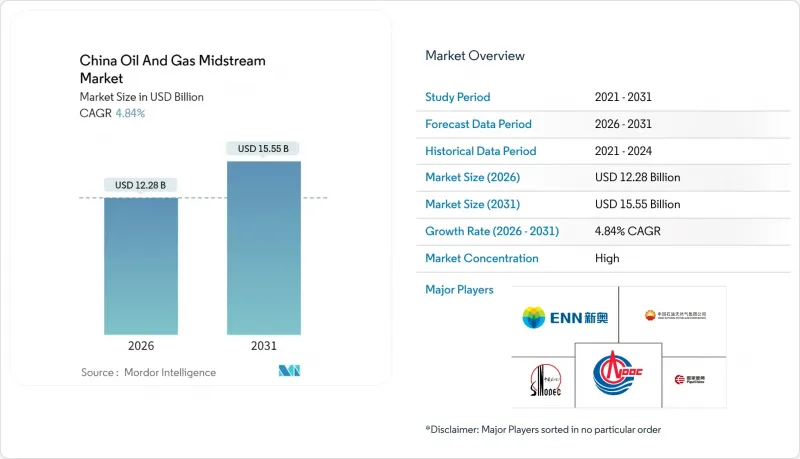
预计到 2026 年,中国中游油气市场规模将达到 122.8 亿美元,高于 2025 年的 117.1 亿美元。
预计到 2031 年将达到 155.5 亿美元,2026 年至 2031 年的复合年增长率为 4.84%。
市场成长的驱动力来自北京提出的能源安全和碳中和的双重目标,这些目标优先考虑基础设施韧性、供应多元化和可衡量的排放。工业和住宅用户对天然气需求的激增,加上国内产量的稳定,推动了对额外运输、进口加工和储存能力的需求。政策支持的管道里程扩张、LNG接收站的加速运作以及强制性战略储备目标,为承包商和设备供应商创造了持续的建设机会。数位化,特别是人工智慧驱动的监控系统,正在推动资产利用率的提高、营运成本的降低以及对环境法规更严格的遵守,从而进一步提升计划的经济效益。
中国油气中游市场趋势与洞察
延长国家天然气管道
中国的「十四五」规划旨在2025年将天然气输送管网扩展至12万公里(比2020年增加25%)。该规划的核心是东西向天然气输送系统。冗余的主干管道降低了地缘政治或技术动盪期间单点故障的风险,并加强了区域平衡。统一的管道所有权加快了互联互通,实现了灵活的双向输送,并提高了运转率。计划于2024年运作的中俄东线将使天然气供应来源多元化,并降低对海运的依赖。省际陆上协调工作较为复杂,但一旦获得许可,集中规划将缩短建设週期。这些计划为专业承包商、高规格管道製造商和数位化监测解决方案提供者带来了巨大的机会。
加速液化天然气再气化终端的建设。
预计到2024年,中国液化天然气(LNG)再气化能力将达到每年1.3亿吨,另有4,000万吨的产能正在兴建中,中国已成为全球最活跃的LNG基础建设国。为了缓解供应瓶颈,中国正在采用小规模、分布更分散的设施。 2022年危机期间,大型接收站出现拥堵,供应瓶颈问题凸显。沿海城市越来越重视浮体式再气化装置(FSRU),因为其部署速度快、资本支出柔软性且对陆上土地的需求量小。舟山第三期接收站于2024年运作,凭藉其先进的蒸气回收系统,甲烷排放减少了15%,树立了国内新的标竿。 65%的平均运转率既保证了策略储备,也为机会性现货采购留出了空间。这有助于进口多元化,并加强该领域的价格风险管理。
延长环境和土地使用许可程序
目前,环境评估需要18至36个月,穿越生态保护区的路线审批时间更长。在人口稠密的东部省份,土地采集费用平均为每公顷5万美元,估价纠纷也屡见不鲜,往往导致计划工期延长。因此,从规划到运作的时间可能长达五至七年,增加了开发商的资金筹措风险,并降低了内部报酬率(IRR)。一个计划于2024年推出的数位化一站式入口网站旨在缩短审批週期,但各机构的执行情况不尽相同。投资者目前会在预算中预留12至18个月的核准缓衝期,导致预算膨胀和收益延迟到帐。
细分市场分析
2026年至2031年,终端产业将以8.16%的复合年增长率成长,超过管线产业(截至2025年,管线产业是中国中游油气市场的主要组成部分,占45.12%)。浮体式再气化装置(FSRU)的引入缩短了建设週期,最大限度地减少了对沿海地区的干扰,从而能够快速响应需求波动。沿海地区政府正在快速建造小规模终端,以实现卸货点的多元化,从而缓解拥塞并抑制区域价格飙升。管道仍然是整个系统的基础,连接着西部资源和俄罗斯进口油气与东部消费量大的省份。人工智慧增强的监控系统可将管道营运和维护成本降低15-20%,并提高安全标准的执行情况,使其成为进一步扩容的理想平台。虽然仓储设施的规模最小,但在强制性20%战略储备政策的推动下,资本支出正转向枯竭油田的再开发和盐穴的开采。总体而言,这些综合基础设施投资兼顾了进口柔软性和运输可靠性,确保了透过多条路线实现天然气供应的稳定性。
其他福利:
- Excel格式的市场预测(ME)表
- 分析师支持(3个月)
目录
第一章 引言
- 研究假设和市场定义
- 调查范围
第二章调查方法
第三章执行摘要
第四章 市场情势
- 市场概览
- 市场驱动因素
- 扩大国内天然气管道总长度
- 加速液化天然气再气化终端的建设
- 工业和住宅部门强制推行煤改气。
- 推出人工智慧驱动的管道健康分析
- 液化天然气动力重型卡车运输的快速成长正在催生小规模规模的液化天然气需求。
- 战略天然气储存能力要求
- 市场限制
- 冗长的环境与土地使用许可流程
- 商品价格波动导致资本投资成本增加
- 运输瓶颈增加了液化天然气停泊成本
- 沿海水资源压力限制了新建LNG接收站。
- 供应链分析
- 监管环境
- 技术展望
- 已安装管道容量分析
- 波特五力模型
- 新进入者的威胁
- 供应商的议价能力
- 买方的议价能力
- 替代品的威胁
- 竞争对手之间的竞争
- PESTEL 分析
第五章 市场规模与成长预测
- 透过基础设施
- 管道
- 终端
- 仓储设施(地下和地上)
- 依产品类型
- 原油
- 天然气
- 石油产品
- LNG
- 按服务类型
- 管道建置
- 管道维护和维修
- 仓储及搬运服务
- 运输/物流
第六章 竞争情势
- 市场集中度
- 策略性倡议(併购、联盟、购电协议)
- 市场占有率分析(主要企业的市场排名和份额)
- 公司简介
- China National Petroleum Corporation(CNPC)
- PipeChina(China Oil & Gas Pipeline Network Corp.)
- China Petroleum & Chemical Corporation(Sinopec Group)
- China National Offshore Oil Corporation(CNOOC)
- PetroChina Pipeline Company
- China Petroleum Pipeline Engineering Co.(CPP)
- Kunlun Energy
- ENN Natural Gas
- Towngas China
- China Gas Holdings
- Guanghui Energy
- Beijing Gas Group
- Shenzhen Gas Corp.
- Guangdong Dapeng LNG Company
- Tian Lun Gas Group
- Xinxing Ductile Iron Pipes Co.
- COSCO Shipping Energy Transportation
- Yantai LNG Co.
- Shanghai Gas Group
- Zhejiang Energy Group
第七章 市场机会与未来展望
China Oil And Gas Midstream Market market size in 2026 is estimated at USD 12.28 billion, growing from 2025 value of USD 11.71 billion with 2031 projections showing USD 15.55 billion, growing at 4.84% CAGR over 2026-2031.
The market growth is driven by Beijing's twin goals of energy security and carbon neutrality, which together prioritize infrastructure resilience, diversified supply routes, and measurable reductions in emissions. Surging natural gas demand from industrial and residential users, combined with steady domestic production, intensifies the need for additional transmission, import handling, and storage capacity. Policy-backed pipeline mileage expansion, accelerated LNG terminal commissioning, and mandatory strategic reserve targets create a sustained construction pipeline for contractors and equipment suppliers. Digitalization-especially AI-enabled monitoring-enhances asset utilization, reduces operating costs, and facilitates stricter environmental compliance, thereby further improving project economics.
China Oil And Gas Midstream Market Trends and Insights
Expansion of National Gas-Pipeline Mileage
China's 14th Five-Year Plan raises the transmission grid target to 120,000 km by 2025-a 25% jump over 2020-anchored by the West-to-East system. Redundant trunk lines mitigate the risk of single-point failure during geopolitical or technical disruptions and enhance cross-regional balancing. PipeChina's unified ownership accelerates interconnections, allowing flexible, bidirectional flows that lift utilization rates. The commissioning of the China-Russia East Route in 2024 diversified supply and reduced reliance on seaborne trade. Although cross-provincial land coordination is complex, centralized planning compresses build times once permits are clear. These projects present sizable opportunities for specialist contractors, high-specification pipe manufacturers, and digital monitoring solution providers.
Accelerated Build-out of LNG Regasification Terminals
Regas capacity hit 130 million tpa in 2024, with 40 million tpa under construction, positioning the country as the world's most active LNG-infrastructure builder. Smaller, distributed facilities mitigate supply bottlenecks that were revealed during the 2022 crisis, when large terminals faced congestion. Coastal governments are increasingly favoring FSRUs due to their rapid deployment speed, flexibility in capital expenditure, and reduced demand for onshore land. The 2024-commissioned Zhoushan III terminal reduced methane emissions by 15% through advanced vapor-recovery systems, setting a new domestic benchmark. Average 65% utilization leaves headroom for opportunistic spot cargo buying while serving strategic stockpiles. The segment thereby underpins import diversification and strengthens price-risk management.
Lengthy Environmental & Land-Use Permitting Process
Environmental reviews now last 18-36 months, with extra delays where routes cross ecologically sensitive zones. Land acquisition in the densely populated eastern provinces averages USD 50,000 per hectare, often triggering valuation disputes that prolong project timelines. As a result, planning-to-operation spans stretch 5-7 years, raising financing risk and slicing IRRs for developers. Digital one-stop portals unveiled in 2024 aim to condense review cycles, yet agency adoption is uneven. Investors now incorporate 12-18 month permitting buffers into their schedules, which inflates budgets and delays revenue generation.
Other drivers and restraints analyzed in the detailed report include:
- Coal-to-Gas Switching Mandates in Industrial & Residential Sectors
- AI-Driven Pipeline-Health Analytics Adoption
- Capex Escalation Amid Commodity-Price Volatility
For complete list of drivers and restraints, kindly check the Table Of Contents.
Segment Analysis
Terminals accounted for an 8.16% CAGR growth between 2026 and 2031, outpacing pipelines, which retained a dominant 45.12% 2025 share of the China oil and gas midstream market size. FSRU rollouts shorten build cycles and limit shoreline disruption, enabling rapid response to demand shifts. Coastal governments are fast-tracking the development of smaller terminals to diversify landing points, thereby reducing congestion and regional price spikes. Pipelines still underpin system integrity, linking western resources and Russian imports with high-consumption eastern provinces. AI-enhanced monitoring reduced pipeline O&M costs by 15-20% and improved safety compliance, enhancing the platform's attractiveness for further capacity expansion. Storage facilities, although the smallest, gain policy momentum from the 20% strategic reserve mandate, shifting capital expenditures toward depleted field re-engineering and salt-cavern leaching. Collectively, blended infrastructure investments strike a balance between import flexibility and transmission reliability, thereby securing multi-path gas flow resilience.
The China Oil and Gas Midstream Market Report is Segmented by Infrastructure (Pipelines, Terminals, and Storage Facilities), Product Type (Crude Oil, Natural Gas, Refined Products, and LNG), and Service Type (Pipeline Construction, Pipeline Maintenance and Repair, Storage and Handling Services, and Transportation and Logistics). The Market Sizes and Forecasts are Provided in Terms of Value (USD).
List of Companies Covered in this Report:
- China National Petroleum Corporation (CNPC)
- PipeChina (China Oil & Gas Pipeline Network Corp.)
- China Petroleum & Chemical Corporation (Sinopec Group)
- China National Offshore Oil Corporation (CNOOC)
- PetroChina Pipeline Company
- China Petroleum Pipeline Engineering Co. (CPP)
- Kunlun Energy
- ENN Natural Gas
- Towngas China
- China Gas Holdings
- Guanghui Energy
- Beijing Gas Group
- Shenzhen Gas Corp.
- Guangdong Dapeng LNG Company
- Tian Lun Gas Group
- Xinxing Ductile Iron Pipes Co.
- COSCO Shipping Energy Transportation
- Yantai LNG Co.
- Shanghai Gas Group
- Zhejiang Energy Group
Additional Benefits:
- The market estimate (ME) sheet in Excel format
- 3 months of analyst support
TABLE OF CONTENTS
1 Introduction
- 1.1 Study Assumptions & Market Definition
- 1.2 Scope of the Study
2 Research Methodology
3 Executive Summary
4 Market Landscape
- 4.1 Market Overview
- 4.2 Market Drivers
- 4.2.1 Expansion of national gas-pipeline mileage
- 4.2.2 Accelerated build-out of LNG regasification terminals
- 4.2.3 Coal-to-gas switching mandates in industrial & residential sectors
- 4.2.4 AI-driven pipeline-health analytics adoption
- 4.2.5 Boom in LNG-fueled heavy-duty trucking creating small-scale LNG demand
- 4.2.6 Strategic gas storage capacity mandates
- 4.3 Market Restraints
- 4.3.1 Lengthy environmental & land-use permitting process
- 4.3.2 Capex escalation amid commodity-price volatility
- 4.3.3 Shipping chokepoints inflating landed LNG costs
- 4.3.4 Coastal water-stress limits on new LNG terminals
- 4.4 Supply-Chain Analysis
- 4.5 Regulatory Landscape
- 4.6 Technological Outlook
- 4.7 Installed Pipeline Capacity Analysis
- 4.8 Porter's Five Forces
- 4.8.1 Threat of New Entrants
- 4.8.2 Bargaining Power of Suppliers
- 4.8.3 Bargaining Power of Buyers
- 4.8.4 Threat of Substitutes
- 4.8.5 Competitive Rivalry
- 4.9 PESTLE Analysis
5 Market Size & Growth Forecasts
- 5.1 By Infrastructure
- 5.1.1 Pipelines
- 5.1.2 Terminals
- 5.1.3 Storage Facilities (Underground and Above-ground)
- 5.2 By Product Type
- 5.2.1 Crude Oil
- 5.2.2 Natural Gas
- 5.2.3 Refined Products
- 5.2.4 LNG
- 5.3 By Service Type
- 5.3.1 Pipeline Construction
- 5.3.2 Pipeline Maintenance and Repair
- 5.3.3 Storage and Handling Services
- 5.3.4 Transportation and Logistics
6 Competitive Landscape
- 6.1 Market Concentration
- 6.2 Strategic Moves (M&A, Partnerships, PPAs)
- 6.3 Market Share Analysis (Market Rank/Share for key companies)
- 6.4 Company Profiles (includes Global level Overview, Market level overview, Core Segments, Financials as available, Strategic Information, Products & Services, and Recent Developments)
- 6.4.1 China National Petroleum Corporation (CNPC)
- 6.4.2 PipeChina (China Oil & Gas Pipeline Network Corp.)
- 6.4.3 China Petroleum & Chemical Corporation (Sinopec Group)
- 6.4.4 China National Offshore Oil Corporation (CNOOC)
- 6.4.5 PetroChina Pipeline Company
- 6.4.6 China Petroleum Pipeline Engineering Co. (CPP)
- 6.4.7 Kunlun Energy
- 6.4.8 ENN Natural Gas
- 6.4.9 Towngas China
- 6.4.10 China Gas Holdings
- 6.4.11 Guanghui Energy
- 6.4.12 Beijing Gas Group
- 6.4.13 Shenzhen Gas Corp.
- 6.4.14 Guangdong Dapeng LNG Company
- 6.4.15 Tian Lun Gas Group
- 6.4.16 Xinxing Ductile Iron Pipes Co.
- 6.4.17 COSCO Shipping Energy Transportation
- 6.4.18 Yantai LNG Co.
- 6.4.19 Shanghai Gas Group
- 6.4.20 Zhejiang Energy Group
7 Market Opportunities & Future Outlook
- 7.1 White-space & Unmet-Need Assessment


