


 |
市场调查报告书
商品编码
1939059
东南亚黏合剂:市场占有率分析、产业趋势与统计、成长预测(2026-2031)Southeast Asia Adhesive - Market Share Analysis, Industry Trends & Statistics, Growth Forecasts (2026 - 2031) |
||||||

※ 本网页内容可能与最新版本有所差异。详细情况请与我们联繫。
预计到 2026 年,东南亚黏合剂市场规模将达到 36.3 亿美元。
这意味着从 2025 年的 34.2 亿美元成长到 2031 年的 49.3 亿美元,2026 年至 2031 年的年复合成长率(CAGR)为 6.27%。
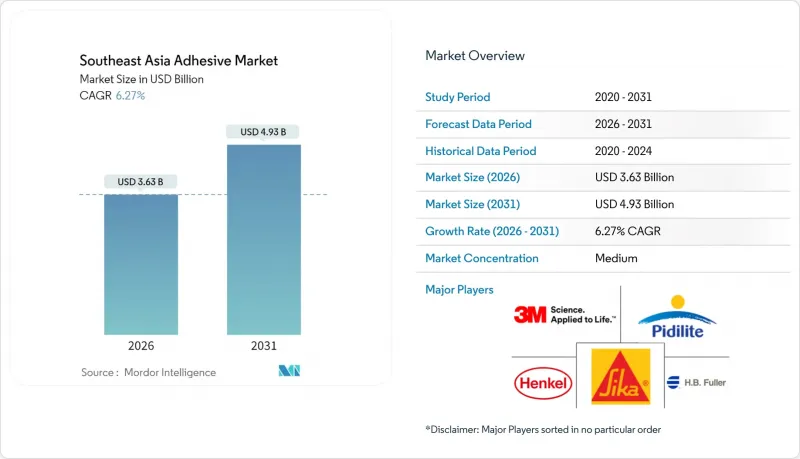
印尼和越南不断增长的建筑支出、泰国和印尼电动汽车电池投资的加速以及向低VOC水性化学品的转变,都支撑着这一增长势头。外国直接投资在电子、鞋类和医疗耗材製造业的涌入,正在扩大区域基本客群,并促进树脂和配方资产的下游在地化。越南的《化学品法》(65/2025/QH15)和新加坡的《国家环境局VOC法规》等法规结构正在重新定义技术选择,并推动对符合循环经济目标的水性、反应型和紫外光固化系统的需求。儘管石化原料价格波动对短期利润率带来压力,但拥有稳定供应合约和垂直整合能力的生产商可以保障利润,并投资于产能扩张,例如将西卡位于勿加泗的工厂的生产线规模扩大一倍。能够将本地化生产、合规化学品和应用培训相结合的黏合剂供应商,在赢得基础设施、包装和电动车供应链计划的新订单具有优势。
东南亚黏合剂市场趋势与洞察
印尼和越南的主导建设热潮
印尼和越南庞大的政府预算正推动水泥、钢材和工程板材等大型企划投入创纪录的用量,例如胡志明市的3号环城公路。黏合剂正在取代磁砖铺设、隔热材料、帷幕墙和模组化预製构件中的机械紧固件,从而缩短现场施工时间并提高气密性。建筑商倾向使用符合东协绿色建筑VOC(挥发性有机化合物)限值50克/公升的水性丙烯酸和反应型聚氨酯产品。雅加达和胡志明市附近的预製构件工厂正在使用无需烘箱即可在炎热潮湿的热带气候下固化的双组分环氧树脂,从而能够在24小时内交货建筑幕墙模组。
电子商务主导了柔性及永续包装需求的成长
东南亚各地的线上零售商对使用黏合剂和水性黏合剂的瓦楞纸包装袋、包装袋和易撕标籤的需求日益增长。像艾利丹尼森的CleanFlake这样的压敏黏着剂产品在清洗过程中可以完全释放,从而提高PET的回收率,并帮助品牌商达到东协循环经济框架下的回收目标。使用汉高Technomelt Supra 115的瓦楞纸加工商每分钟可封口多达120个瓦楞纸箱,节省了溶剂型胶合剂所需的能源。消费者愿意为环保包装支付更高的价格,这提高了获得生物基或无溶剂生产线认证的加工商的利润率。这些趋势共同推动了东南亚黏合剂市场对永续等级产品的潜在需求成长。
严格的挥发性有机化合物和危险化学品法规
为了应对新的VOC阈值法规,中型製造商现在必须对每条产品线进行大量投资,用于产品配方调整、安全测试和重新註册。新加坡的排放报告要求增加了年度管理成本,迫使一些中小企业将生产外包或退出监管严格的行业。水基系统虽然可以解决VOC问题,但需要更长的干燥週期,除非安装除湿设备,否则会增加生产时间,这对注重成本的工厂来说是一个障碍。 APEC的协调促进了跨境贸易,但不同的过渡期造成了暂时的套利机会,并使供应链规划变得复杂。
细分市场分析
在所有树脂中,聚氨酯的成长速度最快,复合年增长率达到6.57%。这主要归功于单面聚氨酯黏合剂的广泛应用,可消除电动车电池和无溶剂鞋类生产线中的排放(VOC)排放。丙烯酸树脂凭藉其成本和性能的平衡优势,在软包装层压材料和瓷砖砂浆领域仍占据主导地位,市占率高达31.18%。环氧树脂则服务于电池组组装等细分结构市场。 SikaPower-4720在室温下固化后可达到25 MPa的拉伸强度。由于瓦克在亚洲新建的符合ISO 10993标准的硅树脂生产线,医疗设备对硅胶树脂的需求正持续成长。
对永续性的日益增长的需求推动了蓖麻油衍生生物基聚氨酯的研发,而BASF的丙烯酸丁酯供应协议则凸显了原料安全的重要性。聚氨酯将铝与碳纤维黏合,在东南亚黏合剂市场中扮演越来越重要的角色,帮助汽车製造商实现轻量化目标,降低车辆重量。
其他福利:
- Excel格式的市场预测(ME)表
- 3个月的分析师支持
目录
第一章 引言
- 研究假设和市场定义
- 调查范围
第二章调查方法
第三章执行摘要
第四章 市场情势
- 市场概览
- 市场驱动因素
- 印尼和越南的主导建设热潮
- 电子商务推动了对灵活、永续包装的需求激增
- 扩大抛弃式产品的生产
- 监理推动低VOC水性及反应性涂料体系的发展
- 在泰国和印尼投资电动车电池製造
- 市场限制
- 严格的挥发性有机化合物和危险化学品法规
- 石油化工原料价格波动剧烈
- 缺乏能够操作先进化学技术的熟练工人
- 价值链分析
- 波特五力模型
- 供应商的议价能力
- 买方的议价能力
- 新进入者的威胁
- 替代品的威胁
- 竞争程度
第五章 市场规模与成长预测
- 通过树脂
- 聚氨酯
- 环氧树脂
- 丙烯酸纤维
- 硅酮
- 氰基丙烯酸酯
- VAE/EVA
- 其他树脂
- 透过技术
- 水溶液
- 溶剂型
- 反应性
- 热熔胶
- 紫外线固化型
- 按最终用户行业划分
- 航太工业
- 车
- 建筑/施工
- 鞋革业
- 卫生保健
- 包装
- 木工和细木工
- 其他终端用户产业
- 按地区
- 印尼
- 马来西亚
- 菲律宾
- 新加坡
- 泰国
- 越南
- 东南亚及其他地区
第六章 竞争情势
- 市场集中度
- 策略趋势
- 市占率(%)/排名分析
- 公司简介
- 3M
- ADB Sealant Co., Ltd
- Arkema
- Ashland
- Avery Dennison Corporation
- Beardow Adams
- Dow
- DuPont
- Dymax Corporation
- Franklin International
- HB Fuller Company
- Henkel AG & Co. KGaA
- Huntsman International LLC
- ITW Performance Polymers
- Jowat SE
- Mapei SpA
- Permabond LLC
- Pidilite Industries Ltd.
- Shin-Etsu Chemical Co., Ltd
- Sika AG
- Soudal NV
- Wacker Chemie AG
第七章 市场机会与未来展望
The Southeast Asia Adhesive Market size in 2026 is estimated at USD 3.63 billion, growing from 2025 value of USD 3.42 billion with 2031 projections showing USD 4.93 billion, growing at 6.27% CAGR over 2026-2031.
Rising construction outlays in Indonesia and Vietnam, accelerating EV-battery investments in Thailand and Indonesia, and the shift toward low-VOC waterborne chemistries collectively underpin this momentum. Foreign direct investment in electronics, footwear, and medical disposables manufacturing expands the regional customer base and stimulates the downstream localization of resin and formulation assets. Regulatory frameworks, such as Vietnam's Law on Chemicals (65/2025/QH15) and Singapore's NEA VOC limits, are redefining technology choices, steering demand toward water-borne, reactive, and UV-cured systems that align with circular economy goals. Price volatility in petrochemical feedstocks creates short-term margin pressure; however, producers with secured supply contracts or vertical integration can protect their earnings and invest in capacity expansions, such as Sika's Bekasi line doubling. Adhesive suppliers that combine localized production, compliant chemistries, and application training are best placed to capture new orders from infrastructure, packaging, and EV supply-chain projects.
Southeast Asia Adhesive Market Trends and Insights
Infrastructure-Led Construction Boom in Indonesia and Vietnam
Significant government budgets in Indonesia and Vietnam channel record volumes of cement, steel, and engineered panels into megaprojects such as the Ho Chi Minh City Ring Road 3. Adhesives replace mechanical fasteners in tile setting, insulation, curtain wall, and modular precast elements, shortening on-site labor and improving airtightness. Contractors prefer water-borne acrylic and reactive polyurethane grades that comply with ASEAN Green Building VOC caps of 50 g/L. Prefabrication plants situated near Jakarta and Ho Chi Minh City utilize two-component epoxies that cure in humid tropical climates without the need for ovens, allowing for a 24-hour turnaround of facade modules.
E-Commerce-Driven Surge in Flexible and Sustainable Packaging
Online retail across Southeast Asia requires corrugate mailers, pouches, and easy-peel labels that rely on hot-melt and water-borne adhesives. Pressure-sensitive products, such as Avery Dennison's CleanFlake, enhance PET recycling rates by detaching cleanly during wash cycles, enabling brand owners to meet recycling targets under the ASEAN Circular Economy framework. Corrugate converters running Henkel Technomelt Supra 115 seal up to 120 cartons per minute, saving energy required by solvent types. Consumer willingness to pay a premium for eco-friendly packaging elevates margins for converters that certify bio-based or solvent-free lines. These trends collectively widen the addressable pool for sustainable grades within the Southeast Asia adhesive market.
Stringent VOC and Hazardous-Chemical Regulations
Mid-sized producers are now required to invest significantly per product line for reformulation, safety testing, and re-registration, all in response to new VOC threshold compliance mandates. Singapore's mandatory emissions reporting adds annual administrative expenses, prompting some SMEs to outsource production or exit high-compliance segments. Water-borne systems solve VOC challenges but extend drying cycles, increasing production time unless dehumidification is installed, a barrier for cost-sensitive workshops. Harmonization under APEC facilitates cross-border trade, but varying phase-in periods create temporary arbitrage, complicating supply chain planning.
Other drivers and restraints analyzed in the detailed report include:
- Expansion of Hygiene and Medical Disposables Manufacturing
- Regulatory Push Toward Low-VOC Water-Borne and Reactive Systems
- Volatile Petrochemical Feedstock Prices
For complete list of drivers and restraints, kindly check the Table Of Contents.
Segment Analysis
Polyurethane achieved a 6.57% CAGR, the fastest among resins, as EV batteries and solvent-free footwear lines specify single-sided PU adhesives that eliminate VOC emissions. Acrylic stayed dominant with a 31.18% share owing to its balanced cost and performance in flexible packaging laminates and tile-setting mortars. Epoxy addressed structural niches, such as battery-pack assembly. SikaPower-4720 reaches a tensile strength of 25 MPa while curing at room temperature. Silicone volumes in medical devices increased, supported by Wacker's new Asian capacity that meets ISO 10993 standards.
Intensifying sustainability pressure drives the development of bio-based polyurethanes derived from castor oil, while BASF's butyl-acrylate supply agreement highlights feedstock security priorities. Polyurethane's bonding of aluminum-to-carbon-fiber joints satisfies OEM lightweighting goals, enabling reduction in vehicle mass, thereby further expanding its role in the Southeast Asia adhesive market.
The Southeast Asia Adhesive Market Report is Segmented by Resin (Polyurethane, Epoxy, Acrylic, Silicone, Cyanoacrylate, and More), Technology (Water-Borne, Solvent-Borne, Reactive, Hot-Melt, and UV Cured), End-User Industry (Aerospace, Automotive, and More), and Geography (Indonesia, Malaysia, Philippines, Singapore, Thailand, Vietnam, and Rest of South-East Asia). The Market Forecasts are Provided in Terms of Value (USD).
List of Companies Covered in this Report:
- 3M
- ADB Sealant Co., Ltd
- Arkema
- Ashland
- Avery Dennison Corporation
- Beardow Adams
- Dow
- DuPont
- Dymax Corporation
- Franklin International
- H.B. Fuller Company
- Henkel AG & Co. KGaA
- Huntsman International LLC
- ITW Performance Polymers
- Jowat SE
- Mapei S.p.A
- Permabond LLC
- Pidilite Industries Ltd.
- Shin-Etsu Chemical Co., Ltd
- Sika AG
- Soudal NV
- Wacker Chemie AG
Additional Benefits:
- The market estimate (ME) sheet in Excel format
- 3 months of analyst support
TABLE OF CONTENTS
1 Introduction
- 1.1 Study Assumptions and Market Definition
- 1.2 Scope of the Study
2 Research Methodology
3 Executive Summary
4 Market Landscape
- 4.1 Market Overview
- 4.2 Market Drivers
- 4.2.1 Infrastructure-led construction boom in Indonesia and Vietnam
- 4.2.2 E-commerce-driven surge in flexible and sustainable packaging
- 4.2.3 Expansion of hygiene and medical disposables manufacturing
- 4.2.4 Regulatory push toward low-VOC water-borne and reactive systems
- 4.2.5 EV-battery manufacturing investments in Thailand and Indonesia
- 4.3 Market Restraints
- 4.3.1 Stringent VOC and hazardous-chemical regulations
- 4.3.2 Volatile petrochemical feedstock prices
- 4.3.3 Shortage of skilled applicators for advanced chemistries
- 4.4 Value Chain Analysis
- 4.5 Porter's Five Forces
- 4.5.1 Bargaining Power of Suppliers
- 4.5.2 Bargaining Power of Buyers
- 4.5.3 Threat of New Entrants
- 4.5.4 Threat of Substitutes
- 4.5.5 Degree of Competition
5 Market Size and Growth Forecasts (Value)
- 5.1 By Resin
- 5.1.1 Polyurethane
- 5.1.2 Epoxy
- 5.1.3 Acrylic
- 5.1.4 Silicone
- 5.1.5 Cyanoacrylate
- 5.1.6 VAE/EVA
- 5.1.7 Other Resins
- 5.2 By Technology
- 5.2.1 Water-borne
- 5.2.2 Solvent-borne
- 5.2.3 Reactive
- 5.2.4 Hot-Melt
- 5.2.5 UV Cured
- 5.3 By End-user Industry
- 5.3.1 Aerospace
- 5.3.2 Automotive
- 5.3.3 Building and Construction
- 5.3.4 Footwear and Leather
- 5.3.5 Healthcare
- 5.3.6 Packaging
- 5.3.7 Woodworking and Joinery
- 5.3.8 Other End-user Industries
- 5.4 By Geography
- 5.4.1 Indonesia
- 5.4.2 Malaysia
- 5.4.3 Philippines
- 5.4.4 Singapore
- 5.4.5 Thailand
- 5.4.6 Vietnam
- 5.4.7 Rest of South-East Asia
6 Competitive Landscape
- 6.1 Market Concentration
- 6.2 Strategic Moves
- 6.3 Market Share (%)/Ranking Analysis
- 6.4 Company Profiles (includes Global level Overview, Market level overview, Core Segments, Financials as available, Strategic Information, Market Rank/Share, Products and Services, Recent Developments)
- 6.4.1 3M
- 6.4.2 ADB Sealant Co., Ltd
- 6.4.3 Arkema
- 6.4.4 Ashland
- 6.4.5 Avery Dennison Corporation
- 6.4.6 Beardow Adams
- 6.4.7 Dow
- 6.4.8 DuPont
- 6.4.9 Dymax Corporation
- 6.4.10 Franklin International
- 6.4.11 H.B. Fuller Company
- 6.4.12 Henkel AG & Co. KGaA
- 6.4.13 Huntsman International LLC
- 6.4.14 ITW Performance Polymers
- 6.4.15 Jowat SE
- 6.4.16 Mapei S.p.A
- 6.4.17 Permabond LLC
- 6.4.18 Pidilite Industries Ltd.
- 6.4.19 Shin-Etsu Chemical Co., Ltd
- 6.4.20 Sika AG
- 6.4.21 Soudal NV
- 6.4.22 Wacker Chemie AG
7 Market Opportunities and Future Outlook
- 7.1 White-space and unmet-need assessment

 全球冷封黏合剂市场:依应用、类型、材料相容性及地区划分-市场规模、产业趋势、机会分析及2026-2035年预测
 2026年全球磁砖黏合剂市场报告
 无尘室黏合垫市场规模、份额和成长分析:按材料、黏合剂类型、产品设计、最终用途产业和地区划分-2026-2033年产业预测
 混凝土黏合剂市场:按产品类型、形式、应用和最终用途产业划分-2026-2032年全球市场预测黏合剂市场:2026-2032年全球市场预测(黏合剂产品形态、化学性质、黏合技术和最终用途产业划分)纺织黏合剂市场:黏合剂类型、形态、功能、织物类型、最终用户和分销管道划分-全球预测,2026-2032年黏合剂机器类型、聚合物类型、速度、黏度、应用、最终用途产业和销售管道,全球预测,2026-2032年有机热连接件市场:依产品类型、应用、终端用户产业及通路划分,全球预测(2026-2032年)橡皮筋黏合剂市场按类型、形式、分销管道、应用和最终用户划分,全球预测(2026-2032年)橡胶基材黏合剂市场按配方技术、树脂类型、基材类型、最终用途产业和应用划分-全球预测,2026-2032年