


 |
市场调查报告书
商品编码
1939080
水性醇酸涂料:市场占有率分析、产业趋势与统计、成长预测(2026-2031)Water-based Alkyd Coatings - Market Share Analysis, Industry Trends & Statistics, Growth Forecasts (2026 - 2031) |
||||||

※ 本网页内容可能与最新版本有所差异。详细情况请与我们联繫。
2025年水性醇酸涂料市场价值为38.6亿美元,预计2031年将达到51.6亿美元,高于2026年的40.5亿美元。
预计在预测期(2026-2031 年)内,复合年增长率将达到 4.95%。
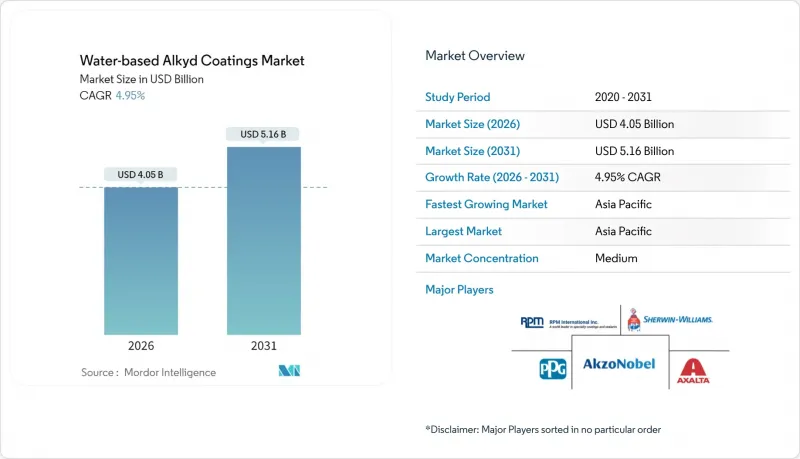
这一增长得益于更严格的环境法规、建设产业的復苏以及持续的产品创新。製造商正致力于研发低挥发性有机化合物(VOC)配方和无钴干燥系统,以满足全球日益严格的法规要求。亚太地区加速工业化进程以及政府对溶剂排放的严厉打击,推动了该地区的消费成长。北美和欧洲的建筑翻新週期支撑了基础需求,而汽车修补漆等快速成长的细分市场则受益于更短的加工时间和更低的能源成本。策略整合和垂直一体化帮助主要品牌保持了定价权,但生物基乳液为寻求差异化的新参与企业提供了机会。
全球水性醇酸涂料市场趋势及洞察
从溶剂型技术转向水性技术
全球法规正推动涂料系统从溶剂型转变为水性醇酸树脂。 2018年上海实施的溶剂型建筑涂料禁令促使中国建设产业在全国推广使用水性醇酸树脂,改变了原料流动,并对区域供应链产生了影响。美国环保署(EPA)计划于2025年修订其气雾剂涂料VOC排放法规,这将进一步刺激对低反应性材料的需求。像Perstorp这样的供应商正在展示新一代乳化剂,这些乳化剂能够在不影响涂料硬度或光泽度的前提下,将VOC排放降至接近零。能够兼顾法规合规性和传统表现的企业将获得先发优势,并增强客户忠诚度。
建筑业復苏与重新粉刷週期
由于老旧住宅存量以及DIY的成本效益,住宅重新粉刷的需求仍然强劲,抵消了新建房屋数量的放缓。据剪切机-Williams)称,其专业通路已占美国涂料销售量的63%,这充分体现了其专业经销商网路的价值。亚洲涂料公司(Asian Paints)透过一项48亿美元的计划,将其装饰涂料产能提高了一倍以上,以响应印度的「人人有房」倡议。这些趋势表明,即使GDP成长幅度不大,也能透过重新粉刷的需求确保稳定的销售量,从而减轻经济週期的影响。
与溶剂型涂料相比:干燥和固化时间更长
高湿度会减缓水分蒸发,导致工期延长和人事费用增加。 Polint 的速干型 DTM 醇酸乳液可加快施工速度,但仍需优化干燥剂配方。配方师正致力于研发钴替代技术,以降低毒性并保持干燥速度。儘管近年来性能差距正在缩小,但赤道气候地区的施工人员仍然倾向于选择溶剂型涂料用于外墙施工。
细分市场分析
预计到2025年,建筑涂料将占水性醇酸涂料市场规模的46.02%,这反映了持续的翻新週期以及住宅室内装修法规主导的需求。配方师正在研发适用于生活空间的低气味涂料,其挥发性有机化合物(VOC)含量限制已降至50克/公升。在亚洲涂料及其区域竞争对手的主导,亚洲地区的产能扩张与城市住宅规划保持同步。增强的耐久性,例如不泛黄的涂层,提升了乙烯基丙烯酸涂料的价值提案。
汽车修补涂料产业将维持最高的成长率,到2031年复合年增长率将达到6.28%。阿克苏诺贝尔的Sikkens Autowave Optima可降低喷漆室能耗60%,并将涂料层数限制在1.5层,进而提高工厂生产效率并降低碳排放强度。工业金属、木材和船舶产业在水性醇酸树脂乳液技术达到ISO 12944防腐蚀标准后,开始采用水性醇酸树脂。家具製造商欢迎符合企业永续性目标的生物基产品,而机械和船舶涂料则为需要先进阻隔添加剂的专业人士提供了机会。
水性醇酸涂料市场报告按应用领域(建筑、防护/工业金属、木器涂料等)、终端用户行业(建筑与基础设施、工业OEM、汽车与交通运输、船舶与海洋工程等)以及地区(亚太地区、北美、欧洲、南美、中东和非洲)进行细分。市场预测以美元计价。
区域分析
预计到2025年,亚太地区将占全球营收的41.05%,并在2031年之前以5.45%的复合年增长率成长。中国上海等城市实施的溶剂禁令正在推动符合标准的水性醇酸树脂的全面转型。国家标准将铅含量限制在90毫克/公斤以内,进一步强化了这项转型,为国内製造商提供了技术要求和出口优势。强劲的建筑需求、不断增长的汽车保有量以及消费者意识的提高,都在支撑多个细分市场的需求。
北美凭藉着完善的分销网络和严格的环境法规,保持着强劲的市场地位。加州50克/公升的污染物排放限值推动了研发,而专业的汽车修补服务也带动了市场需求。美国製造商正透过利用管理式销售管道和自有品牌协议来优化利润率。在汽车修补领域,随着钣金喷漆店意识到缩短製程时间的优势,他们正迅速采用这项技术。
欧洲持续保持创新活力,生物基乳化剂和无钴干燥剂已较早商业化。儘管成熟的消费结构限制了销售成长,但历史建筑的维修和节能维修支撑了稳定的需求。欧盟绿色交易的奖励促进了公共部门采购低挥发性有机化合物(VOC)涂料,并给予符合标准的供应商优先竞标权。
随着城市基础设施的扩张,南美洲的需求正在逐步增长,尤其是在巴西,世界杯前的设施翻新工程更是推动了这一成长。儘管各国监管力道不尽相同,但日益增强的健康意识正促使买家转向水基系统。在中东和非洲,市场存在着早期发展机会,尤其是在高端商业建筑和油气基础设施领域,这些领域需要兼具耐腐蚀性和合规性的解决方案。价格敏感度和极端气候限制了转换率,凸显了开发湿度优化配方和本地化混合的必要性。
其他福利:
- Excel格式的市场预测(ME)表
- 3个月的分析师支持
目录
第一章 引言
- 研究假设和市场定义
- 调查范围
第二章调查方法
第三章执行摘要
第四章 市场情势
- 市场概览
- 市场驱动因素
- 从溶剂型技术转向水性技术
- 建筑业復苏与重新粉刷週期
- 全球加强对挥发性有机化合物(VOC)和有害空气污染物(HAP)的监管
- 对低气味内墙涂料的偏好
- 生物基醇酸乳液达到商业化规模
- 市场限制
- 与溶剂型涂料相比,干燥和固化时间更长。
- 新兴经济体的价格敏感性
- 湿度导致的耐候性受限
- 价值链分析
- 波特五力模型
- 供应商的议价能力
- 买方的议价能力
- 新进入者的威胁
- 替代品的威胁
- 竞争程度
第五章 市场规模与成长预测
- 透过使用
- 建筑学
- 防护/工业金属
- 木器漆
- 汽车修补漆
- 其他(船舶、机械)
- 按最终用户行业划分
- 建筑和基础设施
- 工业OEM
- 汽车和运输设备
- 海洋/近海
- 家具和配件
- 其他的
- 按地区
- 亚太地区
- 中国
- 日本
- 印度
- 韩国
- ASEAN
- 亚太其他地区
- 北美洲
- 我们
- 加拿大
- 墨西哥
- 欧洲
- 德国
- 英国
- 法国
- 义大利
- 俄罗斯
- 其他欧洲地区
- 南美洲
- 巴西
- 阿根廷
- 其他南美洲
- 中东和非洲
- 沙乌地阿拉伯
- 南非
- 其他中东和非洲地区
- 亚太地区
第六章 竞争情势
- 市场集中度
- 策略趋势
- 市占率(%)/排名分析
- 公司简介
- Akzo Nobel NV
- Axalta Coating Systems, LLC
- Benjamin Moore & Co.
- Brillux GmbH & Co. KG
- Caparol Paints
- Cloverdale Paint Inc.
- Hempel A/S
- Jotun
- Kansai Paint Co.,Ltd.
- NATIONAL PAINTS FACTORIES CO. LTD.
- NIPSEA Group
- PPG Industries Inc.
- RPM International Inc.
- The Sherwin-Williams Company
- Tikkurila
第七章 市场机会与未来展望
The Water-based Alkyd Coatings Market was valued at USD 3.86 billion in 2025 and estimated to grow from USD 4.05 billion in 2026 to reach USD 5.16 billion by 2031, at a CAGR of 4.95% during the forecast period (2026-2031).
Stronger environmental compliance rules, a recovering construction sector, and steady product innovation underpin this growth. Manufacturers focus on low-VOC formulations and cobalt-free drying systems to satisfy tightening global regulations. Asia-Pacific dominates consumption, helped by accelerated industrialization and government crackdowns on solvent emissions. Architectural repaint cycles in North America and Europe sustain baseline demand, while fast-growth niches such as automotive refinish benefit from shorter process times and lower energy costs. Strategic consolidation and vertical integration give leading brands pricing power, yet bio-based emulsions open doors for differentiated challengers.
Global Water-based Alkyd Coatings Market Trends and Insights
Shift from Solvent- to Water-based Technology
Global mandates catalyze the conversion from solvent systems to water-based alkyds. Shanghai's 2018 ban on solvent architectural paints triggered nationwide adoption across Chinese construction, altering raw-material flows and influencing regional supply chains. The U.S. EPA's 2025 update of aerosol-coating VOC rules further boosts demand for less reactive ingredients. Suppliers such as Perstorp showcase next-generation emulsifiers that allow near-zero VOC performance without sacrificing hardness or gloss. Firms able to balance compliance with legacy performance secure early mover premiums and strengthen customer loyalty.
Construction Sector Recovery and Repaint Cycles
Residential repainting remains resilient as aging housing stock and DIY affordability offset slower new builds. Sherwin-Williams reports that its pro-contractor channel already captures 63% of U.S. paint volumes, reinforcing the value of professional networks. Asian Paints more than doubled decorative capacity with a USD 4.8 billion program to serve India's Housing for All initiative. These patterns illustrate that even modest GDP growth can unlock steady volume through repaint demand, cushioning cyclicality.
Longer Drying/Curing Time vs. Solvent Systems
Water slows evaporation under high humidity, lengthening project schedules and raising labor costs. Fast-dry DTM alkyd emulsions from Polynt shorten cycles yet still depend on optimized drier blends. Formulators wrestle with cobalt-replacement to mitigate toxicity while preserving siccative action. Performance gaps narrow each year, but contractors in equatorial climates often default to solvent formulations for exterior work.
Other drivers and restraints analyzed in the detailed report include:
- Tightening Global VOC and HAP Regulations
- Preference for Low-odor Indoor Paints
- Humidity-Driven Weatherability Limitations
For complete list of drivers and restraints, kindly check the Table Of Contents.
Segment Analysis
Architectural coatings generated 46.02% of the water-based alkyd coatings market size in 2025, reflecting sustained repaint cycles and regulation-driven demand in residential interiors. Formulators deliver low-odor paints suited to occupied spaces and VOC limits as low as 50 g/L. Asian capacity expansion, led by Asian Paints and regional peers, keeps pace with urban housing programs. Longevity improvements such as non-yellowing finishes strengthen value propositions versus vinyl acrylics.
The automotive refinish segment will post the fastest 6.28% CAGR through 2031. AkzoNobel's Sikkens Autowave Optima cuts booth energy 60% and reduces layers to 1.5, enhancing shop throughput and lowering carbon intensity. Industrial metal, wood, and marine niches adopt water-borne alkyds as emulsification technologies hit ISO 12944 corrosion benchmarks. Furniture makers welcome bio-based variants that align with corporate sustainability goals, while machinery and offshore coatings represent specialized opportunities requiring advanced barrier additives.
The Water-Based Alkyd Coatings Report is Segmented by Application (Architectural, Protective/Industrial Metal, Wood Finishes, and More), End-User Industry (Construction and Infrastructure, Industrial OEM, Automotive and Transportation, Marine and Offshore, and More), and Geography (Asia-Pacific, North America, Europe, South America, and Middle-East and Africa). The Market Forecasts are Provided in Terms of Value (USD).
Geography Analysis
Asia-Pacific commanded 41.05% of global revenue in 2025 and is set to advance at a 5.45% CAGR through 2031. China's solvent bans in cities such as Shanghai prompt wholesale migration to compliant water-based alkyds. National standards capping lead at 90 mg/kg further reinforce the shift, giving domestic producers technical mandates and export leverage. Robust construction, expanding automotive fleets, and rising consumer awareness anchor multi-segment demand.
North America maintains a strong position built on established distribution and stringent environmental codes. California's 50 g/L limit catalyzes research and development, while professional repaint services drive volume. U.S. producers leverage controlled channels and private-label contracts to optimize margins. Rapid adoption in automotive refinish accelerates as bodyshops realize cycle-time reduction.
Europe remains innovation-centric with early commercialization of bio-based emulsions and cobalt-free dryers. Mature consumption moderates volume growth, yet retrofitting of historical buildings and energy-efficient refurbishments sustain steady demand. EU Green Deal incentives encourage public-sector procurement of low-VOC coatings, giving compliant suppliers favored-bidder status.
South America witnesses incremental uptake as urban infrastructure expands, especially in Brazil's pre-World Cup facility renewals. Regulatory enforcement varies by country, but rising health awareness nudges buyers toward water-borne systems. Middle-East and Africa present early-stage opportunities centered on high-end commercial and oil-gas infrastructure needing corrosion-resistant yet compliant solutions. Price sensitivity and climate extremes temper speed of conversion, underlining the need for humidity-optimized formulations and local blending.
- Akzo Nobel N.V.
- Axalta Coating Systems, LLC
- Benjamin Moore & Co.
- Brillux GmbH & Co. KG
- Caparol Paints
- Cloverdale Paint Inc.
- Hempel A/S
- Jotun
- Kansai Paint Co.,Ltd.
- NATIONAL PAINTS FACTORIES CO. LTD.
- NIPSEA Group
- PPG Industries Inc.
- RPM International Inc.
- The Sherwin-Williams Company
- Tikkurila
Additional Benefits:
- The market estimate (ME) sheet in Excel format
- 3 months of analyst support
TABLE OF CONTENTS
1 Introduction
- 1.1 Study Assumptions and Market Definition
- 1.2 Scope of the Study
2 Research Methodology
3 Executive Summary
4 Market Landscape
- 4.1 Market Overview
- 4.2 Market Drivers
- 4.2.1 Shift from Solvent to Water-Based Technology
- 4.2.2 Construction Sector Recovery and Repaint Cycles
- 4.2.3 Tightening Global VOC and HAP Regulations
- 4.2.4 Preference for Low-Odor Indoor Paints
- 4.2.5 Bio-Based Alkyd Emulsions Reach Commercial Scale
- 4.3 Market Restraints
- 4.3.1 Longer Drying/Curing Time Vs. Solvent Systems
- 4.3.2 Price Sensitivity in Emerging Economies
- 4.3.3 Humidity-Driven Weatherability Limitations
- 4.4 Value Chain Analysis
- 4.5 Porter's Five Forces
- 4.5.1 Bargaining Power of Suppliers
- 4.5.2 Bargaining Power of Buyers
- 4.5.3 Threat of New Entrants
- 4.5.4 Threat of Substitutes
- 4.5.5 Degree of Rivalry
5 Market Size and Growth Forecasts (Value)
- 5.1 By Application
- 5.1.1 Architectural
- 5.1.2 Protective/Industrial Metal
- 5.1.3 Wood Finishes
- 5.1.4 Automotive Refinish
- 5.1.5 Others (Marine, Machinery)
- 5.2 By End-User Industry
- 5.2.1 Construction and Infrastructure
- 5.2.2 Industrial OEM
- 5.2.3 Automotive and Transportation
- 5.2.4 Marine and Offshore
- 5.2.5 Furniture and Joinery
- 5.2.6 Others
- 5.3 By Geography
- 5.3.1 Asia-Pacific
- 5.3.1.1 China
- 5.3.1.2 Japan
- 5.3.1.3 India
- 5.3.1.4 South Korea
- 5.3.1.5 ASEAN
- 5.3.1.6 Rest of Asia-Pacific
- 5.3.2 North America
- 5.3.2.1 United States
- 5.3.2.2 Canada
- 5.3.2.3 Mexico
- 5.3.3 Europe
- 5.3.3.1 Germany
- 5.3.3.2 United Kingdom
- 5.3.3.3 France
- 5.3.3.4 Italy
- 5.3.3.5 Russia
- 5.3.3.6 Rest of Europe
- 5.3.4 South America
- 5.3.4.1 Brazil
- 5.3.4.2 Argentina
- 5.3.4.3 Rest of South America
- 5.3.5 Middle-East and Africa
- 5.3.5.1 Saudi Arabia
- 5.3.5.2 South Africa
- 5.3.5.3 Rest of Middle-East and Africa
- 5.3.1 Asia-Pacific
6 Competitive Landscape
- 6.1 Market Concentration
- 6.2 Strategic Moves
- 6.3 Market Share (%)**/Ranking Analysis
- 6.4 Company Profiles (includes Global level Overview, Market level overview, Core Segments, Financials as available, Strategic Information, Market Rank/Share for key companies, Products and Services, and Recent Developments)
- 6.4.1 Akzo Nobel N.V.
- 6.4.2 Axalta Coating Systems, LLC
- 6.4.3 Benjamin Moore & Co.
- 6.4.4 Brillux GmbH & Co. KG
- 6.4.5 Caparol Paints
- 6.4.6 Cloverdale Paint Inc.
- 6.4.7 Hempel A/S
- 6.4.8 Jotun
- 6.4.9 Kansai Paint Co.,Ltd.
- 6.4.10 NATIONAL PAINTS FACTORIES CO. LTD.
- 6.4.11 NIPSEA Group
- 6.4.12 PPG Industries Inc.
- 6.4.13 RPM International Inc.
- 6.4.14 The Sherwin-Williams Company
- 6.4.15 Tikkurila
7 Market Opportunities and Future Outlook

 醇酸树脂市场:依原料、技术、应用和最终用途划分-2026-2032年全球市场预测
 改质醇酸树脂市场规模、份额和成长分析:按树脂类型、应用和地区划分-2026-2033年产业预测
 2026年全球醇酸树脂市场报告2026年全球醇酸涂料市场报告环氧改质丙烯酸酯市场按类型、等级和应用划分,全球预测(2026-2032年)硅基改质树脂冷媒市场(依产品种类、等级、最终用途产业及销售管道),全球预测(2026-2032年)
 改质环氧树脂市场规模、份额和成长分析(依改质剂类型、应用、终端用户产业、销售管道和地区划分)-2026-2033年产业预测
 全球醇酸树脂市场
 改质诺伏勒克环氧树脂市场报告:趋势、预测和竞争分析(至 2031 年)醇酸涂料市场报告:趋势、预测与竞争分析(至2031年)