


 |
市场调查报告书
商品编码
1939090
云端储存:市场占有率分析、产业趋势与统计、成长预测(2026-2031)Cloud Storage - Market Share Analysis, Industry Trends & Statistics, Growth Forecasts (2026 - 2031) |
||||||

※ 本网页内容可能与最新版本有所差异。详细情况请与我们联繫。
预计到 2026 年,云端储存市场规模将达到 1,792.6 亿美元,高于 2025 年的 1,452.3 亿美元。
预计到 2031 年将达到 5,138.6 亿美元,2026 年至 2031 年的复合年增长率为 23.45%。
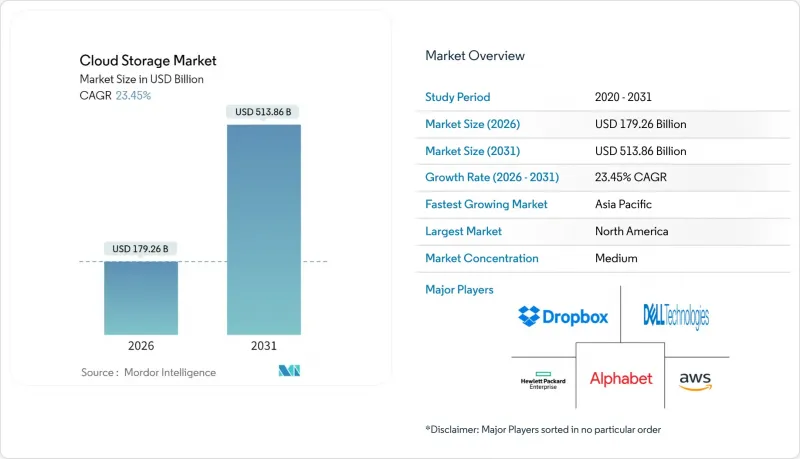
生成式人工智慧的普及、资料主权要求的推行以及对现代化、节能基础设施的需求,正在加速企业迁移,并重塑全球储存架构。超大规模资料中心业者营运商不断增加的投资、亚太地区主权云端支出的成长以及中小企业的稳步采用,都在扩大全球潜在基本客群。同时,与通膨挂钩的建设成本推动了低功耗技术的创新。物件储存主导着人工智慧工作负载,其中混合部署成长最快,亚太地区引领着区域扩张。随着各供应商竞相提供人工智慧优化容量、主权云端区域和低碳环保服务,竞争依然激烈。
全球云端储存市场趋势与洞察
生成式人工智慧主导的资料爆炸性成长将应用于知识工作者应用(2025 年及以后)
生成式人工智慧工作负载正推动企业资料量呈现数量级成长。由于机械硬碟难以满足延迟目标,人工智慧训练环境对固态硬碟 (SSD) 的需求正以每年 35% 的速度成长。预计单次训练运行的储存占用空间将从 2025 年的 30TB 成长到 2030 年的 100TB。同时,随着新产品整合人工智慧功能,推理节点的成长速度将进一步加快。成本模型显示,资料处理成本超过了模型开发成本,迫使供应商优化储存分层和压缩策略。超大规模资料中心业者正在重新设计其储存层级,优先考虑高吞吐量的非挥发性记忆体 (NVM)丛集和针对并行存取最佳化的物件储存桶。
加速媒体和游戏产业的边缘到云端工作流程
媒体和游戏工作室正在采用云端优先的流程,随着串流媒体和即时渲染的扩展,97% 的工作室计划在 2025 年增加储存预算。云端游戏要达到 44% 的复合年增长率,需要分散式快取来维持跨区域的 50 毫秒以下延迟。然而,这些公司将 51% 的储存预算用于 API 呼叫和出口流量,这促使他们采用多重云端部署来规避费用。预计到 2024 年,边缘运算支出将达到 2,320 亿美元,这将迫使服务供应商整合本地网关和超大规模归檔,以实现无缝的资产流。
持久资料主权的复杂性
从美国的《云端法案》到中国的《跨境资料流动条例》,不同的法规迫使企业经营分散的储存环境,并复製资料集以满足当地法律的要求。法律的不确定性增加了遵循成本,并减缓了全球部署速度,因为企业需要避免重迭的司法管辖权纠纷。
细分市场分析
2025年,公共云端占该细分市场收入的58.45%,但由于资料居住法规的日益严格,预计到2031年,混合架构将以25.55%的复合年增长率增长。企业正在将本地节点与公共云端的可扩展性相结合,以满足延迟和合规性目标。政府主权框架进一步推动了混合需求,而边缘投资则将微区域整合到统一的资源池中。目前,82%的企业工作负载在混合环境中进行管理,这表明企业正在从完全依赖公有云的策略转向混合云。
第二个增长点在于人工智慧训练丛集,这类集群需要本地GPU相邻部署以确保吞吐量,同时还需要云端爆发来应对负载高峰。各组织正在采用控制平面软体进行跨站点策略编排,以减少厂商锁定并优化成本。厂商将透过整合监控、自动资料分层和市场生态系统来脱颖而出。随着预算的重新调整,云端储存市场的部署模式将趋向于跨越核心区、边缘区和主权区的灵活、策略驱动型架构。
受非结构化资料爆炸性成长的推动,物件储存库预计在2025年将创造51.05%的收入,并在2031年之前以24.4%的年均成长率持续成长。物件平台云端储存市场规模受益于其固有的可扩展性、丰富的元资料以及纠错编码的经济性,这些优势满足了生成式人工智慧语料库的需求。文件层和区块层仍将继续用于传统工作负载和线上事务处理(OLTP),但其市场份额将逐渐被能够承受Petabyte级并行存取的物件层所取代。
创新重点在于多租户命名空间隔离、在线连续加密以及无需预处理即可直接向训练节点提供资料的GPU直连流水线。美光部署32TB NVMe SSD,凸显了向基于快闪记忆体的物件丛集的转型。专利申请揭示了纠错编码快取和分散式杂凑索引的进步,这些进步显着提升了效能和持久性。随着人工智慧应用的不断扩展,物件储存将成为云端储存市场中内容、模型查核点和向量资料库的基础。
云端储存市场报告按部署模式(私有云端、公共云端等)、储存类型(文件储存、物件储存等)、公司规模(中小企业和大型企业)、应用程式(备份和復原、应用程式管理等)、最终用户垂直产业(银行、金融服务和保险、製造业、零售和电子商务等)以及地区进行细分。
区域分析
到2025年,北美将占据37.40%的收入份额,这主要得益于超大规模资料中心业者资料中心总部位置的需求以及人工智慧的早期应用。资料中心电力需求预计到2028年将维持16%的年增长率,但电网瓶颈和批准延误正在影响这一进程。诸如基于云端的客户身份验证(KYC)等拟议法规可能会扰乱跨境工作流程,促使企业转向多区域架构。儘管硬体短缺会不时限制产能,但持续的投资将使该地区在创新和支出方面保持主导地位。
亚太地区是成长的主要驱动力,在政府数位化计画、主权云端政策以及人工智慧应用日益普及的推动下,实现了24.6%的复合年增长率。预计到2025年,中国在云端领域的支出将达到460亿美元,主要得益于本土供应商和政策支援。印度的服务市场在2024年上半年达到52亿美元,预计2028年将达到255亿美元。澳洲和日本正在推动区域化框架,在居住合规区扩张的推动下,区域资料中心容量实现了13.3%的复合年增长率。
在GDPR的推动下,欧洲正经历稳定成长,产业特定规范推动了加密和资料最小化功能的发展。随着巴西、墨西哥和智利吸引超大规模资料中心业者投资,拉丁美洲的託管市场规模到2029年可望达到100亿美元。非洲的需求正以每年25-30%的速度成长,但在全球收入中所占比例不到1%。本地供应商正透过价格和货币柔软性来脱颖而出。这些趋势共同促成了一个多极化的云端储存市场,其中区域生态系统与全球连结并存。
其他福利:
- Excel格式的市场预测(ME)表
- 分析师支持(3个月)
目录
第一章 引言
- 研究假设和市场定义
- 调查范围
第二章调查方法
第三章执行摘要
第四章 市场情势
- 市场概览
- 宏观经济影响评估
- 市场驱动因素
- 提高各组织机构的云端采用率
- 对低成本、高速储存存取的需求日益增长
- 加速媒体和游戏产业的边缘到云端工作流程
- 知识工作者应用中由生成式人工智慧主导的资料爆炸(2025 年及以后)
- 政府对主权云框架的经济措施
- 以ESG主导的储存优化和注重碳排放的工作负载
- 市场限制
- 持久资料主权的复杂性
- 人们越来越反对收取出口费,以及供应商锁定带来的风险
- 多重云端环境中资料扩散带来的安全挑战
- 边远市场的最后一公里频宽限制
- 价值链分析
- 监管环境
- 技术展望
- 波特五力分析
- 新进入者的威胁
- 供应商的议价能力
- 买方的议价能力
- 替代品的威胁
- 产业间竞争
- 投资分析
第五章 市场规模与成长预测
- 透过部署模式
- 私有云端
- 公共云端
- 混合云端
- 依储存类型
- 文件储存
- 物件储存
- 区块储存
- 按公司规模
- 小型企业
- 大公司
- 透过使用
- 备份和復原
- 资料管理与归檔
- 应用程式管理
- 协作和内容服务
- 按最终用户行业划分
- BFSI
- 医疗保健和生命科学
- 政府/公共部门
- 製造业
- 零售与电子商务
- 资讯科技/通讯
- 媒体与娱乐
- 其他的
- 按地区
- 北美洲
- 我们
- 加拿大
- 墨西哥
- 南美洲
- 巴西
- 阿根廷
- 欧洲
- 德国
- 英国
- 法国
- 俄罗斯
- 亚太地区
- 中国
- 印度
- 日本
- 韩国
- ASEAN
- 亚太其他地区
- 中东和非洲
- 中东
- 沙乌地阿拉伯
- 土耳其
- 非洲
- 南非
- 中东
- 北美洲
第六章 竞争情势
- 市场集中度
- 策略趋势
- 市占率分析
- 公司简介
- Amazon Web Services Inc.
- Microsoft Corporation
- Google LLC(Alphabet)
- Alibaba Cloud(Alibaba Group)
- IBM Corporation
- Oracle Corporation
- Dell Technologies Inc.
- Hewlett Packard Enterprise
- NetApp Inc.
- Dropbox Inc.
- Box Inc.
- Wasabi Technologies
- Backblaze Inc.
- Tencent Cloud
- OVHcloud
- Rackspace Technology
- Hitachi Vantara
- Fujitsu Limited
- pCloud AG
- Tresorit AG
- Iron Mountain
第七章 市场机会与未来展望
The cloud storage market size in 2026 is estimated at USD 179.26 billion, growing from 2025 value of USD 145.23 billion with 2031 projections showing USD 513.86 billion, growing at 23.45% CAGR over 2026-2031.
Generative-AI adoption, data-sovereignty mandates, and the need for modern, energy-efficient infrastructure are accelerating enterprise migration and reshaping storage architectures worldwide. Intensifying hyperscaler investment, rising sovereign-cloud spend across Asia Pacific, and steady SME adoption are widening the global addressable base while inflation-linked construction costs spur innovation in low-power technologies. Object storage dominates AI workloads, hybrid deployment grows fastest, and Asia Pacific leads regional expansion. Competitive rivalry remains high as providers pursue AI-optimized capacity, sovereign-cloud zones, and carbon-aware services.
Global Cloud Storage Market Trends and Insights
Gen-AI-led data explosion in knowledge-worker apps (2025+)
Generative-AI workloads are multiplying enterprise data volumes by an order of magnitude. Solid-state drive demand for AI training environments is climbing 35% per year as spinning disks struggle to meet latency targets. Storage footprints for single training runs are set to scale from 30 TB in 2025 to 100 TB by 2030, while inference nodes grow even faster as new products embed AI features. Cost models now reveal that data-handling charges eclipse model-development expenses, pushing vendors to optimize tiering and compression. Hyperscalers are redesigning storage layers to favor high-throughput NVM-based clusters and object storage buckets tuned for parallel access.
Edge-to-cloud workflow acceleration in media and gaming
Media and gaming studios are embracing cloud-first pipelines; 97% plan to raise storage budgets in 2025 as streaming and real-time rendering expand. Cloud gaming's 44% CAGR requires distributed caches that maintain <50 ms latency across regions. Yet, these firms spend 51% of storage budgets on API calls and egress traffic, catalyzing multi-cloud placement to avoid fees. Edge-compute spend is forecast at USD 232 billion in 2024, pushing providers to integrate on-premise gateways with hyperscale archives for seamless asset flows.
Persistent data-sovereignty complexity
Divergent regulations-from the U.S. CLOUD Act to China's cross-border flow rules-force organizations to operate fragmented storage footprints and duplicate datasets to meet local statutes. Legal uncertainty raises compliance spend and slows global rollouts as firms navigate overlapping jurisdictional claims.
Other drivers and restraints analyzed in the detailed report include:
- Government stimulus for sovereign cloud frameworks
- ESG-driven storage optimization and carbon-aware workloads
- Escalating egress-fee backlash and vendor lock-in risk
For complete list of drivers and restraints, kindly check the Table Of Contents.
Segment Analysis
The segment's revenue in 2025 reflected a 58.45% public-cloud lead, yet hybrid architectures are on track for a 25.55% CAGR to 2031 as data residency laws tighten. Enterprises blend on-premise nodes with public scalability to meet latency and compliance goals. Governments' sovereign frameworks further propel hybrid demand, while edge investments embed micro-regions into unified pools. Hybrid environments now manage 82% of enterprise workloads, validating the shift away from all-public strategies.
A second growth vector lies in AI training clusters that require local GPU adjacency for throughput yet still need cloud bursts for spikes. Organizations adopt control-plane software to orchestrate policies across sites, mitigating lock-in and optimizing cost. Vendors differentiate via integrated observability, automated data-tiering, and marketplace ecosystems. As budgets reallocate, the cloud storage market will see deployment models converge into fluid, policy-driven fabrics spanning core, edge, and sovereign zones.
Object repositories generated 51.05% revenue in 2025 and will compound at 24.4% through 2031 as unstructured data explodes. The cloud storage market size for object platforms benefits from intrinsic scalability, rich metadata, and erasure-coding economics that align with generative-AI corpus needs. File and block tiers persist for legacy and OLTP workloads but cede share to object layers hardened for petabyte-scale parallel access.
Innovation centers on multi-tenant namespace isolation, in-line encryption, and GPU-direct pipelines that feed training nodes without staging. Micron's roll-out of 32 TB NVMe SSDs underscores the migration toward flash-based object clusters. Patent filings reveal advances in erasure-coded caching and distributed-hash indexing, amplifying performance and durability. As AI adoption broadens, object storage will underpin content, model checkpoints, and vector databases within the cloud storage market.
The Cloud Storage Market Report is Segmented by Deployment Mode (Private Cloud, Public Cloud, and More), Storage Type (File Storage, Object Storage, and More), Enterprise Size (SMEs and Large Enterprises), Application (Backup and Recovery, Application Management, and More), End-User Industry (BFSI, Manufacturing, Retail and E-Commerce, and More), and Geography.
Geography Analysis
North America held 37.40% revenue in 2025 as hyperscaler headquarters and early AI adoption drove demand. Data-center power needs are on a 16% annual trajectory to 2028, though transmission bottlenecks and permitting delays pressure timelines. Regulatory proposals such as cloud know-your-customer (KYC) checks may fragment cross-border workflows, nudging enterprises toward multi-region architectures. Hardware shortages intermittently constrain capacity, but continuous investment sustains leadership in innovation and spend.
Asia Pacific is the growth engine, charting a 24.6% CAGR courtesy of government digitization programs, sovereign-cloud mandates, and rising AI adoption. China's spending will hit USD 46 billion in 2025, buoyed by local vendors and policy support. India's services market reached USD 5.2 billion in H1 2024 and targets USD 25.5 billion by 2028. Australia and Japan advance localized frameworks, while a 13.3% CAGR in regional data-center capacity underscores the build-out of residency-compliant zones.
Europe grows steadily under GDPR, with sectoral codes pushing encryption and data-minimization features. Latin America's colocation pipeline could reach USD 10 billion by 2029 as Brazil, Mexico, and Chile court hyperscaler investment. Africa's demand rises 25-30% annually, yet represents <1% global revenue; local providers differentiate on price and currency flexibility. These dynamics confirm a multipolar cloud storage market where regional ecosystems coexist with global connectivity.
- Amazon Web Services Inc.
- Microsoft Corporation
- Google LLC (Alphabet)
- Alibaba Cloud (Alibaba Group)
- IBM Corporation
- Oracle Corporation
- Dell Technologies Inc.
- Hewlett Packard Enterprise
- NetApp Inc.
- Dropbox Inc.
- Box Inc.
- Wasabi Technologies
- Backblaze Inc.
- Tencent Cloud
- OVHcloud
- Rackspace Technology
- Hitachi Vantara
- Fujitsu Limited
- pCloud AG
- Tresorit AG
- Iron Mountain
Additional Benefits:
- The market estimate (ME) sheet in Excel format
- 3 months of analyst support
TABLE OF CONTENTS
1 INTRODUCTION
- 1.1 Study Assumptions and Market Definition
- 1.2 Scope of the Study
2 RESEARCH METHODOLOGY
3 EXECUTIVE SUMMARY
4 MARKET LANDSCAPE
- 4.1 Market Overview
- 4.2 Macroeconomic Impact Assessment
- 4.3 Market Drivers
- 4.3.1 Increase in cloud adoption across organizations
- 4.3.2 Rising demand for low-cost, high-speed storage access
- 4.3.3 Edge-to-cloud workflow acceleration in media and gaming
- 4.3.4 Gen-AI-led data explosion in knowledge-worker apps (2025+)
- 4.3.5 Government stimulus for sovereign cloud frameworks
- 4.3.6 ESG-driven storage optimization and carbon-aware workloads
- 4.4 Market Restraints
- 4.4.1 Persistent data-sovereignty complexity
- 4.4.2 Escalating egress-fee backlash and vendor lock-in risk
- 4.4.3 Multi-cloud data-sprawl security gaps
- 4.4.4 Limited last-mile bandwidth in frontier markets
- 4.5 Value Chain Analysis
- 4.6 Regulatory Landscape
- 4.7 Technological Outlook
- 4.8 Porter's Five Forces Analysis
- 4.8.1 Threat of New Entrants
- 4.8.2 Bargaining Power of Suppliers
- 4.8.3 Bargaining Power of Buyers
- 4.8.4 Threat of Substitutes
- 4.8.5 Industry Rivalry
- 4.9 Investment Analysis
5 MARKET SIZE AND GROWTH FORECASTS (VALUE)
- 5.1 By Deployment Mode
- 5.1.1 Private Cloud
- 5.1.2 Public Cloud
- 5.1.3 Hybrid Cloud
- 5.2 By Storage Type
- 5.2.1 File Storage
- 5.2.2 Object Storage
- 5.2.3 Block Storage
- 5.3 By Enterprise Size
- 5.3.1 SMEs
- 5.3.2 Large Enterprises
- 5.4 By Application
- 5.4.1 Backup and Recovery
- 5.4.2 Data Management and Archiving
- 5.4.3 Application Management
- 5.4.4 Collaboration and Content Services
- 5.5 By End-user Industry
- 5.5.1 BFSI
- 5.5.2 Healthcare and Life Sciences
- 5.5.3 Government and Public Sector
- 5.5.4 Manufacturing
- 5.5.5 Retail and E-commerce
- 5.5.6 IT and Telecom
- 5.5.7 Media and Entertainment
- 5.5.8 Others
- 5.6 By Geography
- 5.6.1 North America
- 5.6.1.1 United States
- 5.6.1.2 Canada
- 5.6.1.3 Mexico
- 5.6.2 South America
- 5.6.2.1 Brazil
- 5.6.2.2 Argentina
- 5.6.3 Europe
- 5.6.3.1 Germany
- 5.6.3.2 United Kingdom
- 5.6.3.3 France
- 5.6.3.4 Russia
- 5.6.4 Asia Pacific
- 5.6.4.1 China
- 5.6.4.2 India
- 5.6.4.3 Japan
- 5.6.4.4 South Korea
- 5.6.4.5 ASEAN
- 5.6.4.6 Rest of Asia Pacific
- 5.6.5 Middle East and Africa
- 5.6.5.1 Middle East
- 5.6.5.1.1 Saudi Arabia
- 5.6.5.1.2 Turkey
- 5.6.5.2 Africa
- 5.6.5.2.1 South Africa
- 5.6.5.1 Middle East
- 5.6.1 North America
6 COMPETITIVE LANDSCAPE
- 6.1 Market Concentration
- 6.2 Strategic Moves
- 6.3 Market Share Analysis
- 6.4 Company Profiles (includes Global level Overview, Market level overview, Core Segments, Financials as available, Strategic Information, Market Rank/Share for key companies, Products and Services, and Recent Developments)
- 6.4.1 Amazon Web Services Inc.
- 6.4.2 Microsoft Corporation
- 6.4.3 Google LLC (Alphabet)
- 6.4.4 Alibaba Cloud (Alibaba Group)
- 6.4.5 IBM Corporation
- 6.4.6 Oracle Corporation
- 6.4.7 Dell Technologies Inc.
- 6.4.8 Hewlett Packard Enterprise
- 6.4.9 NetApp Inc.
- 6.4.10 Dropbox Inc.
- 6.4.11 Box Inc.
- 6.4.12 Wasabi Technologies
- 6.4.13 Backblaze Inc.
- 6.4.14 Tencent Cloud
- 6.4.15 OVHcloud
- 6.4.16 Rackspace Technology
- 6.4.17 Hitachi Vantara
- 6.4.18 Fujitsu Limited
- 6.4.19 pCloud AG
- 6.4.20 Tresorit AG
- 6.4.21 Iron Mountain
7 MARKET OPPORTUNITIES AND FUTURE OUTLOOK
- 7.1 White-space and Unmet-need Assessment

 2026年全球云端储存区域网路(SAN)市场报告2026年全球分散式储存市场报告
 云端储存市场分析及预测(至2035年):类型、产品类型、服务、技术、元件、应用、部署模式、最终用户、解决方案、交付模式2026年全球企业云端储存服务市场报告2026年全球云端储存市场报告
 消费者云端储存服务市场 - 全球产业规模、份额、趋势、机会及预测(按储存层级、用户年龄、部署模式、储存容量、解决方案、地区和竞争格局划分,2021-2031 年)
 云端储存解决方案市场:按服务模式、储存类型、部署模式、组织规模、定价模式和最终用户划分 - 2026-2032 年全球预测云端储存迁移市场按云端类型、迁移方法、组织规模、部署类型、应用程式和最终用户产业划分 - 全球预测(2026-2032 年)
 云端储存市场规模、占有率、成长、全球产业分析:按类型、应用、区域洞察和预测(2026-2034 年)
 日本云端储存市场报告:按元件、部署类型、使用者类型、产业垂直领域和地区划分(2026-2034 年)