


 |
市场调查报告书
商品编码
1939093
声波感测器:市场份额分析、产业趋势与统计、成长预测(2026-2031)Acoustic Sensors - Market Share Analysis, Industry Trends & Statistics, Growth Forecasts (2026 - 2031) |
||||||

※ 本网页内容可能与最新版本有所差异。详细情况请与我们联繫。
预计到 2026 年,声波感测器市场规模将达到 19.6 亿美元,高于 2025 年的 18 亿美元。
预计到 2031 年将达到 30.1 亿美元,2026 年至 2031 年的复合年增长率为 8.93%。
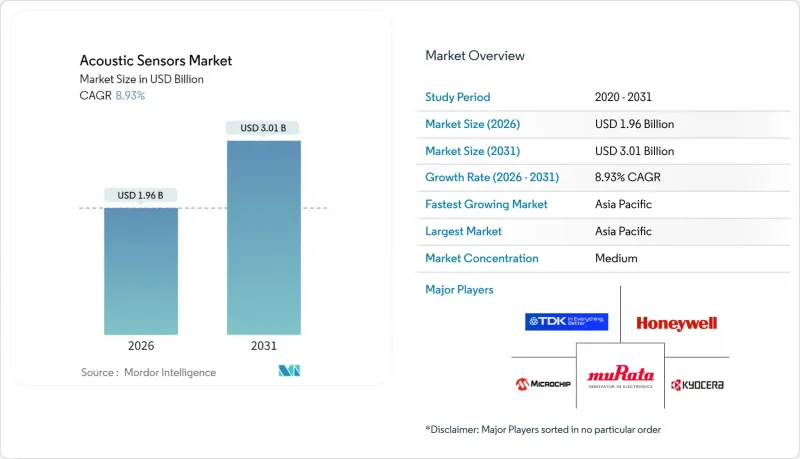
这一成长主要受以下因素驱动:5G 和 Wi-Fi 7 对高频滤波器的强劲需求、交通运输的电气化、工业物联网 (IIoT) 的快速普及以及小型化进程的持续推进。通讯基础设施的升级推动了体声波 (BAW) 滤波器的销售,而表面声波 (SAW) 装置在 3 GHz 以下频段的应用领域也保持着成长势头。电动车 (EV) 和高级驾驶辅助系统 (ADAS) 需要无电池无线感测技术,以减轻线束重量并抵抗强烈电磁干扰。 IIoT 使用者目前倾向于使用边缘声波感测器进行预测性维护,而可印刷压电薄膜则实现了结构健康监测和医疗抛弃式产品领域的超低成本部署。在竞争格局方面,大型半导体公司的进入正在加速创新週期,而压电基板供不应求和地缘政治风险在供应链中也日益凸显。
全球声波感测器市场趋势与洞察
5G 和 Wi-Fi 7 基础设施的快速普及将推动高频滤波器的需求。
随着通讯业者升级到 5G 和 Wi-Fi 7,他们需要工作频率高于 3 频宽 的滤波器,而电子滤波器在该频段的性能已接近极限。表面声波 (SAW)频宽,尤其是体声波 (BAW) 装置,能够提供所需的陡峭滚降特性和低插入损耗。村田製作所 2024 年的产能扩张计画与支援 6 GHz 频段 Wi-Fi 7 的智慧型手机订单直接相关。
车辆电气化将加速无线感测技术的应用。
电动车平台倾向于采用轻量化、无电池的感测器,这些感测器能够采集振动或射频能量。大陆集团将于2024年推出的无线声学胎压监测装置,不仅符合ISO 26262功能安全标准,在高电磁干扰环境下也展现可靠性。
温度漂移和恶劣环境包装限制
石英元件的温度漂移为 20 至 50 ppm/°C,需要高成本的补偿电路或气密封装,对于航太设计而言,-55°C 至 +125°C 的温度范围内,其成本可能比商用元件高成本%,而且振动应力会增加重新校准的需求。
细分市场分析
预计到2025年,声波感测器市场规模将达到11.9亿美元。在製程工业中,由于可靠的电源供应和资料传输,有线方案仍然是首选。然而,价值6.1亿美元的无线解决方案预计将成长更快,这主要得益于维修的经济效益和电动车的需求。无线解决方案10.74%的复合年增长率反映了能源采集技术的进步,这些技术延长了维护週期。基于IEC 61508的标准化和冗余射频通讯协定正在推动其在关键任务系统中的应用。
风能产业的安装商报告称,森萨塔的无电池节点使用寿命延长了10年以上。无线部署被认为是声波感测器市场的主要成长动力,因为布线成本的降低和部署速度的加快可以抵消设备初始价格较高的问题。
预计到2025年,声表面波(SAW)装置的市场规模将达到12.4亿美元(声波感测器市场份额为69.10%),在3GHz以下频段应用领域占据主导地位,并得益于成熟且经济的石英加工技术。然而,随着通讯领域频率的不断提升,体声波(BAW)装置在3GHz以上频段展现出卓越的性能优势,从而带来了5.6亿美元的市场机会。 TDK在日本投资1亿美元用于BAW元件,目标市场为Wi-Fi 7和5G设备,这将推动BAW元件实现两位数的成长。
虽然 SAW 在工业和消费领域得到了广泛应用,但基于物理原理的上限频率限制确保了 BAW 在高频宽需求领域继续占据主导地位。
区域分析
预计到2025年,亚太地区将创造6.7亿美元的市场规模,占全球总营收的37.20%,复合年增长率(CAGR)为9.81%。中国不断扩大的製造地和日本卓越的材料技术巩固了该地区的市场主导地位。韩国5G的快速部署和电动车出口将进一步扩大该地区的声波感测器市场规模。
北美紧追在后,投入5.1亿美元,主要得益于工业IoT改装和航太领域严格的可靠性要求。联邦政府资助的高超音速飞行器监测计画正在加速国防领域的应用。欧洲投入4.3亿美元,受惠于电动车强制令以及强调永续性和工人安全的基建监测法规。
虽然中东、非洲和南美洲仍在发展中,但在石油和天然气、采矿和智慧计划中,无线、无电池节点非常适合偏远和危险的地点,试点部署正在进行中。
其他福利:
- Excel格式的市场预测(ME)表
- 3个月的分析师支持
目录
第一章 引言
- 研究假设和市场定义
- 调查范围
第二章调查方法
第三章执行摘要
第四章 市场情势
- 市场概览
- 市场驱动因素
- 5G 和 Wi-Fi 7 的快速部署正在推动高频 SAW/BAW 滤波器的需求。
- 汽车产业向电动车和高级驾驶辅助系统(ADAS)的转型正在加速无线、无电池感测器的应用。
- 工业IoT和预测性维护计划的成长
- 印刷式柔性压电薄膜可实现超低成本感测表面
- 微型MEMS麦克风促进了语音使用者介面在穿戴和可听装置中的普及。
- 政府法规强制要求对环境和基础设施进行即时监测
- 市场限制
- 恶劣环境下的温度漂移与包装挑战
- 在高精度细分市场中,与光学和电容式替代方案竞争
- 半导体供应链的波动性正在推高前置作业时间和投入成本。
- 材料标准碎片化阻碍了跨平台互通性
- 产业价值/价值链分析
- 监管现状和标准
- 技术展望(边缘运算和人工智慧分析)
- 波特五力分析
- 供应商的议价能力
- 买方的议价能力
- 新进入者的威胁
- 竞争对手之间的竞争
- 替代品的威胁
第五章 市场规模与成长预测
- 按类型
- 有线
- 无线的
- 按波形类型
- 表面声波(SAW)
- 瑞利表面波
- 体声波(BAW)
- 表面声波(SAW)
- 透过检测参数
- 温度
- 压力
- 扭力
- 湿度
- 大量的
- 黏度
- 透过使用
- 车
- 航太/国防
- 家用电子电器
- 卫生保健
- 产业
- 环境监测
- 其他用途
- 按地区
- 北美洲
- 我们
- 加拿大
- 墨西哥
- 欧洲
- 德国
- 英国
- 法国
- 俄罗斯
- 其他欧洲地区
- 亚太地区
- 中国
- 日本
- 印度
- 韩国
- 澳洲
- 亚太其他地区
- 中东和非洲
- 中东
- 沙乌地阿拉伯
- 阿拉伯聯合大公国
- 其他中东地区
- 非洲
- 南非
- 埃及
- 其他非洲地区
- 中东
- 南美洲
- 巴西
- 阿根廷
- 其他南美洲
- 北美洲
第六章 竞争情势
- 市场集中度
- 策略趋势
- 市占率分析
- 公司简介
- Murata Manufacturing Co., Ltd.
- TDK Corporation
- KYOCERA Corporation
- Honeywell International Inc.
- Microchip Technology Inc.(Vectron International)
- Transense Technologies plc
- Pro-micron GmbH & Co. KG
- CTS Corporation
- IFM Electronic GmbH
- Dytran Instruments, Inc.
- Campbell Scientific, Inc.
- API Technologies Corp.
- SENSeOR SAS
- CeramTec GmbH
- Boston Piezo-Optics Inc.
- Teledyne Microwave Solutions
- Raltron Electronics Corporation
- Taiyo Yuden Co., Ltd.
- AVX Corporation
- Althen GmbH Mess-und Sensortechnik
- Sensor Technology Ltd.
第七章 市场机会与未来展望
Acoustic sensor market size in 2026 is estimated at USD 1.96 billion, growing from 2025 value of USD 1.8 billion with 2031 projections showing USD 3.01 billion, growing at 8.93% CAGR over 2026-2031.
The expansion is fueled by soaring high-frequency filtering demand for 5G and Wi-Fi 7, electrification in transportation, rapid industrial Internet of Things (IIoT) adoption, and continuing miniaturization initiatives. Telecommunications infrastructure upgrades are propelling bulk acoustic wave (BAW) filter sales, while surface acoustic wave (SAW) devices sustain growth in sub-3 GHz applications. Electric vehicles (EVs) and advanced driver assistance systems (ADAS) require battery-free wireless sensing to cut harness weight and withstand strong electromagnetic interference. IIoT users now favor edge-enabled acoustic sensors for predictive maintenance, and printed piezoelectric films promise ultra-low-cost deployments across structural health and medical disposables. Competitive dynamics reflect semiconductor majors entering the space, intensifying innovation cycles but exposing the supply chain to piezoelectric substrate shortages and geopolitical risks.
Global Acoustic Sensors Market Trends and Insights
Rapid 5G and Wi-Fi 7 Infrastructure Driving High-Frequency Filter Demand
Telecommunications providers upgrading to 5G and Wi-Fi 7 need filters operating above 3 GHz, a range where electronic alternatives falter. SAW and especially BAW devices deliver the required steep roll-off and low insertion loss. Murata's 2024 capacity expansion directly aligns with smartphone orders targeting the 6 GHz Wi-Fi 7 band.
Automotive Electrification Accelerating Wireless Sensing Adoption
EV platforms favor lightweight, battery-free sensors that harvest vibration or RF energy. Continental's 2024 launch of wireless acoustic tire-pressure units illustrates reliability under high electromagnetic interference while meeting ISO 26262 functional-safety demands.
Temperature Drift and Harsh-Environment Packaging Limitations
Quartz-based devices drift 20-50 ppm / °C, forcing costly compensation or hermetic sealing. Aerospace designs spanning -55 °C to +125 °C may cost 300-500% more than commercial units, and vibration stresses accelerate recalibration needs.
Other drivers and restraints analyzed in the detailed report include:
- Growth of IIoT and Predictive-Maintenance Programs
- Printed and Flexible Piezoelectric Films Enabling Ultra-Low-Cost Sensing
- Semiconductor Supply-Chain Volatility Impacting Material Availability
For complete list of drivers and restraints, kindly check the Table Of Contents.
Segment Analysis
The acoustic sensor market size attributed to wired devices reached USD 1.19 billion in 2025. Wired formats remain favored for reliable power and data in process industries. However, wireless solutions, valued at USD 0.61 billion, are growing faster due to retrofit economics and EV demand. Wireless solutions' 10.74% CAGR reflects energy-harvesting breakthroughs that extend maintenance intervals. Standardization under IEC 61508 and redundant RF protocols improves acceptance in mission-critical systems.
Installers in wind energy report service-life gains exceeding 10 years from Sensata's battery-free nodes. Lower cabling costs and accelerated deployment offset initial device premiums, positioning wireless deployments as a primary growth vector in the acoustic sensor market.
SAW devices contributed USD 1.24 billion, equal to 69.10% acoustic sensor market share in 2025, favored for sub-3 GHz applications and mature, economical quartz processing. Yet ascending frequencies in telecom open USD 0.56 billion BAW opportunities with performance advantages above 3 GHz. TDK's USD 100 million Japanese line targets Wi-Fi 7 and 5G handsets, validating BAW's double-digit expansion.
While SAW maintains broad adoption across industrial and consumer segments, physics-based frequency ceilings ensure BAW's sustained outperformance wherever high-band requirements dominate.
The Acoustic Sensor Market Report is Segmented by Type (Wired, Wireless), Wave Type (Surface Acoustic Wave, Bulk Acoustic Wave), Sensing Parameter (Temperature, Pressure, Torque, Humidity, Mass, Viscosity), Application (Automotive, Aerospace and Defense, Consumer Electronics, Healthcare, Industrial, Environmental Monitoring, Other Applications), and Geography. The Market Forecasts are Provided in Terms of Value (USD).
Geography Analysis
Asia-Pacific provided USD 0.67 billion, commanding 37.20% 2025 revenue and pacing at 9.81% CAGR. China's fab expansions and Japan's materials leadership buttress regional advantages. South Korea's rapid 5G roll-out and EV exports further enlarge the regional acoustic sensor market size.
North America followed with USD 0.51 billion, sustained by IIoT retrofits and stringent aerospace reliability requirements. Federal programs funding hypersonic vehicle monitoring accelerate defense uptake. Europe delivered USD 0.43 billion, benefiting from EV mandates and infrastructure monitoring regulations emphasizing sustainability and worker safety.
Middle East and Africa and South America remain nascent yet attract pilot deployments for oil-and-gas, mining, and smart-city projects where wireless battery-free nodes suit remote or hazardous locales.
- Murata Manufacturing Co., Ltd.
- TDK Corporation
- KYOCERA Corporation
- Honeywell International Inc.
- Microchip Technology Inc. (Vectron International)
- Transense Technologies plc
- Pro-micron GmbH & Co. KG
- CTS Corporation
- IFM Electronic GmbH
- Dytran Instruments, Inc.
- Campbell Scientific, Inc.
- API Technologies Corp.
- SENSeOR SAS
- CeramTec GmbH
- Boston Piezo-Optics Inc.
- Teledyne Microwave Solutions
- Raltron Electronics Corporation
- Taiyo Yuden Co., Ltd.
- AVX Corporation
- Althen GmbH Mess- und Sensortechnik
- Sensor Technology Ltd.
Additional Benefits:
- The market estimate (ME) sheet in Excel format
- 3 months of analyst support
TABLE OF CONTENTS
1 INTRODUCTION
- 1.1 Study Assumptions and Market Definition
- 1.2 Scope of the Study
2 RESEARCH METHODOLOGY
3 EXECUTIVE SUMMARY
4 MARKET LANDSCAPE
- 4.1 Market Overview
- 4.2 Market Drivers
- 4.2.1 Rapid 5G and Wi-Fi 7 roll-outs raising demand for high-frequency SAW/BAW filters
- 4.2.2 Automotive shift to EVs and ADAS accelerating wireless, battery-free sensor adoption
- 4.2.3 Growth of Industrial IoT and predictive-maintenance programs
- 4.2.4 Printed and flexible piezoelectric films enabling ultra-low-cost sensing surfaces
- 4.2.5 Miniaturized MEMS microphones powering voice-UI proliferation in wearables and hearables
- 4.2.6 Government regulations mandating real-time environmental and infrastructure monitoring
- 4.3 Market Restraints
- 4.3.1 Temperature-drift and packaging challenges in harsh environments
- 4.3.2 Competition from optical and capacitive alternatives in high-precision niches
- 4.3.3 Semiconductor supply-chain volatility pushing lead-times and input costs higher
- 4.3.4 Fragmented material standards hindering cross-platform interoperability
- 4.4 Industry Value / Supply-Chain Analysis
- 4.5 Regulatory Landscape and Standards
- 4.6 Technological Outlook (Edge and AI analytics)
- 4.7 Porter's Five Forces Analysis
- 4.7.1 Bargaining Power of Suppliers
- 4.7.2 Bargaining Power of Buyers
- 4.7.3 Threat of New Entrants
- 4.7.4 Intensity of Competitive Rivalry
- 4.7.5 Threat of Substitutes
5 MARKET SIZE AND GROWTH FORECASTS (VALUE)
- 5.1 By Type
- 5.1.1 Wired
- 5.1.2 Wireless
- 5.2 By Wave Type
- 5.2.1 Surface Acoustic Wave (SAW)
- 5.2.1.1 Rayleigh Surface Wave
- 5.2.2 Bulk Acoustic Wave (BAW)
- 5.2.1 Surface Acoustic Wave (SAW)
- 5.3 By Sensing Parameter
- 5.3.1 Temperature
- 5.3.2 Pressure
- 5.3.3 Torque
- 5.3.4 Humidity
- 5.3.5 Mass
- 5.3.6 Viscosity
- 5.4 By Application
- 5.4.1 Automotive
- 5.4.2 Aerospace and Defense
- 5.4.3 Consumer Electronics
- 5.4.4 Healthcare
- 5.4.5 Industrial
- 5.4.6 Environmental Monitoring
- 5.4.7 Other Applications
- 5.5 By Geography
- 5.5.1 North America
- 5.5.1.1 United States
- 5.5.1.2 Canada
- 5.5.1.3 Mexico
- 5.5.2 Europe
- 5.5.2.1 Germany
- 5.5.2.2 United Kingdom
- 5.5.2.3 France
- 5.5.2.4 Russia
- 5.5.2.5 Rest of Europe
- 5.5.3 Asia-Pacific
- 5.5.3.1 China
- 5.5.3.2 Japan
- 5.5.3.3 India
- 5.5.3.4 South Korea
- 5.5.3.5 Australia
- 5.5.3.6 Rest of Asia-Pacific
- 5.5.4 Middle East and Africa
- 5.5.4.1 Middle East
- 5.5.4.1.1 Saudi Arabia
- 5.5.4.1.2 United Arab Emirates
- 5.5.4.1.3 Rest of Middle East
- 5.5.4.2 Africa
- 5.5.4.2.1 South Africa
- 5.5.4.2.2 Egypt
- 5.5.4.2.3 Rest of Africa
- 5.5.4.1 Middle East
- 5.5.5 South America
- 5.5.5.1 Brazil
- 5.5.5.2 Argentina
- 5.5.5.3 Rest of South America
- 5.5.1 North America
6 COMPETITIVE LANDSCAPE
- 6.1 Market Concentration
- 6.2 Strategic Moves
- 6.3 Market Share Analysis
- 6.4 Company Profiles (includes Global level Overview, Market level overview, Core Segments, Financials as available, Strategic Information, Market Rank/Share for key companies, Products and Services, and Recent Developments)
- 6.4.1 Murata Manufacturing Co., Ltd.
- 6.4.2 TDK Corporation
- 6.4.3 KYOCERA Corporation
- 6.4.4 Honeywell International Inc.
- 6.4.5 Microchip Technology Inc. (Vectron International)
- 6.4.6 Transense Technologies plc
- 6.4.7 Pro-micron GmbH & Co. KG
- 6.4.8 CTS Corporation
- 6.4.9 IFM Electronic GmbH
- 6.4.10 Dytran Instruments, Inc.
- 6.4.11 Campbell Scientific, Inc.
- 6.4.12 API Technologies Corp.
- 6.4.13 SENSeOR SAS
- 6.4.14 CeramTec GmbH
- 6.4.15 Boston Piezo-Optics Inc.
- 6.4.16 Teledyne Microwave Solutions
- 6.4.17 Raltron Electronics Corporation
- 6.4.18 Taiyo Yuden Co., Ltd.
- 6.4.19 AVX Corporation
- 6.4.20 Althen GmbH Mess- und Sensortechnik
- 6.4.21 Sensor Technology Ltd.
7 MARKET OPPORTUNITIES AND FUTURE OUTLOOK
- 7.1 White-space and Unmet-Need Assessment

 智慧音讯系统市场预测至2034年-按产品类型、系统、组件、应用、最终用户和地区分類的全球分析
 高精度声波感测器市场分析与预测(至2035年):类型、产品类型、技术、组件、应用、材料类型、最终用户、功能、安装方式、解决方案
 全球浸没式超音波扫描显微镜市场分析及预测(至2032年)
 2026年全球海洋声波感测器市场报告
 全球气密封装超音波感测器市场(按输出类型、安装方式、频率范围、换能器材料、应用和最终用户产业划分)预测(2026-2032年)压电浸没式超音波换能器市场(按产品类型、频率范围、材料类型、应用和最终用户产业划分),全球预测,2026-2032年压电超音波换能器市场:按产品类型、运作频率、材料、应用和最终用户划分,全球预测(2026-2032年)海洋振动地震勘探市场按勘探类型、平台类型、合约类型、频率类型和应用划分-全球预测,2026-2032年超音波换能器市场按应用、产品类型、频率范围、最终用户和销售管道,全球预测(2026-2032年)
 声波感测器市场规模、份额和成长分析(按感测器类型、技术、终端用户产业和地区划分)-2026-2033年产业预测